Reviewed by our editorial team Published
Mallorca has more than 200 official beaches and coves along its coastline, so picking a genuine shortlist from that number is no small task. This guide is the dedicated beach roundup for the whole Mallorca travel guide cluster, bringing together nine of the island’s most distinctive stretches of sand and rock, from the wide, undeveloped south coast to tiny coves tucked beneath the Tramuntana mountains.
Every beach below earns its place for a different reason. Some, like Playa de Muro and Platja de Palma, are long, sandy and built for a full day out with children, while others, like Es Caló des Moro and Cala Varques, are small, wild coves that reward a short walk or a boat ride with genuinely spectacular water.
The island’s coastline changes character dramatically depending on which side you’re standing on. The south and southeast coasts favour flat limestone coves and long dune-backed bays, the north opens into the wide, sheltered sweep of Alcúdia Bay, and the west coast gives way to the sheer cliffs of the Serra de Tramuntana, where a handful of beaches exist only because a mountain road, a ferry or a determined walk gets you there.
What follows is a practical, honest picture of each beach: what it actually looks and feels like, what facilities (if any) are on site, how to physically get there by car, bus or boat, and when it’s realistically quiet enough to enjoy. Mallorca’s supervised beaches fly a coloured flag system, green for calm water, yellow for caution and red for no swimming, and it’s worth a glance at the flag before wading in at any of the busier beaches covered here.
A comparison table sits just below this introduction for a quick side-by-side look at all nine beaches, before the fuller write-up of each one. Every price mentioned throughout is given in euros first, since that’s the currency you’ll actually be charged in, alongside rough pound and dollar equivalents for context.
Mallorca’s Best Beaches at a Glance
The table below summarises all nine beaches covered on this page, so you can quickly match a beach to the kind of day you actually want before reading the fuller detail underneath.
| Beach | Region | Character | Facilities | How to Get There |
|---|---|---|---|---|
| Platja de Palma | Palma Bay | Urban, family-friendly | Sunbeds, showers, toilets, beach bars, lifeguards | EMT city bus, taxi or a short drive from Palma |
| Es Trenc | South coast | Natural, undeveloped | Toilets, lifeguards, mobile kiosks, some sunbeds | Car to a paid car park, or bus plus a walk |
| Cala Mondragó | Southeast, natural park | Sheltered, family cove | Sunbeds, toilets, showers, free car park | Car (free parking) or bus 507 from Cala d’Or |
| Es Caló des Moro | Southeast | Small, dramatic cove | None | Car plus a 15-30 minute walk down steps |
| Cala Varques | East coast | Wild, no direct car access | None | 60-70 minute coastal walk, or a boat tour |
| Playa de Muro | North, Alcúdia Bay | Long, sandy family beach | Full resort facilities, playgrounds, parking | Car, local bus, or on foot from Alcúdia resorts |
| Cala Agulla | Northeast, near Capdepera | Scenic, pine-backed bay | Sunbeds, showers, bars, paid parking | Car or bus from Cala Rajada |
| Sa Calobra / Torrent de Pareis | Tramuntana, west coast | Dramatic gorge-mouth cove | Minimal, a couple of waterside cafés | Mountain road (30 hairpins) or ferry from Sóller |
| Cala Deià | Tramuntana, northwest | Small rocky cove | Two restaurants, no sunbed hire | Narrow road to a small paid car park, or footpath from Deià |
Platja de Palma: The Capital’s Beach
Platja de Palma runs for over 4.5 kilometres along Palma Bay, from the marina at Ca’n Pastilla to the resort strip of S’Arenal. It’s the easiest beach on the island to reach without a car, and the busiest, which makes it the natural choice for a first or last day of a Mallorca trip built around the capital itself.
The sand is soft and pale, and a series of offshore breakwaters keep the water noticeably calmer here than on more exposed beaches elsewhere on the island. That gentle slope and calm water make it a genuinely good pick for families with younger children, even though the beach also has a livelier side around its well-known beach clubs closer to the S’Arenal end.
Facilities are comprehensive along the entire stretch: sunbeds and parasols for hire, public toilets and showers, disabled access points, and lifeguards on duty through the main season. A long beachfront promenade backs the sand with restaurants, ice cream kiosks and bars, so there’s no need to leave the beach for food or a cold drink.
Getting there is straightforward. Free street parking exists behind parts of the beach, but the simpler option is one of the regular EMT city buses that run from central Palma and from Palma airport, covered in more detail in our guide to getting around Mallorca without a car. Anyone landing at Palma airport can realistically be on this sand within half an hour of collecting their luggage.
The trade-off for that convenience is crowding. July and August bring dense crowds along the full length of the beach, particularly around the resort areas closer to S’Arenal, so the quieter Ca’n Pastilla end or an early morning visit are the better bets if you’d rather not queue for a sunbed.
Best for a short trip. Compare rooms by neighbourhood, price and guest rating before you book.
Compare hotelsBest for groups who want one address and separate bedrooms rather than three hotel rooms.
See holiday homesBest as a last check before booking. Compares hotel rates across several sites in one search.
Compare ratesEs Trenc: A Wide, Undeveloped Stretch of White Sand
Es Trenc is routinely described as Mallorca’s most Caribbean-looking beach, and it’s easy to see why. The 7-kilometre stretch of fine white sand and shallow, turquoise water between Sa Ràpita and Colonia Sant Jordi sits behind low dunes, with no hotels or apartment blocks visible from the sand itself, a genuine rarity on an island this developed.
That undeveloped look is deliberate. Es Trenc and the dunes behind it fall within a protected natural area tied to the neighbouring Salobrar de Campos wetlands, which is also why the beach supports genuine birdlife, including ringed plovers and black-winged stilts, rather than sunbed concessions right up to the waterline.
Facilities are still real, just lighter-touch than at a resort beach: lifeguards and toilets, a scattering of mobile kiosks selling drinks and snacks, and sunbeds for hire on some sections. Parts of the beach are wheelchair accessible, with boardwalks laid across the dunes at the main access points.
A car is the easiest way in, following the MA-6040 towards Colonia Sant Jordi to one of the paid car parks behind the wetlands. Expect a daily parking fee in the region of €5-8 (£4-7/$6-9) in peak season, and note that bus lines 508 and 518 also stop near Club Nàutic Sa Ràpita, roughly 1.3 kilometres from the sand, for anyone reading our no-car guide to Mallorca.
Es Trenc’s fame is a double-edged sword. Peak summer days can bring several thousand visitors, and the car parks fill by mid-morning, so arriving before 9am or visiting in May, June or late September gets you most of the same view with a fraction of the company. It’s an easy pairing with a wider south-coast loop covered in our day trips from Palma guide.
Cala Mondragó: A Sheltered Cove Inside a Natural Park
Cala Mondragó sits inside Mondragó Natural Park, a protected area established in 1992 specifically to stop the southeast coast around Cala d’Or from being built up any further. The beach itself is a small, sheltered bay, roughly 75 metres long and 60 metres deep, with soft white sand and a gentle slope into light blue water.
That shallow, calm setting makes it one of the better family beaches on this list, and it’s backed by pine-covered headlands and low dunes rather than hotels. A short walk in either direction opens onto the park’s other coves, including S’Amarador, a useful overflow option roughly 400 metres away when Mondragó itself is full.
Facilities are genuinely good for a protected beach: sunbed and parasol rental, toilets, showers, disabled access ramps and a free car park right behind the sand. A handful of beachside bars and restaurants serve simple Mediterranean food, with more choice a short drive away in Cala d’Or.
Driving in and using the free car park is the most practical option, though bus 507 from Cala d’Or also stops nearby, taking around 45 minutes and fitting neatly into a wider look at the east coast of Mallorca. Lifeguards patrol in the main season, and the natural park designation means the setting itself is protected for good.
Because the bay is small, it fills up fast. Mondragó gets genuinely crowded on any sunny day in July or August, so an early arrival, a late-afternoon swim, or a walk to one of the park’s quieter neighbouring coves are all better strategies than turning up at midday and hoping for space.
Es Caló des Moro: The Island’s Most Photographed Turquoise Inlet
Es Caló des Moro, near Cala Llombards and Cala Figuera in the far southeast, is one of the most photographed coves on the entire island, and in person it lives up to the pictures. It’s a tight limestone inlet rather than a sandy beach, with boulders and flat rock shelves lining a small pool of intensely turquoise water squeezed between two cliffs.
The cove sits on land managed by a private conservation foundation, which is part of why it has stayed genuinely unspoilt. There are no facilities of any kind on site, no café, no toilet, no lifeguard, so anyone visiting needs to bring their own water, shade and sun protection.
Access is on foot only from a car park on the Camí de Cala Llombards, or from tighter street parking closer in if you arrive early enough to find a space. The walk itself takes 15 to 30 minutes depending on where you park, finishing with a steep staircase down to the water, so proper shoes matter more here than at almost any other beach on this list.
Its fame is now its biggest drawback. Because it’s small and endlessly shared online, Es Caló des Moro is routinely full by mid-morning in summer, and the honest advice is to arrive right at sunrise or well after 5pm, or to avoid weekends entirely, if you actually want space to swim rather than a spot on the rocks.

Cala Varques: A Wild Cove Reached on Foot or by Boat
Cala Varques sits on the undeveloped stretch of coast near Porto Cristo and Manacor, and it’s one of the few beaches on Mallorca with genuinely no direct road access at all. That single fact keeps it far less crowded than its dramatic setting would otherwise guarantee, a pale sand cove framed by pine forest and low limestone cliffs, with the sea cave of Cova des Coloms visible just around the headland.
There is nothing here in the way of facilities: no toilets, no bins, no bar and no lifeguard, so visitors need to carry in everything they’ll need, including plenty of water. The cove is also a well-known spot for cliff jumping and deep-water soloing, the rope-free rock climbing discipline sometimes called psicobloc, both of which carry real injury risk if attempted without local knowledge of the water depth.
Reaching it takes some effort. The usual route is a 60 to 70 minute coastal walk (around 3.5 kilometres) on easy terrain from a car park near Cala Romàntica, or a roughly two-hour round trip by boat tour departing Porto Cristo harbour, which typically pauses for swimming along the way.
Timing matters as much as access here. Arriving before 9am or after 5pm avoids both the midday heat on the exposed walk in and the small crowd that does build around midday, and a morning boat tour is the easiest way to see the cove without the walk at all, a useful option covered further in our look at things to do on Mallorca’s east coast.
Playa de Muro: A Long Family Beach on Alcúdia Bay
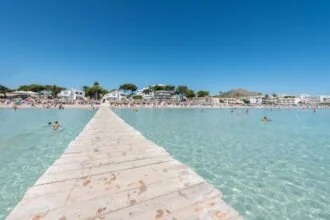
Playa de Muro is the long, Blue Flag-rated beach that fills the western half of Alcúdia Bay, running for around 6 kilometres of fine golden sand and calm, shallow turquoise water. It’s split into several distinct sectors, from busy, hotel-backed stretches near the resorts to genuinely wild dune sections further east, which means the beach can feel completely different depending on exactly where you set up.
The eastern end, known as Es Comú, sits within S’Albufera Natural Park and keeps its dunes, pine trees and juniper scrub largely undisturbed, a genuine contrast to the developed western sectors nearer Alcúdia’s resort strip covered in our guide to Alcúdia and the north.
Facilities are extensive along the developed sectors: sunbeds and parasols for hire, toilets, showers, disabled access, lifeguards, and family-friendly extras including playgrounds and a fun park with a maze near Can Picafort. The long, flat promenade behind the sand is also a genuinely popular stretch for an easy ride, worth knowing about if cycling in Mallorca is part of the trip.
Both designated car parks and on-street parking serve the beach, with access to some sectors requiring a short walk in from areas like Casetes des Capellans. Playa de Muro generally feels a little quieter than the town beach at Alcúdia itself, since it sits outside the main resort centre, though it’s also more exposed to wind, which can make the sea choppier than the sheltered water closer to town.
Crowding follows the sectors: the western stretches nearest the big hotels are busiest in July and August, while Es Comú and the eastern dune sections stay noticeably calmer even at peak season. Late spring and early autumn bring warm water with far fewer people anywhere along the 6 kilometres.
Cala Agulla: A Pine-Backed Bay Near Capdepera
Cala Agulla sits just north of the resort town of Cala Rajada, near the old fortress town of Capdepera, and it’s one of the most scenic beaches on the northeast coast. The 520-metre bay of turquoise-to-azure water is backed by a genuine pine forest rather than hotels, with a distinctive rock outcrop locals nickname El Cocodrilo standing at one end.
The whole area is a designated nature and marine reserve, which has kept the pine woodland and dune system behind the beach intact even as Cala Rajada itself has grown into a full resort town. That protected setting is a large part of the beach’s appeal, a genuinely wild-feeling stretch of sand a short walk from a lively town.
Facilities are solid: sunbed and umbrella rental, freshwater showers, lifeguards, beach bars, and watersports operators offering kayaks, diving trips and banana boat rides. Paid parking is available close to the beach, typically running to a modest daily fee in the region of €5-10 (£4-9/$6-12) in peak season.
On foot, Carrer de l’Agulla runs straight from the centre of Cala Rajada to the sand, and several bus routes (lines 325, 411, 422 and 423) stop around 1.4 kilometres away for anyone travelling without a car. It’s a natural stop on any loop through the region covered in our guide to Mallorca’s east coast.
July and August bring very high occupancy, with sunbeds and umbrellas gone early in the day. The exposed northeast-facing bay can also pick up wind and larger waves at times, which occasionally makes swimming choppier than at the more sheltered beaches further south, so checking the forecast before heading over is worth the extra minute.
Best if you can move a day either way. Shows how the fare changes across the month.
Compare flightsBest if you want maps and messaging working the moment you switch your phone on.
See eSIM plansBest when public transport has stopped, or when you are travelling with children and bags.
Book a transferSa Calobra: A Dramatic Cove at the Mouth of a Gorge
Sa Calobra is the single most dramatic beach on this list, a pale pebble cove at the mouth of the Torrent de Pareis gorge, where limestone walls rise around 200 metres straight out of the sea. The gorge and the wider Serra de Tramuntana carry UNESCO World Heritage status as a cultural landscape, and standing at the beach with the canyon opening up behind you makes that designation easy to understand.
The beach itself is genuinely wild, with no sunbed rental and no real development beyond a couple of waterside restaurants near the small harbour. Reaching the sand from the car park means walking around 15 minutes through two narrow tunnels carved into the rock, which only adds to the sense of arriving somewhere properly remote.
There are two genuinely different ways to arrive. The famous Ma-2141 mountain road drops around 700 metres from the Coll dels Reis summit through roughly 30 hairpin bends, including a section nicknamed the Nus de sa Corbota where the road loops back underneath itself, a highlight of any proper Mallorca road trip best driven before 9am or after 4pm to dodge the coach traffic.
The alternative is a scheduled ferry from Port de Sóller, running several times daily in season and taking around an hour each way, alongside excursion boats and catamarans that add snorkelling stops. A round-trip adult ticket typically costs somewhere around €20-30 (£17-26/$23-35) depending on the operator and season, and pairs naturally with a ride on the Sóller train earlier in the day.
There’s no accommodation at Sa Calobra itself, so most visitors base themselves in Sóller. The gorge above the beach also draws experienced canyon walkers as one of the more serious routes covered in our guide to hiking in the Serra de Tramuntana, though that particular route needs proper equipment and is not a casual add-on to a beach day. Late spring and early autumn give the best balance of warm water and thinner crowds, since the narrow beach fills quickly once the midday coach groups arrive in summer.
Cala Deià: A Small Rocky Cove Below the Artists’ Village
Cala Deià sits directly below the artists’ village of Deià, framed by high cliffs and the wooded slopes of the Tramuntana. It’s a narrow rocky cove, roughly 70 metres long and just 6 metres wide on average, with pebbles and larger stones rather than sand, and boathouses lining what little flat ground exists at the water’s edge.
There’s no sunbed hire and no lifeguard, but the cove is genuinely well served for food: two long-standing waterfront restaurants sit right on the rocks, serving fresh seafood a few steps from the water, which makes this one of the easier small coves to turn into a proper lunch stop rather than just a quick swim.
Getting down is part of the experience. A narrow, winding 3.3-kilometre road descends from Deià to a small paid car park a short walk from the cove, typically charging in the region of €5-10 (£4-9/$6-12) for the day between April and October, or you can walk the steeper 25 to 30 minute footpath directly from the village.
Because the cove is so small, space fills quickly and the little car park is often full by mid-morning in season, one more reason an early start pays off on the same Tramuntana road trip that takes in Sa Calobra and the rest of the west coast, and a theme covered in more depth in our guide to things to do in the Serra de Tramuntana. Arriving before mid-morning, or parking in the village itself and accepting the uphill walk back, are both realistic workarounds once the car park fills.
Staying Safe at Mallorca’s Beaches: Flags, Currents and Sun
Every supervised beach on the island flies one of three coloured flags, and knowing what each one means matters more than it sounds. A green flag signals calm, supervised swimming conditions, a yellow flag means only strong swimmers should head into deeper water, and a red flag means the water is officially closed to bathers, usually because of a strong swell or an offshore current.
Flags change through the day as conditions shift, particularly on exposed bays like Cala Agulla and the eastern end of Playa de Muro, where a rising tramuntana or llevant wind can turn a green morning into a yellow or red afternoon. Always check the flag flying at the lifeguard tower closest to where you’re swimming rather than assuming yesterday’s conditions still apply.
Lifeguard cover itself is inconsistent across the island. Full-season lifeguard cover runs roughly from June to September at resort beaches such as Platja de Palma, Playa de Muro and Cala Agulla, while wilder coves including Es Caló des Moro, Cala Varques, Sa Calobra and Cala Deià have no lifeguard at any time of year, so swimming within your own ability and never alone matters far more at those spots.
Jellyfish are a genuine, if usually minor, hazard in Mediterranean waters, most often the small purple mauve stinger that can appear in swarms after a spell of onshore wind. A sting is painful rather than dangerous for most people, and rinsing with seawater, never fresh water, before applying heat, or asking a lifeguard for a proper sting kit, deals with the vast majority of cases.
Underwater rocks and sudden drop-offs are more of a risk at the walk-in coves than at the sandy resort beaches, particularly around Cala Varques and Es Caló des Moro, where the seabed shelves quickly close to the rocks. Wearing simple water shoes and easing in feet-first rather than diving avoids the great majority of minor cuts and scrapes reported at those spots each summer.
Basic sun safety rounds out the picture, since Mediterranean UV levels in July and August regularly hit the highest end of the scale by late morning. Covering up, seeking shade between roughly midday and 4pm, and drinking more water than feels necessary all matter more at Mallorca’s largely shade-free beaches than they would back home.

Hazards Specific to Mallorca’s Different Beach Types
Currents are a real, if occasional, hazard rather than a constant one, and they tend to matter most at the more exposed bays covered on this page. Cala Agulla’s northeast-facing position and the open ferry crossing to Sa Calobra both pick up a stronger pull once the tramuntana or llevant wind gets going, which is exactly why checking the flag at the lifeguard tower matters more there than at a sheltered cove like Cala Mondragó.
Jellyfish follow the same wind patterns as the currents above. The small purple mauve stinger can appear in swarms at any of the open, wind-exposed beaches after a spell of onshore wind, and while a sting is painful rather than dangerous for most people, rinsing with seawater rather than fresh water is the right first response anywhere on this coastline.
Rocky, uneven entry is the defining hazard at the walk-in coves rather than the sandy resort beaches. Es Caló des Moro and Cala Varques both shelve quickly into rock close to shore, and Cala Deià’s narrow, pebble-and-stone waterline offers no soft sand at all, so proper water shoes rather than flip-flops make a genuine difference at all three.
Shade and facilities thin out fast once you leave the resort beaches. Es Trenc and Cala Mondragó keep only light-touch toilets and some sunbed hire under their natural park protections, while Es Caló des Moro, Cala Varques, Sa Calobra and Cala Deià offer close to nothing beyond a couple of waterside restaurants at the last two, so anyone visiting the wilder coves needs to arrive self-sufficient.
Sun exposure is the one hazard that touches every beach on this list equally. Mediterranean UV levels regularly reach the top of the scale through the middle of the day in July and August, and it’s felt hardest at exactly the shade-free natural beaches, Es Trenc and Sa Calobra among them, where there’s no umbrella hire to fall back on.
Checking Tide Times Before You Swim in Mallorca
Mallorca sits in the Mediterranean, where the tidal range is genuinely small, typically somewhere between 20 and 40 centimetres rather than the metres of difference you’d see on an Atlantic coastline. That doesn’t make tide times irrelevant though, since even a modest shift in water level changes how much sand or rock is exposed at some of the narrower coves covered above.
Es Caló des Moro and Cala Deià both have very little flat ground at the water’s edge, so a lower tide can leave more rock exposed underfoot, while a higher one narrows the useable space considerably. Checking ahead of a visit, especially outside the main lifeguard season when nobody’s on hand to advise, is a small step worth taking.
Cliff jumpers and swimmers at Cala Varques also benefit from knowing the water depth before jumping, since a lower tide can expose rock that’s normally covered. For a genuinely reliable, free tide chart covering Mallorca’s coastline hour by hour, Palma de Mallorca’s tide chart on Tide-Forecast.com gives real-time high and low tide predictions rather than a rough seasonal guess.
Boat trips and ferries, including the Sa Calobra crossing from Port de Sóller, generally run to a fixed timetable rather than the tide, so tides matter less for scheduling and more for judging how much beach or rock you’ll actually find on arrival. Either way, a quick check the night before costs nothing and avoids arriving to a cove that’s mostly underwater.
Tide times also shift by roughly 25 to 50 minutes later each day, which is why a chart checked earlier in the week can be noticeably out by the weekend. Bookmarking a live source rather than relying on memory is the simplest way to get an accurate picture for the specific day of your visit.
What Facilities to Expect at Mallorca’s Beaches
Facilities vary enormously across the beaches covered on this page, and knowing what to expect before you set off saves a wasted trip for a cold drink or a change of clothes. Resort beaches like Platja de Palma, Playa de Muro and Cala Agulla offer sunbeds and parasols for hire, fresh showers, public toilets and a run of beach bars right on the sand.
Prices for a sunbed and parasol for the day typically run from around £8 (€9/$10) at the quieter resort beaches up to £15 (€17/$19) at the busiest stretches in August. Chiringuitos, the small beachfront bars found at most developed beaches, serve everything from a coffee and pastry to a full seafood lunch, and many still prefer cash over card for smaller purchases.
The protected and natural-park beaches, including Es Trenc and Cala Mondragó, sit somewhere in the middle: lifeguards, toilets and some sunbed hire are usually present, but the wider resort infrastructure of bars, playgrounds and shops is deliberately kept away from the sand itself. Accessibility is generally good at these spots too, with boardwalks over the dunes and, at Cala Mondragó, ramps down to the water.
At the opposite end, the wild coves, Es Caló des Moro, Cala Varques, Sa Calobra and Cala Deià, offer close to nothing: no toilets, no showers, no lifeguard and no shop, beyond the couple of small restaurants at Sa Calobra and Cala Deià themselves. Anyone heading to those spots needs to arrive with their own water, food and a rubbish bag, since there’s nowhere on site to buy or bin either.
Parking is worth planning around too, since several of the busier beaches charge a daily fee for their car parks, generally in the region of £4-9 (€5-10/$6-12) in peak season, while a handful, including Cala Mondragó, still offer free parking right behind the sand. None of the coves without road access, Cala Varques most obviously, have any parking at all beyond the trailhead car park a walk away.
Best for solo travellers and anyone watching the budget. Dorm beds and private rooms in the same search.
Browse hostelsBest arranged before you fly rather than after. Covers claim handling, plus lounge access on eligible delays.
Explore AirHelp+Best if your room is not ready yet. Left luggage booked in advance, so you are not hunting for a locker.
Check storageSunscreen and Sun Safety on Mallorca’s Beaches
Mediterranean sun is considerably stronger than it looks, especially between May and September when the UV index regularly reaches 8 or higher through the middle of the day. A high-factor sunscreen, reapplied roughly every two hours and straight after swimming, matters more here than on a typical UK beach day.
Factor 30 is a reasonable minimum for most adults, and factor 50 is worth packing for children or for the first couple of days of a trip, before any tan has built up. The water itself reflects and intensifies UV exposure, so time spent floating or snorkelling burns skin just as fast as time spent lying on the sand.
A handful of the coves covered on this page, particularly Es Caló des Moro, Cala Varques and Sa Calobra, sit inside protected natural areas where reef-safe or mineral-based sunscreens are worth choosing over standard chemical formulas. These protected coves support genuinely sensitive marine life close to shore, and mineral sunscreens, zinc oxide or titanium dioxide based, break down less readily in the water than some chemical filters.
Shade is genuinely scarce at most of Mallorca’s beaches, since sunbed umbrellas only cover a fraction of any busy stretch and the wilder coves have none at all. Packing a proper beach shade tent, or at minimum a wide-brimmed hat and a long-sleeved rash vest for children, makes a real difference on a full-day visit to somewhere like Es Trenc or Playa de Muro.
The two or three hours either side of midday carry the strongest sun of the day, and it’s also, conveniently, the busiest and hottest time to be on the sand at the popular beaches. Timing a visit for the morning or the last couple of hours before sunset, already the better strategy for avoiding crowds at spots like Es Caló des Moro, does double duty for sun safety too.
Best Beach in Mallorca for a Family Day Out
Three of the nine beaches on this page stand out for a family day out, and each suits a slightly different kind of trip. Cala Mondragó is the pick for younger children specifically, since its small, sheltered bay has a gentle slope into shallow water, a free car park right behind the sand and proper toilets and showers within easy reach of a pushchair.
Playa de Muro works best for a family planning a full day rather than a quick swim, thanks to its 6 kilometres of shallow, calm water, playgrounds, a fun park near Can Picafort and enough space that finding a quiet patch of sand is rarely a problem even in August. Its size also means older and younger children can be entertained at the same time without anyone getting bored.
Platja de Palma suits families staying in the capital or flying in and out of Palma airport, since the calm, breakwater-protected water and the short journey from the city make it the easiest option logistically, even if it’s also the busiest of the three. The long promenade behind the sand means food, ice cream and shade are never more than a short walk away.
All three beaches share the same core ingredients that matter most for families: a gentle slope into the water rather than a sudden drop, lifeguard cover through the main season, and real facilities including toilets and showers close to the sand. Es Trenc’s shallow water is also genuinely good for children, though its lighter-touch facilities and busier car parks make it a slightly less convenient choice for a first visit with very young kids.
For a first Mallorca trip with children under about six, Cala Mondragó is the single easiest recommendation, purely because the bay is small enough to keep an eye on everyone at once. Families with older children who want more space to swim and play are generally better served by Playa de Muro or Platja de Palma instead.
Water Sports to Try at Mallorca’s Beaches
Watersports availability tracks pretty closely with how developed a beach is, and the busier resort beaches are where you’ll find the widest range of options. Cala Agulla has established operators offering kayak hire, banana boat rides and diving trips, while Platja de Palma and Playa de Muro both have jet ski and paddleboard rental readily available through the main season.
Stand-up paddleboarding and snorkelling are the two most accessible options almost everywhere, since both need little more than calm, clear water and a rented board or mask. Es Trenc’s shallow, gin-clear shoreline and Cala Mondragó’s sheltered bay are both genuinely good for a first attempt at either, with rental typically costing from around £12 (€14/$16) an hour for a paddleboard.
Sailing and small boat charters are concentrated around the marinas at Palma, Port de Sóller and Porto Cristo rather than directly off the beaches themselves, and are the easiest way to reach genuinely remote spots like Cala Varques without the coastal walk. A half-day skippered boat trip from Porto Cristo, often pausing to swim and snorkel along the way, typically runs from roughly £45-70 (€50-80/$58-92) per person depending on the season and operator.
Diving and snorkelling around the rockier coves, particularly Cala Deià, Es Caló des Moro and the waters off Cala Agulla’s marine reserve, reward the effort with genuinely clear visibility and small marine life close to the rocks. A guided introductory dive typically starts from around £55-75 (€60-85/$70-100) including equipment, aimed at complete beginners as much as certified divers.
Jet skiing is generally limited to the larger resort beaches with a dedicated watersports concession, and Platja de Palma and Cala Agulla both fit that description, rather than the protected natural park beaches or the wild coves, where motorised watercraft are either restricted or simply impractical to launch. Checking with the specific operator on the day is always more reliable than assuming a wilder beach will have the same options as a resort one.
Which Beach Suits Which Kind of Traveller
With nine very different beaches covered on this page, the honest answer to which one to pick usually depends on who’s actually going. The table below matches four common kinds of trip to the specific beaches already detailed above, rather than trying to name one single best beach for everyone.
| Traveller Type | Best Picks | Why It Fits |
|---|---|---|
| Families with young children | Cala Mondragó, Playa de Muro | A gentle slope into shallow water, real toilets and showers, and, at Cala Mondragó, a small bay that’s easy to keep an eye on |
| Couples wanting a quiet spot | Cala Deià, Cala Varques | Small, low-key coves with no resort infrastructure; Cala Deià pairs a quiet swim with a proper seafood lunch, while Cala Varques’ lack of road access keeps its crowds genuinely thin |
| Groups wanting facilities and nightlife | Platja de Palma, Cala Agulla | Sunbeds, showers, watersports operators and beach bars right on the sand, plus, at Platja de Palma’s S’Arenal end, the liveliest beach-club scene on the island |
| Snorkellers | Es Trenc, Cala Mondragó (beginners); Cala Deià, Es Caló des Moro (more experienced) | Shallow, clear water at the first two suits a first attempt, while the rockier shoreline at the second two rewards more experienced snorkellers with better visibility |
None of these pairings are exclusive, and plenty of the beaches above suit more than one kind of trip, but they’re a reasonable starting point for narrowing nine options down to the two or three worth actually planning a day around, especially on a first visit to the island.

Rupert’s Handy Travel Tips
Rupert has swum at most of these himself, and reckons the biggest single mistake visitors make is treating every Mallorca beach like a resort beach with a sunbed guaranteed:
- Arrive by 9am for the famous coves: Es Caló des Moro, Cala Varques and Es Trenc’s main car parks all fill by mid-morning through July and August.
- Carry cash for the small kiosks: plenty of the beach chiringuitos and cove car parks still don’t take cards.
- Pack proper shoes, not flip-flops: the walks into Cala Varques, Es Caló des Moro and Sa Calobra all cross uneven rock or steps.
- Check the wind before you go northeast: Cala Agulla and the Sa Calobra ferry crossing can both turn choppy in a strong tramuntana or llevant wind.
- Sort your cover before any cliff jumping: Cala Varques in particular draws jumpers and climbers, so a policy that covers water sports and minor injuries, like the options in our travel insurance apps guide, is worth having in place first.
Want to meet the reindeer behind our travel tips? Find out more in our page Who is Rupert?.




Frequently Asked Questions About Mallorca’s Best Beaches
Which beach in Mallorca is best for families with young children?
Cala Mondragó and Playa de Muro are the strongest picks. Both have a gentle slope into shallow water, real facilities including toilets and showers, and enough space that a pushchair or a picnic isn’t a squeeze.
Is Es Trenc really worth the hype?
For most visitors, yes. The combination of white sand, shallow turquoise water and an unbroken natural skyline is genuinely unusual for a European beach this accessible, though it’s worth timing your visit for early morning or shoulder season to avoid the biggest crowds.
How do you actually get to Sa Calobra beach?
There are two realistic options: drive the dramatic Ma-2141 mountain road with its roughly 30 hairpin bends, or take a scheduled ferry or excursion boat from Port de Sóller. Both routes take around an hour and both are worth doing at least once.
Do you have to pay to visit Mallorca’s best beaches?
The beaches themselves are free and public, as they are everywhere in Spain, but many of the more popular ones charge for parking. Expect a daily fee of roughly €5-10 (£4-9/$6-12) at car parks near Es Trenc, Cala Agulla and Cala Deià.
Do I need a car to reach Mallorca’s best beaches?
Not for all of them. Platja de Palma, Playa de Muro and Cala Agulla are all reachable by public bus, but the more remote coves, particularly Cala Varques and Sa Calobra, are genuinely easier with a car, a boat tour or both, as covered in our guide to getting around Mallorca without a car.
What’s the best time of year to visit Mallorca’s beaches?
Late May, June and September offer the best balance: the sea is warm enough to swim comfortably, and the crowds at the famous coves are noticeably thinner than the July and August peak. Winter swimming is possible for the hardy, but most beach facilities and lifeguard cover close down outside the main season.
Further Reading for a Longer Mallorca Beach Trip
This beach roundup works best as one piece of a wider Mallorca trip, and the Mallorca travel guide hub ties together every other guide in the cluster if you’re planning from scratch. Anyone thinking about self-driving to the more remote coves covered above, particularly Sa Calobra and Cala Deià, should read our Mallorca road trip guide first, since the mountain roads on the west coast are a genuinely different driving experience to the rest of the island.
If you’d rather skip car hire altogether, our guide to getting around Mallorca without a car covers the buses, trains and boats that reach several of the beaches above. The classic Sóller train is worth combining with a Sa Calobra boat trip on the same day, and our guide to hiking in the Serra de Tramuntana covers the mountain routes above several of the west coast coves for anyone who wants more than a swim out of the same stretch of coastline.
For a slower, self-powered way to link some of these beaches together, our guide to cycling in Mallorca covers the flatter coastal routes near Alcúdia and Palma Bay, and our regional guides to Mallorca’s east coast and Alcúdia and the north go beyond the beaches into what else is worth doing nearby.