Reviewed by our editorial team Updated
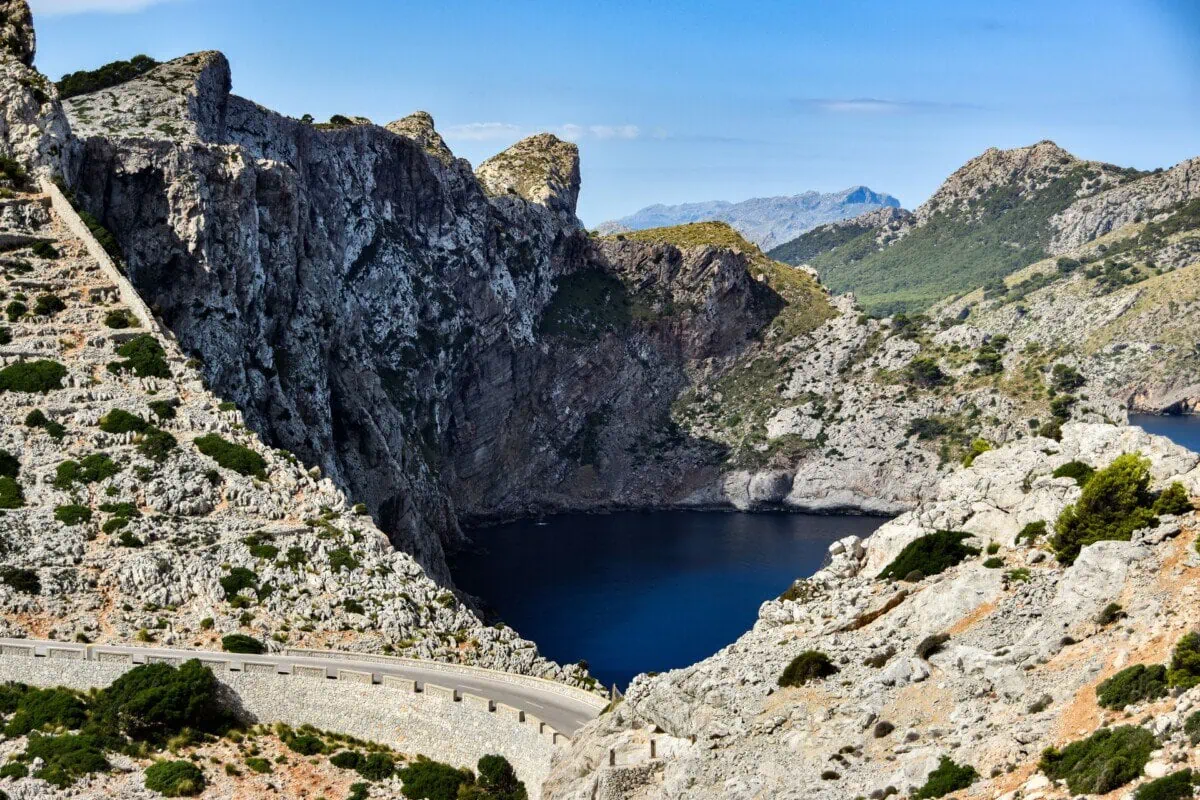
The Serra de Tramuntana is the mountain range that runs along Mallorca’s entire northwest coast, from Andratx in the south to the Formentor peninsula in the north. UNESCO listed the range as a World Heritage Cultural Landscape in 2011, recognising a thousand years of dry-stone terracing, water channels and olive groves carved into slopes that rise straight out of the Mediterranean.
Scattered through the valleys and clinging to the hillsides are some of Mallorca’s most atmospheric towns and villages, each with its own personality. Valldemossa and its Carthusian monastery drew Chopin and George Sand; Deià became a magnet for writers and artists; Sóller built its wealth on oranges; and tiny Fornalutx, Banyalbufar and Estellencs still look much as they did a century ago. This guide covers those towns in depth, alongside the range’s other major draw: the mountains rising above them, walked by hikers on the GR221 long-distance trail and a handful of well-known standalone day hikes.
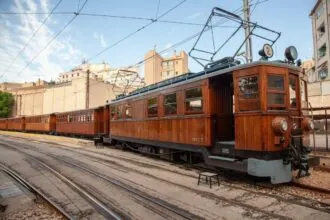
The vintage Sóller Train that rattles up from Palma gets its own dedicated coverage elsewhere on this site rather than being repeated here, since it’s one of the most charming ways to reach the valley in its own right. Everything else, from a gentle village wander to a multi-day trek across the range, is covered on this page.
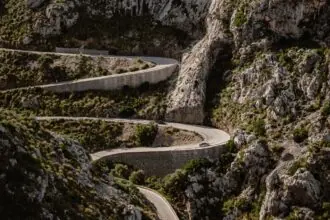
Most of the villages below are genuinely reachable without a rental car, though services can be infrequent outside peak summer months. TIB, the Balearic public transport authority, runs a network of numbered bus routes into the mountains from Palma’s Estació Intermodal, and this guide notes the relevant route for each stop; for the fuller picture of taxis, buses and car hire across the island see our guide to getting around Mallorca without a car. Drivers should budget extra time for the coast road’s hairpin bends, which are as much a part of the Tramuntana experience as any single stop.
Whether it’s a single day out from Palma, a longer stay based in one village, or a multi-day hike across the whole range, this guide is built to cover all three. The village sections below explain what to actually do in each place, roughly how long to allow, and the practicalities of getting in and back out again; the hiking sections that follow cover the GR221 and four well-documented day hikes in full practical detail.
Which Tramuntana Villages Are Actually Worth Your Time
With limited time, some stops earn priority over others. Valldemossa is the natural first choice for most visitors, combining a genuinely important historic monastery with an easy, pretty village to wander, and it sits closest to Palma of anywhere in this guide.
Deià rewards a slower pace: it’s a village to sit in a café and look at rather than tick off a list, with the added pull of Son Marroig’s clifftop views a short walk beyond the centre. Sóller and Port de Sóller together make the most complete day out in the range, pairing an elegant inland town with a working harbour and a swimmable cove.
For travellers with a car or willing to build a full day around buses, Fornalutx is the single prettiest village in the mountains and genuinely worth the detour up from Sóller. Banyalbufar and Estellencs, further southwest along the coast road toward Andratx, see far fewer visitors than the villages above and reward anyone chasing quieter terraces and sea views without the crowds.
A realistic plan is one, at most two, of these stops per day if travelling by bus, given how the coast road winds and how spaced out the timetables can be. Drivers can reasonably combine three in a single loop, for example Valldemossa, Deià and Sóller, or Banyalbufar and Estellencs as a shorter, quieter half-day.
Valldemossa and the Carthusian Monastery Where Chopin Once Stayed
Valldemossa is the village most visitors reach first, sitting only around 17km from Palma on the road up into the mountains. Its centrepiece is the Royal Carthusian Monastery (Reial Cartoixa), a former monastery founded on the site of a 14th-century royal palace and later home to a community of Carthusian monks until the order was expelled in the 1830s.
The monastery’s most famous residents never took vows at all. Composer Frédéric Chopin and writer George Sand spent the winter of 1838-39 in a set of cells here, an unhappy, damp stay that Sand later wrote about scathingly in her memoir “A Winter in Majorca” but which Chopin’s compositions from the period made famous regardless. A visit today takes in the monks’ cells, a pharmacy stocked with 18th-century remedies, a printing press, King Sancho’s former palace rooms and a church with frescoes by Francisco Bayeu, and most tickets include a short piano recital of Chopin’s work on the museum’s period instrument.
General admission to the monastery is around €12.50 (£11/$15), with children up to 10 admitted free, and booking online in advance shaves a little off the price and avoids queuing at the door in peak season. Allow around an hour to see the complex properly, plus more time to explore the village itself.
Outside the monastery walls, Valldemossa’s steep, cobbled streets are worth as much time as the main attraction. Whitewashed houses spill geraniums from window boxes along lanes that funnel down toward small squares, and the village is well known for coca de patata, a soft, sugar-dusted potato bun sold in nearly every bakery on the main street. Parking in the centre is largely restricted to residents, so drivers should use one of the paid car parks on the village’s edge rather than hunting for a space near the monastery.
Valldemossa is one of the easiest Tramuntana villages to reach without a car. TIB bus line 203 runs between Palma and Port de Sóller via Valldemossa, and line 210 covers a longer route between Platja de Palma and Port de Sóller that also calls at Valldemossa, Deià and the tiny coastal hamlet of Llucalcari, making it possible to combine Valldemossa and Deià on the same bus ticket. Journey time from Palma’s Estació Intermodal is roughly 30-40 minutes depending on the service.
Best for a short trip. Compare rooms by neighbourhood, price and guest rating before you book.
Compare hotelsBest for families, or any stay past about four nights. A kitchen and a washing machine start paying for themselves.
Browse rentalsBest for double-checking. Runs the same search across several booking sites so you are not leaving money behind.
Compare pricesDeià: The Artists’ Village That Drew Robert Graves
Deià is a small stone village stacked up a hillside between the mountains and the sea, and it has punched well above its size in cultural weight since the 1930s. British poet and novelist Robert Graves settled here in 1929 and lived in the village on and off until his death in 1985, and his home, Ca N’Alluny, is now open to the public as the Robert Graves House museum.
Graves’s presence drew a wider circle of writers, musicians and artists over the decades, and that reputation as an artists’ village has stuck. Today the centre is a tangle of narrow lanes climbing to a hilltop parish church and cemetery with sweeping views back down the valley to the sea, and Graves himself is buried in that cemetery under a simple headstone. Small galleries and studios are dotted through the village, and the main street has a handful of good, if not cheap, restaurants that trade on the setting as much as the food.
Just outside the village toward Sóller, Son Marroig is a former estate that belonged to Archduke Ludwig Salvator of Austria, a 19th-century naturalist who fell in love with Mallorca and bought up huge tracts of the Tramuntana coastline to protect them from development. The house is now a small museum of his life and travels, but the real draw is the terrace behind it: a white marble belvedere framing one of the most photographed views in Mallorca, looking down over cliffs to the sea stack of Sa Foradada.
Entry to Son Marroig runs to a few euros, generally around €4 (£3/$5), and it’s an easy stop of 30-45 minutes on the way in or out of Deià. Getting to Deià by bus uses the same TIB line 210 that serves Valldemossa, continuing on from there toward Port de Sóller, while drivers should note that parking in the village itself is extremely tight and a signed pay car park on the approach road is usually the easier option.
Banyalbufar: Terraced Vineyards on the Wild Southwest Coast
Banyalbufar sits on the coast road southwest of Valldemossa, and it looks entirely different from the villages further north. The whole hillside below the village has been carved into dry-stone terraces, known locally as marjades, that step down almost to the water and were originally built to grow the sweet malvasia grape that gave the area its wine trade centuries ago.
That malvasia tradition nearly died out entirely in the 20th century but has been revived by a handful of small local producers who still work the same terraces, and a couple of bodegas in and around the village offer tastings if arranged in advance. The village itself is compact and quiet, built around a single main street with a church and a scattering of small guesthouses, and it has a genuinely local, unhurried feel that’s rarer the closer you get to Palma.
The real reason to stop in Banyalbufar is the coastal scenery rather than any single sight. A short walk down through the terraces leads to a small watchtower, Torre de ses Ànimes, perched on the cliffs with uninterrupted views along the coast toward Estellencs, and it’s one of the easiest short walks in the whole region for anyone not planning a full hiking day.
Public transport here is thinner than further north. TIB line 131 connects Banyalbufar with Estellencs, Andratx and the Calvià coast, and other services run from Palma via Esporles, but departures are infrequent, often just a handful a day, so checking the current TIB timetable before travelling is worth the few minutes it takes. Anyone without a car should plan around the timetable rather than assume they can turn up and go.
Estellencs: Mallorca’s Quietest Mountain Village
A few kilometres further southwest, Estellencs is smaller again, one of the least-visited villages covered in this guide and one of the smallest permanent populations on the whole island. Stone houses cluster around a small square and a modest parish church, and the pace here barely changes between low and high season.
The village sits between the mountains and a dramatic stretch of cliff coastline, and a steep lane leads down from the centre to a small pebble cove, Cala d’Estellencs, that’s a genuine local secret rather than a tourist beach. It’s not a place for sunbathing in comfort, but the walk down through terraced olive groves and the setting once there are worth the effort for anyone happy to scramble over rocks for a swim.
Estellencs is also a popular starting or finishing point for day walkers tackling sections of the GR221, covered in full further down this page. For a stop rather than a hike, an hour or two wandering the village and the lane down to the cove is enough for most visitors.
TIB line 202 runs between Estellencs and Palma, and line 131 links the village onward to Banyalbufar and Andratx, but as with Banyalbufar, services are limited and this is one of the harder stops in this guide to reach without your own transport. Drivers get the reward of one of the most scenic short stretches of the entire coast road just either side of the village.

Sóller: A Handsome Valley Town Built on Oranges
Sóller sits inland in a wide, sheltered valley ringed by some of the highest peaks in the Tramuntana, including Puig Major, and it’s a genuinely handsome working town rather than a museum-piece village. Its wealth was built on oranges and lemons, grown in the groves that still cover much of the valley floor and once exported directly from Port de Sóller by sea when the mountain roads made overland transport impractical.
The heart of town is the elegant Plaça de la Constitució, a broad square lined with pavement cafés and dominated by the parish church of Sant Bartomeu, whose striking Modernista facade was redesigned in the early 20th century by Joan Rubió, a collaborator of Antoni Gaudí. The square and the streets fanning out from it are the best place to simply sit, order a coffee or a fresh orange juice, and watch the town go by.
A Saturday market fills the square and surrounding streets with local produce, cheese and crafts, and if the timing lines up with a visit in early May, the town’s Fira de la Taronja (Orange Fair) turns the whole centre over to a celebration of the valley’s signature crop. Sóller’s famous vintage train from Palma terminates a short walk from the square; it’s covered in full in our separate guide to the Sóller Train rather than repeated here.
Sóller town is easy to reach by bus as well as train. TIB lines 203, 210 and 211 all run between Palma and Sóller or Port de Sóller, calling at the town along the way, with the fastest services using the road tunnel through the mountains in around 30-40 minutes rather than the older switchback pass road.
Port de Sóller: A Sheltered Harbour and a Century-Old Tram
Port de Sóller is the valley’s harbour town, curved around a near-perfectly sheltered natural bay a few kilometres from Sóller itself. It has a genuinely different character to its inland neighbour: a proper working fishing fleet still shares the harbour with pleasure boats, and a long promenade lined with restaurants and ice cream shops wraps most of the way around the bay.
The two halves of the valley are connected by the antique Sóller tram, a narrow wooden-carriaged tramway dating from 1913 that trundles between the town and the port along the seafront, a short and charming ride distinct from the mountain railway that runs the longer route to Palma. At the port end, a small sandy and shingle cove beach sits right on the bay, calm and family-friendly thanks to the enclosed harbour, though anyone planning a proper beach day should see our full guide to Mallorca’s best beaches for the wider island roundup.
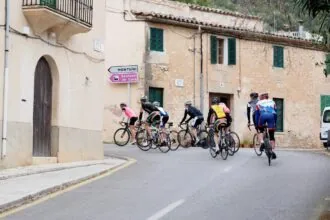
A lighthouse walk leads out along the headland on the southern side of the bay for good views back over the harbour, and the northern arm has a smaller, quieter beach away from the main promenade crowds. The port is also one of the more popular bases in the region for cyclists tackling the valley’s climbs; our dedicated guide to cycling in Mallorca covers the routes in and out of the area.
TIB line 211 runs between Palma and Port de Sóller through the tunnel, while line 210 continues on from the port around the coast towards Deià, Valldemossa and Platja de Palma, and line 204 also links the port directly to Palma. Between the tram, the train and these bus links, Port de Sóller is one of the best-connected stops in this entire guide.
Fornalutx and Biniaraix: Two of Spain’s Prettiest Villages
Fornalutx sits a few kilometres up the valley from Sóller and is routinely ranked among the prettiest villages in Spain, a reputation built on tight lanes of honey-coloured stone houses, green shuttered windows and staircases that climb steeply between terraced orange groves. It has repeatedly featured in national and international “most beautiful village” lists, most recently drawing renewed attention from travel outlets in 2026, and it’s easy to see why within minutes of arriving.
There’s no single headline attraction here; the village itself, its small central square shaded by orange trees, and the surrounding terraces are the point. A short, gentle walk connects Fornalutx to the neighbouring hamlet of Biniaraix, an even smaller cluster of houses around a plane-tree square that’s the traditional starting point for one of the range’s best-known hiking routes up into the mountains, the Barranc de Biniaraix, covered in full further down this page.
Both villages are best treated as a slow wander rather than a checklist: an hour or two is enough to see everything, but many visitors find themselves lingering longer over a coffee in one of the small squares. Anyone wanting to turn the walk between the two into a proper hike, or continue up into the mountains beyond Biniaraix, will find the full route detail in the hiking sections below.
Fornalutx and Biniaraix are linked to Sóller by a small circular TIB bus line 212, running Sóller to Biniaraix to Fornalutx and back, though it’s a light service best checked in advance, and the walk up from Sóller itself takes a leisurely 45 minutes to an hour for anyone who’d rather not wait on a timetable. Drivers will find parking in Fornalutx limited to a small area on the village edge.
Best if you can move a day either way. Shows how the fare changes across the month.
Compare flightsBest for short trips. Install the eSIM at home and arrive with working data, no shop queue.
Browse eSIMsBest if you would rather not work out the transport on arrival. Book it now and forget it.
View transfersHiking the Tramuntana: The GR221 and the Range’s Best Day Hikes
Beyond the villages, the Serra de Tramuntana is where Mallorca’s reputation as a serious hiking destination actually comes from. Its limestone ridges rise to over 1,400 metres, and this section covers the practical side of walking those mountains: the long-distance trail that strings the range together end to end, and four well-documented standalone day hikes that can each be done without committing to a multi-day trek.
None of this is flat walking. Even the shorter day hikes below involve real elevation gain, loose rock underfoot and long stretches with no shade, and this is a genuinely different pace of visit to a village wander above.
Comparing the Tramuntana’s Best Trails at a Glance
The table below sets the GR221’s full route alongside the four standalone day hikes covered in this guide, so it is easier to see which trail actually matches your available time and fitness. All five are genuinely well-documented routes with reliable waymarking, rather than obscure paths that are hard to research before you travel.
| Trail | Distance | Difficulty | Duration | Start / End Points |
|---|---|---|---|---|
| GR221 “Ruta de Pedra en Sec” (full route) | ~150 km | Hard (multi-day) | 7-9 days | Port d’Andratx to Port de Pollença |
| Torrent de Pareis | 6.5-10 km one-way | Hard | 4-6 hours | Escorca to Sa Calobra |
| Puig de l’Ofre | 12.2 km round trip | Moderate | 3.5-4.5 hours | Cúber Reservoir (out and back) |
| Barranc de Biniaraix | 8-12 km round trip | Easy to Moderate | 3-5 hours | Biniaraix (out and back) |
| Camí de s’Arxiduc | 13.7 km loop | Moderate | ~5 hours | Valldemossa (loop) |
Anyone with a single free morning and no hiking experience is best served by the lower stretch of the Barranc de Biniaraix, which follows an old paved mule track rather than open rock. The Torrent de Pareis sits at the opposite end of the scale and should only be attempted by confident, properly-equipped hikers who have checked the season and conditions carefully.
The GR221 is supported by a chain of mountain refuges (refugis) spaced roughly a day’s walk apart, and beds genuinely must be booked in advance through the Consell de Mallorca’s official refuge booking page, since the busiest sell out weeks ahead in the popular spring and autumn hiking seasons. A dormitory bed at a refuge like Tossals Verds costs from around €14 a night (roughly £12/$16), with meals booked and paid separately.
Of the four standalone day hikes, the Torrent de Pareis is the most dramatic and the most serious: a limestone gorge walked from Escorca down to the beach at Sa Calobra, roughly 6.5 to 10km one-way, with a genuine flash-flood risk that means it should only be attempted in the drier months from April/May to September/October and never after recent rain upstream. The Puig de l’Ofre is a gentler proposition, an out-and-back summit hike of about 12.2km from the Cúber Reservoir reaching 1,091 metres, taking most walkers 3.5 to 4.5 hours for one of the best panoramic viewpoints in the range.
The Barranc de Biniaraix is the easiest of the four, an old dry-stone mule path out of the hamlet of Biniaraix near Fornalutx that’s genuinely manageable for a fit visitor with no hiking experience, at least on its lower section, before it joins the GR221 and gets steeper further up. The Camí de s’Arxiduc is a 13.7km ridge-top loop out of Valldemossa named after the Archduke who once owned much of this coastline, taking around 5 hours and rewarding the climb with sweeping views back over the valley toward Deià.
Waymarking uses the standard red and white GR flashes on the official stages, though older variant paths away from the main line are far less reliable, so a downloaded GPS track (Wikiloc and Komoot are the apps most hikers use) is worth having as backup. Water is genuinely scarce across the range for long stretches, so carrying at least 1.5 to 2 litres per person is a sensible minimum, and proper hiking boots with ankle support matter more here than on most European trails given how loose and polished the limestone underfoot can get.
April, May, June, September and October offer the most comfortable hiking temperatures and the lowest flash-flood risk; midsummer is very hot and exposed, and winter brings cold, storms and higher flooding risk in the gorges.
What to Do in an Emergency While Hiking the Tramuntana
Spain’s nationwide emergency number is 112, and it covers a mountain incident exactly as it covers a road accident back in Palma. Operators take the call, establish your location and what has happened, then dispatch whichever service the situation needs.
Genuine mountain rescue in the range falls to GREIM, the Guardia Civil’s mountain unit, whose Palma detachment of roughly a dozen trained rescuers covers the whole Tramuntana. They deploy on foot or by helicopter, but every callout still starts with that same 112 call.
Mobile coverage genuinely drops out across long stretches of the GR221 and the deeper valleys, so a call that connects near a village can fail an hour further along the trail. This is a real limitation of the range, not a minor inconvenience.
Telling someone your planned route and expected return time costs nothing and matters more than any item in a pack. If you go quiet, someone already knows roughly where to look, which is often the biggest factor in how quickly help can reach you.
If injured, the sensible move is to stay where you are rather than keep moving, since a stationary casualty is easier to find. If lost, retrace your last known point if safe, and keep the group together rather than splitting up.
A helicopter lift in the Balearics can run to €6,000 (£5,300/$7,200), and while genuine emergencies are rarely billed to the hiker, travel insurance that actually covers mountain hiking is worth confirming before you set out. None of this is a reason to hesitate over calling 112.

Where to Get Hiking Kit on the Island
Anyone who arrives without full kit is best sorting it in Palma rather than waiting until reaching the mountains. The island’s outdoor specialists are concentrated in the capital, not spread through the Tramuntana villages.
Foracorda, on Carrer Miquel Marquès near the city centre, is generally reckoned the best-stocked dedicated mountain shop in Palma. It carries proper hiking boots, poles and technical clothing rather than a generalist sports range.
Decathlon runs two large stores in Palma, at Son Moix and the Fan Mallorca retail park. Both stock a full range of boots, backpacks, trekking poles and hydration gear at prices well below specialist outdoor brands.
Sóller works well as a base for planning a hike, but not as a place to buy or rent serious gear. Its shops lean toward cycling, reflecting the valley’s popularity with road cyclists rather than hikers.
Renting full hiking kit is not really established on the island the way it is in the Alps, and boots in particular are rarely offered for hire anywhere. Buying rather than renting is the realistic plan for boots, poles or a daypack.
In the busier spring and autumn GR221 season, a smaller specialist shop can run low on a specific boot size. It is worth calling ahead or checking stock online before making a special trip, with Decathlon’s larger inventory as a reliable fallback.

Rupert’s Handy Travel Tips
Rupert has wandered every village on this page, and reckons a little planning goes a long way whether you’re on foot or on a bus timetable.
- Book the monastery ahead: Valldemossa’s Carthusian Monastery gets genuinely busy with coach tours by mid-morning, so an early or online-booked slot saves real queuing time.
- Don’t chain more than two villages by bus: the coast road’s hairpins make journeys slower than the map distance suggests, and a tight bus connection missed by minutes can cost an hour.
- Carry cash for small villages: Banyalbufar, Estellencs and Fornalutx have few card machines outside the main cafés, and rural bakeries and tastings are often cash-only.
- Time Son Marroig around Deià: the belvedere terrace gets crowded with day-trip coaches by late morning, so an early or late visit gives a much better shot at the view without a crowd.
Want to meet the reindeer behind our travel tips? Find out more in our page Who is Rupert?.




Frequently Asked Questions About the Serra de Tramuntana
Is the Serra de Tramuntana worth visiting if I’m only in Mallorca for a few days?
Yes. Even a single day trip from Palma covering Valldemossa, Deià and Sóller gives a genuinely different side of the island to the beaches, and it’s easily done by bus, train or hire car.
Can I visit the Serra de Tramuntana without a car?
Yes, though it takes more planning. TIB buses reach every village in this guide from Palma, but rural routes like those serving Banyalbufar, Estellencs and Fornalutx run infrequently, so checking timetables in advance matters more here than almost anywhere else on the island.
Which village should I prioritise if I only have time for one?
Valldemossa is the easiest and most rewarding single stop for most visitors, pairing its historic monastery with an attractive village, but Deià or Sóller both make equally strong choices for a slower, less crowded day.
Is the Sóller Train the same as the tram in Port de Sóller?
No, they’re two different services. The Sóller Train is the mountain railway connecting Palma to Sóller town, while the separate, shorter tram runs only between Sóller and Port de Sóller along the seafront.
Do I need to hike the GR221 to enjoy this region?
No. Most visitors see the Tramuntana purely as a villages-and-scenery day out, and the four standalone day hikes covered above can each be done without any interest in the full multi-day route.
Do I need to book GR221 refuges in advance?
Yes. Beds must be reserved through the Consell de Mallorca’s official refuge booking page, and the busiest refuges sell out weeks ahead during the popular spring and autumn hiking seasons.
Further Reading
For the full mountain railway experience left out of this guide, our dedicated feature on the Sóller Train covers the carriages, the route and ticket options in detail, and pairs naturally with a day exploring the villages above. Beyond the mountains, our broader Mallorca travel guide hub ties together every corner of the island, while day trips from Palma sets these villages alongside the island’s other easy excursions if a single Tramuntana stop isn’t enough.
Anyone weighing up whether to rent a car for the coast road should see our Mallorca road trip guide first, and our piece on getting around Mallorca without a car covers the bus and train alternative in full. Once in the water at Port de Sóller or Estellencs’s hidden cove, our full guide to Mallorca’s best beaches rounds out the island’s coastline beyond the Tramuntana.
Cyclists tackling the valley’s climbs should pair this guide with our feature on cycling in Mallorca, several of whose routes climb the same mountain roads covered above. Whatever the trip, it’s worth checking a travel insurance app before setting off into the mountains, where mobile coverage can be patchy and medical evacuation from a hiking trail is not cheap.