Reviewed by our editorial team Published
The Sóller Train (Ferrocarril de Sóller) is a genuine working railway rather than a theme-park replica, and its century-old wooden carriages still climb from Palma up into the Serra de Tramuntana on the same narrow-gauge track laid in 1912. The journey takes about an hour, threading through thirteen tunnels and a string of small stone stations before descending into the orange-scented Sóller valley, and it remains one of the most atmospheric ways to reach the mountains without renting a car.
This page covers the train itself in full: where it came from, what the carriages and the route are actually like, how the connecting vintage tram down to Port de Sóller fits in, and the practical detail of tickets, timing and seating that most guides skip past. It also takes a first look at Sóller town and the day trip the train makes possible further down the page, though our guide to things to do in the Serra de Tramuntana goes into far more depth on every stop across the valley.
Riding the line is as much about the journey as the arrival. The train climbs steadily out of Palma’s suburbs, crosses open farmland studded with almond and carob trees, then switches back through the mountains before dropping into a valley that has grown citrus fruit for centuries, and every tunnel exit reveals a slightly different angle on the same view.
It is not the fastest way to Sóller, and it is not meant to be. A hire car or the TIB bus network covered in our guide to getting around Mallorca without a car will get there quicker through the road tunnel, but neither delivers the same slow, panoramic approach to the valley that has made this railway a genuine Mallorcan institution rather than just a way to get from A to B.
A Railway Built on Oranges
The line opened in 1912, funded largely by profits from Sóller’s booming orange and lemon export trade at a time when the mountain roads were too poor for goods to travel any other way. Locals nicknamed it the “Orange Express,” and citrus fruit rather than passengers was the original point of the whole enterprise.
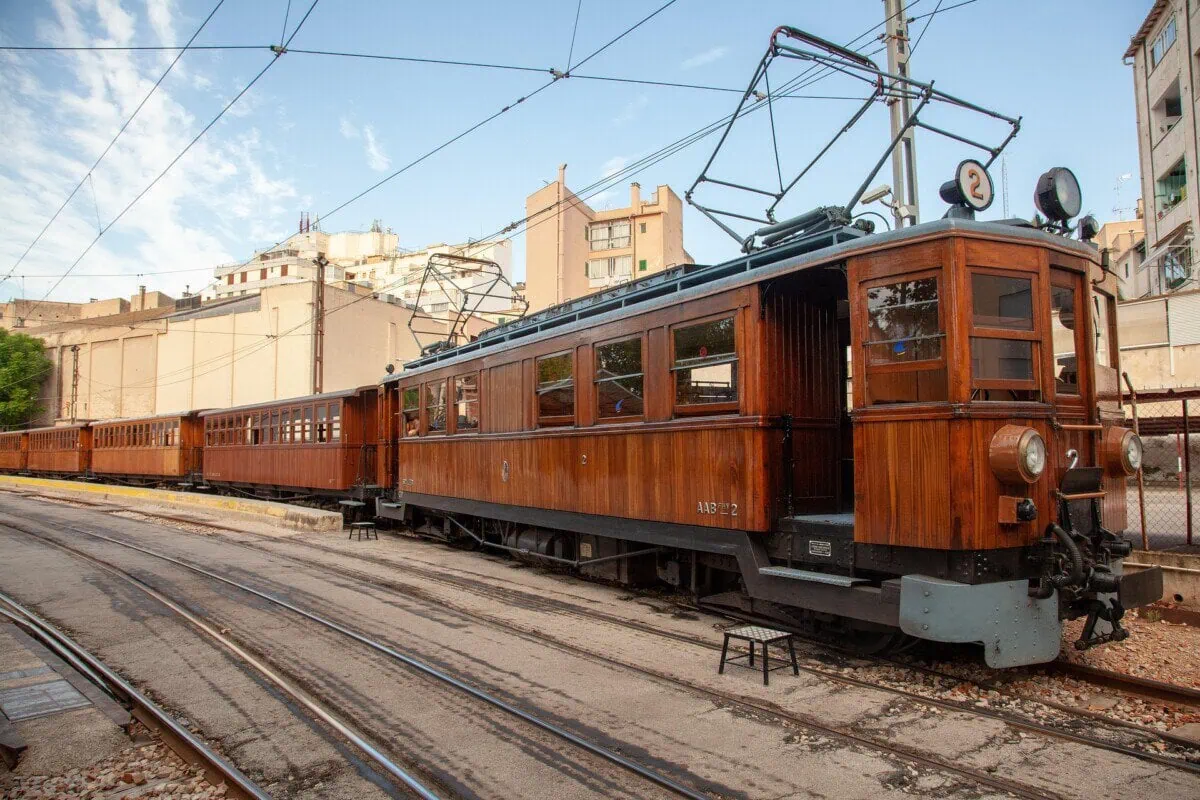
The railway switched from steam to electric traction in the 1920s, running on overhead power lines that still carry the service today, and much of the original rolling stock has been kept in service ever since through careful restoration rather than replacement. The result is a set of wooden, varnished carriages with brass fittings and Belle Époque styling that genuinely date back over a century, not a modern train dressed up to look old.
That authenticity is the whole appeal for many riders. The seats are narrow wooden benches rather than airline-style upholstery, the windows drop down by hand, and the carriages creak and sway in a way that no high-speed train ever will, which is exactly why enthusiasts and casual tourists alike still make the trip.
The company still owns and operates both the mountain railway and the connecting tram down to Port de Sóller, making it one of the few privately run heritage railways in Europe that also functions as everyday public transport for the valley’s residents. Full, current timetables and fares are published directly by the operator at trendesoller.com, and it is worth checking that page before travelling since services do shift a little between seasons.
The Journey from Palma to Sóller
Trains leave from Palma’s own dedicated Estació del Ferrocarril de Sóller, tucked just off Plaça d’Espanya and separate from the main Estació Intermodal used by TIB buses and the regular Mallorca rail network. There are typically up to seven departures a day in each direction, roughly every one to two hours through the morning and afternoon, though the exact pattern varies by season and is always worth checking against the operator’s live timetable rather than an old printout.
The ride itself takes around an hour and passes through thirteen tunnels, the longest of which runs nearly three kilometres and marks the highest point of the whole route at roughly 200 metres above sea level. A shorter tunnel known locally as the “500,” barely half a kilometre long, curves through a dramatic 180-degree turn that briefly points the train back the way it came before straightening out again.
Between tunnels the train calls at Bunyola, a preserved century-old village station framed by lemon groves and gardens, before continuing its climb into the Serra de Tramuntana proper. Passengers who only want a taste of the line without going all the way to Sóller can buy a shorter ticket to Bunyola and back, which still takes in several tunnels and a good stretch of the mountain scenery.
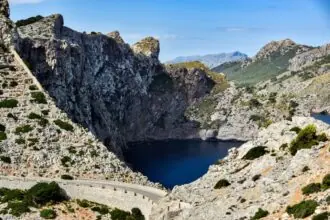
The final approach into the valley is the highlight for most riders. Each tunnel exit on the descent frames a new angle of the Sóller valley floor, ringed by peaks including Serra d’Alfàbia and Puig de l’Ofre, with terraced orange groves filling the flat ground below before the train pulls into Sóller’s own handsome, ivy-covered station a short walk from the town’s main square.
Best for two or three nights. The widest choice of rooms, with filters for free cancellation and included breakfast.
View staysBest for families, or any stay past about four nights. A kitchen and a washing machine start paying for themselves.
Browse rentalsBest as a last check before booking. Compares hotel rates across several sites in one search.
Compare ratesTickets, Fares and Practical Options
Tickets can be bought online in advance through the operator’s own site, which emails a boarding pass for a specific departure, or in person at the ticket office at either end on the day of travel. Buying online guarantees a seat on a chosen train and is the more reliable option in peak summer weeks, while the ticket office is the only place to buy less common combinations such as a one-way trip that doesn’t match the standard bundles sold online.
There is no discounted first-class cabin on the Sóller Train; every seat is the same wooden bench regardless of ticket type, so the price differences below come down purely to route and whether a return is booked. The table gives the main options as a starting point, but always cross-check the live fares at trendesoller.com before travelling, since prices are reviewed periodically.
| Option | Route | Frequency / Duration | Adult Fare |
|---|---|---|---|
| Vintage train, one-way | Palma ↔ Sóller | ~1 hour; up to 7 departures daily | €23 (£20/$27) |
| Vintage train, return | Palma ↔ Sóller ↔ Palma | Same-day return, any listed departure | €30 (£26/$35) |
| Vintage train, one-way (shorter run) | Palma ↔ Bunyola | ~35 minutes | €11 (£9/$13) |
| Vintage train, return (shorter run) | Palma ↔ Bunyola ↔ Palma | Same-day return | €19 (£16/$22) |
| Vintage tram, one-way | Sóller ↔ Port de Sóller | ~20-25 minutes; roughly every 30 minutes, 08:00-20:35 | €10 (£9/$12) |
| Combined train + tram bundle | Palma ↔ Sóller ↔ Port de Sóller ↔ Palma | Full valley-to-coast day trip | €40 (£34/$47) |
Children generally travel at a reduced fare and the operator’s own site lists current junior pricing, so it is worth checking the exact figure for a given travel date rather than assuming a fixed discount. Arrive at least 30 minutes before departure in peak season, since the platform and ticket office at the Palma end can queue up badly on summer mornings even for passengers who already booked online.
The Vintage Tram to Port de Sóller
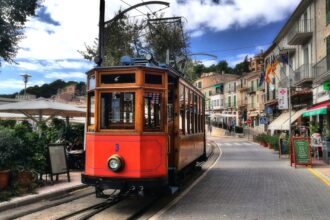
The mountain railway ends in Sóller town, but the valley’s other half, the harbour at Port de Sóller, is reached by a separate and much shorter service. A narrow, open-sided wooden tram dating from 1913 trundles along the seafront road between the two, rattling past cafés and front doors close enough to touch before opening out along the final stretch beside the bay.
The tram runs roughly every 30 minutes between about 08:00 and 20:35, considerably more often than the mountain train, and the ride itself takes only 20 to 25 minutes. It is a completely different experience from the train: lower, slower, and open to the street on both sides in many of its older cars, which makes it feel closer to riding through the town than travelling past it.
Buying the combined train and tram ticket from Palma makes sense for anyone planning to see both the valley town and the harbour in a single day, since it covers the full run from Palma to Sóller, on to Port de Sóller by tram, and back again for one bundled price. Travellers who only want the harbour and don’t care about the mountain railway can simply take a TIB bus most of the way and ride the tram for its own sake once in Sóller.
What to actually do at either end, from the square in Sóller town to the beach and lighthouse walk at the port, is covered in full in our guide to things to do in the Serra de Tramuntana, and anyone wanting a proper swim afterwards should see our roundup of Mallorca’s best beaches.
Train Alone, Combined Ticket or a Guided Day Trip?
Most visitors weigh up three ways to do this trip, and the right one depends on how independent a day out you want. Riding the vintage train alone covers just the mountain crossing, either one-way or as a same-day return, and it suits travellers who already know what they want to do once they reach Sóller town, whether that’s wandering Plaça de la Constitució or catching the Saturday market, and who are happy sorting the tram or lunch themselves. The combined train and tram bundle adds Port de Sóller to the same fare, turning the trip into a full valley-to-coast day out without any extra planning. A fully organised excursion from Palma goes further again, typically wrapping the train, and often the tram, into a package with hotel pickup, a guide and sometimes lunch, aimed squarely at travellers who would rather have the whole day arranged for them than work out timetables and connections alone.
| Option | What It Costs (Per Adult) | What’s Included | Who It Suits |
|---|---|---|---|
| Vintage train alone | €23 (£20/$27) one-way, or €30 (£26/$35) same-day return | The Palma to Sóller mountain crossing only, either direction | Independent travellers with their own plan for Sóller town |
| Combined train + tram | €40 (£34/$47) | Palma to Sóller by train, the tram on to Port de Sóller and back, and the return train to Palma | Travellers who want the valley and the harbour in one bundled fare |
| Organised excursion from Palma | Set by the operator, generally above the combined ticket once extras are bundled in | Hotel pickup and drop-off, a guide, the train (and often the tram), sometimes lunch | Travellers who want the whole day arranged, with no timetables or logistics to manage |
For most independent travellers, the train alone or the combined ticket are the more cost-effective options, since both use the same historic carriages and tram cars covered elsewhere on this page, just with less bundled around them. A guided excursion earns its higher price by removing the logistics entirely, which suits cruise passengers working to a fixed return time or travellers without their own way to reach the Estació del Ferrocarril de Sóller, but anyone comfortable booking online at trendesoller.com and following the timetable above will get the same ride for considerably less.

What to Do in Sóller Town
The train’s final stop is a genuine working town, not just a platform, and it rewards an hour or two of wandering on its own terms. Its heart is Plaça de la Constitució, a café-lined square dominated by the neo-Gothic front of Sant Bartomeu church, built with input from a collaborator of Gaudí.
Two blocks away runs the Gran Via, a broad avenue of modernista, regionalist and colonial townhouses funded by Sóller’s nineteenth-century citrus trade. Buildings such as Can Magraner and Can Cremat still carry the sculpted balconies and ornate porches that made the valley’s merchant families visibly wealthy.
Every Saturday morning the square itself becomes a farmers’ market, with stalls selling local cheese, olive oil, wine and produce alongside handmade crafts. It is worth timing a visit around this, since it is one of the liveliest and most authentic markets on the island.
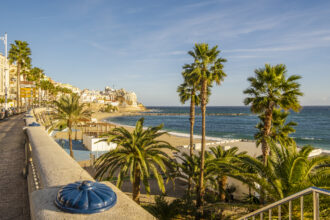
The same vintage tram that meets the mountain railway continues from the square down to Port de Sóller, rattling along the seafront in about twenty minutes. The harbour has its own sandy beach, waterfront restaurants and a small rocky swimming spot, Platja d’en Repic, beside the old fishing quarter.
Between the town and the coast, the valley floor is filled with orange and lemon groves that have been farmed here for centuries and give Sóller its nickname, the Orange Valley. Fresh orange juice sold near the square is squeezed from fruit grown just outside town rather than trucked in.
Travellers with a car can reach quieter coves further along the coast, including Cala Deià and Cala Tuent, both small and rocky rather than sandy but backed by seafood restaurants worth the detour. Neither is reachable by train or tram, so they suit a longer stay rather than the rail-only day trip below.
Best Seats, Timing and Getting On Board
Seating on the train is unreserved within a carriage, so arriving a little early and choosing a seat matters more than it does on a modern service. Most regular riders and guides point to the right-hand side heading toward Sóller as the better side for the valley views on the final descent, since that is the side facing the open mountainside as the train winds down through the last few tunnels.
Travelling on an early or midday departure generally means a quieter carriage than the late-morning and early-afternoon trains favoured by day-trip groups from Palma’s cruise terminal and resorts. Photographers chasing clear light for the valley shots on the way down tend to prefer a morning train, when the sun sits behind rather than directly ahead of the descent into Sóller.
Luggage space is limited to what fits on the racks above the wooden benches or on a lap, since these carriages were never built with modern suitcases in mind, so this is not the right service for travellers arriving with large cases straight from the airport. Bicycles and electric scooters are not permitted on board at all, and only guide dogs or animals in an approved carrier are allowed to travel.
Accessibility for wheelchair users is not something the operator publishes clear guidance on, and the century-old carriages have high steps and narrow doorways typical of rolling stock this age, so anyone travelling with a wheelchair or significant mobility needs should contact the operator directly before booking to confirm what is realistically possible on the day. Those planning a full circuit including cycling elsewhere on the island should see our guide to cycling in Mallorca for routes that don’t rely on bringing a bike aboard the train itself.
A Day Trip to Sóller by Train
A single day is enough to see the valley and the coast properly if the timing is planned around the timetable rather than left to chance. Catching the 10:10 departure from Palma’s Estació del Ferrocarril de Sóller lands in the valley by around 11:10, leaving a full afternoon ahead.
The first hour suits Sóller town itself: a loop around Plaça de la Constitució, a coffee under the church, and a walk up the Gran Via to see the modernista townhouses. Saturday visitors can time this around the morning market in the square.
From the station it is a short walk to the tram stop, and the ride down to Port de Sóller takes 20 to 25 minutes along the seafront. Arriving by early afternoon leaves several hours for lunch by the harbour and a swim off the beach.
Heading back, aim to be at the town station by around 17:30 to allow for the tram ride up and any delays along the way. The 18:00 departure back to Palma is a dependable choice that doesn’t need the box-office consultation some later trains require.
That plan gives roughly six and a half hours in the valley and at the coast, with the train arriving back in Palma by around 19:00. It is a long day out rather than a rushed one, with room to spare for a slower lunch or extra time on the beach.
The simplest way to book it is the combined train and tram ticket, which covers Palma to Sóller, the tram down to the port and back, and the return train home for around £34 (€40/$47) per adult. Always check the live times on the operator’s own site before travelling, since departures do shift a little by season.

Rupert’s Handy Travel Tips
Rupert has ridden this line more times than he can count, and a little planning turns a good trip into a genuinely great one.
- Book online for peak season: the Palma ticket office queue can run long on summer mornings, and an online booking guarantees a seat on the departure you actually want.
- Sit on the right heading to Sóller: that side faces the open valley on the final descent, which is where the best views of the whole trip line up.
- Don’t bring a big suitcase: the wooden carriages have very limited luggage space, so this works best as a light day-bag excursion rather than a transfer with full cases.
- Combine the train and tram in one day: the bundled ticket covers Palma to Sóller and on to Port de Sóller by tram, making a full valley-to-coast day out of a single fare.
- Check the live timetable before travelling: departure times shift a little by season, so confirm the current schedule at trendesoller.com rather than relying on an old printout.
Want to meet the reindeer behind our travel tips? Find out more in our page Who is Rupert?.




Best for long or awkward journeys. Builds one itinerary out of separate flights.
View flightsBest for short trips. Install the eSIM at home and arrive with working data, no shop queue.
Browse eSIMsBest after a long flight or a late landing. Price agreed before you travel, and no taxi queue.
Check transfersFrequently Asked Questions About the Sóller Train
How long does the Sóller Train take from Palma?
The journey takes around one hour, passing through thirteen tunnels and a stop at Bunyola before reaching Sóller.
Is the Sóller Train the same as the Sóller tram?
No. The train is the mountain railway between Palma and Sóller, while the tram is a separate, much shorter service that runs only between Sóller town and Port de Sóller along the seafront.
How much does a ticket cost?
A one-way adult ticket from Palma to Sóller costs around €23 (£20/$27), with a same-day return around €30 (£26/$35), and current fares are always confirmed on the operator’s own site before travelling.
Do I need to book in advance?
It isn’t strictly required outside peak season, but booking online guarantees a seat on a specific departure and avoids the ticket office queue that can build up on busy summer mornings.
Which side of the train has the best views?
The right-hand side heading toward Sóller generally faces the open valley on the final descent, giving the clearest views of the mountains and orange groves below.
Is the train wheelchair accessible?
The operator does not publish detailed accessibility guidance, and the century-old carriages have high steps and narrow doors typical of their age, so travellers with mobility needs should contact the operator directly before booking.
Further Reading
Once the train pulls into Sóller, our full guide to things to do in the Serra de Tramuntana covers the town, the port and the wider mountain villages in depth, and it’s the natural next stop for planning what to actually do once you arrive. Travellers weighing up the train against other ways into the mountains should see our guide to getting around Mallorca without a car, which covers the TIB bus network and other public transport options across the island.
For a broader day out from the capital, our roundup of day trips from Palma sets the Sóller Train alongside the island’s other easy excursions, while our wider Mallorca travel guide hub ties together everything else worth knowing before a trip. Walkers looking to continue beyond the valley on foot should see our dedicated guide to walking routes in the Serra de Tramuntana.
It’s also worth checking a travel insurance app before setting off, particularly if a mountain excursion is part of a longer, more active Mallorca itinerary. And once you’ve explored the valley by rail, our guide to Mallorca’s best beaches rounds out the coastline beyond Port de Sóller for anyone chasing a swim afterwards.