Reviewed by our editorial team Published
Palma de Mallorca Airport, known by its code PMI and officially named Aeroport de Son Sant Joan, is one of Spain’s busiest gateways and the arrival point for the vast majority of visitors to the island. It sits close enough to the capital that most transfer options take well under half an hour, but the airport’s genuinely busy layout, seasonal crowds and several very different ways of reaching the city can still catch first-time visitors off guard. Working out whether to jump on a bus, queue for a taxi, book a private transfer or head straight to a car hire desk makes a real difference to how smoothly a Mallorca trip starts.
This guide covers every practical way of getting from PMI into Palma and beyond, including the regulated EMT airport bus, taxis and their approximate fares, private transfers, and the island’s very large car hire market. It also settles a question that trips up a lot of visitors researching their transfer in advance: whether Palma airport actually has a train station on the island’s SFM rail network. Anyone planning to explore beyond Palma, particularly the Serra de Tramuntana, will find more detail in the site’s dedicated guides to getting around Mallorca without a car and to driving a full road trip route around the island.
None of the options below require advance planning beyond knowing roughly which one suits the trip. Families with luggage and a fixed budget tend to do best with the airport bus or a pre-booked private transfer, while anyone renting a car to reach the Tramuntana coast or rural finca hotels should head straight for the car hire desks. The sections below break down cost, journey time and where to actually find each option once through arrivals.
Comparing Your Transfer Options at a Glance
Deciding between the airport bus, a taxi, a private transfer and a hire car is easier once approximate journey times are set side by side. The table below covers four popular destinations beyond Palma itself, from the nearby resort of Magaluf to the northern town of Alcúdia, using the transfer methods already outlined in this guide.
Bus travel to these resort towns generally means starting on the A1 into Palma before continuing on a regional TIB service, though a handful of direct regional lines run straight from the airport. A private transfer or hire car covers the same distance in roughly the same time as a taxi, since all three travel by road, so the real trade-off is cost and convenience rather than speed.
| Transfer Method | Alcúdia | Cala d’Or | Sóller | Magaluf |
|---|---|---|---|---|
| Bus (A1 + Regional Network) | ~90 minutes (direct regional line) | ~2 to 2.5 hours (change in Palma) | ~80 to 100 minutes (change in Palma) | ~40 to 45 minutes (direct regional line) |
| Taxi | ~55 to 70 minutes | ~45 to 60 minutes | ~35 to 45 minutes | ~20 to 25 minutes |
| Private Transfer | ~55 to 70 minutes | ~45 to 60 minutes | ~35 to 45 minutes | ~20 to 25 minutes |
| Hire Car (self-drive) | ~55 to 70 minutes | ~45 to 60 minutes | ~35 to 45 minutes | ~20 to 25 minutes |
Where Palma Airport Is and How Far It Is From the City
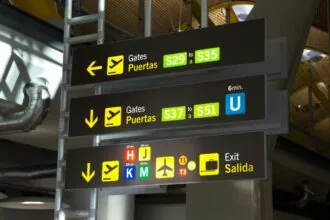
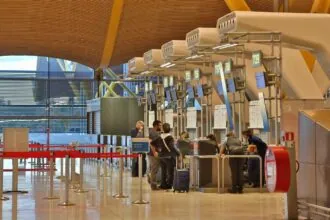
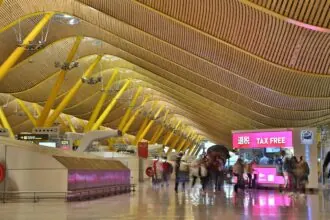
Palma de Mallorca Airport sits around 8km (5 miles) east of Palma’s city centre, next to the coastal district of Can Pastilla and the start of the Playa de Palma strip. That short distance is a genuine advantage for visitors, since even the slowest transfer option rarely takes more than half an hour to reach the old town. The airport’s single terminal building is split into four connected modules, A, B, C and D, so it is worth checking signage carefully after a long-haul flight to find the right exit for buses, taxis or car hire.
In 2024 the airport handled over 33 million passengers, making it Spain’s third-busiest after Madrid and Barcelona and one of Europe’s busiest single-runway airports during peak summer weeks. That volume means queues at taxi ranks and bus stops can build quickly in July and August, so building in a little extra time either side of a flight is sensible. Full official details on terminals and services are published by Aena, the airport’s operator.
All four modules feed into a single shared arrivals concourse, so a step-free route via lifts and moving walkways connects every gate to baggage reclaim and the transport links beyond. This matters more than it sounds for travellers with pushchairs, heavy suitcases or mobility needs, since none of them face a separate, harder route to the taxi rank or bus stop. Signage for the EMT bus, taxi rank and car hire area is colour-coded and repeated frequently along the concourse, so it is rarely necessary to backtrack once through customs.
Best for a short trip. Compare rooms by neighbourhood, price and guest rating before you book.
Compare hotelsBest for longer stays. Whole apartments and houses, so you are not eating out three times a day.
View rentalsBest as a last check before booking. Compares hotel rates across several sites in one search.
Compare ratesThe Airport Bus: EMT Line A1
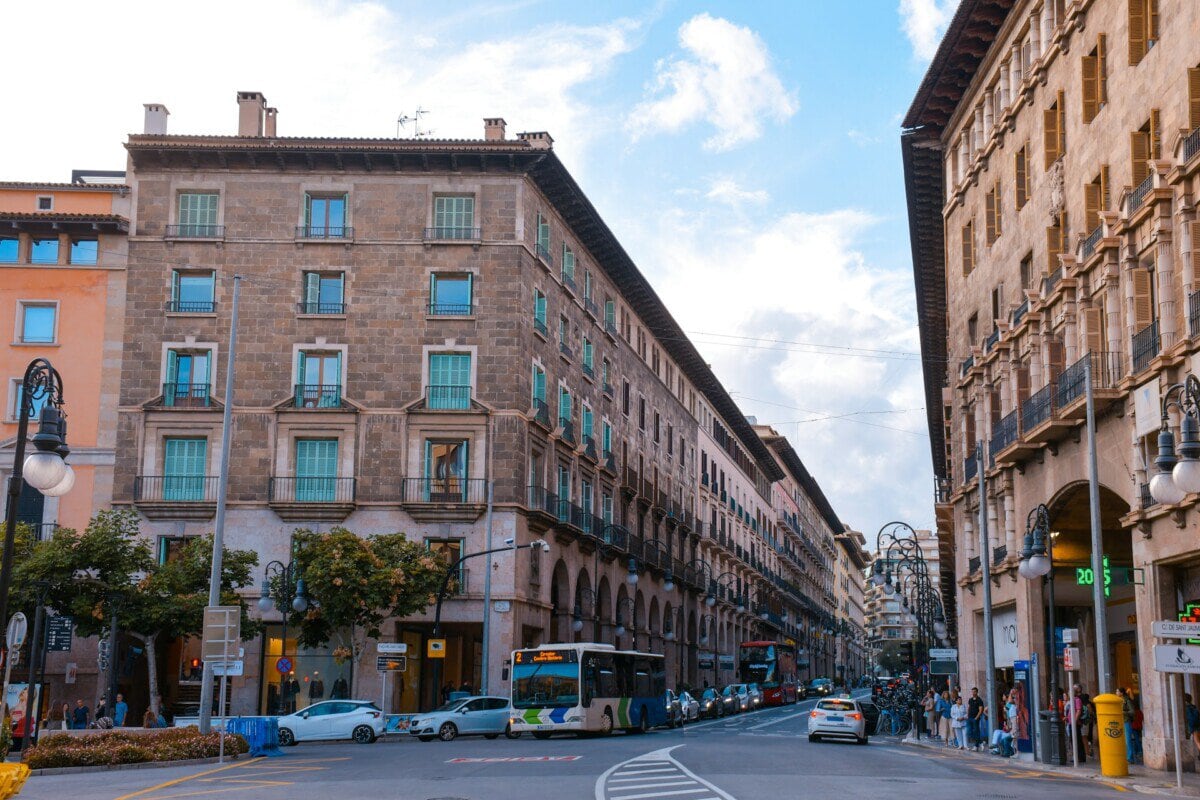
The cheapest and most straightforward public transport option from PMI is the EMT A1 bus, which runs directly between the airport and Palma’s Plaça d’Espanya, the city’s main bus, coach and rail interchange. Buses run roughly every 10 to 15 minutes through most of the day, with services continuing into the early hours to cover late arrivals, and the journey itself takes about 20 to 30 minutes depending on traffic. Stops along the route include Es Baluard art museum and several points around the edge of the old town, so it is worth checking the stop map rather than assuming the terminus is the only useful drop-off.
Fares are kept deliberately simple: a single ticket costs around €5 (£4/$6) paid in cash to the driver, or around €3 (£3/$4) if paid by contactless card, which makes tapping a bank card the cheaper option on every journey. Tickets are bought on board and there is no need to book ahead. The A1 stop at the airport sits just outside the arrivals area and is clearly signposted, making it one of the least stressful ways to reach the city with luggage in tow.
Buses on the A1 route are modern, low-floor vehicles with a dedicated luggage rack near the doors, and every service is wheelchair and pushchair accessible without needing to book ahead. Live arrival times can be checked through the EMT Palma app or on the digital screens at the stop, which is useful for deciding whether to wait or head straight for a taxi instead. Since the A1 also calls at Plaça d’Espanya, it connects directly with Palma’s SFM rail and metro network for anyone continuing beyond the city itself.
Buses to Alcúdia, Manacor and Other Resorts
Travellers heading straight to a resort rather than Palma have several direct options from the same airport bus stops. The A2 line runs to S’Arenal via Can Pastilla and the Playa de Palma strip roughly every 25 minutes, taking around 32 minutes end to end for a fare of €5 (£4/$6) cash or €3 (£3/$4) by card, the same pricing structure as the A1.
Beyond that, a set of TIB regional routes fan out from the airport to the island’s main holiday coasts. Line A11 heads west via Palmanova, Magaluf, Santa Ponça and on to Camp de Mar, with a fare to Palmanova of around €6.75 (£6/$8) cash or €4.05 (£3/$5) by card and a journey of roughly 40 minutes.
Line A32 runs north via Inca to Alcúdia, Playa de Muro and on to Can Picafort, a longer trip of around 90 minutes priced at roughly €13.50 (£12/$16) cash or €8.10 (£7/$9) by card. Line A42 covers the east coast instead, running via Manacor to Cala Millor and Cala Bona for a broadly similar fare and journey time.
A shorter route, line A51, runs south through S’Arenal to Llucmajor and Campos, useful for the quieter south coast rather than the busier resort belts. All of these regional routes run less frequently than the A1, often hourly rather than every 10 to 15 minutes, so checking a live timetable on the official TIB website before relying on one for a same-day connection is worthwhile.
Every regional line boards from the same cluster of stops just outside arrivals as the A1 and A2, so there is no need to walk to a separate terminal or coach station to find one. Buying the ticket directly from the driver works for all of them, though a contactless card again beats paying cash, and having the destination town’s name ready to show speeds up boarding at busy times.
Does Palma Airport Have a Train Station?
This is a genuinely common point of confusion, so it is worth stating plainly: Palma airport does not currently have its own train or metro station. Mallorca’s SFM rail and metro network, including the Palma-Inca-Manacor line and the Palma metro’s M1 line, all begin and end at the Estació Intermodal beneath Plaça d’Espanya in central Palma, not at the airport itself. Anyone hoping to step straight from a flight onto a train will need to cover that first short leg by bus or taxi.
In practice this changes nothing about how easy the transfer is, since the A1 bus covers the gap to Plaça d’Espanya in around 20 to 30 minutes anyway, dropping passengers right above the same interchange the trains use. A new rail line connecting the airport to Palma via Llucmajor has been discussed by regional authorities as a future project, but it remains unbuilt and has no confirmed opening date, so it should not factor into any current trip planning.
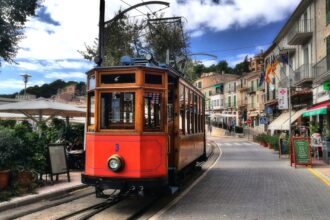
SFM, the operator behind the island’s trains and the Palma metro, runs both networks from that same underground interchange, so a single walk down from street level covers every onward rail connection. Travellers heading onward to towns like Inca, Manacor or Sóller should treat the airport-to-Plaça d’Espanya bus or taxi as the first leg of that journey rather than expecting a through-train, then buy an onward SFM ticket once inside the station itself.

Taxis from Palma Airport
The official taxi rank sits right outside the arrivals hall, and taxis are the fastest way into Palma, typically covering the roughly 9km journey in 15 to 20 minutes. Fares run on a regulated meter rather than a flat rate, and a typical fare from the airport to the city centre lands somewhere between €28 (£24/$33) during the day and around €37 (£32/$43) at night, when a late-evening supplement applies. A fixed airport supplement of roughly €4.65 (£4/$5) is added on top of the metered fare, and there is a minimum charge of around €14 (£12/$16) even for very short hops.
Queues at the rank can grow long around peak arrival banks in summer, so it is worth allowing extra time rather than assuming a taxi will be instantly available. Drivers accept card payment as standard, and receipts are issued automatically, which is useful for anyone tracking trip expenses. Taxis remain the best choice for late-night arrivals when bus frequency drops, or for groups splitting the fare between three or four people.
Official Palma taxis are cream-coloured with a licence plate carrying a blue stripe, and every legitimate rank vehicle displays a visible licence number on the dashboard, which is worth checking before getting in at a busy time. A standard taxi carries up to four passengers plus luggage, and larger groups can usually flag down an estate or people-carrier model by asking rank staff directly rather than waiting for one to arrive by chance. Tipping is not expected in Spain, though rounding up the fare is common practice.
Private Transfers
A pre-booked private transfer is a popular middle ground between the bus and a taxi rank queue, particularly for families or anyone arriving late at night into an unfamiliar airport. A driver typically waits in the arrivals hall with a name board, and the fixed price is agreed before travel, which removes any surprise over metered fares or night-time supplements. Most operators price a standard car for up to three or four passengers from around €25-€35 (£22-£30/$29-$41) one way to central Palma, broadly in line with a daytime taxi fare.
Private transfers become better value the further the destination is from Palma itself, since resort towns on the north or east coasts push a metered taxi fare much higher than a pre-agreed private rate. This option also suits anyone travelling with young children, awkward luggage such as golf clubs or bikes, or a large group where a taxi rank queue would mean waiting for two or three separate cars. As with any pre-booked transfer, it is worth checking the confirmed pickup point and flight-tracking policy before travelling, since terminal changes and delayed flights are common at a hub this busy.
Most private transfer services offer a free flight-monitoring service as standard, so a delayed arrival is tracked automatically rather than leaving a driver waiting at the wrong time. Larger vehicles, including seven and eight-seat minivans, are usually available for a modest supplement over the standard car rate, and most operators can provide a child or booster seat if requested in advance at no extra charge. A generous free cancellation window, typically 24 to 48 hours before pickup, is standard practice across most reputable services, which is worth checking before paying in full.

Compare Airport Transfer Companies
Pre-booking your airport transfer can save time and reduce stress when you arrive. Whether you need a private taxi, shared shuttle or executive transfer, comparing providers can help you find the best price and service for your journey.
We’ve selected three trusted airport transfer companies so you can compare prices, vehicle options, cancellation policies and customer reviews before you travel.
Car Hire at Palma Airport
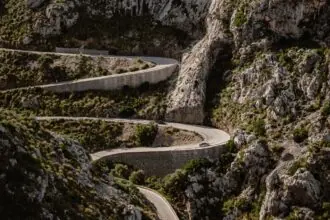
Palma is one of Europe’s busiest car hire airports, and for good reason: large parts of Mallorca, especially the Serra de Tramuntana coast road and the rural interior, are genuinely difficult to explore properly without a car. All the major international car hire brands operate here, and booking ahead online during peak summer months is strongly recommended, since availability and prices both tighten noticeably in July and August.
Where a specific desk sits depends on the company. Avis, Budget, Europcar, Hertz and Sixt all keep counters directly inside the terminal, with their cars parked in the multi-storey car park just across the road, so collection from these brands takes only a few minutes on foot. Smaller and often cheaper names such as Enterprise, National and Alamo operate from an off-site depot instead, reached by a free shuttle bus that runs regularly from a designated stop outside arrivals, adding roughly ten to fifteen minutes to the collection process.
Prices vary hugely by season and by which comparison site is used, but booking a small hatchback well ahead of a July or August trip typically works out considerably cheaper than the same booking made just days before arrival. It is worth checking whether a hire car includes full insurance cover and an adequate excess, since Mallorca’s mountain roads and narrow village streets are unforgiving of minor scrapes, and whether a debit card is accepted for the security deposit, since some operators in Spain still insist on a credit card.
Picking up a car at the airport rather than in Palma itself saves navigating the city’s one-way system and limited on-street parking on day one, which matters more than it sounds once jet-lagged and unfamiliar with local road signage. For a full breakdown of the island’s best driving route, including the Tramuntana coast road, Sóller, Deià and Valldemossa, see the site’s dedicated Mallorca Road Trip guide.

Explore Mallorca with a Hire Car
Hiring a car can open up more of Mallorca and its surrounding region, giving you the freedom to travel beyond the main public transport routes.
Compare offers from Discover Cars and EconomyBookings before booking so you can check both price and rental conditions.
Best for finding routes the airlines do not sell as a single ticket. Combines carriers to bring the fare down.
Search flightsBest for short trips. Install the eSIM at home and arrive with working data, no shop queue.
Browse eSIMsBest if you would rather not work out the transport on arrival. Book it now and forget it.
View transfersAirport Facilities: WiFi and Currency Exchange
Palma airport offers free WiFi throughout the terminal via the “Airport_Free_Wifi_AENA” network, which is fine for checking emails, messaging or looking up a transfer booking while waiting for luggage. A faster paid tier is also available for anyone needing to work or stream during a longer layover, priced at roughly €9 (£8/$11) for an hour or around €15 (£13/$18) for a full 24 hours. Free public internet terminals are also dotted around the arrivals and departures halls for anyone without a personal device to hand.
Currency exchange desks and ATMs are available across the terminal for travellers who land without euros, though the exchange rate at any airport kiosk is rarely the most competitive available. Withdrawing euros from an ATM using a fee-free travel card, or exchanging a small amount before leaving home, generally works out cheaper than a terminal bureau de change. Anyone planning to hire a car or take a taxi on arrival should have at least a little cash on hand regardless, since not every driver defaults to card payment first.
Free luggage trolleys are available throughout the baggage reclaim area, and a staffed left luggage desk in the terminal can hold bags for a few hours or several days for anyone with a late flight home and a full day still to fill. A pharmacy, several cafes and a small selection of shops selling chargers, adapters and local SIM cards round out the practical facilities, so a forgotten essential is rarely more than a short walk away.

Rupert’s Handy Travel Tips
I’ve hopped off enough Mallorca flights now to know the airport rush isn’t the bit to worry about, it’s what happens the moment you clear arrivals.
- Skip the cash queue: tap a contactless card on the A1 bus instead of paying the driver cash, it’s noticeably cheaper per journey.
- Don’t wait for a train that isn’t there: if you’re heading onward to Inca, Manacor or Sóller, plan on the bus or taxi into Plaça d’Espanya first, then change onto the rail network from there.
- Book your hire car early for summer: Palma’s car hire desks sell out of the popular sizes fast in July and August, so reserve well ahead rather than chancing it on arrival.
- Keep some euros on you: a fee-free card withdrawal at an airport ATM usually beats the exchange desk, but have a little cash ready for taxis just in case.
- Allow extra time at peak hours: the taxi rank and bus stops both get busy when several wide-body flights land together, so build in a buffer either side of a tight connection.
Want to meet the reindeer behind our travel tips? Find out more in our page Who is Rupert?.




Frequently Asked Questions
Is there a train from Palma airport into the city?
No, Palma airport has no train or metro station of its own. Mallorca’s SFM rail and metro lines all start from the Estació Intermodal at Plaça d’Espanya in central Palma, which is reached from the airport by the A1 bus or a taxi in around 20 to 30 minutes.
How much does the airport bus cost from Palma airport?
The EMT A1 bus to Plaça d’Espanya costs around €5 (£4/$6) paid in cash or around €3 (£3/$4) with a contactless card, running roughly every 10 to 15 minutes.
How long does a taxi take from Palma airport to the city centre?
A taxi typically takes 15 to 20 minutes to cover the roughly 9km journey, with a metered fare usually landing between €28 (£24/$33) by day and €37 (£32/$43) at night.
Do I need to hire a car at Palma airport?
It depends on the trip: Palma itself and the main resorts are easy to reach by bus or taxi, but exploring the Serra de Tramuntana or rural inland villages properly is much easier with a hire car, which is covered in more depth in our Mallorca Road Trip guide.
Is there free WiFi at Palma airport?
Yes, free WiFi is available throughout the terminal via the Airport_Free_Wifi_AENA network, with a faster paid tier available for longer layovers.
Can I exchange currency at Palma airport?
Yes, currency exchange desks and ATMs are available across the terminal, though a fee-free card withdrawal generally offers a better rate than an airport bureau de change.
Further Reading
This transfer guide is one piece of a wider look at getting around Mallorca once the flight has landed. Our Mallorca Travel Guide hub is the best place to start for an overview of the whole island, including the three main ways in and how long to budget for a first visit.
For anyone deciding whether to skip car hire altogether, our guide to Getting Around Mallorca Without a Car covers the island’s regional bus network and rail lines in detail, including how far they reach beyond Palma. If a hire car is the plan instead, the Mallorca Road Trip guide lays out a full driving route around the Tramuntana coast, Sóller, Deià and the north of the island.
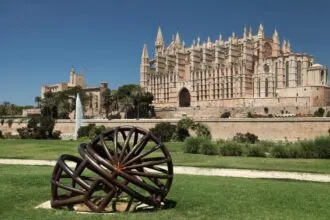
Once settled into Palma itself, our guide to Things to Do in Palma de Mallorca covers the old town, La Seu cathedral and the waterfront in full, making a natural next stop after arrival.