Reviewed by our editorial team Published
Adolfo Suárez Madrid-Barajas Airport, known by its code MAD, is one of Europe’s busiest gateways and the main arrival point for almost every visitor flying into the Spanish capital. It sits roughly 12km northeast of the city centre, close enough that most transfer options take well under an hour door to door. Working out the right option in advance makes the first hour of a Madrid trip far less stressful.
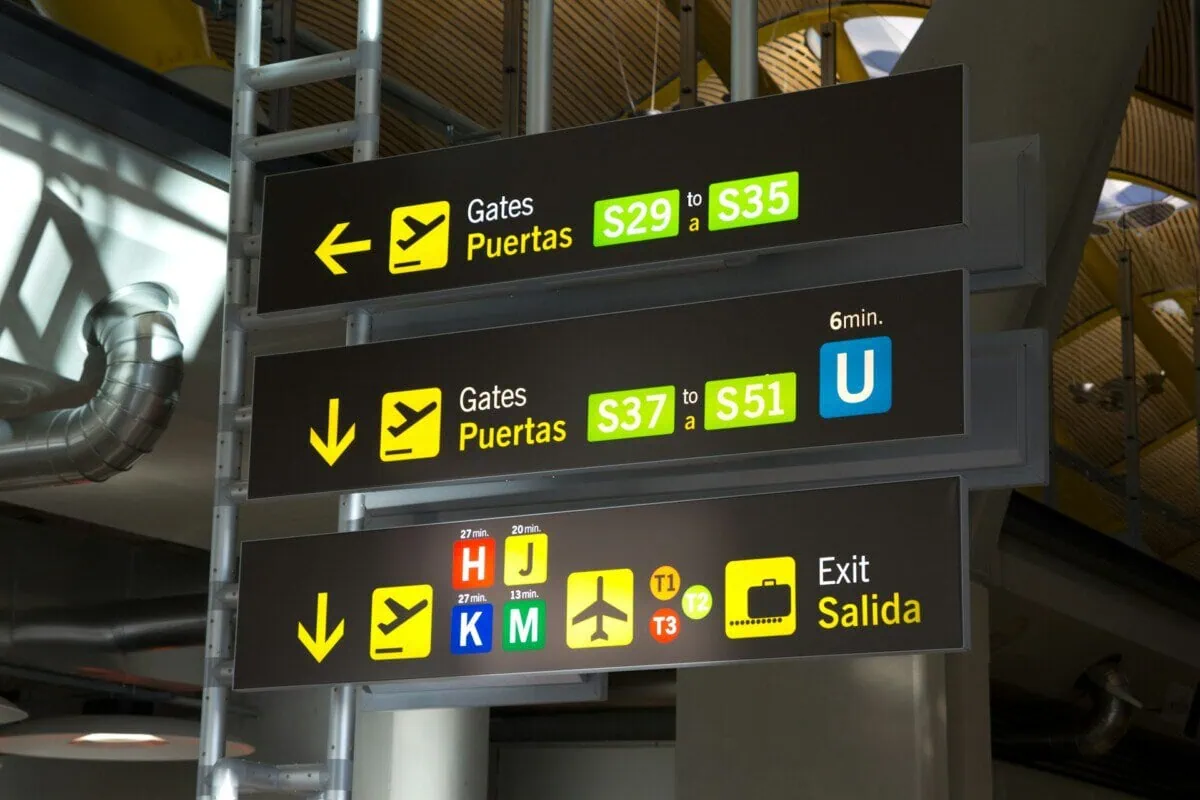
Barajas is split across two distinct areas that matter for transfers. Terminals T1, T2 and T3 sit together in one connected building complex, while Terminal 4 (plus its satellite, T4S) is a separate structure a couple of kilometres away, linked back to T1-2-3 by a free shuttle bus. Some transfer options serve T4 directly, while others are built primarily around the T1-2-3 side.
The Metro station, the Cercanías rail stop and the main bus links each have their own separate access points depending on which terminal a flight lands at, so checking signage carefully after arrival saves a wrong turn. The fastest route from T4 is not always the same as the fastest route from T1-2-3, which is worth knowing before heading for the exit.
This guide covers every genuine way of reaching central Madrid from Barajas, including the Metro, the Cercanías commuter rail, the dedicated Exprés Aeropuerto bus, taxis, private transfers and car hire. Anyone planning onward rail travel around the rest of Spain after landing may also find the site’s Spain Rail Pass Guide useful for working out whether a pass is worth buying before setting off.
None of the options below require advance planning beyond knowing which one suits the trip. Families with heavy luggage or a late-night arrival tend to do best with a taxi or the 24-hour Exprés Aeropuerto bus, while budget-conscious travellers with light bags usually find the Metro or Cercanías train perfectly comfortable. The sections below break down cost, journey time and practical detail for each option in turn.
Comparing Your Transfer Options at a Glance
Deciding between the Metro, Cercanías, the airport bus, a taxi, a private transfer and a hire car is easier once approximate times and prices sit side by side. The table below sets out the six main options covered in this guide, based on a typical journey between Barajas and central Madrid.
Journey times vary depending on which terminal a flight lands at, since T4 sits further from the Metro and Cercanías stations than T1-2-3. Prices are shown as a general guide rather than an exact fare, and the detailed sections further down cover route, frequency and any conditions worth knowing before travelling.
| Transfer Method | Approx. Journey Time | Approx. Price |
|---|---|---|
| Metro (Line 8) | 15-20 min from T1-2-3, ~20-25 min from T4 | €5 (£4/$5) |
| Cercanías (C1) | ~25-30 min from T4 to the centre | €2–€3 (£2–£3/$2–$3) |
| Exprés Aeropuerto (Bus 203) | 30-40 min depending on terminal | €5 (£4/$5) |
| Taxi | 20-30 min | €33 (£28/$36) |
| Private Transfer | 20-30 min | Varies by group size |
| Car Hire (self-drive) | 20-30 min | Varies by provider |
Metro Line 8: The Pink Line to Nuevos Ministerios
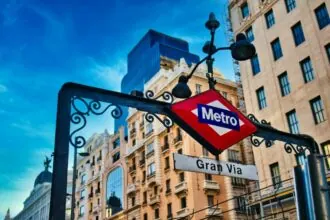
Madrid’s Metro Line 8, shown in pink on the network map, is the most direct rail link between Barajas and the city, running non-stop to Nuevos Ministerios in the heart of the business district. From there, every other Metro line and several Cercanías services connect onward, making it a genuinely useful hub rather than a dead end.
The journey takes around 15 to 20 minutes from the T1-2-3 station, and a little longer, roughly 20 to 25 minutes, from the separate T4 station further out. Trains run frequently through most of the day, so waiting times are rarely a real issue outside the very early hours.
Fares include a mandatory airport supplement on top of the standard Zone A fare, bringing a single journey to around €5 (£4/$5). Travellers holding a Madrid City Card have that supplement waived automatically, which is worth factoring in for anyone planning several days of Metro use anyway.
The Metro suits travellers with light luggage who are comfortable navigating stairs and escalators, since not every station along the route has full step-free access. For a fast, cheap link straight into the business district, it remains hard to beat, especially for solo travellers or couples without oversized bags.
Best if you want daily housekeeping and a front desk. Filter by area first, then by price.
Check availabilityBest for longer stays. Whole apartments and houses, so you are not eating out three times a day.
View rentalsBest if you have already picked a hotel. Checks the big booking sites for the same room and shows who is cheapest.
Check dealsCercanías C1: The Direct Train to Terminal 4
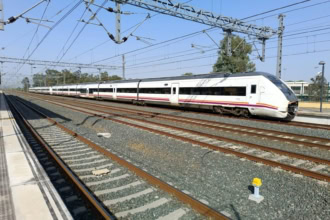
The Cercanías C1 line is Renfe’s commuter rail service, and it is the only rail option that reaches Terminal 4 directly, calling at the Aeropuerto T4 station before continuing on to Chamartín. For anyone landing at T4 without heavy luggage, it is a genuinely comfortable way into the city.
Trains run roughly every 25 minutes through the day, and the journey to central interchanges such as Nuevos Ministerios or Chamartín takes approximately 25 to 30 minutes, though this figure is worth treating as an estimate rather than a fixed schedule. The C1 continues beyond Chamartín to Atocha, Madrid’s other major station, useful for onward AVE connections.
A standard Zone A single ticket applies, typically costing around €2–€3 (£2–£3/$2–$3) depending on the exact fare band, and the same Tarjeta Multi card used on the Metro and EMT buses can be loaded with Cercanías trips. Contactless payment is becoming more common at Cercanías stations, though coverage is not yet universal across every gate.
The C1’s main limitation is that it only serves T4, so travellers landing at T1, T2 or T3 would need to reach T4 by shuttle bus first, which rarely makes sense compared with taking the Metro directly. For a T4 arrival with a train connection already planned onward, though, the C1 is often the smoothest single option available.
Exprés Aeropuerto: The 24-Hour Airport Bus
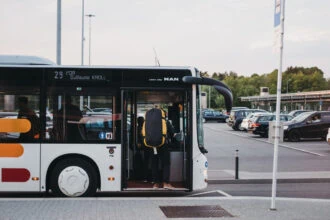
The Exprés Aeropuerto, bus route 203, is Madrid’s dedicated airport shuttle, and its standout feature is that it runs 24 hours a day, 365 days a year. That makes it the only public transport option genuinely built around round-the-clock flight arrivals, rather than following the Metro or Cercanías’ more limited overnight schedule.
During the day, buses depart from Atocha station roughly every 15 to 20 minutes, calling at Plaza de Cibeles and O’Donnell metro station on the way to the airport terminals. Overnight, the route switches to a reduced service departing from Plaza de Cibeles roughly every 35 minutes, still covering every terminal.
Journey time from Atocha is approximately 30 minutes to T1, with roughly 5 extra minutes each to reach T2 and then T4, so the full run can take closer to 40 minutes at the far end of the route. The fare is a flat rate of around €5 (£4/$5), payable on board by cash or contactless card, with no need to book ahead.
This bus is a strong choice for anyone arriving very early, very late, or simply wanting one fixed price regardless of traffic. Its direct link to Atocha also makes it convenient for travellers heading straight onto an AVE high-speed service without detouring through the Metro first.
Taxis from Madrid Airport
Taxis wait at clearly marked ranks outside every terminal, and they remain the fastest and most predictable way to reach central Madrid, particularly for groups or anyone arriving with a lot of luggage. Unlike many European airports, Madrid regulates airport taxi fares with a flat rate rather than a standard meter.
The official flat fare for any journey within the M-30 ring road, which covers virtually the entire city centre, is €33 (£28/$36), confirmed by the Ayuntamiento de Madrid’s most recent fare update. This flat rate applies regardless of traffic or time of day, which removes a lot of the uncertainty that comes with metered fares elsewhere.
Journeys tend to take around 20 to 30 minutes depending on the destination and traffic conditions, and official taxis are white with a red diagonal stripe and a visible licence number, worth checking before getting in during busy periods. Card payment is standard, and a receipt is issued automatically.
Taxis are the obvious choice for late-night or early-morning arrivals when other services run less frequently, or for families and groups where the flat fare works out cheaper per person than several separate Metro or bus tickets. They also remove any need to navigate stations with heavy suitcases in tow.
Private Transfers
A pre-booked private transfer is a popular middle ground between public transport and a taxi rank, especially for families, business travellers or anyone arriving into Madrid for the first time. A driver typically waits in the arrivals hall with a name board, and the price is agreed before travel, removing any uncertainty over fares.
This option particularly suits late-night arrivals, large groups with excess luggage, or travellers heading straight to a hotel rather than exploring the city centre first. Most operators track incoming flights automatically, so a delayed arrival does not mean a driver waiting at the wrong time or an awkward wait once through customs.
Pricing is typically comparable to a daytime taxi fare for a standard car, though it varies by group size, vehicle type and how far in advance the transfer is booked. Larger vehicles for bigger groups, and child or booster seats, are usually available on request at little or no extra cost.
A pre-booked private transfer will never be the cheapest option on this list, but it removes queueing entirely and offers a fixed cost known before departure. For anyone prioritising a smooth, stress-free start to a Madrid trip over saving a few euros, it is worth serious consideration.

Compare Airport Transfer Companies
Pre-booking your airport transfer can save time and reduce stress when you arrive. Whether you need a private taxi, shared shuttle or executive transfer, comparing providers can help you find the best price and service for your journey.
We’ve selected three trusted airport transfer companies so you can compare prices, vehicle options, cancellation policies and customer reviews before you travel.
Car Hire at Madrid Airport
Barajas is one of Europe’s largest car hire hubs, and every major international brand operates here, with desks split between the T1-2-3 terminal building and a separate area serving T4. Booking ahead online is generally cheaper than arriving without a reservation, particularly during busy summer weeks and around major Spanish public holidays.
A hire car makes the most sense for travellers planning day trips beyond the city, since destinations such as Toledo, Segovia and Aranjuez are also reachable by train, but more remote spots benefit from the flexibility a car provides. Within Madrid itself, though, a car is rarely necessary and can be a genuine hindrance given the city’s congestion charge zones and limited parking.
Most major brands keep their pick-up counters and car parks close to the terminal, though a handful of smaller or budget operators run from an off-site depot reached by a free shuttle bus, adding some time to the collection process. Checking exactly where a specific booking is collected from before travelling avoids confusion after a long flight.
It is worth confirming whether a hire car includes adequate insurance cover and whether a debit card is accepted for the security deposit, since some operators in Spain still require a credit card. For anyone combining Madrid with day trips further afield, our Spain Rail Pass Guide is worth checking first, since several popular routes work out just as easily by train.

Book Car Hire for Your Madrid Trip
If your plans in Madrid include day trips, rural areas or several stops, having your own car can make the itinerary much easier to manage.
Discover Cars and EconomyBookings both let you compare available vehicles and prices from a range of rental companies.
Which Transfer Option Suits Your Trip
With six genuine options on the table, the right choice usually comes down to luggage, budget and what time a flight actually lands. Solo travellers and couples with light bags landing during the day are usually best served by the Metro or Cercanías, both quick, cheap and frequent enough not to need a fixed schedule in mind.
Families with pushchairs, larger groups, or anyone arriving with several suitcases will generally find a taxi or a pre-booked private transfer far less stressful than hauling luggage through station turnstiles and up escalators. The flat taxi fare in particular makes cost easy to predict and split between several passengers.
For very early or very late flights, the Exprés Aeropuerto bus and taxis are the two options genuinely built for round-the-clock arrivals, since both the Metro and Cercanías run reduced or no service overnight. Anyone landing outside normal daytime hours should treat this as the deciding factor before anything else.
Car hire only really earns its place for travellers planning day trips well beyond Madrid’s public transport network, since the city centre itself is comfortably covered by Metro, bus and on-foot exploring. Weighing up luggage, arrival time and onward plans together, rather than picking on price alone, tends to produce the smoothest start to a Madrid trip.
Best for finding routes the airlines do not sell as a single ticket. Combines carriers to bring the fare down.
Search flightsBest if you want maps and messaging working the moment you switch your phone on.
See eSIM plansBest after a long flight or a late landing. Price agreed before you travel, and no taxi queue.
Check transfersThe Best Option for Where You’re Headed
The right transfer option often comes down to exactly where in Madrid a trip is headed, not just budget or luggage. The table below matches six common arrival scenarios to the single best option, based on the routes and services covered above.
| Destination or Situation | Best Option | Why |
|---|---|---|
| Sol | Metro Line 8, changing at Nuevos Ministerios | Nuevos Ministerios connects onto the central lines serving Sol directly, making Metro the fastest link into the pedestrian core. |
| Atocha | Exprés Aeropuerto bus | The 203 terminates at Atocha itself with no interchange needed, handy for anyone continuing straight onto an AVE service. |
| Gran Vía | Metro Line 8, changing at Nuevos Ministerios | The same interchange used for Sol also reaches Gran Vía’s stations within one further change, keeping the journey quick and cheap. |
| Chamartín | Cercanías C1 (from T4) | The C1 continues past the airport straight to Chamartín without changing trains, though this route is only available from T4. |
| Late-night arrival | Taxi | The flat €33 (£28/$36) fare and door-to-door service avoid waiting alone at a stop once Metro and Cercanías have cut back to reduced or no overnight service. |
| Family with luggage | Taxi | One flat fare split between the group usually beats several individual tickets, with no turnstiles or escalators to manage with heavy suitcases. |
T1/T2/T3 versus T4: Why the Terminal Matters
Which terminal a flight actually uses changes the decision more than most travellers expect, since Madrid-Barajas splits transport access across two separate hubs. T1, T2 and T3 share one connected building with a single Metro station, Aeropuerto T1-T2-T3, served by Line 8.
T4 and its satellite T4S sit in a separate building a couple of kilometres away, with their own Metro station, Aeropuerto T4, also on Line 8. Crucially, T4 is the only terminal with a Cercanías station, since the C1 line does not call at T1-2-3 at all.
Anyone landing at T1, T2 or T3 who wants the Cercanías train needs to reach T4 first on the free inter-terminal shuttle bus, which runs around the clock roughly every 5 minutes by day and every 20 to 40 minutes overnight. The ride itself takes about 7 to 10 minutes each way, so it’s rarely worth the detour unless a train connection is already the plan.
In practice, this makes the Metro the more flexible rail option for T1-2-3 arrivals, since it needs no terminal transfer at all. T4 arrivals get a genuine choice between Metro and Cercanías, with the train being the smoother pick for anyone continuing straight on to Chamartín or Atocha.
Tapping a Bank Card at the Metro Gates
From June 2026, Metro de Madrid began switching on direct contactless bank card and mobile wallet payment at its ticket gates, letting passengers tap straight through instead of queueing at a machine first. Reporting around the launch points to a large share of turnstiles being enabled network-wide, though the exact count varies by source, with JCB confirming its own cards and wallets work this way from the same date.
The rollout’s first phase appears limited to single-trip fares rather than multi-trip bundles, and a temporarily discounted flat rate has reportedly been used to encourage early adoption. Coverage of exactly how it interacts with the mandatory airport supplement is thin and inconsistent across sources at the time of writing, so it’s worth treating as genuinely useful rather than guaranteed foolproof.
For an airport arrival specifically, tapping a contactless card at the Aeropuerto T1-T2-T3 or Aeropuerto T4 gates is worth trying first, but keeping a Tarjeta Multi loaded as backup avoids any awkwardness if a particular gate hasn’t been upgraded yet or the supplement isn’t calculated correctly. Checking signage at the gate itself remains the most reliable way to confirm on the day.

Rupert’s Handy Travel Tips
Landing at Madrid Barajas? Here are a few tips to help you get into the city smoothly.
- Know your terminal before you plan: T4 is a genuine shuttle-bus ride from T1-2-3, so double-check which one your flight actually uses before picking a transfer option.
- Try contactless, but keep a backup: bank-card tap payment is rolling out at Metro gates, though coverage is still uneven, so keep a loaded Tarjeta Multi in your pocket just in case.
- Trust the flat taxi fare: the €33 rate within the M-30 removes any meter surprises, but it’s still worth confirming with the driver before setting off.
- Landing very late or early: the Exprés Aeropuerto bus runs all night and drops close to Atocha, making it a cheaper alternative to a taxi outside normal hours.
- Heading onward by train: from T4, the Cercanías C1 connects straight to Chamartín and Atocha, so there’s no need to detour via the Metro first.
- Check the City Card first: if several days of Metro travel are already planned, the Madrid City Card waives the airport supplement automatically.
Want to meet the reindeer behind our travel tips? Find out more in our page Who is Rupert?.




Frequently Asked Questions
What is the cheapest way to get from Madrid airport to the city centre?
The Cercanías C1 train and Metro Line 8 are generally the cheapest options, both costing only a few euros once the airport supplement is included, though neither serves every terminal as directly as the Exprés Aeropuerto bus.
How long does the Metro take from Barajas to the centre?
Metro Line 8 takes around 15 to 20 minutes from the T1-2-3 station to Nuevos Ministerios, and roughly 20 to 25 minutes from the separate T4 station further out.
Does the Cercanías train serve all four terminals?
No, the Cercanías C1 line only calls at Terminal 4. Travellers landing at T1, T2 or T3 would need to reach T4 first, so the Metro or Exprés Aeropuerto bus is usually the more practical choice from those terminals.
How much does a taxi cost from Madrid airport?
Madrid operates an official flat fare of €33 (£28/$36) for any taxi journey between the airport and a destination within the M-30 ring road, which covers virtually the whole city centre.
Is the Exprés Aeropuerto the same as a normal city bus?
Not quite. Bus route 203 is a dedicated airport shuttle that runs 24 hours a day between Atocha station and every terminal, with a flat fare of around €5 (£4/$5), rather than following the standard EMT city bus network.
Do I need the Madrid City Card to save money on transport?
It isn’t essential, but the Madrid City Card waives the mandatory airport supplement on Metro fares and includes unlimited Zone A travel, so it can be worthwhile for anyone already planning several days of Metro use.
Is public transport available around the clock at Madrid airport?
The Exprés Aeropuerto bus and taxis both run 24 hours a day, but the Metro and Cercanías operate reduced or no overnight service, so late-night or very early arrivals should plan around the bus or a taxi instead.
Should I hire a car just to get into Madrid?
Generally not. A hire car is rarely necessary for reaching the city centre and can be a hindrance given congestion zones and limited parking, but it becomes genuinely useful for day trips beyond destinations that are also reachable by train, such as Toledo or Segovia.
Further Reading
Getting from the airport is only the first step of a Madrid trip. Once you’re in the city, our Madrid Public Transport guide covers the Metro, Cercanías and buses in full, and anyone planning to explore further afield by rail will find the site’s Spain Rail Pass Guide useful for working out whether a Renfe pass or discount card is worth buying. For longer journeys across the country, the Interrail Spain Pass guide covers AVE reservations and how the pass works alongside Spain’s regional rail network.
Travellers continuing on to other Spanish cities may also want to compare notes with the site’s other airport guides. Our Malaga Airport Transfers guide covers the train, bus and taxi options for reaching the Costa del Sol, while the Palma de Mallorca Airport Transfers guide does the same for the Balearic Islands.
Each guide follows the same honest approach as this one, weighing up cost, comfort and journey time rather than simply listing every option available. Reading a couple of these alongside a Madrid trip is a useful way to compare how Spain’s major airports differ in their transfer options.