Reviewed by our editorial team Updated
Milan rarely gets the fanfare that Rome or Florence attract, but the city rewards anyone who spends real time inside it. Its skyline mixes a Gothic cathedral with glass towers, and its streets hide world-class art inside quiet cloisters.
This guide walks through Milan’s genuine range, from the soaring spires of the Duomo to the hush of Leonardo’s Last Supper, from canal-side aperitivo to a fashion district where the shopfronts are attractions in their own right. Each stop gets its own practical detail, covering what it costs, how long to allow, and when advance booking actually matters.
Some of Milan’s best experiences need almost no planning at all. Wandering the Brera district or Corso Buenos Aires costs nothing beyond time, while a handful of the city’s headline sights, particularly the Last Supper, require booking weeks or even months ahead to avoid disappointment.
Milan also works well as a base for exploring beyond the city itself, whether that is a mountain day trip to the ski resorts north of town or an afternoon beside Lake Como. This page focuses purely on what to see and do inside Milan, leaving that wider region to its own dedicated guides.
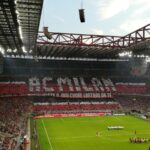
Football pilgrims will find only a passing mention of San Siro here, since the stadium’s tours and match-day access deserve a dedicated guide of their own. Everything else below covers Milan’s real depth: its historic churches and modern towers, its museums and markets, its grand opera house, and its quieter neighbourhood corners.
Comparing Milan’s Top Sights by Time, Cost and Booking
If you are deciding what deserves space in a short visit, this is the quickest way to narrow the list. Milan mixes free neighbourhoods, timed masterpieces and major paid landmarks, so the planning requirement varies more than it first appears.
| Attraction | Time to Allow | Cost Level | Booking? | Best For |
|---|---|---|---|---|
| Duomo & Rooftop Terraces | 1-2 hours | Paid | Recommended | First visits, architecture, city views |
| The Last Supper | 30-60 minutes including check-in | Paid | Essential | Leonardo and Renaissance art |
| Galleria Vittorio Emanuele II | 30-60 minutes | Free to enter | No | Architecture and shopping |
| Castello Sforzesco | 1-3 hours | Grounds free; museums paid | Usually no | History, museums and families |
| Pinacoteca di Brera | 1.5-2 hours | Paid | Useful at busy times | Italian art |
| Navigli | 1-3 hours | Free | No | Aperitivo and evening atmosphere |
| San Bernardino alle Ossa | 20-30 minutes | Free/donation | No | Unusual history and architecture |
| Porta Nuova & Bosco Verticale | 1-2 hours | Free | No | Modern Milan and photography |
Duomo di Milano and Its Rooftop Terraces
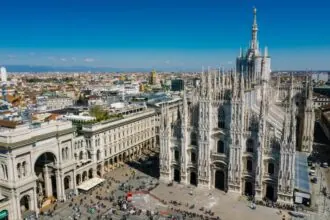
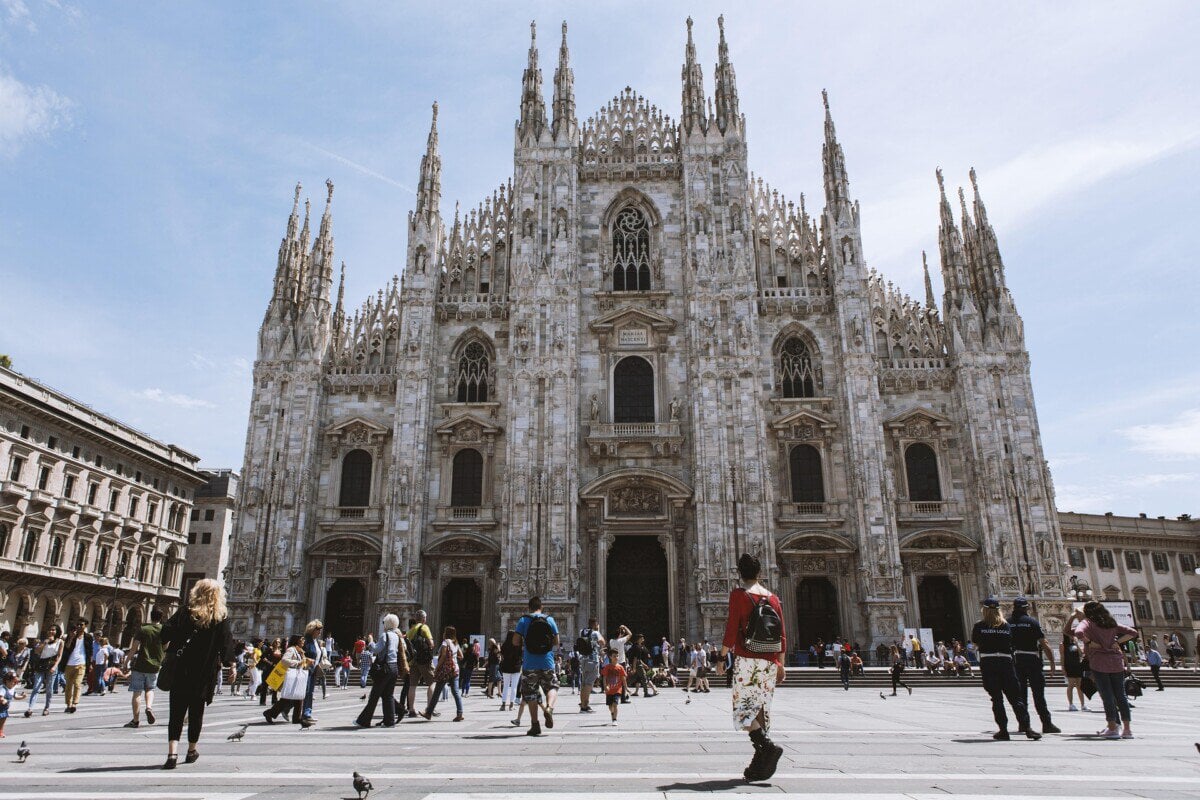
The Duomo di Milano dominates the city centre, and it remains one of the largest Gothic cathedrals anywhere in the world. Its facade bristles with spires and statues, a project that took nearly six centuries to complete after construction began in 1386.
Inside, the cavernous marble nave is worth the entry alone, but the real highlight for most visitors is climbing onto the roof itself. From the terraces, walkways weave between flying buttresses and carved spires, with the Alps visible on a clear day beyond the rooftops.
A combined cathedral and museum ticket costs from around €10 (£9/$11), while rooftop access costs more depending on how you go up. Climbing the stairs runs from about €16 (£14/$17), taking the lift instead costs from around €18 (£16/$19), and combination tickets covering the cathedral too are priced from roughly €22 (£19/$24) by stairs or €26 (£23/$28) by lift.
Security queues build quickly, especially in summer, so booking a timed slot online in advance is worth doing rather than relying on walk-up tickets. Most visits take around one to two hours in total once the rooftop is included. The official Duomo di Milano website is the safest place to check current ticket types, opening notices and rooftop access before you go.
The cathedral sits directly above the Duomo metro stop, making it the natural starting point for almost any Milan itinerary. The Galleria Vittorio Emanuele II and Piazza del Duomo both sit immediately alongside it.
Best for a short trip. Compare rooms by neighbourhood, price and guest rating before you book.
Compare hotelsBest for longer stays. Whole apartments and houses, so you are not eating out three times a day.
View rentalsBest as a last check before booking. Compares Milan hotel rates across several sites in one search.
Compare ratesThe Last Supper at Santa Maria delle Grazie
Leonardo da Vinci’s Last Supper is painted directly onto the refectory wall of the Santa Maria delle Grazie convent, and it remains one of the most fragile and closely guarded artworks in Europe. The mural was completed around 1495 to 1498, using a technique that has made it notoriously difficult to preserve.
Visits are tightly controlled, with groups capped at around 40 people allowed into a climate-controlled chamber for exactly fifteen minutes at a time. That brevity is part of the experience, and most visitors find it more moving than rushed once they are actually standing in front of it.
Standard tickets cost from about €15 (£13/$16) for adults, with a reduced rate of around €2 (£2/$2) for those aged 18 to 25 and free entry for anyone younger. Tickets are released on a rolling quarterly schedule and sell out weeks or months in advance, so this is one Milan sight that genuinely cannot be left to chance. The official Last Supper Museum website confirms that reservations are compulsory and releases admissions in scheduled batches.
Arriving at least thirty minutes before the booked slot is mandatory, since a late arrival forfeits the ticket entirely with no refund. The painting sits a short walk or tram ride from the Duomo, in the Santa Maria delle Grazie area west of the centre.
For travellers who want the logistics handled, a verified guided option bundles this sight with the cathedral’s rooftop terraces into a single half-day outing.
Galleria Vittorio Emanuele II
Stepping through the arched entrance beside the Duomo brings you into the Galleria Vittorio Emanuele II, a glass-domed 19th-century arcade often called Milan’s living room. It opened in 1877 and remains one of the oldest shopping galleries of its kind anywhere in the world.
Marble floors, ornate ironwork, and a soaring glass roof give the arcade a grandeur that has nothing to do with the boutiques inside it, though those boutiques include some of the biggest names in Italian fashion. Prada’s original store still occupies its historic corner here.
Underfoot, a mosaic of a bull marks the centre of the arcade, and local tradition holds that spinning on your heel over a certain spot brings good luck. It is a small, free ritual that almost every visitor ends up trying at least once.
There is no entry charge to walk through, and the arcade connects Piazza del Duomo directly to Piazza della Scala on the far side. Ten minutes covers a walk-through, though lingering for coffee under the dome is the better way to experience it.
Evening light through the glass roof is particularly striking, making a return visit after dark worthwhile if the daytime crowds feel overwhelming.
Teatro alla Scala and the Museo Teatrale
La Scala has been one of the world’s most important opera houses since it opened in 1778, and its stage has hosted premieres by Verdi and Puccini among many others. Even without a performance ticket, the building itself is worth stepping inside.
The attached Museo Teatrale alla Scala lets visitors see the gilded auditorium from a private box without needing a ticket for a show, alongside instruments, costumes, and composer memorabilia spanning the theatre’s history. It is a compact museum that rarely takes more than an hour.
Standard museum admission costs from about €12 (£10/$13) for adults, with a reduced rate of around €8 (£7/$9) for students, under-18s, and over-65s. The museum opens daily from roughly 9:30am to 5:30pm, with last admission thirty minutes before closing.
Seeing an actual performance is a different proposition, with tickets ranging from budget gallery seats to significantly pricier stalls, and popular productions selling out well ahead of the date. Checking the official season calendar before travelling is worth doing if opera is the goal.
The theatre sits directly on Piazza della Scala, a short walk from both the Duomo and the Galleria, making it an easy addition to a first afternoon in the city centre.
Castello Sforzesco
Castello Sforzesco began life as a 15th-century fortress for the ruling Sforza family, and its brick towers and moat still dominate the western edge of the city centre. Over the centuries it has served as a barracks, a warehouse, and now a museum complex.
The main courtyard is free to enter during the castle’s extended opening hours, making it an easy stop even without paying for the museums inside. Visitors can wander the grounds and photograph the rebuilt Torre del Filarete without spending anything.
Inside, the castle’s museums hold an eclectic collection that includes Michelangelo’s unfinished final sculpture, the Pieta Rondanini, alongside armour, furniture, and archaeological pieces. A combined museum ticket costs from about €5 (£4/$5) for adults, with a reduced rate of around €3 (£3/$4), and under-18s enter free.
The museums open Tuesday to Sunday from roughly 10am to 5:30pm, with last entry thirty minutes before closing, and the castle is closed on Mondays. Allowing around ninety minutes covers both the courtyard and a proper look through the main collections.
Beyond the castle’s rear gate, Parco Sempione opens up immediately, making it natural to combine the two into a single relaxed afternoon.
Pinacoteca di Brera
The Pinacoteca di Brera holds one of Italy’s most important collections of Renaissance and Baroque painting, housed inside a former Jesuit college in the heart of the Brera district. Its rooms move chronologically through some of the biggest names in Italian art history.
Highlights include Mantegna’s Lamentation of Christ, painted with a startling foreshortened perspective, and Raphael’s Marriage of the Virgin, alongside significant works by Caravaggio, Bellini, and Tintoretto. The collection rewards visitors who take their time rather than rushing through room by room.
The Grande Brera ticket, which now covers both the Pinacoteca and the adjoining Palazzo Citterio, costs from around €20 (£17/$22) for a standard adult entry. Reduced rates apply for students and young EU citizens, and booking a day ahead is worth doing in peak season.
Admission is free on the first Sunday of every month with a reservation, which makes that a genuinely good way to see world-class art without spending anything, though it also tends to be the busiest day to visit.
A visit typically takes around two hours, and the gallery sits a short walk from both the Duomo and Castello Sforzesco, making it easy to slot into a wider day of sightseeing.
The Navigli Canal District
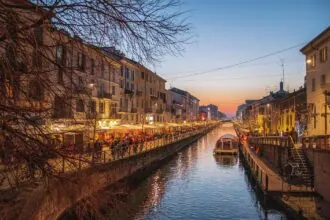
South of the city centre, the Navigli district is built around a handful of surviving 19th-century canals that once carried goods into Milan. Today the towpaths are lined with bars, restaurants, and small independent shops rather than barges.
The area comes alive in the evening, when aperitivo culture takes over the canal-side terraces and locals spill out onto the pavements with a drink and a plate of snacks included in the price. It is one of the best places in Milan to see how residents actually spend a weeknight.
On Saturdays, a lively market sets up along the canal selling clothes, antiques, and bric-a-brac, giving the district a completely different daytime character to its evening buzz. Browsing the stalls costs nothing beyond whatever catches your eye.
The Navigli sits a short walk or a couple of tram stops south of the Duomo, and the area is easy to reach on foot from the centre. No entry fee applies to the district itself, since it is simply a neighbourhood rather than a ticketed attraction.
An evening visit works best, ideally arriving before sunset to see the canals in daylight before the bars fill up for the night.
Best for finding routes the airlines do not sell as a single ticket. Combines carriers to bring the fare down.
Search flightsBest for anyone whose home plan charges by the megabyte abroad. Pay a fixed price up front.
Check eSIMsBest when public transport has stopped, or when you are travelling with children and bags.
Book a transferCasa Milan and the Mondo Milan Museum
A short tram ride northwest of the centre, Casa Milan doubles as AC Milan’s club headquarters and home to the Mondo Milan Museum, which traces more than 125 years of the club’s history through shirts, trophies and match memorabilia. It sits well away from most of the sights covered so far, but fans passing through Milan often treat it as a worthwhile detour on a day without a match.
The museum’s Trophies Room displays the club’s major honours on open view, a separate hall is dedicated to the club’s Ballon d’Or winners, and a holographic theatre, one of the first installed in any football club museum, walks visitors through key moments from the club’s past. A photo booth near the exit lets visitors buy a printed souvenir on the way out.
Standard adult admission costs around €20 (£17/$23), with reduced rates for children and over-65s and free entry for under-7s. The museum opens daily from 10am to 7pm, with last admission an hour before closing, and a visit typically takes about an hour to see everything on display.
The Brera District
Brera is Milan’s traditional artists’ quarter, a tangle of cobbled streets and quiet courtyards just north of the Duomo that has kept its bohemian character even as the rest of the city has modernised around it. It grew up around the art academy that still occupies part of the neighbourhood.
Independent galleries, antiquarian bookshops, and small boutiques line streets far too narrow for cars, and the whole area invites slow wandering rather than a checklist of sights. Via Fiori Chiari and Via Madonnina are particularly good for browsing.
The district is also home to the Pinacoteca di Brera itself, so the neighbourhood and the gallery naturally pair into a single half-day visit. Cafes and small trattorias tucked into the side streets make it an easy place to stop for lunch between sights.
There is no cost to explore Brera, and the area rewards getting lost on purpose rather than following a fixed route. Evenings bring a livelier crowd, particularly around the small bars that spill onto the pavements near the old academy.
Brera sits within easy walking distance of both the Duomo and Castello Sforzesco, making it simple to fold into a longer day covering the historic centre.
Quadrilatero della Moda
The Quadrilatero della Moda, or fashion quadrilateral, is the four-street grid of Via Montenapoleone, Via della Spiga, Via Sant’Andrea, and Via Manzoni where Italy’s biggest fashion houses keep their flagship stores. It is the closest thing Milan has to an open-air fashion museum.
Window displays here are treated as an art form in their own right, with houses like Armani, Versace, and Gucci rotating elaborate storefronts that change with the seasons. Even without buying anything, walking the grid gives a real sense of Milan’s design pedigree.
The streets themselves are elegant rather than flashy, lined with restored 19th-century buildings and quiet enough to feel worlds away from the crowds around the Duomo a few minutes’ walk south. Cafes tucked between the boutiques make good stopping points.
There is no cost to walk the quadrilateral, and an hour is enough to cover its main streets at an easy pace. It sits directly between the Duomo and the Giardini Pubblici, making it a natural link between sights on either side.
Fashion Week transforms the area into one of the city’s busiest districts, so travellers visiting purely to window shop may prefer to avoid those specific dates.
Anyone buying from outside the EU here can usually reclaim a share of the VAT built into the price before flying home, and our guide to claiming back VAT in Europe covers the self-service customs kiosks and newer app-based refund services that now pay out more than the traditional Global Blue or Planet desk.

Porta Nuova and the Bosco Verticale Skyline
Porta Nuova is Milan’s modern skyline, a cluster of glass towers built over the past fifteen years that gave the city its first real high-rise district. At its centre sits Piazza Gae Aulenti, a circular plaza ringed by cafes and framed by the towers above it.
The area’s best-known landmark is the Bosco Verticale, two residential towers designed by architect Stefano Boeri and covered in hundreds of full-sized trees and thousands of shrubs across their balconies. Completed in 2014, it remains one of the most photographed pieces of architecture in the city.
Viewing the towers costs nothing, since they are residential buildings best appreciated from the street or the surrounding piazza rather than entered. The contrast between greenery and glass is what makes the district worth the detour.
Porta Nuova sits a short walk north of the historic centre, easily reached from Milano Porta Garibaldi station or the Garibaldi metro stop. Thirty minutes is enough to see the piazza and towers properly.
The district also has a growing cluster of restaurants and bars, making it a reasonable stop for an evening drink away from the more tourist-heavy centre.
Fondazione Prada
Fondazione Prada occupies a former distillery on the southern edge of the city, transformed by architect Rem Koolhaas into one of Europe’s more unusual contemporary art spaces. The complex mixes original industrial buildings with new additions, including a striking gold-leaf-clad tower.
Exhibitions rotate regularly and tend toward ambitious, large-scale contemporary art, with the foundation’s own collection supplemented by major loan shows. It is not a place for a quick walk-through, since the scale of some installations demands real time.
A standard adult ticket costs from about €15 (£13/$16), which also covers the foundation’s smaller Osservatorio space near the Duomo within thirty days of the first visit. The venue closes on Tuesdays and opens the rest of the week from roughly 10am to 7pm.
Fondazione Prada sits outside the main tourist core, in the Largo Isarco area south of the centre, best reached by tram or metro rather than on foot from the Duomo. Allowing two hours covers the main exhibition spaces at a comfortable pace.
It rewards travellers with a genuine interest in contemporary art and design rather than those simply working through a standard sightseeing list.
Parco Sempione
Parco Sempione is Milan’s largest central park, spreading out behind Castello Sforzesco in the shape of an English-style landscaped garden rather than a formal Italian one. Winding paths, a small lake, and mature trees make it a genuine escape from the surrounding city streets.
At its northwestern edge stands the Arco della Pace, a triumphal arch begun under Napoleon and completed in 1838, originally intended to mark the start of the road toward the Alps and Paris. It remains one of Milan’s more overlooked landmarks despite its scale.
The park is free to enter and open throughout the day, making it an easy place to rest between sights or to picnic on a warm afternoon. The Triennale Milano design museum also sits within its grounds, alongside a small aquarium building.
Cyclists, joggers, and families make the park genuinely lively rather than simply decorative, particularly at weekends when much of the surrounding neighbourhood seems to end up here. An hour or two is enough for a relaxed loop.
Combining the park with Castello Sforzesco and the Triennale makes for a full, mostly free half-day covering three sights in one area.
Best for a short stop where being central matters more than the room. Dorms and private rooms both listed.
See hostelsBest if you have ever given up on a claim. AirHelp checks whether the flight qualifies and pursues it for you.
See the benefitsBest if your room is not ready yet. Left luggage booked in advance, so you are not hunting for a locker.
Check storageSaving on Entry Tickets with a Milan City Card
Between the Duomo’s rooftop terraces, the Last Supper, La Scala’s museum, Castello Sforzesco and the Pinacoteca di Brera, it doesn’t take long to rack up several separate entry fees on a single Milan trip. Anyone planning to see more than two or three of these sights is usually better off checking whether a bundled pass works out cheaper than paying for each ticket on its own.
Milan’s city card market is smaller and more mixed than in a city like Rome or Paris, with two genuinely active products on offer rather than one dominant pass, and neither covers every sight on this page. Our guide to Milan’s city cards compares both against buying tickets separately, using the same prices referenced throughout this page, to work out when a card actually pays off.
Basilica di Sant’Ambrogio
Basilica di Sant’Ambrogio is one of the oldest churches in Milan, founded in the 4th century by Saint Ambrose himself and rebuilt in its current Romanesque form over subsequent centuries. Its two bell towers and quiet cloistered courtyard feel far removed from the busier sights near the Duomo.
Inside, the atmospheric dim interior holds early Christian mosaics, a golden altar dating back over a thousand years, and the remains of Saint Ambrose himself displayed beneath the main altar. Few churches in the city feel quite as historically layered as this one.
Entry to the basilica is free, making it an easy addition to a day that already includes nearby sights without adding any cost to the itinerary. A visit typically takes around thirty to forty minutes.
The basilica sits a short walk southwest of the centre, easily reached via the Sant’Ambrogio metro stop, which shares its name with the church. It also neighbours the Catholic University, giving the surrounding streets a studious, unhurried feel.
Visiting outside of mass times gives the best chance to see the interior properly without disrupting an active service.
Basilica di Sant’Eustorgio and the Portinari Chapel
Basilica di Sant’Eustorgio sits at the edge of the Navigli district and carries a legend that has followed it for centuries, that its founding stone once held the relics of the Three Kings before they were moved elsewhere. The basilica itself is free to enter.
Its real highlight is the Portinari Chapel, a Renaissance masterpiece attached to the side of the church and considered one of the finest small chapels in Lombardy. Frescoes covering its dome and walls depict scenes from the life of Saint Peter Martyr.
Visiting the chapel requires a separate ticket, priced from about €6 (£5/$6) for adults, or a combined ticket covering the chapel alongside the basilica’s museum and paleochristian cemetery from around €10 (£9/$11). Reduced rates apply for groups and students.
The basilica and chapel together take roughly forty-five minutes to an hour to see properly, and the site pairs naturally with a wider walk through the neighbouring Navigli canals. It sits an easy walk south of the centre.
This is one of Milan’s better under-visited sights, drawing a fraction of the crowds seen at the Duomo despite its genuine historical weight.

Cimitero Monumentale
Cimitero Monumentale functions less like a traditional cemetery and more like an open-air sculpture museum, filled with elaborate tombs commissioned by wealthy Milanese families since it opened in 1866. Wandering its avenues feels closer to visiting an art gallery than a burial ground.
The scale and variety of the funerary art here spans everything from Realist figures to full Art Nouveau monuments, with some tombs rivalling small chapels in size and ambition. Composer Arturo Toscanini and novelist Alessandro Manzoni are among those buried here.
Entry is completely free, and the cemetery opens Tuesday to Sunday from roughly 8am to 6pm, closing on Mondays. Its scale means a proper visit can easily run to an hour or more for anyone interested in sculpture or Milanese history.
The cemetery sits north of the historic centre, reachable by tram or a short walk from the Garibaldi area, making it easy to combine with a visit to Porta Nuova nearby.
It remains one of the quietest major sights in the city, rarely crowded even when the Duomo and Galleria nearby are packed with visitors.
Seeing Milan’s Sights by Open-Top Bus
Between the historic centre around the Duomo and quieter, spread-out sights like Cimitero Monumentale and Porta Nuova, Milan’s attractions cover more ground than they first appear to on a map. Working out which tram or bus links them all can eat into a short visit, especially for anyone unfamiliar with the city’s transport network.
An open-top hop-on hop-off bus sidesteps that planning entirely, looping past most of what’s listed on this page with a single ticket covering the whole day. Our guide to Milan’s hop-on hop-off routes covers the two operators running these open-top services and which line reaches which sights, so you can pick the route that matches this list before you set off.
Triennale Milano
Triennale Milano occupies the Palazzo dell’Arte inside Parco Sempione, and it has served as one of Italy’s leading venues for design, architecture, and applied arts since the 1930s. Its rotating exhibitions cover everything from furniture and product design to photography and urban planning.
The building itself is a fine piece of rationalist architecture, and its cafe and bookshop are worth a look even for visitors not planning to see a full exhibition. The museum sits directly beside Castello Sforzesco, making it easy to combine both into one visit.
Ticket prices vary by exhibition rather than sitting at one fixed rate, so checking the current show and its pricing before travelling is worth doing. The museum opens Tuesday to Sunday from around 10:30am to 8pm, closing on Mondays.
A visit typically takes an hour to ninety minutes, depending on how many of the current exhibitions are open at once. Its location inside the park makes it a natural stop on a longer walk through Parco Sempione.
Design-focused travellers in particular should not skip this one, since it consistently punches above its profile compared with better-known Milan museums.

Museo del Novecento
Museo del Novecento traces Italian art through the entire twentieth century, housed inside the Palazzo dell’Arengario directly on Piazza del Duomo. Its collection moves from early Futurism through to Arte Povera, giving a condensed but genuinely useful overview of modern Italian art.
The undoubted highlight is Umberto Boccioni’s Unique Forms of Continuity in Space, a bronze sculpture that has become one of the defining images of Italian Futurism. The museum’s spiral internal ramp also offers striking views back toward the Duomo through its windows.
A standard adult ticket costs from about €10 (£9/$11), with reduced rates for students, and booking ahead in peak season is worth doing since the museum’s location beside the cathedral makes it a natural add-on for visitors already in the piazza.
The museum takes around ninety minutes to see properly, and it opens most days, though hours vary slightly midweek versus weekends, so checking the current schedule before arriving is worth doing.
Its position directly on the main piazza makes it one of the easiest sights in the entire city to work into any Duomo-based itinerary.
10 Corso Como
10 Corso Como was one of the world’s first true concept stores, opened in the early 1990s by the legendary fashion editor and gallerist Carla Sozzani. It combined a boutique, an art gallery, a bookshop, and a cafe inside a single converted courtyard building, a format since copied by cities worldwide.
The store still curates fashion, design objects, and books with the same editorial eye that made it famous, and a small garden courtyard gives it a calmer feel than a typical retail space. Browsing costs nothing beyond whatever ends up in a shopping bag.
A rooftop restaurant and a boutique hotel occupy the upper floors, making the site as much a destination for a coffee or a meal as for shopping. Thirty to forty-five minutes covers a proper look around the ground floor spaces.
The store sits just north of Porta Nuova, an easy walk or short tram ride from the historic centre, making it simple to combine with a visit to the Bosco Verticale nearby.
For anyone interested in Milan’s design and fashion identity beyond the big-name boutiques, this remains one of the city’s more distinctive stops.
Via Paolo Sarpi and Milan’s Chinatown
Via Paolo Sarpi and its surrounding streets form Milan’s historic Chinese quarter, a neighbourhood shaped by Chinese immigration to the city stretching back over a century. The pedestrianised main street is lined with restaurants, import shops, and grocers rather than typical tourist stops.
Food is the main draw here, with genuine regional Chinese cooking on offer alongside the fusion dishes more commonly found elsewhere in the city. Small bakeries and dumpling shops along the street are worth stopping at even for a quick snack between sights.
There is no entry cost to the neighbourhood, since it is simply a district rather than a ticketed attraction, and an hour is enough to walk its main streets and stop for food along the way.
The area sits northwest of the centre, easily reached from the Sondrio or Moscova metro stops, and it makes a good contrast to the more polished districts closer to the Duomo. Weekday afternoons tend to be quieter than weekend evenings.
Visiting gives a different side of Milan entirely, one built on immigration and small business rather than fashion houses or grand architecture.

Corso Buenos Aires
Corso Buenos Aires is one of the longest and busiest shopping streets in Europe, running for roughly one and a half kilometres between Porta Venezia and Piazzale Loreto. More than three hundred shops line the street, ranging from high-street chains to independent boutiques.
Unlike the Quadrilatero della Moda’s luxury flagships, this is Milan’s everyday shopping street, popular with locals as much as visitors, and prices here run far closer to standard high-street rates. It gives a more realistic sense of how Milanese people actually shop.
There is no cost to walk the street itself, and it stays busy well into the evening, with cafes and gelaterias offering easy stopping points along the way. An hour covers a decent stretch, though committed shoppers could easily spend an entire afternoon here.
The street runs between two metro stops, Porta Venezia and Loreto, both on the M1 line, making it simple to start at one end and finish at the other without doubling back.
It sits a short distance northeast of the centre, making it easy to combine with a wider day exploring that side of the city.

Rupert’s Handy Travel Tips
Rupert has wandered every corner of Milan chasing good coffee and better views, and he has picked up a few tricks worth knowing before you set off.
- Book the Last Supper the moment you have dates: tickets release quarterly and vanish fast, so this is not one to leave until the week before.
- Climb the Duomo roof by stairs if you can: it is cheaper than the lift and gives you a slower, more dramatic approach to the terraces.
- Time the Navigli for early evening: arrive before sunset to see the canals properly, then let the aperitivo crowd build around you.
- Visit Brera on a first Sunday: pair free entry to the Pinacoteca with a wander through the district’s galleries and bookshops.
- Wear comfortable shoes for Corso Buenos Aires and Paolo Sarpi: both streets reward a slow walk rather than a rushed dash between metro stops.
Want to meet the reindeer behind our travel tips? Find out more in our page Who is Rupert?.




Frequently Asked Questions About Things to Do in Milan
What is the best way to see the main sights in Milan?
Most travellers cover the Duomo, Galleria Vittorio Emanuele II, and Castello Sforzesco on foot within a single day, since all three sit within a short walk of each other in the historic centre.
How far in advance should I book the Last Supper?
Tickets are released on a rolling quarterly schedule and often sell out weeks or months ahead, so booking as soon as dates open is essential rather than optional.
Is Milan expensive compared with other Italian cities?
Milan runs slightly above the Italian average for hotels and dining, but many of its best sights, including Parco Sempione, the Navigli canals, and the Quadrilatero della Moda, cost nothing to enjoy.
How many days do I need to see Milan properly?
Two to three full days covers the city’s main sights comfortably, including at least one museum, one historic church, and time to simply walk the neighbourhoods.
Can I visit Milan’s attractions without pre-booking anything?
Most sights allow walk-up entry, but the Last Supper requires advance booking without exception, and the Duomo rooftop and Pinacoteca di Brera are far smoother with a timed ticket booked ahead.
Further Reading & Related Guides
Getting into the city is the first practical step for most visitors, and the route depends entirely on which airport you land at. Our guides to Milan Malpensa Airport to city centre, Milan Bergamo Airport to city centre, and Milan Linate Airport to city centre each break down the fastest and cheapest ways in, whichever airport your flight lands at.
Once you’re in the city, it helps to know how to get around it. Our Milan Public Transport Explained guide covers the metro, trams and buses in full, while the Milan Hop-On Hop-Off Bus Guide is worth a look if you’d rather sightsee from an open-top deck on your first day. Football fans making the trip should also read Getting to San Siro Stadium in Milan for the fastest routes on match day, and our Milan City Card Explained guide breaks down whether a discount card is worth buying for your trip.
Once settled in the city, Milan also makes an excellent base for exploring further afield. Our guide to Milan to Lake Como covers the best routes and day trip options for reaching one of Italy’s most photographed lakes, while things to do at Lake Como fills in what to do once you arrive. Skiers and snowboarders should look at our guide to Milan to the ski resorts for routes into the mountains north of the city, and anyone extending their trip toward Bergamo will find things to do in Bergamo a useful companion. For a wider round-up of escapes by train, our Day Trips from Milan: Real Escapes by Train guide covers further options beyond Lake Como and the mountains, and if your visit falls in December, A Christmas Guide to Milan rounds up the festive markets and lights worth building a day around.
For the practical side of a longer Italian trip, our Interrail Italy Pass guide explains how rail passes work for onward travel, and our European Railway Journeys page covers scenic routes further afield for those continuing beyond Milan. Staying connected throughout is easier with the right setup covered in our eSIM apps guide, which is worth reading before landing rather than after.