Reviewed by our editorial team Published
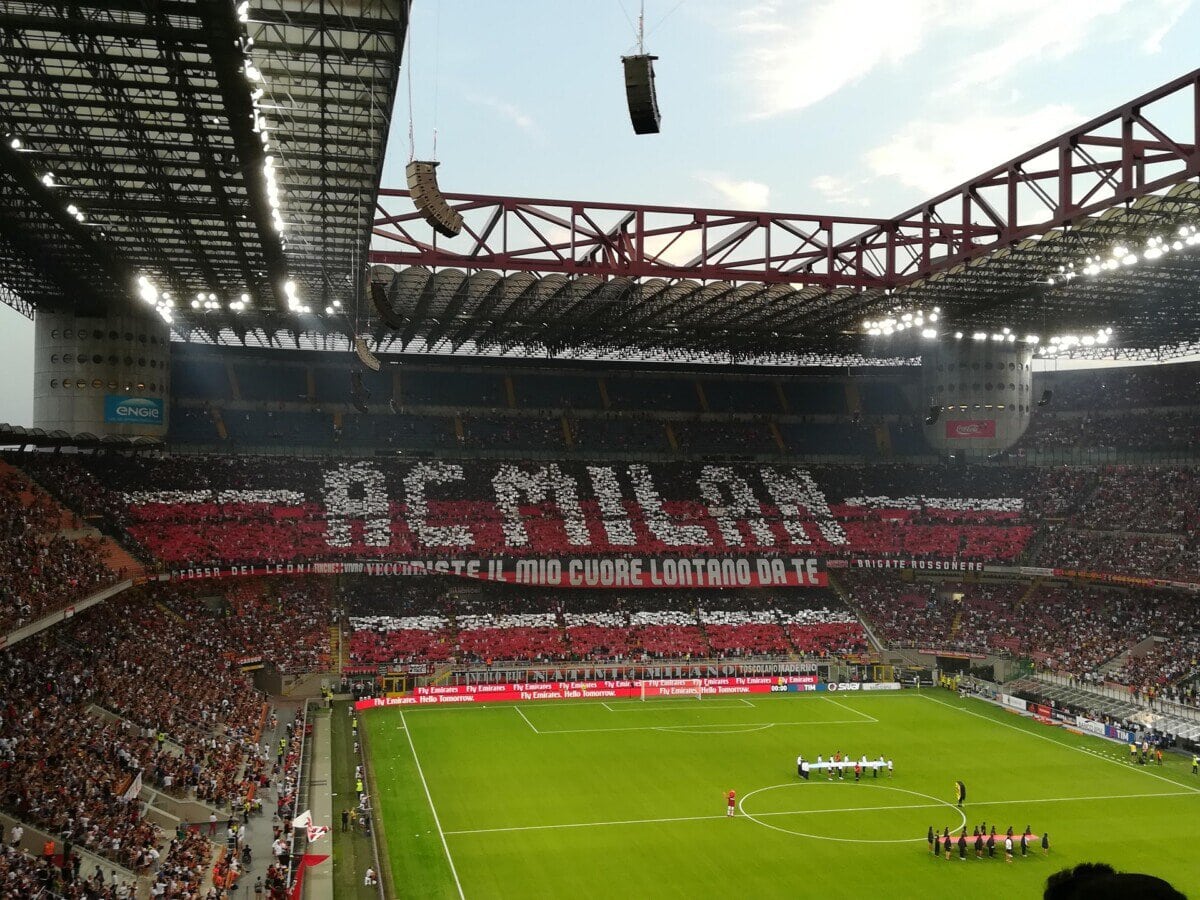
San Siro is one of the few stadiums in world football that belongs to two fierce rivals at once. Officially named the Stadio Giuseppe Meazza, this vast concrete bowl on the western edge of Milan is the shared home of both AC Milan and Inter Milan, and working out how to reach it is the first real test of matchday planning.
San Siro reached its centenary in September 2026, having opened on 19 September 1926 with a Milan derby that Inter won 6-3. That century of history sits inside a ground built for around 75,800 fans, with a maximum configuration pushing past 80,000 for the biggest occasions.
Getting there is easier than the size of the crowd suggests, provided you know which of the two nearby metro stops to use. The purple M5 line has a station built specifically to swallow stadium crowds, while a second stop a short walk away serves the neighbouring racecourse instead.
Beyond the metro, there is a scenic tram, a handful of match day bus routes, and a proper park-and-ride shuttle for anyone who insists on driving. Each option has a different trade-off between speed, cost and how close it actually drops you to the turnstiles.
San Siro is not only a matchday destination either. On non-match days the stadium runs a joint tour and museum covering both clubs’ histories side by side, plus a separate rooftop walk for anyone who wants the view rather than the fixtures.
This guide breaks down every practical route to San Siro, from the fastest metro connection to what actually happens with parking and tickets, so the transport side of your visit takes care of itself long before kick-off.
San Siro Stadium Transport Options at a Glance
| Transport Option | Journey Time | Cost | Best For |
|---|---|---|---|
| Metro (M5 to San Siro Stadio) | Around 20-30 minutes from the Duomo area | €2.50 (£2/$3) single ATM ticket | Fastest, most reliable route to the turnstiles |
| Tram 16 | Around 35-40 minutes from the centre | €2.50 (£2/$3) | A scenic, street-level alternative to the metro |
| Local buses (49, 64, 78, 80, 98) | Varies, often diverted on match days | €2.50 (£2/$3) | Feeder routes from nearby districts |
| Taxi | 20-30 minutes from central Milan | Around €20-50 (£17-43/$23-57), traffic dependent | Late arrivals, groups splitting the fare |
| Matchday shuttle (Lampugnano park-and-ride) | Around 10-15 minutes plus parking | From €1.50 (£1/$2), special event rate on matchdays | Drivers avoiding gridlock near the ground |
| Driving direct to the stadium | 20-40 minutes, longer in heavy traffic | Limited paid parking, often congested | Not recommended on matchdays |
Reaching San Siro by Metro
The purple M5 line is the easiest way into San Siro, and its western terminus was purpose-built for exactly this job. San Siro Stadio station sits at the foot of the ground, with a wide entrance and multiple turnstiles designed to move roughly 500 people every three minutes on big match nights.
The walk from the platform to the nearest gate takes only around two minutes, which makes it the obvious choice whether you are heading to a derby or a daytime museum visit. The stop before it, San Siro Ippodromo, actually serves the neighbouring racecourse rather than the stadium itself, so it is worth double-checking you get off at the right one.
To reach the line from the historic centre, the simplest route is the red M1 line to Lotto, then a change onto the M5 for the final couple of stops. The whole trip from around the Duomo typically takes about 30 minutes door to door, including the change.
A single ATM ticket covers the journey and currently costs €2.50 (£2/$3), valid across the metro, tram and bus network within the standard urban zone. Day and weekly passes are worth considering if you are combining the stadium with other sightseeing that day.
On matchdays the M5 runs a reinforced service, but it also closes earlier than the other lines, so late finishers heading home well after midnight should have a backup plan in mind before they even set off.
Best if you want daily housekeeping and a front desk. Filter by area first, then by price.
Check availabilityBest for families, or any stay past about four nights. A kitchen and a washing machine start paying for themselves.
Browse rentalsBest as a last check before booking. Compares Milan hotel rates across several sites in one search.
Compare ratesTaking the Tram to San Siro Stadium
For visitors who would rather see some of the city than disappear underground, tram 16 is a genuinely pleasant way of reaching San Siro. It runs at street level all the way from the centre out towards the stadium, covering the trip in around 35-40 minutes, noticeably slower than the M5 metro but far more scenic along the route.
Several of its stops sit within easy walking distance of the ground, so it is worth checking which one lines up best with your entrance before you set off, in much the same way metro travellers need to know which turnstile they are heading for. Trams run at regular intervals throughout the day, and extra services are typically added on matchdays to cope with demand, though it is always worth allowing a little more time than a quiet, non-matchday journey would need.
The same single ATM ticket used on the metro and buses covers tram 16 as well, currently priced at €2.50 (£2/$3) and valid across the wider urban network. If you are combining the game with other sightseeing that day, a day or weekly pass can work out better value than buying single tickets for every leg of the journey. For anyone happy to trade a few extra minutes for a look at the city, the tram is a comfortable alternative to fighting metro crowds, particularly on quieter, non-derby fixtures.
Catching the Bus to San Siro Stadium
A handful of local bus routes, including 49, 64, 78, 80 and 98, also pass close to San Siro and can be a useful option if you are staying somewhere the metro or tram does not reach directly. These routes act mainly as feeder services from nearby districts rather than the fastest way in from central Milan, so they suit visitors already near one of the stops more than those starting from the city centre.
Journey times on these routes vary considerably, and they are often diverted or modified around kick-off as police close roads near the stadium for crowd safety. Rather than relying on a fixed timetable, it is worth checking ATM’s live updates on the day of your visit, since a route that runs one way on a normal weekday can look very different a couple of hours before a big fixture.
The same single ATM ticket covers buses as well as the metro and tram network, priced at €2.50 (£2/$3), so there is no need to buy anything separately if you are switching between modes. Buses are generally most useful as part of a wider journey, connecting a metro or tram stop to a specific neighbourhood, rather than a standalone route the vast majority of matchgoers would choose from the centre of Milan.
Getting a Taxi to San Siro Stadium
Taxis remain a straightforward option for anyone who would rather skip public transport altogether, especially late at night or when travelling with heavier bags. A ride from central points such as Milano Centrale typically costs somewhere between €20 and €50 (£17-43/$23-57), with the final fare depending heavily on traffic and the exact route the driver takes.
For groups of three or four, splitting a taxi fare can end up comparable to buying individual metro or tram tickets, particularly once you factor in the time saved not waiting on a platform. It is generally easier to find a taxi in the city centre before setting off than to hail one directly outside the stadium once a match has finished, when demand spikes sharply and drivers can be scarce.
Whichever direction you are travelling, it pays to build in extra time before big fixtures, since the roads around the ground slow down considerably in the hour before kick-off and taxis get caught in the same congestion as everyone else. Booking through a licensed taxi app or a hotel concierge is generally more reliable than hailing one from the street on a big matchday, and it also helps avoid any confusion with unlicensed drivers approaching fans near the stadium.
The Matchday Shuttle and Park-and-Ride at Lampugnano
For anyone determined to drive, Milan’s transport authority ATM runs a proper park-and-ride facility at Lampugnano, at the far end of the red M1 line. It has around 1,830 spaces, including bays reserved for disabled drivers and women travelling alone, and it stays open from early morning until 1am.
Standard parking here starts from around €1.50 (£1/$2) for stays of up to five hours, though a special event tariff applies on match nights, so budget for a little more than the everyday rate. The car park connects directly onto the M1 metro line, or on fixtures you can use the dedicated shuttle bus that runs between Lampugnano and the stadium, dropping passengers near the Via Natta and Via Achille junction.
This combination genuinely works better than it sounds, because it removes you from the worst of the traffic converging directly on the ground while still getting you within a short walk of the turnstiles. It is a particularly good choice if you are driving in from outside Milan and do not know the local road network well.
Just allow more time than you think you need. Both the car park and the shuttle get busy in the hour before kick-off, and queuing for a space is common on high-profile fixtures such as the Milan derby.
Driving and Parking Near the Stadium
Driving straight to San Siro and parking near the ground itself is possible in theory, but it is rarely a good idea on matchdays. There are car parks around both the stadium and the neighbouring racecourse, but spaces are limited, and the surrounding streets become heavily congested as kick-off approaches.
Road closures around the stadium are common for major fixtures, and local traffic police reroute cars away from the immediate area for crowd safety. What looks like a short drive on a map can easily turn into a long, frustrating crawl through diversions you did not plan for.
Free or low-cost parking does exist a little further out, around Parco Trenno and Via Osoppo, but expect a walk of roughly 20 minutes from there to the stadium. That trade-off, a short walk in exchange for an easier parking experience, is often the more realistic option than hunting for a space right by the gates.
On non-matchdays, when you are simply visiting for the stadium tour, driving is far more relaxed, and paid parking closer to the entrances is generally easier to find. The difference between a fixture day and a quiet weekday visit is significant enough that it is worth checking the club’s match calendar before deciding how you will arrive.
The San Siro Stadium Tour and Museum
Away from fixtures, San Siro runs as a genuine visitor attraction, and the tour is one of the more unusual stadium experiences in Europe because it belongs to both clubs equally. The museum and tour cover the shared history of AC Milan and Inter Milan side by side, rather than favouring one team’s story over the other.
A standard visit takes you through the Milan and Inter dressing rooms, the mixed zone and the tunnel players use walking out onto the pitch, plus pitch-edge access near the team benches. The museum itself displays historic shirts, trophies and memorabilia from both clubs, and the full tour and museum experience takes around an hour.
A separate Skywalk experience is sold on top of the standard ticket, taking visitors out onto the stadium’s roof structure roughly 55 metres above the pitch for panoramic views over the city. It adds around another 30 minutes and has to be booked separately from the museum and tour.
Opening hours shift with the seasons, generally around 9:30am to 6pm from April to October and slightly shorter over winter, with last entry usually 30 minutes before closing. Access is regularly restricted or suspended around match preparation, so always check the current opening calendar and any matchday changes before travelling if you are combining the tour with anything else that day.
Best for long or awkward journeys. Builds one itinerary out of separate flights.
View flightsBest if you want maps and messaging working the moment you switch your phone on.
See eSIM plansBest if you would rather not work out the transport on arrival. Book it now and forget it.
View transfersFood, Stores and Seating Facilities Inside San Siro Stadium
Once inside the concourses, San Siro operates much like other major Italian grounds, with food and drink kiosks selling the usual matchday staples such as panini, pizza slices, coffee and soft drinks dotted around each ring. Toilets are spread through the concourse levels rather than concentrated in one area, and queues build quickly in the fifteen minutes either side of kick-off, so a visit before you settle into your seat is worth the extra few minutes. Card and contactless payment is the norm at most Italian stadium kiosks these days, though it is sensible to carry a little cash as a backup in case a particular stand or terminal is cash-only on the day.
Both clubs run their own retail operations rather than sharing a single stadium shop. Casa Milan, AC Milan’s flagship store and museum building a short walk from the ground, is the main outlet for official Rossoneri merchandise, while Inter operates its own megastore for supporters looking for Nerazzurri kit and memorabilia. Matchday kiosks inside the stadium itself typically stock a smaller range than the full stores, so fans after a specific shirt or size are generally better off visiting the dedicated store before or after the game rather than relying on finding it at the ground.
The seating bowl itself is one of the more distinctive pieces of stadium architecture in European football. San Siro’s third tier, added for the 1990 World Cup, is supported on eleven towers wrapped in spiral ramps rather than conventional internal stairwells, giving the exterior its famous cylindrical, almost industrial look, a design covered in more detail on the stadium’s Wikipedia architecture and history page. Walking up to the higher tiers means following these helix ramps around the outside of the building, which is a genuinely memorable part of the experience even before a ball is kicked.
Accessibility provision follows a similar pattern to the rest of the ground. The exterior spiral ramps double as step-free access to the upper tiers for wheelchair users and anyone who cannot manage stairs, and there are designated accessible seating areas within the bowl. Provision and exact locations can vary by stand and by event, so anyone with specific access needs is best contacting the relevant club’s ticket office directly ahead of a visit to confirm what is available for a particular fixture.
The San Siro Neighbourhood Around the Stadium
San Siro sits within its own compact sporting district rather than a typical city-centre matchday quarter. The San Siro Hippodrome, the horse racing track next to the stadium and already worth knowing about simply to avoid getting off at the wrong metro stop, doubles as a useful orientation landmark, sitting immediately north of the ground and helping first-time visitors get their bearings quickly.
A scattering of bars and cafes in the streets around the stadium fill up in the couple of hours before kick-off, offering a coffee, a beer or a quick bite before fans head to the turnstiles. Exactly which ones are open and how busy they get varies by fixture, so it is worth treating this as a genuine option rather than a guarantee, particularly on bigger derby nights when tables disappear fast.
The area also has a fair amount of green space nearby, including parts of Parco Trenno to the west, which makes for a pleasant spot to pass the time before an evening kick-off if the weather cooperates. It is a reasonable alternative to standing around outside the ground itself while you wait.
What is worth setting expectations on is that San Siro sits in a residential, low-rise suburb rather than a dense entertainment district built around matchdays, so the choice of places to eat and drink right by the stadium is more limited than fans arriving from a big European derby elsewhere might expect. The more reliable approach is to eat and drink well before you set off, either in the city centre or somewhere along your route out, and to save a proper meal for once you are back in central Milan afterwards rather than counting on finding much variety immediately around the ground.
Prohibited Items and Security Checks at San Siro
San Siro applies the kind of security restrictions typical of major Italian football stadiums, rather than a bespoke set of rules unique to this ground, and both AC Milan and Inter Milan publish their own matchday regulations that are worth checking closer to your visit since specifics can be updated. In practice, this generally means only small bags are allowed inside, with large rucksacks, suitcases and bulky holdalls typically refused at the gates, so travelling light on matchday saves a headache at the turnstile.
Glass bottles and cans are not permitted inside the ground, and the same generally applies to alcohol brought in from outside, even if it was bought legitimately elsewhere in the city that day. Anything you are carrying tends to get a visual check or a pat-down as you pass through security, so building a few extra minutes into your arrival time is sensible.
Large flags and banners usually need prior authorisation from the club before they can be brought into the stadium, and items such as laser pointers are banned outright on safety grounds. Professional camera equipment and tripods are typically restricted to accredited media as well, so casual fans wanting photos are better off relying on a phone rather than turning up with a full camera kit.
The rule enforced most seriously of all is around flares, smoke devices and other pyrotechnics, which are banned outright and treated as a genuine safety and legal matter at Italian football grounds rather than a minor infringement. Standard prohibitions on weapons and other dangerous objects apply too, in line with what you would expect at any major European stadium, and security staff have the final say on anything borderline on the day.
Buying Tickets for AC Milan and Inter Milan
Because two clubs share one stadium, ticket buying at San Siro means picking the right club’s channel rather than a single stadium box office. AC Milan sells directly through its own booking portal, alongside the Casa Milan ticket office and flagship store, while Inter sells through Vivaticket links published on its official site.
Both clubs typically release sales in stages, starting with season ticket holders and official membership schemes before opening to the general public. Categories usually include standard match tickets, hospitality packages and options with limited resale flexibility, though the exact structure shifts from season to season.
Prices for both clubs vary constantly depending on the opponent, competition and seating area, so this guide deliberately avoids quoting a specific figure. The safest approach is always to buy directly from each club’s official site, since third-party resale sites can charge significantly more and carry a higher risk for a shared stadium where seating blocks change between fixtures.
If you are targeting a big derby or a Champions League night, it is worth registering for club membership schemes well in advance, since those fixtures sell out fastest and general sale windows can be very short.
Matchday Timing, Crowds and Weather
Arriving early pays off at San Siro, and most regulars suggest giving yourself at least an hour before kick-off once you factor in ticket checks, bag searches and the walk from whichever station you used. This buffer becomes even more important for bigger fixtures, when the approach roads and metro platforms fill up well before the players appear.
Leaving is often the more dramatic part of the day. With over 75,000 people funnelling through the same handful of exits, nearby stations including San Siro Ippodromo close temporarily after the final whistle for crowd control, and the M5 corridor around Lotto can be restricted too. Once the metro stops running for the night, reinforced buses take over on the main routes.
Segregation between home and away sections is standard for Serie A and European nights, so if you are travelling with a mixed group of supporters, check your ticket categories match before you arrive, since crossing between blocks is not possible once inside.
Weather is worth a thought too, even though most of the bowl sits under San Siro’s roof. Coverage protects the majority of seats, but wind-driven rain can still reach the lowest rows nearest the pitch, so a light waterproof is a sensible addition even if the forecast looks manageable.

Rupert’s Handy Travel Tips
Rupert has queued for a metro platform after a Milan derby and lived to tell the tale, so his tips here are about avoiding the worst of the crush as much as getting there in the first place.
- Pick the right stop: Get off at San Siro Stadio, not San Siro Ippodromo, unless you are actually heading to the racecourse.
- Buy your ATM ticket before travelling: Machines get busy right before kick-off, so grab your €2.50 (£2/$3) ticket in advance if you can.
- Consider the shuttle over driving: The Lampugnano park-and-ride and matchday shuttle save more stress than fighting for a space near the ground.
- Pack a light layer: San Siro’s roof does not cover every seat, and wind-blown rain can still reach the front rows.
- Buy match tickets only from official club sites: acmilan.com and inter.it are the only channels worth trusting for genuine seats.
Want to meet the reindeer behind our travel tips? Find out more in our page Who is Rupert?.




Frequently Asked Questions About Getting to San Siro Stadium
Which metro station is closest to San Siro Stadium?
San Siro Stadio on the purple M5 line, about a two-minute walk from the turnstiles. San Siro Ippodromo, one stop earlier, serves the racecourse instead of the stadium.
Is there a shuttle bus to San Siro on matchdays?
Yes. ATM runs a park-and-ride at Lampugnano with a direct shuttle bus to the stadium on match days, which is useful for anyone driving in from outside Milan.
Should I drive to San Siro on a matchday?
Generally no. Parking near the ground is limited and the surrounding roads get congested, so the metro, tram or the Lampugnano shuttle usually work better.
Can I tour San Siro on a non-matchday?
Yes, a joint tour and museum covering both AC Milan and Inter Milan runs most days, with hours varying by season and access sometimes restricted around fixtures.
Where do I buy match tickets for AC Milan or Inter Milan?
Each club sells separately through its own official channels, acmilan.com for AC Milan and Vivaticket links via inter.it for Inter, rather than a shared stadium box office.
Is San Siro’s stadium roof fully covered?
Most seats are protected, but the lowest front rows can still catch wind-driven rain during heavy weather, so it is worth packing a light waterproof.
Best for solo travellers and anyone watching the budget. Dorm beds and private rooms in the same search.
Browse hostelsBest for anyone flying more than once or twice a year. Handles the compensation claim so you are not chasing the airline.
See AirHelp+Best for the gap between checking out and your train. Drop bags at a shop or hotel nearby and carry on.
Store your bagsFurther Reading & Related Guides
Most visitors reach San Siro after landing at one of Milan’s three airports, so getting the first leg right matters just as much as the final stretch to the stadium. Our guides to Milan Malpensa Airport, Milan Bergamo Airport and Milan Linate Airport walk through the fastest way into the centre from each one, which is worth sorting out before you even think about metro tickets to the ground.
Once you are settled in the city, the same M5 and M1 lines that carry you to San Siro will get you almost everywhere else worth seeing, and our local transport apps guide covers the tools that make navigating Milan’s wider network far less stressful on a day already built around one big journey. For a fuller picture of that network, our Milan public transport guide covers the wider M5 line and the rest of the ATM system beyond just the stadium stop, while our Milan hop-on hop-off bus guide is worth a look too, since its Line C route also reaches San Siro and makes a relaxed alternative to squeezing onto the metro.
If your trip extends beyond matchday, Milan is also one of the easiest bases in northern Italy for a day out, and our Milan to Lake Como guide breaks down the routes north to the lake. For inspiration on filling the rest of your visit, our things to do in Milan guide rounds up the city’s wider sights and activities beyond the stadium. Staying connected throughout all of this is simpler with a good eSIM, and our eSIM apps guide explains how to set one up before you land, so live scores, tickets and directions are never more than a tap away.