Reviewed by our editorial team Updated
Why Oslo Rewards a Day Away from the Capital
Oslo is one of the few European capitals where a wooded ski jump, a fjord full of islands and a mainline railway toward the mountains all sit within a single day’s reach. Norway’s rail network fans out from Oslo Central Station in almost every direction, while a metro line and city ferries handle the closer attractions without needing a car at all.
The city’s own transport authority, Ruter, covers the metro, trams and inner Oslofjord ferries on a single ticket system, which makes several of the trips below no harder to plan than a normal day out in the city. Longer journeys into Buskerud, Innlandet and Østfold generally mean swapping onto Vy or SJ Nord trains instead.
This guide runs through day trips within easy striking distance of Oslo, from the ski jump above Holmenkollen to the fortified old town of Fredrikstad and the silver mines of Kongsberg. Options for winter mountain trips are covered too, though those are detailed more fully in a dedicated guide linked further down.
Not every destination suits a rushed there-and-back trip. Lillehammer and Kongsberg both reward a slightly longer visit, so travellers with more time may prefer to treat some of these as a relaxed full day rather than a tight half day. Booking ahead matters more in midsummer and around Christmas, when both trains and seasonal boats fill up quickly.
Holmenkollen and the Ski Jump Museum
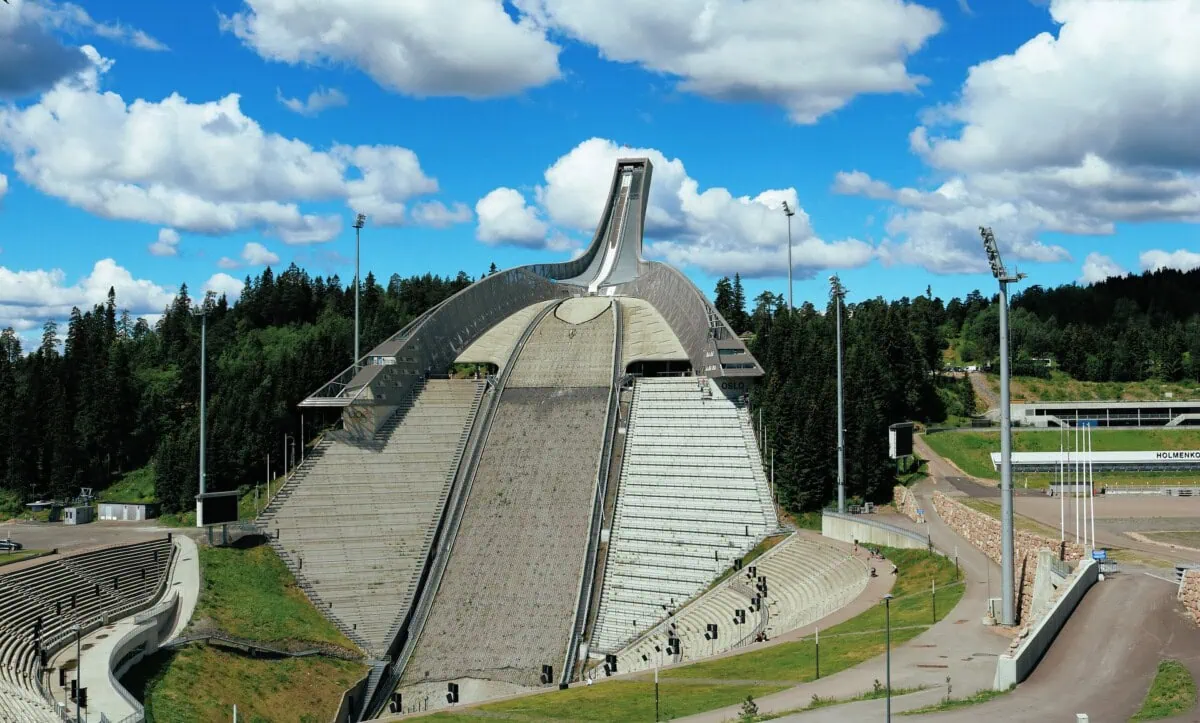
Holmenkollen is the closest thing on this list to a trip that needs no planning at all, sitting on the T-bane’s line 1 only around 30 minutes from central Oslo. The ski jump has hosted competitions since 1892 and still towers over the city from its ridge above Holmenkollen road.
The Holmenkollen Ski Museum, built into the base of the jump tower, traces the history of Norwegian skiing from wooden boards used by farmers to the carbon fibre skis of recent Winter Olympics. A lift inside the tower carries visitors up to a viewing platform at the top of the in-run, with the whole of Oslo and the fjord spread out below.
A combined ticket covering the museum and the tower currently costs NOK 200 (€17/£15/$18) for an adult, with children between six and seventeen paying NOK 100 (€9/£7/$9) and a family ticket for two adults and two children priced at NOK 500 (€43/£37/$46). A separate ski simulator inside the museum charges its own small additional fee.
Because it sits on a regular metro line rather than a seasonal service, Holmenkollen works well as a half day trip that can easily be combined with the forest trails above it, or with a return into the city for the afternoon. Opening hours shift slightly by season, generally running from 10am to 5pm in summer and 10am to 4pm through the winter months.
Best if you want daily housekeeping and a front desk. Filter by area first, then by price.
Check availabilityBest for families, or any stay past about four nights. A kitchen and a washing machine start paying for themselves.
Browse rentalsBest if you have already picked a hotel. Checks the big booking sites for the same room and shows who is cheapest.
Check dealsFrognerseteren and the Oslomarka Forest Trails
One stop beyond Holmenkollen, Frognerseteren is the final station on the T-bane’s line 1 and the gateway to Oslomarka, the enormous forest that wraps around the north side of the city. From the platform, marked trails lead off in several directions without any need for a car or a bus connection.
The best known route drops down through the trees to Øvresetertjern and on to Holmenkollen station, a walk most visitors complete in around an hour and a half at an easy pace. Longer options push further into Nordmarka toward Sognsvann, giving a full day of hiking for anyone with the time and the right footwear.
A wooden lodge and restaurant at Frognerseteren has served food to visitors since the 1890s, and its terrace is a popular spot to stop for waffles with cream and jam, a genuinely traditional Norwegian trail snack, before heading back down. No entry fee applies to the trails or the viewpoint itself.
Because Frognerseteren sits on the same metro line as Holmenkollen, the two make an easy pairing for a single outing, museum first and forest second, all on one Ruter ticket without any additional transfers to plan.
Island Hopping the Oslofjord
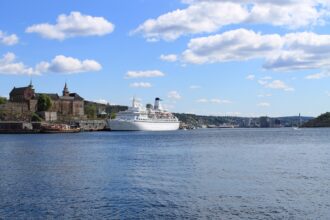
A short walk from the harbour at Aker Brygge or Vippetangen, the Oslofjord’s inner islands feel far removed from the surrounding city despite being only minutes away by boat. Hovedøya carries the ruins of a 12th century Cistercian monastery, while Langøyene, further out, is better known for its sandy swimming beaches in summer.
These islands are served by Ruter’s B1 Øyene ferry line, which runs on an ordinary public transport ticket rather than a separate boat fare, currently priced at around NOK 46 (€4/£3/$4) for a single adult journey. Full timetables and live departures are published on the operator’s own site, Ruter’s ferry page.
Sailings run more frequently in summer than in winter, when some island stops are reduced or suspended altogether, so it is worth checking the current timetable before setting out on a colder month’s visit. Hovedøya alone can fill a relaxed half day, with its monastery ruins, gun batteries and coastal footpath easily covered on foot.
For a longer outing, several islands can be strung together on a single ticket, hopping from Hovedøya to Lindøya or Gressholmen before finishing at Langøyene for a swim, weather permitting. No booking is required for the standard ferry service, unlike the seasonal sightseeing boats that also operate from the same harbour.
| Island | How to Get There | What There Is to See and Do |
|---|---|---|
| Hovedøya | Ruter’s B1 Øyene ferry from Vippetangen or Aker Brygge, a crossing of only a few minutes | Twelfth century Cistercian monastery ruins, old coastal gun batteries and a waymarked footpath around the shoreline |
| Lindøya | B1 ferry, which calls at separate piers on the island’s eastern and western sides | Rows of small private cabins, quiet walking paths and a few pebble beaches for a swim |
| Gressholmen | B1 ferry, or the seasonal B2 line, from the same city harbour | A nature reserve and old quarantine station, plus the neighbouring islets of Heggholmen and Rambergøya, which are physically joined to Gressholmen and explored on foot in one visit |
| Langøyene | B2 ferry, the furthest stop from the city | Oslo’s best known sandy swimming beaches and informal summer camping, with no shops on the island itself |
It helps to know that Ruter’s B1 line runs a single looping route rather than letting passengers get off and on in whatever order suits them. Starting from Aker Brygge, the loop calls at Hovedøya, then the eastern pier on Lindøya, then Gressholmen, Bleikøya and Nakholmen, before calling at Lindøya’s western pier and returning to Hovedøya and back into the city. Langøyene is not on this loop at all.
Langøyene is reached on a separate line, B2, which sails a simpler route from Aker Brygge to Hovedøya, Gressholmen and Langøyene rather than joining the wider B1 loop. Bleikøya and Nakholmen, the two extra B1 stops not listed in the table above, are small islands given over almost entirely to private summer cabins, so most visitors stay aboard rather than getting off there.
The table below sets out the B1 loop leg by leg, using the timings published in Ruter’s own printed timetable. Treat the minutes as a helpful guide rather than a live guarantee, since sailing times shift a little between seasons and are only confirmed exactly through Ruter’s current timetable or journey planner.
| From | To | Route | Duration |
|---|---|---|---|
| Aker Brygge | Hovedøya | B1 Øyene loop | Around 8 minutes |
| Hovedøya | Lindøya øst (east pier) | B1 Øyene loop | Around 6 minutes |
| Lindøya øst | Gressholmen | B1 Øyene loop | Around 4 minutes |
| Gressholmen | Bleikøya | B1 Øyene loop | Around 4 minutes |
| Bleikøya | Nakholmen | B1 Øyene loop | Around 11 minutes |
| Nakholmen | Lindøya vest (west pier) | B1 Øyene loop | Around 4 minutes |
| Lindøya vest | Hovedøya | B1 Øyene loop | Around 9 minutes |
| Hovedøya | Aker Brygge | B1 Øyene loop | Around 8 minutes |
A genuine question worth answering plainly is whether these islands connect to one another once ashore, rather than each one needing its own separate crossing back to the city. For most of them the answer is no: Hovedøya, Lindøya and Langøyene are each standalone islands with no bridge or footpath linking them together, so moving from one to the next always means reboarding the ferry.
Gressholmen is the one exception on this list, since it is consistently described by Oslo’s own tourism board as forming one connected group with the neighbouring islets of Heggholmen and Rambergøya. A visitor who lands there can walk across all three without needing a second boat, something none of the other stops on this list allow.
Ruter’s own B1 Øyene line reflects the wider pattern too, looping around the separate islands on one continuous circular route rather than charging a fresh fare for every hop between them. Even so, it remains a boat journey rather than a footpath that actually carries passengers from one island to the next for every stop except the Gressholmen cluster.
The Five Pearls of the Oslofjord Boat Tour
Alongside the do-it-yourself ferry route covered above, a separate bookable tour packages much of the same stretch of water into one guided outing sold under the name the Five Pearls of the Oslofjord. Rather than choosing a route on the day, travellers on this option join a fixed guided departure that visits five islands back to back.
The itinerary groups together five stops, Hovedøya, Gressholmen, Heggholmen, Lindøya and Langøyene, largely the same islands already covered above plus the small cluster around Gressholmen. An English-speaking guide accompanies the group ashore on each one, pointing out the monastery ruins, old gun batteries and lighthouse buildings that a self-guided visitor might otherwise walk straight past.
Island-hopping – The Five Pearls of the Oslofjord
A typical departure runs for around six hours from meeting point back to drop-off, cruising between islands by boat with a fair amount of walking ashore, and a packed lunch is usually included along the way. Pricing for this kind of guided island-hopping tour generally starts from around €85 (£72/$90) per adult, though it is worth checking current availability and pricing directly given how much seasonal demand can move it.
Compared with the self-guided Ruter ferry route above, this option trades flexibility for convenience, since a guide handles timing, commentary and island selection rather than leaving those decisions to the traveller. It suits visitors who would rather hear the history of Hovedøya’s ruins from someone who knows them, or who feel unsure about navigating an unfamiliar ferry timetable alone.
It suits a traveller less well who would rather swim at Langøyene at their own pace or linger over one single island, since the schedule stays fixed across all five stops for the whole group. Anyone short on time but keen to see several islands in one outing, rather than settling for Hovedøya on its own, is the most likely to get genuine value from booking this tour ahead.
Drøbak, the Norwegian Christmas Town
Around 40 minutes south of Oslo by road, Drøbak is a wooden harbour town best known for its year-round Christmas shop, Julehuset, which has sold festive decorations from the same waterfront building since the 1980s. The town’s narrow lanes and white timber houses make it a pleasant stop regardless of season.
Bus route 500 runs from Oslo roughly every half hour and takes about 40 minutes, while a seasonal Ruter boat, lines B21 and B22, sails from Aker Brygge on summer days and on weekends through spring and autumn. Drivers can also reach Drøbak in around 40 minutes via the E6 and Route 156.
Just offshore sits Oscarsborg Fortress, the island stronghold whose guns famously sank the German cruiser Blücher in April 1940, delaying the invasion of Oslo by a crucial day. Boat trips out to the fortress run from the town harbour in summer, though schedules are seasonal and worth checking locally before travelling.
Travellers drawn to Drøbak’s festive reputation may also enjoy our Oslo Christmas Markets guide, which covers the capital’s own seasonal stalls and ice rink for anyone combining a Drøbak day trip with a winter city break. Summer visitors, meanwhile, tend to focus on the harbour cafes and the short ferry ride across to Oscarsborg.
Tusenfryd for Family Thrills
A short distance further along the same road corridor as Drøbak, Tusenfryd is Norway’s largest amusement park, with rollercoasters, water rides and a section themed around Norwegian folklore. It sits close enough to Drøbak that families sometimes combine both into a single, longer day out.
Ruter’s bus route 505 runs from Oslo Bus Terminal to Tusenfryd in under 30 minutes, making it one of the more straightforward public transport trips on this list, with no train change or seasonal timetable to worry about. Drivers reach the park in a similar time via the E6.
An adult day ticket booked online currently costs NOK 409 (€35/£31/$38), rising to NOK 619 (€53/£46/$57) if bought at the gate on the day, while children measuring under 95 centimetres are admitted free. Booking online in advance is consistently cheaper than paying on arrival, and prices shift with demand throughout the season.
The park operates only through the warmer months, generally opening in spring and closing in early autumn, so this is very much a summer day trip rather than a year-round option like most of the other destinations covered here.
Fredrikstad’s Old Town
Fredrikstad’s Gamlebyen, or Old Town, is one of the best preserved fortified towns in Northern Europe, its cobbled streets and moated ramparts largely unchanged since the 17th century. Craft shops, galleries and cafes now fill many of the old timber and brick buildings inside the walls.
Vy trains run roughly hourly from Oslo Central Station, reaching Fredrikstad Station in a little under an hour, which makes this one of the fastest rail day trips from the capital on this whole list. From the station, Gamlebyen sits a short taxi ride or a scenic ferry crossing away, depending on the route taken.
A small passenger ferry shuttles across the Glomma river between the modern town centre and the Old Town for a nominal fare, adding a pleasant few minutes on the water to what is otherwise a straightforward rail journey. Several museums inside the ramparts charge modest entry fees that vary by season, so checking current prices locally is worth doing before setting out.
Because the journey itself takes under an hour each way, Fredrikstad works comfortably as a half day trip, leaving time to also explore the newer town centre or the coastal Hvaler archipelago a little further south for travellers with a full day to spare.
Best for long or awkward journeys. Builds one itinerary out of separate flights.
View flightsBest if you want maps and messaging working the moment you switch your phone on.
See eSIM plansBest when public transport has stopped, or when you are travelling with children and bags.
Book a transferLillehammer and the Olympic Legacy
Host of the 1994 Winter Olympics, Lillehammer remains one of Norway’s best known small towns, its Olympic legacy still visible in the ski jump towers that overlook Lake Mjøsa. The wider Olympic Park hosts occasional summer events alongside its winter sporting facilities.
Vy trains run frequently from both Oslo Central Station and Oslo Airport, reaching Lillehammer in around two hours, on a journey that runs alongside Lake Mjøsa, Norway’s largest, before climbing into the Gudbrandsdalen valley. This is the same Dovre Line route covered in more depth in our Dovre Line Guide.
The town’s other major draw is Maihaugen, one of Norway’s largest open-air museums, with more than 200 historic buildings relocated from across the region and reassembled to show rural Norwegian life across several centuries. Current adult admission pricing was not consistently published at the time of writing, so it is worth checking the museum’s own site before travelling.
Because the rail journey alone takes close to four hours round trip, Lillehammer suits a full day away from Oslo rather than a quick half day excursion, particularly if Maihaugen is on the itinerary alongside the Olympic sites.
Skiing Day Trips into the Mountains
For visitors travelling in winter, several of Norway’s ski resorts are close enough to Oslo for a determined day trip, even though most skiers prefer to stay overnight given the distances involved. Norefjell, the closest of them, sits only around 90 minutes from the capital by car.
Resorts further out, including Hafjell, Kvitfjell, Geilo, Trysil and Hemsedal, generally take between two and four hours to reach depending on the route and transport used, which makes a genuine day trip tight but not impossible for an early start and a late return. Our dedicated Oslo Airport to Ski Resorts guide covers train, bus and car options for all six resorts in detail.
Rail is often the more comfortable choice for the resorts that sit directly on a mainline route, since Geilo and Kvitfjell both have their own stations without needing a connecting bus. Trysil, Hemsedal and Norefjell instead rely on dedicated winter coach services that run a reduced seasonal timetable.
Whichever resort is chosen, booking well ahead matters even more for a single day visit than for a full ski week, since coach and train seats during Christmas, New Year and the February school holidays can fill quickly, leaving little flexibility for a same-day return.
Hadeland Glassverk
Hadeland Glassverk, on the shore of the Randsfjord roughly an hour outside Oslo, has been in continuous operation since 1762, making it Norway’s oldest industrial enterprise still producing glass today. Visitors can watch glassblowers at work in the historic hytte before browsing the galleries and shops that now surround it.
There is no public rail link to Jevnaker, so most visitors arrive by car, though a seasonal express bus runs directly from Oslo on several days a week through the summer months and requires advance booking. The drive itself follows Road 4 through pleasant farmland scenery north of the city.
Watching the glassblowers work is free of charge, with the site making its money instead through its shops, galleries and restaurants, several of which sit inside striking modern buildings alongside the older glassworks. Exact pricing for any paid workshop activities varies by season, so it is worth checking current details before a visit.
The nearby Kistefos sculpture park and art museum sits close enough to combine with a Hadeland Glassverk visit for travellers driving rather than relying on the seasonal bus, turning a single stop into a fuller day exploring this stretch of Norwegian countryside.
Kongsberg’s Silver Mines
Once the source of Norway’s most important silver deposit, Kongsberg grew directly out of a mining boom that began in 1623 and continued for more than three centuries. The town’s Norwegian Mining Museum and its underground Silver Mines site now preserve that history for visitors.
Vy trains run roughly hourly from Oslo Central Station, reaching Kongsberg in around an hour and fifteen minutes, making this one of the more time-efficient rail day trips on this list. The Silver Mines themselves sit a short distance further out at Saggrenda, reachable by local bus or taxi from the station.
The mine visit itself involves boarding a narrow underground train that carries visitors 342 metres down into the King’s Mine, followed by a walking tour of the old workings. An adult ticket currently costs NOK 350 (€30/£26/$32), rising to NOK 430 (€37/£32/$40) for a combined ticket that also includes the museum.
Because the museum building itself has been undergoing renovation, it is worth checking ahead to confirm which parts of the site are open on the day of a planned visit. The mine tour alone is usually enough to fill a satisfying couple of hours underground regardless of the museum’s status.
Halden and Fredriksten Fortress
Close to the Swedish border, Halden grew up around Fredriksten Fortress, a star-shaped stronghold built in the late 17th century to defend Norway’s southern approaches. The fortress is where the Swedish king Charles the Twelfth was killed during a siege in 1718, an event that still shapes the town’s identity today.
Vy trains run roughly hourly from Oslo Central Station, reaching Halden in around an hour and a half, on a line that continues south toward the Swedish border and on into Gothenburg for travellers extending their trip. The fortress itself sits a short, steep walk up from the town centre and station.
The ramparts and grounds are free to walk around, with sweeping views over Halden and the fjord below rewarding the climb up from town. Several buildings inside the fortress house small museums and exhibitions, with entry fees that vary by season and are best confirmed locally before travelling.
Because the walk up to the fortress is fairly steep, Halden suits visitors comfortable with a reasonable amount of walking, though the reward is one of the best preserved 17th century fortifications anywhere in Norway, combined with a proper small-town feel rarely found this close to Oslo.
Choosing Train, Bus, Car or Ferry
With so many different destinations covered above, the right transport choice depends heavily on which one is being visited. Ruter’s metro, tram and inner-fjord ferries cover Holmenkollen, Frognerseteren and the Oslofjord islands on a single ticket, with no advance booking required for any of them.
Longer trips to Fredrikstad, Lillehammer, Kongsberg and Halden all run on Vy’s mainline network, generally departing roughly hourly from Oslo Central Station, so a same-day return is realistic without needing to plan around a sparse timetable. Booking through Entur, Norway’s national journey planner, covers tickets across operators in a single app.
Destinations without a direct rail link, including Drøbak, Tusenfryd and Hadeland Glassverk, rely instead on dedicated bus routes or seasonal boats, some of which need advance reservation during the busier summer months. Car hire remains the most flexible option for combining several stops in one day, particularly for Drøbak, Tusenfryd and Hadeland Glassverk together.
Travellers arriving straight from the airport rather than starting in the city itself should also check our Oslo Airport to the City guide, since several of these day trips, including Lillehammer and the ski resorts, can realistically be started directly from Gardermoen without detouring into central Oslo first.
Best if you would rather spend the money on Oslo than on the room. Compare hostels by location and rating.
Search hostelsBest if you have ever given up on a claim. AirHelp checks whether the flight qualifies and pursues it for you.
See the benefitsBest for a day with a bag and nowhere to put it. Find a storage point near where you already are.
View storagePairing Day Trips Together for a Longer Day
Several of the destinations covered above sit close enough to each other that a determined traveller can fold two into one longer outing rather than treating each as a separate day. Holmenkollen and Frognerseteren are the simplest example, since both sit on the same metro line and can be visited back to back without an extra transfer.
Drøbak and Tusenfryd work the same way for families heading south of the city, given how close the amusement park sits to the harbour town along the same road corridor. Visitors driving rather than relying on the bus can add Oscarsborg Fortress into the same day too, turning a single stop into a fuller circuit around the fjord’s southern shore.
Further north, Hadeland Glassverk pairs naturally with the nearby Kistefos sculpture park and art museum for anyone travelling by car, since both sit within easy reach of the same road. A visitor relying on the seasonal express bus instead has less flexibility to add a second stop, since that service runs to a fixed timetable rather than a driver’s own schedule.
Less obviously, Fredrikstad and Halden sit on the same Østfold Line south of Oslo, with a direct train between the two towns taking around half an hour and running roughly hourly through the day. An early start makes it possible to see both fortified towns in one fairly full day, though this suits a traveller happy to keep moving rather than one hoping to linger at either stop.
Lillehammer and the ski resorts covered separately are the clearest exceptions to this pairing approach, since the travel time alone to reach either one already fills most of a working day. Adding a second destination onto either of those two simply is not realistic within a single day trip from the capital, however tempting the map might make it look.
Matching Day Trips to the Time of Year
Oslo’s daylight swings dramatically across the year, and that shift genuinely changes which of these trips are worth doing outside the warmer months. Midsummer brings close to 19 hours of daylight, with the sun barely dipping before eleven at night, while midwinter compresses the same day into little more than six hours of proper light.
That difference matters most for the trips built around being outdoors, since a long summer evening leaves plenty of time to walk the Oslomarka trails above Frognerseteren or swim at Langøyene after an already full day elsewhere. A midwinter visit to either spot still works, but with daylight gone by mid-afternoon, an earlier start becomes necessary rather than optional.
Several of the destinations covered above are seasonal by nature rather than by daylight alone. Tusenfryd only opens through the warmer months, the Drøbak boat and Hadeland Glassverk’s express bus both run to a summer-only timetable, and some of the smaller Oslofjord island stops are reduced or suspended once the colder months set in.
Winter, in turn, is when the ski resorts covered in a dedicated guide elsewhere on this site come into their own, alongside the more reliably year-round options such as Holmenkollen, Fredrikstad, Kongsberg and Halden. Booking further ahead also matters more in winter for anything relying on a coach or a train, since Christmas, New Year and the February school holidays all draw heavier demand than an ordinary week.
Shoulder season, broadly spring and autumn, tends to suit the rail-based trips best, since Fredrikstad, Kongsberg, Lillehammer and Halden all run on year-round timetables regardless of the weather outside. It is the islands, Drøbak’s boat crossing and Tusenfryd that lose the most flexibility outside summer, so a traveller visiting in shoulder season is generally better served leaning toward the trips that depend on trains rather than seasonal boats.

Rupert’s Handy Travel Tips
Planning a day trip out of Oslo? Here are a few useful tips to make your journey smoother:
- Buy a Ruter ticket before boarding: it covers the metro, tram and inner Oslofjord ferries in one go, so Holmenkollen, Frognerseteren and the islands need no separate boat fare.
- Book seasonal buses and boats early: the Tusenfryd bus, the Drøbak boat and Hadeland Glassverk’s express bus all run reduced summer-only timetables that can fill up.
- Use Entur for train tickets: it covers Vy and SJ Nord services to Fredrikstad, Lillehammer, Kongsberg and Halden in a single app.
- Check opening seasons before travelling: Tusenfryd and some seasonal boats close entirely outside summer, while museums such as Holmenkollen and the Silver Mines run shorter winter hours.
- Allow extra time for connections outside the city: buses to Drøbak, Tusenfryd and Hadeland Glassverk run less frequently than city routes, so missing one can cost an hour or more.
Want to meet the reindeer behind our travel tips? Find out more in our page Who is Rupert?.




Frequently Asked Questions about Day Trips from Oslo
What is the easiest day trip to do from Oslo without a car?
Holmenkollen, Frognerseteren and the Oslofjord islands are all reachable on Oslo’s own metro, tram or Ruter ferry network, with no train or seasonal bus needed.
How far is Lillehammer from Oslo?
Lillehammer sits around two hours from Oslo by train, on the Dovre Line, with frequent Vy services from both Oslo Central Station and Oslo Airport.
Can I visit the Oslofjord islands on a normal public transport ticket?
Yes. The Ruter B1 Øyene ferry line to islands such as Hovedøya and Langøyene runs on a standard ticket rather than a separate boat fare.
Is Tusenfryd open all year?
No. Norway’s largest amusement park operates only through the warmer months, generally from spring to early autumn, so it isn’t a year-round day trip option.
Do I need to book train tickets in advance for these day trips?
It isn’t essential for most routes, but booking ahead is strongly advised for Fredrikstad, Lillehammer, Kongsberg and Halden during summer and around Christmas, when demand rises sharply.
Which day trip suits a winter visit best?
Holmenkollen, Frognerseteren and Drøbak all work well in winter, while Tusenfryd and the seasonal Drøbak boat are summer-only, and the ski resorts covered separately need their own snow-season timing.
Further Reading
For a fuller look at Norway’s winter mountain options, our Oslo Airport to Ski Resorts guide covers Trysil, Hemsedal, Hafjell, Kvitfjell, Geilo and Norefjell in detail, including train, bus and car routes for each. Anyone spending longer in the capital itself should also read our Best Things to Do in Oslo guide covering the city’s museums, fjord cruises and Viking ship collections.
Travellers arriving or leaving by rail may find our Dovre Line Guide and Ferries from Oslo guide useful for planning journeys beyond the day trips covered here, while our Oslo Christmas Markets guide pairs naturally with a winter visit to Drøbak’s year-round festive shop.
Travellers continuing west by rail may also want our Bergen Line Guide, which covers the classic route from Oslo Central Station over the mountains to Bergen.
Anyone stacking several of these day trips into a longer Norwegian itinerary should also read our Norway on a Budget guide, which covers discounted DNT cabins, the AutoPASS Ferry scheme and other genuine savings worth setting up before a trip like this.