Reviewed by our editorial team Published
Every December since 1947, the city of Oslo has felled a Norway spruce from its own forests and shipped it to London, where it stands lit in Trafalgar Square as thanks for Britain’s support during the Second World War. That gift says more about how Oslo actually does Christmas than any description of its own market could: understated, a little more serious than showy, and genuinely rooted in real history rather than manufactured spectacle.
Oslo’s own Christmas market, Jul i Vinterland, runs along Spikersuppa, the sunken park beside Karl Johans gate, Oslo’s main boulevard, and draws more than three million visitors across its six-week run. It’s a proper market with an ice rink, a Ferris wheel and dozens of stalls, but it also draws real local criticism for feeling more like a fairground than a Norwegian Christmas tradition, and this guide covers that honestly rather than only selling the postcard version.
This page covers where the market actually sits, the Trafalgar Square tree tradition and how the tree is now chosen, ice skating and rides, what’s genuinely on the stalls, food and drink (including real, sometimes eye-watering, Norwegian prices), entertainment, the city’s Christmas lights, shop and transport hours over the holiday period, the honest truth about New Year’s Eve fireworks (Oslo doesn’t run its own official display anymore), and just how dark and cold a Nordic December actually gets. Prices are shown in Norwegian kroner first, since that’s the currency the market genuinely trades in, with pound and dollar conversions alongside.
Jul i Vinterland and the Norsk Folkemuseum’s Christmas Weekends
| Event | Location | Character |
|---|---|---|
| Jul i Vinterland | Spikersuppa, Karl Johans gate | Main commercial market, rink, rides, ~60 stalls, free entry |
| Norsk Folkemuseum Christmas Weekends | Bygdøy | Traditional, costumed, weekends only, genuinely Norwegian |
Both sit within a normal Oslo visit, one right in the city centre and the other a short ferry or bus ride out to the Bygdøy peninsula. The sections below cover each in turn, along with everything else worth building into an Oslo Christmas trip.
Jul i Vinterland: Where Oslo’s Christmas Market Actually Is
Jul i Vinterland fills Spikersuppa, the long sunken park that runs alongside Karl Johans gate between the National Theatre and the Norwegian Parliament, right through the heart of Oslo’s main pedestrian boulevard. It’s genuinely central, a five-minute walk from Oslo S (the central station) and directly served by Stortinget metro station and the Øvre Slottsgate and Stortorvet tram stops.
Based on the confirmed 2026 season, the market runs from 7 November 2026 to 3 January 2027, one of the longer runs among Europe’s Christmas markets, with special holiday hours applying from 22 December through 1 January. Standard hours run 12pm to 8pm Monday to Thursday, 12pm to 9pm Friday, and 10am to 8pm or 9pm on weekends, with entry completely free throughout.
The market is run by organiser Aasmund Lund and employs around 500 seasonal workers, a genuinely large operation for a market of Oslo’s size. That scale is part of why it splits local opinion, some Oslo residents see it as the city’s biggest festive draw, others as an oversized fairground squatting on the capital’s most photographed street for six weeks straight.
Whichever side of that debate you land on, the location itself is hard to beat. Spikersuppa sits directly between the Royal Palace and Oslo Cathedral, so a market visit folds naturally into an ordinary day of sightseeing rather than requiring a special trip of its own.
See hotel options and places to stay in Oslo.
Browse hotelsExplore holiday homes and apartments around Oslo.
See holiday homesCompare prices for Oslo hotels across multiple booking sites.
Check dealsThe Trafalgar Square Connection: Oslo’s Christmas Tree Gift to London
Few Christmas market cities have a story quite like Oslo’s. Since 1947, the city has gifted London a Norway spruce for Trafalgar Square, a plaque at its base explaining it is given “as a token of Norwegian gratitude to the people of London for their assistance during the years 1940-45,” when Norway’s government and royal family lived in exile in the city under German occupation.
The tree itself is a proper spectacle: typically a 50 to 60 year old Norway spruce over 20 metres tall, felled each November in a ceremony attended by the British Ambassador to Norway, the Mayor of Oslo and the Lord Mayor of Westminster. Forestry workers have nicknamed past trees “the Queen of the Forest,” and a replacement sapling is planted in the same forest after each felling, so the tradition genuinely regenerates rather than simply extracting.
The tradition has evolved too. For the most recent tree, Oslo residents were invited to vote publicly between three nominated trees, Nordic Star, Fjord Fir and the eventual winner, Ever Oslo, a genuinely democratic twist on a 78-year-old tradition. It was shipped by road and sea to London and lit in Trafalgar Square in the first week of December, with a ceremony including carol singing from London and Norwegian children’s choirs.
For any UK visitor to Oslo, this is worth knowing before arriving: the tree in Trafalgar Square every Christmas genuinely comes from Oslo’s own certified forests, most recently from a hiking area in the Nordmarka/Lillomarka district north of the city. It’s a real, ongoing piece of shared history, not a marketing line, and it’s arguably Oslo’s single strongest point of difference from every other European Christmas market city.
Ice Skating, the Ferris Wheel and Other Rides
The Spikersuppa ice rink sits right inside the market itself, opening around 30 November each year and running through the winter. Entry is free, with skate hire available on site for anyone who hasn’t brought their own, and it’s a proper full-size outdoor rink rather than a small novelty patch.
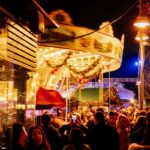
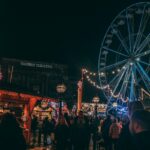
A Ferris wheel and a run of carnival rides sit alongside the rink, giving the market a genuinely fairground character that some visitors love and some local critics resent. Two rounds on the wheel typically cost around 98 NOK (£7.70/$11), a real, confirmed price rather than a rough estimate, and worth budgeting for if it’s on the list.
Unlike the multi-market cities further south in Europe, Oslo doesn’t spread its activities across several squares, everything at Jul i Vinterland sits within Spikersuppa’s single, walkable stretch. That makes it an easy add-on to a day of sightseeing rather than a destination requiring its own separate half-day.
Santa meet-and-greets run through the market’s opening weeks too, a standard but genuinely well-organised feature for families, alongside the rink and rides. Weekday afternoons are noticeably quieter than weekend evenings, worth knowing if avoiding the busiest crowds matters more than the atmosphere of a full house.
What’s on the Stalls: Norwegian Knitwear, Wooden Toys and Glass Art
Across the market’s roughly 60 stalls, genuine Norwegian craft sits alongside a fair amount of generic festive merchandise, and it’s worth knowing which is which before shopping. Norwegian knitwear, patterned jumpers and mittens in the traditional Selbu and Setesdal styles, is a proper local buy, alongside handcrafted wooden toys and artisan glass art from small Norwegian producers.
Jewellery stalls selling silver and amber pieces are common too, a genuine Nordic craft tradition rather than something dreamed up for tourists. Decorative items, ornaments and candles round out the more traditional end of the market’s offer.
That said, local criticism of the market is worth repeating honestly here. A frequently voiced complaint from Oslo residents is that the market leans too heavily on generic festive food and merchandise with limited connection to actual Norwegian Christmas tradition, with critics singling out stalls selling Spanish-style churros as a symbol of that drift. It’s a fair point to weigh against the market’s obvious convenience and scale.
For visitors specifically wanting genuinely Norwegian craft over festive merchandise generally, the traditional knitwear and glass stalls are the strongest picks, and the Norsk Folkemuseum’s own Christmas weekends, covered later in this guide, are a genuinely deeper alternative for anyone who wants tradition over spectacle.
Food, Drink and the Real Cost of a Night at the Market
Norway’s reputation for being expensive holds up firmly at Jul i Vinterland, and this guide would rather show real, confirmed prices than downplay it. A candied apple typically costs around 65 NOK (£5/$7), a beer around 129 NOK (£10/$14), and a hot chocolate with cream around 69 NOK (£5.50/$7.50), prices that would be considered steep almost anywhere else in Europe’s Christmas market circuit.
Traditional stalls sell grilled sausages (pølse), Norwegian pancakes (sveler) and gløgg, the local mulled wine, alongside newer additions like bubble waffles and international street food including Indian and Mexican options. Vegetarian choices are widely available, though vegan and gluten-free options remain genuinely limited compared with markets further south in Europe.
Practically, budgeting 200 to 400 NOK (£16 to £32/$22 to $44) per person for a snack, a drink and a ride or two is realistic, and that’s before any actual gift shopping. Eating a full meal elsewhere in the city and treating the market purely as a browse-and-drink stop is a genuinely sensible way to manage costs.
None of this is unusual for Norway specifically, restaurant and bar prices across Oslo run similarly high, but it’s worth arriving with the right expectations rather than being caught out by a single round of drinks. A market visit is genuinely worth doing regardless, the atmosphere and setting earn the visit even if the food budget stays modest.
Entertainment and the Norsk Folkemuseum’s Traditional Alternative
Jul i Vinterland runs a genuine programme of live performances through its six-week season, including plays and concerts featuring established Norwegian performers, generally free to attend as part of the wider market. It’s a proper entertainment schedule rather than a single stage tucked into a corner, and it runs most weekends throughout the season.
For a genuinely different, more traditional take on Norwegian Christmas, the Norsk Folkemuseum on the Bygdøy peninsula runs its own dedicated Christmas weekends, most recently confirmed for 5 to 6 and 12 to 13 December, 10am to 4pm. Costumed performers demonstrate historical Norwegian Christmas customs across the museum’s collection of period buildings, a genuinely immersive alternative to the commercial market in the city centre.
Reaching Bygdøy means a short ferry from Aker Brygge in season, or a bus year-round, adding maybe 20 to 30 minutes each way to a market-only itinerary. For visitors with only a single day in Oslo, that’s a real trade-off worth weighing against the convenience of Spikersuppa’s city-centre location.
For anyone who found the earlier honest note about Jul i Vinterland’s churros and fairground feel off-putting, the Folkemuseum’s weekends are the genuine remedy, a proper Norwegian Christmas experience rather than a commercial one, even if it costs an extra half-day and a museum entry fee to reach.
Christmas Lights Across Oslo
Research for this guide found no evidence of a single, dated lights switch-on ceremony in Oslo, unlike some UK cities that build a whole evening event around one moment. Instead, the city’s lighting comes on gradually through November as installations are completed across several separate locations, similar to the decentralised pattern already confirmed for Cologne and Düsseldorf.
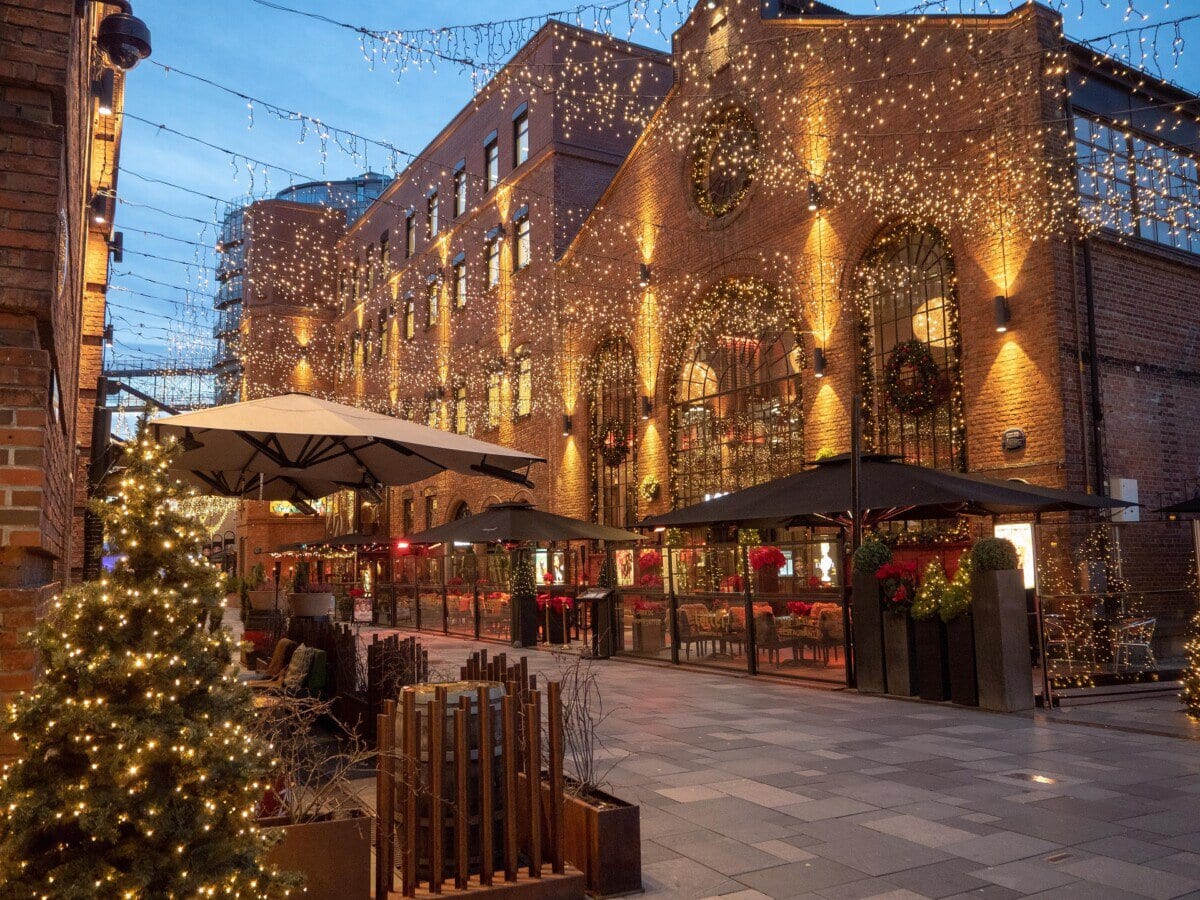
Karl Johans gate itself, stretching from the Royal Palace to Oslo S, carries the most concentrated display, strung with lights the whole length of the boulevard. Aker Brygge, the waterfront district, adds its own festive lighting with a view out over the Oslofjord, a genuinely different atmosphere from the city-centre streets.
Frogner Park, home to Gustav Vigeland’s famous sculpture collection, is lit through December too, giving the park’s statues a genuinely different character after dark than during a daytime visit. The Botanical Garden and the Sørenga waterfront also run their own seasonal light displays, both a little further off the main tourist track and correspondingly quieter.
Residential neighbourhoods including Grünerløkka and parts of Frogner put up their own community light installations too, genuinely worth a wander for visitors staying more than a couple of days and wanting to see how Oslo residents themselves decorate for the season, rather than only the city-centre displays aimed at visitors.
Search flights and useful route combinations for your trip.
View flightsChoose an Airalo eSIM and arrange mobile data before you arrive.
Browse eSIMsHave a private airport pickup arranged before you travel.
Book a transferBeyond the Market: Other Christmas Things to Do in Oslo
Several of Oslo’s major attractions stay genuinely open through the holiday period rather than closing entirely, worth knowing if a trip spans Christmas Day or New Year itself. The Ekeberg Sculpture Park, MUNCH, the Holmenkollen Ski Museum and Tower, the Kon-Tiki Museum, the Vigeland Sculpture Park, the Fram Museum and Viking Planet all remain open on 24 to 25 December and 31 December to 1 January, a genuinely useful list for anyone visiting over the holidays themselves.
Holmenkollen in particular is worth building into a festive Oslo trip regardless of the market, the ski jump tower gives genuinely spectacular views back over the city and the Oslofjord on a clear winter day, and the surrounding area often carries real snow even when the city centre itself doesn’t.
Oslo Cathedral and the Oslo Philharmonic both run seasonal concert programmes through December, a genuine local choral and orchestral tradition rather than something staged purely for tourists. Checking each venue’s own listings closer to a visit is worth doing, since specific dates shift year to year.
From 26 to 30 December, several additional museums reopen too, including the Natural History Museum, the National Museum and the Nobel Peace Center, giving visitors staying the full week between Christmas and New Year a genuinely full programme beyond the market itself.
Shop, Transport and Attraction Hours Over Christmas and New Year
Norway’s Sunday-closing law means most shops are closed on Sundays year-round, with an exception made for the last three Sundays before Christmas Eve, when city-centre stores open with extended evening hours to accommodate festive shopping. On 24 and 31 December, shops typically close by 4pm, and on 25, 26 December and 1 January they’re closed entirely, treated as public holidays under the same law that governs ordinary Sundays.
Ruter, Oslo’s public transport operator, keeps the city moving throughout with a genuinely well-documented holiday timetable. On 24 December, weekday service runs until 4am, switches to a Saturday schedule from 4am to 4pm, then drops to a reduced evening service with buses roughly every half hour to an hour. On 25 and 26 December, a standard Sunday timetable applies, including night services, and the island ferry is cancelled both days.
For New Year’s Eve, Ruter runs weekday service until 4am, then a Saturday schedule for the rest of the day with an enhanced night service, extended subway and tram hours plus extra departures on several lines to get people home safely. 1 January runs like a regular Sunday, again with enhanced night service and the island ferry cancelled.
Restaurants and bars thin out noticeably on 24 December, with only a handful of venues staying open, though a wider selection reopens for 25 and 26 December. On 31 December, booking ahead is genuinely worth doing, since the limited venues that stay open fill up fast for New Year’s Eve dinner.
New Year’s Eve in Oslo: The Fireworks Show That Isn’t
This is the single most important honest correction in this guide. Many visitors assume a European capital runs an official New Year’s Eve fireworks display, and Oslo genuinely doesn’t anymore. The city government cancelled its own publicly funded display some years ago, citing cost and the distress fireworks cause to animals, and a costly light-show alternative tried in its place drew heavy public criticism.
A private crowdfunding push to bring back a communal display at Rådhusplassen, the square in front of Oslo City Hall, failed to reach its funding target and was called off, with donations returned. Oslo is not alone either: several other Norwegian cities, including Ålesund, Bodø, Mosjøen and Mo i Rana, cancelled their own public displays for the same reason going into the 2025/26 season, while Bergen, Stavanger, Kristiansand and Tromsø kept theirs running, generally with business sponsorship.
Oslo does maintain an official ban on private fireworks within the inner city, though by most accounts it’s widely ignored and genuinely difficult to enforce. Private displays still go up informally across the city at midnight, and a national survey found 53% of Norwegians reported witnessing an unsafe situation involving privately set-off fireworks, a real safety concern that’s fed the wider national debate about whether fireworks should be banned outright.
For anyone visiting Oslo specifically to watch fireworks on New Year’s Eve, the honest advice is to look elsewhere in Norway, Bergen or Stavanger are the more reliable choices for an organised display. In Oslo itself, the evening is better spent at a restaurant with a fixed New Year’s menu, or simply out walking the harbour at Aker Brygge to watch whatever informal displays go up around the fjord.
Oslo’s December Darkness: Weather and What to Pack
Oslo’s December is genuinely cold rather than merely brisk. Daytime highs run from around 1°C (34°F) at the start of the month down to about -1.7°C (29°F) by the end, with overnight lows dropping from roughly -3.9°C (25°F) to -6.7°C (20°F), cold enough that layering properly matters far more here than at most Central European Christmas markets.
Snow is a genuine, reliable feature rather than a long shot, with the chance of a snowy day rising from around 6% to 11% across the month and snowfall totals building steadily, unlike Germany’s Rhineland markets where snow is closer to a rarity. Rain, by contrast, becomes less likely as December goes on, dropping from around 19% to 14% of days as temperatures fall too low for it to fall as anything but snow.
What genuinely sets Oslo apart from Central Europe’s Christmas markets is daylight, not just temperature. On 1 December there’s still around 6 hours 29 minutes of daylight, but by the shortest day, 21 December, that drops to just 5 hours 54 minutes. In practice, that means the sun doesn’t rise until well into the morning and has set again by mid-afternoon, so a market visit at 3pm already feels like an evening one.
Cloud cover is heavy too, overcast or mostly cloudy skies around 67% of the time through December, so genuinely clear, crisp days are the exception rather than the rule. Practically, that means a proper insulated winter coat, waterproof boots with real grip for icy pavements, and thermal layers underneath matter more in Oslo than almost anywhere else on this site’s Christmas market coverage, dressing for a Central European December here is a genuine mistake.
Getting to Oslo and Where to Stay
Oslo Airport, Gardermoen (OSL), sits around 45 kilometres north of the city, but the Flytoget airport express train covers the distance in a genuinely fast 19 minutes, departing every 10 minutes for most of the day. A one-way adult fare typically runs around 268 NOK (£21/$29), noticeably more than a standard city public transport fare, though the speed and reliability make it worth it for most visitors. Our Oslo Airport to City Centre guide covers every route in, including the cheaper regional train and bus alternatives.
Once in the city, Oslo’s compact centre means Spikersuppa, the Royal Palace, Oslo Cathedral and Oslo S all sit within an easy walk of each other, with the metro and tram network covering anywhere further out, including Bygdøy’s ferry terminal at Aker Brygge in season. A car is genuinely unnecessary, and often actively unhelpful given limited and expensive city-centre parking.
Accommodation is where Oslo’s expense is felt most directly. Central double rooms in December typically run from around 1,200 to 2,500 NOK (£95 to £198/$132 to $275) a night, genuinely higher than most other European Christmas market cities covered on this site, and worth budgeting for honestly rather than being caught out. Staying near Karl Johans gate or Oslo S keeps the market, the rink and most major attractions within easy walking distance.
A single day is enough to take in Jul i Vinterland alongside Oslo’s central sights, but visitors wanting to add Holmenkollen, a Bygdøy museum visit or the Norsk Folkemuseum’s Christmas weekends properly are better served staying two or three nights. Given the genuinely high cost of eating and drinking in Oslo, budgeting realistically for food and drink matters as much as booking accommodation early.

Rupert’s Handy Travel Tips
Oslo genuinely isn’t like the big Central European markets, so here’s how I’d set expectations before a trip.
- Budget for real Norwegian prices: a beer at the market runs around 129 NOK (£10/$14), so set your spending expectations before you arrive, not after the first round.
- Visit the Norsk Folkemuseum on a Christmas weekend: it’s the genuinely traditional alternative if Jul i Vinterland’s fairground feel isn’t what you’re after.
- Don’t plan your trip around Oslo fireworks: the city hasn’t run an official display in years. Head to Bergen or Stavanger if that matters to you.
- Dress properly for the dark, not just the cold: the sun sets by mid-afternoon in late December, so layer up and bring a torch app for evening walks.
- Look out for London’s Christmas tree’s Oslo cousins: the Nordmarka forest that supplies Trafalgar Square is a genuinely nice winter walk in its own right.
- Book Flytoget online ahead of arrival: it’s the fastest way into the city and fares are usually cheaper booked in advance rather than at the station.
Want to meet the reindeer behind our travel tips? Find out more in our page Who is Rupert?.




Frequently Asked Questions About Oslo Christmas Markets
Where is Oslo’s Christmas market?
Jul i Vinterland runs along Spikersuppa, the park beside Karl Johans gate in the city centre, a short walk from Oslo S and directly served by Stortinget metro station.
Is it true Oslo sends London its Christmas tree?
Yes. Oslo has gifted a Norway spruce for Trafalgar Square every year since 1947, as thanks for Britain’s support to Norway during the Second World War, and the tradition continues, with Oslo residents now voting on which tree to send.
When does Jul i Vinterland open in 2026?
Based on the confirmed 2026 season, the market runs from 7 November 2026 to 3 January 2027, with special holiday hours from 22 December through 1 January.
Is there an ice rink at Oslo’s Christmas market?
Yes. The Spikersuppa ice rink sits inside the market itself, opens around 30 November, and is free to enter, with skate hire available on site.
Are there fireworks in Oslo on New Year’s Eve?
Not officially. Oslo’s city government cancelled its own public fireworks display some years ago, and a private crowdfunding attempt to revive it failed. Private displays still go up informally, but Bergen and Stavanger are more reliable choices for an organised show.
Is Oslo’s Christmas market expensive?
Yes, genuinely so. A beer typically costs around 129 NOK (£10/$14) and a candied apple around 65 NOK (£5/$7), prices in line with Norway’s generally high cost of living rather than inflated specifically for the market.
How dark does Oslo get in December?
Genuinely dark. Daylight drops to around 5 hours 54 minutes on the shortest day, 21 December, with the sun setting by mid-afternoon and heavy cloud cover common throughout the month.
Compare hostels and budget-friendly accommodation around Oslo.
Browse hostelsAccess compensation support, eligible lounge benefits and faster payouts when flights go wrong.
See the benefitsLeave your luggage somewhere convenient and enjoy Oslo hands-free.
View storageFurther Reading & Related Guides
Oslo’s market sits within a much broader European Christmas market scene, and anyone comparing it against the bigger Central European markets should read our European Christmas Markets Guide, which covers dates, atmosphere and what makes each city’s approach distinctive.
For the market’s own confirmed opening hours and any last-minute changes, VisitOSLO’s official Jul i Vinterland listing is worth checking before a trip.
For getting into the city itself, our Oslo Airport to City Centre guide covers Flytoget, the regional train and bus options in full, including pricing for anyone travelling with luggage.
If Oslo is part of a longer Norwegian trip, our Best Things to Do in Oslo guide covers the city’s fjords, museums and Viking history beyond the festive season, while our Ferries from Oslo guide is worth reading for anyone continuing on to Denmark or exploring the Oslofjord by boat.
Visitors curious about Norway’s wider rail network can also read our Norway Night Trains guide, a practical way to combine Oslo’s Christmas market with a wider winter trip to Bergen, Trondheim or further north, without the expense of domestic flights.