Reviewed by our editorial team Published
Why Norway Doesn’t Have to Break the Bank
Norway has a reputation as one of Europe’s most expensive countries to visit, and on restaurant menus and hotel rates alone, that reputation is fair. Look past the headline prices, though, and Norway is unusually well set up for budget travellers who know where to look.
A national hiking association offers genuinely discounted mountain accommodation to anyone who joins, a smart toll and ferry system can cut driving costs considerably, and a legal right to roam means free camping is built into the culture rather than tolerated as a loophole.
Add in surplus-food apps, some of Europe’s most dramatic free scenic driving routes, and supermarkets that undercut restaurant prices by a wide margin, and a genuinely affordable Norwegian trip starts to look realistic rather than theoretical.
None of this requires giving up on the fjords, the hiking or the midnight sun. It mostly means swapping a handful of defaults, a restaurant for a self-catered cabin, a taxi for a prepaid ferry, a hotel for a free wild camp, for options built into how Norwegians already travel.
This guide runs through the specific schemes worth setting up before departure, from DNT membership to AutoPASS, along with the everyday habits that make the biggest difference to a Norwegian travel budget.
Norway’s Money-Saving Schemes at a Glance
Before the detail below, here is a quick reference for the main schemes this guide covers, what each one actually costs to join or use, and the saving it unlocks.
| Scheme | What It Covers | Cost | Typical Saving |
|---|---|---|---|
| DNT Membership | Discounted mountain cabins nationwide | From 375 NOK/year | Up to 50% off self-service cabins |
| AutoPASS Ferry | Prepaid private vehicle ferry crossings | Free to set up, top up balance | 50% off ferry fares |
| Fortidsminneforeningen | Free entry to ~40 historic sites and stave churches | From 300 NOK/year | Free admission + 10% at De Historiske |
| Too Good To Go | Surplus food from bakeries and supermarkets | Free app, pay per bag | Magic bags from around 49 NOK |
| Oslo Pass | Free transport + 30+ Oslo museums | Daily rate, varies by duration | Best for short, museum-heavy stays |
| Bergen Card | Free transport + discounted Bergen attractions | From 400 NOK/24 hours | Best for 2-3 paid attractions a day |
| VAT Refund | Refund on purchases over 250 NOK per invoice | Free, minus operator deductions | Recovers part of the 25% MVA rate |
Treat these figures as a starting point rather than a fixed price, since membership fees and card rates are reviewed periodically. The sections below walk through each scheme’s mechanics, eligibility and small print in full.
Best for two or three nights. The widest choice of rooms, with filters for free cancellation and included breakfast.
View staysBest for families, or any stay past about four nights. A kitchen and a washing machine start paying for themselves.
Browse rentalsBest as a last check before booking. Compares Norway hotel rates across several sites in one search.
Compare ratesJoin DNT for Discounted Mountain Cabins
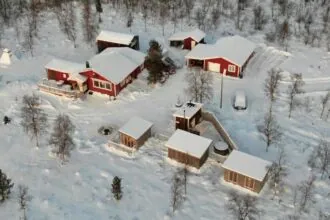
DNT (Den Norske Turistforening, the Norwegian Trekking Association) runs a network of more than 550 cabins across the country’s hiking trails, and membership is one of the single best value moves available to anyone planning to hike or drive through rural Norway.
Annual membership costs 885 NOK (£62/€75/$93) for adults aged 26 to 66, dropping to 375 NOK (£26/€32/$39) for anyone aged 13 to 25 and 695 NOK (£49/€59/$73) for seniors. A family membership covering three or more people at the same address costs 1,580 NOK (£110/€132/$166).
Membership unlocks discounted rates across DNT’s staffed lodges, self-service cabins and no-service huts, and members under 26 pay half price at most self-service cabins, with children under 12 often staying free. Non-members can still use the cabins, just at noticeably higher rates.
Joining is straightforward and can be done entirely online before departure through DNT’s membership site, so there is no need to wait until arriving in Norway to start benefiting from the discount.
Membership brings more than the cabin discount too, including a subscription to DNT’s member magazine, access to organised guided trips and courses around the country, and discounted rates on hiking gear at partner retailers. For anyone building a longer itinerary around Norway’s trail network, those extras add up alongside the accommodation savings themselves.
How DNT’s Self-Service Cabins Actually Work
DNT’s self-service cabins run on a trust-based system that surprises most first-time visitors. A standard DNT key, available only to members for a refundable 100 NOK (£7/€8/$9) deposit, opens the majority of self-service and no-service cabins across the network.
Inside, cabins are stocked with tinned food, dry goods and firewood on an honesty basis: guests self-cater, record what they use, and pay through the DNT app, which works offline and syncs once reception returns.
Beds can be booked and prepaid in advance through DNT’s online booking system, though many self-service cabins also keep space for hikers who simply turn up and pay through the app on arrival. Guests are expected to chop wood, fetch water and leave the cabin ready for the next visitor.
DNT membership also carries a modest reciprocal discount, rather than full member pricing, at a handful of Swedish Tourist Association cabins just across the border, useful for anyone combining Norway with a stretch of Swedish hiking.
Bring a sleeping bag or liner of your own, since cabins provide mattresses and blankets but not bedding, along with a headlamp for the outdoor toilet after dark. Honesty-system food prices typically run a little higher than a staffed lodge meal, but still well below a restaurant price, given there is no one there to cook or serve it.
Set Up AutoPASS Before You Drive
Norway’s road tolls run on AutoPASS, an automatic number-plate recognition system that no longer requires a physical tag to use. Cameras photograph passing plates and bill the registered owner, whether that vehicle is Norwegian or foreign.
Rental cars are generally pre-registered with AutoPASS by the hire company, so tolls are captured automatically and added to the card used at pickup, sometimes with a small admin fee. There is usually nothing extra to set up when driving a rental.
Visitors driving their own foreign-registered car are billed after the fact by Euro Parking Collection, the company Norwegian toll operators use to invoice overseas plates, payable by international transfer or card. A late fee of around 300 NOK (£21/€25/$28) applies if that invoice goes unpaid.
Pre-registering payment details with Euro Parking Collection before travel is not compulsory, but it speeds up billing and avoids the risk of a missed invoice turning into an unnecessary late fee.
Registering a Norwegian AutoPASS account directly, rather than relying on a foreign-plate invoice, brings its own reward: vehicles with a valid user agreement and tag get a 20 percent discount on toll transactions at most collection points nationwide. For a visitor in a rental car, whether that discount actually reaches the final bill depends on the rental company’s own account, covered further below.

Save on Ferries With AutoPASS Ferry
Norway’s fjord-cut coastline means road trips often involve ferry crossings, and a separate system called AutoPASS Ferry is where the real savings sit. It works alongside the road-toll system but has its own account and its own discount tiers.
Setting up a prepayment agreement online before travel, topping up a balance sized to the vehicle’s length, earns a genuine 50 percent discount on private vehicle ferry fares, the single biggest saving covered in this guide for anyone touring fjord country by car.
Registering a plate without prepaying still earns a smaller 10 percent discount, while travelling with no registration at all means paying full fare plus a 35 NOK (£2/€3/$3) invoice fee once the crossing is billed automatically afterwards.
For a single ferry hop, registration may not be worth the setup, but anyone expecting two or more crossings, common on a proper fjord itinerary, should set up the prepayment agreement before leaving home rather than paying full price at each crossing.
Fares themselves scale with a vehicle’s length and the specific crossing, so a short hop on a quiet route costs a fraction of a longer car ferry through Lofoten or the western fjords. Foot passengers and cyclists typically travel free or for a token fee on the same crossings, since the discount system is built primarily around vehicles.
AutoPASS and Rental Cars: What to Actually Expect
Almost every hire car in Norway arrives already carrying an active AutoPASS registration under the rental company’s own account, not the driver’s. Tolls and any AutoPASS-enabled ferry crossings are captured automatically as you drive, then billed after the car is returned, usually itemised and charged to the card used at pickup.
Most companies add a handling fee on top of the actual toll cost, and it varies a fair amount between them. Renter reports put Avis around 40-50 NOK (£3-4/€3-4/$4-5) per day the car crosses a toll, reportedly capped at five days per rental, with Europcar and Sixt often quoted higher, while some renters report Hertz charging no daily fee at all, just the toll cost itself. These figures shift and are not all confirmed on official rate cards, so treat them as a rough guide rather than a fixed price.
It is worth asking the rental desk directly, before driving off, how tolls and ferries are billed, whether the admin fee is capped, and whether charges appear during the rental or only afterwards. Charges have been known to surface on a card weeks after a car is returned, so getting the answer in writing and keeping an eye on statements afterward is a sensible habit.
Whether a rental company passes on the AutoPASS Ferry discount, or the guaranteed toll and ferry discount that electric vehicles receive nationally, is genuinely unclear and varies by company, since the account and its discount tier belong to them rather than the renter. Given how common electric rentals are in Norway, it is worth asking specifically whether that discount is reflected in the final bill rather than assuming it automatically is.
Does Too Good To Go Work in Norway?
Yes, Too Good To Go operates in Norway, though coverage is concentrated in the bigger cities rather than spread evenly across the country. Oslo has by far the strongest presence, with Bergen and Trondheim also carrying a reasonable number of active listings.
Bakeries and grocery stores are the most consistent category, with magic bags typically priced around 49 NOK (£3/€4/$5), a strong saving given how expensive a café lunch or restaurant meal runs elsewhere in the country.
Coverage thins out noticeably once outside Oslo, Bergen and Trondheim, so travellers heading into smaller towns or rural fjord regions should treat the app as a reliable city tactic rather than something to rely on nationwide.
Checking the app in the late afternoon or evening tends to produce the best results, since that is when bakeries and supermarkets typically list the day’s surplus stock for same-day collection.
Coop, one of Norway’s largest supermarket groups, is a listed partner chain on the app nationally, alongside independent bakeries and cafés, which gives Oslo in particular a dense spread of daily listings. Collection windows are usually tight, often a single hour shortly before closing, so it is worth turning on notifications rather than checking only once a day.
Best for finding routes the airlines do not sell as a single ticket. Combines carriers to bring the fare down.
Search flightsBest if you want maps and messaging working the moment you switch your phone on.
See eSIM plansBest after a long flight or a late landing. Price agreed before you travel, and no taxi queue.
Check transfersShop Like a Local: The Cheapest Supermarkets
Self-catering is the single biggest lever on a Norwegian budget, given the gap between grocery and restaurant prices. Rema 1000, Kiwi and Coop Extra consistently come out cheapest in Norwegian price comparisons, typically ten to fifteen percent below the more upscale chains.
Despite its name, Bunnpris is not actually the cheapest option, and Meny tends to sit at the pricier end of mainstream supermarkets. Store-brand ranges like First Price and X-tra typically cost half to a third of branded equivalents on the same shelf.
A basic daily grocery shop runs to roughly 110 to 200 NOK (£8-14/€9-17/$10-19) per person, compared with 150 to 250 NOK (£11-18/€13-22/$14-23) for a simple café lunch or 700 to 1,200 NOK (£49-84/€60-103/$65-112) for a three-course dinner for two.
Treating a hotel breakfast, usually included in the room rate, as the main meal of the day and self-catering the rest is a genuinely common strategy among budget-minded visitors, rather than eating out three times a day.
Most Norwegian supermarkets close by 9 or 10pm on weekdays and stay shut on Sundays, under a long-standing trading law that closes most retail nationwide, so stocking up the evening before a Sunday drive is worth planning for. Petrol station shops and a handful of Sunday-licensed convenience stores fill the gap, usually at a noticeable markup over a standard supermarket.
Camp for Free Under Allemannsretten
Allemannsretten, Norway’s legal right to roam, permits free wild camping on uncultivated land, mountains, forest and much of the coastline, without needing to book a site or pay a fee, a genuinely rare freedom by European standards.
The core rule is straightforward: pitch at least 150 metres from the nearest inhabited house or cabin, and you can stay in one spot for up to two nights without asking permission, longer in remote mountain areas away from any settlement.
Camping on cultivated farmland or fenced land is not covered by the right, and some heavily visited areas, including parts of Lofoten and Fjord Norway, have introduced local rules steering campers towards designated sites to manage overcrowding.
The expectation throughout is leave-no-trace camping, and travellers who treat the right with the same care locals do will find it one of the most valuable free resources available anywhere in the country.
Open fires are restricted between 15 April and 15 September, a nationwide ban aimed at preventing wildfires in dry forest and heathland, so a camping stove rather than a campfire is the safer default for most of the summer. The right covers tents and simple overnight stops rather than parking a campervan or motorhome overnight, which generally needs a designated site or specific local permission instead.
Drive the Free National Tourist Routes
Norway’s 18 official Scenic Routes (Nasjonale Turistveger) are ordinary public roads threaded through some of the country’s most dramatic fjord, coastal and mountain landscapes, punctuated by striking architect-designed viewpoints and rest stops.
There is no entry fee for any of them, only the cost of fuel and any tolls or ferries along the way, making them arguably the best free sightseeing available anywhere in the country for anyone with a car.
Routes like Trollstigen and Atlanterhavsveien (the Atlantic Ocean Road) rank among Norway’s most photographed drives, and combining two or three routes into a single road trip is a common way to see the country’s landscapes without paying for a single organised excursion.
Because these are public roads rather than tourist attractions with opening hours, they can be driven at any time of day, and an early morning or evening run tends to bring both quieter roads and better light.
Beyond Trollstigen and the Atlantic Ocean Road, Sognefjellsvegen climbs to the highest mountain pass in northern Europe at 1,434 metres, while the Lofoten route threads past working fishing villages and rorbu cabins along the archipelago. The Geiranger-Trollstigen route also runs past the UNESCO-listed Geirangerfjord, pairing a free scenic drive with one of Norway’s best-known World Heritage views.

Get Around for Less Without a Car
For train and long-distance travel, Entur is Norway’s national journey planning and ticketing app, covering trains, buses and ferries across the country. Long-distance train fares rise sharply closer to departure, so booking as early as tickets go on sale, often around three months ahead, brings the biggest savings.
In Oslo, the city transport operator Ruter sells a 24-hour zone one ticket for a little over 100 NOK (£7/€8/$9), while a seven-day pass costs only a little more than double that, strong value for anyone staying most of a week.
The Oslo Pass bundles unlimited transport with free entry to more than 30 museums, but its daily price runs several times a plain transport ticket, so it only pays off for a short, museum-heavy visit rather than a longer or outdoors-focused trip.
Bergen’s equivalent operator, Skyss, runs a similar app and ticketing system for the city and surrounding region, worth checking before defaulting to taxis between sights.
For longer intercity hops that don’t suit a train, Nor-Way Bussekspress runs a nationwide coach network that is typically cheaper than the equivalent rail fare, if slower, and worth checking through Entur alongside the train options. The ordinary regional train to Oslo Airport also costs a fraction of the dedicated Flytoget express and takes only a little longer, a straightforward saving on that specific leg.
Drink Duty-Free and Refill Your Bottle
Alcohol is taxed heavily in Norway, and it shows: a night out drinking can undo a day’s worth of grocery savings quickly. Buying duty-free at the airport on arrival, before clearing customs, is consistently cheaper than buying from Vinmonopolet, the state alcohol retailer, once in the country.
Supermarkets only sell beer and cider up to 4.7 percent ABV, with sales cutting off at 8pm on weekdays and 6pm on Saturdays, so anything stronger, or anything after those hours, means a trip to Vinmonopolet instead, where mid-range wine tends to offer better relative value than beer or spirits.
Away from alcohol, Norway’s tap water is safe and genuinely high quality nationwide, so refilling a bottle rather than buying drinks throughout the day is a small but consistent saving over the course of a trip.
Bringing an allowance of alcohol in from outside Norway, within the personal quota, is another common way seasoned visitors sidestep the country’s steep domestic pricing altogether.
That personal quota works out to one litre of spirits, 1.5 litres of wine and 2 litres of beer per adult, with the spirits allowance exchangeable for extra wine or beer instead. The minimum age is 18 for beer and wine and 20 for anything above 22 percent ABV, and buying up to the allowance at the airport is almost always cheaper than the Vinmonopolet equivalent once inside the country.
Time It Right and Claim Your VAT Back
Travelling in the shoulder season, roughly May or September, brings noticeably lower accommodation and transport prices than the peak summer months, along with thinner crowds at the country’s best-known sights and scenic routes.
Visitors resident outside Scandinavia can also claim a VAT refund on purchases over 250 NOK (£18/€21/$23) excluding tax per invoice, either through a Norwegian Customs certificate stamped at a manned border crossing, or through a private tax-free operator at participating shops.
The private operator route is generally the more straightforward option for anyone flying out, since the refund is processed directly on departure rather than requiring paperwork to be mailed back after the trip.
Combined with the DNT and AutoPASS savings covered earlier in this guide, shoulder-season timing and a claimed VAT refund round out a genuinely workable budget approach to a country that rarely gets credit for being one.
Norway’s standard VAT rate, known locally as MVA, sits at 25 percent, one of the highest in Europe, which is exactly why the refund is worth claiming on anything beyond a modest souvenir. A reduced 15 percent rate applies to groceries and food, one more reason self-catering already stretches a Norwegian travel budget further than eating out.
Best if you would rather spend the money on Norway than on the room. Compare hostels by location and rating.
Search hostelsBest arranged before you fly rather than after. Covers claim handling, plus lounge access on eligible delays.
Explore AirHelp+Best for the gap between checking out and your train. Drop bags at a shop or hotel nearby and carry on.
Store your bagsFortidsminneforeningen: Norway’s Answer to a National Trust
Ireland’s OPW Heritage Card and the UK’s National Trust membership both work the same way: pay a single annual fee and get free entry to a network of historic sites for the rest of the year. Norway’s closest match is Fortidsminneforeningen, the Norwegian Society for the Preservation of Ancient Monuments, a heritage charity founded in 1844 and often called the National Trust of Norway.
Membership starts at a basic 300 NOK (£21/€25/$31) subscription, rising to 650 NOK (£45/€55/$68) once the quarterly Fortidsvern magazine and yearbook are included, with a discounted 350 NOK (£24/€30/$37) rate for anyone under 30. A family membership covering two adults and children up to 26 costs 1,000 NOK (£70/€85/$105).
That membership buys free admission to every property the society owns nationwide, around forty historic buildings and monuments in total, including eight medieval stave churches such as Borgund and Urnes. Coverage runs through 18 county branches from Agder to Finnmark, so the sites are genuinely spread across the country rather than clustered around Oslo.
Members also get a 10 percent discount at De Historiske, a partner network of heritage hotels and restaurants housed in historic buildings, on top of the free entry. Sign-up works online in English before travelling, exactly like DNT membership, so the discount is active from the first stop rather than after a wait.
It is a smaller scheme than the National Trust or an OPW Heritage Card, covering dozens of sites rather than hundreds, so it pays off mainly for travellers planning several stave churches or historic houses rather than general sightseeing. For a culture-focused Norway trip, it is a genuine, often-overlooked saving.
Is the Bergen Card Worth It?
Bergen has its own version of the Oslo Pass, called the Bergen Card, bundling free public transport with free or discounted entry to most of the city’s paid attractions. It runs on Skyss buses and the Bergen Light Rail, including the airport line, plus a Zone A boat service to Askøy and Nordhordland.
A 24-hour adult card costs 400 NOK (£28/€34/$42), rising to 500 NOK (£35/€42/$52) for 48 hours, 600 NOK (£42/€51/$63) for 72 hours and 700 NOK (£49/€59/$73) for 96 hours, with child prices running at roughly a quarter of the adult rate.
Free entry covers the Fløibanen funicular and Ulriken cable car, Bergen Aquarium, and the Kode art museums, alongside discounted rates at further attractions, restaurants and selected shops on Bryggen. The card is not valid on long-distance VY trains, express coaches or ferry routes beyond central Bergen’s Zone A.
As with the Oslo Pass, the maths only works for a short, sightseeing-heavy stay. A traveller planning to visit two or three of the paid attractions above alongside a day of city transport will usually come out ahead, while anyone spending most of their time on fjord tours or hiking outside the city will not.
Sample Daily Budgets: Backpacker, Couple and Road Trip
Turning the schemes above into a single daily figure is tricky, since so much depends on where you sleep and how much you self-cater, but three rough traveller profiles make the maths easier to picture. Each range below assumes a realistic mix of the savings covered elsewhere on this page, from a Too Good To Go bag to a DNT cabin, rather than paying full price at every turn.
| Traveller Type | Accommodation | Food | Local Transport | Typical Daily Total |
|---|---|---|---|---|
| Backpacker (hostel dorm, self-catering) | 350-450 NOK | 250-350 NOK | 100-200 NOK | 700-1,000 NOK |
| Couple (mid-range hotel, one restaurant meal a day) | 1,900-2,200 NOK | 700-1,000 NOK | 200-400 NOK | 2,800-3,600 NOK |
| Road trip (DNT or campsite cabin, mostly self-catered) | 750-1,400 NOK | 500-700 NOK | 200-400 NOK | 1,450-2,500 NOK |
A solo backpacker sleeping in hostel dorms and cooking most meals can realistically get by on 700 to 1,000 NOK (£49-70/€59-85/$73-105) a day. A couple splitting a mid-range hotel room and eating out once daily should budget closer to 2,800 to 3,600 NOK (£196-252/€237-305/$293-377) between them, while a self-catering road trip using DNT or campsite cabins typically lands at 1,450 to 2,500 NOK (£101-175/€123-212/$152-262) for two. These figures move with season, region and how many nights are spent in a city rather than a rural cabin, so treat them as a starting point rather than a quote.

What Is Actually Expensive in Norway?
Grocery shopping and free activities cover most of a Norwegian budget, but a handful of categories catch first-time visitors off guard regardless of how carefully everything else is planned. Restaurant dining sits at the top of that list: a proper three-course dinner for two commonly runs 700 to 1,800 NOK (£49-126/€59-153/$73-188), and even a casual burger and chips can pass 100 NOK (£7/€8/$10) once a drink is added.
Alcohol is the next shock, and not only at Vinmonopolet. A standard 0.5-litre beer in an ordinary bar or restaurant typically costs 90 to 140 NOK (£6-10/€8-12/$9-15), several times the supermarket price, and a glass of house wine with dinner adds a similar amount again. Buying duty-free on arrival, covered earlier in this guide, remains the easiest way to blunt that particular cost.
Taxis are the third genuine surprise. Norwegian cabs charge a flagfall of roughly 114 NOK (£8/€10/$12) before the meter even starts moving, then add around 18 NOK (£1/€2/$2) per kilometre, so a short two or three-kilometre hop across town can easily clear 150 NOK (£10/€13/$16). Public transport, walking or a rental car worked out for the whole day are all cheaper defaults than flagging one down.
None of this makes Norway a place to avoid. Budgeting realistically just means putting these three categories, rather than accommodation, at the centre of the plan, since self-catering and the schemes covered earlier in this guide already handle the biggest cost of any trip.
Rupert’s Handy Travel Tips
Planning a budget trip to Norway? Rupert has a few tips that can save both time and money:
- Join DNT before you leave home: membership sign-up is entirely online, so the cabin discount applies from your very first night.
- Set up AutoPASS Ferry’s prepayment agreement in advance: the 50 percent discount only kicks in once the account is topped up, not after your first crossing.
- Buy alcohol at the airport before clearing customs: duty-free is consistently cheaper than Vinmonopolet once you’re in the country.
- Check Too Good To Go in Oslo, Bergen and Trondheim: coverage drops off fast once you’re outside the bigger cities.
- Book long-distance trains on Entur as early as possible: fares climb sharply the closer you get to departure.
- Skip the taxi for a wild camp instead: allemannsretten makes free camping genuinely straightforward, provided you keep 150 metres from the nearest house.
Want to meet the reindeer behind our travel tips? Find out more in our page Who is Rupert?.
Frequently Asked Questions About Norway on a Budget
Is Norway really as expensive as people say?
Restaurants and hotels are genuinely pricey, but self-catering, DNT cabins and free activities like hiking and wild camping bring the overall cost down considerably.
How much does DNT membership cost?
Adult membership costs 885 NOK (£62/€75/$93) a year, dropping to 375 NOK (£26/€32/$39) for those aged 13 to 25.
Do I need a physical AutoPASS tag to drive in Norway?
No. Automatic number-plate recognition bills vehicles directly, so a physical tag is no longer required, though it can still bring a small discount for domestic accounts.
How much can AutoPASS Ferry save on crossings?
A prepayment agreement set up in advance earns a 50 percent discount on private vehicle ferry fares, the largest saving available on the system.
Does AutoPASS work with hire cars?
Yes. Rental companies pre-register their fleets with AutoPASS, so tolls and ferries are captured automatically and billed to the card used at pickup afterwards, usually with a per-day handling fee added on top.
Do rental cars get the AutoPASS Ferry discount or the EV toll discount?
It depends on the company, since the account and its discount tier belong to them rather than the renter. It is worth asking directly at pickup whether either discount is reflected in your final bill.
Does Too Good To Go work outside Oslo, Bergen and Trondheim?
Coverage exists but thins out considerably, so it is best treated as a reliable city tactic rather than a nationwide one.
Is wild camping actually free and legal in Norway?
Yes, under allemannsretten, provided you camp on uncultivated land at least 150 metres from the nearest inhabited house and follow leave-no-trace practice.
Further Reading & Related Guides
Planning where to go once your budget is sorted? Our Best Day Trips from Oslo guide and Day Trips from Bergen guide cover fjords, forests and mountain villages within reach of Norway’s two biggest cities.
Heading further north? Our Lofoten Islands Travel Guide and Things to Do in Tromsø guide cover fishing villages, fjords and the Arctic in more depth.
Continuing down the coast to Stavanger instead? Our Bergen to Stavanger guide weighs up the flight, coastal bus, direct ferry and two-crossing drive, including how the same AutoPASS Ferry discounts covered above apply to that stretch of coast.
Driving in from Sweden? Our Kiruna Airport Transfers guide covers the Swedish Arctic gateway many Norway road trips connect through.