
Why Sicily Has a Dark Tourism History
Sicily has one of the most layered and complex dark tourism landscapes anywhere in the Mediterranean. The island’s history includes volcanic disasters, organised crime, wartime destruction, ancient burial practices, earthquakes and migration tragedies, all of which left behind tangible places that visitors can still explore today.
Unlike destinations centred around a single historical event, Sicily’s darker history stretches across thousands of years. Ancient catacombs, abandoned earthquake towns, anti mafia memorials, wartime invasion sites and volcanic destruction zones all exist within the same island region.
One of the defining features of dark tourism in Sicily is how connected many locations remain to modern life. Sites linked to judges Giovanni Falcone and Paolo Borsellino still hold major emotional significance in modern Italy, while volcanic destruction around Mount Etna continues shaping Sicilian communities today.
Natural disasters form a major part of Sicily’s dark tourism identity. The island sits within one of Europe’s most geologically active regions, and eruptions from Mount Etna alongside major earthquakes such as the 1693 Sicily earthquake and the 1968 Belice earthquake permanently changed entire towns and landscapes.
The island also played a major role during the Second World War, particularly during the Allied invasion known as Operation Husky in 1943. Military cemeteries, invasion beaches, bunkers and wartime memorials remain scattered across parts of Sicily today.
Sicily’s history with organised crime created another major dark tourism theme. Memorials connected to anti mafia judges, museums documenting the struggle against the mafia and sites connected to major assassinations have become important historical locations, especially around Palermo.
The island also contains some of Europe’s most visually striking death related attractions. The famous Capuchin Catacombs of Palermo preserve thousands of human bodies, while ancient burial complexes around Syracuse and prehistoric tomb landscapes at Pantalica reveal how death and burial shaped Sicilian society for centuries.
For travellers interested in difficult history, abandoned places, volcanic disasters, organised crime history and atmospheric historical locations, Sicily offers one of the most varied dark tourism destinations anywhere in southern Europe.
Quick Facts About Sicily Dark Tourism
| Site | Dark Tourism Theme | Main Area |
|---|---|---|
| Capuchin Catacombs | Death and preservation | Palermo |
| Poggioreale Vecchia | Abandoned ghost town | Western Sicily |
| Belice Earthquake Sites | Natural disaster | Belice Valley |
| Mount Etna Lava Fields | Volcanic destruction | Eastern Sicily |
| Capaci Memorial | Mafia assassination | Palermo |
| Via D’Amelio Memorial | Mafia attack | Palermo |
| No Mafia Memorial Museum | Organised crime history | Palermo |
| Operation Husky Sites | Second World War | Southern and Eastern Sicily |
| Catacombs of Syracuse | Ancient burial history | Syracuse |
| Lampedusa Memorials | Migration tragedy | Lampedusa |
Dark tourism in Sicily is unusually diverse because it combines volcanic disasters, earthquakes, organised crime history, war history, migration and burial culture within a single island.
Many of Sicily’s dark tourism sites are also major historical or UNESCO attractions. This means travellers frequently encounter difficult history while visiting some of the island’s most famous destinations.
The strongest concentration of mafia related sites lies around Palermo, while volcanic dark tourism is centred around Mount Etna near Catania.
The island’s most famous death related attraction is the Capuchin Catacombs, one of Europe’s best known burial sites and among the most visually confronting historical locations anywhere in Italy.
Meanwhile western Sicily contains some of the Mediterranean’s most haunting abandoned settlements, particularly around the Belice Valley, where the 1968 earthquake destroyed entire communities.
Because Sicily is a large island, dark tourism itineraries usually work best when divided into regional clusters around Palermo, Catania, western Sicily and southeastern Sicily.
Compare hotels and other places to stay in Sicily.
Check availabilityBrowse apartments, holiday homes and self-catering stays in Sicily.
View rentalsSee hotel prices from multiple booking sites in one search.
Compare ratesLocation of Sicily’s Dark Tourism Sites
Sicily’s dark tourism sites are spread across the island in several major regional clusters, each connected to different parts of the island’s history.
The strongest concentration of mafia related sites lies around Palermo in northwestern Sicily. This area contains the Capaci Memorial, Via D’Amelio, the No Mafia Memorial Museum and the famous Capuchin Catacombs.
Western Sicily also contains some of the island’s most important earthquake related locations. The abandoned settlements and memorial landscapes of the Belice Valley sit inland from Trapani and Agrigento, where entire towns were destroyed during the 1968 Belice earthquake.
Eastern Sicily is dominated by volcanic and geological dark tourism. Mount Etna towers above Catania, and many lava fields, destroyed landscapes and eruption scars remain visible around the volcano today.
The southeastern side of Sicily contains several important burial and wartime sites. Syracuse contains catacombs, ancient quarries and Greek era burial landscapes, while nearby coastal regions played major roles during Operation Husky in 1943.
Far south of mainland Sicily lies Lampedusa, whose memorials and migration related sites reflect one of the Mediterranean’s most important humanitarian stories of recent decades.
One of the reasons Sicily works so well for dark tourism is the sheer variety of experiences available within relatively manageable distances. Travellers can move from catacombs and mafia memorials to volcanoes, abandoned towns and wartime landscapes during the same trip.
However, Sicily is significantly larger than many visitors initially expect. Travel times between regions can therefore be longer than anticipated, particularly when relying entirely on public transport.
Most visitors use either Palermo or Catania as their main base before exploring surrounding dark tourism locations through day trips, rental cars or organised excursions.
Capuchin Catacombs Palermo
The Capuchin Catacombs of Palermo are among the most famous and visually disturbing dark tourism sites anywhere in Europe. Located beneath the Capuchin Monastery in Palermo, the catacombs contain thousands of preserved human bodies displayed throughout underground corridors.
The site originally began during the 16th century as burial chambers for Capuchin monks before gradually expanding to include wealthy Sicilian families, professionals, women and children.
What makes the catacombs so unusual is the level of preservation. Rather than remaining hidden inside sealed tombs, many bodies were embalmed, dressed in clothing and displayed openly along the walls. Visitors walk through corridors lined with mummified remains still wearing garments from different historical periods.
The catacombs became especially famous because of Rosalia Lombardo, a young child whose body remains extraordinarily preserved more than a century after her death. Her preservation is considered one of the most remarkable examples of embalming anywhere in the world.
Different sections of the catacombs were historically organised according to profession, social class and gender. Separate corridors existed for monks, women, children, professionals and aristocratic families, reflecting Sicily’s historical social hierarchy even after death.
The atmosphere inside the catacombs is extremely unusual and often unsettling. Unlike many archaeological museums, the human remains remain highly visible and personal, creating a very direct confrontation with mortality and historical burial culture.
Photography restrictions and behavioural rules are taken seriously because the site remains connected to real individuals and families rather than simply functioning as entertainment.
The catacombs are also historically important because they reveal changing Sicilian attitudes towards death, religion, preservation and remembrance across several centuries.
For travellers interested in burial culture, religious history, mortality and unusual historical sites, the Capuchin Catacombs remain one of the most powerful dark tourism experiences anywhere in Italy.
Poggioreale Vecchia Ghost Town
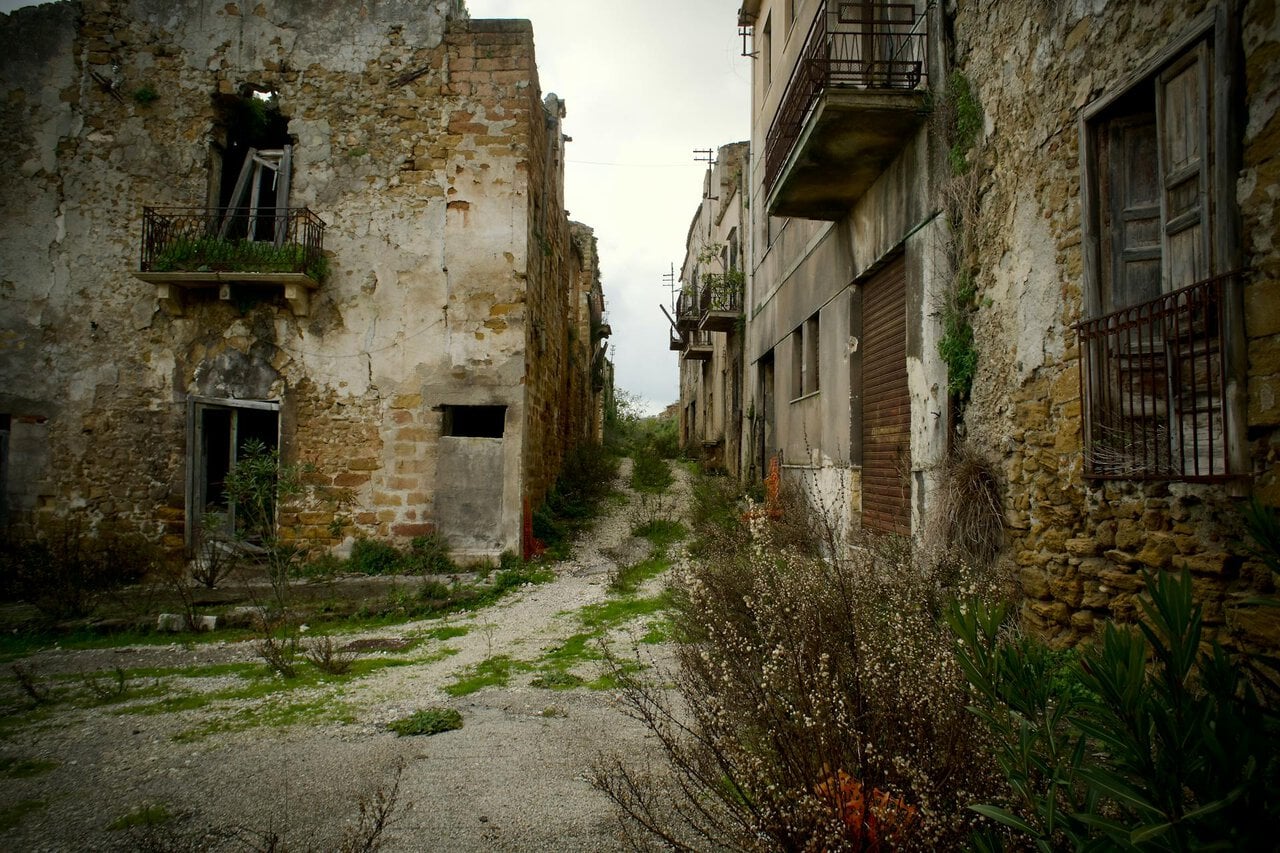
Poggioreale Vecchia is one of the most haunting abandoned settlements anywhere in Italy and one of Sicily’s most atmospheric dark tourism locations. The ruined town sits in western Sicily within the Belice Valley, where the devastating 1968 Belice earthquake destroyed entire communities across the region.
Before the earthquake, Poggioreale was a traditional Sicilian hill town with narrow streets, churches, homes and public squares overlooking the surrounding countryside. During the powerful earthquake sequence of January 1968, huge sections of the town collapsed or became structurally unsafe.
Rather than rebuilding directly on the damaged site, authorities constructed a new settlement nearby called Poggioreale Nuova, leaving the original historic town abandoned.
Today, the remains of Poggioreale Vecchia still stand as a frozen landscape of destruction. Streets, staircases, ruined homes, churches and public buildings remain visible across the hillside, creating one of the Mediterranean’s most striking ghost towns.
Walking through the abandoned streets creates an unusually powerful atmosphere because the town still feels recognisably urban despite decades of decay. Visitors can clearly identify former homes, alleyways and public spaces slowly being reclaimed by vegetation and weather damage.
The site has become increasingly popular with photographers, urban explorers and travellers interested in abandoned places because of the scale of preservation and the dramatic hilltop setting.
However, conditions inside the ruined town remain unstable in places. Many buildings are partially collapsed, and some areas may be fenced off or unsafe depending on current conditions. Visitors should always respect barriers and avoid entering dangerous structures.
The wider Belice Valley contains several other earthquake related memorial landscapes and abandoned settlements connected to the same disaster, making the region one of the strongest dark tourism areas anywhere in southern Europe.
For travellers interested in abandoned towns, disaster history and atmospheric ruined landscapes, Poggioreale Vecchia is one of Sicily’s most visually unforgettable sites.
Belice Earthquake Ruins & Memorials
The 1968 Belice earthquake was one of the most devastating natural disasters in modern Italian history and permanently transformed large parts of western Sicily. Entire towns were destroyed or heavily damaged across the Belice Valley, leaving behind ruined settlements, memorial landscapes and abandoned urban areas that still exist today.
The earthquake struck in January 1968 and caused widespread destruction across rural Sicilian communities. Thousands of people were left homeless, many settlements became unsafe and several historic town centres were eventually abandoned completely.
One of the most famous memorial landscapes connected to the disaster is the Cretto di Burri near Gibellina Vecchia. This enormous white concrete artwork was created over the ruins of the destroyed town by artist Alberto Burri.
The memorial covers the former street layout of the abandoned settlement, preserving the shape of the old town beneath huge white concrete pathways. From above, the site resembles a giant fractured landscape spreading across the hillside.
The atmosphere at Cretto di Burri is extremely unusual. It functions simultaneously as a memorial, a work of land art and the physical remains of a destroyed community.
Nearby areas of Gibellina Vecchia and the wider Belice Valley still contain abandoned structures, damaged buildings and earthquake related memorials connected to the disaster.
The region also tells an important story about post disaster reconstruction in Italy. Several replacement towns were built nearby, often with radically modernist architecture that contrasts sharply with the older Sicilian settlements destroyed by the earthquake.
Unlike some dark tourism destinations focused primarily on spectacle, the Belice sites feel deeply connected to themes of loss, displacement and rebuilding. Entire communities were uprooted, and traces of that disruption remain visible throughout the region today.
For travellers interested in abandoned landscapes, disaster memorials, post disaster architecture and unusual historical sites, the Belice Valley offers one of the most distinctive dark tourism experiences anywhere in the Mediterranean.
Mount Etna Disaster Landscapes
Mount Etna is not only one of Sicily’s greatest natural landmarks but also one of the island’s most important dark tourism landscapes. As the largest active volcano in Europe, Etna has repeatedly destroyed villages, roads and forests through eruptions that continue shaping eastern Sicily today.
The volcano’s destructive history is visible across huge areas of the mountain. Hardened lava fields, buried buildings, abandoned structures and black volcanic landscapes reveal the immense power of Etna’s eruptions far more clearly than a normal mountain landscape ever could.
One of the most important historical eruptions occurred in 1669, when lava flows reached the city walls of Catania after destroying villages and farmland across the volcano’s lower slopes. Sections of the city were permanently altered by the eruption.
More recent eruptions also left dramatic scars across the mountain. The major 2002 eruption heavily damaged parts of the northern slopes near Piano Provenzana, destroying ski facilities, roads and forests beneath lava and volcanic ash.
Today, visitors can still see large lava fields created by relatively recent eruptions. In some places, roads cut directly through hardened lava flows, while abandoned or damaged buildings remain trapped within volcanic landscapes.
The southern slopes near Rifugio Sapienza provide some of the easiest access to volcanic destruction landscapes. Black lava deserts, collapsed craters and ash covered terrain surround the main tourist zone.
One of the reasons Etna works so well as a dark tourism destination is because the volcano remains active. Visitors are not simply viewing ancient geological history but exploring landscapes still shaped by ongoing eruptions and volcanic activity.
During periods of increased activity, ash clouds, lava fountains and glowing eruptions may even become visible from surrounding towns and coastal areas.
At the same time, life continues around the volcano. Vineyards, villages and forests exist beside destructive lava landscapes, creating one of the most striking contrasts anywhere in Italy between natural danger and human settlement.
For travellers interested in volcanic disasters, geological destruction and active natural hazards, Mount Etna offers one of the most dramatic dark tourism landscapes anywhere in Europe.
Falcone & Borsellino Mafia Memorial Sites
The memorials connected to judges Giovanni Falcone and Paolo Borsellino are among the most important modern historical sites in Sicily and form a central part of the island’s anti mafia memory.
Both judges became internationally known for their fight against the Sicilian mafia during the late twentieth century. Their investigations and prosecutions represented some of the strongest attempts by the Italian state to dismantle organised crime networks operating across Sicily.
On 23 May 1992, judge Giovanni Falcone, his wife and several police escorts were killed during the Capaci bombing near Palermo. The attack involved a huge explosive device placed beneath the motorway leading from the airport into the city.
Today, the Capaci Memorial stands near the site of the attack and has become one of Italy’s most important anti mafia memorial locations. Murals, plaques and remembrance spaces honour Falcone and the others killed in the bombing.
Only weeks later, on 19 July 1992, judge Paolo Borsellino and several police officers were killed in another mafia bombing at Via D’Amelio in Palermo.
The Via D’Amelio Memorial remains an emotionally powerful site because it sits within an ordinary residential street where the attack occurred. Memorial plaques, photographs and symbolic objects left by visitors continue marking the location today.
These memorials are significant not simply because of the assassinations themselves but because they represent Sicily’s wider struggle against organised crime and corruption.
Many visitors combine the memorials with anti mafia museums, guided historical tours and broader explorations of Palermo’s modern political history.
The atmosphere at these sites is generally reflective and respectful rather than sensational. They function primarily as memorials to resistance, justice and the fight against organised crime.
For travellers interested in political history, organised crime history and modern Italy, the Falcone and Borsellino memorial sites are among Sicily’s most historically important dark tourism locations.
Search routes and flight options for your trip to Sicily.
Search flightsChoose an Airalo eSIM and arrange mobile data before you arrive.
Browse eSIMsCheck private pickup options and plan your onward journey before arrival.
View transfersNo Mafia Memorial Museum Palermo
The No Mafia Memorial Museum in Palermo is one of the most important modern historical museums in Sicily and provides a detailed look at the island’s long struggle against organised crime.
Located inside the historic centre of Palermo, the museum focuses on the history of the Sicilian mafia, the impact of organised crime on everyday life and the efforts of journalists, judges, police officers and ordinary citizens who resisted mafia influence.
Unlike fictional portrayals of the mafia in films and television, the museum presents the subject through the lens of violence, corruption, political influence and social damage. The exhibitions focus heavily on real victims, anti mafia activism and the long campaign against organised crime networks.
One of the strongest sections of the museum covers judges Giovanni Falcone and Paolo Borsellino, whose assassinations in 1992 became defining moments in modern Sicilian history. Documents, photographs and multimedia exhibits explain how their investigations challenged mafia structures across the island.
The museum also explores major events such as the Maxi Trial during the 1980s, one of the largest anti mafia prosecutions in Italian history. This trial marked a turning point in the state’s efforts to confront organised crime more directly.
Visitors also learn about the wider social consequences of mafia influence in Sicily, including extortion, political corruption and violence against journalists, business owners and public officials.
The atmosphere inside the museum is serious and educational rather than sensationalised. The focus remains firmly on remembrance, public awareness and the defence of democratic institutions rather than romanticised crime narratives.
Many travellers combine the museum with visits to the Capaci Memorial, Via D’Amelio and anti mafia walking tours around Palermo, creating a broader understanding of how organised crime shaped modern Sicilian society.
For travellers interested in modern Italian history, organised crime, politics and social history, the No Mafia Memorial Museum is one of Sicily’s most important and thought provoking dark tourism sites.
Operation Husky & WWII Sicily Sites
Operation Husky, the Allied invasion of Sicily in 1943, was one of the most important military operations of the Second World War and permanently shaped the island’s modern history.
The invasion began on the night of 9 July 1943, when Allied forces landed along large sections of the southern and southeastern Sicilian coastline. The operation marked the beginning of the Allied campaign to push into mainland Italy and eventually contributed to the collapse of Mussolini’s regime.
Today, traces of the invasion remain visible across parts of Sicily through military cemeteries, bunkers, coastal defences, memorials and wartime museums.
Several landing beaches connected to Operation Husky can still be visited, particularly around areas such as Gela, Licata, Pachino and southeastern Sicily. These coastal regions witnessed major fighting during the first stages of the invasion.
The Sicily Rome American Cemetery near Nettuno on mainland Italy commemorates many soldiers killed during the Sicily campaign, while Commonwealth war cemeteries and local memorials across Sicily itself honour Allied and local losses connected to the invasion.
Some former military structures and defensive positions remain scattered along parts of the Sicilian coastline, especially near strategic landing zones and ports.
The city of Catania suffered significant wartime bombing during the conflict, while ports such as Augusta and Syracuse played important strategic roles during the Allied advance across the island.
One of the reasons Sicily’s wartime history is so interesting for dark tourism is the scale of historical change connected to the invasion. The campaign directly influenced the wider course of the war in the Mediterranean and the eventual Allied advance into mainland Europe.
The wartime landscapes also contrast sharply with Sicily’s modern tourist image. Beaches now associated with holidays and coastal resorts were once invasion zones filled with military equipment, defensive fortifications and active combat.
For travellers interested in military history, wartime landscapes and the Mediterranean theatre of the Second World War, Sicily offers one of the most historically important regions anywhere in southern Europe.
Syracuse Catacombs & Ancient Burial Sites
The ancient burial landscapes around Syracuse are among the oldest dark tourism locations in Sicily and reveal how death, religion and burial practices shaped the island for thousands of years.
One of the most important sites is the Catacombs of San Giovanni, located beneath Syracuse near the ruins of the early Christian church of San Giovanni. These underground burial tunnels form one of the largest catacomb systems anywhere in Italy outside Rome.
The catacombs date largely from the early Christian period and contain corridors, tomb chambers and underground burial areas carved directly into the rock beneath the city.
Walking through the underground passageways creates a very different atmosphere from Sicily’s grand cathedrals and archaeological monuments above ground. The narrow tunnels, burial recesses and dim lighting make the site one of the island’s most atmospheric historical experiences.
Syracuse also contains older burial landscapes connected to the ancient Greek and Roman city. Tombs, quarries and necropolis areas remain scattered throughout the archaeological zones surrounding the historic centre.
One of the most unusual nearby sites is the Ear of Dionysius, a huge limestone cave within the ancient stone quarries of Syracuse. Although primarily known for its acoustics and Greek history, the quarry system was historically connected to imprisonment and harsh labour conditions during antiquity.
Further inland lies Pantalica, one of Europe’s most important prehistoric burial landscapes and part of the UNESCO recognised Syracuse and the Rocky Necropolis of Pantalica site.
Thousands of tombs carved into steep canyon cliffs surround the valleys of Pantalica, creating one of the Mediterranean’s most visually dramatic ancient necropolises.
Together, Syracuse and Pantalica reveal how burial traditions evolved across Sicily from prehistoric societies through the Greek, Roman and early Christian eras.
For travellers interested in ancient burial culture, underground sites, catacombs and early religious history, the Syracuse region offers some of the richest dark tourism landscapes anywhere in southern Italy.
Compare hostels and lower-cost places to stay in Sicily.
Search hostelsGet help with compensation, eligible lounge access and disruption support.
Explore AirHelp+Use convenient luggage storage around Sicily between arrival, check-in and departure.
Check storageLampedusa Migration Memorials
The island of Lampedusa occupies a unique and emotionally powerful place within modern Mediterranean history. Located far south of mainland Sicily and closer to North Africa than much of Italy, the island became one of the most important arrival points for migrants and refugees crossing the Mediterranean.
Over recent decades, thousands of people attempted dangerous sea crossings towards Europe using overcrowded and often unsafe boats. Many survived the journey, while others died at sea attempting to reach the island.
As a result, Lampedusa became internationally associated with one of the Mediterranean’s largest humanitarian and migration crises.
Several memorials and artistic installations on the island now commemorate lives lost during these crossings. These sites focus on remembrance, humanitarian awareness and the realities of migration rather than political spectacle.
One of the best known memorials is the Gate of Europe, a large monument overlooking the sea dedicated to migrants who died attempting to cross the Mediterranean.
The harbour areas and coastal landscapes of Lampedusa also carry symbolic importance because they became central locations during rescue operations, migrant arrivals and humanitarian responses.
Unlike many historical dark tourism destinations, the themes connected to Lampedusa remain highly contemporary and politically sensitive. For this reason, respectful behaviour and thoughtful engagement are especially important when visiting related memorial sites.
The atmosphere on the island itself can feel very different from Sicily’s larger cities. Ordinary island tourism exists alongside a deeply significant humanitarian history that shaped modern perceptions of the Mediterranean migration crisis.
For travellers interested in modern humanitarian history, migration and contemporary Mediterranean issues, Lampedusa offers one of Europe’s most important modern dark tourism landscapes.
Most Atmospheric Dark Tourism Sites in Sicily
Some dark tourism sites in Sicily stand out not only because of their history but because of the atmosphere surrounding them. Abandoned streets, underground burial tunnels, volcanic landscapes and ruined settlements create some of the most visually powerful environments anywhere in southern Europe.
The most unsettling location for many visitors is the Capuchin Catacombs in Palermo. Walking through corridors lined with preserved human bodies creates an atmosphere unlike almost any other historical attraction in Italy.
For abandoned urban landscapes, Poggioreale Vecchia remains one of Sicily’s most haunting locations. Empty streets, ruined homes and collapsing churches spread across the hillside create the feeling of an entire town frozen in time after the 1968 earthquake.
The huge white concrete memorial of the Cretto di Burri near Gibellina Vecchia creates another extremely unusual atmosphere. The vast geometric structure covering the buried remains of the destroyed town feels simultaneously artistic, memorialistic and unsettling.
At Mount Etna, the atmosphere comes from scale and destruction rather than abandoned buildings. Black lava deserts, smoking crater zones and hardened lava flows create one of Europe’s most dramatic natural disaster landscapes.
The underground catacombs beneath Syracuse also create a powerful atmosphere because of their narrow tunnels, silence and historical connection to early Christian burial culture.
Some of Sicily’s most atmospheric locations are also the quietest. Smaller memorials connected to the assassinations of Giovanni Falcone and Paolo Borsellino often feel more emotionally powerful because they remain embedded within ordinary modern streets and landscapes rather than formal museum environments.
The volcanic island of Stromboli in the Aeolian Islands can also feel surprisingly intense during periods of volcanic activity. Seeing glowing eruptions against the night sky creates one of the most dramatic natural dark tourism experiences in the Mediterranean.
What makes Sicily especially effective for dark tourism is the contrast between beauty and tragedy. Coastal scenery, Baroque architecture and Mediterranean landscapes often exist directly beside places associated with disaster, death and historical trauma.
For photographers, historians and travellers interested in atmosphere as much as historical facts, Sicily offers some of the most visually striking dark tourism sites anywhere in Europe.
Best Dark Tourism Sites Near Palermo
The area around Palermo contains the strongest concentration of dark tourism sites anywhere in Sicily, combining organised crime history, catacombs, memorials and difficult modern political history within relatively short distances.
The most famous site is the Capuchin Catacombs, where thousands of preserved bodies remain displayed beneath the Capuchin Monastery. The catacombs are among Europe’s most visually confronting historical attractions and attract visitors from across the world.
The city is also central to Sicily’s anti mafia history. The Capaci Memorial outside Palermo marks the location where judge Giovanni Falcone, his wife and police escorts were killed in the 1992 mafia bombing.
Within the city itself, Via D’Amelio commemorates judge Paolo Borsellino and the police officers killed in another mafia attack only weeks later. The memorial remains embedded within an ordinary residential area, which often makes the site feel especially personal and emotional.
The No Mafia Memorial Museum provides historical context for understanding organised crime, anti mafia activism and the wider social consequences of mafia influence across Sicily.
Palermo also contains older dark historical sites beyond mafia history. Underground crypts, churches, cemeteries and former prison related locations reflect the city’s long and often turbulent history under multiple empires and rulers.
One of the biggest advantages of the Palermo region is accessibility. Most major dark tourism sites can be reached relatively easily using local buses, taxis or walking routes within the city itself.
The atmosphere of Palermo also contributes heavily to the experience. The city’s dense historic centre, faded aristocratic buildings, chaotic traffic and layered historical identity create a very different feeling from more polished tourist destinations elsewhere in Italy.
For travellers interested in organised crime history, political violence, burial culture and modern Sicilian history, the Palermo region offers the island’s strongest overall dark tourism concentration.

Best Dark Tourism Sites Near Catania
The region surrounding Catania offers a very different style of dark tourism from western Sicily. Here, the dominant themes are volcanic destruction, natural disasters, wartime history and ancient burial landscapes.
The most important site is undoubtedly Mount Etna, whose eruptions repeatedly reshaped eastern Sicily over centuries. Lava fields, destroyed landscapes, buried structures and crater zones create one of Europe’s most dramatic disaster tourism environments.
The southern tourist routes around Rifugio Sapienza provide some of the easiest access to volcanic destruction landscapes, while northern areas around Piano Provenzana still show scars from the major 2002 eruption.
The city of Catania itself also carries traces of repeated disaster history. Major eruptions and earthquakes repeatedly damaged the city over centuries, especially during the catastrophic 1669 Etna eruption and the 1693 earthquake that devastated much of southeastern Sicily.
South of Catania lies Syracuse, home to ancient catacombs, quarries and burial landscapes connected to Greek, Roman and early Christian history.
The Catacombs of San Giovanni beneath Syracuse are among the largest underground burial systems anywhere in Italy outside Rome, while nearby archaeological areas reveal darker aspects of ancient life including imprisonment, quarry labour and burial culture.
The southeastern coastline also played a major role during Operation Husky in 1943. Several coastal areas near Syracuse and southeastern Sicily were directly connected to Allied landing operations during the invasion of Sicily.
One of the advantages of the Catania region is the combination of dark tourism with some of Sicily’s most famous natural scenery. Volcanoes, coastlines, Baroque cities and ancient ruins exist within relatively compact travel distances.
Because Catania Airport is one of Sicily’s main international gateways, eastern Sicily also works particularly well for shorter dark tourism itineraries focused around volcanic and historical landscapes.
How to Travel Between Sicily’s Dark Tourism Sites
Travelling between Sicily’s dark tourism sites requires careful planning because the island is much larger and more mountainous than many visitors initially expect.
The two main transport bases are usually Palermo in western Sicily and Catania in eastern Sicily. Most dark tourism itineraries begin from one of these cities because they contain the island’s strongest airport, rail and bus connections.
Public transport works reasonably well for some routes. Regional trains connect major cities such as Palermo, Catania, Messina, Syracuse and Agrigento, making it possible to reach several major dark tourism regions without driving.
However, many of Sicily’s strongest dark tourism locations sit beyond the main rail network. Places such as Poggioreale Vecchia, sections of the Belice Valley and some wartime landscapes are significantly easier to reach using a rental car.
Hiring a car is usually the most efficient option for travellers wanting to explore multiple dark tourism regions across the island. Driving allows much greater flexibility when visiting abandoned towns, memorial landscapes and volcanic areas where public transport can be infrequent.
The Capuchin Catacombs, No Mafia Memorial Museum and other Palermo based sites are relatively easy to reach using local buses, taxis and walking routes within the city.
For Mount Etna, organised tours, rental cars and the seasonal AST 607 bus from Catania provide the easiest access to the volcanic landscapes.
The Aeolian Islands and Lampedusa require ferry or air connections rather than road travel. Ferry schedules can vary heavily depending on season and sea conditions, especially during winter months.
One of the smartest strategies for Sicily dark tourism is focusing on regional clusters rather than attempting to cross the entire island repeatedly. Many travellers separate itineraries into western Sicily around Palermo, eastern Sicily around Catania, the volcanic islands, and the Belice Valley region.
This creates far more manageable travel days and allows more time at the sites themselves rather than constantly moving between regions.
| Site | Nearest Base | Public Transport Possible? | Best Transport Option | Difficulty |
|---|---|---|---|---|
| Capuchin Catacombs | Palermo | Yes | Walking, taxi or local bus | Easy |
| Capaci Memorial | Palermo | Partly | Train + taxi or rental car | Moderate |
| Via D’Amelio | Palermo | Yes | Taxi or local bus | Easy |
| No Mafia Memorial Museum | Palermo | Yes | Walking | Easy |
| Poggioreale Vecchia | Trapani / Castelvetrano | Very limited | Rental car | Difficult |
| Belice Earthquake Sites | Trapani | Limited | Rental car | Difficult |
| Mount Etna | Catania | Yes | AST 607 bus, tour or rental car | Moderate |
| Syracuse Catacombs | Syracuse | Yes | Walking or taxi | Easy |
| Operation Husky Sites | Syracuse / Gela | Partly | Rental car | Moderate |
| Lampedusa Memorials | Lampedusa | Yes | Walking, scooter or taxi | Easy |
| Aeolian Islands Volcano Sites | Milazzo | Yes | Ferry or hydrofoil | Moderate |
Suggested Sicily Dark Tourism Itinerary
| Day | Base | Main Sites | Key Themes |
|---|---|---|---|
| Day 1 | Palermo | Capuchin Catacombs, No Mafia Memorial Museum | Burial culture, organised crime history |
| Day 2 | Palermo | Capaci Memorial, Via D’Amelio | Anti mafia history and political violence |
| Day 3 | Trapani Region | Poggioreale Vecchia, Belice Valley | Earthquake destruction and abandoned towns |
| Day 4 | Agrigento / Syracuse | Wartime coastal areas and historical sites | Second World War Sicily |
| Day 5 | Catania | Mount Etna lava fields and crater landscapes | Volcanic destruction |
| Day 6 | Syracuse | Catacombs of San Giovanni, ancient quarries | Burial history and ancient imprisonment |
| Day 7 | Aeolian Islands or Lampedusa | Stromboli or migration memorials | Volcanic danger or humanitarian history |
This route works best when travelled from western Sicily towards the eastern side of the island. Starting in Palermo allows travellers to explore Sicily’s strongest concentration of mafia history and burial related sites before continuing towards the abandoned earthquake landscapes of the Belice Valley.
The middle part of the itinerary focuses on Sicily’s disaster history, particularly the volcanic destruction landscapes around Mount Etna and wartime locations connected to Operation Husky during the Second World War.
The final days introduce either the volcanic island landscapes of the Aeolian Islands or the modern humanitarian history connected to Lampedusa, depending on the traveller’s interests and available time.
Most travellers will find that a rental car becomes particularly useful from Day 3 onwards, especially for reaching abandoned settlements and earthquake memorial landscapes where public transport is limited.
Travellers with less time usually focus either on the Palermo region or eastern Sicily around Catania and Syracuse rather than attempting to cover the entire island.
Because Sicily’s dark tourism themes are so varied, the itinerary naturally combines organised crime history, natural disasters, wartime landscapes, burial culture and modern humanitarian memorials within the same journey.
Safety & Respect Advice for Dark Tourism in Sicily
Many dark tourism sites in Sicily are connected to real tragedies, disasters and ongoing social issues, so respectful behaviour is extremely important when visiting them.
Sites linked to organised crime and anti mafia history, particularly memorials connected to Giovanni Falcone and Paolo Borsellino, remain emotionally significant for many Sicilians today. Visitors should treat these locations primarily as memorial spaces rather than entertainment attractions.
Photography may also be restricted or discouraged in certain locations, especially inside the Capuchin Catacombs and some religious or memorial sites. Visitors should always follow local rules and avoid disruptive behaviour.
Abandoned locations such as Poggioreale Vecchia and sections of the Belice Valley can also present physical risks. Some buildings remain unstable, partially collapsed or fenced off for safety reasons. Entering unsafe structures should always be avoided.
At Mount Etna, volcanic safety rules must be taken seriously. Weather conditions, eruptions and gas emissions can change rapidly, and access restrictions around crater zones exist for genuine safety reasons.
Travellers visiting migration related memorials in Lampedusa should also remember that the subject matter remains highly contemporary and politically sensitive. Respectful and thoughtful behaviour is especially important in these locations.
One of the most important things to remember is that dark tourism in Sicily often overlaps with ordinary daily life. Memorials, historical buildings and sites connected to tragedy frequently sit within active communities and residential neighbourhoods rather than isolated museum spaces.
For most travellers, Sicily’s dark tourism sites are most rewarding when approached through historical understanding, curiosity and respect rather than shock value or sensationalism.
Costs & Budget Tips
Dark tourism in Sicily can be surprisingly affordable compared with many major historical destinations elsewhere in western Europe, particularly outside peak summer season.
Many of the island’s most important dark tourism locations are either free or relatively inexpensive to visit. Memorials such as Capaci, Via D’Amelio and many wartime or earthquake related landscapes can usually be explored without major entrance fees.
The largest paid attractions are typically sites such as the Capuchin Catacombs, museums and some archaeological or volcanic experiences around Mount Etna.
Transport is often the biggest expense, especially for travellers trying to reach abandoned settlements or remote earthquake landscapes. Public transport works reasonably well around Palermo, Catania and Syracuse, but western Sicily becomes much easier with a rental car.
Hiring a car is usually the most practical option for reaching places such as Poggioreale Vecchia, sections of the Belice Valley and some smaller wartime locations.
Accommodation costs vary heavily depending on season and location. Cities such as Palermo and Catania generally provide the widest range of hotels, hostels and apartments across different budgets.
Travelling during spring or autumn often provides the best balance between weather, pricing and crowd levels. Summer heat can become exhausting at abandoned settlements, archaeological landscapes and volcanic sites.
One advantage of Sicily is that food remains relatively good value compared with many tourist heavy parts of mainland Italy. Street food in Palermo, cafés in Catania and local restaurants in smaller towns often provide excellent meals without extreme prices.
Travellers attempting to cover too much of the island too quickly often spend unnecessarily on transport and rushed logistics. Focusing on regional dark tourism clusters usually creates both a cheaper and more rewarding trip.

Rupert’s Handy Travel Tips
Rupert recommends treating Sicily’s dark tourism locations as historical and memorial spaces rather than simply unusual attractions. Many of these places remain emotionally important to local communities, particularly sites connected to the mafia, migration tragedies and earthquake destruction.
- Rent a car for Poggioreale Vecchia: the abandoned streets of Poggioreale Vecchia and the wider Belice Valley are easiest to explore this way, since public transport in the region is very limited.
- Respect the rules at the Capuchin Catacombs: photography restrictions may apply and respectful behaviour is expected at all times.
- Pair Palermo’s memorials with the No Mafia Memorial Museum: visiting the museum alongside the mafia history sites gives far more historical context than simply viewing the locations alone.
- Check safety advice for Mount Etna: volcanic landscapes can change rapidly due to eruptions, ash and weather conditions, so always check local safety advice before travelling.
- Visit in spring or autumn: these seasons usually provide the best conditions for dark tourism trips across Sicily, since temperatures are far more comfortable for walking through archaeological areas, abandoned towns and volcanic terrain.
Want to meet the reindeer behind our travel tips? Find out more in our page Who is Rupert?.

Frequently Asked Questions About Sicily Dark Tourism
Is Sicily good for dark tourism?
Yes. Sicily is one of the strongest dark tourism destinations in the Mediterranean because it combines mafia history, volcanic disasters, abandoned towns, wartime sites, catacombs and migration memorials within the same region.
What is the most famous dark tourism site in Sicily?
The most internationally famous site is probably the Capuchin Catacombs of Palermo, where thousands of preserved human bodies remain displayed inside underground corridors beneath the monastery.
Can you visit mafia related sites in Sicily?
Yes. Visitors can see memorials connected to judges Giovanni Falcone and Paolo Borsellino, visit the No Mafia Memorial Museum in Palermo and explore locations connected to Sicily’s anti mafia history.
Are the Capuchin Catacombs disturbing?
Many visitors find the catacombs extremely unsettling because of the large number of visible preserved bodies. The experience is very different from ordinary museums or archaeological sites.
What is the best abandoned place in Sicily?
Most travellers consider Poggioreale Vecchia one of Sicily’s most atmospheric abandoned settlements. The ruined earthquake damaged town remains largely frozen in time within the Belice Valley.
Can you visit volcanic disaster sites on Mount Etna?
Yes. Many lava fields, eruption scars and volcanic destruction landscapes around Mount Etna are accessible through roads, hiking routes and guided volcano tours.
Are Sicily’s dark tourism sites safe to visit?
Most sites are safe when visited responsibly. However, abandoned settlements and volcanic landscapes can contain hazards such as unstable buildings, loose terrain and restricted areas.
Which city is best for Sicily dark tourism?
Palermo offers the strongest concentration of dark tourism locations, especially for mafia history and burial related sites, while Catania is best for volcanic and geological dark tourism.
Do you need a car for Sicily dark tourism?
Not always. Major sites in Palermo, Catania and Syracuse are accessible using public transport, but abandoned towns and earthquake landscapes are usually much easier to reach with a rental car.
What is the best time for a Sicily dark tourism trip?
The best periods are usually spring and autumn, especially April to June and September to October, when temperatures are more comfortable for exploring volcanic landscapes, abandoned settlements and archaeological sites.
Further Reading & Related Guides
Travellers exploring Sicily’s darker history often combine these sites with the island’s volcanic landscapes, UNESCO heritage and wider transport routes. Our detailed Mount Etna Guide explains how to visit Europe’s largest active volcano, including crater areas, lava landscapes, cable cars and volcanic destruction zones connected to past eruptions. For a wider look at atmospheric and unusual destinations elsewhere in Britain and Europe, our broader Dark Tourism Guide covers similar themes beyond Sicily.
For travellers interested in Sicily’s volcanic island landscapes, our Aeolian Islands Travel Guide covers Stromboli, Vulcano and the wider UNESCO recognised volcanic archipelago north of Sicily.
Visitors wanting to understand Sicily’s wider historical heritage should also read our Sicily UNESCO Sites Guide, which covers locations such as the Valley of the Temples, Syracuse, Pantalica and the Arab Norman Palermo monuments.
Travellers arriving through eastern Sicily may also find our Catania Airport Transfers guide useful, while visitors exploring western Sicily can use our Palermo Airport Transfers and Trapani Airport Transfers pages for regional transport planning.
Our Sicily Train Guide explains rail routes between destinations such as Palermo, Catania, Syracuse, Messina and Agrigento, while the Sicily Ferry Guide covers ferry routes to the mainland, the Aeolian Islands, Malta and wider Mediterranean connections.
Travellers arriving from mainland Italy may also find our Rome to Sicily Sleeper Train Guide useful, especially for understanding the famous overnight rail ferry crossing across the Strait of Messina.
For travellers wanting reliable mobile connectivity while exploring Sicily’s cities, volcanic regions and smaller towns, our eSIM Apps Guide compares the best travel eSIM options for Italy and wider European travel.