Reviewed by our editorial team Updated
Discover the Best Day Trips from Utrecht
Utrecht sits almost dead centre of the Netherlands, and that geography is the single best reason to base yourself here rather than in Amsterdam. From Utrecht Centraal, the country’s busiest and best-connected railway hub, you can reach the Randstad’s biggest cities, a fairy-tale castle, a UNESCO windmill village and a medieval cheese town all within an hour or so, often on a train that leaves every ten to fifteen minutes. Utrecht itself is compact enough to explore in a day or two, which leaves plenty of time to branch out and see the rest of the country without ever needing to change hotels.
This guide covers the best day trips from Utrecht for travellers who want variety: the canals and museums of Amsterdam, the storybook towers of Kasteel de Haar, the windmill-lined waterways of Kinderdijk, the cheese market and Gothic church windows of Gouda, and the medieval walls of Amersfoort. We’ve also added Rotterdam, The Hague and the Hoge Veluwe National Park, because Utrecht’s location makes all three realistic same-day options too, and no guide to day tripping from this city would be complete without them.
Every destination below comes with real train times from Utrecht Centraal, the platform or bus number you’ll need on arrival, an honest estimate of how long to budget, and a sense of who each trip suits best. We’ve tried to be precise rather than vague: where a journey takes 26 minutes, we say 26 minutes, not “under half an hour“. Where a connection needs a bus change, we tell you the bus number so you’re not standing at a rural stop squinting at a timetable.
Dutch public transport rewards a little planning. Trains run on the Nederlandse Spoorwegen (NS) network and are almost all “sprinter” (all-stops) or “intercity” (limited-stop) services, both covered by the same ticket. An OV-chipkaart or a contactless bank card tapped in and out at the yellow readers works for trains, trams, buses and metros across the whole country, which makes hopping between a train and a local bus far less stressful than it sounds. For travellers doing several of these trips in one visit, it’s worth weighing up a multi-day rail pass against pay-as-you-go contactless travel; we touch on that in the practical section further down.
It also helps to understand a little about how Dutch trains are structured before you set off. Most of the routes below run on “intercity” services that skip smaller stations, which is why the timings quoted throughout this guide are often faster than you might expect for the distance covered. A handful of routes, particularly the connection toward De Haar Castle via Vleuten, run on “sprinter” services that stop everywhere, so don’t be surprised if a short-distance trip still takes several stops to complete. Both ticket types are interchangeable and priced the same way per kilometre, so you don’t need to hunt for a specific service type when buying a ticket, just check the platform display for your train’s final destination and stopping pattern before boarding.
None of these destinations need an early alarm. Utrecht Centraal’s first departures start rolling before 6am and the last trains back run past midnight on most routes, so even a leisurely breakfast in Utrecht still leaves a full day at the other end. Read on for the full breakdown of each trip, a comparison table to help you plan your itinerary, and guidance on whether to go it alone or book a guided tour.
Use this table as a fast reference before you dive into the full write-ups below. Journey times are for the direct or fastest realistic public transport connection from Utrecht Centraal, door to door at the other end will usually add another 10-20 minutes depending on the specific attraction.
| Destination | Typical Journey | Best Transport | Recommended Time | Best For |
|---|---|---|---|---|
| Amsterdam | Approx. 26-30 minutes | Direct train, several per hour | Full day | Museums, canals, first-time visitors |
| De Haar Castle | Approx. 45-60 minutes door to door | Sprinter train to Vleuten, then bus 127 | Half day to full day | Fairy-tale architecture, families, gardens |
| Kinderdijk | Approx. 1 hour 20 minutes to 1 hour 40 minutes | Train to Rotterdam, then bus 90/489 or Waterbus | Half day | UNESCO windmills, photography, cycling |
| Gouda | Approx. 18-20 minutes | Direct train, several per hour | Half day | Cheese market, Gothic church, easiest trip on this list |
| Amersfoort | Approx. 12-13 minutes | Direct train, up to 8 per hour | Half day | Medieval old town, quick trips, low-key charm |
| Rotterdam | Approx. 37-41 minutes | Direct train, several per hour | Full day | Modern architecture, harbour views, markets |
| The Hague | Approx. 37-41 minutes | Direct train, several per hour | Full day | Museums, government buildings, beach at Scheveningen |
| Hoge Veluwe National Park | Approx. 24 minutes to Ede-Wageningen, plus bus | Train to Ede-Wageningen, then bus 106 | Full day | Nature, cycling, the Kröller-Müller Museum |
Amsterdam
Amsterdam is the obvious day trip from Utrecht, and it’s obvious for good reason: the two cities are joined by one of the busiest rail corridors in the Netherlands, with direct trains running several times an hour and a journey time that averages around 26-30 minutes. From Utrecht Centraal, board any train heading toward Amsterdam Centraal (most routes to Schiphol, Haarlem or beyond pass through it), and you’ll typically find yourself walking out of Amsterdam Centraal station and onto the Damrak in well under half an hour. Trains run from before 6am to close to midnight, so a full day trip, or even an evening out for dinner and a canal walk, is entirely realistic.
Because the journey is so short, this is the one destination on this list where you genuinely don’t need to plan around train times at all; if you arrive at the station and miss one train, another will be along in ten to fifteen minutes. That flexibility means you can build your Amsterdam day around whatever you actually want to see rather than a rail timetable. The Rijksmuseum and Van Gogh Museum both sit on the Museumplein and reward at least half a day between them if you have any interest in Dutch art; the Anne Frank House requires timed-entry tickets booked well in advance and is one of the most emotionally resonant museum visits in Europe. If you’d rather stay outdoors, a canal cruise along the UNESCO-listed Grachtengordel, a wander through the Jordaan’s narrow streets, or an afternoon browsing the Albert Cuyp Market in De Pijp all make for a satisfying day without a single queue for a ticket.
Because so many visitors treat Amsterdam as their main event rather than a side trip, it’s worth reading a dedicated guide before you go rather than trying to improvise on the day. Our full Things to Do in Amsterdam guide breaks down the major museums, canal experiences and neighbourhoods in far more depth than we can cover here, including which attractions need advance booking and which are fine to turn up to.
If Amsterdam ends up being the highlight of your trip and you find yourself wanting to explore even further afield from there, our Day Trips from Amsterdam guide covers places like Zaanse Schans, Haarlem and Volendam that are easiest to reach from Amsterdam Centraal rather than from Utrecht. It’s a useful cross-reference if you’re splitting your Netherlands trip between the two cities, since a handful of destinations (De Haar Castle among them) are genuinely closer and easier from Utrecht, while others favour an Amsterdam base.
One practical note: Amsterdam’s city centre gets crowded, especially around Centraal Station, Dam Square and the Red Light District in the middle of the day. If you can manage an earlier start from Utrecht, arriving by 9am gives you a couple of relatively peaceful hours before the day-trip crowds from elsewhere in Europe arrive on later trains.
Because the train ride is so short and so frequent, it’s also worth considering Amsterdam as an evening trip rather than only a daytime one. A late afternoon departure from Utrecht gets you into the city in time for dinner in the Jordaan or De Pijp, an evening canal cruise when the bridges are lit up, or a concert at the Concertgebouw, with trains running back to Utrecht until close to midnight most days. Splitting Amsterdam into a museum-focused day trip and a separate evening trip is a good way to avoid trying to cram everything into a single exhausting day, particularly if you’re also planning several of the other destinations in this guide.
Best for a short trip. Compare rooms by neighbourhood, price and guest rating before you book.
Compare hotelsBest for longer stays. Whole apartments and houses, so you are not eating out three times a day.
View rentalsBest as a last check before booking. Compares Utrecht hotel rates across several sites in one search.
Compare ratesDe Haar Castle (Kasteel de Haar)
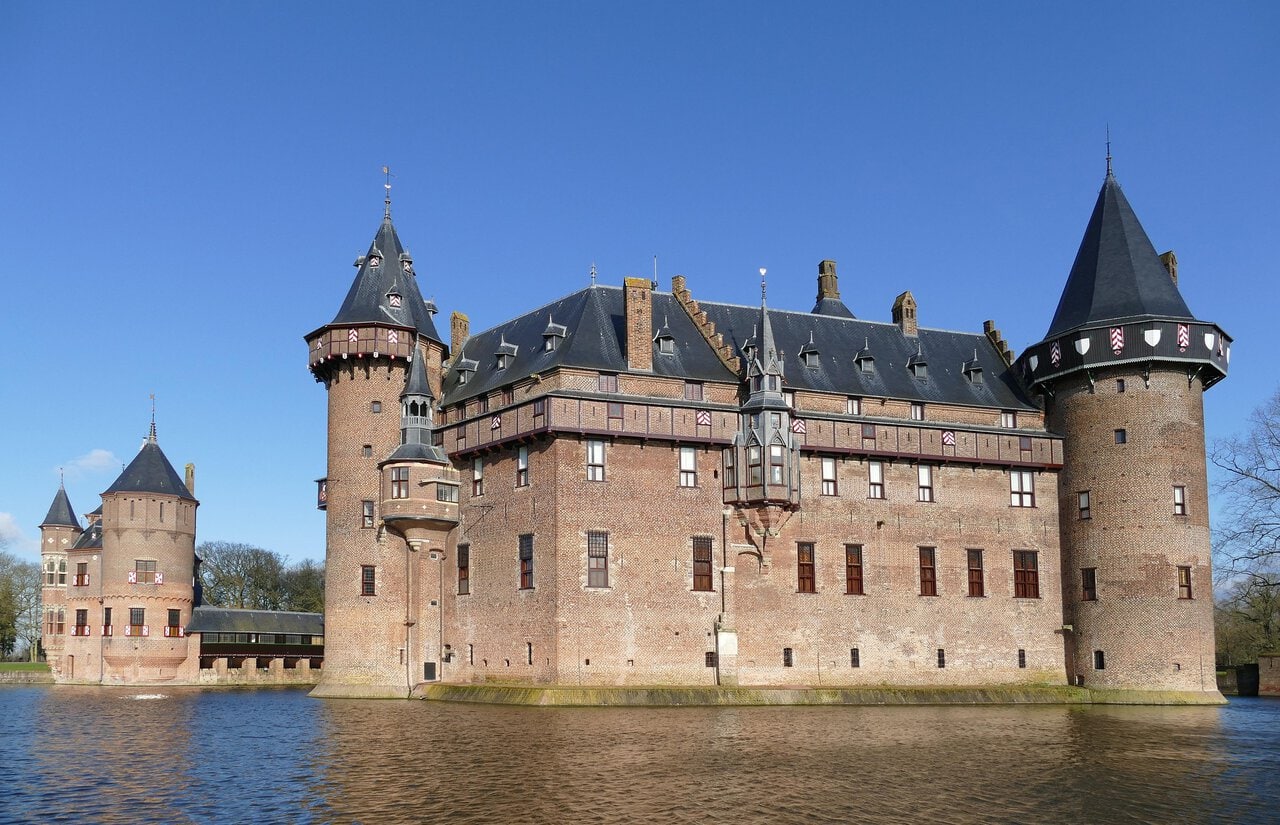
Kasteel de Haar is the closest thing the Netherlands has to a Disney-style fairy-tale castle, and it’s genuinely only a short hop from Utrecht. The current building is largely a late-19th-century reconstruction: architect Pierre Cuypers, who also designed Amsterdam Centraal station and the Rijksmuseum, rebuilt the ruined medieval castle for the wealthy Van Zuylen van Nijevelt family between 1892 and 1912, complete with turrets, a moat, drawbridges and lavishly furnished interiors. The surrounding estate includes formal French gardens, English-style parkland and a small village, Haarzuilens, that was relocated to make way for the grounds.
Getting there by public transport takes a bit more coordination than a direct train, but it’s straightforward once you know the route. From Utrecht Centraal, take a sprinter train in the direction of Den Haag Centraal to Vleuten station, a ride of around 8-10 minutes. From Vleuten, catch bus 127 (direction Breukelen) to the Brink, Haarzuilens stop, then it’s roughly a 15-minute walk to the castle entrance, or about 12 minutes by OV-fiets (the Dutch public rental bike scheme, available for pickup at most stations) through the surrounding countryside. All told, budget 45 minutes to an hour door to door, and check a journey planner like 9292 before you leave, since bus 127 doesn’t run every few minutes.
Once inside, admission to the castle interior and gardens runs to roughly €21.50 for adults and €13.50 for children aged 4-12, with under-4s free; gardens-only tickets are cheaper, at around €12.50 in the April-to-October season and €8 over winter. Museumkaart holders and several other museum pass schemes get in free, which is worth checking if you already hold one for other Dutch museums on your trip. The castle’s opening days and hours vary seasonally and it does close for private events on some dates, so it’s worth checking the current calendar on Kasteel de Haar’s website before you travel rather than assuming it’s open every day.
A half day is enough to see the castle interior and wander the immediate gardens, but if you enjoy formal grounds and quiet walking paths, the wider estate can easily fill a full day, especially if you cycle out on an OV-fiets rather than walking. This is a particularly good choice for families and for anyone travelling with children who might find a full day of art museums in Amsterdam or Rotterdam a harder sell; turrets and a moat tend to need less explaining.
Inside, the interior rooms are furnished much as the Van Zuylen van Nijevelt family left them, with a great hall, a chapel and a library that give a strong sense of how a wealthy Dutch family lived at the turn of the 20th century, even though the building itself deliberately evokes a much older medieval style. Photography is generally permitted in most rooms without flash, and guided tours in English run at set times on busier days, worth asking about at the ticket desk if you’d like more context than the information cards alone provide. The estate also hosts occasional seasonal events, including a Christmas illuminations trail in December, so it’s worth checking the calendar if you’re visiting outside the main summer season, since the castle’s character changes noticeably depending on the time of year.
Kinderdijk
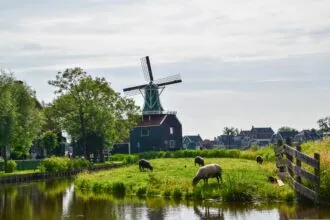
Kinderdijk is the postcard image of the Netherlands made real: 19 wooden windmills, built around 1740, still standing in neat rows along the polder canals where they once pumped floodwater away from land that sits below sea level. The site was inscribed as a UNESCO World Heritage Site in 1997 for the way it demonstrates centuries of Dutch water management, and it remains one of the most photographed spots in the country, particularly in early morning or late afternoon light when the windmill blades and reflections line up along the water.
It’s also the least direct trip on this list, so it needs a bit more planning than the others. From Utrecht Centraal, the most reliable public transport route is to take a train to Rotterdam (either Rotterdam Centraal or, for one option, Rotterdam Alexander), then connect onto a local bus, line 90 or line 489, that runs to the Kinderdijk Molenkade stop, or onto the Waterbus network that connects Rotterdam’s Erasmusbrug with Kinderdijk by boat. Total journey time runs from around 1 hour 20 minutes on the fastest train-and-bus combination up to around 1 hour 40 minutes depending on your connection, so this is best treated as a half-day trip built around a slightly later start rather than an early one.
The Waterbus option deserves a special mention if the weather is decent, because arriving by water rather than road adds genuine atmosphere to the visit; it’s a scenic way to approach a site that’s fundamentally about water management. Whichever route you choose, once you’re at Kinderdijk itself you can walk or cycle the towpath between the windmills freely, and a small number of the mills are open as museum interiors so you can see how a miller’s family actually lived and worked inside one. Renting a bike at the visitor centre is a popular way to cover the full stretch of windmills without tiring yourself out before the journey home.
Give yourself at least two to three hours on-site to do the windmills justice, longer if you plan to visit one of the museum mill interiors or take a short boat trip along the canals, which several local operators run alongside the main walking path. The site can get busy with coach tours in the middle of the day during peak summer months, so an early or late visit, timed around your train and bus connections, tends to be quieter and better for photography. Comfortable, flat walking shoes are all you need; there’s no steep terrain here, just several kilometres of towpath running alongside the canals.
Because the connection runs via Rotterdam, this also works well as a combined day: see Kinderdijk in the morning, then spend the afternoon in Rotterdam itself before heading back to Utrecht. We cover Rotterdam’s own attractions, including the Cube Houses and Markthal, in the Rotterdam section below, and in far more depth in our dedicated Things to Do in Rotterdam guide, which is worth a read if you’re planning to combine the two.
Gouda
Gouda is, unsurprisingly, best known for its cheese, but there’s more to the town than the export that made its name. It’s also one of the easiest day trips on this entire list: a direct train from Utrecht Centraal takes roughly 18-20 minutes, with services running several times an hour throughout the day, meaning you can genuinely head there on a whim without much planning at all.
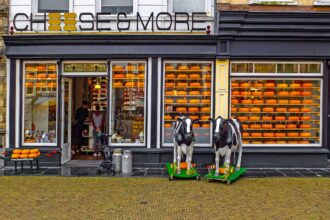
The centrepiece of a Gouda visit, if your timing allows, is the traditional cheese market held on the Markt square in front of the historic Waag (weigh house). It runs weekly on Thursday mornings from around early April through late August, typically from 10am to 12:30pm, with wheels of cheese wheeled in on barrows, weighed on the old scales and traded with the traditional hand-slapping ritual that once sealed a deal before written contracts. It’s touristy in the sense that it’s staged for visitors as much as genuine commerce these days, but it’s a genuinely enjoyable half-hour, and the surrounding stalls sell cheese, stroopwafels and local crafts if you time your visit for a Thursday.
Outside of market hours, Gouda’s other standout is Sint-Janskerk, the longest church in the Netherlands, whose real draw is its collection of 70 stained-glass windows dating from the 16th century onward, some of them enormous and remarkably detailed for their age. The Waag building itself now houses a small museum on the history of cheese and crafts production in the region, and the town’s canals and gabled merchant houses make for a pleasant wander even without a specific itinerary. Gouda’s old town is compact enough to cover on foot in a few hours, which makes it easy to pair with another nearby stop, or simply treat as a relaxed half-day trip.
If cheese and stroopwafels are a theme of your Netherlands trip, it’s worth noting that Gouda’s market runs on a different day and season to Alkmaar’s better-known cheese market north of Amsterdam, so check the calendar for the specific week you’re travelling rather than assuming either is running.
Amersfoort
Amersfoort is the quickest trip on this list by rail, direct trains from Utrecht Centraal take approximately 12-13 minutes, with up to eight departures an hour on this heavily used commuter corridor. That makes it an easy add-on to a Utrecht itinerary rather than a trip that needs a day of its own: many visitors combine a morning in Amersfoort with an afternoon back in Utrecht, or vice versa.
The town’s medieval core is genuinely well preserved, ringed by two concentric canal systems that mark the old and later city walls, with several original gates and defensive towers still standing. The Onze Lieve Vrouwetoren, a freestanding 15th-century church tower that’s one of the tallest in the country, dominates the skyline and is climbable for visitors who don’t mind a steep, narrow staircase in exchange for a panoramic view over the old town’s red rooftops and canals. The tower is the last remnant of a church destroyed in a gunpowder explosion in 1787, and the surrounding square, Lieve Vrouwekerkhof, is one of the most photographed spots in the city.
Beyond the tower, Amersfoort’s Muurhuizen, houses literally built into the line of the old medieval city wall, are worth a slow walk; you can see where curved sections of wall were incorporated directly into later house foundations. The Kunsthal KAdE contemporary art museum and the Mondriaanhuis, the birthplace of painter Piet Mondrian, give the town a cultural draw beyond its architecture, and the compact old town centre has a good spread of cafes and lunch spots around the Hof square, the old market square that still hosts a general market on Fridays and Saturdays.
Because it’s so quick to reach and easy to cover in half a day, Amersfoort works particularly well as a lower-key alternative to Amsterdam or Rotterdam on a day when you’d rather avoid crowds and queues altogether, or as a same-day pairing with Utrecht’s own old town if you’re short on time and want a taste of a second Dutch city without committing a full day to travel.
Rotterdam
Rotterdam is the Netherlands’ most architecturally daring city, and it makes a striking contrast with Utrecht’s canal-lined medieval centre. Direct trains from Utrecht Centraal take approximately 37-41 minutes, with frequent departures throughout the day, so it’s an easy full-day trip, or a manageable half-day if you’re focused on one or two specific sights.
The city was almost entirely levelled by bombing in May 1940, and rather than rebuilding a facsimile of the old town, Rotterdam rebuilt itself as a testbed for modern architecture, which is exactly why it looks so different from every other Dutch city today. The Cube Houses (Kubuswoningen), a cluster of tilted yellow cube-shaped homes near Blaak station, are the most photographed result of that approach, and several are open to visitors as a small museum house. Nearby, the Markthal is a vast horseshoe-shaped market hall with a food market at ground level and apartments built into the arch above it, its interior ceiling covered in an enormous, colourful mural of fruit, flowers and insects that’s worth the visit on its own.
Rotterdam’s working harbour, still one of the busiest ports in Europe, is visible from the Erasmusbrug (the “Swan Bridge”) and from Hotel New York, itself a former Holland America Line headquarters building on the Wilhelminapier, a useful reminder that this was historically the departure point for Dutch and European emigrants heading to America. Harbour boat tours run regularly from the city centre if you want to see the scale of the port up close, and the Euromast tower gives a high vantage point over the whole skyline for anyone who wants an overview before diving into individual neighbourhoods.
Rotterdam also rewards a slower, neighbourhood-based visit if you have the time. Katendrecht, once a rough dockworkers’ district, has been reinvented as a food and culture hub with the Fenix warehouse and a lively weekend food market, while Witte de Withstraat is the centre of the city’s gallery and nightlife scene. If your day trip coincides with decent weather, the water taxis that shuttle across the Maas river between the main sights are a cheap and genuinely fun way to get around, cutting out longer walks or tram transfers between the north and south banks of the river.
Rotterdam has enough to fill a full day on its own, from the Fenix migration museum on the Katendrecht waterfront to the Kunsthal and Museum Boijmans Van Beuningen for art. If Rotterdam becomes a bigger part of your trip than a single day trip, our dedicated Things to Do in Rotterdam guide goes into far more depth on the city’s neighbourhoods and museums than we can here.
The Hague
The Hague (Den Haag) is the Netherlands’ seat of government and the home of the International Court of Justice, which gives it a more formal, stately character than Amsterdam or Rotterdam. Direct trains from Utrecht Centraal take approximately 37-41 minutes to Den Haag Centraal, with frequent departures across the day, making it another comfortable full-day trip. Note that some services terminate at Den Haag HS (Hollands Spoor) rather than Centraal, so check your specific train’s final stop against the sight you want to see first.
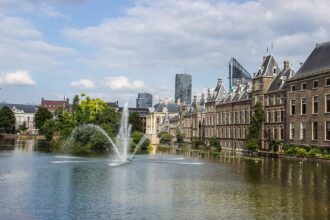
The city’s single best-known museum is the Mauritshuis, a relatively small but exceptional collection housed in a 17th-century mansion overlooking the Hofvijver pond, home to Vermeer’s Girl with a Pearl Earring and Rembrandt’s The Anatomy Lesson of Dr Nicolaes Tulp, among other Dutch Golden Age masterpieces. Right next door, the Binnenhof, the historic complex of government buildings including the Dutch parliament, is one of the oldest continuously used parliamentary buildings in the world and is partly open to visitors depending on ongoing renovation works, worth checking in advance. The Peace Palace, home to the International Court of Justice, is a striking building in its own right even if you don’t book one of the limited guided tours inside.
The Hague also has a beach, which surprises many first-time visitors: Scheveningen, a proper North Sea seaside resort with a long pier, a sandy beach and a promenade of restaurants and bars, is a short tram ride from the city centre and makes a good way to end a day trip if the weather cooperates, even just for a walk along the pier and an ice cream. For art beyond the Mauritshuis, the Kunstmuseum Den Haag holds the world’s largest collection of Mondrian’s work, including his final, unfinished painting.
The city centre itself is easy to navigate on foot, with the Hofvijver pond and its reflection of the Binnenhof forming one of the most recognisable views in the country, and the Grote Markt square nearby offering a good concentration of restaurants for lunch or dinner. Trams run frequently between the centre and Scheveningen if walking the full distance doesn’t appeal, and the whole area, including the Kurhaus, a grand 19th-century seafront hotel, makes a genuinely different final stop compared to the more inland destinations elsewhere on this list.
Given how much there is to see, The Hague rewards a full day rather than a rushed half-day, and pairs surprisingly well with a beach walk at Scheveningen to close out the afternoon before the train back to Utrecht. Our Things to Do in The Hague guide covers the city’s museums and neighbourhoods in much greater depth if you decide to prioritise it.
Best if you can move a day either way. Shows how the fare to Utrecht changes across the month.
Compare flightsBest for anyone whose home plan charges by the megabyte abroad. Pay a fixed price up front.
Check eSIMsBest when public transport has stopped, or when you are travelling with children and bags.
Book a transferHoge Veluwe National Park
If you want a full day away from cities altogether, De Hoge Veluwe National Park is the best nature-focused day trip within realistic reach of Utrecht. It’s one of the largest continuous nature reserves in the Netherlands, a mix of woodland, heathland and drifting sand dunes that feels genuinely wild by Dutch standards, and it’s home to red deer, wild boar and mouflon sheep that roam largely undisturbed across the park’s fenced but expansive grounds.
Getting there takes a bit more effort than the shorter trips on this list. From Utrecht Centraal, take a direct train to Ede-Wageningen, a journey of around 24 minutes with frequent departures. From there, bus 106 runs directly to the Kröller-Müller Museum and the park entrance during the summer season (roughly late June through late September on weekends, and a shorter window on weekdays); outside that window, you’ll need bus 108 toward Apeldoorn to the Otterlo, Rotonde stop, then transfer onto bus 106 for the final stretch. Once inside the park, hundreds of free white bicycles are available at multiple points for visitors to borrow and ride around the extensive network of cycling paths, which is genuinely one of the best ways to see the park’s scale.
The park’s other headline attraction is the Kröller-Müller Museum, which holds the second-largest collection of Van Gogh paintings in the world after the Van Gogh Museum in Amsterdam, alongside an outstanding sculpture garden set among the dunes and pines that includes works by Rodin, Dubuffet and a striking large-scale piece by Jean Dubuffet’s contemporaries. Note that park entry and museum entry are ticketed separately, and park admission includes a per-person fee plus a separate charge if you arrive by car, so public transport visitors avoid one of those costs entirely.
Because of the transfer required and the size of the park itself, this is very much a full-day trip rather than a quick add-on, and it’s best suited to travellers who enjoy walking or cycling and want a genuine change of pace from the Netherlands’ cities and towns. If the weather is poor, it’s worth saving this one for a clearer day, since much of its appeal is outdoors.
Which Day Trip Is Right for You?
With eight solid options and only so many days, it helps to think about what kind of day you actually want rather than trying to tick every box. If you have only one day to spare and this is your first visit to the Netherlands, Amsterdam is still the obvious choice, its museums and canals are simply unmatched elsewhere on this list, and the short, frequent train connection means you lose almost no time getting there.
If you’re travelling with children or simply want something visually striking without gallery fatigue, De Haar Castle and Kinderdijk both deliver on spectacle. The castle suits a half-day and works well even in mixed weather since the interior is the main draw; Kinderdijk rewards a clear day and a willingness to spend a couple of hours outdoors, ideally with a bike.
For travellers who want maximum reward for minimum travel time, Amersfoort and Gouda are the pragmatic choices, both under 20 minutes from Utrecht Centraal, both walkable old towns, and both easy to combine with an afternoon back in Utrecht itself. If architecture and a modern, cosmopolitan feel interest you more than medieval streets, give the day to Rotterdam instead; if government history, world-class art and a beach afternoon sound appealing, choose The Hague. And if you’d rather swap Dutch cities for Dutch nature entirely, the Hoge Veluwe is worth the slightly longer journey, particularly if you’re already planning to see Van Gogh’s work and would like a second, quieter encounter with it away from Amsterdam’s crowds.
A realistic four or five day stay in Utrecht could reasonably cover Amsterdam, one of Rotterdam or The Hague, Gouda or Amersfoort as a shorter add-on, and either De Haar Castle or Kinderdijk depending on your appetite for a slightly longer connection. Trying to fit all eight into a single short trip is possible on paper but will leave you spending more time on trains and buses than actually exploring, so it’s worth being selective rather than exhaustive.
Travelling Independently or Joining a Guided Tour
Most of the destinations in this guide are entirely manageable on your own using the NS train network and local buses. The Netherlands has one of the most reliable, well-signposted public transport systems in Europe, journey planners like the NS app and 9292 give live departure times and platform numbers in English, and stations are generally clean, safe and easy to navigate even for first-time visitors. For Amsterdam, Gouda, Amersfoort, Rotterdam and The Hague, in particular, independent travel by train is genuinely the easiest and often cheapest option, since these are direct routes with frequent departures and no timed-entry logistics beyond individual museum tickets.
Where a guided tour earns its cost is on the destinations that require a bus or boat connection, De Haar Castle, Kinderdijk and the Hoge Veluwe. A tour operator handles the coordination between train, bus and, in Kinderdijk’s case, the Waterbus, which removes the small but real risk of missing a connecting bus that only runs every 30-60 minutes in a rural area. Guided tours to these three destinations, and combination tours pairing Kinderdijk with a Rotterdam harbour cruise, or De Haar Castle with a countryside cycling stop, are widely available and tend to include admission tickets in the price, which can work out similar to doing it independently once you add up train fares, bus fares and entry fees separately.
A useful middle ground for cost-conscious independent travellers doing several of these trips is to look at a regional or national rail pass rather than buying individual tickets each time. Passes like the Holland Travel Ticket and the NS Day Ticket both cover unlimited train travel within the Netherlands for a set number of days, which can be worthwhile if you’re planning to hit three or more of the destinations above in quick succession. If your trip extends into Belgium or Luxembourg as well, the Interrail Benelux Pass is worth comparing against buying individual tickets, particularly if Rotterdam or The Hague are stepping stones toward Antwerp or Brussels later in your trip.
In short: go independently for the straightforward direct-train destinations, and weigh up a guided tour or a rail pass for the ones that involve a bus or boat transfer, especially if you’re short on time or would simply rather not manage a rural bus timetable on holiday.

Rupert’s Handy Travel Tips
Utrecht makes a brilliant base for day trips, but a few small habits will save you time and hassle along the way.
- Tap in and tap out every time: whether you use an OV-chipkaart or a contactless bank card, always tap on and off at both trains and buses, even on multi-leg journeys like Utrecht to De Haar Castle or Kinderdijk, or you’ll be charged a maximum fare.
- Check the platform on the departure boards, not just the time: Utrecht Centraal is enormous and platforms for the same line can change at short notice, so glance at the yellow departure boards rather than relying on the platform you used last time.
- Build in buffer time for bus connections: rural buses to places like Vleuten’s bus 127 or the Hoge Veluwe’s bus 106 run far less frequently than city trains, so a delayed train can mean a 30-60 minute wait for the next connecting bus.
- Grab an OV-fiets for the last stretch: the Dutch public bike rental scheme is available at most stations for a small daily fee and often turns an awkward last-mile walk, like the one to De Haar Castle from Vleuten, into a scenic 10-15 minute ride.
Want to meet the reindeer behind our travel tips? Find out more in our page Who is Rupert?.




Frequently Asked Questions
What is the best day trip from Utrecht?
It depends on your interests, but Amsterdam is the most popular choice thanks to its 26-30 minute direct train and unmatched range of museums and canals. If you want something more distinctive to the Utrecht area specifically, De Haar Castle and Kinderdijk are both excellent and less crowded alternatives.
How do you get from Utrecht to Kinderdijk?
There’s no direct train. The most reliable route is a train from Utrecht Centraal to Rotterdam, followed by a connecting bus (line 90 or 489) to Kinderdijk Molenkade, or a transfer onto the Waterbus network. Total journey time is around 1 hour 20 minutes to 1 hour 40 minutes depending on the connection.
How far is De Haar Castle from Utrecht?
Around 45 minutes to an hour door to door. Take a sprinter train from Utrecht Centraal to Vleuten (roughly 8-10 minutes), then bus 127 toward Breukelen to the Brink, Haarzuilens stop, followed by a 15-minute walk or a 12-minute bike ride to the castle.
Can you visit Amsterdam and Utrecht in the same day?
Yes, easily. The train between Utrecht Centraal and Amsterdam Centraal takes around 26-30 minutes with several departures every hour, so many visitors base themselves in Utrecht and treat Amsterdam as a straightforward day trip rather than the other way around.
Is Gouda worth a day trip from Utrecht?
Yes, particularly on a Thursday morning between April and August when the traditional cheese market runs on the Markt square. Even outside market season, the Sint-Janskerk stained-glass windows and the old town’s canals make for a pleasant half-day, and the direct train takes only around 18-20 minutes.
What’s the quickest day trip from Utrecht?
Amersfoort, at around 12-13 minutes by direct train with up to eight departures an hour. It’s an easy add-on to a Utrecht day rather than a full day trip in its own right, with a well-preserved medieval old town and the climbable Onze Lieve Vrouwetoren.
Do I need to book tickets in advance for these day trips?
Train and bus tickets don’t need advance booking, you can simply tap in with an OV-chipkaart or contactless card. Some attractions do require advance booking, most notably the Anne Frank House in Amsterdam and, at busier times, the Kröller-Müller Museum in the Hoge Veluwe, so check specific attraction websites ahead of time if there’s one you don’t want to miss.
Is it cheaper to buy individual train tickets or a rail pass?
It depends on how many trips you’re taking. For one or two day trips, individual OV-chipkaart or contactless fares are usually cheaper. If you’re planning three or more day trips in quick succession, a pass like the NS Day Ticket or Holland Travel Ticket can work out better value, and removes the need to top up a chipkaart each time.
Further Reading
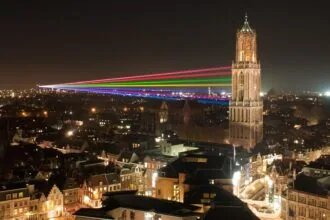
If Utrecht itself deserves more time before you head out on any of these trips, our Things to Do in Utrecht guide covers the Dom Tower, the sunken Oudegracht canal wharves and the city’s museums in full, and pairs naturally with this guide since most of these day trips start and end at Utrecht Centraal. Travellers splitting time between Utrecht and Amsterdam should also look at our Things to Do in Amsterdam and Day Trips from Amsterdam guides, both cornerstone resources for the country’s most visited city, and both useful if Amsterdam ends up anchoring more of your itinerary than a single day trip.
For the destinations covered above that also have their own dedicated guides, our Things to Do in Rotterdam and Things to Do in The Hague pages go far deeper into each city’s neighbourhoods, museums and practical tips than a single section in a day-trip roundup can manage, and are worth reading before you commit a full day to either. If Rotterdam ends up being more than a passing visit, our Day Trips from Rotterdam guide picks up from there and covers destinations best reached from that city instead.
Finally, if you’re planning to travel on to Belgium, Luxembourg or further afield in the Netherlands after your time in Utrecht, our Interrail Benelux Pass guide and our Holland Travel Ticket guide both help with working out which rail pass, if any, makes sense for the rest of your trip.