Reviewed by our editorial team Updated
Discover the Best Day Trips from Eindhoven
Eindhoven doesn’t look or feel like most Dutch cities. It’s younger, more industrial in its bones, and built around design and technology rather than canals and gabled houses, which is exactly why it makes such a good base for day trips. Sit at Eindhoven Centraal for five minutes and you’ll notice how many directions open up: south into Belgium, west into the historic cities of Brabant, north to the cathedral city of Den Bosch, and out into the quiet heathland and dune landscapes that most visitors to the Netherlands never see.
This guide covers six genuinely different day trips from Eindhoven: the Gothic canal city of ‘s-Hertogenbosch (Den Bosch), the hilly border city of Maastricht, the royal garden city of Breda, the design-and-textile city of Tilburg, a proper international side trip into Belgium (Antwerp), and the Dutch countryside around Eindhoven: De Kempen’s heathland villages and the shifting sand dunes of Loonse en Drunense Duinen National Park. We’ve also added a bonus family-focused option, Efteling theme park, since it’s one of the most commonly searched day trips from this part of Brabant. Every one of these is realistically doable there-and-back in a single day using Eindhoven Centraal as your starting point.
One thing worth flagging before you plan anything: Eindhoven’s location in the far south of the Netherlands means it isn’t quite as centrally placed for day trips as Amsterdam or Utrecht. You won’t be nipping up to the Zaanse Schans windmills or the flower fields around Keukenhof in an afternoon from here; those sit two hours or more away and are better tackled from a base further north. What Eindhoven does exceptionally well instead is Brabant itself, plus a genuinely easy hop into Belgium, and that’s the focus of this guide.
What makes Eindhoven such a strong hub is North Brabant’s dense, fast rail network. NS (Nederlandse Spoorwegen) runs frequent Intercity and Sprinter services in every direction, several of the destinations below are under 40 minutes away, and even Maastricht (the furthest Dutch city on this list) is comfortably reachable in about an hour. Cross the border into Belgium and things slow down slightly, since you’ll typically need one change of train, but Antwerp is still an entirely realistic day out.
We’ve focused on real, current journey times gathered from NS and international timetable data, rather than generic estimates, because a day trip lives or dies on how much time you actually lose to transport. We’ve also tried to be honest about which trips work best independently by train, and which are easier with a bit of planning, a bike, or a small guided tour, particularly the countryside routes, which don’t always have a train station sitting conveniently at the front door.
If you’re staying in Eindhoven itself, it’s worth pairing this guide with our Best Things to Do in Eindhoven guide for what to see in the city itself, and our Eindhoven Airport Transfers guide if you’re flying in or out of Eindhoven Airport rather than Schiphol. Below, we break down each destination in detail, including how to get there, what to see once you arrive, and roughly how long to set aside.
| Destination | Typical Journey | Best Transport | Recommended Time | Best For |
|---|---|---|---|---|
| ‘s-Hertogenbosch (Den Bosch) | Approx. 20-22 minutes | Direct NS Intercity/Sprinter train | Half day to full day | Gothic cathedral, canal boat tours, historic centre |
| Maastricht | Approx. 1 hour 5-10 minutes | Direct NS Intercity train | Full day (or overnight) | Hilly old town, border-city café culture, caves |
| Breda | Approx. 35-40 minutes | Direct NS Intercity train | Half day to full day | Parks, royal/military history, relaxed pace |
| Tilburg | Approx. 21-25 minutes | Direct NS Intercity/Sprinter train | Half day | Contemporary art, textile heritage, industrial cool |
| Antwerp, Belgium | Approx. 1 hour 20-40 minutes | NS train to Breda/Roosendaal, change to Belgian IC | Full day | International city break, fashion, Rubens and grand architecture |
| Dutch Countryside (De Kempen & national parks) | 25 minutes to 1 hour | Bravo regional bus or train + bus/bike | Half day to full day | Heathland walks, cycling, shifting sand dunes, slow travel |
| Efteling Theme Park (bonus) | Approx. 1 to 1.5 hours | Train to Tilburg or Den Bosch, then connecting bus | Full day | Families, fairy-tale rides, all-day theme park visit |
‘s-Hertogenbosch (Den Bosch): Gothic Grandeur, 20 Minutes Away
Locally known simply as “Den Bosch,” ‘s-Hertogenbosch is arguably the single easiest and most rewarding day trip on this list. It’s the provincial capital of North Brabant, a compact, walkable city built around a horseshoe of canals, and it sits so close to Eindhoven that many people commute between the two. Direct trains leave Eindhoven Centraal for Den Bosch several times an hour, and the journey itself takes only around 20-22 minutes, meaning you can be standing in the historic Markt square before your coffee has properly cooled.
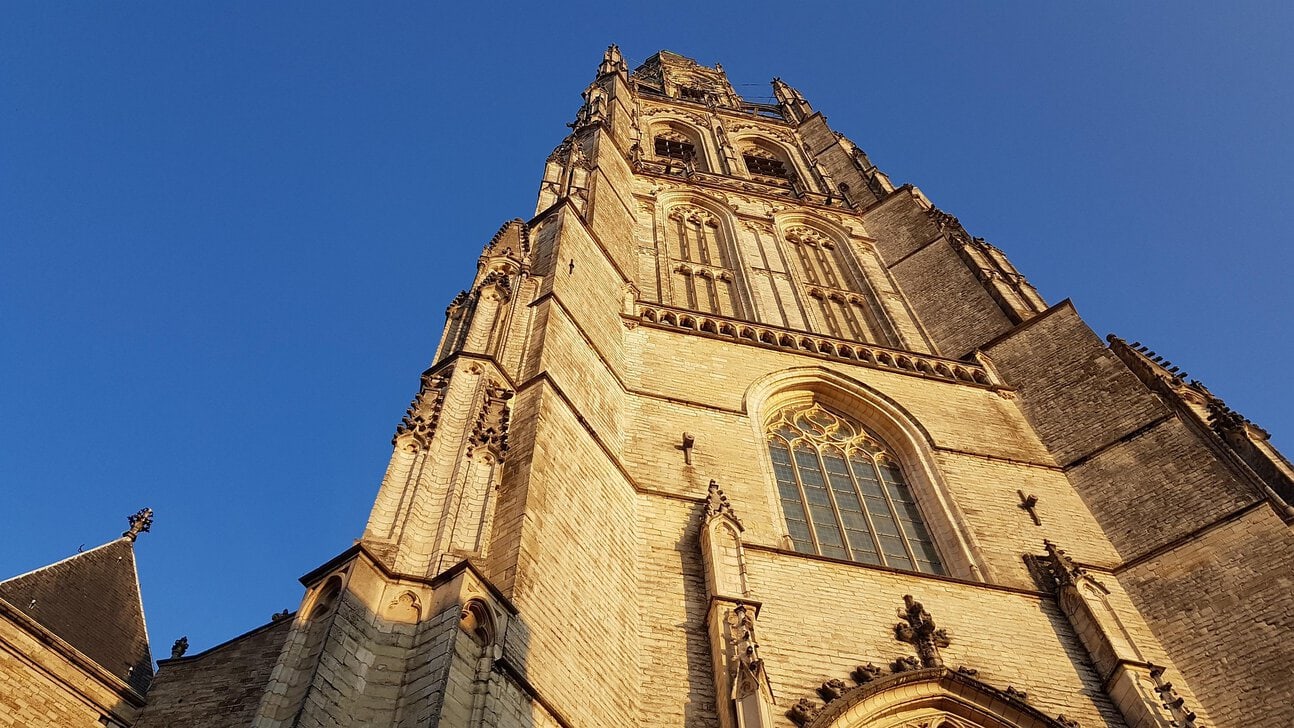
The undisputed centrepiece is Sint-Janskathedraal (St. John’s Cathedral), a colossal Brabantine Gothic cathedral that took roughly two centuries to complete and is widely regarded as one of the finest Gothic buildings in the Netherlands. Its exterior is covered in intricate flying buttresses and hundreds of carved figures; look for the small bronze sculpture of a figure in headphones tucked among the traditional stonework, a modern addition that’s become something of a local in-joke. Inside, the scale and the stained glass are worth twenty minutes alone, even if you’re not usually a cathedral person.
What sets Den Bosch apart from other Dutch canal cities, though, is the Binnendieze: a network of small canals and covered waterways that actually run underneath parts of the city centre. Guided boat tours (roughly 45-75 minutes depending on the operator) take you through these tunnels and hidden courtyards that you’d never find on foot, and they run regularly through the warmer months. It’s a genuinely different way to see a historic Dutch centre and one of the more memorable half-day activities on this whole list.
Beyond the cathedral and the canal tour, Den Bosch rewards slow wandering. The Markt square is lined with cafés and the striking gabled façade of De Moriaan, thought to be one of the oldest brick buildings in the Netherlands, dating back to around the 13th century. The Noordbrabants Museum covers regional art and history in a former governor’s residence, while Design Museum Den Bosch (housed in a former medieval hospital complex) leans into the city’s connection to fashion and design. And no visit is complete without trying a Bossche Bol, an oversized chocolate-glazed cream puff that’s a genuine local specialty, sold at bakeries around the centre.
Because the train journey is so short, Den Bosch works well as either a relaxed half-day trip or a fuller day if you add the canal tour and a proper sit-down lunch. It’s also an easy add-on if you’re combining destinations: some travellers pair it with Tilburg (also on this list) since both sit on the same rail corridor northwest of Eindhoven, making a two-city day achievable if you start early.
Practically speaking, everything worth seeing sits within a 15-minute walk of Den Bosch railway station, so you won’t need to think about local buses or trams here. Saturday is market day on the Markt square, which adds a nice extra layer of activity if your visit falls on a weekend, though it also means the centre gets noticeably busier. If you’re travelling with the OV-chipkaart or a contactless bank card for tap-in, tap-out travel, the whole trip from Eindhoven and back requires nothing more complicated than tapping in and out at each station.
Best if you want daily housekeeping and a front desk. Filter by area first, then by price.
Check availabilityBest for families, or any stay past about four nights. A kitchen and a washing machine start paying for themselves.
Browse rentalsBest as a last check before booking. Compares Eindhoven hotel rates across several sites in one search.
Compare ratesMaastricht: Hills, History and a Genuine Border-City Feel
Maastricht is the furthest destination on this list from Eindhoven, but it’s also one of the most distinctive cities in the Netherlands, and the direct train connection makes it a completely realistic day trip. NS Intercity trains run from Eindhoven Centraal to Maastricht in around 1 hour 5 to 10 minutes at the fastest, with dozens of direct services running throughout the day, so you’re not relying on a single connection to make it work.
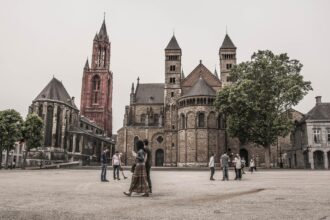
What makes Maastricht feel so different from the rest of the Netherlands is its position, tucked into the southern tip of Limburg between Belgium and Germany, with actual hills (a rarity in the Netherlands) rising just outside the city. The historic centre is anchored by the Vrijthof, a grand square surrounded by cafés and dominated by the towers of the Basilica of Saint Servatius, one of the oldest churches in the country. A short walk away, the Sint-Pietersberg hill and its old marl caves and Fort Sint Pieter offer a completely different kind of sightseeing: guided cave tours take you through kilometres of tunnels that have been used for shelter, quarrying and even hidden art over the centuries.
Maastricht also has one of the more unusual bookshops in Europe: Boekhandel Dominicanen, a working bookstore built inside a converted 13th-century Dominican church, complete with vaulted ceilings and a café tucked where the altar once stood. Add in the Bonnefanten Museum for contemporary and medieval art, the winding lanes of the old town, and a food and café culture that leans noticeably more Burgundian than the rest of the Netherlands, and it’s easy to see why so many visitors extend their stay.
Because it borders both Belgium and Germany so closely, Maastricht is also a natural base for further cross-border exploring, and it’s worth knowing that the Euregio Ticket covers unlimited regional travel across this Dutch-Belgian-German border area for a full day, which can be useful if you decide to stay longer or explore beyond the city centre itself.
Given the length of the journey, we’d treat Maastricht as a full-day trip rather than a quick half-day add-on; you’ll want a solid six to eight hours there to make the travel time worthwhile. If Maastricht sounds like somewhere you might want to base yourself for a night or two rather than just visit for the day, our dedicated guides go into far more depth: see Best Things to Do in Maastricht for a full attractions breakdown, and Best Day Trips from Maastricht if you want to use Maastricht itself as a base for exploring the wider Belgian and German border region.
Worth noting: several of the direct Eindhoven-Maastricht services actually run through as part of longer Intercity lines, so double-check the platform and destination board rather than assuming every southbound train from your platform is going all the way, though a small number require a change at Sittard or Weert rather than running direct. It’s a minor point, but worth thirty seconds of checking on the NS app before you board, especially if you’re catching an early or late train outside peak hours.
Visit National Monument Camp Vught
One of the most thought-provoking day trips from Eindhoven is National Monument Camp Vught, located in the town of Vught, around 30 minutes by car or approximately 45 minutes by train and bus from Eindhoven. Originally known as Konzentrationslager Herzogenbusch, it was the only SS concentration camp established outside Nazi Germany, making it one of the Netherlands’ most significant Second World War memorial sites.
Today, the former camp has been transformed into a museum and memorial that tells the stories of the more than 32,000 prisoners from 35 different nationalities who passed through Camp Vught during the war. Rather than focusing solely on dates and statistics, the exhibitions use personal stories, original artefacts, photographs and eyewitness accounts to explain what daily life was like for those imprisoned here and the devastating impact of the Nazi occupation on the Netherlands.
The permanent exhibition, “Camp Vught: Seven Seasons and 32,000 Stories,” provides an excellent introduction before you step outside to explore the remains of the former camp. Visitors can see a reconstructed barracks, several watchtowers, the original crematorium, restored railway freight wagons used during deportations and the poignant Children’s Memorial, which commemorates the transport of more than 1,200 Jewish children from the camp in 1943.
One of the most moving parts of the visit is the 4-kilometre walking route through the surrounding woodland to the former execution site, where 329 resistance fighters and prisoners were executed. The peaceful setting today provides a powerful contrast to the tragic events that took place there and offers visitors an opportunity for quiet reflection.
An audio guide is included with admission in several languages, helping to explain the exhibits and individual stories as you move around the museum. Allow three to four hours for your visit if you plan to explore both the museum and the outdoor memorials, and wear comfortable footwear, particularly if you intend to complete the woodland walk.
While this is understandably not a light-hearted excursion, it is one of the Netherlands’ most important historical sites and offers a powerful insight into the country’s wartime history. For visitors interested in history, human rights or the Second World War, Camp Vught is an unforgettable and deeply meaningful day trip from Eindhoven.
Breda: Royal Gardens and a Slower Pace
Breda is one of the most underrated cities in North Brabant, and its proximity to Eindhoven makes it a genuinely easy add to any Netherlands itinerary. Direct NS trains connect Eindhoven Centraal to Breda in around 35-40 minutes, with fast services capable of doing it in as little as 35 minutes, and departures run frequently throughout the day.
Breda has a noticeably calmer, greener feel than many Dutch cities, largely thanks to Valkenberg Park, a large landscaped park right in the centre that wraps around part of the old city and makes for an easy, pleasant stroll. Just beside it sits Breda Castle, a former residence of the House of Orange-Nassau that now houses the Royal Military Academy; it’s not generally open to the public, but its grounds and the surrounding gardens are, and the building’s presence gives the whole area a stately, quietly grand atmosphere.
The historic centre is built around the Grote Kerk (also known as the Onze-Lieve-Vrouwekerk), a striking late-Gothic church whose tower you can climb for panoramic views over the rooftops of Breda and out towards the surrounding Brabant countryside. Nearby, the Begijnhof, a small, walled courtyard of almshouses originally built for religious laywomen, offers one of those quiet, almost secret corners that Dutch cities do so well. The main square, Grote Markt, and the surrounding streets are dense with cafés, independent shops and terraces that get busy on warmer afternoons.
Breda’s position close to the Belgian border also gives it a slightly different rhythm and cuisine compared to cities further north: expect a stronger café and brasserie culture, and a food scene with clear Flemish influence. It’s an easy city to explore entirely on foot from the station, and most of the key sights sit within a 15-20 minute walk of each other.
We’d rate Breda as a comfortable half-day trip if you’re moving at a normal pace, or a relaxed full day if you want to properly sit down for lunch, browse the shops, and take a slow walk through Valkenberg Park rather than rushing between sights.
Breda also makes a sensible stop if you’re planning to continue on to Antwerp the same day, since it’s the same station where you’ll change trains for the Belgian leg of that journey; some travellers break up the Antwerp trip by spending the morning in Breda before catching an afternoon connection south. Just be mindful of timing if you plan to do both in one day, since it will make for a long one.
Tilburg: Textiles, Contemporary Art and Industrial Cool
Tilburg is the closest thing to a sister city Eindhoven has on this list: both are former industrial powerhouses (textiles in Tilburg’s case, electronics and manufacturing in Eindhoven’s) that have reinvented themselves around design, culture and higher education. Direct trains from Eindhoven Centraal reach Tilburg in as little as 21 minutes and typically around 25 minutes, and it’s one of the most frequently served routes on this entire list, with dozens of departures throughout the day.
The city’s industrial history is the star attraction. The TextielMuseum (Textile Museum) is a genuinely hands-on museum built inside a former wool-spinning mill, where working looms and knitting machines are still in operation and visitors can even design and have their own textiles produced on-site. It’s one of the more unusual and engaging industrial museums anywhere in the Netherlands, and it typically takes 1.5-2.5 hours to see properly.
Just outside the centre, De Pont Museum voor Hedendaagse Kunst (Museum of Contemporary Art) occupies a former wool-processing factory and holds a well-regarded collection of post-1960s art in large, light-filled industrial halls, a favourite for anyone with even a passing interest in contemporary art. Back near the station, the Spoorzone district has transformed a former railway repair yard into a cultural quarter, anchored by the LocHal, a striking public library built inside a vast former locomotive shed that regularly appears on lists of the world’s most beautiful libraries.
Tilburg also has a lively, youthful energy thanks to Tilburg University and a large student population, which shows up in the bar and café scene around the centre. If you’re visiting in late July, you might catch the tail end of the Tilburgse Kermis, reputedly the largest fair (kermis) in the Benelux region, though it’s worth checking exact dates in advance since it typically runs for about ten days.
Given the short journey and the relatively compact centre, Tilburg works well as a half-day trip: enough time for one of the two main museums plus a wander through Spoorzone, though art and design fans could easily stretch it into a full day covering both.
Both the TextielMuseum and De Pont sit a short walk or quick bus ride from Tilburg station, and the city centre itself is compact enough to cover on foot. Tilburg is also the jumping-off point for reaching Efteling theme park by bus, which we cover in more detail further down this guide, so if you’re travelling with children, it’s worth considering whether to combine a shorter museum visit here with an afternoon at the park instead of treating them as two separate trips.
Antwerp, Belgium: A Genuine International Day Trip
One of the underrated advantages of basing yourself in the southern Netherlands is how close Belgium actually is, and Antwerp is the best-connected Belgian city for a day trip from Eindhoven. There’s no single direct train; you’ll typically travel from Eindhoven Centraal to Breda (or occasionally Roosendaal) on a Dutch NS service, then change onto a Belgian Intercity train (the Beneluxtrein/IC Brussels line) for the final leg into Antwerpen-Centraal. All told, budget around 1 hour 20 minutes to 1 hour 40 minutes each way including the change, with services running roughly hourly throughout the day.
The reward at the other end is one of Europe’s most architecturally rich cities. Antwerp’s Grote Markt is ringed by ornate 16th-century guild houses and the towering Antwerp City Hall, while just around the corner, the Cathedral of Our Lady (Onze-Lieve-Vrouwekathedraal) houses several major Rubens masterpieces beneath the tallest church spire in the Low Countries. Peter Paul Rubens’ actual home and studio, Rubenshuis, is also open to visitors and gives a fascinating look at how the artist lived and worked.
For a more modern architectural fix, MAS (Museum aan de Stroom) rises out of the old harbour district in a striking spiral of red sandstone and glass, with a free rooftop viewing platform offering panoramic views over the city and River Scheldt. Antwerp’s Centraal Station itself is worth a stop even if you’re not catching another train from it, since its cavernous, cathedral-like main hall is regularly ranked among the most beautiful railway stations in the world. Fashion and design fans should head to the streets around the Nationalestraat and Kammenstraat for Antwerp’s well-known fashion scene (home of the “Antwerp Six” designers), while the Diamond District right by the station is a reminder that Antwerp is still one of the world’s major diamond trading hubs.
Because you’re crossing into a different country with a different rail operator, it’s worth double-checking timetables the day before rather than assuming you can simply turn up; connections at Breda aren’t always immediate. Travellers planning more than one Belgian side trip during their time in the Netherlands might find the Interrail Benelux Pass worth a look, since it covers train travel across the Netherlands, Belgium and Luxembourg on a flexible number of travel days.
Given the total travel time, Antwerp is a full-day commitment rather than a quick side trip; realistically you’re looking at a 6-7am start if you want a full afternoon and evening in the city before heading back. It’s absolutely worth it for travellers who want a genuine taste of Belgium without organising a separate multi-day Belgian trip.
A quick note on money and connectivity: Belgium uses the euro just like the Netherlands, so there’s no currency to sort out, and EU mobile roaming rules generally mean UK and EU SIM cards work the same way they do at home. The main practical difference travellers notice is the language shift: Antwerp is Dutch-speaking (Flemish), so if you’ve picked up any Dutch in the Netherlands, it will serve you well here too, though English is also very widely spoken in the city centre and tourist areas.
Dutch Countryside: De Kempen’s Heathland and the Shifting Dunes of Loonse en Drunense Duinen
Not every day trip from Eindhoven needs to end in a city centre. The region immediately surrounding Eindhoven, known as De Kempen, is a quiet landscape of heathland, pine forest, sculpture routes and small brick-built villages that feels a world away from the Randstad’s canals and gabled townhouses, and it’s easily reached without a car.
Regional Bravo (Hermes) buses run directly from Eindhoven’s central bus station, next to Eindhoven Centraal, out into De Kempen. Bus 318 runs south to Valkenswaard, a pleasant village bordering the Groote Heide nature reserve, in around 25-30 minutes, while buses 19 and 319 head southwest to Eersel and on to Bladel and Reusel, taking roughly 30-40 minutes depending on your stop. These villages are known locally for cycling routes through heath and woodland, the “Kunstenroute” open-air sculpture trails around Bergeijk, and a noticeably slower, more rural pace of life than anywhere else on this list. Renting a bike once you arrive (many villages have rental points) is genuinely the best way to explore, since the appeal here is the landscape itself rather than any single attraction.
For something more dramatic, Loonse en Drunense Duinen National Park, sometimes nicknamed the “Brabantse Sahara” for its wind-blown, shifting sand dunes rising out of surrounding forest and heath, makes an excellent combination trip with Tilburg. The easiest approach is to take the direct train from Eindhoven to Tilburg (around 21-25 minutes), then continue by local bus or rented bike towards Loon op Zand or Drunen, where marked walking trails lead into the dunes themselves. It’s an unusual landscape to find in the Netherlands, and one that photographs beautifully in low afternoon light.
Birdwatchers and quieter nature lovers might instead consider De Groote Peel National Park, a former raised bog to the east of Eindhoven known for its boardwalk trails and bird life, including cranes and a wide range of migratory species. It’s less straightforward by public transport: you’ll typically take a train to Deurne and then a taxi, or a regional bus toward Someren followed by a walk, so this one genuinely suits travellers with a car, a bike, or plenty of patience more than a quick public-transport day trip.
Because these countryside routes depend more on buses, bikes and walking than on a single train line, we’d treat them as a flexible half-day for a focused village visit or nature walk, or a full day if you want to properly cycle through De Kempen or hike a good stretch of the dunes at Loonse en Drunense Duinen. They’re also some of the few genuinely quiet, uncrowded destinations within an hour of Eindhoven, a good antidote if the cities above start to feel busy.
A few practical notes if you’re planning a countryside day: pack proper walking shoes, since paths through the dunes and heathland are sandy or uneven in places rather than paved. Facilities are far sparser than in the cities on this list: villages like Bergeijk and Eersel have cafés and small supermarkets, but you won’t find the density of restaurants and shops you’d get in Breda or Den Bosch, so it’s worth bringing water and snacks if you’re heading further into the heath or dunes themselves. Weekday visits also tend to be noticeably quieter than weekends, when local cyclists and walkers head out in bigger numbers, particularly around Loonse en Drunense Duinen.
Best for finding routes the airlines do not sell as a single ticket. Combines carriers to bring the fare down.
Search flightsBest for short trips. Install the eSIM at home and arrive in Eindhoven with working data, no shop queue.
Browse eSIMsBest after a long flight or a late landing. Price agreed before you travel, and no taxi queue.
Check transfersBonus: Efteling Theme Park
It isn’t mentioned in most classic “day trips from Eindhoven” lists because it’s a theme park rather than a historic destination, but Efteling is one of the most-searched day trips from this part of Brabant, and it’s genuinely reachable from Eindhoven, so it earns a place here as a bonus option, particularly for anyone travelling with children.
Efteling is one of the oldest and most-loved theme parks in Europe, built around fairy-tale and folklore themes rather than the thrill-ride focus of many modern parks, though it does have its share of roller coasters and log flumes too. The Fairytale Forest (Sprookjesbos), with its walk-through scenes from Grimm and Andersen stories, is the park’s signature attraction and still charms adults as much as children. It’s a full-day destination in its own right; most visitors budget six to eight hours to see even a good portion of it.
Getting there from Eindhoven takes a bit more planning than the city destinations on this list, since Efteling doesn’t have its own train station. The most reliable route is to take the direct train to either Tilburg (around 21-25 minutes) or ‘s-Hertogenbosch (around 20-22 minutes), then connect onto one of the regional buses that serve the park directly: lines 300, 301 and 136 run from both stations, with route 800 also serving Den Bosch and 801 serving Tilburg. Bus journeys to the park typically add another 30-45 minutes on top of the train, so budget around 1 to 1.5 hours door-to-door from Eindhoven Centraal, and check the exact bus number and platform on the day, since routings are occasionally adjusted.
Because of the combined train-and-bus journey and the sheer size of the park, Efteling really needs a full day rather than a half day; arriving as close to opening time as possible makes a noticeable difference to queue times, particularly for the newer, more popular rides. If you’re travelling with young children specifically, it’s worth building in a buffer on the return journey too, since a full day at a theme park tends to run later than planned.
Which Day Trip Is Right for You?
If you only have time for one day trip from Eindhoven, the choice really comes down to what kind of experience you’re after. For the best ratio of travel time to reward, ‘s-Hertogenbosch (Den Bosch) is hard to beat: a 20-minute train ride for a genuinely striking Gothic cathedral and a boat tour through underground canals. If you want the single most memorable and distinctive city on this list and don’t mind a longer journey, Maastricht is worth the extra travel time, particularly if you can turn it into an overnight stay.
Travellers short on time but wanting culture and design should lean toward Tilburg, which pairs a short journey with two excellent, very different museums. Those who want a slower, greener pace without sacrificing history should choose Breda. If crossing an international border for the day appeals to you, Antwerp delivers a completely different architectural and cultural flavour, provided you’re comfortable with the roughly 1.5-hour journey each way and one change of train. And if you’d rather swap cities and museums for heathland, cycling routes and shifting sand dunes, the Dutch countryside around De Kempen and Loonse en Drunense Duinen offers a genuinely different side of the region that most itineraries skip entirely.
With more than a couple of days available, a sensible combination is Den Bosch and Tilburg on one day (they sit on the same rail corridor and are both quick trips), Breda or the countryside on another, and Maastricht or Antwerp reserved for a dedicated full day given their longer journey times.
Travelling with children changes the calculation somewhat. Efteling is the obvious choice for a family day out and is worth ring-fencing an entire day for, given the combined train-and-bus journey and the size of the park. For families who’d rather stay closer to Eindhoven, Den Bosch’s Binnendieze boat tour and Breda’s Valkenberg Park are both easy, low-effort wins that don’t demand a long day of walking or complicated connections.
If budget and time are tighter, prioritise the destinations with the shortest, most frequent direct trains: Den Bosch, Tilburg and Breda all fall comfortably under 40 minutes each way, so even a late start or an early finish won’t waste much of your day. Maastricht, Antwerp and Efteling all involve well over an hour of one-way travel, so they’re better suited to days when you can commit to an early departure and a later return.
Travelling Independently or Joining a Guided Tour
Every destination in this guide can be done entirely independently, and for most of them, that’s genuinely the better option. The Dutch rail network is frequent, punctual and easy to navigate even without much Dutch: station signage, ticket machines and NS’s app and website all work fully in English, and Den Bosch, Breda and Tilburg in particular are simple, single-train, no-change journeys where a guided tour would add cost without adding much practical value.
A single-use NS Day Ticket can be a straightforward way to cover Dutch train travel for the day without juggling individual fares, and it’s worth comparing against the Holland Travel Ticket if you also want to use buses, trams or metros once you arrive at your destination city. Neither is necessary for every trip on this list, but they can simplify things if you’re moving around a lot in a single day.
Where a guided option genuinely earns its keep is Maastricht’s underground cave system at Sint-Pietersberg, where the tunnels are only accessible with an official guide for safety reasons; this isn’t optional if you want to go inside, so book ahead during busier periods. Antwerp is also a good candidate for at least a guided walking tour of the historic centre on your first visit, simply because there’s a lot of dense architectural and artistic history packed into a small area, and a knowledgeable local guide can connect the dots between the cathedral, the guild houses and Rubens’ life far faster than wandering alone with a guidebook.
For the countryside routes around De Kempen and Loonse en Drunense Duinen, independence is really the whole point: hire a bike locally, pick up a walking or cycling map, and go at your own pace. These landscapes reward slow, unstructured exploring far more than a fixed-itinerary tour ever could.
If you’d rather not think about connections at all, particularly for the Belgium leg or a family day at Efteling, a small number of organised day-tour operators run coach trips from Eindhoven and the wider Brabant region that handle the transport end-to-end. These tend to cost more than the equivalent train-and-bus combination but can be worth it if you’re travelling with a larger group, have mobility considerations, or simply want one less thing to plan on a holiday. For most solo travellers and couples, though, the train network alone gets you everywhere in this guide without much extra cost or complexity.

Rupert’s Handy Travel Tips
I’ve hopped around North Brabant and the Belgian border enough times now to know what actually saves a day trip from going sideways: here’s what I always keep in mind.
- Buy Belgium-bound tickets carefully: if you’re heading to Antwerp, check your connection at Breda in advance rather than assuming the platform change will be quick, since cross-border transfers occasionally run tighter than domestic Dutch ones.
- Start early for Maastricht and Antwerp: both take over an hour each way, so an early train buys you a proper afternoon and evening rather than a rushed few hours.
- Book Sint-Pietersberg cave tours ahead: the caves near Maastricht can only be visited with a guide, and popular time slots do sell out, especially at weekends.
- Bring cash or a card that works abroad for Belgium: most places take card, but it’s still the euro on both sides of the border, so there’s no currency hassle, just make sure your card doesn’t carry a foreign transaction fee.
- Rent a bike for De Kempen: the villages and heathland around Valkenswaard, Eersel and Bergeijk are built for cycling, and you’ll see far more of the landscape on two wheels than on foot.
Want to meet the reindeer behind our travel tips? Find out more in our page Who is Rupert?.




Frequently Asked Questions
What is the best day trip from Eindhoven for someone with only one day?
‘s-Hertogenbosch (Den Bosch) is the easiest and most efficient choice, with a direct train of around 20-22 minutes and a compact historic centre that can be seen well in half a day, leaving time for a canal boat tour or a relaxed lunch.
Can I visit Belgium as a day trip from Eindhoven?
Yes. Antwerp is the most practical Belgian day trip, reached via a change of train at Breda, with a total journey of roughly 1 hour 20 minutes to 1 hour 40 minutes each way. It requires an earlier start than the Dutch destinations on this list, but it’s entirely doable in a single day.
Is Maastricht worth the longer train journey from Eindhoven?
Most visitors say yes. At just over an hour each way, it’s the longest domestic journey on this list, but Maastricht’s hilly setting, underground cave tours and border-city atmosphere are genuinely different from anywhere else in the Netherlands, making it worth treating as a dedicated full-day trip.
Do I need to book train tickets in advance for these day trips?
For domestic Dutch routes (Den Bosch, Breda, Tilburg, Maastricht), you generally don’t need to book ahead: NS tickets can be bought on the day via the app, station machines or OV-chipkaart. For the Antwerp trip, it’s worth checking your connecting service the day before, since it involves a Belgian operator and a change of train.
Which day trip is best for families with children?
Den Bosch’s Binnendieze canal boat tour and Breda’s Valkenberg Park are both easy, low-stress options for families. Tilburg’s hands-on TextielMuseum, where you can watch (and sometimes help operate) working textile machinery, also tends to go down well with older children.
How do I reach the Dutch countryside around Eindhoven without a car?
Regional Bravo (Hermes) buses run directly from Eindhoven’s bus station to De Kempen villages such as Valkenswaard, Eersel and Bladel in around 25-40 minutes. For Loonse en Drunense Duinen National Park, take the train to Tilburg first, then continue by local bus or rented bike. De Groote Peel National Park is the least straightforward without a car, generally requiring a train to Deurne followed by a taxi or a longer bus-and-walk combination.
Are these day trips suitable if I’m also visiting Amsterdam?
Yes, though they’re designed around Eindhoven as your base. If you’re splitting your trip between Eindhoven and Amsterdam, it’s worth checking our Best Day Trips from Amsterdam guide too, since several destinations further north (like Utrecht and The Hague) are better reached from Amsterdam than from Eindhoven.
Roughly how much should I budget for train travel on these day trips?
Domestic Dutch train fares scale with distance, so shorter hops like Den Bosch, Tilburg and Breda cost noticeably less than the longer run to Maastricht. Cross-border tickets to Antwerp typically cost more again, since they combine a Dutch and a Belgian fare. If you’re making several trips in a short space of time, it’s worth comparing single tickets against a multi-day pass such as the Holland Travel Ticket or Interrail Benelux Pass to see which works out cheaper for your specific itinerary.
What’s the fastest day trip from Eindhoven?
Tilburg, with a fastest direct train time of around 21 minutes, followed closely by ‘s-Hertogenbosch at around 19-21 minutes. Both are realistic even as a short half-day outing.
Can I visit Efteling theme park as a day trip from Eindhoven?
Yes. Take a direct train to either Tilburg or ‘s-Hertogenbosch (both around 20-25 minutes), then connect onto a regional bus (lines 300, 301, 136, or 800/801 depending on your station) directly to the park. Budget roughly 1 to 1.5 hours door-to-door, and set aside a full day once you arrive.
Further Reading
If you’re spending more time in Eindhoven itself before or after these day trips, our Best Things to Do in Eindhoven guide covers the city’s design museums, architecture and industrial heritage in full, and our Eindhoven Airport Transfers guide is worth a look if you’re flying into Eindhoven Airport rather than Amsterdam Schiphol.
Maastricht comes up repeatedly in this guide as one of the standout day trips, and if it appeals to you, our Best Things to Do in Maastricht and Best Day Trips from Maastricht guides go into much greater depth, including how to use Maastricht itself as a base for exploring further into Belgium and Germany. For cross-border travel specifically, the Euregio Ticket and Interrail Benelux Pass are both worth comparing depending on how much of the wider region you plan to see.
If your trip also includes Amsterdam, our Best Things to Do in Amsterdam and Best Day Trips from Amsterdam guides cover that side of the country in the same level of detail, including destinations like Utrecht and The Hague that sit outside comfortable reach of Eindhoven but work well from an Amsterdam base.