Reviewed by our editorial team Updated
Discover the Best of Utrecht
Utrecht is often described as Amsterdam’s smaller, quieter cousin, but spend even a single afternoon wandering its wharf-level canal paths and you will understand why so many Dutch people quietly consider it the more beautiful of the two. This is the fourth-largest city in the Netherlands and one of the oldest, founded by the Romans in the year 47 AD as a fort along the Rhine, and it wears that history in a genuinely lived-in way rather than a museum-piece way. Students on bicycles cut through medieval alleyways, canal-side terraces spill out from beneath centuries-old wharf cellars, and the tallest church tower in the country still dominates the skyline exactly as it has since 1382.
What makes Utrecht distinct from every other Dutch city is its two-level canal system. Where Amsterdam’s canals sit at street level with houses rising straight from the water, Utrecht’s Oudegracht (“Old Canal”) was dug down into the earth so that wharves, warehouses and cellars could be built directly at water level, with a second row of streets and townhouses running along the rim above. The result is a uniquely three-dimensional cityscape: boats glide past restaurant terraces built into brick cellars one storey below the pavement where everyday city life continues. Nowhere else in the Netherlands looks quite like this.
This guide covers everything worth doing in Utrecht, from the essential sights that first-time visitors shouldn’t skip, such as the Dom Tower and Dom Church, to the city’s excellent and eclectic museum scene, which spans art, mechanical music, railways and even Miffy the rabbit. We’ll cover the wharf cellars and canal walks that define the city’s character, the best shopping streets, where to eat and drink, a nearby fairytale castle worth the short trip out, and a handful of genuine hidden gems that most visiting itineraries miss entirely.
Utrecht is compact enough to see the highlights in a long day trip from Amsterdam (the train takes as little as 26 minutes from Amsterdam Centraal), but it rewards a full weekend far better than most people expect. The historic centre is entirely walkable, the cycling infrastructure is some of the best in the world if you want to explore like a local, and the restaurant and bar scene, powered by one of Europe’s largest universities, is lively without being touristy. Whether you have four hours or four days, here is exactly what to prioritise.
| Attraction | Time Needed | Admission | Best For |
|---|---|---|---|
| Dom Tower | 1 hour (guided climb) | Approx. €13-16 adults | Panoramic views, city orientation |
| Dom Church & Cloister | 30-45 minutes | Free (donations welcome) | Gothic architecture, quiet cloister garden |
| Oudegracht & Wharf Cellars | 1-2 hours (self-guided walk) | Free to walk | Photography, canal-level cafés |
| Centraal Museum | 2-3 hours | Approx. €18 adults | Dutch art, Miffy/Bruna, Utrecht history |
| Museum Speelklok | 1.5-2 hours | Approx. €17 adults | Mechanical music, families |
| Spoorwegmuseum (Railway Museum) | 2.5-3 hours | Approx. €19.50 adults | Families, train enthusiasts |
| Nijntje (Miffy) Museum | 1-1.5 hours | Approx. €14 adults/children | Young children (under 8) |
| DOMunder | 1 hour (guided) | Approx. €14.50 adults | Roman & medieval archaeology underfoot |
| Kasteel de Haar | Half day (with travel) | Approx. €21.50 adults | Fairytale castle day trip |
| Sonnenborgh Observatory | 1 hour | Approx. €7-9 adults | Astronomy, city fortifications |
| Botanic Gardens Utrecht | 1-2 hours | Approx. €9 adults | Gardens, quiet green escape |
| Nicolaikerk & Museumkwartier | 30-60 minutes | Free to low-cost | Off-the-radar architecture |
| Oudkerkhof & Twijnstraat Shopping | 1-2 hours | Free to browse | Independent boutiques, jewellery |
Dom Tower: Climb the Netherlands’ Tallest Church Tower
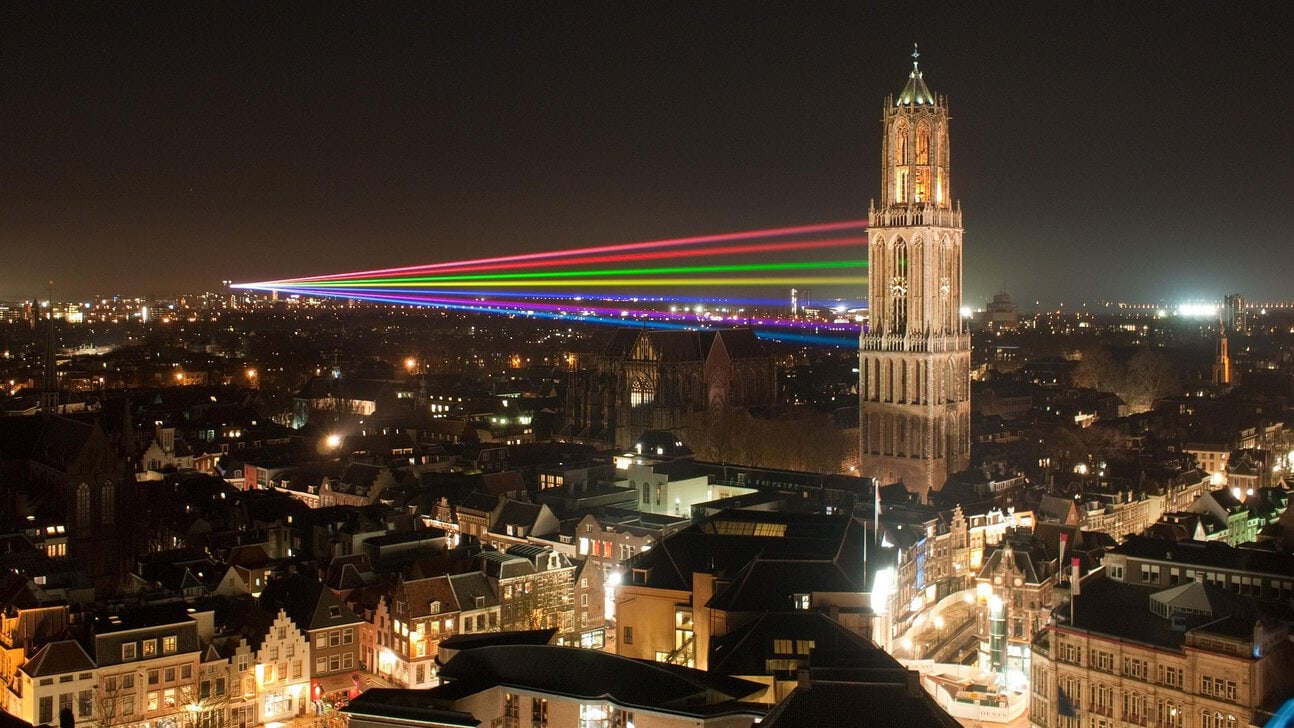
The Dom Tower (Domtoren) is Utrecht’s defining landmark and, at 112.3 metres, the tallest church tower in the Netherlands. Built between 1321 and 1382 to a design by the architect John of Hainaut, it was originally intended as the bell tower for a cathedral that would rival anything in France or Germany. The tower itself was finished, but the ambition slightly outpaced the engineering: on 1 August 1674, a freak tornado tore through Utrecht and collapsed the unfinished nave of the cathedral, permanently separating the tower from the church building it was meant to adjoin. The two structures have stood apart ever since, with the open space between them, Domplein square, marking exactly where the nave used to stand (the outline of the missing columns is picked out in the paving stones today).
Climbing the tower means tackling 465 steps via a narrow spiral staircase, and visits are only possible on a guided tour that departs from the visitor centre on Domplein, since the climb passes through the working bell chambers, including the historic Salvator bell and the 50-bell carillon that still rings out over the city centre. The tour takes roughly an hour and pauses partway up at a viewing platform before continuing to the very top, where on a clear day you can see as far as Amsterdam, Rotterdam and even the coast. Tickets run approximately €13-16 for adults with reduced rates for children, and it is genuinely worth booking online in advance during weekends and school holidays, since group sizes are limited and popular time slots sell out.
Practical tip: the staircase is steep, narrow and not accessible for those with mobility issues, prams or serious claustrophobia, and there is no lift. Wear proper shoes rather than sandals, since some sections of the route are open to the elements. If you only do one paid attraction in Utrecht, this is the one most visitors rate as the highlight of their trip, simply because the view puts the entire wharf-canal layout of the city into perspective in a way you cannot appreciate from ground level.
Directly beneath Domplein, don’t miss DOMunder, a genuinely excellent underground archaeology experience that takes small guided groups through excavated remains of the Roman fort, the original 8th-century church, and the collapsed cathedral’s foundations, using video projection and augmented sound rather than static display cases. It’s one of the more inventive museum concepts in the Netherlands and pairs naturally with a Dom Tower visit, since both start from the same square. Tickets are around €14.50 for adults and tours run for about an hour; booking ahead is recommended as group numbers are capped.
Best for a short trip. Compare rooms by neighbourhood, price and guest rating before you book.
Compare hotelsBest for families, or any stay past about four nights. A kitchen and a washing machine start paying for themselves.
Browse rentalsBest if you have already picked a hotel. Checks the big booking sites for the same room and shows who is cheapest.
Check dealsDom Church and the Cloister Garden
Standing separately from its tower, the Dom Church (Domkerk) is what remains of the original St Martin’s Cathedral, and it’s a striking example of Dutch Gothic architecture even in its truncated form. Construction began in 1254 on the site of earlier churches dating back to the 7th century, and although the nave was never rebuilt after the 1674 storm, the choir, transept and side chapels survive intact and are free to enter. Inside, look out for the elaborately carved choir stalls, the memorial to Count Guy of Avesnes, and the stained glass windows that were carefully restored after wartime damage.
Attached to the church is the Pandhof, a serene 15th-century cloister garden enclosed by covered walkways with delicate tracery windows. It’s a genuinely peaceful spot planted with medicinal herbs in the medieval style, and because it sits just off the main tourist route between Domplein and the Centraal Museum, it’s routinely overlooked, even though entry is free. Students from Utrecht University, whose historic buildings surround the square, often cut through here between lectures, which gives the space a lived-in rather than purely ornamental feel.
The church hosts occasional organ recitals and choral concerts, and Domplein itself is the social heart of the old city, ringed with cafés and usually busy with a mix of students, tourists and buskers. Give yourself 30-45 minutes here, more if a service or concert is on, and combine it naturally with the tower climb and DOMunder since all three sit within metres of each other.
Oudegracht and Utrecht’s Unique Two-Level Wharf Canals
The single most distinctive feature of Utrecht is the Oudegracht, the “Old Canal” that curves through the historic centre, and the wharf structure (werven) that lines it. Dug from the 12th century onward as the city’s main trading artery, the canal was cut deliberately below street level so that goods could be unloaded directly from boats into cellar-level warehouses, with the main streets and townhouses running along the top of the embankment. Nowhere else in the Netherlands, and arguably nowhere else in Europe, has this exact double-decker canal arrangement, which is why locals are quietly proud that Amsterdam, for all its fame, doesn’t actually have anything quite like it.
Over the past few decades, many of these brick wharf cellars (werfkelders) have been converted into restaurants, bars and boutique shops, so you can sit at water level, boats gliding past at eye height, while the everyday bustle of shoppers and cyclists continues on the street above you, entirely out of sight. Some of the best-known cellar restaurants cluster around the Stadhuisbrug and Lijnmarkt stretches of the canal; look for terraces built directly into the old loading bays, often marked by the original stone steps down from street level.
The best way to experience the Oudegracht is simply to walk both levels: stroll the upper street past the flower stalls, bookshops and cafés, then descend one of the many public staircases to the wharf path itself and walk along the water. A full loop of the historic canal ring takes roughly 1-2 hours at an easy pace, and it’s worth doing at two different times of day, once around midday when the terraces are lively, and once in the evening when the wharf buildings are lit up and reflected in the water. Canal boat tours also run regularly from docks near Oudegracht and Ganzenmarkt, giving you a seated, guided view of the wharf architecture from the water itself, typically 45-75 minutes and a good option if you’re short on time or mobility.
Photographers should pay particular attention to the bridges that cross the Oudegracht, since the arched stone bridges frame the wharf cellars and canal boats in a way that’s genuinely photogenic from almost any angle, and the golden hour light around sunset picks out the warm brick tones of the cellar walls especially well. The stretch between the Bakkerbrug and Stadhuisbrug bridges is generally considered the most picturesque, and it’s also where you’ll find the highest concentration of open cellar terraces if you decide to stop for a drink partway through your walk.
If you’re visiting in the darker months, keep an eye out for Trajectum Lumen, Utrecht’s permanent light art trail: a series of 34 site-specific illuminated artworks by different artists installed along historic buildings, bridges and canal walls across the city, designed to be enjoyed as an evening walking route rather than a temporary festival. Several installations sit directly along the Oudegracht, so a night walk along the wharves doubles as a light-art tour at no extra cost.
Explore Utrecht’s Famous Canals by Boat
One of the very best ways to discover Utrecht is from the water. While Amsterdam may be known for its canals, Utrecht’s waterways are older, quieter and arguably even more distinctive, thanks to the city’s unique wharf cellars, waterside terraces and medieval architecture. A relaxing canal cruise offers a completely different perspective of the city and is one of the most popular experiences for first-time visitors.
Cruises travel along the historic Oudegracht (Old Canal), which has been the heart of Utrecht for centuries. As you glide beneath picturesque bridges, you’ll pass elegant canal houses, bustling cafés built into the famous wharf cellars and some of the city’s oldest buildings, many of which date back to the Middle Ages. The route also provides excellent views of the magnificent Dom Tower, the tallest church tower in the Netherlands and Utrecht’s most recognisable landmark.
During the cruise you’ll also leave the Old Canal to explore parts of the former defensive moat, where you’ll learn about Utrecht’s historic fortifications while passing attractive green spaces including Zocherpark. Other sights along the journey include the Railway Museum, the impressive Hoog Catharijne shopping centre and several historic bridges and quays that have shaped Utrecht’s development for hundreds of years.
Depending on the departure you choose, cruises last between one hour and 90 minutes and depart from convenient locations in the city centre or near Hoog Catharijne. Commentary is available through a multilingual digital audio guide that connects to your smartphone, allowing you to learn about Utrecht’s history as you sail. Most visitors agree that taking a canal cruise early in their visit is worthwhile, as it provides an excellent overview of the city before exploring on foot.
Whether you’re interested in history, photography or simply relaxing on the water, Utrecht’s canal cruise is one of the city’s essential experiences and a fantastic introduction to one of the Netherlands’ most beautiful historic centres.
Discover the World’s Largest Apple Collection
Technology enthusiasts shouldn’t miss The Apple Museum, one of Utrecht’s newest and most unusual attractions. Home to the world’s largest collection of Apple products and memorabilia, the museum tells the story of more than fifty years of innovation, following Apple’s journey from the famous California garage of Steve Jobs and Steve Wozniak to one of the world’s most influential technology companies.
Spread across an impressive 2,000 square metres, the museum displays hundreds of iconic products, rare prototypes, historic accessories and unique collectibles. Unlike many traditional museums, most exhibits are not displayed behind glass, allowing visitors to get much closer to the technology that transformed personal computing, music, smartphones and digital design.
You’ll find everything from early Macintosh computers and classic iPods to vintage iPhones and rare Apple hardware that many people have never seen before. Interactive areas make the experience even more engaging, including the opportunity to use working vintage Macintosh computers, experiment with classic Apple software and even create your own retro-style iPod advertisement in the dedicated iPod Room. The interactive iPad Room provides hands-on activities suitable for visitors of all ages.
The museum is entirely self-guided, allowing you to explore at your own pace. Most visitors spend between 90 minutes and three hours discovering the collection, although technology fans could easily stay longer. Free parking is available for visitors arriving by car, while the museum is also accessible by public transport and offers step-free access throughout.
Whether you’re a lifelong Apple enthusiast, interested in the history of technology or simply looking for something a little different during your visit to Utrecht, The Apple Museum offers a fascinating look at one of the world’s most recognisable brands.
Centraal Museum: Dutch Art, Miffy and Utrecht’s Own History
The Centraal Museum is the oldest municipal museum in the Netherlands, tracing its origins to 1838, and it houses a genuinely broad collection spanning Old Masters, Utrecht Caravaggisti painters (a group of 17th-century artists, including Gerard van Honthorst, who brought Caravaggio’s dramatic chiaroscuro style back from Italy to Utrecht), modern and contemporary art, fashion, and applied design. The building itself is a converted medieval convent, so the galleries wind through a genuinely atmospheric mix of old brick corridors and modern white-cube extensions.
Two collections make this museum a must-visit rather than a generic city art museum. The first is the Gerrit Rietveld collection, the largest in the world, including original furniture designs from the De Stijl movement and detailed material on the Rietveld Schröder House across town (a UNESCO World Heritage Site that fans of modernist architecture should also try to visit if time allows). The second is the museum’s dedicated wing for Dick Bruna, the Utrecht-born illustrator who created Miffy (Nijntje in Dutch), showcasing original artwork, sketches and the evolution of his distinctive flat, primary-colour illustration style over six decades.
Admission runs approximately €18 for adults, €10.50 for students and CJP cardholders, €10 for ages 13-17, and free for children 0-12, though special exhibitions occasionally carry a small surcharge. The museum is open Tuesday to Sunday, 11am to 5pm, and closed Mondays. Budget 2-3 hours to do the permanent collection and at least one temporary exhibition justice; the on-site café overlooking the museum garden is a pleasant, uncrowded spot for a break partway through.
Museum Speelklok: A Museum That Plays Itself
Museum Speelklok, housed in a former 15th-century church just off the Steenweg shopping street, is one of Europe’s finest collections of self-playing musical instruments, from ornate street organs and barrel organs to musical clocks, automatons and dance-hall organs the size of small trucks. What sets it apart from a typical static museum is that almost everything on display is fully functional, and the entire visit is conducted as a guided walkthrough where staff actually play and demonstrate instruments as you move through the collection, rather than leaving you to read wall text in silence.
It sounds like a niche interest on paper, but in practice this is one of the most consistently enjoyed museums in the city among visitors of every age, largely because the demonstrations are genuinely theatrical: enormous fairground organs blast out full orchestral arrangements, and delicate 18th-century musical clocks chime melodies unchanged for centuries. Children in particular tend to love the scale and noise of the largest pieces, though the historical and mechanical detail rewards adult visitors just as much.
Admission is approximately €17 for adults, €12.50 for ages 13-17, and €9 for children aged 4-12, with under-3s free. The museum is open Tuesday to Sunday from 10am to 5pm, extending to include Mondays during Dutch school holidays. Visits are guided rather than fully self-directed, so allow around 1.5-2 hours including at least one full demonstration cycle, and check the day’s tour times when you arrive since they run at set intervals rather than continuously.
Best for long or awkward journeys. Builds one itinerary out of separate flights.
View flightsBest for anyone whose home plan charges by the megabyte abroad. Pay a fixed price up front.
Check eSIMsBest if you would rather not work out the transport on arrival. Book it now and forget it.
View transfersSpoorwegmuseum: The Dutch Railway Museum
Housed in and around the beautifully restored 1874 Maliebaan station, a 15-20 minute walk or short bus ride east of the city centre, the Nederlands Spoorwegmuseum (Dutch Railway Museum) is one of the most family-friendly attractions in Utrecht and easily worth half a day if you have train enthusiasts in your group. The museum combines dozens of full-size historic locomotives and carriages, many of which you can climb aboard, with immersive indoor exhibits, a miniature railway, and outdoor rides on a genuine narrow-gauge train around the museum grounds.
Highlights include the “Great Discovery” experience for younger children, walk-through carriages recreating different eras of Dutch train travel from steam-age third class through to modern high-speed rail, and rotating exhibitions on the social history of the railways in the Netherlands, including the sobering role trains played during the Second World War. The scale of the collection, several full engine halls under the original station’s iron-and-glass train shed roof, makes this feel considerably bigger than a typical city museum.
Admission is approximately €19.50 for visitors aged 4 and up, with under-3s free and NS employees receiving a reduced rate with ID. Note that even with a valid ticket or Museumkaart, you’re required to reserve a free timed entry slot online in advance, so don’t turn up without booking. The museum is generally open daily except Mondays outside school holiday periods. Budget at least 2.5-3 hours, and consider timing your visit around a mealtime, since the on-site restaurant is set inside a genuine restored dining carriage.
Nijntje (Miffy) Museum: Utrecht’s Own Rabbit
Miffy, the simple white rabbit with black dot eyes, was created in Utrecht by illustrator and graphic designer Dick Bruna, and the city takes understandable pride in the character, right down to a Miffy-shaped traffic light near the Nijntje pleintje (Miffy square) close to Bruna’s old studio. The Nijntje Museum, part of the Centraal Museum group and located inside the same historic complex, is a hands-on, interactive space built specifically for young children rather than a conventional gallery: kids can climb into Miffy-scale rooms, dress up, draw, and explore recreated scenes from the books.
This is squarely aimed at children roughly aged 2-8, and adults without kids in tow will likely find the standard Centraal Museum’s Dick Bruna gallery (covered above) more rewarding than the interactive museum itself. Admission runs approximately €14 for both children and accompanying adults, with free entry for babies under 1. If you’re travelling with young children, this pairs naturally with the main Centraal Museum next door, letting one parent do the art galleries while the other takes the kids through the interactive space, then swap.
Budget 1-1.5 hours for the interactive museum itself. Combination tickets covering both the Nijntje Museum and Centraal Museum are typically available and worth asking about at the desk, since most family visitors end up wanting to see both.
Kasteel de Haar: A Fairytale Castle on Utrecht’s Doorstep
For a proper castle experience, Kasteel de Haar sits around 10km northwest of central Utrecht in the village of Haarzuilens, and it’s routinely described as the Netherlands’ most “fairytale” castle, complete with turrets, a moat, drawbridges and extensive formal gardens and parkland. What visitors often don’t realise is that although a fortified house has stood on this site since the 14th century, the castle you see today is largely the result of a dramatic late-19th-century rebuild by the famous Dutch architect Pierre Cuypers (who also designed Amsterdam Centraal station and the Rijksmuseum), commissioned by Baron Etienne van Zuylen and his wealthy Rothschild-family wife.
The interior is furnished with an impressive collection of tapestries, armour, porcelain and furniture, and the surrounding grounds, designed in part by the same landscape architect behind Amsterdam’s Vondelpark, are genuinely lovely for a slow walk regardless of whether you go inside the castle itself. Spring is particularly popular, when the estate’s daffodils and rhododendrons are in bloom.
Combined castle-and-garden admission is approximately €21.50 for adults and €13.50 for children aged 4-12, while garden-only tickets are cheaper, roughly €12.50 for adults in the April-October season and €8 in the quieter winter months. Getting there without a car takes a little planning: the most reliable option is bus service from Utrecht Centraal towards Haarzuilens, or combining a train to Vleuten station with a short bus or taxi transfer; door-to-door journey time is typically 30-45 minutes. Because of the travel time, treat this as a half-day add-on rather than a quick stop, and check the castle’s current opening days before setting out, since it closes to visitors on selected dates for private events.

Rietveld Schröder House: A UNESCO-Listed Modernist Icon
Tucked away on a quiet residential street, Prins Hendriklaan, a short tram or cycle ride from the centre, the Rietveld Schröder House looks almost unremarkable from a distance and then genuinely startling up close: a stark composition of white, grey, black, red, yellow and blue planes and lines that still looks radical a century after it was built. Designed in 1924 by furniture-maker-turned-architect Gerrit Rietveld for Truus Schröder-Schräder, who wanted a home without traditional walls or fixed room divisions, it’s considered one of the defining buildings of the De Stijl art movement and was added to the UNESCO World Heritage list in 2000.
What makes the interior so influential is its first-floor “flexible living area,” where sliding and rotating partition walls let the upper floor be reconfigured from a single open-plan space into several separate bedrooms and back again within minutes, an idea that still feels ahead of its time. Every fitting, from the built-in furniture to the corner window that opens completely to dissolve the boundary between inside and outside, was designed by Rietveld specifically for this house.
Because the house is small and the interior fragile, visits are strictly by guided tour with limited group sizes, and slots regularly sell out days in advance, particularly on weekends, so book online well ahead if this is a priority. Tours typically run around an hour and are usually combined with a short audio-visual introduction at the nearby visitor centre before you’re walked through the house itself. If original Rietveld furniture and De Stijl design appeal to you, pair this visit with the dedicated Rietveld collection at the Centraal Museum, which holds the world’s largest assembly of his work and provides useful context before or after seeing the house in person.
Best Time to Visit Utrecht
Utrecht is a genuinely year-round destination, but the experience shifts noticeably with the seasons. Late spring through early autumn (May to September) brings the longest daylight hours and the liveliest canal-terrace atmosphere, with the wharf-level restaurants along the Oudegracht at their busiest and best. This is also when the Utrecht Early Music Festival, one of the largest early and classical music festivals in Europe, fills the Dom Church and other historic venues across the city, typically over ten days in late August and early September.
Early autumn brings the Netherlands Film Festival, the country’s leading film event, held across Utrecht’s cinemas and cultural venues, while November sees Le Guess Who?, an internationally respected experimental and alternative music festival that takes over venues throughout the city, including the Dom Church itself for some performances. If you’re travelling with a tighter budget or prefer thinner crowds, spring and autumn shoulder seasons offer a good balance of comfortable weather and manageable visitor numbers at the major museums.
Winter has its own appeal: the canal-side Christmas market and festive lighting along the Oudegracht are genuinely charming, cold air makes the wharf cellars’ warm interiors even more inviting, and Trajectum Lumen‘s illuminated art trail is at its best on long, dark evenings. Whatever time of year you visit, note that several major museums, including the Centraal Museum and the Railway Museum, close on Mondays outside school holiday periods, so it’s worth checking specific opening days before building a tight itinerary.
Getting To and Around Utrecht
Utrecht Centraal is one of the busiest and best-connected railway stations in the Netherlands, sitting directly beneath the Hoog Catharijne shopping centre and roughly a 10-15 minute walk from Domplein and the historic centre. Direct trains connect Amsterdam Centraal to Utrecht in as little as 26-40 minutes depending on the service, run every few minutes throughout the day, and make Utrecht one of the easiest cities in the country to combine with an Amsterdam-based trip. Direct or near-direct services also connect Utrecht to Rotterdam (around 40 minutes), The Hague (around 40-50 minutes), and Schiphol Airport (roughly 25-30 minutes), making it a genuinely convenient base for exploring the wider Randstad region.
Once you’re in the city, the historic centre is compact and almost entirely walkable, with most of the sights covered in this guide, Domplein, the Oudegracht, Museum Speelklok and the Centraal Museum, within a 15-20 minute walk of each other and of the station. For destinations slightly further out, such as the Spoorwegmuseum, the Rietveld Schröder House, or the Botanic Gardens, the city’s bus network departs from directly outside Utrecht Centraal, and journeys rarely take more than 15-20 minutes.
For a genuinely local way to get around, renting a bicycle is worth strong consideration: Utrecht is consistently ranked among the best cycling cities in the world, with dedicated cycle lanes on virtually every street and the world’s largest bicycle parking facility built directly into the station complex. Several rental outlets operate near Utrecht Centraal, and a half-day rental opens up neighbourhoods like Wittevrouwen, Lombok and the area around the Botanic Gardens that are a stretch to reach comfortably on foot. If you’re combining Utrecht with a trip to Kasteel de Haar, note that this is one destination genuinely better reached by bus or car than by bike, given the distance.
Best for a short stop where being central matters more than the room. Dorms and private rooms both listed.
See hostelsBest if you have ever given up on a claim. AirHelp checks whether the flight qualifies and pursues it for you.
See the benefitsBest for a day with a bag and nowhere to put it. Find a storage point near where you already are.
View storageShopping in Utrecht: Oudkerkhof, Steenweg and Twijnstraat
Utrecht’s shopping scene splits neatly into two personalities. For chain stores and mainstream fashion, head to Hoog Catharijne, the large indoor shopping centre connected directly to Utrecht Centraal station, one of the biggest of its kind in the Netherlands, along with the pedestrianised high streets that fan out from it, including Steenweg and Lange Elisabethstraat, which link the station area to Domplein.
For something more distinctive, the historic centre’s smaller streets are where Utrecht earns its reputation as a genuinely good shopping city. Oudkerkhof, a narrow lane running behind the Dom Church, has quietly become known as the city’s jewellery and design quarter, packed with independent goldsmiths, silversmiths and small ateliers where you can watch pieces being made by hand. Twijnstraat, on the southern side of the centre near the Museumkwartier, has a similarly independent, slower character, home to design boutiques, vintage and second-hand clothing shops, specialty bookshops and homeware stores that reward unhurried browsing rather than a quick pass-through.
The Saturday market on Vredenburg square, one of the largest general markets in the country, is worth timing a visit around if you’re in town on a weekend, with stalls selling everything from Dutch cheese and stroopwafels to flowers and fabric. For a quieter alternative to the main tourist streets, the antique and book stalls that occasionally set up along the Oudegracht wharf level add another layer worth poking through if you’re already down there exploring the canal cellars.
Where to Eat: Wharf Cellars, Cafés and Utrecht’s Food Scene
Eating in Utrecht is inseparable from the wharf-cellar architecture described earlier, and some of the most memorable meals in the city happen at canal level, boats gliding past at eye height while you eat. Restaurants and bars occupying converted werfkelders cluster particularly thickly around the Stadhuisbrug, Lijnmarkt and Ganzenmarkt stretches of the Oudegracht, ranging from casual lunch spots doing Dutch classics like bitterballen and uitsmijter to more polished dinner menus built around seasonal, often locally-sourced ingredients.
Because Utrecht is home to one of the largest universities in the Netherlands, the food scene skews notably younger, more international and more casual than you might expect from a historic Dutch city centre. The area around Neude square and the Nobelstraat/Voorstraat axis is dense with affordable lunch spots, coffee roasters and ethnic restaurants popular with students, while Twijnstraat and the Museumkwartier have a slightly more grown-up, brunch-and-wine-bar feel. For a classic Dutch pancake (pannenkoeken) or poffertjes stop with kids in tow, several dedicated pancake houses operate directly on or just off the canal.
If you want a genuinely local evening out, look for a “bruine kroeg” (brown café), the traditional Dutch pub style with dark wood interiors and a serious beer list, several of which cluster around Ganzenmarkt and the Domplein area. Utrecht also has a strong coffee culture, with independent roasters scattered through the Wittevrouwen and Lombok neighbourhoods just outside the main tourist core, both worth a wander if you want to see a more residential, lived-in side of the city alongside your coffee.
Hidden Gems: Sonnenborgh, the Botanic Gardens and Nicolaikerk
Most visitors never make it past the Dom Tower and the main canal loop, which means a handful of genuinely excellent spots stay pleasantly uncrowded. Sonnenborgh Museum and Observatory, built into a 16th-century fortified bastion on the southern edge of the old city, combines a working historic observatory with exhibits on astronomy and meteorology, and its slightly eccentric mix of star-gazing equipment and Renaissance-era fortress walls makes for one of the more unusual small museums in the country. Admission is modest, roughly €7-9, and evening stargazing sessions run periodically, weather permitting, and are worth checking for if you’re visiting after dark.
The Utrecht University Botanic Gardens, a short cycle or bus ride from the centre, are far less visited than the equivalent gardens in Amsterdam despite covering a larger area and including a rock garden, systematic garden, glasshouses and an arboretum planted since 1723. It’s an easy, quiet way to spend an hour or two away from the crowds, and admission runs around €9 for adults.
In the old centre itself, the Nicolaikerk (St Nicholas Church) and the surrounding Museumkwartier, a cluster of streets south of Domplein including Nicolaaskerkhof and Agnietenstraat, offer a genuinely atmospheric, almost entirely tourist-free stretch of medieval Utrecht, with the Museum Catharijneconvent (a leading collection of medieval religious art, housed in another former convent) tucked in among the quiet lanes. Finally, if you want to see Utrecht’s canal architecture from a genuinely different angle, walk or cycle the Wittevrouwensingel and the old fortified “Singel” ring that loops around the historic centre where the medieval city walls once stood; several original defensive towers survive and now house small businesses and cafés, a detail almost no visiting itinerary mentions.
Further out, the neighbourhoods of Wittevrouwen and Lombok reward the small effort it takes to reach them. Wittevrouwen, just northeast of the centre near the Railway Museum, has a relaxed, residential feel with independent coffee roasters, bakeries and small shops spread along Nachtegaalstraat and Bergstraat. Lombok, west of the centre along the Kanaalstraat, is Utrecht’s most multicultural neighbourhood, home to a long-running Wednesday and Saturday street market and a dense concentration of Middle Eastern, Turkish and Surinamese grocers, bakeries and restaurants that offer a genuinely different flavour of the city compared to the postcard-perfect old town. Neither neighbourhood features in typical day-trip itineraries from Amsterdam, which is exactly why they’re worth the short detour if you have more than a few hours to spend.

Which Attractions Are Right for You?
If you only have a few hours in Utrecht, prioritise the free, high-impact combination of Domplein: the Dom Church, a walk along both levels of the Oudegracht, and, if time allows, the Dom Tower climb for the view that ties it all together. This trio captures what makes the city distinctive without requiring more than half a day.
Travelling with children under 10, structure your day around the Spoorwegmuseum or the Nijntje Museum paired with Museum Speelklok’s interactive demonstrations, all of which are built for hands-on engagement rather than quiet gallery-browsing. Art and design lovers should make the Centraal Museum, with its Rietveld and Dick Bruna collections, their anchor, while history and architecture enthusiasts will get more out of DOMunder, Sonnenborgh and a wander through the Museumkwartier’s quieter lanes.
If you have a full day or more and access to a car or willingness to take a short bus transfer, add Kasteel de Haar as a half-day excursion, ideally in the morning before the castle’s grounds get busy with weekend visitors. And whatever else you do, don’t skip an evening walk along the wharf level of the Oudegracht; it’s free, it takes an hour, and it’s the single experience most past visitors say defines their memory of Utrecht.

Rupert’s Handy Travel Tips
Utrecht’s canals have a hidden lower level, and so does its best advice, here’s what I’ve picked up exploring the wharves myself.
- Book the Dom Tower climb ahead: tours are guided, capped in size, and sell out on weekends, so reserve your slot online rather than turning up hoping for a spot.
- Walk the canal at two levels, twice: do the Oudegracht once at street level and once down on the wharf path, and come back after dark to see the cellars and Trajectum Lumen light art lit up.
- Reserve a free timeslot for the Railway Museum: even with a valid ticket or Museumkaart, you need a booked entry time, don’t skip this step or you may be turned away.
- Rent a bike for a half day: Utrecht has some of the best cycling infrastructure in the world, and reaching quieter spots like the Botanic Gardens or Wittevrouwensingel is far easier by bike than on foot.
- Skip the queue for Kasteel de Haar: book castle tickets online in advance for a fixed entry slot, since walk-up tickets from the vending machine can mean a wait during busy periods.
Want to meet the reindeer behind our travel tips? Find out more in our page Who is Rupert?.




Frequently Asked Questions
How many days do you need in Utrecht?
A full day covers the essentials, Domplein, the Dom Tower, the Oudegracht canal walk and one museum, but two to three days lets you add the Railway Museum, a Kasteel de Haar half-day trip, and time to explore neighbourhoods like the Museumkwartier and Twijnstraat without rushing.
Is Utrecht worth visiting if I’ve already seen Amsterdam?
Yes. Utrecht’s two-level wharf canal system is genuinely unique in the Netherlands, and the city has a different, more student-driven, less tourist-heavy atmosphere than central Amsterdam, despite being only around 26-40 minutes away by direct train.
Can you climb the Dom Tower without a guided tour?
No, access is guided only, since the route passes through the working bell chambers. Tours run at set times throughout the day and are best booked online in advance, particularly on weekends and during school holidays.
Is Utrecht suitable for a day trip with young children?
Very much so. The Spoorwegmuseum, Nijntje Museum and Museum Speelklok are all designed with young children in mind, and the flat, largely car-free historic centre is easy to navigate with a pram.
How do you get from Amsterdam to Utrecht?
Direct trains run frequently from Amsterdam Centraal to Utrecht Centraal, typically taking between 26 and 40 minutes depending on the service, making Utrecht one of the easiest and quickest day trips from Amsterdam.
Do I need to book museum tickets in advance?
It’s recommended for the Spoorwegmuseum, where a timed entry slot is required regardless of ticket type, and advisable for the Dom Tower and DOMunder due to capped group sizes. Centraal Museum and Museum Speelklok are generally easier to visit without advance booking outside peak season.
Is Kasteel de Haar easy to reach without a car?
Yes, though it takes a little more planning than the city-centre sights. Bus services run from Utrecht Centraal towards Haarzuilens, or you can take a short train to Vleuten and connect by bus or taxi; door-to-door journey time is typically 30-45 minutes.
What’s the best way to see the wharf cellars if I don’t want to eat at one?
Simply walk the lower wharf path along the Oudegracht; it’s public, free, and lined with cellar architecture whether or not you stop to eat, and canal boat tours also depart regularly from docks near Ganzenmarkt for a seated view from the water.
Further Reading
If Utrecht has won you over, it makes an excellent base for exploring more of the surrounding region, and our Best Day Trips from Utrecht guide covers the towns and countryside within easy reach by train and bus. Many visitors also combine Utrecht with a look at the country’s biggest hub: our cornerstone guide to Things to Do in Amsterdam and the companion Day Trips from Amsterdam guide are both worth reading if Amsterdam features anywhere in your itinerary, since Utrecht itself is one of the most popular day-trip destinations covered there.
For getting around the country more broadly, the NS Day Ticket is worth considering if you plan on combining Utrecht with several other Dutch cities in one trip, while the Holland Travel Ticket and Interrail Benelux Pass both cover the Utrecht-Amsterdam-Rotterdam-The Hague corridor if you’re travelling more widely across the Netherlands and neighbouring Belgium and Luxembourg. If you’re flying into Schiphol before heading to Utrecht, our Schiphol Airport Transfers guide covers the fastest routes onward.
Further afield, if your Dutch itinerary extends south, our guides to Things to Do in The Hague and Things to Do in Rotterdam cover two more of the Netherlands’ most rewarding cities, both easily reached from Utrecht by direct train in well under an hour.