Reviewed by our editorial team Updated
Escape Dublin for the Day
Dublin makes a brilliant base, but some of Ireland’s finest scenery, history and coastline sit within an hour or two of the city centre. From the granite cliffs of Howth to the Neolithic passage tomb at Newgrange, which predates Stonehenge, the choice of day trips from Dublin is genuinely one of the best in Europe for a capital city this compact. Whether you fancy a quiet coastal DART ride, a scenic bus into the Wicklow Mountains, or a cross-border train to Belfast, there is a realistic option for almost every budget and timeframe.
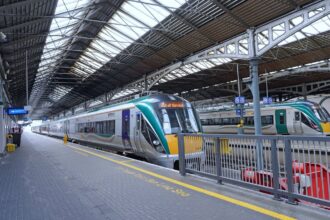
This guide covers eight of the best day trips from Dublin, each with real train, bus and driving times so you can plan around opening hours rather than guesswork. Dublin’s DART line makes the coastal towns of Howth, Bray and Malahide especially easy, with trains departing every 20 to 30 minutes from Connolly, Tara Street and Pearse stations. Further afield, Irish Rail intercity services reach Kilkenny in around 90 minutes, while the Enterprise service, jointly run by Iarnród Éireann and Translink, covers the 181km to Belfast in just over two hours.
Not every destination on this list is reachable by rail. Glendalough, Powerscourt Estate and Newgrange are better suited to a dedicated bus service, a scheduled Dublin Bus route, or a guided coach tour, since none currently has a direct train link.
The comparison table below gives you a quick snapshot of journey times, the best public transport option, and how long to realistically set aside for each destination before we go into detail on every one of them.
| Destination | Journey Time | Best Public Transport | Ideal Time Needed |
|---|---|---|---|
| Howth | 25 to 30 minutes | DART from Connolly, Tara Street or Pearse | Half day (3 to 4 hours) |
| Glendalough | Around 1 hour 20 minutes | St Kevin’s Bus from St Stephen’s Green | Full day |
| Kilkenny | 1 hour 27 minutes to 1 hour 45 minutes | Irish Rail from Heuston Station | Full day |
| Belfast | 2 hours 5 minutes to 2 hours 20 minutes | Enterprise train from Connolly Station | Full day |
| Newgrange | Around 45 minutes by road | Guided coach tour from Dublin city centre | Half day to full day |
| Bray | 35 to 45 minutes | DART from Connolly, Tara Street or Pearse | Half day |
| Malahide | 22 to 28 minutes | DART from Connolly Station | Half day |
| Powerscourt Estate | Around 45 to 60 minutes | Dublin Bus route 44 to Enniskerry | Half day |
Walk the Cliffs at Howth
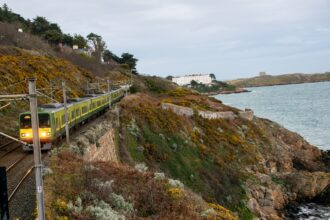
Howth is the easiest day trip from Dublin, and one of the most rewarding. The DART runs directly from Connolly, Tara Street and Pearse stations to Howth in around 25 to 30 minutes, with trains every 20 to 30 minutes through the day. A single fare using a Leap Card costs around €2 under the current 90-minute fare system, making it one of the cheapest excursions on this list. The station sits barely 50 metres from the harbour, so there is no onward transfer needed once you arrive.
The main draw is the Howth Cliff Path Loop, a signposted coastal trail that winds around Howth Head past gorse-covered headland and the Baily Lighthouse, with views across Dublin Bay to Ireland’s Eye and, on a clear day, as far as the Mourne Mountains. Several loop lengths are signposted from the village, so you can tailor the walk to however much time you have before the last train back.
Howth is still a working fishing harbour, and the seafood stalls and restaurants along the pier are a big part of the appeal, with fresh crab claws, smoked salmon and chowder sold within sight of the boats that landed them. Boat trips to the seabird colony on Ireland’s Eye also depart from the harbour in season. Between the DART’s low cost, the short journey time and the combination of a proper cliff walk with a genuine fishing village, Howth is hard to beat for a half-day escape from the city.
Browse hotels and accommodation for your visit to Dublin.
View staysExplore holiday homes and apartments around Dublin.
See holiday homesCompare hotel deals in Dublin from multiple booking sites.
Compare pricesCruise the Coast on a Howth Boat Tour
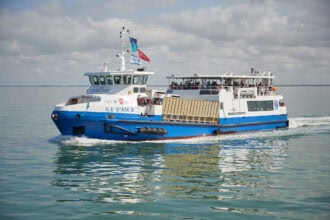
Once you have walked at least part of the Cliff Path, seeing Howth from the water gives a genuinely different perspective on the same coastline. A Howth coastal boat tour departs from the West Pier, a short walk from the DART station, and runs for around 50 minutes, taking small groups of up to eleven passengers out along the base of the Howth Cliffs and around the small island of Ireland’s Eye.
The island and surrounding water form part of the Dublin Bay UNESCO Biosphere, and the boat gets close enough to spot the seal colony that gathers around the harbour and island year-round, along with seabirds including gannets, guillemots, kittiwakes and, in season, puffins. The skipper provides live commentary throughout on the history of the peninsula, with a bit of local Irish music playing in the background, and it is a relaxed, low-effort way to round off a day that started with the cliff walk.
Given the small boat size, booking ahead online is worth doing, particularly on a fine weekend when demand is highest, and it is worth checking the weather beforehand since sailings can be affected by rough conditions. Combined with the Cliff Path Loop and a plate of fresh seafood on the pier, it makes for a genuinely full day out from a single DART journey.
Discover Glendalough and the Wicklow Mountains
Glendalough sits deep in the Wicklow Mountains, roughly 50km south of Dublin, and has no direct rail link, so the easiest public transport option is St Kevin’s Bus, which departs from St Stephen’s Green North and takes around 1 hour 20 minutes to reach the site. Fares are paid on board and cost around €14 one way or €23 return, though departures are limited to a couple of services a day, so it is worth checking glendaloughbus.com before you travel. Drivers can reach Glendalough in around an hour via the N11 and the scenic R755 through the Wicklow Gap.
The valley’s centrepiece is its early monastic settlement, founded in the 6th century by Saint Kevin, a hermit and member of a ruling Leinster family who chose the site where two rivers meet. The remains include a near-perfectly preserved round tower standing around 30 metres tall, a ruined cathedral, and several smaller churches scattered among the graveyard, all set against the Upper and Lower Lakes.
Beyond the monastic ruins, Glendalough sits within Wicklow Mountains National Park, and waymarked trails of varying difficulty climb from the Upper Lake into the surrounding hills, including the popular Spinc Loop with its boardwalk sections and views back down over both lakes. Because bus departures are infrequent, it is worth building your whole day around the timetable rather than trying to see everything on a tight turnaround.
Explore Medieval Kilkenny
Kilkenny is comfortably reachable by rail, with Irish Rail running direct intercity trains from Heuston Station to Kilkenny MacDonagh in around 1 hour 27 minutes to 1 hour 45 minutes, with around five direct services running each day. It is the furthest destination on this list that still works comfortably as a single day out, provided you catch an early train down and keep an eye on the last service back in the evening.
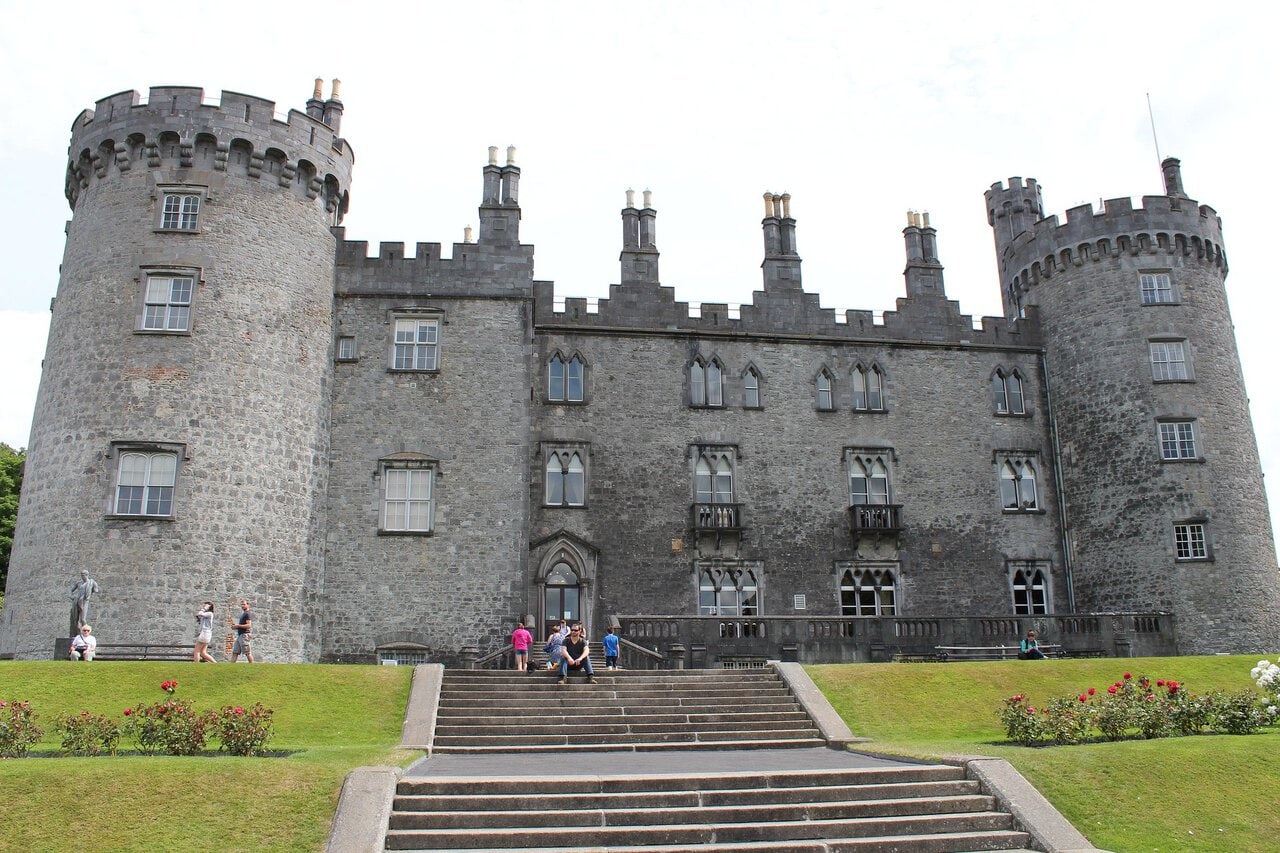
The city is built around Kilkenny Castle, a fortress begun in the 12th century that served as the principal seat of the Butler family, earls, marquesses and dukes of Ormond, for almost 600 years before passing into state ownership in 1969. Self-guided tours of the castle’s Victorian-era interiors, including its long Picture Gallery, cost around €8 for adults, with the castle open daily from 9:15am to 5:30pm between April and September.
Beyond the castle, Kilkenny’s Medieval Mile links the castle to St Canice’s Cathedral through narrow medieval streets and laneways lined with independent shops, traditional pubs and craft workshops, making it one of Ireland’s best-preserved medieval city centres. Between the castle grounds, the cathedral and the compact walkable centre, Kilkenny comfortably fills a full day without feeling rushed.
Combine Wicklow, Glendalough and Kilkenny in One Guided Day
Given that Glendalough has no direct rail link and Kilkenny sits a fair distance south, independently combining both destinations with the Wicklow Mountains in a single day by public transport is genuinely impractical. A Wicklow Mountains, Glendalough and Kilkenny tour solves this by covering all three in one coach journey, with a driver-guide handling the route between them.
The order typically depends on the season: in summer, the day usually begins in Kilkenny, with free time to explore the castle grounds and Medieval Mile, before continuing through the Wicklow Mountains to Glendalough for a guided or self-guided walk around the monastic site and Lower Lake. In winter and on Sundays, the order often reverses, with Glendalough and Wicklow first and Kilkenny in the afternoon. Along the way, many of these tours also stop at a working sheep farm for a traditional sheepdog demonstration, and pass through countryside used as filming locations for productions including Braveheart and P.S. I Love You.
This kind of tour suits visitors who want to see both Glendalough and Kilkenny without the logistics of St Kevin’s Bus timetables and a separate rail journey on different days, and it removes the need to drive yourself through the Wicklow Gap, a scenic but narrow mountain road best enjoyed as a passenger rather than behind the wheel.
Visit Belfast
Belfast is the most ambitious day trip on this list, but it is entirely doable thanks to the Enterprise train, a cross-border service jointly operated by Iarnród Éireann and Translink. Trains run from Dublin Connolly to Belfast Grand Central Station in 2 hours 5 minutes to 2 hours 20 minutes depending on the number of stops, covering 181km, with an hourly weekday and Saturday timetable since the service was expanded in October 2024. For full details on fares, timetables and booking, our dedicated Dublin to Belfast guide covers everything you need to plan the journey itself.
Given the length of the journey, Belfast rewards an early start more than any other destination here. The city centre is compact enough to cover on foot from Lanyon Place, with the Titanic Quarter, the Cathedral Quarter’s pubs and murals, and Victorian landmarks like Belfast City Hall all within easy reach. We cover the best of it in our Best Things to Do in Belfast guide, which is worth reading before you travel so you can prioritise what matters most in a single day.
If you have more than a day to spare, or fancy hiring a car once you arrive, Belfast also makes a sensible staging point for the Giant’s Causeway on Northern Ireland’s Antrim coast. It is too far to combine with the train journey on a single day trip from Dublin, but our Giant’s Causeway Visitor Guide is worth bookmarking if Belfast turns into an overnight stop.
Experience Newgrange
Newgrange, in the Boyne Valley of County Meath, is one of the few destinations on this list without a practical public transport route, so a guided coach tour is genuinely the easiest way to visit. Operators such as Mary Gibbons Tours run day tours from Dublin city centre for around €80 all-inclusive, covering coach transport, guiding and site entry. Drivers can reach the Brú na Bóinne Visitor Centre independently in around 45 minutes via the M1, though it is worth noting that visitors cannot drive directly to the Newgrange monument itself and must instead be brought in by shuttle bus from the visitor centre, with pre-booked tickets essential.
Newgrange is a Neolithic passage tomb built around 3200 BC, making it older than both Stonehenge and the Egyptian pyramids. It forms part of the Brú na Bóinne UNESCO World Heritage Site, alongside the neighbouring tombs of Knowth and Dowth, and together they hold the largest collection of megalithic art in Western Europe.
The tomb’s most famous feature is its winter solstice alignment, where sunrise on the shortest days of the year shines directly through a roof box above the entrance and along the passage into the inner chamber, a feat of Neolithic engineering that still draws thousands of applicants into an annual lottery for access on the day itself. Because ticket numbers to the visitor centre are limited and pre-booking is essential, this is one day trip from Dublin worth arranging well ahead of time rather than turning up on spec.
Search routes and flight options for your trip to Dublin.
Search flightsUse an eSIM to get online without hunting for a local SIM after arrival.
See eSIM optionsCheck private pickup options and plan your onward journey before arrival.
View transfersSee the Cliffs of Moher, Burren and Galway City in a Day
The Cliffs of Moher sit on the far side of the country from Dublin, well over three hours away by road, which puts them beyond a sensible independent day trip for anyone without a car and a very early start. A Cliffs of Moher, Burren and Galway City day tour makes it achievable in a single, long day by handling the entire journey by coach.
These tours typically depart Dublin early in the morning, crossing the counties of Kildare and Limerick before reaching the west coast. Most itineraries include around two hours at the Cliffs of Moher themselves, with premium access to the Atlantic Edge visitor experience, followed by a scenic drive along the Burren coastal route through the karst landscape of the Burren, and a stop of an hour or two in Galway city, often with a short walking tour included, before the drive back to Dublin in the evening.
Given the distances involved, this is a genuinely long day, often twelve to thirteen hours door to door, so it suits visitors who specifically want to tick off the west coast highlights in one go rather than build a separate overnight trip around them. Booking a few days ahead during summer is worth doing, since the more popular departures do sell out.
Relax in Bray
Bray sits around 20km south of Dublin city centre, right on the border of County Wicklow, and the DART gets you there in 35 to 45 minutes from Connolly, Tara Street or Pearse, with frequent departures roughly every 10 to 20 minutes during the day. Buses on the 145 route also run into Bray but take closer to 50 to 75 minutes depending on traffic, so the DART is the more reliable option for a day trip. Drivers can expect around 30 to 45 minutes via the M50 and N11.
Bray’s long Victorian seafront promenade is the town’s main attraction, backed by amusement arcades, ice cream shops and a strip of restaurants facing the beach. At the southern end, Bray Head rises steeply above the town and offers a shorter alternative for anyone who does not fancy the full coastal trail, with paths climbing to a large cross at the summit and views back over Bray’s harbour and the Sugar Loaf inland.
For a longer walk, the coastal path toward Greystones hugs the cliffs south of Bray Head, passing old railway tunnels and rocky coves along a route of around 7km. Sections of the path have been prone to closures due to erosion in recent years, so it is worth checking current conditions before setting out. Between the promenade, Bray Head and the cliff path, Bray works well either as a relaxed half day by the sea or a more active outing for keen walkers.
Wander Around Malahide
Malahide is the quickest coastal escape from Dublin on this list. The DART runs directly from Connolly Station to Malahide in around 22 to 28 minutes, making it easy to combine with another nearby stop, or simply to head out after a late breakfast and still have most of the day ahead of you. The village itself is a short walk from the station, with a marina, seafront green and a good spread of cafes and restaurants along the main street.
The main attraction is Malahide Castle and Gardens, home to the Talbot family for almost 800 years after the land was first granted to them in 1185 for services to the crown. What began as an Anglo-Norman tower house was expanded over the centuries into the current castle, and the interior now houses opulent state rooms and period art collections, open daily from 9:30am to 5:30pm with a minimum of two hours recommended for a full visit.
The surrounding demesne includes a walled garden, a butterfly house and a fairy trail aimed at younger visitors, all set within parkland that makes for a pleasant wander even without paying for the castle tour itself. Because the journey is so short, Malahide also pairs naturally with a morning in Dublin city centre and an afternoon by the coast, without needing to commit an entire day to travel.
Visit the Game of Thrones Studio Tour from Dublin
If you’re a Game of Thrones fan, this is one of the most impressive day trips you can take from Dublin. Located at Linen Mill Studios in Banbridge, Northern Ireland, this is the world’s only official Game of Thrones Studio Tour, giving visitors the chance to step inside the real filming location where much of the series was brought to life.
The package includes return coach travel from Dublin city centre, making the journey completely hassle-free. After a comfortable 90-minute coach ride, you’ll have plenty of time to explore more than 110,000 square feet of authentic sets, costumes, props and behind-the-scenes exhibits before returning to Dublin later in the afternoon.
Unlike many television attractions, nothing here is a replica. You’ll walk through the Great Hall of Winterfell, stand inside Dragonstone’s war room, admire the real Iron Throne, and see over 150 original costumes worn by the cast. Interactive displays explain how the visual effects, makeup, weapons, scenery and special effects were created, making the experience just as interesting for anyone fascinated by film and television production.
The attraction is entirely indoors, making it an excellent option if the Irish weather isn’t cooperating, and the self-guided format means you can explore at your own pace. There’s also a café, restaurant and the largest Game of Thrones merchandise shop in the world, selling exclusive items you won’t find elsewhere. Even visitors who have never watched the series often enjoy seeing how one of television’s biggest productions was created.
Giant’s Causeway, Titanic Belfast and the Dark Hedges
If you’re looking to pack as much as possible into a single day, this full-day guided tour from Dublin is one of the best-value excursions available. Combining Northern Ireland’s most famous natural attraction, one of Europe’s finest museums and several iconic filming locations, it’s a long but incredibly rewarding journey.
The highlight for many visitors is the spectacular Giant’s Causeway, a UNESCO World Heritage Site made up of around 40,000 interlocking basalt columns created by ancient volcanic activity. Whether you believe the scientific explanation or prefer the legendary tale of the giant Finn McCool, it’s one of Ireland’s most unforgettable landscapes. You’ll have around 90 minutes to explore the rocks, coastal paths and dramatic viewpoints.
The tour also includes admission to Titanic Belfast, one of the world’s leading interactive museums. Built on the very site where RMS Titanic was constructed, the museum tells the complete story of the famous ship through immersive exhibitions, reconstructed interiors and multimedia displays. Even visitors who aren’t particularly interested in maritime history are often surprised by how engaging the experience is.
Along the way you’ll stop for photographs at the dramatic ruins of Dunluce Castle, perched dramatically on the cliffs above the Atlantic Ocean, before continuing to the atmospheric Dark Hedges, a beautiful avenue of ancient beech trees made famous as the Kingsroad in Game of Thrones. Before returning to Dublin there’s also some free time in Belfast, allowing you to see landmarks such as St Anne’s Cathedral, the Albert Memorial Clock and the city’s bustling shopping streets. Although it’s a 13 to 14-hour day, it’s one of the easiest ways to experience Northern Ireland’s biggest highlights without hiring a car.
Discover Powerscourt Estate
Powerscourt Estate sits just outside the village of Enniskerry in County Wicklow, described by the estate itself as around 20 minutes south of Dublin by car, though public transport takes a little longer. Dublin Bus route 44 runs from the city centre to Enniskerry in around 45 to 60 minutes, from where it is a short walk to the estate gates. Drivers can expect a similar journey time via the N11, with parking available on site.
Powerscourt’s 47-acre gardens were ranked the third-best garden in the world by National Geographic, and are divided into distinct sections including the formal Italian Garden, a Japanese Garden and a Walled Garden, all set below the dramatic backdrop of the Sugar Loaf mountain. Garden admission costs around €14, with the gardens open daily from 9:30am to 5:30pm, last entry thirty minutes before closing.
A separate ticket covers the Powerscourt Waterfall, Ireland’s highest at 121 metres, located around 6km from the main estate within its own parkland and popular for picnics. Waterfall admission costs around €7.50, with hours from 9:30am to 7pm and last admission at 6pm. Between the gardens, the house and the waterfall, Powerscourt easily fills a relaxed half day trip from Dublin.
Browse hostels and budget-friendly stays around Dublin.
See hostelsGet help with compensation, eligible lounge access and disruption support.
Explore AirHelp+Leave your luggage somewhere convenient and enjoy Dublin hands-free.
View storageChoosing Between Train, Bus and Car
For the coastal towns closest to Dublin, the DART is almost always the best choice. Howth, Bray and Malahide are all served by frequent trains running every 15 to 30 minutes, fares are cheap under the Leap Card’s 90-minute fare system, and there is no need to worry about parking or traffic on the M50. For destinations further out, such as Kilkenny or Belfast, Irish Rail’s intercity and Enterprise services are generally faster and more comfortable than driving, and they let you relax rather than navigate unfamiliar roads.
Bus travel makes the most sense for destinations without a rail link, such as Glendalough with St Kevin’s Bus or Powerscourt with Dublin Bus route 44, though it is worth checking timetables carefully since some services run only a couple of times a day. A hire car gives the most flexibility, particularly for combining two nearby stops such as Powerscourt and Glendalough in the same day, or for reaching Newgrange without booking a coach tour, but you will need to budget for parking, tolls on routes like the M50, and slower journey times through Dublin’s rush hour traffic on the way out of the city.
As a general rule, if a destination is on the DART line, take the train. If it involves winding mountain roads through Wicklow, or a genuinely long haul out to the west coast for the Cliffs of Moher, a scheduled bus or a guided coach tour is usually more relaxing than self-driving, particularly if you would rather look at the scenery than the road.
Booking an Organised Day Tour
For destinations like Glendalough, Powerscourt, Newgrange and the Cliffs of Moher, an organised coach tour often works out simpler than piecing together bus timetables yourself, especially if you are short on time or travelling without a car. Many operators combine two or three stops into a single day, such as pairing Glendalough with Kilkenny, or Newgrange with the Hill of Tara, which suits visitors who want to cover more ground without renting a car or working around infrequent local bus services.
The trade-off is less flexibility over timing, since you will be following a set itinerary and a fixed return time rather than lingering as long as you like at any one stop. For sites with limited capacity or timed entry, such as Newgrange, booking through a tour operator also removes the risk of arriving to find tickets sold out, since the coach transport and site entry are usually bundled together in a single advance booking.
Using the OPW Heritage Card for Dublin Day Trips
Ireland’s Office of Public Works manages 173 heritage sites around the country, and its Heritage Card gives unlimited admission to all of them for a full 12 months from the date of purchase. Pricing is set at €40 for an adult, €30 for a senior aged 60 or over, €10 for a student with valid ID, and €10 for a child aged 12 to 18, while a family card covering two adults and up to five children costs €90. Full pricing and details on how to order a card are available on the Heritage Ireland website. Children under 12 are admitted free at OPW sites in any case, so the card is really aimed at adults, students and older teenagers who plan to visit more than one property, rather than families travelling with only younger children.
Three of the destinations covered in this guide happen to be OPW-managed sites, which makes the card worth factoring into your planning rather than an afterthought. The monastic site and visitor centre at Glendalough, as covered in the Glendalough section above, falls under OPW management, as does Kilkenny Castle, detailed in the Medieval Kilkenny section, where standard adult admission to the castle interior otherwise runs to around €8. The Brú na Bóinne Visitor Centre, the mandatory access point for Newgrange described in the Newgrange section, is also OPW-run, and admission there is included under the card as well, rather than needing to be booked separately as part of a paid coach tour.
Paid individually at standard admission prices, Kilkenny Castle, the Brú na Bóinne Visitor Centre and Glendalough would together cost more than the price of a single adult Heritage Card, so anyone planning to visit even two of the three should find the card pays for itself. It becomes even better value if your Dublin day trips are the start of a longer road trip, since the same card covers dozens of other OPW properties around the country, from castles and abbeys to gardens and historic houses, without needing to pay separate entry at each stop. Full details on how to buy the card, where it is accepted and how it works alongside pre-booked tickets at sites like Brú na Bóinne are covered in our OPW Heritage Card guide.

Rupert’s Handy Travel Tips
I’ve trotted around most of these day trips myself, so here’s what actually makes a difference when you’re heading out of Dublin for the day.
- Top up your Leap Card first: load enough credit for a return DART journey before you leave the house, since not every small station has a working ticket machine.
- Check St Kevin’s Bus times twice: the Glendalough service only runs a couple of times a day, so build your whole itinerary around the return departure rather than the outbound one.
- Book Newgrange tickets in advance: the visitor centre limits daily numbers, and turning up without a pre-booked ticket often means being turned away entirely.
- Start early for Belfast: with a journey of over two hours each way, catching the first Enterprise service gives you the most time in the city before the last train home.
- Pack a light waterproof: Wicklow and the coast can turn wet fast even on a forecast sunny day, and there’s rarely shelter halfway up a cliff path.
- Book the Cliffs of Moher tour well ahead in summer: it’s a long day out and seats on the most popular departures sell out days in advance.
Want to meet the reindeer behind our travel tips? Find out more in our page Who is Rupert?.




Frequently Asked Questions
What is the closest day trip to Dublin by DART?
Malahide is the quickest, reachable from Connolly Station in around 22 to 28 minutes, closely followed by Howth at around 25 to 30 minutes.
Can you visit Belfast from Dublin in a single day?
Yes, the Enterprise train covers the journey in around 2 hours 5 minutes to 2 hours 20 minutes each way, so an early departure leaves a full day in the city before the last train home.
Do I need to book Newgrange tickets in advance?
Yes, pre-booking is essential since visitor numbers at Brú na Bóinne are limited, and you cannot access the Newgrange monument without a ticket for the shuttle bus from the visitor centre.
Is Glendalough accessible without a car?
Yes, St Kevin’s Bus runs from St Stephen’s Green in Dublin to Glendalough in around 1 hour 20 minutes, though services are limited to a couple of departures a day.
Which day trip from Dublin is best for families?
Malahide Castle is a popular choice thanks to its short DART journey and family-friendly grounds, including a butterfly house and fairy trail alongside the castle tour.
Can I visit the Cliffs of Moher from Dublin in one day?
Yes, though it is a long day, typically twelve to thirteen hours door to door. A guided coach tour covering the Cliffs of Moher, the Burren and Galway City is the most practical way to do it without driving yourself across the country.
Can I combine Glendalough and Kilkenny in one day?
Yes, a guided tour covering the Wicklow Mountains, Glendalough and Kilkenny together is the most practical way to see both, since there is no direct rail link between them and public transport connections are limited.
Further Reading
If Belfast has caught your attention, our full Dublin to Belfast guide covers Enterprise train fares, timetables and booking in more detail than we can fit here. For a wider look at how Ireland’s train network fits together beyond the routes covered in this guide, our Ireland Rail Network Guide is a useful next stop, particularly if you are planning to combine several day trips into a longer Irish itinerary.
Before heading out of the city, it is also worth spending time exploring Dublin itself. Our guide to the Things to Do in Dublin rounds up the best of the capital for the days you are not out on a day trip, while our Dublin Public Transport Guide explains how the Leap Card, DART, Luas and bus network all fit together, which is well worth reading before your first day trip so you are not figuring out fares at the station.