Reviewed by our editorial team Updated
Explore Ireland’s Wild West From Galway
Galway city sits right at the edge of Ireland’s Wild West, which makes it one of the best bases anywhere in the country for day trips. Within an hour or two of the city you can reach limestone mountains, a Benedictine abbey built for a Victorian love story, three windswept islands in Galway Bay, and cliffs that rise more than 200 metres straight out of the Atlantic.
Few Irish cities put so much dramatic landscape within such easy reach, and that is exactly why Galway works so well as a launchpad rather than just a destination in its own right.
The catch is that this is genuinely rural Ireland, and public transport does not always run where you might expect. Some destinations, like the Aran Islands, are served by regular ferries and even an eight-minute flight from Connemara Airport. Others, like the Burren or Cong, have no direct scheduled bus at all, which is why an organised tour or a hire car often makes far more sense than trying to piece together connections.
This guide walks through the seven best day trips from Galway, with real journey times, operators and practical advice for each one, plus a look at the OPW Heritage Card for anyone planning to see several state-managed sites during a longer stay.
Before you commit to a route, it helps to see how the main options stack up against one another. The table below compares journey times, the best way to travel and how long you realistically need at each spot, based on current timetables from operators including Citylink, Bus Éireann and Aran Island Ferries.
| Destination | Journey Time | Best Transport | Ideal Time Needed |
|---|---|---|---|
| Connemara (Clifden) | About 1 hour 30 minutes | Citylink bus or car | Full day |
| Kylemore Abbey | About 1 hour 15 minutes (80km) | Organised tour or car | Half day |
| Aran Islands | 40 minutes by ferry from Rossaveal, or 8 minutes by air | Aran Island Ferries or Aer Arann Islands | Full day |
| Cliffs of Moher | About 1 hour 20 minutes by car (75km) | Bus Éireann Route 350 or car | Half day |
| The Burren | About 1 hour to Ballyvaughan | Organised tour or car | Half to full day |
| Cong | About 45 to 50 minutes (42km) | Organised tour or car | Half day |
| Doolin | About 1 hour (69km) | Bus Éireann Route 350 or car | Half day |
Experience Connemara: Bogland, the Twelve Bens and Diamond Hill
Connemara is the wild, boggy, mountainous region that stretches west of Galway city towards the Atlantic, and it is the destination most visitors picture when they imagine Ireland’s west coast. The easiest way to reach it without a car is the Citylink route 923 bus, which runs up to nine times daily from Galway Coach Station and reaches Clifden, the region’s main town, in around 90 minutes.
The bus stops in Oughterard after roughly 35 minutes and at Recess after about 70 minutes, both useful jumping-off points for walkers heading into the hills. Driving the same route via the N59 takes a similar amount of time, though it can easily stretch into a full day once you factor in stops.
What makes Connemara worth the journey is the sheer scale of the landscape. The region is dominated by the Twelve Bens mountain range and by Connemara National Park, a 2,000 hectare stretch of mountain, bog, heath and grassland that was founded and opened to the public in 1980.
Much of the parkland was once part of the Kylemore Abbey estate and the Letterfrack Industrial School, and its southern reaches once belonged to Richard “Humanity Dick” Martin, the local landowner and MP who helped found what became the RSPCA in the early nineteenth century.
The park’s highest peak, Benbaun, rises to 729 metres, though most day visitors instead climb Diamond Hill, a 442 metre peak on a looped boardwalk trail that draws an estimated 10,000 climbers a year out of roughly 80,000 total visitors to the park. On a clear day the summit gives views across bogland, lakes and the Atlantic that rival anywhere on the Wild Atlantic Way.
Connemara ponies, a hardy native breed, are now the largest mammals roaming the park, while red deer, once hunted out of the area around a century and a half ago, have recently been reintroduced. The park’s visitor centre sits on the Clifden side of Letterfrack and has its own car park, making it the natural starting point before tackling Diamond Hill or any of the shorter looped nature trails through the bog.
Connemara’s history runs deeper than the scenery suggests. Just south of Clifden, the boggy Derrygimlagh site marks where Guglielmo Marconi built a transatlantic wireless station in 1907, and the same stretch of bog is where aviators John Alcock and Arthur Brown crash-landed in June 1919 after completing the first non-stop transatlantic flight, mistaking the soft green bog for a field. A short looped walking trail at Derrygimlagh now links both sites with information panels.
Beyond the history, Connemara rewards slow driving. Villages like Roundstone and Letterfrack sit along a coastline of small inlets and white sand beaches that feel far removed from the busier tourist trail further south. Roundstone itself was laid out in the 1820s by the Scottish engineer Alexander Nimmo as a planned fishing village, and its small harbour beneath Errisbeg hill still has the same tucked-away, end-of-the-road feel that later drew artists and musicians to settle there.
Combining Connemara with Kylemore Abbey in the same day is common, since the abbey lies just off the main Clifden road, but doing both properly in one visit means an early start and, ideally, your own transport rather than relying solely on scheduled bus times.
Compare hotels and other places to stay in Galway.
Check availabilityExplore holiday homes and apartments around Galway.
See holiday homesSee hotel prices from multiple booking sites in one search.
Compare ratesVisit Kylemore Abbey: A Victorian Love Story on Kylemore Lough
Kylemore Abbey sits on the shore of Kylemore Lough in the heart of Connemara, around 80 kilometres from Galway city, a drive of roughly 1 hour 15 minutes along the N59. There is no single direct bus, so most independent visitors either drive, catch a Citylink or Bus Éireann service toward Clifden and Letterfrack and arrange transfers from there, or join one of the organised day tours that run from Galway specifically for the abbey and its gardens.
The abbey is open seven days a week from 10am to 6pm, with last entry to the visitor experience at 5pm, and adult admission runs to around €16 (£14 / $19), which includes the Victorian Walled Garden.
The building itself has a genuinely romantic backstory. It was built as a private residence between 1867 and 1871 by Mitchell Henry, a wealthy London doctor and Manchester textile magnate who later served as MP for County Galway, and it was designed by architect James Franklin Fuller, who employed around 100 men for four years to complete it.
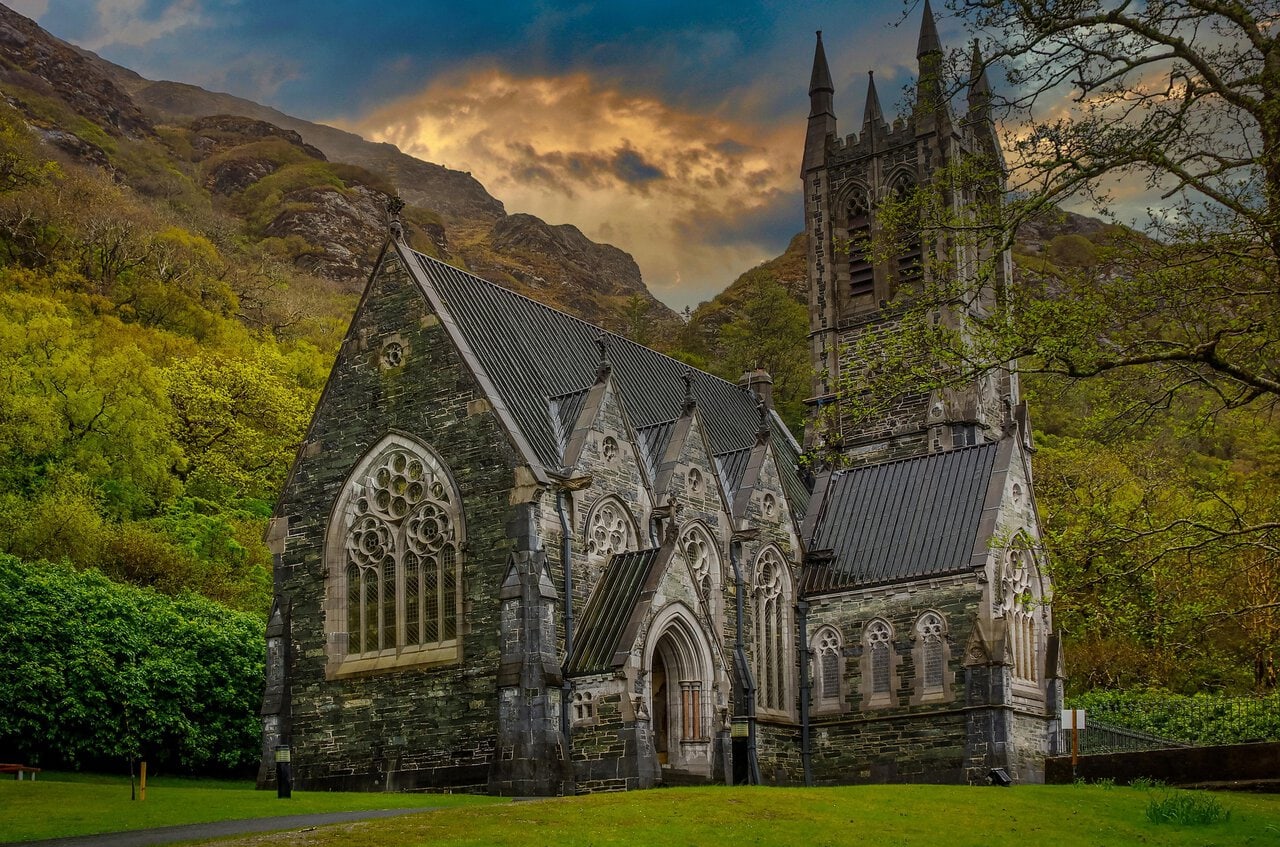
After his wife Margaret died in 1874, Henry added a Gothic chapel and family mausoleum on the grounds as a memorial to her, both of which are still open to visitors today. The chapel was modelled as a miniature cathedral, with each stone of a different Irish marble said to represent a different county. Henry was also an enthusiastic tree planter, and the wider estate, once running to several thousand acres of mountain, lake and woodland, still carries the mark of his Victorian landscaping in its mixed forest walks around Kylemore Lough.
The castle later became a Benedictine abbey when a community of Irish nuns arrived in 1920 after being bombed out of their original abbey in Ypres, Belgium during the First World War. Two years later the nuns opened a girls’ boarding school on the estate, which ran for decades until it closed in 2010, when a shrinking, ageing community of nuns no longer had the numbers to staff it.
The nuns still maintain a presence on the estate, and the six-acre Victorian Walled Garden, originally laid out by head gardener James Garnier in 1870 and tended by around 40 gardeners in its Victorian heyday, fell into disrepair through the twentieth century before a full restoration back to its nineteenth-century layout began in 1995.
Today it is divided into a formal flower garden and a kitchen garden that once supplied the abbey’s own kitchens, and it remains one of the most photographed spots in Connemara. A craft shop, tea room and the ruined former head gardener’s house all sit within the walled garden grounds, and a free shuttle bus links the garden to the abbey itself for visitors who would rather not walk the full loop.
Between the lake, the mountains and the abbey’s reflection on the water, it is easy to see why this is one of the most visited sites on any Galway day trip itinerary, and it pairs naturally with a Connemara loop earlier the same day.
Sail to the Aran Islands: Ferries, Flights and Dún Aonghasa
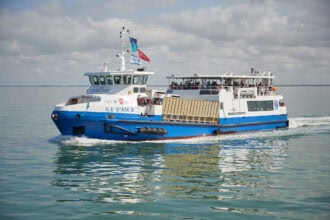
The Aran Islands, made up of Inis Mór, Inis Meáin and Inis Oírr, sit out in Galway Bay and are the one destination on this list that genuinely requires a boat or a plane rather than a road. The main operator, Aran Island Ferries, runs a coach from Galway city to the harbour at Rossaveal, from where the crossing to Inis Mór takes about 40 minutes; sailing directly from Galway city’s own dock takes closer to 90 minutes.
An adult return ticket costs around €34 (£29 / $39). For something faster, Aer Arann Islands flies tiny propeller planes from Connemara Airport in Inverin to all three islands in as little as 8 minutes, a genuinely thrilling way to arrive.
An alternative route worth knowing about is the Doolin Ferry Company, which sails from Doolin in County Clare rather than Galway. Its crossings are even shorter, taking about 15 minutes to Inis Oírr and 35 minutes to Inis Mór, which makes it a smart option if you are combining the islands with the Cliffs of Moher in the same trip rather than starting from Galway city itself.
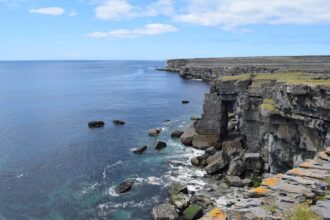
Inis Mór, the largest of the three, is home to Dún Aonghasa, a dramatic Bronze and Iron Age stone fort that is over 3,000 years old and was refortified again between roughly AD 700 and 800. It sits on a sheer sea cliff with an 87 metre drop to the Atlantic below, ringed by three massive drystone defensive walls and, on its landward side, a dense field of upright jagged stones known as a chevaux de frise, designed to slow any attacker on foot.
Excavations have turned up prehistoric metalworking hearths, house foundations and burials, and the site is managed today by the Office of Public Works, whose OPW Heritage Card is worth knowing about if you plan to see more than one state-run site during your trip (more on that further down this page).
A visitor centre near the base of the site, upgraded with a €1.6 million investment from the OPW, Fáilte Ireland and the Department of Housing, Local Government and Heritage, sits about a fifteen to twenty minute uphill walk from the fort itself, and a typical visit including the walk in both directions takes around 1 to 1.5 hours.
On Inis Oírr, the smallest of the three islands, the rusting wreck of the MV Plassy, a cargo steamer driven ashore in a storm in March 1960 while carrying whiskey, stained glass and yarn, has become a minor celebrity in its own right thanks to its appearance in the opening credits of the sitcom Father Ted.
All three islands share a landscape of drystone walls, Irish-speaking communities and a pace of life that feels decades removed from the mainland. Bicycles are the classic way to explore once you land, and most visitors find that a full day, rather than a rushed half day, is needed to do the island justice, particularly if a visit to Dún Aonghasa and its cliff-edge views is on the itinerary.
Inis Meáin, the middle and least visited of the three islands, sees only a fraction of the day-trip traffic that lands on Inis Mór, which makes it a good option for anyone hoping to escape the crowds entirely, though it means fewer facilities and a smaller ferry timetable to plan around.
Book Your Aran Islands Ferry
A trip to the Aran Islands is one of the highlights of visiting Ireland’s west coast. Whether you’re heading to Inis Mór, Inis Meáin or Inis Oírr, the islands offer dramatic Atlantic scenery, ancient stone forts, quiet beaches and traditional Irish culture that feels a world away from the mainland.
Most visitors travel by ferry from Rossaveel (near Galway) or Doolin (County Clare), with seasonal sailings also available from other ports. Crossing times are typically 30 to 60 minutes, depending on your departure point and the weather.
Use the Direct Ferries search tool below to compare ferry routes, sailing times and ticket prices in one place. Booking in advance is recommended during the summer months, school holidays and weekends, when the most popular departures can sell out quickly.
Stand Above the Cliffs of Moher: Ireland’s Most Visited Natural Attraction
The Cliffs of Moher are Ireland’s single most visited natural attraction and its second most visited fee-paying attraction overall, drawing more than 1 million visits a year. They sit roughly 75 kilometres from Galway city, about 1 hour 20 minutes by car via the coast road through Kinvara and Doolin.
For anyone without a car, Bus Éireann’s Route 350 runs directly between Galway and Ennis via Kinvara, Doolin and the cliffs themselves, with up to ten services a day during the summer months, though the journey by bus stretches closer to 2 hours each way.
Gate admission to the visitor centre costs €15 (£13 / $17) for an adult, and booking online in advance is generally cheaper and guarantees entry during busy periods. The visitor centre itself opened in 2007 and was deliberately built into the hillside rather than on top of it, giving it a cave-like profile that has minimal visual impact on the cliffs above and earned it Best Public/Cultural Building at that year’s Royal Institute of Architects of Ireland awards.
Inside, an interactive exhibition covers the ocean, rock, nature and human history of the site, alongside the Ledge, Ireland’s first 4D cinema experience, two cafés and a craft shop, and free binocular and picnic blanket loans for anyone walking the cliff path.
The cliffs themselves run for about 14 kilometres along the County Clare coastline and reach their highest point at 214 metres, just north of O’Brien’s Tower, a stone viewing tower built in 1835 by local landowner Sir Cornelius O’Brien to encourage the tourists already flocking to the area in the early nineteenth century.
The rock face is made up of Namurian shale and sandstone laid down between 313 and 326 million years ago, and the cliffs form the largest mainland seabird breeding colony in Ireland, home to more than 30,000 seabirds including guillemots, razorbills, kittiwakes, choughs and, from late March onward, puffins.
At the southern end of the site, a headland known as Hag’s Head is said in local legend to resemble the profile of an old woman, tied to a folk tale about a hag pursuing the mythical hero Cú Chulainn along the coast. The cliffs have also featured on screen more than once, including as the fictional Cliffs of Insanity in The Princess Bride and in Harry Potter and the Half-Blood Prince.
On a clear day the views stretch across Galway Bay to the Aran Islands and the mountains of Connemara, tying this stop neatly back into the rest of a Galway-based itinerary. Keen walkers can also pick up the wider Cliffs of Moher Coastal Walk, an unofficial trail that runs well beyond the paved visitor path all the way from Hag’s Head in the south to Doolin in the north, though the exposed, unfenced sections nearer Doolin should only be attempted in good weather and sturdy footwear.
Because the cliffs sit roughly halfway between Galway and Doolin, many visitors combine the two in a single half day, or extend further south along the Wild Atlantic Way toward Loop Head. Whichever way you arrive, allow at least two hours at the site itself to walk the cliff path in both directions from the visitor centre.
Discover the Burren: Limestone, Wildflowers and a 5,000-Year-Old Tomb
The Burren is a vast expanse of exposed limestone pavement covering parts of north Clare, and it is unlike anywhere else in Ireland. The gateway village of Ballyvaughan lies about 48 kilometres from Galway city, roughly 56 minutes by car, but there is no direct scheduled bus into the heart of the region, which is why most visitors either self-drive or join an organised tour that loops through the Burren alongside the Cliffs of Moher.
The 66 kilometre Burren Scenic Drive links Ballyvaughan, Carran, Kilfenora, Lisdoonvarna, Fanore and Black Head, and makes a satisfying full-day loop if you have your own car.
The landscape formed over 325 million years ago in a tropical sea, and its cracked limestone pavements, known locally as “grikes” and “clints,” support an extraordinary mix of plant life. The Burren is home to more than 70% of Ireland’s native flower species, including 23 varieties of orchid, growing in the same square metre as Arctic, Mediterranean and alpine plants, a botanical quirk found almost nowhere else in Europe. Human presence here runs a long way back too, though not as far as is sometimes claimed: the earliest accepted evidence anywhere in Ireland is a bear knee bone butchered by people and found in a cave near Ennis, dated to around 12,500 years ago, as the Burren and Cliffs of Moher UNESCO Global Geopark itself sets out. Anything much earlier than that falls inside the last Ice Age, when this landscape lay under ice.
Beneath the pavement, the region is honeycombed with caves; Aillwee Cave, near Ballyvaughan, was discovered in 1944 when a farmer named Jack McGann followed his dog into a hillside opening, though it was not developed and opened to the public until 1976, the same year cavers found the bones of two brown bears inside that were later dated at over 10,000 years old.
The most iconic sight above ground is Poulnabrone Dolmen, a Neolithic portal tomb whose capstone has stood for millennia. Excavations uncovered the remains of 33 people buried there, dated to between 3,800 and 3,200 BC, making it older than the pyramids of Giza.
Nearby, Burren National Park covers 1,500 hectares, making it the smallest of Ireland’s six national parks, and offers waymarked trails through the same karst terrain without an entry fee. The wider region was designated the Burren and Cliffs of Moher UNESCO Global Geopark in recognition of its geology, archaeology and traditional farming practices, a status shared with Doolin further down the coast.
The village of Kilfenora, sometimes called the city of the seven crosses, is worth the detour for its ruined cathedral, which dates to the late twelfth century and stands beside one of the largest collections of high crosses anywhere in Ireland, most carved around 1152 when the site was raised to diocesan status.
Nearby Ballyvaughan is also home to the Burren College of Art at Newtown Castle, a sixteenth-century tower house that now doubles as a working art school and gallery, a reminder that this stark landscape has drawn artists as well as archaeologists for generations.
Walkers with more time can also pick up sections of the Burren Way, a waymarked trail running 114 kilometres from Lahinch to Corofin via Doolin and the Cliffs of Moher, while a smaller family-run stop near Carran, the Burren Perfumery, makes natural soaps, balms and fragrances by hand from a herb garden on site and is a pleasant, low-key break from the archaeology-heavy itinerary elsewhere in the region.
Wander Around Cong: The Quiet Man Village and Ashford Castle
Cong straddles the border between County Galway and County Mayo, on the strip of land between Lough Corrib and Lough Mask, about 42 kilometres from Galway city via the N84 through Headford. Lough Corrib itself is the largest lake in the Republic of Ireland, covering around 176 square kilometres and scattered with well over a thousand islands, and it remains one of the country’s most sought-after wild brown trout and salmon fisheries, with boats for hire in Cong for anyone keen to fish rather than just sightsee.
By car the journey takes around 45 to 50 minutes, while public transport involves changing from Bus Éireann route 456 to route 422 in Headford and can take anywhere from 1.5 to 2 hours, which makes a car or an organised tour the far more practical choice for a day trip.
Cong’s biggest claim to fame is cinematic. The village was the setting for the 1952 Oscar-winning film The Quiet Man, starring John Wayne and Maureen O’Hara, and several original filming locations, including Cohan’s Bar, are still standing and open to visitors today, alongside a small museum dedicated to the film.
Just outside the village sits Ashford Castle, whose story stretches back to 1228, when the Anglo-Norman de Burgo family built the first castle on the site on the grounds of a former monastic settlement. The de Burgos, later known as the Burke family, held it for more than 350 years until it passed to an English official in 1589.
In the 1850s the estate was bought by the Guinness brewing family, and Lord Ardilaun, Arthur Guinness, extended it further between 1875 and 1881 in Neogothic style, the form the castle still largely takes today; it became a hotel in 1939 and has since hosted guests including King George V, Ronald Reagan and John Lennon.
The castle grounds are also home to Ireland’s School of Falconry, the oldest established falconry school in the country, where guests can fly a Harris hawk through the woodland even without booking an overnight stay, and spectators are never charged simply to watch the birds fly.
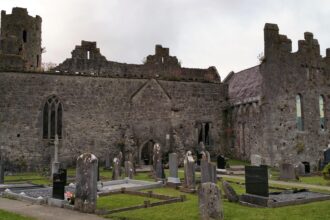
Cong also has a much older story to tell. Cong Abbey was founded in 1135 by Turlough O’Connor, High King of Ireland, on the site of an earlier sixth-century monastery, and once housed an estimated 3,000 monks at its peak. It later became the burial place of Rory O’Connor, Ireland’s last High King.
Between the ruined abbey, the castle grounds and a network of dry limestone caves and underground rivers nearby, including the atmospheric Pigeon Hole cave, Cong offers a quieter, more historical counterpoint to the coastal scenery found elsewhere on this list.
One more curiosity worth seeking out is the Cong Canal, a six kilometre channel begun in 1848 as a famine relief scheme to link Lough Corrib and Lough Mask. The project was abandoned unfinished in 1854 after engineers discovered too late that the district’s cavernous limestone simply swallowed the water, and the unused channel, still known locally as the Dry Canal, can be walked along its excavated bed today.
Search flights and useful route combinations for your trip.
View flightsUse an eSIM to get online without hunting for a local SIM after arrival.
See eSIM optionsCheck private pickup options and plan your onward journey before arrival.
View transfersVisit Doolin: Ireland’s Unofficial Capital of Traditional Music
Doolin is a small village on the County Clare coast, about 69 kilometres from Galway city, a drive of roughly 1 hour 3 minutes via the N67. It is really made up of three small clusters, Fisherstreet, Roadford and the harbour area around Doolin Pier, strung along the road rather than a single centre, so it can feel smaller and quieter than its reputation suggests until the pubs fill up in the evening.
It sits directly on Bus Éireann’s Route 350, the same service that runs between Galway and Ennis via Kinvara and the Cliffs of Moher, which makes it one of the easier stops on this list to reach without a car. Doolin is also the departure point for the Doolin Ferry Company, whose boats run to the Aran Islands and on short cruises beneath the Cliffs of Moher from March through November, so it works well as a base for combining several Wild West highlights in one outing.
Doolin is also a popular overnight stop for exactly this reason, since it lets visitors split the Cliffs of Moher, the Aran Islands and the Burren across two shorter days rather than trying to force all three into one long day from Galway.
What Doolin is best known for, though, is traditional Irish music. The village is often called the unofficial capital of Irish trad, and its handful of pubs, including Gus O’Connor’s, McGann’s and McDermott’s, host live sessions most nights of the week that draw musicians from across the country.
The village grew into this reputation gradually through the twentieth century as visiting musicians settled locally, and today it remains one of the most reliable places in Ireland to hear unamplified, informal trad sessions rather than a staged performance. Sessions typically get going from around 9pm, and while nothing is ever guaranteed in an informal setting, arriving early enough to get a seat near the musicians is usually worth it during the busy summer months.
Beyond the music, Doolin sits within the Burren and Cliffs of Moher UNESCO Global Geopark, and just outside the village is Doolin Cave, discovered by British cavers in 1952 but not opened to the public until 2006 after years of debate over how to protect it.
Inside hangs the Great Stalactite, a single free-hanging formation measuring around 7.3 metres, believed to be the longest of its kind in Europe and outmatched by only a handful of caves worldwide. The cliffs themselves are just a short walk or drive to the south, and Doolin Pier marks the northern end of the unofficial Cliffs of Moher Coastal Walk described above, making it a natural point to start or finish that route on foot rather than by car.
A half day in Doolin, timed around a ferry crossing, a cave tour or an evening session, is usually enough to get a feel for the place.
Choosing Between Train, Bus and Car for These Day Trips
Galway city itself is well connected by rail, with regular Iarnród Éireann services running to Dublin Heuston in around 2.5 hours, and full details are covered in our Ireland Rail Network Guide.
Once you are trying to head out into Connemara, Clare or south Mayo, though, the train network stops being useful, since none of these day trip destinations sit on a rail line. From Galway, everything covered in this guide is reached by bus, ferry, organised tour or car instead. It is a similar story elsewhere in the west of Ireland, so if a day trip from Galway is only one leg of a longer visit, it is worth checking rail coverage for the rest of the country before assuming a train will get you close to any of these destinations.
Citylink and Bus Éireann cover the two busiest corridors well. Citylink’s route 923 handles Connemara and Clifden with up to nine daily departures, while Bus Éireann’s Route 350 links Galway to Doolin, the Cliffs of Moher and Ennis with up to ten daily services in summer.
Beyond these two routes, though, bus coverage thins out fast. Cong needs a change of bus in Headford and can take up to two hours each way, the Burren has no direct service at all, and Kylemore Abbey requires a walk or transfer from the nearest Connemara bus stop. Taxis and private drivers can fill some of these gaps for a single leg, but for a genuine full-day loop taking in two or three stops, they tend to work out considerably more expensive than either a hire car or an organised coach tour.
A hire car gives the most flexibility and is worth considering if you plan to visit more than one or two destinations in a single day, particularly for Cong and the Burren. That said, driving on narrow, unfamiliar rural roads is not for everyone, especially with limited time.
Ireland drives on the left, many of the smaller regional roads out towards Connemara and the Burren narrow to a single lane with passing points, and parking at popular spots like Diamond Hill, Poulnabrone Dolmen and the Kylemore Abbey car park can fill up by mid-morning in July and August.
Galway city itself is worth planning around too, since the compact one-way system and limited on-street parking in the centre mean most visitors are better off collecting a hire car from an out-of-town depot rather than trying to navigate the city streets themselves.
In practice, the choice usually comes down to how many stops you are trying to fit in: one clear destination suits the bus or ferry perfectly well, while a loop combining several sites, such as Kylemore, Connemara and the Burren, is much easier with a car or an organised tour doing the driving for you.
Booking an Organised Day Tour From Galway
For destinations without direct public transport, an organised coach tour from Galway is often the simplest solution, and it is usually the only realistic option for visitors who would rather not drive on unfamiliar rural roads at all. Operators including Lally Tours and the Galway Tour Company run daily departures covering combinations such as Connemara and Kylemore Abbey together, or the Cliffs of Moher and the Burren in a single loop, typically departing central Galway between 7am and 9am and returning by early evening.
A typical full-day coach tour covering the Cliffs of Moher and the Burren runs to around eight hours, includes free hotel pick-up, and usually calls at a handful of extra stops along the way, such as a photo stop at Dunguaire Castle in Kinvara, an optional underground tour at Aillwee Cave and a lunch break in Doolin, on top of roughly ninety minutes at the cliffs themselves.
These tours remove the guesswork around bus connections and parking, and a guide on board usually adds context about the history and geology that self-drivers would otherwise miss.
The trade-off is flexibility. A coach tour runs to a fixed schedule with set stopping times at each location, so if you want to linger longer at Poulnabrone Dolmen or skip a photo stop entirely, a hire car or private driver gives you that control instead.
For the Aran Islands specifically, combined tickets covering the coach to Rossaveal, the ferry crossing and a minibus tour of Inis Mór are widely available and tend to work out cheaper than booking each leg separately, and most of these itineraries build in enough time at Dún Aonghasa to walk out to the fort and back without rushing.
It is worth checking exactly what a combined ticket includes before booking, since some cover only transport and a guided island tour while others also bundle in admission to sites like Dún Aonghasa itself. Whichever destination you choose, booking a day tour a few days ahead during the summer months is sensible, since seats on the more popular Connemara and Cliffs of Moher routes do sell out.
Group sizes vary by operator too, from smaller minibus tours capped at a dozen or so passengers up to larger coaches carrying upward of sixty people in peak season, so it is worth checking the vehicle type if you would rather avoid a full-sized bus.
Visiting Dún Aonghasa With the OPW Heritage Card
Dún Aonghasa, the clifftop stone fort on Inis Mór covered above in the Aran Islands section, is one of the roughly 780 heritage properties looked after by the Office of Public Works, the state body responsible for the country’s castles, abbeys, gardens and prehistoric monuments, and one of the smaller number of those, more than 90 nationwide, that charge admission and accept the OPW Heritage Card.
Standard admission to the site is around €5 (£4.50 / $6) for an adult, but frequent visitors to OPW sites can instead buy an OPW Heritage Card, which gives unlimited admission for twelve months from first use to every fee-charging OPW site, more than 90 of them nationwide, from Dún Aonghasa itself to sites as far afield as Kilmainham Gaol, Rock of Cashel and Newgrange.
Current pricing puts an adult card at €40 (£34 / $46), a senior card for those aged 60 and over at €30 (£26 / $35), and a student card at €10 (£8.50 / $11.50). Children aged 12 to 18 also pay €10 (£8.50 / $11.50), children under 12 go free, and a family card covering two adults and up to five children costs €90 (£77 / $104). Full terms and the current list of participating sites are set out in our OPW Heritage Card guide.
Whether the card makes sense really depends on your itinerary rather than this one visit. For a single day trip out to Dún Aonghasa alone, paying the standard gate admission is cheaper than buying an adult card outright.
The card only starts to pay for itself once you are combining several OPW sites across a longer Irish trip, for example pairing Dún Aonghasa with a stop at a national park visitor centre, a historic house or a monastic ruin elsewhere in the country during the same twelve-month window. If your Galway day trips are one part of a wider tour that also takes in sites further afield, it is worth doing the sums before you travel rather than assuming the card is automatically good value.

Rupert’s Handy Travel Tips
Having trotted around most of Galway’s day trip routes myself, here are a few things I wish someone had told me before I set off.
- Book Aran ferries early in summer: the Rossaveal crossing and the connecting coach from Galway can sell out on fine days between June and August, so book at least a day ahead.
- Check Kylemore’s last entry time: the abbey stops admitting visitors at 5pm even though the grounds stay open until 6pm, so aim to arrive by early afternoon.
- Pack proper waterproofs regardless of the forecast: the cliff paths at Moher and the boardwalks on Diamond Hill are exposed to Atlantic wind and rain that can arrive with little warning.
- Book Cliffs of Moher tickets online: it is cheaper than paying at the gate and it guarantees you a slot during the busiest midday hours.
- Do not try to cram Connemara, Kylemore and the Burren into one day without a car: the distances look short on a map but the roads are narrow and winding, so pick two destinations rather than three if you are relying on public transport.
Want to meet the reindeer behind our travel tips? Find out more in our page Who is Rupert?.




Frequently Asked Questions
Do I need a car to visit the Aran Islands from Galway?
No, the islands are reached by ferry from Rossaveal or Galway city, or by an eight-minute flight from Connemara Airport, so a car is not required and can be a hindrance once you arrive since the islands are small.
What is the best day trip from Galway without a car?
The Cliffs of Moher and Doolin are the easiest to reach on public transport, since Bus Éireann’s Route 350 runs directly between Galway and both destinations with up to ten daily services in summer.
How long does it take to get to the Cliffs of Moher from Galway?
By car it takes about 1 hour 20 minutes to cover the 75 kilometres, while the Bus Éireann service takes closer to 2 hours depending on stops along the way.
Can I visit Connemara and Kylemore Abbey in one day?
Yes, since Kylemore Abbey sits just off the main Clifden road, and many organised tours and self-drive itineraries combine the two, though it makes for a long day if you also want to hike Diamond Hill.
Is it cheaper to book an organised tour or travel independently?
For a single destination like the Cliffs of Moher, independent bus travel is usually cheaper, but for places with no direct public transport, such as the Burren or Cong, an organised tour often works out better value than a taxi or car hire for a single day.
Is the OPW Heritage Card worth buying for a Galway day trip to Dún Aonghasa?
Not usually for a single visit, since standard gate admission to Dún Aonghasa is only around €5 (£4.50 / $6). The card, priced at €40 (£34 / $46) for an adult for twelve months of unlimited entry to more than 90 fee-charging OPW sites, is better suited to travellers combining several OPW-managed attractions across a longer trip around Ireland.
Further Reading
Galway is only one stop along a much longer coastal route, and our Wild Atlantic Way Guide covers how these day trips fit into a wider journey stretching from Donegal down to Cork, including where to base yourself for longer if you want to see more of the coastline than a single day allows.
If you are arriving into the west of Ireland by train, our Ireland Rail Network Guide explains how Galway connects to Dublin and the rest of the national rail network, which is useful for planning the wider trip around these day trips rather than just the excursions themselves.
And before you head out to Connemara or the Burren, it is worth spending proper time in the city itself. Our guide to Things to Do in Galway rounds up the best of the Latin Quarter, the Spanish Arch and Galway Bay, all of which make a fitting start or end point to any day trip on this list.
If you’re also considering the Shannon Estuary or Bunratty on your travels, our guide to Exploring the Limerick Area covers castles and villages a little further south that pair well with a longer west of Ireland itinerary.