Reviewed by our editorial team Updated
Discover Ireland’s Cultural Capital
Galway has earned its nickname the honest way. This is a city where a medieval street pattern still shapes the way people move, where a Saturday market has traded beside the same church for generations, and where traditional music spills out of pub doorways most nights of the week. It was named European Capital of Culture in 2020 alongside Rijeka in Croatia, a title that simply confirmed what visitors had already worked out for themselves: few Irish cities pack this much character into such a walkable footprint. Everything covered in this guide sits within an easy stroll of Eyre Square, making Galway one of the most compact and rewarding city breaks in Ireland.
For most visitors arriving from Britain, the gateway to all of this is Ireland West Airport Knock, roughly 53 miles (around 86 kilometres) north of the city, with a drive time of about an hour and ten minutes down the N17 and N18. If you are flying in rather than routing through Dublin or Shannon, it is worth reading our full Ireland West Airport Knock Transfers guide before you travel, since it covers the bus, taxi and car hire options for getting from the runway into the city centre without any wasted time.
What follows is a local’s route through the things that actually make Galway worth the trip: the square where JFK once stood, the tangle of lanes known as the Latin Quarter, a limestone cathedral that is one of the youngest of its kind in Europe, a two-kilometre promenade the whole city seems to walk on a Sunday, and the pubs where traditional Irish music is not a performance laid on for tourists but simply how the evening unfolds. Bring good shoes and an appetite, because both will be tested.
Explore Eyre Square
Eyre Square is where most visits to Galway begin, and it has been the city’s civic heart for centuries. The land was formally presented to the town in 1710 by then-mayor Edward Eyre, though it had already functioned as an open green space known simply as “the Green” long before that. Today the park covers around three acres and is officially named Kennedy Memorial Park, a renaming that took place in 1965 to commemorate President John F. Kennedy, who addressed a crowd here on 29 June 1963 during his state visit to Ireland, becoming the first serving US president to visit Galway.
Look closely and the square reveals layers of Galway history in a small space. The Browne Doorway, a carved stone entrance rescued from a merchant’s townhouse on Abbeygate Street, was relocated here in 1905 and now stands as a monument to the old “tribes” of Galway, the fourteen merchant families whose names are still flown on flags around the park. Nearby stands a statue of the poet and writer Pádraic Ó Conaire, erected in 1935, along with a pair of cast-iron cannons that saw service in the Crimean War. The Quincentennial Fountain, a sculpture of stylised sails, marks the five hundredth anniversary of the city’s charter, which was granted in 1484.
Eyre Square’s western side was pedestrianised in 2006, and the square now functions as much as a meeting point and events space as a park, hosting everything from Christmas markets to festival stages. It is also simply the most useful orientation point in the city: Shop Street and the Latin Quarter run off it to the south, the train and bus station sits at its northeastern corner, and most of the hotels and shops on this list are within a ten-minute walk in any direction.
See hotel options and places to stay in Ireland.
Browse hotelsBrowse apartments, holiday homes and self-catering stays in Ireland.
View rentalsCompare hotel deals in Ireland from multiple booking sites.
Compare pricesWander the Latin Quarter
South of Eyre Square, the streets narrow into Galway’s Latin Quarter, a compact medieval grid built around Shop Street, High Street and Quay Street that has been the commercial and social centre of the city since the Anglo-Norman era. This is genuinely a place to wander without a fixed plan: buskers set up outside shopfronts most afternoons, independent bookshops and craft stores sit beside centuries-old pubs, and the street pattern itself has barely shifted since the walled town was first laid out.
At the southern edge of the Latin Quarter, where the streets open out toward the River Corrib, stands the Spanish Arch. Despite the name, it has no direct Spanish origin; the structure was more likely known as the Eyre Arch when it was extended in the 18th century to allow access from the town to new quays built by the Eyre family, and it sits on fortifications that date back to 1584. It survived a partial battering by the tsunami generated by the 1755 Lisbon earthquake, a fact still pointed out by local guides today, and it now marks the start of the riverside walk known as the Long Walk, a row of brightly painted houses that is one of the most photographed spots in the city.
The Latin Quarter is also where you will find the highest concentration of Galway’s independent shops, from Connemara marble jewellers to the kind of secondhand bookshops that reward an idle half hour. Come evening, the same streets fill with the sound of live music drifting from open pub doors, which makes an early evening stroll here one of the best free things to do in the city.
Visit Galway Cathedral
Officially the Cathedral of Our Lady Assumed into Heaven and St Nicholas, Galway Cathedral is one of the youngest cathedrals in Europe and, for that reason, one of the more surprising sights in the city. Construction began in 1958 on the site of the old city prison, and the building was consecrated on 15 August 1965, with President Éamon de Valera lighting the sanctuary candle at the dedication ceremony. It is often described as the last great stone cathedral built in Europe, and it was constructed almost entirely from local limestone.
Designed by architect John J. Robinson, the cathedral blends Renaissance, Gothic and Romanesque influences under a dome that rises to 44.2 metres (145 feet), still one of the most recognisable features of the Galway skyline from almost any angle across the city. Inside, the mosaics, rose windows and side chapels are worth the slow lap, and the pipe organ, originally built by Rushworth & Dreaper in 1966 and later expanded in the mid-2000s, is regularly used for recitals.
The cathedral is generally open to visitors daily from around 8am until 8pm, though these hours can shift around religious services and special occasions, so it is worth timing a visit outside of Mass. There is no admission charge, though a donation of €3 (£2.50 / $3.50) is requested to help with the upkeep of the building, and there is wheelchair access via a ramp at the east transept. Given its scale and its proximity to the river and the university, it is an easy addition to a walking route that also takes in the Salmon Weir Bridge and University of Galway’s quadrangle.
Walk the Salthill Promenade
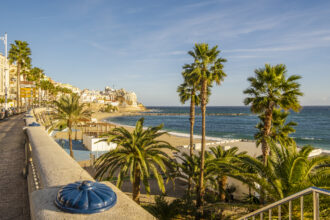
No visit to Galway is complete without walking the Salthill Promenade, a flat, paved seafront path that runs for roughly 2 kilometres along the edge of Galway Bay from the edge of the city out to the suburb of Salthill. Locals call it simply “the Prom,” and walking it out and back, a round trip of around 4 kilometres, is as much a Galway ritual as a scenic outing, with views across the bay toward the Burren and Clare hills on a clear day.
The promenade ends at Blackrock, home to a diving tower that has been a gathering spot for swimmers since the 1950s and is still used by locals for a bracing dip in Galway Bay’s Atlantic-fed water year round. This is also where the city’s best-known walking tradition takes place: by long custom, walkers kick the sea wall at the turning point before heading back into town. Nobody can pin down exactly how the habit started, but skipping it is considered bad form by anyone who grew up in the city.
Salthill itself has amusements, a leisure centre, and a run of cafés and pubs facing the water, making it an easy half-day trip from the city centre on foot, by bike, or on the regular local bus service. Sunset is a particularly good time to walk it, when the promenade fills with joggers, dog walkers and families taking advantage of the long evening light.
Sample Poitín and Gin at Micil Distillery
Tucked upstairs above the Oslo Bar in Salthill, Micil Distillery is Galway’s first working distillery in over a century, and the story behind it is as good as anything on the tasting sheet. Head distiller Pádraic Ó Griallais is the sixth generation of his family to distil spirits on the shores of Galway Bay, a tradition that traces back to 1848, when his great-great-great-grandfather, Micil Mac Chearra, began producing illicit poitín on a Connemara hillside using a local botanical called bogbean. The visitor centre and working distillery opened to the public in July 2018, bringing that 170-year family story fully into the open for the first time.
The Micil Distillery Experience runs for around an hour and fifteen minutes, taking small groups of up to 20 through the working distillery itself, tucked into a genuinely tiny footprint behind the bar, before finishing with tastings of poitín, whiskey and the distillery’s award-winning gin, made using local Connemara botanicals. Guides share the family history, including some of the more colourful stories of illicit distilling that give poitín its outlaw reputation, and tours run in English or Irish at set times throughout the day, generally around 2pm, 4pm and 6pm.
Booking ahead online is worth doing given the small group sizes, and it is worth noting that the distillery is not wheelchair accessible and can be a little chilly inside, so a light jacket is sensible even in summer. Combined with a walk along the nearby Salthill Promenade, covered above, it makes a genuinely distinctive half-day out that few visitors to Galway know to plan for in advance.
See the City on a Hop-On Hop-Off Bus
Run by City Sightseeing Galway (Lally Tours), the city’s open-top hop-on hop-off bus covers 13 stops across Galway city and Salthill, making it a genuinely useful option for getting your bearings quickly or for anyone with limited time. The route starts at Eyre Square, passing the Browne Doorway, before taking in the Spanish Arch, Galway Cathedral, University of Galway, the Claddagh and Woodquay on its way out to the Wild Atlantic Way mid-point marker, the Blackrock diving board and the length of Salthill Promenade.
Buses depart roughly every 45 to 90 minutes depending on the season, with a first departure around 9:30am and the last around 3:30pm, and a full loop of the route takes about an hour. Tickets, priced from around €16 to €19 (£14 to £16 / $19 to $22), are valid for either 24 or 48 hours, with an English-language audio guide running throughout. The service typically operates from March to October, so it is worth checking availability if you are visiting outside the main season.
It is a particularly good fit for a first morning in the city, letting you scope out the Latin Quarter, the cathedral and Salthill before deciding where to spend the rest of your time on foot, or for anyone combining Galway with a wider road trip who only has a few hours here.
Cruise the Corrib River and Lake
For a different perspective on the city and the countryside beyond it, a scenic cruise along the Corrib River and Lake departs from the city centre and heads out onto Lough Corrib, one of the largest lakes in Ireland, before returning along the river back through Galway itself.
The cruise passes wooded shorelines, small islands and glimpses of Connemara’s hills in the distance, offering a genuinely peaceful contrast to the bustle of the Latin Quarter, with commentary along the way covering the history and wildlife of the lake and river system. It is an easy way to add a slower, scenic couple of hours into an otherwise walking-heavy itinerary, particularly on a day when the weather makes an open-top bus tour less appealing.
Departures run seasonally, so booking ahead and checking the current schedule is worth doing before building your day around it, and the cruise makes a natural pairing with a wander around the cathedral and Salmon Weir Bridge area, both close to the departure point.
Compare routes and fares for your journey to Ireland.
Compare flightsChoose an Airalo eSIM and arrange mobile data before you arrive.
Browse eSIMsArrange a private airport pickup for your trip to Ireland.
Check transfersExperience Traditional Irish Music
Galway’s reputation as a music city is not marketing spin; it is built on pubs where sessions happen because musicians simply turn up, not because a poster promised they would. Tigh Neachtain, universally known as Neachtain’s, has been trading at 17 Cross Street since 1894, in a building that was once the home of animal rights campaigner Richard Martin. Its blue and yellow façade is one of the most photographed pub fronts in the city, and its warren of small rooms opens daily from 11am to midnight (from noon on Sundays), with conversation and music equally central to the atmosphere.
Across town on Sea Road, The Crane Bar is considered by many musicians to be the city’s most authentic traditional music pub. It has an upstairs room holding around 70 people that hosts dedicated trad sessions, and a downstairs bar that keeps the feel of an old-style Galway pub largely unchanged. Music happens nightly both upstairs and down, spanning traditional, folk and roots sessions, and it opens from 3pm to 11.30pm on weekdays and Saturdays, and from 1pm on Sundays.
Between these two, and scattered through the surrounding Latin Quarter, dozens of smaller sessions kick off most evenings, usually unannounced and free to walk into. The etiquette is simple: find a seat, order a pint, and let the musicians lead. Turning up around 9pm gives the best chance of catching a session building rather than winding down, and midweek nights outside peak summer tend to be quieter and, for many visitors, more atmospheric than a Saturday crush.
Browse Galway Market
Galway Market sets up in the laneway between Church Lane, Shop Street and Market Street, wrapped around the walls of St Nicholas’ Collegiate Church, and it is one of the oldest continuously running street markets in Ireland. The core trading day is Saturday, generally from 8am to 6pm, with a smaller Sunday and bank holiday market also running for much of the year. Over the summer months of July and August, the market runs daily from around midday, and a dedicated Christmas market takes over the same streets from 14 to 24 December.
Stalls sell a genuine mix of the everyday and the artisan: fresh fruit and vegetables sit next to gourmet olives, farmhouse cheeses, fresh pasta, sourdough bread, crepes and mussels cooked to order, alongside craft stalls selling Connemara marble jewellery, hand-poured candles, prints and woodwork. It is as much a place locals do their weekly shop as it is a visitor attraction, which gives it an honesty that more curated markets elsewhere sometimes lack.
Because it sits right in the middle of the Latin Quarter, it is easy to fold a browse of the market into the same morning as a wander down Shop Street, and Galway Cathedral is about a ten-minute walk away on the far side of the River Corrib, over the Salmon Weir Bridge, if you want to add it to the same route. Arriving before 11am on a Saturday tends to mean thinner crowds and first pick of the fresh produce, while the food stalls in particular get busy through early afternoon as the lunchtime rush builds.
Discover Galway’s Food Scene
Seafood defines Galway’s food identity more than any other single ingredient, and the city’s relationship with the oyster runs deep enough to have its own festival. The Galway International Oyster Festival was founded in 1954 and now runs on the last weekend of September, marking the start of oyster season with the Irish and World Oyster Opening Championships alongside tastings across the city’s restaurants and pubs. It has been described by the Sunday Times as one of the twelve greatest shows on earth, and it remains one of the best times of year to visit if seafood is the priority.
For a taste of that tradition outside festival season, McDonagh’s Seafood House on Quay Street has been serving fish since 1902, and its fish and chip counter, sitting alongside a full seafood restaurant under the same roof, is considered by many locals to be the benchmark for the dish in the city. Beyond McDonagh’s, the Latin Quarter and the Long Walk area hold a dense cluster of seafood restaurants, oyster bars and casual chowder spots, most within a few minutes of each other.
The wider food scene has grown well beyond seafood, with a strong café culture around Kirwan’s Lane and Middle Street, and a growing number of restaurants sourcing from Galway Market and the county’s farms and fishing boats. Galway’s compact centre means a food-focused evening rarely requires more than a short walk between courses, drinks and dessert.
Enjoy Galway After Dark
Galway’s nightlife is anchored in the same Latin Quarter streets that are busy by day, but the mood shifts considerably once the shops close. Quay Street and Cross Street in particular fill with a mix of live music pubs, late bars and small clubs, and the walk between venues rarely takes more than a few minutes given how tightly the old town is packed together. Traditional music pubs like Tigh Neachtain and The Crane Bar tend to draw an earlier, more relaxed crowd, while venues further along toward Eyre Square and the Salmon Weir area lean later and louder as the night goes on.
Most standard pubs in the city hold licences that allow trading until around 11.30pm on weeknights and Saturdays, with a small number of late bars and clubs extending well beyond that on Thursday, Friday and Saturday nights, particularly during term time when the two universities in the city add tens of thousands of students to the population. Dress codes are generally relaxed by Irish city standards, though the later clubs toward the weekend do tend to apply the usual smart-casual rules.
For a quieter evening, several of the hotel bars around Eyre Square and along the riverside offer a calmer alternative without losing the live music element, and a good number of the Latin Quarter’s daytime cafés convert into wine bars after dark. Whichever direction the evening takes, the compactness of the city centre means it is entirely possible to walk everywhere and never need a taxi between venues.
Planning the Perfect Visit
Galway rewards even a short visit, but two to three full days is the realistic minimum to cover Eyre Square, the Latin Quarter, the cathedral, Salthill and at least one proper night of traditional music without rushing. Add an extra day or two if seafood, markets and a slower pace matter more than ticking off sights, since much of the city’s appeal lies in simply sitting in the right pub at the right time rather than moving quickly between attractions.
Timing a visit around one of the city’s major events changes the character of a trip considerably. The Galway International Arts Festival runs across two weeks each summer, with the 2026 edition scheduled for 13 to 26 July, bringing theatre, music and street performance across the city. The day after it closes, the Galway Races Summer Festival takes over Ballybrit Racecourse, with 2026 dates set for 27 July to 2 August; the meeting has been run since 1869 and is one of the busiest weeks of the year for accommodation in the city, so book well ahead if visiting during either event.
Galway’s small size also makes it an excellent base for exploring the wider region, from the Cliffs of Moher to Connemara and the Aran Islands. For visitors with a spare day or two built into their itinerary, our Day Trips from Galway guide covers the best routes out of the city and how to fit them around everything covered here.

Rupert’s Handy Travel Tips
Galway’s city centre is tiny by design, so pack light and plan to explore almost everything on foot.
- Book ahead for race and festival weeks: Rooms fill up fast during the Galway International Arts Festival and Galway Races, so sort accommodation months in advance if your trip lands in July or August.
- Wear proper shoes for the Prom: The Salthill Promenade is flat and paved, but a stiff Atlantic wind is common even in summer, so bring a windproof layer along with comfortable footwear.
- Arrive at pub sessions early for a seat: Traditional music sessions at spots like Tigh Neachtain and The Crane Bar can fill up fast after 9pm, so get there a little earlier if you want to sit near the musicians.
- Book Micil Distillery ahead: Group sizes are small and it only runs a handful of tours a day, so it’s worth reserving before you arrive rather than turning up on spec.
- Carry coins for the cathedral: Entry to Galway Cathedral is free, but a small cash donation is appreciated, and the public toilets there require coins too.
- Check the market’s summer hours: Galway Market runs beyond its usual Saturday slot with daily trading in July and August, so a midweek visit in high summer is still worthwhile.
Want to meet the reindeer behind our travel tips? Find out more in our page Who is Rupert?.




Frequently Asked Questions
How many days do you need in Galway?
Two to three full days covers the city centre highlights comfortably, including Eyre Square, the Latin Quarter, the cathedral and Salthill, with an extra day or two useful if you plan on day trips to Connemara or the Aran Islands.
Is Galway Cathedral free to visit?
Yes, entry is free, though the cathedral asks for a voluntary donation of around €3 (£2.50 / $3.50) to help with the upkeep of the building, and it is generally open daily from roughly 8am to 8pm.
What is the nearest airport to Galway city?
Ireland West Airport Knock is the closest airport for many international visitors, roughly 53 miles and just over an hour’s drive north of the city.
Where can I hear traditional Irish music in Galway?
Tigh Neachtain on Cross Street and The Crane Bar on Sea Road are the two most established venues for traditional sessions, though smaller unannounced sessions happen most nights across the Latin Quarter’s other pubs.
What day is Galway Market on?
The main trading day is Saturday, from roughly 8am to 6pm, beside St Nicholas’ Collegiate Church, with a smaller Sunday market and daily trading through July and August.
What is Micil Distillery known for?
It is Galway’s first working distillery in over a century, run by a sixth-generation poitín distilling family, offering guided tours and tastings of poitín, whiskey and gin above the Oslo Bar in Salthill.
Further Reading
If you are flying into the region rather than routing through Dublin, our Ireland West Airport Knock Transfers guide covers every option for getting from the runway into Galway city, from pre-booked transfers to car hire and the public bus link.
Once you have the city centre covered, our Day Trips from Galway guide sets out the best routes into Connemara, the Aran Islands and beyond for travellers with an extra day or two to spare, and our Wild Atlantic Way Guide puts Galway in the context of the wider coastal route for anyone planning a longer road trip along Ireland’s west coast.
For onward travel by rail once you’re ready to move on, our Ireland Rail Network guide explains how Galway connects to Dublin, Cork and the rest of the country’s train network.