Reviewed by our editorial team Updated
Why Understanding the Ireland Rail Network Makes Travel Easier
The Ireland rail network is one of the easiest railway systems in Europe to understand once you know how it is organised. Unlike countries such as Germany, France, or Italy, which have multiple major hubs and complex high-speed networks, most rail travel in Ireland revolves around Dublin, with routes spreading across the country towards Cork, Galway, Waterford, Sligo, Westport, Ballina, Rosslare Europort, and Belfast. For visitors, this creates a network that is straightforward to navigate while still providing access to many of the country’s most famous destinations.
For travellers arriving in Ireland, the railway can often be the simplest way to move between major cities without the stress of driving unfamiliar roads. Journeys between Dublin and Cork, Dublin and Galway, and Dublin and Belfast are among the busiest routes in the country and provide fast, comfortable alternatives to long coach journeys. Meanwhile, branch lines reach destinations such as Westport, Tralee, Cobh, and Midleton, allowing visitors to explore areas that might otherwise require a car.
One of the most interesting aspects of the Irish rail network is that it combines two railway systems. In the Republic of Ireland, services are operated by Iarnród Éireann (Irish Rail), while services in Northern Ireland are operated by Translink NI Railways. The two networks connect seamlessly through the important Dublin to Belfast Enterprise service, creating one of the most useful international rail routes in Europe.
Although Ireland does not have high-speed rail, the network remains highly effective for tourism. Many of the country’s most popular destinations sit directly on railway lines, including Galway, Cork, Killarney, Westport, Waterford, and Belfast. Combined with scenic routes through the Irish countryside and easy access to ferry ports, the railway provides an excellent foundation for exploring the island without a car.
Ireland Rail Network Map
The simplified Ireland railway map included in this guide has been designed specifically for travellers rather than railway professionals. Official railway maps often include dozens of minor stations, operational details, and route variations that can make the network appear far more complicated than it actually is. By focusing on the most important corridors, interchange stations, airports, and ferry connections, this map shows how the railway works from a traveller’s perspective.
At the centre of the map sits Dublin, which acts as the primary hub for almost all long-distance rail travel. From here, lines spread north towards Belfast, west towards Athlone, Galway, Westport, and Ballina, south-west towards Cork and Tralee, and south-east towards Waterford and Rosslare Europort. Understanding these major corridors makes it much easier to plan journeys and identify where changes may be required.
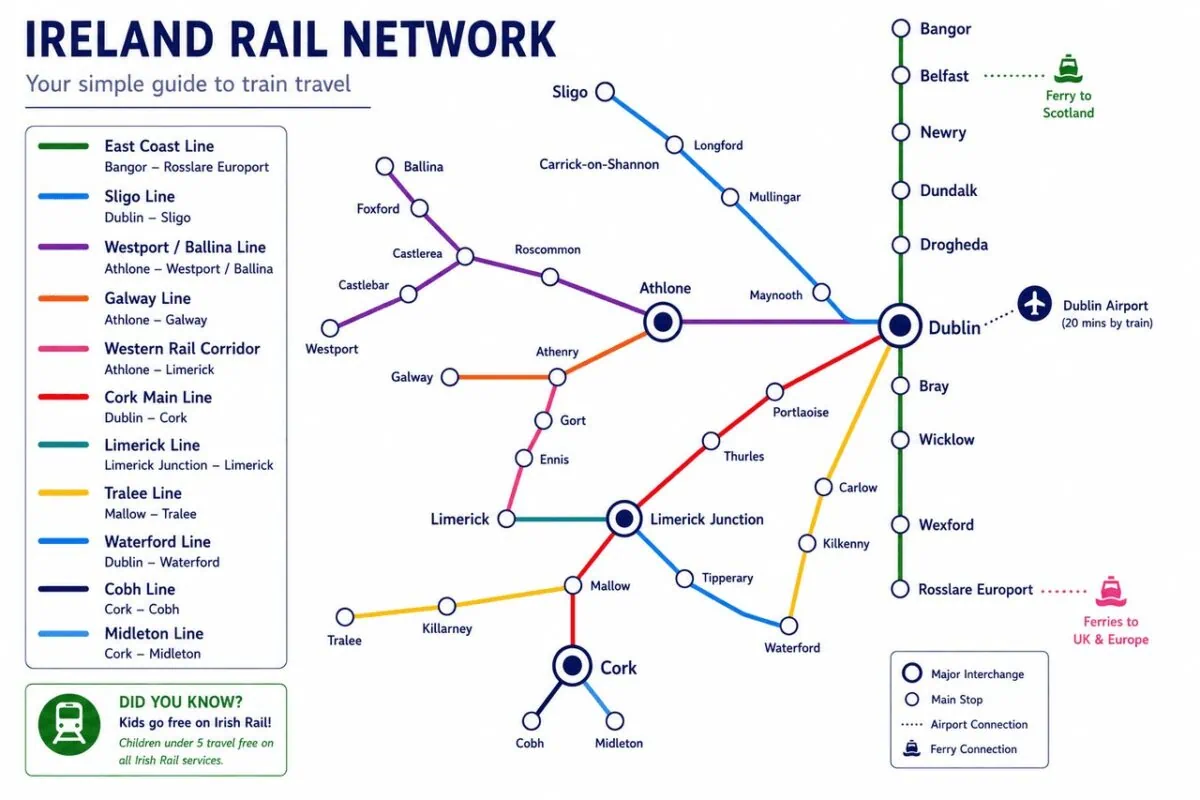
Several key interchange stations appear larger than ordinary stops. These include Athlone, Athenry, Limerick Junction, and Cork, all of which play important roles in connecting different parts of the network. For example, Athenry links the route from Dublin and Galway with the Western Rail Corridor, while Limerick Junction provides access between the Cork main line, Limerick, and Waterford routes.
The map also highlights important transport connections beyond the railway itself. Rosslare Europort provides ferry links to Britain and mainland Europe, while Belfast connects to ferry services serving Scotland and northern England. Airports are shown where they have significant relevance to rail travellers, helping visitors understand how different forms of transport fit together.
Best if you want daily housekeeping and a front desk. Filter by area first, then by price.
Check availabilityBest for families, or any stay past about four nights. A kitchen and a washing machine start paying for themselves.
Browse rentalsBest as a last check before booking. Compares Ireland hotel rates across several sites in one search.
Compare ratesIreland Rail Network at a Glance
| Feature | Details |
|---|---|
| Main Rail Operator | Iarnród Éireann (Irish Rail) |
| Northern Ireland Operator | Translink NI Railways |
| Largest Rail Hub | Dublin |
| Main International Route | Dublin to Belfast Enterprise |
| Major Interchange Stations | Dublin, Athlone, Athenry, Limerick Junction, Cork |
| Main Ferry Rail Connections | Rosslare Europort, Belfast |
| Longest Major Route | Dublin to Tralee |
| Key Tourist Routes | Dublin to Galway, Cork, Belfast, Westport |
| Western Cross-Country Route | Galway to Limerick via Athenry and Ennis |
| Airport Rail Relevance | Dublin Airport, Cork Airport |
The Irish railway network covers much of the island despite being relatively compact compared with continental European systems. Most services are designed around intercity travel, connecting the country’s largest urban centres with regional towns and tourist destinations. This means that even visitors making their first trip to Ireland can quickly understand how the network operates.
The busiest route is generally the corridor between Dublin and Cork, which serves Ireland’s two largest cities. Other heavily used routes include Dublin to Belfast, Dublin to Galway, and Dublin to Waterford. These services form the backbone of rail travel across the island and carry both commuters and tourists throughout the year.
A notable feature of the network is the importance of strategic junctions. Stations such as Athlone, Athenry, and Limerick Junction may not be among Ireland’s largest cities, but they play a critical role in allowing passengers to move between routes without returning to Dublin. These interchanges make the network significantly more flexible than many first-time visitors expect.
Because Ireland is relatively small geographically, most major rail journeys can be completed within a few hours. This makes rail travel particularly attractive for city breaks, regional exploration, and multi-destination itineraries that combine destinations such as Dublin, Galway, Cork, and Belfast in a single trip.
How the Ireland Rail Network Is Organised
The easiest way to understand the Ireland rail network is to think of it as several major corridors connected by a handful of important junctions. While Dublin remains the dominant hub, there are enough cross-country links and regional routes to create a surprisingly flexible system for travellers.
The first major corridor is the East Coast Line, which runs from Bangor and Belfast in the north through Newry, Dundalk, Drogheda, and Dublin, before continuing south through Wexford to Rosslare Europort. This route combines commuter services, intercity trains, and international ferry connections, making it one of the most important transport corridors on the island.
The second major corridor runs west from Dublin towards Athlone, which acts as the principal gateway to western Ireland. From here, routes diverge towards Galway, Westport, and Ballina, providing access to much of the Wild Atlantic Way region. For tourists exploring western Ireland, Athlone functions as one of the network’s most important interchange points.
To the south, the Cork Main Line connects Dublin, Portlaoise, Thurles, Limerick Junction, Mallow, and Cork. This is Ireland’s premier intercity route and forms the backbone of rail travel in the southern half of the country. Branches from this line reach Tralee, Cobh, and Midleton, extending the network into popular tourist regions including County Kerry and Cork Harbour.
Finally, the often-overlooked Western Rail Corridor creates a valuable cross-country connection linking Galway, Athenry, Gort, Ennis, Limerick, and Limerick Junction. Combined with the Limerick Junction to Waterford route, this corridor allows passengers to travel across large parts of Ireland without needing to return to Dublin, making it one of the most strategically important sections of the railway despite carrying fewer passengers than the major intercity routes.
Dublin: The Heart of the Irish Rail Network
At the centre of the Ireland rail network sits Dublin, the country’s largest city and the point from which most long-distance rail journeys begin. Whether travelling to Belfast, Cork, Galway, Sligo, Westport, Ballina, Waterford, or Rosslare Europort, chances are your journey will either start, finish, or pass through the Irish capital. Understanding Dublin’s railway stations is therefore essential for anyone planning rail travel in Ireland.
Unlike many European capitals, Dublin does not rely on a single central station. Instead, the city’s rail services are divided between several important terminals. Dublin Heuston Station serves routes heading towards Cork, Galway, Westport, Ballina, Limerick, Tralee, and Waterford, making it the primary gateway to western and southern Ireland. Meanwhile, Dublin Connolly Station handles services towards Belfast, Sligo, Rosslare Europort, and much of the suburban network. Nearby Dublin Pearse Station plays an important role for commuter and coastal services along the east coast.
For visitors arriving by air, Dublin’s railway system has one notable limitation. Unlike many major European capitals, Dublin Airport does not currently have a direct rail connection. Instead, travellers typically use the highly frequent Dublin Express or Aircoach services to reach the city centre before connecting to the rail network. While this may initially seem inconvenient, journey times remain relatively short and most onward rail connections are straightforward once you reach the city.
Because nearly every major rail route passes through Dublin, the city also serves as the natural starting point for rail-based itineraries around Ireland. Whether you are planning a short city break in Galway, exploring the dramatic coastline around Westport, heading south to Cork, or crossing the border into Northern Ireland, Dublin provides the foundation upon which the entire Irish railway system is built.
Main Rail Routes in Ireland
The Ireland rail network consists of several core corridors that connect the country’s largest cities and most important tourist destinations. While the network is smaller than those found in many European countries, it covers a surprising amount of territory and provides access to much of Ireland’s population and visitor infrastructure.
The flagship route is undoubtedly the Dublin to Cork line. Linking Ireland’s two largest cities, this corridor passes through important stations including Portlaoise, Thurles, Limerick Junction, and Mallow before reaching Cork. Frequent departures, modern trains, and relatively fast journey times make it one of the most heavily used routes in the country.
To the west, the Dublin to Galway route provides access to one of Ireland’s most popular visitor destinations. Trains pass through Athlone, one of the network’s key interchange stations, before continuing to Athenry and Galway. The route is particularly popular with visitors exploring the Wild Atlantic Way, the Cliffs of Moher, and Ireland’s rugged west coast.
The international Dublin to Belfast Enterprise service occupies a unique place within the Irish railway system. Crossing the border between the Republic of Ireland and Northern Ireland, the route links two capital cities and provides one of the most comfortable ways to travel between them. Stations such as Drogheda, Dundalk, and Newry provide useful intermediate stops along the way.
Further routes connect Dublin with Sligo, Westport, Ballina, Waterford, and Rosslare Europort. Together these lines create the core structure of the Irish rail network, ensuring that travellers can reach most major regions without the need for a car. While journey frequencies vary between routes, the network remains one of the easiest ways to explore Ireland’s cities, towns, and coastal regions.
Ireland’s Major Interchange Stations
Although Dublin dominates the network, several other stations play a crucial role in allowing passengers to move efficiently around Ireland. These interchange points form the hidden backbone of the railway system and are often more important operationally than their size might suggest.
Perhaps the most important of these is Athlone, located near the geographical centre of the country. Trains travelling west from Dublin pass through Athlone before diverging towards Galway, Westport, and Ballina. For travellers exploring western Ireland, Athlone acts as a critical gateway between multiple routes and destinations.
Further west, Athenry serves as the key junction between the Galway line and the Western Rail Corridor. While it is a relatively small town, its strategic location means that passengers can travel between Galway, Ennis, Limerick, and other destinations without returning to Dublin. As a result, Athenry occupies an outsized role within the overall structure of the Irish railway network.
To the south, Limerick Junction is one of Ireland’s most important railway hubs. Located on the main Dublin to Cork corridor, it provides connections towards Limerick and Waterford, allowing passengers to move between different regions of the country. Despite its name, the station is located some distance from Limerick itself and functions primarily as a transfer point rather than a city station.
Finally, Cork acts as both a major destination and an important regional hub. Branch lines to Cobh and Midleton originate here, while onward road and coach connections extend access to destinations such as Killarney, Kenmare, and the wider south-west of Ireland. Together with Dublin, Athlone, Athenry, and Limerick Junction, Cork forms one of the key pillars supporting the entire Irish railway system.
The Western Rail Corridor
Among all sections of the Ireland rail network, few are as interesting as the Western Rail Corridor. While the main intercity routes focus on connecting Dublin with the rest of the country, this line provides a valuable north-south link across western Ireland. For travellers seeking alternatives to the capital-centric structure of the network, it offers one of the most useful and distinctive rail experiences on the island.
The corridor currently connects Galway, Athenry, Gort, Ennis, and Limerick, creating a route that links major destinations along the western side of the country. Rather than funnelling passengers through Dublin, the line allows direct travel between regions that would otherwise require lengthy detours. This makes it particularly useful for visitors exploring multiple destinations along the Wild Atlantic Way.
One of the most important stations on the corridor is Athenry, where passengers can transfer between services heading towards Galway, Athlone, Westport, Ballina, and Dublin. The station’s role as a junction is reflected in the simplified rail map, where it acts as a key connection point between the western and national networks.
At the southern end of the corridor, trains reach Limerick, one of Ireland’s largest cities. From there, connections continue to Limerick Junction, providing onward access to Cork, Waterford, and the broader southern rail network. Although the Western Rail Corridor carries fewer passengers than routes such as Dublin to Cork or Dublin to Belfast, it plays an important strategic role and demonstrates that the Irish railway system is more interconnected than many visitors initially realise.
Best if you can move a day either way. Shows how the fare to Ireland changes across the month.
Compare flightsBest for anyone whose home plan charges by the megabyte abroad. Pay a fixed price up front.
Check eSIMsBest if you would rather not work out the transport on arrival. Book it now and forget it.
View transfersAirport Connections by Rail
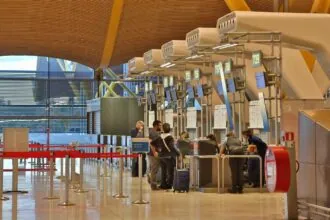
One of the few weaknesses of the Ireland rail network is that several of the country’s busiest airports are not directly connected to railway stations. Unlike destinations such as Amsterdam, Zurich, or Vienna, where trains serve airport terminals directly, rail passengers in Ireland often need to combine train travel with buses, coaches, or taxis. Fortunately, most airport transfers remain relatively straightforward and are well established.
The busiest airport in the country, Dublin Airport, handles the majority of international arrivals but currently has no rail station of its own. Travellers heading onwards by train normally transfer to either Dublin Heuston Station or Dublin Connolly Station using dedicated airport coach services. Frequent operators such as Dublin Express and Aircoach provide fast links into the city centre, making rail connections relatively easy despite the absence of a direct railway.
Further south, Cork Airport also lacks a rail connection. However, the airport sits only a short distance from Cork Kent Station, which serves trains to Dublin, Mallow, Cobh, and Midleton. Taxi journeys between the airport and station are quick, while regular bus services connect the two throughout the day.
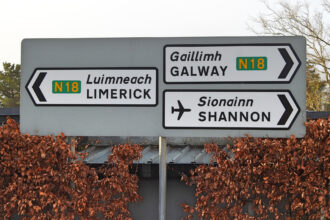
The situation is similar at Shannon Airport, which is located between Limerick and Ennis. Although trains do not reach the airport directly, both cities are connected to the Western Rail Corridor, allowing passengers to combine rail and bus travel when exploring western Ireland. Meanwhile, Ireland West Airport Knock is accessible via nearby stations such as Claremorris, Castlebar, and Ballina, making it a useful gateway for visitors exploring County Mayo and the surrounding region.
Despite the lack of direct airport rail stations, the compact size of Ireland means transfer times are often shorter than travellers expect. Most major airports sit within easy reach of the railway network, allowing visitors to continue their journeys efficiently once they have arrived in the country.
Ferry Connections by Rail
The Irish railway network remains an important part of the wider transport system thanks to its links with several major ferry ports. These connections allow travellers to combine rail and sea travel when arriving from Great Britain or mainland Europe, creating opportunities for car-free journeys across the region.
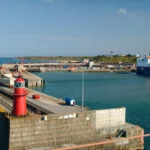
The most significant rail-connected ferry port in the Republic of Ireland is Rosslare Europort. Located in the south-east of the country, Rosslare sits directly on the railway line from Dublin, making it one of the easiest ferry ports in Ireland to access by train. Services from Dublin connect directly with the port, where ferry operators provide sailings to destinations including Wales, France, and Spain. For travellers arriving from continental Europe, Rosslare often serves as the gateway to the Irish rail system.
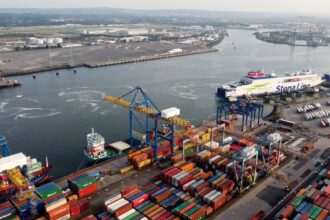
Further north, Belfast provides another important ferry connection. While the port itself is not directly attached to the railway network, the city is served by frequent trains from both Dublin and other parts of Northern Ireland. Ferry services connect Belfast with destinations in Scotland and northern England, making the city an important multimodal transport hub.
Another useful connection can be found at Larne, which is served by the Northern Ireland railway network. Trains from Belfast provide access to Larne, where ferry services cross the North Channel to Scotland. Although not as widely used by tourists as Rosslare or Belfast, Larne remains an important component of rail and ferry integration on the island.
For travellers planning a car-free holiday, these ferry connections can be particularly valuable. It is entirely possible to arrive by ferry, continue by train to destinations such as Dublin, Galway, Cork, or Belfast, and explore much of the island without ever needing a vehicle.
Scenic Rail Journeys in Ireland
While Ireland’s railway system is primarily designed as a practical transport network, several routes also rank among the most scenic train journeys in the British Isles. Travelling by rail allows visitors to enjoy landscapes that are often difficult to appreciate when driving, making train travel an attraction in its own right rather than simply a means of reaching a destination.
The route between Dublin and Galway offers one of the most accessible introductions to Ireland’s countryside. After leaving the capital, trains pass through the broad plains of the midlands before reaching Athlone, crossing the River Shannon, and continuing west towards Galway Bay. The changing landscapes provide an excellent overview of Ireland’s geography within a relatively short journey.
Further north, the line from Dublin to Sligo passes through a mixture of rolling farmland, lakes, and rural landscapes before reaching the dramatic scenery of Ireland’s north-west. Although less famous internationally than some routes, it provides a fascinating glimpse into parts of the country rarely seen by visitors who remain on the more popular tourist circuits.
The branch towards Westport is often regarded as one of the most attractive rail journeys in Ireland. Travellers pass through the heart of County Mayo, with increasingly dramatic scenery appearing as the train approaches the Atlantic coast. Westport itself is one of Ireland’s most charming railway destinations and serves as an excellent base for exploring the surrounding region.
In Northern Ireland, the route between Belfast and Derry is frequently cited as one of the finest railway journeys in Europe. Running alongside dramatic sections of coastline, crossing estuaries, and passing through some of the country’s most spectacular landscapes, it demonstrates the scenic potential of rail travel on the island. Many railway enthusiasts consider this route alone worth visiting Ireland for.
Meanwhile, the journey from Mallow to Tralee offers a gateway into some of the most beautiful scenery in south-west Ireland. Passing through Killarney and approaching the mountains of County Kerry, the line provides easy access to one of Ireland’s most famous tourist regions.
Ticket Types and Rail Passes
The Ireland rail network offers a range of ticket options designed to accommodate both regular passengers and visitors exploring the country. Understanding the available fares can often save travellers significant amounts of money, particularly when planning longer journeys or multi-destination itineraries.
Most passengers use standard point-to-point tickets purchased through Irish Rail or Translink. Advance fares are often substantially cheaper than tickets bought on the day of travel, especially on popular routes such as Dublin to Cork, Dublin to Galway, and Dublin to Belfast. Booking ahead is therefore one of the easiest ways to reduce travel costs.
For residents and frequent users, the Leap Card provides convenient access to public transport in the Dublin region and can be used on a variety of local rail services. While its usefulness for international visitors is generally limited to the capital area, it remains an important part of the wider transport system.
Travellers planning extensive rail journeys may wish to consider Interrail or Eurail passes. These passes are valid on much of the Irish rail network and can offer excellent value for visitors exploring multiple destinations. Popular itineraries combining Dublin, Galway, Cork, Belfast, and Westport can often be completed efficiently using a rail pass, particularly when combined with local transport connections. Visitors staying only within the Republic for a few days should also compare Irish Rail‘s own short-term unlimited-travel tickets, such as the Explorer and Trekker passes, which can work out cheaper than a full Interrail pass for a short trip. Our Irish Rail Passes Explained guide breaks down pricing and coverage for each option.
Families also benefit from a range of discounted fares, while students and senior travellers may qualify for additional concessions depending on eligibility. Because fare structures change periodically, it is always worth checking current pricing before travelling. However, compared with many parts of western Europe, rail travel in Ireland remains relatively straightforward, with a ticketing system that is easy for first-time visitors to understand.
Is Ireland’s Rail Network Good for Tourists?
For most visitors, the Ireland rail network is an excellent way to explore the country. While it may not offer the extensive coverage found in larger European nations, it connects many of Ireland’s most important cities, tourist destinations, ferry ports, and transport hubs. For travellers who prefer to avoid driving on unfamiliar roads or navigating city traffic, rail travel provides a comfortable and stress-free alternative.
One of the biggest advantages of travelling by train in Ireland is the simplicity of the network. The majority of long-distance routes are easy to understand, journey planning is straightforward, and stations are generally located close to city centres. Travellers arriving in Galway, Cork, Waterford, Belfast, Westport, or Sligo can often walk directly from the station to hotels, attractions, restaurants, and public transport connections.
The network is particularly well suited to visitors planning a multi-city itinerary. A traveller could easily combine Dublin, Galway, Cork, and Belfast in a single trip without needing a car. Rail travel also eliminates concerns about parking costs, fuel expenses, toll roads, and driving on narrow rural roads, which can be intimidating for overseas visitors.
However, the railway does have limitations. Some of Ireland’s most famous scenic regions, including parts of County Kerry, Donegal, Connemara, and the more remote sections of the Wild Atlantic Way, are easier to access by car. In these areas, rail travel often needs to be combined with buses, organised tours, taxis, or car hire. The lack of direct rail links to Dublin Airport, Cork Airport, and Shannon Airport is another weakness compared with many continental European transport systems.
Overall, the strengths of the network outweigh its shortcomings. For travellers focusing on Ireland’s cities, major towns, and most popular visitor destinations, the Irish rail network remains one of the most enjoyable and convenient ways to experience the country.
Suggested Rail Itineraries
One of the greatest advantages of the Ireland rail network is the ability to build flexible itineraries around the country’s major cities and regions. Because journey times are relatively short compared with many European countries, visitors can cover a surprising amount of ground in just a few days.
A popular three-day rail itinerary begins in Dublin, where visitors can explore attractions such as Trinity College, Dublin Castle, and the Guinness Storehouse. On the second day, a train to Galway provides access to the west coast and its lively atmosphere. The final day can be spent in Cork, reached via Dublin or as part of a longer onward journey. This itinerary introduces visitors to three of Ireland’s most important cities while relying entirely on rail transport.
Travellers with a week available can create a far more comprehensive route. A typical seven-day Ireland by train itinerary might include Dublin, Galway, Westport, Cork, and Belfast, providing a mixture of urban attractions, coastal scenery, and cultural experiences. Such a trip showcases many of Ireland’s highlights while avoiding the need for a rental car.
Those interested in western Ireland can use the railway to build a Wild Atlantic Way rail itinerary. Starting in Galway, continuing to Westport, and then travelling south via the Western Rail Corridor towards Limerick, this route explores some of Ireland’s most scenic regions while remaining largely accessible by public transport.
A particularly rewarding option combines both jurisdictions on the island. Travelling from Dublin to Belfast, continuing to Derry, and then returning south through the Republic creates an itinerary that highlights the diversity of both Ireland and Northern Ireland. The international nature of the Enterprise service between Dublin and Belfast adds an extra dimension to the journey and remains one of the most interesting train routes on the island.
Best for solo travellers and anyone watching the budget. Dorm beds and private rooms in the same search.
Browse hostelsBest for anyone flying more than once or twice a year. Handles the compensation claim so you are not chasing the airline.
See AirHelp+Best for a day with a bag and nowhere to put it. Find a storage point near where you already are.
View storageApps for Train Travel in Ireland
Modern rail travel increasingly depends on smartphones, and the Ireland rail network is no exception. A small number of well-chosen apps can make journey planning, ticket purchasing, disruption management, and navigation significantly easier for visitors exploring the country by train.
The most important app is the official Irish Rail app, which provides timetables, live departure information, platform details, and service updates across the Republic of Ireland. For travellers using the network regularly, it is often the quickest source of operational information.
Anyone travelling within Northern Ireland should also consider downloading Translink NI. The app covers trains, buses, journey planning, and ticket information throughout Northern Ireland, including routes serving Belfast, Derry, and Larne.
Finally, Google Maps remains invaluable for station navigation, local transport connections, walking directions, and onward travel. While it is not a railway-specific application, it often fills the gaps between train journeys and helps travellers move efficiently between stations, hotels, attractions, and transport hubs.

Rupert’s Handy Travel Tips
Planning to explore the Ireland rail network? Here are a few useful tips to help your journey run smoothly:
- Check your Dublin station: Long-distance trains depart from both Heuston and Connolly stations, so always confirm which one your service uses before travelling.
- Book early for the best fares: Advance tickets on routes such as Dublin to Cork, Dublin to Galway, and Dublin to Belfast are often significantly cheaper than buying on the day.
- Allow time for airport transfers: Dublin Airport is not directly connected to the railway network, so factor in extra time for buses, coaches, or taxis before your train departs.
- Don’t overlook the Western Rail Corridor: The route linking Galway, Athenry, Ennis, and Limerick can save considerable time when travelling around western Ireland without returning to Dublin.
- Download the Irish Rail app: Live departures, platform information, and service updates are particularly useful during busy holiday periods and adverse weather.
Want to meet the reindeer behind our travel tips? Find out more in our page Who is Rupert?.




Frequently Asked Questions About the Ireland Rail Network
Is Ireland good for travelling by train?
Yes. The Ireland rail network connects most major cities and many important tourist destinations, making rail travel a practical and comfortable way to explore the country.
What is the main railway company in Ireland?
Most services in the Republic of Ireland are operated by Iarnród Éireann (Irish Rail). In Northern Ireland, services are operated by Translink NI Railways.
Can I travel from Dublin to Belfast by train?
Yes. The Enterprise service links Dublin and Belfast several times per day and is one of the most popular routes on the island.
Does Dublin Airport have a train station?
No. Dublin Airport is not directly connected to the rail network. Passengers normally use buses or coaches to reach Dublin Heuston Station or Dublin Connolly Station.
Can I reach Galway by train?
Yes. Frequent services operate between Dublin and Galway, with trains travelling via Athlone and Athenry.
Is there a rail connection to Cork?
Yes. The Dublin to Cork route is one of the busiest and fastest intercity lines in Ireland.
Can I use Interrail in Ireland?
Yes. Interrail and Eurail passes are valid on much of the Irish railway network, making them useful for travellers planning multiple rail journeys.
What is the most scenic train journey in Ireland?
Many travellers consider the route between Belfast and Derry to be the most scenic. Other highly regarded journeys include Dublin to Westport, Dublin to Galway, and the route from Mallow to Tralee.
Further Reading & Related Guides
Planning a rail journey around Ireland? Our Interrail Ireland Guide explains how rail passes work across the island and whether they make sense for your itinerary. If you are arriving by ferry, our Dublin Port Guide, Dublin Port Transfers Guide, Belfast Ferry Terminal Guide, Belfast Port Transfers Guide and Rosslare Ferry Terminal Guide can help you connect from port to rail.
For travellers arriving by air, our Dublin Airport Transfers Guide, Cork Airport Transfers Guide, Shannon Airport Transfers Guide, Ireland West Airport Knock Transfers Guide, Belfast International Airport Transfers Guide and George Best Belfast City Airport Transfers Guide explain how to reach city centres and onward transport links.
If you are building a city itinerary around the rail network, our Things to Do in Dublin Guide, Best Things to Do in Belfast Guide and Things to Do in Cork Guide will help you decide where to spend more time. For mobile data across the island, compare options in our eSIM Apps Guide.