Reviewed by our editorial team Updated
Discover the Best Day Trips from Bologna
Bologna sits at the centre of Italy’s high-speed rail network, which makes it one of the best bases in the country for day trips. Within an hour or two you can reach Renaissance cities, Byzantine mosaics, Ferrari country and even a hilltop republic, all without changing hotels.
Regional neighbours Modena, Parma and Ravenna are all under 90 minutes away and pack in world-class food, art and architecture. Further afield, Florence, Venice and Milan are all realistic for a long but rewarding single day.
This guide covers 12 of the best day trips from Bologna, with real train times, what each place is known for, and how to fit them into a single day without rushing every stop into a blur. Some are ideal for a quick half-day outing, while others are worth a fully committed early start.
Most destinations here are reachable by Trenitalia regional or high-speed trains direct from Bologna Centrale, though a handful, including San Marino and Dozza, need a connecting bus or a short drive to finish the journey once you arrive.
If you haven’t yet explored the city itself, our guide to things to do in Bologna covers the essential sights before you branch out further afield.
And if you are flying into the region, see our guide to getting from Bologna Airport to the city centre before working out your day-trip plans.
Each entry below includes a realistic journey time, the highlights worth prioritising and how much time to set aside, whether you have half a day free or a full one to spend away from Bologna.
Bologna: The Perfect Day-Trip Base
Bologna Centrale is one of the busiest and best-connected stations in Italy, with frequent Frecciarossa, Italo and regionale services fanning out in every direction. Few Italian cities offer this many genuinely different day trips within a two-hour radius.
To the west, Modena and Parma sit on the same high-speed line as Milan, all part of Emilia-Romagna’s celebrated food belt. To the east, regional trains reach Ferrara and Ravenna, with their Renaissance and Byzantine history respectively.
South and further afield, the same high-speed line that runs through Bologna connects directly to Florence in around 35 minutes and on to Rome in under two hours, while a separate route heads east towards Rimini, San Marino and the Adriatic coast.
Regional trains are cheap, ticketless in the sense that you rarely need to reserve a seat, and generally run at least once or twice an hour on the routes covered in this guide. High-speed services need advance booking for the best fares.
Below, each destination is covered with a realistic journey time, what makes it worth the trip, and how much time to set aside. Distances given are one-way; double them, roughly, for a full round trip.
Buying tickets is straightforward: the Trenitalia app and self-service machines at Bologna Centrale cover almost every route in this guide, and staff at the ticket office can help if you would rather book in person.
A competing operator, Italo, runs high-speed services on some of the same routes as Trenitalia, particularly towards Florence, Venice and Milan, and is worth comparing for price and departure times.
Fares vary considerably by time of day and how far ahead you book, so it is worth comparing both operators directly on their respective apps before settling on a departure time for a longer trip.
| Day Trip | Journey from Bologna | Best Transport | Time Needed | Best For |
|---|---|---|---|---|
| Modena | 20–25 mins | Direct train | Half/full day | Ferrari, food & balsamic vinegar |
| Ferrara | 30–55 mins | Direct train | Half/full day | Cycling & Renaissance history |
| Florence | Around 35 mins | High-speed train | Full day | Renaissance art & major sights |
| Parma | 50–70 mins | Train | Full day | Parmesan, prosciutto & food |
| Rimini | 55–70 mins | Train | Full day | Beaches & Roman history |
| Ravenna | 60–75 mins | Train | Full day | Byzantine mosaics & UNESCO sites |
| Milan | Around 1 hour | High-speed train | Full day | Duomo, art & shopping |
| Comacchio | 75–90 mins | Car/public transport | Full day | Canals, wetlands & wildlife |
| Venice | Around 90 mins | High-speed train | Full day | Canals & iconic sights |
| Mantua | Around 90 mins | Train, usually with change | Full day | Renaissance art & quieter streets |
| Dozza | 30–40 mins | Car/tour | Half day | Murals, wine & village atmosphere |
| San Marino | 2.5–3 hrs | Train + bus | Long full day | Visiting another country |
| Po Delta | Around 1.5 hrs+ | Car | Full day | Nature, flamingos & wetlands |
Best for two or three nights. The widest choice of rooms, with filters for free cancellation and included breakfast.
View staysBest for families, or any stay past about four nights. A kitchen and a washing machine start paying for themselves.
Browse rentalsBest if you have already picked a hotel. Checks the big booking sites for the same room and shows who is cheapest.
Check dealsModena: Ferraris, Balsamic Vinegar and a UNESCO Cathedral
Modena is the closest major day trip from Bologna, just 20 to 25 minutes away by regional train, with dozens of departures throughout the day in both directions. It is one of the easiest destinations in this guide to fit into a half day, even for travellers nervous about navigating Italian train timetables.
The historic centre is anchored by the Duomo di Modena, a UNESCO-listed Romanesque cathedral begun in 1099, and its adjoining Torre Ghirlandina, a leaning bell tower with panoramic views over the surrounding plain, both forming part of Piazza Grande, the city’s civic and social heart.
Car fans should head to the Enzo Ferrari Museum, a short walk from the station under a striking yellow aerodynamic roof designed to evoke a race car’s bonnet. The main Ferrari Museum and factory sit in nearby Maranello, reachable by shuttle bus with advance booking.
Food lovers shouldn’t skip Mercato Albinelli, an Art Nouveau covered market dating to 1931 and selling local specialities like gnocco fritto and cured meats, though note it is closed on Sundays.
Modena is also the global home of traditional balsamic vinegar, aged for years in wooden barrels at small family acetaie around the city; several offer tastings and tours, though booking ahead is essential.
Half a day covers the historic centre comfortably; a full day lets you add Maranello or a vinegar tasting. Modena’s compact size makes it forgiving even if your train back to Bologna is delayed.
Opera fans might also recognise Modena as the birthplace of Luciano Pavarotti, whose former home is now a small museum on the outskirts of the city, worth a visit for dedicated fans with extra time.
Parma: Prosciutto, Parmesan and Renaissance Art
Parma is around 50 to 70 minutes from Bologna by train, a little further than Modena but well worth the extra time for its food scene and Renaissance architecture, all within an easily walkable centre that rarely feels crowded even at the height of summer.
The Duomo di Parma and its adjacent Baptistery, both dating to the 12th century, are among the finest Romanesque buildings in northern Italy, with a famously vivid fresco cycle by Correggio inside the cathedral dome depicting the Assumption of the Virgin, painted between 1526 and 1530.
Parma gives its name to two of Italy’s most famous exports: Prosciutto di Parma and Parmigiano Reggiano. Delis around the centre sell both, and several producers outside town offer tours and tastings if you have extra time.
Music lovers should look out for connections to Giuseppe Verdi, born in a village nearby, celebrated at the Teatro Regio opera house and a small museum dedicated to his life and work.
The elegant Palazzo della Pilotta houses several of the city’s museums, an archaeological collection and a beautiful wooden theatre, worth a stop if you enjoy art and architecture as much as food.
Allow a full day for Parma if you want to properly explore both the historic centre and sample its famous produce; it is a longer round trip than Modena, so start reasonably early.
The riverside Parco Ducale, a formal park just across the river from the centre, is a pleasant spot to rest between museum visits, especially on a warm afternoon after a heavy lunch.
Ravenna: Byzantine Mosaics and UNESCO Heritage
Ravenna sits around 60 to 75 minutes from Bologna by train and holds one of Italy’s most underrated collections of ancient art: eight separate UNESCO World Heritage monuments, all decorated with dazzling Byzantine mosaics that rival anything found in Rome or Istanbul.
The Basilica di San Vitale and the nearby Mausoleum of Galla Placidia are the standout stops, their walls and ceilings covered in gold-ground mosaics that have survived in remarkable condition since the 5th and 6th centuries, largely thanks to Ravenna’s relative isolation from later invasions and its distance from major trade routes.
Ravenna was once the capital of the Western Roman Empire and later the Byzantine exarchate, which explains why a relatively small city holds such an extraordinary concentration of early Christian and Byzantine art.
Literature fans should visit the Tomb of Dante, a small neoclassical monument marking the final resting place of the poet, who died in exile in Ravenna in 1321 after being banished from Florence.
A combined ticket covers several of the mosaic sites and is worth buying in advance if you plan to see more than two or three, since individual entry fees add up quickly across the city.
Allow a full day given the travel time, though the historic centre itself is compact enough to cover the major mosaic sites in four to five hours of unhurried walking.
Ravenna is also close enough to the coast that some visitors combine it with an afternoon at the beach in nearby Marina di Ravenna, though this stretches an already full day considerably.
Ferrara: A Renaissance City on Two Wheels
Ferrara is roughly 30 to 55 minutes from Bologna depending on the service, and one of the most rewarding day trips in this guide for anyone who enjoys cycling through quiet, well-preserved streets largely free of the crowds found in Florence or Venice.
The moated Castello Estense dominates the centre, complete with drawbridges, frescoed ceilings and dungeons that can be explored on a single ticket, along with tower views over the surrounding Po plain and the terracotta rooftops below.
Ferrara’s historic centre and its 5.5-mile ring of city walls are together a UNESCO World Heritage Site, and the walls themselves make one of the best short bike rides in the region, largely traffic-free and shaded by trees.
The striking Palazzo dei Diamanti, its façade covered in over 8,000 diamond-shaped marble blocks that catch the light differently through the day, houses the city’s national art gallery and is one of the more unusual buildings you will see in Emilia-Romagna.
Bike rental is easy to find near the station, and a couple of hours on two wheels along the walls is a genuinely different way to see a historic Italian city compared with walking alone.
Half a day covers the castle and centre; add an hour or two if you want to cycle a decent stretch of the walls, which are well worth the extra time.
Ferrara is also known for its own culinary specialities, including cappellacci di zucca (pumpkin-filled pasta) and a dense, salted bread called coppia ferrarese, both worth seeking out for lunch at one of the trattorie near Piazza Trento e Trieste.
Florence: Renaissance Icons in Under an Hour
Thanks to Italy’s high-speed rail network, Florence is only around 35 minutes from Bologna, making it entirely realistic as a day trip despite being a major destination in its own right that many visitors give an entire week.
The city needs little introduction: the Duomo, the Uffizi Gallery, the Accademia and Michelangelo’s David, and the Ponte Vecchio are all within easy walking distance of Firenze Santa Maria Novella station, making a car or taxi unnecessary.
Because Florence is so popular, a day trip works best if you pre-book tickets for the Uffizi or Accademia well in advance, since queues without a reservation can easily eat up an hour or more of a day that is already tightly scheduled.
Given the short journey time, an early train out and a late one back gives you close to a full day in the city, though Florence is genuinely a place that rewards a longer, unhurried stay if you can manage it.
For more detail on making the most of a Florence visit, see our guides to things to do in Florence and Florence Airport to the city centre.
If you want to go further, Florence itself is a good jumping-off point for Tuscany; our guide to day trips from Florence covers the options in more detail.
Because so many travellers already base themselves in Florence, some choose to flip this trip around and visit Bologna as a day trip from Florence instead, using the same short high-speed hop in reverse.
Venice: A Long but Rewarding Day Trip
Venice is around 90 minutes from Bologna on a direct high-speed train, making it a long but genuinely doable day trip if you leave early and accept a full day of walking and canal-side sightseeing.
From Venezia Santa Lucia station, you step directly onto the Grand Canal, with St Mark’s Square, the Doge’s Palace and the Rialto Bridge all reachable on foot or by the city’s vaporetto water bus network.
Because the round trip alone takes three hours, it is worth being realistic about what you can see: the main sights around St Mark’s and the Rialto are achievable, but side islands like Murano and Burano need considerably more time than a single day allows.
Booking the fastest available Frecciarossa or Italo service in both directions makes a real difference here, since a slower regional connection with a change at another city can easily add 30 to 45 minutes each way.
If Venice is a priority, consider whether an overnight stay makes more sense than a rushed single day; but for travellers short on time, the day trip is still a genuinely worthwhile option.
Avoid visiting on a cruise ship day if you can help it; St Mark’s Square can become extremely crowded when several large ships dock at once, noticeably changing the pace of a visit.
Comfortable shoes matter more in Venice than almost anywhere else on this list; the city is entirely pedestrian, criss-crossed by hundreds of small bridges and steps that add up quickly over a full day.
Best for long or awkward journeys. Builds one itinerary out of separate flights.
View flightsBest for anyone whose home plan charges by the megabyte abroad. Pay a fixed price up front.
Check eSIMsBest after a long flight or a late landing. Price agreed before you travel, and no taxi queue.
Check transfersSan Marino: A Day Trip to a Different Country
One of the more unusual day trips from Bologna is San Marino, one of the world’s smallest and oldest republics, perched on a mountainside above the Adriatic coast.
Getting there involves two legs: a train to Rimini, then a connecting bus that winds up into the mountains, with the whole journey taking roughly 2.5 to 3 hours each way by public transport, longer if connections don’t line up neatly.
Given the travel time, San Marino works best as a long day out or, better still, combined with a night in Rimini, rather than a rushed there-and-back from Bologna in a single day that leaves little room for delays.
The bus climbs steeply in its final stretch, offering increasingly dramatic views back over the Adriatic coastline, a scenic bonus that makes the connecting leg feel less like dead travel time and more like part of the day out.
Once there, the walled hilltop capital, City of San Marino, offers fortress towers, sweeping coastal views and a genuinely distinct atmosphere from anywhere else on this list, despite sitting entirely surrounded by Italian territory on all sides.
Our full San Marino travel guide covers routes, tickets and what to see once you arrive, including options from both Bologna and Rimini.
Bring your passport even though there is no formal border check; some travellers like to visit the tourist office in the historic centre for an optional stamp as a souvenir of the trip.
San Marino’s duty-free shopping, a legacy of its independent tax status, draws some visitors on its own; electronics, perfume and alcohol are often noticeably cheaper than across the border in Italy.
Rimini: Beaches, Gelato and Roman History
Rimini is around 55 to 70 minutes from Bologna by train, best known for its long sandy beaches but with a genuinely interesting historic centre that many day-trippers heading straight to the sand skip entirely, missing a worthwhile stop.
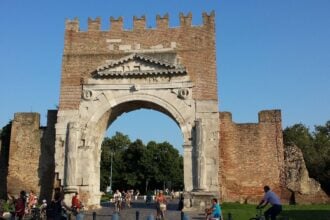
The Arch of Augustus and the Tiberius Bridge, both still standing from Roman times, sit at either end of the old town, a reminder that Rimini’s history runs far deeper than its 20th-century seaside reputation as a package-holiday beach resort.
Film fans should look out for references to Federico Fellini, Rimini’s most famous son, whose life and work are celebrated at a dedicated museum in the city.
In the warmer months, the beach itself is the main draw, with rows of organised bathing clubs renting sunloungers, umbrellas and pedalos by the day, alongside Italy’s famously generous gelato.
Rimini also makes a natural base for reaching San Marino, so some travellers choose to combine both in a single overnight trip rather than two separate day trips from Bologna.
See our guides to things to do in Rimini and day trips from Rimini for more detail on making the most of the Adriatic coast.
Rimini’s day trips page also mentions onward options towards Bologna, so if you are based on the coast rather than in the city, the connection works comfortably in either direction.
Milan: Fashion, Design and the Last Supper
Milan is around an hour from Bologna on a direct Frecciarossa or Italo service, fast enough that many visitors treat it as a legitimate day trip despite being Italy’s second-largest city and its financial capital.
The Duomo di Milano, with its forest of marble spires and rooftop terraces open to visitors, and the elegant glass-roofed Galleria Vittorio Emanuele II shopping arcade sit right next to each other in the heart of the city.
Art lovers should book well ahead for Leonardo da Vinci’s The Last Supper, housed at Santa Maria delle Grazie; tickets are limited and frequently sell out weeks in advance in peak season.
Shoppers can head to the Quadrilatero della Moda, Milan’s high-fashion district lined with flagship designer boutiques, while football fans might time a visit around a match at the iconic San Siro stadium, shared by AC Milan and Inter.
Given the size of the city, a single day only scratches the surface, so pick two or three priorities in advance rather than trying to see everything Milan has to offer in one visit.
Because the round trip eats up close to two hours on the train alone, an early departure from Bologna is worth it to maximise your time actually exploring Milan itself.
Milan’s excellent metro system makes it easy to cover the wider city beyond the historic centre, useful if your priorities include the Navigli canal district or a stadium visit at San Siro.
Mantua: A Quiet Gonzaga Stronghold
Mantua (Mantova) sits around 90 minutes from Bologna by train, usually with a change at Modena or Verona, and rewards the extra effort with one of the least crowded, most atmospheric historic centres in northern Italy.
For three centuries, Mantua was ruled by the Gonzaga family, whose wealth and patronage left behind an extraordinary concentration of Renaissance art and architecture packed into a relatively small, easily walkable city.
The highlight is Palazzo Te, a lavish 16th-century pleasure palace decorated with dramatic frescoes, including the famous Sala dei Giganti, where giants appear to tumble from a collapsing ceiling.
The vast Palazzo Ducale, the Gonzaga family’s main residence for generations, contains hundreds of rooms and Mantegna’s celebrated Camera degli Sposi frescoes, one of the great works of Renaissance painting.
Mantua is surrounded on three sides by artificial lakes, originally engineered as a defensive measure, giving the historic centre an unexpectedly watery, atmospheric setting that feels quite different from the other cities in this guide.
Given the longer journey, this works best as a full-day trip for travellers with a genuine interest in Renaissance art and a preference for quieter streets over major tourist crowds.
Mantua is also known locally for tortelli di zucca, a pumpkin-filled pasta similar to Modena’s version, worth trying at one of the trattorie around Piazza delle Erbe before heading back to catch the return train.
Dozza: A Hilltop Village Covered in Murals
For something completely different, Dozza is a tiny medieval hilltop village around 30 to 40 minutes from Bologna by car or bus, best suited to travellers with their own transport, plenty of patience, or an organised tour.
Since the 1960s, Dozza has hosted the Biennale del Muro Dipinto, an ongoing project that invites artists to paint murals directly onto the village’s house façades, turning the entire centre into an open-air gallery.
The hilltop Rocca Sforzesca, a well-preserved medieval fortress with sweeping countryside views, houses a regional enoteca (wine cellar) showcasing wines from across Emilia-Romagna, with tastings available for visitors.
Dozza has no train station, so a car is the most practical way to visit; a handful of regional buses connect from Bologna and nearby Imola, though services are limited.
Two to three hours is enough to wander the murals and fortress, making it easy to combine with lunch in nearby Imola, itself known for motorsport heritage and a pleasant historic centre.
An organised half-day tour, often paired with a nearby winery, is worth considering if you don’t have your own transport, since Dozza’s limited bus service makes independent visits slightly harder work.
Spring and early autumn are the best times to visit Dozza, when the surrounding vineyards are at their most photogenic and the village’s narrow, winding streets are noticeably quieter than in peak summer.
Comacchio and the Po Delta
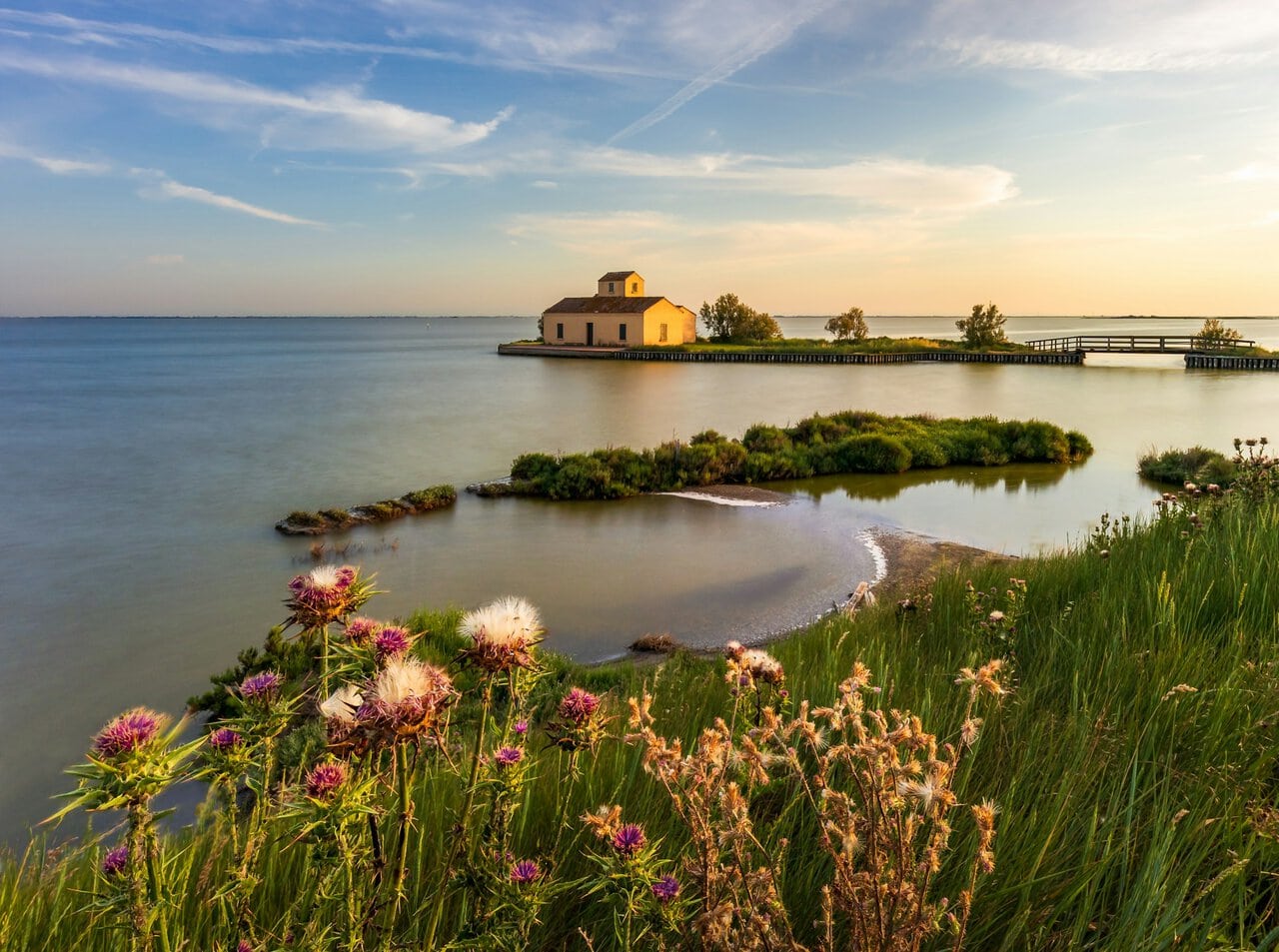
Often overlooked in favour of nearby Ferrara, Comacchio is a small lagoon town around 75 to 90 minutes from Bologna, built across a series of islands and canals that have earned it the nickname “Little Venice,” though far quieter and considerably less visited by tourists.
The town’s most photographed spot is the Trepponti bridge, a distinctive five-way stone crossing built in the 17th century, still the centrepiece of the historic centre’s network of canals and arched footbridges.
Comacchio sits at the edge of the Po Delta Park, a vast wetland reserve known for pink flamingos, birdwatching and the local speciality, marinated eel, a dish the town has been famous for since medieval times.
Boat tours into the surrounding lagoon and valli (shallow salt-water basins) are widely available in season, offering a completely different landscape from the historic city centres covered elsewhere in this guide.
Public transport connections are limited compared with Ferrara or Ravenna, so a car makes the visit considerably easier, particularly if you want to combine Comacchio with a stop in the wider delta.
Half a day covers the historic centre and Trepponti bridge comfortably; add a boat tour and it becomes a full, unhurried day away from Bologna’s more famous day-trip destinations.
Combining Comacchio with nearby Ferrara in a single day is possible for travellers with a car, though public transport makes this considerably harder and is better treated as two separate trips.
Photographers should aim for late afternoon light along the canals, when the colours of the lagoon and the reflections off the water are at their most striking for a genuinely memorable shot.
Best for solo travellers and anyone watching the budget. Dorm beds and private rooms in the same search.
Browse hostelsBest arranged before you fly rather than after. Covers claim handling, plus lounge access on eligible delays.
Explore AirHelp+Best if your room is not ready yet. Left luggage booked in advance, so you are not hunting for a locker.
Check storageGuided Day Tours from Bologna
If planning train connections isn’t your idea of a relaxing day out, organised day tours from Bologna cover most of the destinations in this guide with door-to-door transport included, usually departing directly from the city centre early in the morning.
Food-focused tours are especially popular, typically combining Modena and Parma in a single day: a working Parmigiano Reggiano dairy, a balsamic vinegar acetaia and often a stop at the Ferrari Museum, usually with a hearty lunch included.
For San Marino, a guided tour removes the need to manage the train-and-bus connection yourself, and can be a sensible option if you are short on time or travelling with a group.
Ravenna’s mosaic sites are also commonly covered by small-group tours from Bologna, often paired with a local guide who can explain the history behind the Byzantine artwork in more depth than a self-guided visit.
Prices for a full-day guided tour, including transport, generally run higher than the equivalent train ticket, but they remove the logistics entirely and often include skip-the-line access to popular sights.
For independent travellers comfortable navigating Trenitalia, the train remains cheaper and more flexible; guided tours suit those who would rather hand over the planning and focus purely on the day itself.
Most tours can be booked online a day or two in advance, though popular food tours combining Modena and Parma in peak season are worth reserving a week or more ahead.
Which Day Trip Is Right for You?
If you have only half a day, Modena is the easiest option: a short train ride, a walkable centre and enough food and architecture to feel like a proper trip without eating into your whole day.
For food lovers with a full day to spare, Parma edges out Modena on depth, particularly if you can fit in a producer visit for prosciutto or Parmigiano Reggiano alongside the historic centre.
If art and history matter more than food, Ravenna’s mosaics and Mantua’s Renaissance palaces are the strongest picks, though both need a full day given the longer travel times involved.
Travellers who want a major city without leaving Bologna’s rail network behind should prioritise Florence over Venice or Milan, purely on the strength of its short 35 minute journey time.
For something more unusual, San Marino and Dozza both offer a genuinely different experience from Italy’s classic cities, at the cost of a longer or less convenient journey to reach them.
Families with young children may prefer Modena or Ferrara, both compact enough to manage without long train journeys eating into nap times or patience levels.
Travellers combining a coastal stay with a Bologna base should look at Rimini and San Marino together, since the two are naturally linked by the same connecting bus route out of Rimini station.
Finally, if you genuinely can’t decide, Modena remains the safest first choice for most travellers: short, cheap, walkable and packed with enough food and history to justify the trip on its own.
Whichever you choose, resist the temptation to cram two or three destinations into a single day; the travel time alone tends to eat into the experience, leaving you rushing through places that deserve more attention.
It is also worth mixing up your choices across a longer trip rather than picking similar destinations back to back; a food-focused day in Modena pairs naturally with a slower, art-focused day in Ravenna or Mantua.
Planning Your Day Trip from Bologna
Regional trains generally don’t require seat reservations, so you can turn up at Bologna Centrale and buy a ticket shortly before departure, though it is worth checking the timetable the night before.
High-speed services to Florence, Venice or Milan are cheaper when booked a few days ahead, and fares can roughly double if you buy on the day, especially in summer and around holidays. Fare classes range from a basic non-refundable ticket to fully flexible options, so check the conditions before assuming the cheapest fare suits your plans.
If you are travelling to several cities over a longer trip, it is worth comparing the Trenitalia Pass, the Interrail Italy Pass and the Italia in Tour Pass against individual tickets.
Validate paper regional tickets at the small green or yellow machines on the platform before boarding; failing to do so can result in an on-the-spot fine even if you genuinely intended to pay.
Left-luggage facilities at Bologna Centrale make it easy to drop bags before a day trip if you are travelling onward the same evening, rather than lugging suitcases around another city all day and back again.
Finally, always build in a little buffer before your return train, particularly on trips involving a bus connection like San Marino, since a single delay can otherwise cascade into a missed connection.
Weekday trips are generally quieter than weekends, particularly for popular destinations like Modena and Florence, where regional trains can fill up with commuters and other day-trippers during peak periods.
Pack a portable charger and download offline maps before you leave; mobile signal can be patchy on some regional routes through the Emilia-Romagna countryside, especially on older rolling stock.
Keep a rough backup plan for each trip; if a museum is unexpectedly closed or a train is cancelled, most of the destinations in this guide have enough else to see nearby that the day is not entirely wasted.
Finally, do not underestimate how tiring a full day of walking and trains can be; building in a proper sit-down lunch, rather than rushing between sights, generally makes for a more enjoyable trip overall.
Dress in layers where possible; regional trains and older stations are not always well air-conditioned in summer, and evenings in hilltop destinations like San Marino or Dozza can turn surprisingly cool.
Check the return timetable before you head out for the day rather than relying on memory, particularly on Sundays and public holidays, when regional services often run less frequently than on weekdays.

Rupert’s Handy Travel Tips
I’ve hopped on and off more regional trains around Bologna than I can count, here’s what I’d want a fellow day-tripper to know.
- Check before you validate: Regional tickets bought at the station need stamping at the platform machine, high-speed tickets with a seat number don’t.
- Modena first, if unsure: It’s the shortest, easiest day trip on this list and a good gauge for how much you enjoy this style of travel.
- Book San Marino’s bus leg early: The Rimini to San Marino bus can fill up in summer, buy your ticket as soon as you arrive at Rimini station.
- Keep a paper backup: Rural connections, especially to Dozza, aren’t always reliable for mobile tickets, a printed copy avoids awkward conversations with the conductor.
Want to meet the reindeer behind our travel tips? Find out more in our page Who is Rupert?.



Frequently Asked Questions
What is the best day trip from Bologna?
Modena is the easiest and shortest, while Parma and Ravenna offer more depth for travellers with a full day to spare. There is no single right answer, it depends on your priorities.
Can I visit Florence as a day trip from Bologna?
Yes, high-speed trains take around 35 minutes each way, making Florence one of the most realistic longer-distance day trips on this list, even for a single afternoon.
How do I get from Bologna to San Marino?
Take a train to Rimini, then a connecting bus up into the mountains. The full journey takes roughly 2.5 to 3 hours each way.
Do I need to book train tickets in advance?
Regional trains rarely need advance booking, but high-speed services to Florence, Venice or Milan are cheaper and more reliable if booked a few days ahead, particularly in peak season.
Is Venice worth a day trip from Bologna?
Yes, though the round trip takes around three hours, so it works best with an early start and a focus on the main sights near St Mark’s Square.
What day trips are good for food lovers?
Modena and Parma are the strongest choices, covering balsamic vinegar, Parmigiano Reggiano and Prosciutto di Parma within a short train ride of Bologna, with plenty of tasting opportunities along the way.
Can I visit Dozza without a car?
It is possible by regional bus from Bologna or Imola, but services are limited, so a car or organised tour is a more reliable option.
Are Modena and Parma easy to combine in one day?
It is possible but rushed, since both cities reward at least half a day each; most visitors are better served treating them as two separate, more relaxed trips.
Further Reading
Before heading out on any of these trips, make sure you’ve made the most of the city itself first, with our guide to things to do in Bologna, covering the Two Towers, Piazza Maggiore and the Quadrilatero market, and check Bologna Airport to the city centre if you are arriving by air.
If Florence catches your eye, our guides to things to do in Florence and day trips from Florence cover the wider region in considerably more depth for anyone extending their trip into Tuscany, alongside Florence Airport to the city centre.
For the Adriatic coast, see our guides to things to do in Rimini, Rimini airport transfers and the full San Marino travel guide. For rail passes covering multiple cities, compare the Trenitalia Pass and Interrail Italy Pass.