Reviewed by our editorial team Updated
Discover the Best of Bologna
Tucked between Florence and Venice on Italy’s high-speed rail map, Bologna is often treated as a stopover rather than a destination in its own right. That is a mistake. This is the capital of Emilia-Romagna, home to Europe’s oldest university and widely considered the food capital of Italy.
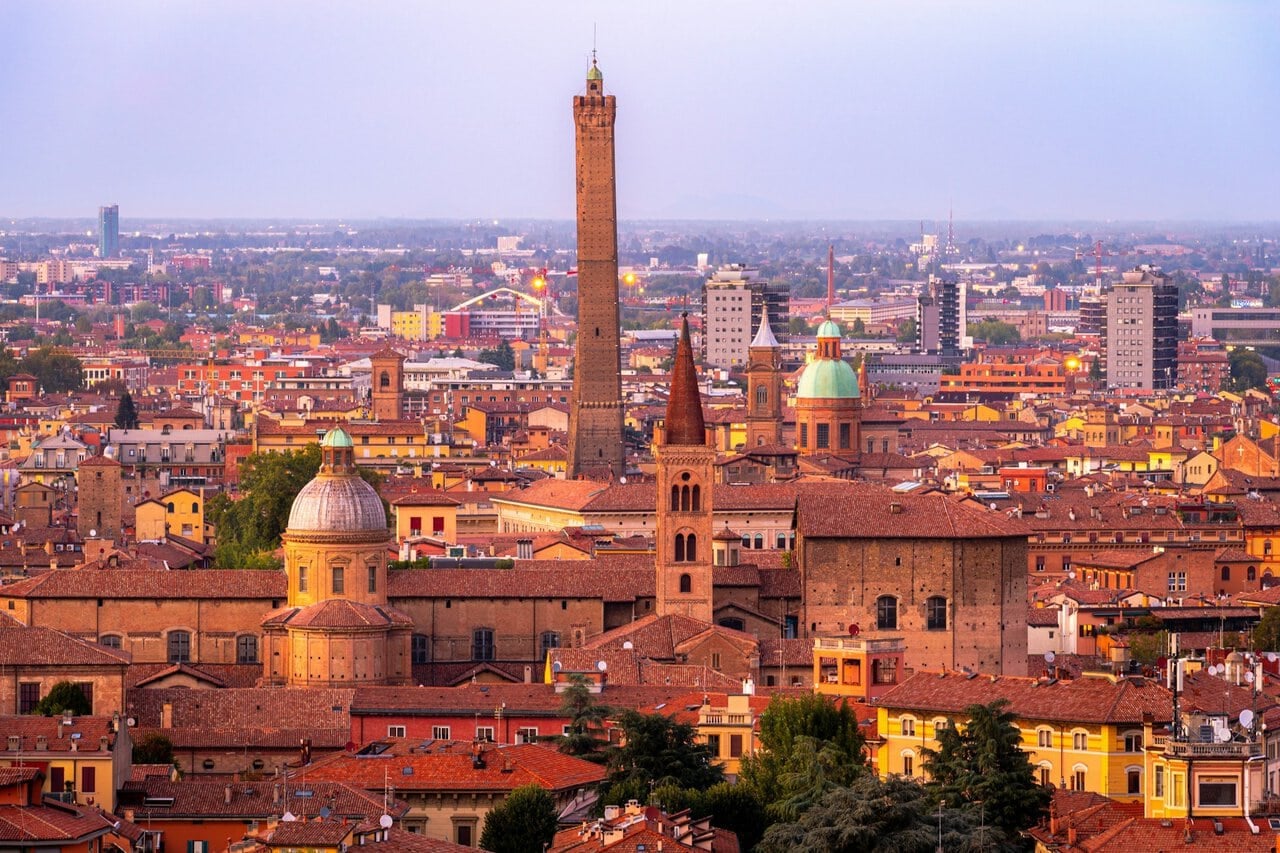
The historic centre is compact, largely traffic-free and wrapped in 40 kilometres of covered porticoes, a UNESCO-listed feature that lets you explore whatever the weather is doing. Terracotta rooftops, medieval towers and a genuinely lived-in old town make it easy to fill two or three full days here.
Locals sum the city up with three nicknames: La Dotta (the learned, for its 1,000-year-old university), La Grassa (the fat, for tortellini, mortadella and ragù) and La Rossa (the red, for both its terracotta roofs and its politics). All three show up constantly as you wander around.
This guide covers Bologna’s essential sights, from Piazza Maggiore and the Two Towers to hidden canals, covered markets and the hilltop Sanctuary of San Luca. Museums, food experiences and lesser-known corners are all included, arranged so you can build your own itinerary.
Unlike Florence or Venice, Bologna sees relatively few overseas visitors, which means streets stay lived-in rather than turned over entirely to tourism. Restaurants cook for locals first, and prices for food and coffee remain noticeably lower than its more famous neighbours. That said, the city is far from undiscovered among Italians and other Europeans, particularly around university term time and major food festivals, so it still pays to book popular restaurants and paid attractions a little ahead of time.
If you are flying in, our guide to getting from Bologna Airport to the city centre covers the Marconi Express and other options. And once you have covered the city, see our guide to the best day trips from Bologna for onward ideas.
Bologna Attractions at a Glance
With so much packed into a small historic centre, it helps to know what you are working with before you set off. The table below summarises the sights covered in this guide, roughly how long each one takes and who they suit best.
Most of these are within a 15 to 20 minute walk of each other, so you can easily mix and match rather than following a strict order. Save the hilltop sanctuary for a morning when you have more energy for the climb.
A handful of sights, notably San Luca and the Certosa, sit a little further out and are best treated as a dedicated outing rather than squeezed between other stops, so build them into a slower morning or afternoon.
Prices below are approximate and can change seasonally, particularly for special exhibitions at MAMbo or the Pinacoteca, so treat the “time needed” column as the more reliable planning figure of the two.
Note that the Two Towers entry combines the closed Torre degli Asinelli with its working alternative, the Torre dell’Orologio, since the latter is currently the only way to climb for a view over the rooftops.
| Attraction | Type | Time Needed | Good For |
|---|---|---|---|
| Piazza Maggiore | Historic square | 30-45 minutes | Everyone, first stop |
| San Petronio Basilica | Church | 30-40 minutes | History and architecture fans |
| Two Towers & Torre dell’Orologio | Medieval towers | 45-60 minutes | Views and photos |
| Portico di San Luca | Covered walkway & hilltop sanctuary | 2-3 hours | Walkers, views over the city |
| Quadrilatero Market | Historic food market | 1-2 hours | Food lovers |
| MAMbo & Bologna’s museums | Art and history museums | 1-2 hours each | Art and culture fans |
| Archiginnasio | Historic university building | 30-45 minutes | History and medicine buffs |
| Santo Stefano | Seven-church complex | 30-45 minutes | Quiet, off the main square |
| Via Zamboni & University Quarter | Neighbourhood | 1-2 hours | Street life, bars, students |
| Hidden Canals | Secret viewpoint | 15-20 minutes | A quick, quirky detour |
| Giardini Margherita & Le Serre | Park | 1-2 hours | Families, relaxing |
| Ghetto Ebraico | Historic Jewish quarter | 30-45 minutes | Quieter streets, boutiques |
| Certosa di Bologna | Monumental cemetery | 45-60 minutes | Art, history, quiet corners |
Best for a short trip. Compare rooms by neighbourhood, price and guest rating before you book.
Compare hotelsBest for families, or any stay past about four nights. A kitchen and a washing machine start paying for themselves.
Browse rentalsBest for double-checking. Runs the same search across several booking sites so you are not leaving money behind.
Compare pricesPiazza Maggiore and the Fountain of Neptune
Piazza Maggiore is Bologna’s living room and the natural place to start any visit. This vast medieval square has been the city’s civic heart for over 700 years, framed by the Palazzo d’Accursio, the Palazzo dei Notai and the unfinished façade of San Petronio.
Just off the main square sits the Fountain of Neptune, a 16th-century bronze masterpiece by Giambologna. Locals simply call it “Il Gigante” (the giant), and its cheeky mermaid figures are a favourite photo stop for visitors passing through.
The square is at its liveliest in the early evening, when Bolognesi gather for aperitivo at the surrounding bars and cafés. Arrive around 6pm to 8pm to see the piazza at its most animated, glass of Lambrusco in hand.
In summer, Piazza Maggiore also hosts free outdoor film screenings after dark as part of the long-running Sotto le Stelle del Cinema festival, with deckchairs set out facing a giant screen against the basilica wall.
On the northern edge of the square, look for Palazzo Re Enzo, a 13th-century palace once used to hold a defeated king prisoner, and the adjoining Piazza del Nettuno, effectively an extension of the main square around the fountain itself.
In December, the square transforms into a proper Christmas market, with wooden stalls selling ornaments, mulled wine and local crafts set up beneath the basilica, one of the better festive markets in northern Italy.
Give yourself at least 30 to 45 minutes here on your first pass, longer if you want to sit with a coffee and simply watch the square go about its business. Nearly every other sight in this guide is within easy walking distance.
Basilica di San Petronio
Dominating the south side of Piazza Maggiore, San Petronio is one of the largest brick churches ever built and, for centuries, was intended to outdo St Peter’s in Rome. That ambition explains its unfinished, half-marble façade, which was never completed.
Inside, the basilica is genuinely enormous, with side chapels stretching along both walls. The Cappella Bolognini is a highlight, decorated with 15th-century frescoes depicting scenes from Dante’s Divine Comedy, including a famously vivid vision of hell.
Look down as you walk and you will spot the Meridian Line, a 67-metre sundial line set into the floor in 1655 by astronomer Gian Domenico Cassini. It is still one of the longest sundials in the world and still functions accurately today.
Entry to the main church is free, though a small fee applies if you want to see the museum or climb the terraces for rooftop views. Photography is generally allowed but be respectful during services.
The stained glass in the Bolognini Chapel dates to the 15th century and is among the best preserved in Italy, while a pair of historic organs, one dating to around 1470, still occasionally accompany services and concerts.
Construction on San Petronio began in 1390 and, despite its scale, was never actually finished; funds originally earmarked for the façade were diverted by the Pope towards building a university instead, which is why the marble stops abruptly halfway up.
Budget around 30 to 40 minutes for a visit, more if the terraces are open when you arrive. It sits right on Piazza Maggiore, so it is easy to combine with the fountain and towers in a single loop.
The Two Towers and Torre dell’Orologio
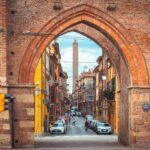
Bologna’s skyline is defined by Le Due Torri, the Two Towers, a pair of leaning medieval structures near Piazza Maggiore that have stood since the 12th century. Torre degli Asinelli is the taller of the two at almost 97 metres.
At the time of writing, Torre degli Asinelli is closed to visitors while structural monitoring and restoration work continues on the shorter, more visibly leaning Torre Garisenda next to it. There is no confirmed reopening date, so check current status before planning around it.
With the main tower closed, the best substitute for panoramic views is the Torre dell’Orologio (Clock Tower), reached through Palazzo d’Accursio on Piazza Maggiore. Tickets cost around €10 and use timed entry slots, so booking ahead in high season is wise.
Even without climbing, the Two Towers are worth seeing at street level. Their pronounced lean, more dramatic than Pisa’s when viewed from certain angles, has made them a symbol of the city for over 800 years.
Bologna once had as many as 180 towers built by rival noble families competing to show off their wealth and status. Most were demolished or collapsed over the centuries, leaving the Two Towers as the most famous survivors.
Fencing now cordons off the base of Torre Garisenda as a safety precaution, so don’t be surprised to find the immediate area partly closed off. It is still an impressive sight from across the small square.
Allow 45 to 60 minutes if you are climbing the Clock Tower, including queuing time. The surrounding streets, lined with cafés and gelaterie, are a pleasant spot to linger afterwards.
Portico di San Luca and the Sanctuary Above the City
For one of Bologna’s most memorable experiences, follow the Portico di San Luca, a UNESCO-listed covered walkway stretching 3.8 kilometres and made up of 666 arches, from the city gate at Porta Saragozza up to a hilltop sanctuary.
The walk climbs steadily to the Sanctuary of the Madonna di San Luca, a baroque basilica that has drawn pilgrims for centuries. It is entirely undercover, which means you can do it in rain or shine, though the uphill stretch is a genuine workout.
Walking one way takes roughly 60 to 90 minutes at a steady pace. If you would rather save your legs, a seasonal express minibus runs from the city centre to the sanctuary, with round-trip tickets costing around €13.
The reward at the top is one of the best panoramic views over Bologna, the surrounding hills and, on a clear day, as far as the Apennines. There is also a small café near the sanctuary for a well-earned coffee.
Once a year, on the Saturday before Ascension Day, an icon of the Madonna with Child is carried in procession down the entire length of the portico into the city centre, a tradition dating back over 600 years.
Each of the 666 arches was historically funded and maintained by a different family, guild or institution, and small plaques along the route still record who paid for which section.
Set aside at least 2 to 3 hours for the round trip if walking both ways, or closer to an hour if you take the express bus up and walk down. Morning is the coolest and quietest time to go, especially in summer.
The Quadrilatero Market District
Just east of Piazza Maggiore, the Quadrilatero is Bologna’s medieval market quarter, a tangle of narrow lanes still named after the trades that once lined them: Via Pescherie Vecchie (fishmongers), Via Drapperie (drapers) and Via degli Orefici (goldsmiths).
This is a working market rather than a tourist reconstruction. Stalls sell fresh fish, cured meats, cheeses and produce alongside delis and wine bars where you can eat standing up, plate in hand, surrounded by locals doing their daily shop.
Inside the quarter, the Mercato di Mezzo is a covered food hall with communal tables serving typical Emilia-Romagna dishes, while the larger Mercato delle Erbe nearby combines produce stalls with sit-down spots like Formaggeria Barbieri.
Come hungry and graze: a few slices of mortadella, a wedge of aged Parmigiano Reggiano and a glass of local wine cost only a few euros and make for one of the best casual lunches in the city.
In the early evening, the same stalls and nearby wine bars shift into aperitivo mode, with locals stopping for a glass of Pignoletto or Lambrusco and a plate of cured meats before heading home or on to dinner.
The street names themselves are a small history lesson: Via Pescherie Vecchie once housed the fish market, and traces of the old trades still surface in a handful of specialist shops that have operated for generations.
Late morning through early afternoon is the liveliest time to visit, roughly 10am to 2pm. Allow 1 to 2 hours to properly wander and graze your way through it.
MAMbo and Bologna’s Museums
Bologna has a strong contemporary art scene, led by MAMbo (Museum of Modern Art of Bologna), housed in a former bakery with almost 9,500 square metres of exhibition space. Entry to the permanent collection is free, though it is closed on Mondays.
For something more hands-on, MAST (the Manifattura di Arti, Sperimentazione e Tecnologia) explores industry, technology and photography through interactive exhibits. It is also free to enter and sits a short bus ride from the centre on routes 19, 81 or 91.
Art lovers who prefer older work should head to the Pinacoteca Nazionale, a 17th-century gallery with an excellent collection of Renaissance and Baroque paintings by Bolognese masters. Standard admission is around €12, waived if you hold a Bologna Welcome Card.
Between the three, you get a genuinely broad sweep of Bologna’s artistic output, from medieval altarpieces to contemporary installations, without ever needing to leave the historic centre or its immediate surroundings for long.
MAMbo also houses the Museo Morandi, dedicated to Bologna-born painter Giorgio Morandi, whose quiet still-life paintings of bottles and jars are among the most celebrated Italian art of the 20th century.
If you are visiting several museums, ask about combined tickets at the first one you visit; several of Bologna’s civic museums offer joint passes that work out cheaper than paying for each individually.
Plan for 1 to 2 hours per museum. If you only have time for one, MAMbo offers the best balance of free entry and genuinely interesting rotating exhibitions.
Best for finding routes the airlines do not sell as a single ticket. Combines carriers to bring the fare down.
Search flightsBest for short trips. Install the eSIM at home and arrive with working data, no shop queue.
Browse eSIMsBest when public transport has stopped, or when you are travelling with children and bags.
Book a transferArchiginnasio and the Anatomical Theatre
Tucked behind Piazza Maggiore, the Palazzo dell’Archiginnasio was the main seat of the University of Bologna, founded in 1088 and generally regarded as the oldest continuously operating university in the Western world, from 1563 until 1803.
Its courtyards and staircases are covered in thousands of painted coats of arms, left behind by generations of graduating students and noble families over some four centuries, a striking sight even before you reach the building’s most famous room.
That room is the Anatomical Theatre, a 17th-century lecture hall carved almost entirely from wood, where public dissections once took place under carved wooden statues of famous physicians looking down on the proceedings.
Entry with an audio guide costs around €10, and online reservation is recommended in peak season since space inside the theatre itself is limited. The building also houses a historic public library, still in daily use.
The original Anatomical Theatre was largely destroyed by bombing in 1944 and later rebuilt using salvaged and recreated pieces, which makes its survival, and its atmosphere, all the more remarkable given what it went through.
Look up in the main hall for the carved wooden ceiling figures, including Apollo flanked by allegorical statues, watching over the space where public dissections were once performed for students and visiting scholars.
Allow 30 to 45 minutes for a visit. It pairs naturally with a walk down nearby Via Zamboni, the heart of the university quarter, described in more detail below.
See Bologna by Open-Top Bus and Taste the Local Food
If you want to see a lot of Bologna in a relatively short time, the city’s open-top sightseeing bus combines a tour of the main landmarks with a tasting of some of the food for which Emilia-Romagna is famous.
The experience starts at Piazza Galvani, just behind Piazza Maggiore, before heading through Bologna on an approximately 50-minute bus circuit. The route passes many of the sights covered elsewhere in this guide, including San Petronio, the Two Towers, Archiginnasio, Neptune’s Fountain, Porta Saragozza and Teatro Comunale.
You can get on and off at designated stops, making it useful if you only have a day in Bologna or would rather avoid walking between every attraction. A multilingual audio guide is included, with commentary available in English and several other languages.
What makes this particular ticket more interesting than a straightforward sightseeing bus is the local food tasting included afterwards. The itinerary allows around 30 minutes in a historic market, where the included voucher can be used to sample local products.
The combination works particularly well on a first day in Bologna. You can use the bus circuit to get your bearings and identify places you want to return to on foot, while the market visit provides an introduction to Bologna’s famous food culture without committing to a longer dedicated food tour.
The experience is sold as a one-day ticket, with free cancellation available up to 24 hours beforehand. Bear in mind that although you reserve a particular time, actual boarding can still depend on how many other passengers are waiting.
Visit the Ducati Museum
Bologna’s attractions aren’t confined to medieval towers and Renaissance buildings. The city is also closely associated with Ducati, one of Italy’s most famous motorcycle manufacturers, whose headquarters and museum are in Borgo Panigale on the western side of Bologna.
The Ducati Museum traces the manufacturer’s history from its beginnings in 1926 through to the motorcycles that established Ducati as one of the world’s best-known performance brands. Exhibits include historic road bikes, racing motorcycles and machines connected with Ducati’s successes in international motorsport.
You don’t need to be a committed motorcycling fan to find it interesting. The museum provides a very different look at Bologna’s industrial and engineering heritage, making it a useful contrast to the churches, galleries and medieval streets dominating the historic centre.
It is outside the central sightseeing area, so allow for the journey to and from Borgo Panigale rather than trying to squeeze it between Piazza Maggiore attractions. Depending on the ticket you choose, visits may also be available alongside a Ducati factory experience, making advance booking particularly worthwhile.
For motorcycle enthusiasts, this is one of the Bologna attractions I’d actively make time for rather than treating as an optional extra. Ducati is part of the modern identity of the city in much the same way that its porticoes and university represent historic Bologna.
Santo Stefano and the Seven Churches
A short walk from Piazza Maggiore, the Santo Stefano complex is one of Bologna’s most atmospheric corners, a cluster of medieval churches built around a quiet romanesque courtyard that feels a world away from the busier streets and shopfronts nearby.
Originally made up of seven churches, only four survive today, but the complex is still known locally as “Sette Chiese.” Its layout was deliberately designed to echo the holy sites of Jerusalem, a common pilgrimage tradition among wealthy medieval European cities.
Inside, look for the Basin of Pilate, an 8th-century marble basin, and the peaceful cloister garden, one of the few genuinely quiet green spaces in the historic centre.
Local legend holds that the basin was used by Pontius Pilate to wash his hands, though historians date it firmly to the early medieval period, centuries after the events it is said to commemorate.
On some weekends, the courtyard hosts a small antiques or craft market, adding a bit of extra colour to an already photogenic setting. Check ahead if you want to catch one.
Entry is free, which makes it an easy add-on rather than a planned stop. There is a small museum and gift shop inside run by the resident religious community.
Budget 30 to 45 minutes to wander through all four surviving churches and the courtyard. Early morning is the quietest and most atmospheric time to visit.
Via Zamboni and the University Quarter
Via Zamboni and the streets around it form the beating heart of student Bologna, lined with faded palazzi, second-hand bookshops and some of the city’s best-value bars, pizzerie and trattorie catering to a mostly local, mostly young crowd.
This is where the University of Bologna, founded in 1088, spills out into daily life: lecture halls sit next to graffiti-covered walls and student housing, and the energy shifts noticeably from the more formal centre around Piazza Maggiore.
In the evening, the neighbourhood becomes one of the best places in the city for an affordable aperitivo, a Bologna tradition. Look for small bars offering a drink with a generous buffet included, a Bologna tradition that easily doubles as dinner.
Along the way, don’t miss Piazza Verdi, the informal social hub of student life, especially lively on weekend evenings, and the porticoed façade of the Teatro Comunale opera house.
The quarter is also home to several excellent second-hand bookshops and independent record stores, a legacy of decades of student life, worth a browse for the atmosphere alone even if you don’t read Italian.
Street art is another feature of the neighbourhood, with political murals and stencils appearing regularly on walls and shutters, a visible sign of Bologna’s long tradition of student activism.
There is no fixed itinerary here; allow 1 to 2 hours to wander and stop wherever looks interesting. Evenings, from around 6pm onwards, are when the quarter really comes alive.
Bologna’s Hidden Canals
Few visitors realise that Bologna was once criss-crossed by navigable canals, most of which were covered over in the 20th century. A handful of glimpses remain, hidden in plain sight for anyone who knows where to look.
The best known is the Finestrella di Via Piella, a tiny window set into a wall on Via Piella. Peer through it and you will see a stretch of open canal lined with colourful buildings, often nicknamed “Little Venice.”
A second, less crowded viewpoint sits along Via Capo di Lucca, offering a similar glimpse of the old waterway system without the queues that can build up at the more famous window.
Both spots are free to visit and take only a couple of minutes each, though the Via Piella window can get busy, so early morning or later afternoon are the best times to get a clear look.
The canals originally formed part of a network connecting Bologna to the River Po and, from there, to Venice, allowing goods like silk to be transported by boat as far back as the medieval period.
Most of the network was covered over in the 1950s to make way for roads, so these two small windows are effectively the only easy way to see what the city looked like before then.
Allow around 15 to 20 minutes to find and photograph both windows. They sit a short walk north of the Quadrilatero, so it is easy to fold them into a morning market visit.
Best if you would rather spend the money on the trip than on the room. Compare hostels by location and rating.
Search hostelsBest if you have ever given up on a claim. AirHelp checks whether the flight qualifies and pursues it for you.
See the benefitsBest if your room is not ready yet. Left luggage booked in advance, so you are not hunting for a locker.
Check storageGiardini Margherita and Le Serre
When the historic centre starts to feel busy, Giardini Margherita offers a genuine break. This is Bologna’s largest public park, a favourite spot for locals to jog, picnic or simply stretch out on the grass after a morning of sightseeing.
Inside the park, Le Serre, a set of restored 19th-century greenhouses, has been converted into a relaxed cultural centre with gardens, a bookshop, exhibition space and the Vetro Bistrot restaurant, open daily from around 8am to 10:30pm.
Le Serre regularly hosts free live music and community events in the warmer months, making it a good option for an evening that feels more local than touristy.
The park includes a small artificial lake with a jogging path looping around it, popular with runners in the early morning and early evening once the day’s heat has faded.
Bring a picnic if the weather is good: there are plenty of benches and open grass areas, and a few kiosks nearby sell drinks and snacks if you would rather not carry your own.
The park is around a 15 to 20 minute walk from Piazza Maggiore, or a short bus ride if you would rather save your legs after a day of sightseeing.
Give it 1 to 2 hours, more if you settle in at Le Serre for a drink. Families with children will find it a welcome change of pace from churches and museums.
The Ghetto Ebraico
Between Via Zamboni and the Two Towers, a warren of narrow medieval lanes marks Bologna’s former Jewish quarter, the Ghetto Ebraico, home to the city’s Jewish community from the 14th century until it was formally closed and its residents restricted by decree in the 16th century.
Today the streets, including Via dell’Inferno and Via Valdonica, are lined with independent boutiques, vintage shops and street art tucked into archways that have barely changed shape in centuries.
A small plaque marks the site of the former synagogue, and a modern Jewish Museum nearby, the Museo Ebraico di Bologna, tells the community’s history in more depth for anyone who wants to go beyond a wander through the streets and archways.
Street names like Via dell’Inferno (Hell Street) hint at the district’s cramped, shadowy medieval layout, with buildings so close together that upper floors sometimes almost touch across the narrow lanes.
The area rewards slow, aimless wandering more than any single landmark, so resist the urge to rush through it on the way to somewhere else.
In the evening, bars like Camera a Sud draw a relaxed crowd for spritz and conversation, a good alternative to the busier squares if you want somewhere quieter to unwind.
Allow 30 to 45 minutes simply to wander, longer if you visit the museum. It is an easy add-on between the Two Towers and Via Zamboni.
Certosa di Bologna: The Monumental Cemetery
Not every visitor expects a cemetery to be a highlight, but the Certosa di Bologna is one of the city’s more unexpected sights, a vast monumental cemetery built on the site of a 14th-century Carthusian monastery that was suppressed under Napoleonic rule.
Wandering its cloisters and avenues, you will find hundreds of elaborate 19th and 20th-century tombs and sculptures, ranging from soberly classical to theatrically sentimental, commissioned by wealthy Bolognese families over more than two centuries.
The site is genuinely enormous, covering roughly 29 hectares, and combines the original monastery cloisters with later galleries and open-air sections, making it feel closer to an outdoor sculpture museum than a traditional graveyard.
Composer Ottorino Respighi and several notable Bolognese academics, scientists and artists are buried here, and the site remains an active cemetery today alongside its role as a genuine open-air gallery of 19th-century funerary sculpture.
Entry is free, and it sits a short bus or tram ride southwest of the historic centre. It is a quiet, reflective stop, best suited to a slower day rather than a packed itinerary.
Allow 45 minutes to an hour to explore the main cloisters and galleries. Opening hours vary seasonally, so check ahead, particularly if visiting in the late afternoon.
Local buses and the modern tram network both stop within a short walk of the entrance, making it an easy half-hour detour to combine with Giardini Margherita on the same side of town if you have a spare afternoon.

How Much Time Do You Need in Bologna?
With one full day, focus on the centre: Piazza Maggiore, San Petronio, the Two Towers area and a proper graze through the Quadrilatero market. It is a full but very doable itinerary on foot.
With two days, add the Portico di San Luca walk, Archiginnasio’s anatomical theatre and either MAMbo or the Pinacoteca, plus an evening exploring Via Zamboni and the university quarter.
A third day leaves room for the quieter corners: Santo Stefano, the Ghetto Ebraico, the hidden canals, the Certosa and Giardini Margherita, at a slower pace with time for long lunches.
Travellers with limited time sometimes wonder whether Bologna is worth a detour from a classic Florence-Venice itinerary. Given the food, architecture and relatively light crowds, it is easily worth at least one overnight stay rather than a rushed half-day stop.
Families travelling with children may want to prioritise Giardini Margherita, the hidden canals and a relaxed market lunch over the more physically demanding San Luca walk, saving the hilltop trek for a day when energy levels are higher.
Solo travellers and couples on a tighter schedule can comfortably see the top highlights: Piazza Maggiore, the Two Towers area and the Quadrilatero, in a single well-planned afternoon if arriving mid-morning from another city.
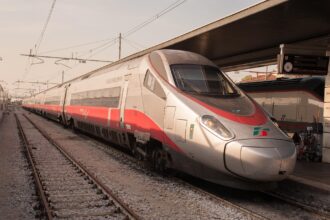
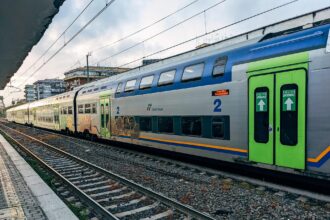
Bologna’s excellent rail connections also make it a natural base for exploring further afield. Modena, Parma and Ravenna are all under an hour away, and Florence is just 35 minutes by high-speed train.
If you have four or more days, consider splitting your time between the city and one or two of these towns. Our guide to day trips from Bologna covers the best options in detail.
Repeat visitors sometimes choose to base themselves in Bologna for a longer stretch of a wider Italian trip, using it as a low-cost, well-connected hub for day trips rather than changing hotels every night or two.
Practical Tips for Visiting Bologna
The best months to visit are April to June and September to October, when temperatures are comfortable and the porticoes provide shade from the sun or shelter from the occasional shower.
Summer, particularly July and August, can be hot and humid, and many family-run restaurants close for a week or two around mid-August for the traditional Ferragosto holiday, so check ahead if you have a specific spot in mind.
Consider the Bologna Welcome Card, which bundles free or discounted entry to several museums, the Clock Tower and a Portico di San Luca express bus ride into a single pass, worth it if you plan to visit multiple paid sights.
Wear comfortable shoes: the porticoes are wonderful for shade but their uneven, centuries-old paving is not kind to heels or flimsy sandals.
Most restaurants serve lunch from around 12:30pm to 2:30pm and dinner from 7:30pm onwards, with a break in between, so plan your food stops around these windows rather than expecting all-day service.
Getting around on foot is easy, but the historic centre also has an efficient network of local buses if your feet need a rest, particularly useful for reaching the Certosa or MAST on the city’s edges.
Tap water is safe to drink, and Bologna’s public drinking fountains, known as fontanelle, are dotted around the centre, a handy way to refill a bottle without buying more plastic.
Tipping is not expected in the way it is in the US; rounding up the bill or leaving a euro or two for good service is generally plenty in restaurants and cafés.
If you need to store luggage for a few hours, Bologna Centrale station has a staffed left-luggage office, useful if you are arriving early or leaving late and don’t want to drag bags around the historic centre.
Free public wifi is available in parts of Piazza Maggiore and around some university buildings, though it is patchy; a local SIM or an eSIM data plan is a more reliable option if you need to stay connected all day.
English is widely understood in restaurants, hotels and shops around the historic centre, but learning a few basic Italian phrases, particularly for ordering food, goes a long way and is genuinely appreciated by locals.
Public toilets are limited in the historic centre; your best bet is usually a café, where a small purchase buys access, or one of the paid museums and attractions listed throughout this guide, several of which also have decent facilities.
If you are arriving by air, our guide to getting from Bologna Airport to the city centre covers journey times and fares for every option.

Rupert’s Handy Travel Tips
I’ve trotted through Bologna’s porticoes more times than I can count, here’s what I’d want a fellow traveller to know before setting off.
- Skip the tower queue: With Torre degli Asinelli closed, head straight for the Torre dell’Orologio on Piazza Maggiore instead and book your timed slot in advance.
- Graze, don’t sit: The Quadrilatero market is built for standing and snacking, order small plates from two or three stalls rather than one big sit-down meal.
- Walk San Luca in the morning: The 3.8km portico gets warm fast in summer, start early and take the express bus back down if your legs need a rest.
- Carry small change: Some market stalls and the San Luca bus ticket machines don’t always take cards, a few euro coins save a lot of hassle.
Want to meet the reindeer behind our travel tips? Find out more in our page Who is Rupert?.




Frequently Asked Questions
How many days do I need in Bologna?
One full day covers the essentials, but two or three days let you add the Portico di San Luca, museums and quieter neighbourhoods without rushing.
Is Torre degli Asinelli open?
No, it is currently closed while restoration work continues on the neighbouring Torre Garisenda. The Torre dell’Orologio on Piazza Maggiore is the best alternative for city views.
Is Bologna walkable?
Yes, the historic centre is compact and largely pedestrianised, with most major sights within a 20 minute walk of Piazza Maggiore, much of it under covered porticoes.
What food should I try in Bologna?
Look for tagliatelle al ragù, tortellini in brodo, mortadella and aged Parmigiano Reggiano. The Quadrilatero market is the best place to sample several at once.
Is the Portico di San Luca walk difficult?
It is a steady uphill climb over 3.8 kilometres and 666 arches, manageable for most fitness levels, though a seasonal express bus is available if you would rather skip the walk up.
Are museums free in Bologna?
Several, including MAMbo’s permanent collection and MAST, offer free entry. Others like the Pinacoteca Nazionale and Archiginnasio charge a small fee, often discounted with a Bologna Welcome Card.
Can I visit Bologna as a day trip from Florence or Venice?
Yes, high-speed trains connect Bologna to Florence in around 35 minutes and to Venice in around 90 minutes, making it an easy add-on to either itinerary.
Is Bologna expensive?
Generally no, especially compared with Florence or Venice. Market lunches, aperitivo and casual trattorie remain some of the best value dining in northern Italy.
Further Reading
Once you have settled on how to spend your time in the city, our guide to Bologna Airport to the city centre covers every arrival option, from the Marconi Express to taxis and private transfers.
Bologna’s location makes it an ideal base for exploring further, and our guide to day trips from Bologna covers Modena, Parma, Ravenna and further-flung options including Florence and San Marino.
If your trip continues along the Adriatic coast, see our guides to things to do in Rimini and Rimini airport transfers. If you are stringing together several cities on one trip, our guide to day trips from Florence is a useful companion piece. For travelling more widely by train, the Trenitalia Pass, Interrail Italy Pass and Italia in Tour Pass are all worth comparing before you book.