Reviewed by our editorial team Updated
The Belgrade to Bar Train: One of Europe’s Greatest Railway Journeys
The Belgrade to Bar Train isn’t just a way of getting from Serbia to Montenegro, it’s widely considered one of Europe’s great railway journeys in its own right. Over the course of a single trip, it carries you across dramatic mountain ranges, deep river canyons, soaring viaducts and hundreds of tunnels before finally arriving at the Adriatic coast.
Stretching almost 500 kilometres, the Belgrade–Bar Railway links the Serbian capital with Montenegro’s largest port city, crossing some of the most spectacular landscapes anywhere in the Balkans along the way. It climbs through remote mountain scenery before dropping down towards the sparkling Adriatic, and for a lot of travellers, the journey itself ends up being just as memorable as wherever they’re actually headed.
It’s also one of the last great international overnight rail experiences left in Europe. Leaving Belgrade in the evening, you travel through the night and wake to sweeping views of Montenegro’s mountains, forests and river valleys as the train approaches Podgorica and Bar. Heading the other way offers exactly the same drama in reverse, arriving into Serbia the following morning.
Whether you’re a rail enthusiast, an Interrailer, a backpacker working your way through the Balkans, or simply after a genuinely memorable way to reach Montenegro, this train offers something that’s hard to find anywhere else on the continent.
It’s also one of those journeys that changes how you think about arriving somewhere. Flying into Montenegro drops you straight into the country with barely any sense of transition, whereas rolling into Bar after a night crossing mountains and gorges gives you a genuine feel for the landscape before you’ve even left the station. A lot of travellers say it’s the single best way to start a Montenegro trip, precisely because it sets the scene so well.
Belgrade to Bar Railway at a Glance
Before booking, here’s a quick overview of one of Europe’s more remarkable railway lines.
| Feature | Details |
|---|---|
| Route | Belgrade (Serbia) – Bar (Montenegro) |
| Distance | Approximately 476 km |
| Journey Time | Around 11 hours 20 minutes |
| Frequency | Daily in both directions |
| Train Number (Belgrade → Bar) | 433 “Lovćen” |
| Train Number (Bar → Belgrade) | 1130 / 432 “Lovćen” |
| Departure (Belgrade) | 19:35 |
| Arrival (Bar) | 06:54 |
| Departure (Bar) | 20:10 |
| Arrival (Belgrade) | 07:25 |
| Countries | Serbia & Montenegro |
| Type | International overnight train |
| Sleeper Available | Yes |
| Restaurant Car | Usually available (subject to operational changes) |
The railway is famous not only for its overnight service but for the sheer scale of the engineering behind it. Over the course of the journey you’ll cross 435 bridges, pass through 254 tunnels and cross the spectacular Mala Rijeka Viaduct, one of the highest railway bridges anywhere in Europe, numbers that are worth keeping in mind next time someone tells you rail travel is dull.
Because the route crosses an international border, journey times can occasionally shift depending on border formalities or operational conditions, though the timetable itself is generally very reliable and rarely deviates by more than a few minutes either way.
Keep in mind that this table covers the standard scheduled service. Occasional seasonal timetable adjustments, engineering works or reduced services around public holidays in either country can shift the specifics slightly, so it’s always worth double-checking the current schedule close to your travel date rather than relying purely on older information found elsewhere online.
Compared with flying, the total travel time is obviously longer, but you’re also not losing an evening to airport transfers, security queues or an early check-in. Factor that in and the eleven-hour overnight train starts to look considerably more time-efficient than it first appears on paper.
See hotel options and places to stay for your trip.
Browse hotelsExplore holiday homes and apartments for your trip.
See holiday homesCompare prices from multiple hotel booking sites.
Check dealsThe Route: From Belgrade’s Suburbs to Montenegro’s Coast
The Belgrade to Bar Train passes through some of the most beautiful scenery in both Serbia and Montenegro, linking lively cities with remote mountain villages long before it ever reaches the Adriatic.
The principal stations served are:
| Country | Major Stops |
|---|---|
| Serbia | Zemun, Beograd Centar (Belgrade Centre), Rakovica, Lazarevac, Lajkovac, Valjevo, Kosjerić, Požega, Užice, Priboj |
| Montenegro | Bijelo Polje, Kolašin, Podgorica, Golubovci, Sutomore, Bar |
After leaving Belgrade, the train heads steadily south-west through central Serbia before gradually entering more mountainous country. By the time you reach Užice, the landscape has changed completely, with deep valleys and forest-covered hills taking over as the dominant feature outside your window.
Once you cross into Montenegro, the scenery steps up another level entirely. The railway twists through rugged mountains, follows dramatic river gorges and crosses towering bridges before descending through Kolašin and Podgorica towards the coast. During daylight hours, this stretch is widely considered the highlight of the whole journey.
Plenty of travellers break their trip in Podgorica or Bar, but the train also connects conveniently for anyone continuing on to Budva, Kotor, Tivat or Ulcinj by bus or taxi once you arrive.
Not every stop listed sees the same volume of passengers, and some of the smaller Serbian stations are really only of interest to locals joining or leaving partway through. For visitors, the meaningful stops tend to be Belgrade itself, Užice as the gateway into the mountains, and then Bijelo Polje, Kolašin, Podgorica and Bar once you’re across the Montenegrin border.
Current Timetable for the Lovćen Overnight Service
The Lovćen international train runs every day of the year, with one overnight departure in each direction.
| Direction | Train | Departs | Arrives | Frequency |
|---|---|---|---|---|
| Belgrade → Bar | 433 | 19:35 | 06:54 | Daily |
| Bar → Belgrade | 1130 / 432 | 20:10 | 07:25 | Daily |
These overnight timings let you make the most of your holiday, travelling while you sleep and arriving early enough to keep exploring rather than losing half a day to transit.
Tickets are currently only released 60 days before departure and, at the time of writing, generally can’t be booked through international booking platforms. Instead, they’re sold through railway ticket offices in Serbia and Montenegro, which makes advance planning particularly worthwhile if you’re hoping to reserve a sleeper cabin during the busy summer months. It’s also always worth checking the latest timetable before you travel, since engineering works and seasonal changes can occasionally shift departure or arrival times.
Because there’s only one departure a day in each direction, it’s worth building your other plans around this fixed schedule rather than assuming flexibility. Missing the evening departure from Belgrade, for instance, generally means waiting until the following day rather than catching a later service, so allow a comfortable buffer if you’re connecting from another train or flight beforehand.
Arriving into Bar at 06:54 does mean an early start, but most travellers find this works in their favour, giving a full day to settle in, find accommodation and start exploring rather than losing the afternoon to a late arrival.
Buying Tickets for the Belgrade to Bar Train
Buying tickets for the Belgrade to Bar train is now much easier than it used to be. As of July 2026 tickets can be purchased online through ŽPCG, the Montenegrin national railway operator, giving travellers the option to book before arriving in the region.
Tickets are generally released around 60 days before departure. If you are travelling during July or August, or want the security of a sleeper compartment, it is worth booking as soon as reservations open. Sleeper accommodation is limited and is often the first option to sell out, especially on trains travelling from Belgrade towards the Montenegrin coast.
When booking, you can normally choose between a standard seat, a couchette or a sleeping cabin, depending on availability. Although sleeper accommodation costs more, many travellers find it worthwhile, allowing them to wake up refreshed and enjoy the spectacular mountain scenery rather than spending the journey trying to sleep in a standard seat.
If online tickets are no longer available, or you prefer to buy in person, tickets can still be purchased from railway ticket offices in both Serbia and Montenegro. Outside the busy summer season, it is often possible to buy tickets just a few days before departure, although booking in advance is always recommended for overnight services.
Whether you book online or at a station, keep either a digital copy or a printed copy of your ticket or booking confirmation with you throughout the journey. While electronic tickets are becoming more common, having your confirmation readily available can make ticket inspections and boarding at smaller stations much smoother.

Seat, Couchette or Sleeper: Choosing the Right Accommodation
The Belgrade to Bar Train gives you a few different ways to travel overnight, so it’s worth understanding the differences before you book rather than working it out on the platform.
Standard seats are the cheapest option, and fine if you’re keeping costs down. They recline slightly but are really built for daytime travel, so most passengers find it genuinely difficult to sleep properly across an eleven-hour overnight journey in one.
A couchette is a solid step up. Compartments usually hold several bunks with basic bedding provided, letting you lie down properly while sharing the space with other travellers. They’re popular with backpackers and Interrailers who want a decent night’s sleep without paying for a private compartment.
For the best experience, book a sleeping cabin. These have proper beds with bedding, pillows and blankets included, and depending on availability can be configured for single, double or triple occupancy, making them suitable for solo travellers, couples and families alike. They cost more than a standard seat, but plenty of travellers consider it money well spent, since arriving rested in Bar means you can start sightseeing straight away rather than needing to recover first.
If you’re travelling as a family or small group, ask specifically about triple-occupancy cabins when booking, since staying together in one compartment is generally more comfortable than being split across a couchette carriage, particularly with younger children who may find a shared open compartment harder to settle in overnight.
Solo travellers on a tighter budget often find a couchette the best middle ground, cheaper than a private cabin but still considerably more restful than an upright seat for eleven hours.
What Are the Sleeper Cabins Actually Like?
Sleeping on the Belgrade to Bar Train is genuinely part of the adventure. The cabins aren’t luxurious in the way modern hotel trains can be, but they’re comfortable, practical, and offer a proper classic European overnight rail experience.
Each compartment has fold-down beds with mattresses, clean bedding, pillows and blankets provided as standard. Most can be locked from the inside while occupied, which gives you a bit of extra privacy and peace of mind overnight.
Luggage usually goes beneath the lower bunks or on overhead racks, though it’s sensible to keep valuables, passports and electronics close to you rather than tucked away out of reach. Compartments also have reading lights and coat hooks, and some carriages provide power sockets, though this varies depending on the specific rolling stock in use that day.
Shared toilets and washrooms sit at the end of each carriage. They’re functional rather than glamorous, but perfectly adequate for freshening up before you arrive in Bar or Belgrade the following morning.
Don’t expect air conditioning to be particularly powerful in the height of summer, and pack accordingly with lightweight sleepwear. Equally, in winter the heating is generally reliable, so you’re unlikely to feel cold overnight even as the train climbs into snowier stretches of the route.
A small fold-down table is usually included too, handy for a phone, a book or a bottle of water without it rolling off the bunk as the train sways through the mountains overnight.
Facilities on Board: Catering, Heating and Wi-Fi
The Belgrade to Bar Train covers the essentials for a comfortable overnight journey, though it’s worth setting expectations around a traditional international sleeper rather than a modern high-speed service.
A restaurant or buffet car usually operates, serving hot meals, sandwiches, snacks, tea, coffee, beer and soft drinks. The menu is fairly simple, but it’s a convenient way to grab dinner after departure or breakfast before arrival. Catering arrangements do change occasionally, so it’s still worth bringing your own snacks and water as a backup.
Heating runs throughout the winter months, so the train stays comfortable even crossing Montenegro’s snow-covered mountains, and every carriage has toilets and basic washing facilities alongside the bedding provided to sleeper passengers.
Wi-Fi isn’t normally available, and mobile signal comes and goes given how many of the 254 tunnels and remote mountain sections the line passes through. Plenty of regular travellers actually count this as part of the charm, a rare excuse to properly disconnect for a night.
Prices in the restaurant car are reasonable by Western European standards, and paying in euros is usually straightforward even on the Serbian side of the border, though carrying some local currency in each country is still a sensible backup in case card payment isn’t available.
If specific dietary requirements matter to you, bring your own food as a backup, since the buffet car’s menu is limited and doesn’t always cater well to vegetarian, vegan or allergy-specific needs.
Search routes and flight options for your journey.
Search flightsBrowse Airalo eSIM options for convenient travel data.
Check eSIMsCheck private airport pickup options and plan the first part of your journey in advance.
View transfersWhat Should You Pack for the Journey?
A little preparation makes the overnight journey considerably more comfortable.
Even with a sleeper booked, pack a small overnight bag with your passport, phone charger, power bank, toiletries, any medication, a bottle of water and anything else you’ll want before morning. Keeping these close at hand means you won’t need to dig through your main suitcase mid-journey.
Comfortable clothing helps too. Plenty of passengers change into lightweight trousers, a T-shirt or proper sleepwear before bed, particularly in a sleeper compartment, and earplugs plus an eye mask are worth packing if you’re a light sleeper.
Don’t forget your camera either. The stretch through Montenegro after sunrise is one of the highlights of the entire trip, with dramatic mountain scenery, deep river gorges and the magnificent Mala Rijeka Viaduct providing more photo opportunities than you’ll know what to do with.
A refillable water bottle is worth bringing too, since buying drinks on board throughout an eleven-hour journey adds up quickly. If you take regular medication, keep it in your hand luggage rather than a checked bag, given there’s no straightforward way to access stowed luggage once the train is moving.
A small padlock for your bag adds peace of mind if you’re in a shared couchette, and a compact travel pillow makes a genuine difference to sleep quality compared with relying on the cabin’s own bedding alone.
What Is the Journey Actually Like?
The Belgrade to Bar Railway is famous because the scenery keeps changing throughout the trip. Leaving the Serbian capital, the train first passes through towns, farmland and rolling countryside before gradually climbing into more dramatic landscapes.
Heading towards western Serbia, valleys narrow and mountains start to dominate the horizon. Rivers carve deep gorges through the countryside and forest covers the surrounding hills, and even before you reach Montenegro it’s clear this is no ordinary railway journey.
The real highlight comes after the border. Here the railway twists through breathtaking mountain scenery, crosses huge viaducts and disappears into what feels like an endless run of tunnels before emerging above spectacular river canyons. Around almost every bend there’s another view worth photographing, especially in the early morning as the rising sun catches the surrounding peaks.
As the train descends towards Podgorica and finally Bar, the landscape shifts again. Mountains give way to olive groves, vineyards and eventually glimpses of the Adriatic Sea, a genuinely fitting end to one of Europe’s great railway adventures.
Try to stay awake, or at least set an alarm, for the stretch through Montenegro if you’re travelling southbound overnight. Sleeping through this section is the one genuine regret past passengers mention, since it’s easily the most dramatic part of the entire eleven-hour trip.
Even seasoned travellers who’ve seen plenty of mountain scenery elsewhere in Europe tend to admit this stretch exceeds expectations, largely because so few other railways anywhere give you this much dramatic terrain from the comfort of a train window.
Engineering Highlights: 435 Bridges and 254 Tunnels
The Belgrade to Bar Railway is considered one of the great engineering achievements of the Balkans. Built across exceptionally difficult terrain, it required an astonishing amount of tunnelling and bridge building to connect Serbia with Montenegro’s Adriatic coast.
In total, the railway passes through 254 tunnels and crosses 435 bridges, a remarkable feat for a route of just under 500 kilometres. These structures let the line navigate steep mountain slopes, deep river valleys and rugged terrain that would otherwise be nearly impossible to cross by rail.
The undisputed highlight is the Mala Rijeka Viaduct, one of the highest railway bridges in Europe. Towering high above the valley floor, it’s become one of the defining images of the whole route and a firm favourite among railway photographers from around the world.
Combined with the mountain scenery, these engineering feats go a long way towards explaining why the Belgrade to Bar Train regularly turns up on lists of Europe’s most scenic railway journeys, and why rail enthusiasts specifically plan trips around riding it.
The line was originally built during the Yugoslav era, largely completed by the 1970s, and remains a genuine feat of twentieth-century engineering even by today’s standards. It’s worth remembering this history as you cross the Mala Rijeka Viaduct, since building a bridge of this scale through such remote terrain, decades before modern construction equipment made the job considerably easier, was no small achievement.
Maintenance crews work year-round to keep the line operational through harsh mountain winters, a detail that’s easy to overlook until you’re crossing a viaduct in a snowstorm and appreciate just how much upkeep a route like this demands.
Crossing the Serbia–Montenegro Border Overnight
One of the more unusual parts of this journey is crossing an international border in the middle of the night. Fortunately, the process is generally straightforward and requires very little from passengers.
During the night, the train stops at the border while Serbian and Montenegrin border police carry out passport and customs checks. In most cases you simply stay in your compartment while officials walk through the train, inspecting passports and occasionally asking a routine question or two.
If you’re in a sleeper cabin, don’t be surprised if you’re woken briefly for the passport check before drifting back off. The process is usually efficient and factored into the overall journey time, so it rarely causes any real delay.
As always, keep your passport and any travel documents somewhere easy to reach before you go to sleep. It makes the inspection quicker for everyone and gets the whole train back up to speed with minimum fuss.
Citizens of the UK, EU, US, Canada and most other Western countries can cross visa-free for short stays, but it’s worth checking current entry requirements before you travel given that rules occasionally change. Keep your documents in the same easily accessible spot each night of your trip, so the checks become routine rather than a scramble.
Occasionally, officials may ask to see onward accommodation details or return travel plans, so having a rough itinerary saved on your phone is a sensible precaution, even though it’s rarely actually requested in practice.
Luggage, Power and Staying Connected on Board
Storage racks are provided for luggage in every carriage, though it’s good practice to keep valuables, passports and electronics with you rather than stowed away overhead while you sleep. Many experienced travellers also bring a portable power bank, since sockets aren’t guaranteed in every carriage or compartment depending on the rolling stock in service.
Mobile signal comes and goes for long stretches as the train passes through remote mountain regions and one tunnel after another, so don’t plan on staying continuously connected. Downloading maps, music or anything else you might want offline before you board saves a lot of frustration later.
Sleeper passengers benefit from a noticeably quieter, more private environment than the open seating carriages, and bedding is included as part of the fare, so there’s no need to bring your own sleeping bag or blankets.
Rather than treating patchy signal as an inconvenience, most travellers end up simply enjoying one of Europe’s most spectacular railway journeys without feeling obliged to check their phone every few minutes.
If you’re relying on a phone for photos, switch to airplane mode with data off overnight to preserve battery, since constantly searching for signal in tunnels can drain a phone considerably faster than normal use. A physical camera is a reasonable backup for anyone serious about capturing the Montenegrin section properly.
If you’re travelling with a laptop or other valuable electronics, keep them in your cabin rather than in shared luggage racks near the carriage doors, simply as a sensible precaution on any long overnight service.
Is the Belgrade to Bar Train Worth It?
Without hesitation, yes.
If reaching Montenegro as quickly as possible is your only priority, flying will always win. But if you want a genuinely unforgettable travel experience, this train offers something no airline can come close to matching.
Few railways anywhere in Europe combine such dramatic scenery with such impressive engineering. Crossing 435 bridges, passing through 254 tunnels, rolling over the Mala Rijeka Viaduct and heading straight into the heart of Montenegro’s mountains is the kind of experience that stays with you long after you’ve arrived.
It’s practical too. Leaving Belgrade in the evening and arriving in Bar early the next morning saves you the cost of a night’s accommodation while maximising sightseeing time at both ends of the trip. For a lot of travellers, booking a sleeper cabin turns the journey into part of the holiday itself, rather than simply a way of getting somewhere.
Even travellers who’ve done plenty of scenic rail journeys elsewhere in Europe, the Bernina Express or Norway’s Flåm Railway among them, regularly rank this one among the best, largely because of how much ground it covers and how dramatically the landscape shifts along the way.
If you’re weighing it up against a two-hour flight, remember you’re not just comparing transport options, you’re comparing an efficient but forgettable transfer against an experience that regularly gets remembered as the best part of the whole trip.
Browse hostels and budget-friendly stays.
See hostelsGet fast compensation payouts, eligible lounge benefits and expert help when flights go wrong.
See AirHelp+ benefitsArriving before check-in or leaving later? Store your luggage and enjoy the extra time hands-free.
Store your bagsTravelling With an Interrail or Eurail Pass
The Belgrade to Bar Train is a popular choice with both Interrail and Eurail pass holders, and it’s one of the more scenic international rail journeys covered by either pass.
Your pass covers the journey itself, but it doesn’t automatically guarantee you a bed or even a seat. If you want a couchette or sleeping cabin, you’ll need to buy the relevant reservation and accommodation supplement separately, on top of the pass.
Because sleeper accommodation is limited, reserving as early as possible is strongly recommended, especially during the busy summer season. Leaving it until the day of departure often means being stuck with standard seating, which is considerably less comfortable across an overnight journey of more than eleven hours.
If you’re planning a longer Balkan trip, this railway combines naturally with other routes through Serbia, Montenegro and the wider region, and tends to end up one of the genuine highlights of any Interrail or Eurail itinerary.

Rupert’s Handy Travel Tips
Planning to travel on the Belgrade to Bar Train? Here are a few tips to make your journey more comfortable:
- Book as early as possible: Tickets are only released 60 days before departure, and sleeper cabins can sell out quickly during the summer.
- Choose a sleeper if your budget allows: Waking up to the spectacular scenery of Montenegro is far more enjoyable after a good night’s sleep than after spending eleven hours in a standard seat.
- Keep your passport close by: Border officials will check travel documents during the night, so make sure they’re easy to reach without unpacking your luggage.
- Bring snacks and a power bank: A restaurant car usually operates, but services can vary. Having your own food, water and backup battery is always a good idea on an overnight journey.
- Don’t sleep through Montenegro: If you’re travelling from Belgrade to Bar, try setting an alarm before sunrise. The section between Kolašin, Podgorica and the Adriatic coast contains some of the most spectacular railway scenery anywhere in Europe.
Want to meet the reindeer behind our travel tips? Find out more in our page Who is Rupert?.




Frequently Asked Questions
How long does the Belgrade to Bar Train take?
Around 11 hours and 20 minutes, depending on operational conditions and the time taken for the international border crossing between Serbia and Montenegro.
Is the Belgrade to Bar Train a sleeper train?
Yes. The daily Lovćen service runs overnight in both directions and offers standard seats, couchettes and sleeping cabins.
Can I book the Belgrade to Bar Train online?
At the time of writing, no, not through international booking platforms. Tickets are generally available 60 days before departure from railway ticket offices in Serbia and Montenegro.
Is the Belgrade to Bar Railway scenic?
Extremely. It’s widely regarded as one of Europe’s most scenic railway journeys, crossing 435 bridges, passing through 254 tunnels and travelling over the spectacular Mala Rijeka Viaduct through Montenegro’s mountains and river canyons.
Do I need my passport on the train?
Yes. The train crosses the international border between Serbia and Montenegro, and you’ll need it for border checks during the night.
Do you have to get off the train at the border?
Normally not. Border officials usually board the train and check passports while passengers stay in their seats or sleeper compartments.
Is there food on the Belgrade to Bar Train?
Most services include a restaurant or buffet car, though availability can vary. Bringing your own snacks and water is always a sensible backup.
Can I use Interrail or Eurail?
Yes, both are valid on this route, though you’ll need to pay any required seat, couchette or sleeper reservation supplement.
What is the best side of the train to sit on?
Both sides offer great views at different points, but many experienced travellers recommend the left-hand side from Belgrade to Bar for some of the finest views across Montenegro’s mountains and river valleys.
Is the Belgrade to Bar Train worth it?
Without question. For many travellers it’s the highlight of a Balkans trip, combining spectacular scenery, genuinely impressive engineering and the experience of travelling overnight from the Serbian capital to the Adriatic coast.
Further Reading
Stepping off the train in Bar, the town itself is worth a proper look before you rush onward, the Old Town and beaches sit right where the railway ends. Once you’re ready to keep moving, the bus and ferry network picks up where the train line stops.
Continuing up the coast, Budva and Kotor are the two most popular next stops, and if you’re flying out through Tivat at the end of the trip, this covers that transfer.
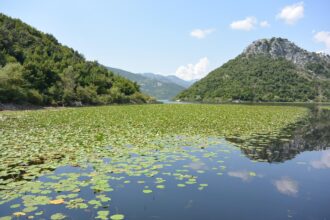
Combining the train with time inland is also worth considering, Lake Skadar sits close to the railway’s midpoint and makes a natural stop if you’re not in a rush to reach the coast.
If the train is just one leg of a longer Montenegro trip, this 14-day itinerary shows how it can fit alongside the coast, the mountains and the national parks.