Reviewed by our editorial team Published
Bergen sits at the mouth of several major fjords, which makes it one of the easiest cities in Norway to use as a base for a single day beyond the harbour. Within a couple of hours by train, bus or boat, travellers can reach glacier-fed waterfalls, working fjord villages and one of the most photographed rail journeys in the world.
This page focuses squarely on trips out of the city rather than sights inside it, since Bergen’s own harbour, museums and viewpoints already have their own dedicated coverage in our guide to the best things to do in Bergen. What follows instead is a rundown of the destinations that reward a proper day away from the city, from the famous Norway in a Nutshell route to quieter islands most visitors never reach.
Travel time varies enormously depending on the trip. Some destinations sit within forty minutes by local bus, while others, most notably Trolltunga, genuinely need a full day of hiking on top of the drive and are better treated as an overnight rather than squeezed into a single day from Bergen.
Anyone arriving specifically to explore beyond the city should also read our guides to Bergen Airport transfers and the Bergen Line, both of which set up the transport connections that many of these day trips build on. A little planning around timetables makes a surprising difference to how many of these places can realistically be combined into one visit.
Bergen Day Trips at a Glance
| Destination | Distance/Time from Bergen | Best For | How to Get There |
|---|---|---|---|
| Flåm & Sognefjord (Nutshell) | Full day, 8-12 hours round trip | Fjord cruise and scenic railway | Train, bus and boat combined, or a packaged tour |
| Voss | About 1 hour by train each way | Adventure sports and lake views | Direct Vy train from Bergen Station |
| Hardangerfjord & Steinsdalsfossen | About 1h15 by car, 1h25 by bus each way | Waterfalls and fjord scenery | Car, Skyss bus 925/930, or guided tour |
| Trolltunga | About 3 hours’ drive plus 10-12 hours hiking | Serious hikers only, overnight advised | Car or bus to Tyssedal, then hike from Skjeggedal |
| Rosendal (Baroniet) | About 1h55 each way by boat | Historic manor, gardens and glacier views | Hardangerfjord Express boat from Bergen harbour |
| Ulvik | About 13 hours round trip (seasonal) | Quiet cider orchards and fjord villages | Bus to Norheimsund, then Hardangerfjord cruise |
| Osterøy | About 30-40 minutes each way | Rural island life and hairpin roads | Car via Osterøy Bridge, or Skyss bus 925 |
| Lysøen | About 40-50 minutes each way | Ole Bull’s island villa grounds (villa closed for restoration) | Private boat or water taxi from Buena |
| Mostraumen | About 3.5-4 hours round trip cruise | A short, dramatic fjord cruise | Direct cruise boat from Bergen harbour |
Treat the table as a starting point rather than a fixed itinerary. Voss and Osterøy both work comfortably as half-day trips by public transport, while Rosendal, Ulvik and the Norway in a Nutshell route are realistically full days built around a single fixed timetable.
Flåm and the Sognefjord on the Norway in a Nutshell Route
The single most famous day trip from Bergen is the loop known as Norway in a Nutshell, which strings together a train, a bus, a fjord cruise and one of the steepest railways in the world into a single circular day out. Most visitors travel via Voss and Gudvangen before crossing the Nærøyfjord to Flåm and picking up the train back to Bergen through Myrdal.
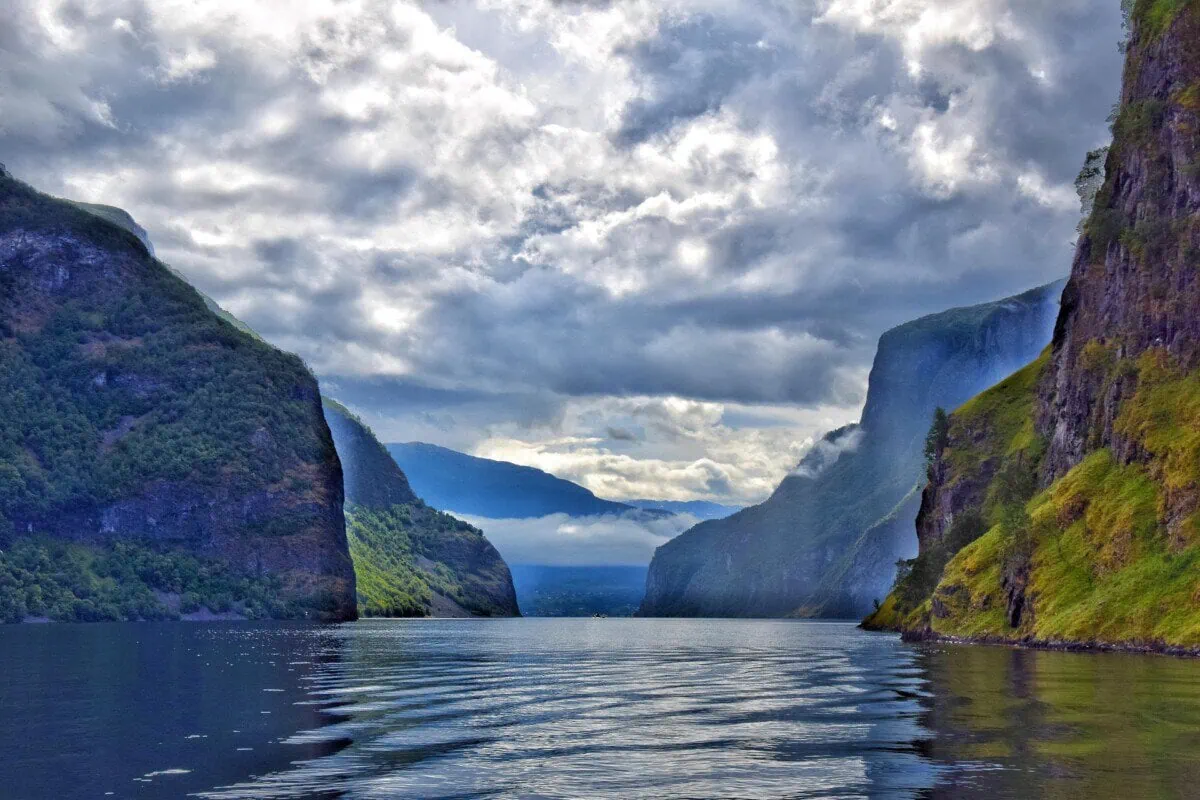
The centrepiece is usually the boat crossing of the Nærøyfjord, a UNESCO-listed arm of the wider Sognefjord narrow enough that cliffs and waterfalls seem to close in on both sides of the vessel. It links the village of Gudvangen, reachable by bus from Bergen, with Flåm itself at the head of the Aurlandsfjord.
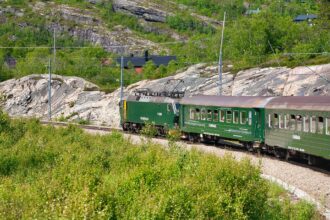
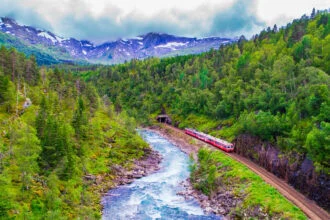
From Flåm, the return leg climbs back into the mountains on the Flåm Railway, which gains around 800 metres in under an hour on some of the steepest sections of normal-gauge track anywhere in the world. The train makes a short scheduled stop at Kjosfossen waterfall partway up, giving passengers a few minutes to step onto the platform and photograph the falls before continuing to Myrdal.
At Myrdal, the Flåm Railway connects directly onto the Bergen Line for the final stretch back into the city, closing the loop in a single long day. Full details on the mountain railway itself, including seating and photography tips, are covered in our separate Flåm Railway guide.
Packaged versions of the route booked as one ticket typically start from around NOK 2,698 (€250/£215/$290) per person, covering every leg of the journey without needing separate tickets. Booking each leg independently through Vy, Skyss and the fjord cruise operator can save roughly €65-€140 (£55-£120/$75-$160) per person, though it takes more planning and leaves less room for error if a connection runs late.
The full circuit normally takes somewhere between eight and twelve hours depending on which direction it is run and how long the connections at Voss and Myrdal allow. Summer daylight makes an early start unnecessary, but winter visitors should build in extra time given how much earlier darkness falls across the mountains.
Travellers who would rather assemble the route themselves than book it as one packaged ticket can follow it as five distinct legs, each timed to meet the next connection. Both directions of the loop work, though the sequence below follows the more common Bergen-first order already described above.
Step one begins at Bergen Station, where a direct Vy train covers the roughly one-hour run to Voss along the Bergen Line, the same stretch of track covered in our separate line guide. Trains run several times a day, so the exact departure matters less than allowing a sensible gap before the next connection.
Step two picks up at Voss with a bus transfer on to Gudvangen, a journey of around an hour along the valley road that most timetables set to arrive shortly before the fjord cruise departs. Connection windows at Voss are usually built to allow twenty to thirty minutes, enough for a quick coffee but not much more.
Step three is the boat crossing itself, a roughly two-hour cruise across the Nærøyfjord and into the Aurlandsfjord that most travellers treat as the highlight of the whole day. It ends at Flåm, where an hour or so is normally free before the railway departs, enough time for lunch or a walk around the small harbour.
Step four is the climb back out on the Flåm Railway, which takes about an hour to reach Myrdal and includes the short scheduled stop at Kjosfossen waterfall described earlier on this page. The railway’s own timetable is built to meet the mainline train at Myrdal after only a short wait rather than a long one.
Step five joins the Bergen Line at Myrdal for the final run back into the city, a trip of roughly an hour and twenty minutes that closes the loop. Because the same sequence works equally well in reverse, some travellers and packaged tours instead start at Myrdal and finish at Voss, so it is worth checking which direction a booked ticket or tour actually runs before the day itself.
Put those five steps onto a clock using the fjord cruise’s and the railway’s actual published departure times, rather than the tightest connections possible, and there are genuinely two ways to run this loop. A quick route gets back to Bergen at a sensible hour while still building in real time at each stop, and a slower route trades a later finish for a proper visit to Flåm or Voss rather than a token stop at either.
The quick route takes the second sailing of the day on the fjord cruise rather than the very first, which alone is enough to turn the tightest possible connections into a genuine stop at each stage.
| Leg | Departs | Arrives | Free time at that stop |
|---|---|---|---|
| Bergen → Voss (Vy train) | 07:54 | ~09:00 | About 40 minutes before the bus |
| Voss → Gudvangen (bus) | ~09:40 | ~10:40 | About 20 minutes before the boat |
| Gudvangen → Flåm (fjord cruise) | 11:00 | 13:00 | About 90 minutes before the railway |
| Flåm → Myrdal (Flåm Railway) | 14:30 | ~15:20 | A short wait for the mainline train |
| Myrdal → Bergen (Bergen Line) | ~15:40 | ~17:00 | Loop closes |
The 11:00 sailing from Gudvangen and the 14:30 departure on the Flåm Railway are both real, published departure times rather than illustrative ones. Voss gets a modest but genuine forty minutes, since the local bus runs roughly every seventy minutes and the boat’s own times are fixed, while Flåm gets closer to an hour and a half, enough for a proper lunch by the harbour rather than a rushed sandwich. The quick route’s real advantage is timing: back in Bergen by early evening, with the rest of the night still free for the city itself.
The Flåm Railway leg in that table already includes the scheduled stop at Kjosfossen waterfall described in Step four above, so nothing extra needs adding to either route’s timings for photographs at the falls themselves.
The slower route keeps exactly the same start, the 07:54 train, the bus and the 11:00 boat, but stretches one leg considerably further depending on which village is the bigger draw.
For more time in Flåm itself, skip the 14:30 railway and catch the 16:50 departure instead.
| Leg | Departs | Arrives | Free time at that stop |
|---|---|---|---|
| Gudvangen → Flåm (fjord cruise) | 11:00 | 13:00 | Close to four hours before the later railway |
| Flåm → Myrdal (Flåm Railway) | 16:50 | ~17:30 | A short wait for the mainline train |
| Myrdal → Bergen (Bergen Line) | ~17:45 | ~19:05 | Loop closes, a later finish |
Close to four hours in Flåm covers more than the harbour and a coffee. The small Flåm Railway Museum right at the station covers the line’s construction in fifteen to twenty minutes for free, and Ægir Bryggeri, a Norse-themed brewpub in the village centre, makes a genuinely good lunch stop with a tasting flight of its own beers. Anyone with time to spare can add the three-kilometre riverside walk out to the seventeenth-century Flåm Church, or, for the more energetic, the steeper round trip up to Brekkefossen waterfall, a five-kilometre hike with around 155 metres of climbing.
If Voss is the bigger draw instead, extend the morning stop there rather than visiting it twice in the same day. Take a later bus on to Gudvangen instead of the one that connects straight off the 07:54 train, and pick up the 13:30 boat rather than the 11:00 sailing to match it.
| Leg | Departs | Arrives | Free time at that stop |
|---|---|---|---|
| Bergen → Voss (Vy train) | 07:54 | ~09:00 | About three hours before the bus |
| Voss → Gudvangen (bus) | ~12:00 | ~13:00 | About 30 minutes before the boat |
| Gudvangen → Flåm (fjord cruise) | 13:30 | 15:30 | About 80 minutes before the railway |
| Flåm → Myrdal (Flåm Railway) | 16:50 | ~17:30 | A short wait for the mainline train |
| Myrdal → Bergen (Bergen Line) | ~17:45 | ~19:05 | Loop closes, evening finish |
Close to three hours in Voss is enough for the Voss Gondola up Mount Hangur, the 1277 Vangskyrkja church or the Voss Folk Museum at Mølstertunet, all within walking distance of the station, in one proper visit rather than two shorter ones either side of the loop. Flåm still gets a genuine eighty minutes before the last practical railway departure, so this version trades some of the Flåm-focused route’s four hours in that village for a single, unbroken stop in Voss instead.
Either version of the slower route finishes two to three hours later than the quick one, which really only suits summer’s long daylight since the loop still has to close the same day. Its advantage is the opposite of the quick route’s: Flåm or Voss becomes an actual visit rather than a place merely passed through on the way round the loop.
Connection times between the train, bus, boat and railway legs can shift slightly with the season, so it is worth checking current departures before relying purely on the outline above. The most reliable way to check them independently is Entur, Norway’s official journey planner, which searches trains, buses and ferries together in a single result and is also available as a free app for checking timetables on the move.
Travellers who would rather have the whole loop pre-coordinated on one ticket instead of checking connections themselves should look at norwaynutshell.com, the official operator behind the packaged pricing already covered earlier in this section. Its departures are fixed and pre-timed to meet each connection, trading the savings of the independent route for one booking that removes the guesswork.
Best for a short trip. Compare rooms by neighbourhood, price and guest rating before you book.
Compare hotelsBest for groups who want one address and separate bedrooms rather than three hotel rooms.
See holiday homesBest if you have already picked a hotel. Checks the big booking sites for the same room and shows who is cheapest.
Check dealsFolgefonna National Park and a Glacier Lake Tour
Folgefonna is often described as Norway’s third-largest glacier area, a sprawling ice cap protected within Folgefonna National Park on the southern side of the Hardangerfjord. Its meltwater feeds several small glacial lakes, and the best known of these, Bondhusvatnet, has become the focus of a popular guided day tour out of Bergen.
A typical glacier lake tour combines a scenic drive with a short Hardangerfjord ferry crossing, then a gentle walk into the Bondhus valley to reach the lake itself. Most itineraries build in a packed lunch eaten beside the glacier-fed water, with the walk pitched at a pace suited to reasonably fit travellers rather than serious hikers.
Door to door from Bergen, this kind of trip generally runs to around ten and a half hours, and many operators fold in a stop at Steinsdalsfossen waterfall on the way out or back. That makes it a genuinely full day, though a considerably gentler one than Trolltunga or the longer Hardangerfjord driving loops.
The obvious comparison is the DIY Hardangerfjord trip covered earlier on this page, which reaches Steinsdalsfossen easily enough but does not extend into the national park or up to a glacier lake without a car and a fair amount of planning. A packaged tour like this one arranges the ferry, the hike and the lunch as a single booking rather than several separate legs.
For travellers who want a genuine glacier landscape without committing to Trolltunga’s full-day hike or a self-drive itinerary, this is one of the more accessible ways to see Folgefonna up close from Bergen. The tour below covers this exact itinerary and can be booked directly.
Bergen: Folgefonna National Park & Glacier Lake Tour & Lunch
Voss and Western Norway’s Adventure Sports Town
Voss sits directly on the Bergen Line, which makes it one of the simplest day trips on this page logistically, roughly an hour from Bergen by train with no changes required. The town built its reputation on extreme sports, and paragliding, zip-lining and white-water rafting outfits still operate from bases around the lake and surrounding mountains.
Voss’s own lake, Vangsvatnet, sits right beside the town centre and station, making it easy to combine a short walk along the waterfront with lunch before heading back to the train. The wooden Vangskyrkja church, dating from the 1270s, and a nearby folk museum give the town some historical weight beyond its outdoor sports scene.
A cable car, the Voss Gondol, climbs from close to the station up to Mount Hangur for wide views back across the lake and surrounding valleys, and operates through most of the year weather permitting. It is a straightforward way to get a proper mountain view without committing to a full day’s hiking.
Because Voss sits on the same railway as the Norway in a Nutshell route, many travellers treat it as a stop-off on the way to or from Flåm rather than a destination in its own right. Both work well, though a dedicated day in Voss leaves considerably more time for the adventure activities the town is known for.
Train frequency is generally good throughout the day, with several direct services each way between Bergen and Voss, and fares are modest compared with the longer journey onward to Oslo. Checking Vy’s timetable before travelling is worth doing since departures can shift slightly with the season.
Njardarheimr Viking Village and the Nærøyfjord Cruise
This tour packages three of the biggest highlights of the Norway in a Nutshell route into a single guided day, adding a stop at Gudvangen’s Viking village that the independent version of the trip does not usually include. It suits travellers who would rather have transport, tickets and timing handled for them than assemble the train, bus and boat legs themselves.
The village in question is Njardarheimr, a reconstructed Viking settlement built beside the fjord with working blacksmiths, weavers and market stalls staffed in character. It gives the crossing of the Nærøyfjord a cultural stop that the plain rail-and-boat version of the Nutshell route, covered earlier on this page, does not build in.
From Gudvangen, the tour continues onto the same Nærøyfjord cruise and Flåm Railway combination described in our main Nutshell section, climbing back up through Myrdal via the Kjosfossen waterfall stop. The difference lies almost entirely in what happens before the boat, rather than in the fjord crossing or the railway itself.
Booking it as one guided package removes the need to time a bus connection at Gudvangen or buy separate train and boat tickets, which matters most for travellers short on time or wary of missing a fixed departure. It comes at a higher price than assembling the same legs independently, in line with the packaged Nutshell pricing already covered on this page.
Anyone who has read the independent breakdown of the Nutshell route above and would still rather not manage the connections themselves should treat this as the most convenient version of that same day out. The booking widget below covers this specific itinerary.
Bergen: Viking Village, Nærøyfjord Cruise & Flåm Railway
The Hardangerfjord and Steinsdalsfossen Waterfall
The Hardangerfjord is Norway’s second-longest fjord and one of the country’s most productive fruit-growing regions, with orchards running down almost to the waterline in several villages. A day trip out here typically combines fjord scenery with at least one substantial waterfall, and Steinsdalsfossen near Norheimsund is usually the easiest to reach.
Steinsdalsfossen is one of the few Norwegian waterfalls with a path running directly behind the curtain of falling water, giving a genuinely different view from the usual roadside stop. The drive from Bergen along the E16 and RV7 over Kvamskogen takes around an hour and fifteen minutes, with free parking directly opposite the falls.
Travellers without a car can reach the same waterfall on Skyss bus routes 925 or 930 from Bergen bus station, a journey of roughly an hour and twenty-five minutes that is covered by the Bergen Card. Public toilets at the site operate only between May and October, which is worth knowing before a winter visit.
Several guided full-day tours combine Steinsdalsfossen with a short Hardangerfjord cruise and stops at additional waterfalls or the Voss Gondola, generally priced from around €185 (£155/$210) per person. These suit travellers who want the scenery without arranging bus connections or driving Kvamskogen’s winding mountain pass themselves.
The wider Hardanger region also includes Ulvik and Rosendal, both covered in more detail further down this page, so a single trip out here can realistically be extended into a longer loop for anyone with a full day and a hire car. Spring is a particularly good season to visit, when the region’s apple and cherry orchards are in blossom along the fjord’s edge.
Trolltunga: A Serious Full-Day Hike, Not a Casual Trip
Trolltunga, the flat slab of rock jutting horizontally out over Lake Ringedalsvatnet, is one of the most photographed hiking destinations in Norway, and also one of the most demanding. The round trip from the main car park at Skjeggedal covers roughly 28 kilometres and typically takes between ten and twelve hours to complete.
Reaching the trailhead itself already takes a significant chunk of a day, since the drive from Bergen to Tyssedal near Odda runs to roughly three hours each way on top of the hike. Combined with the return drive, that pushes a genuine day trip well past eighteen hours door to door, which is not realistic or safe for most hikers.
For this reason, most experienced guides and tour operators recommend treating Trolltunga as an overnight trip rather than a day trip from Bergen, staying in Odda or Tyssedal the night before and after the hike. Starting from the higher car park at Mågelitopp when it is open shortens the round trip to around 20 kilometres and seven to ten hours, though it still leaves little time for the drive on the same day.
Trailhead parking fills quickly in peak summer and charges rise steeply during the busiest weeks, so checking current rates and arriving early is worth doing regardless of which car park is used. Guided group hikes also run from Tyssedal for travellers who would rather not navigate the route or logistics alone.
Anyone determined to attempt Trolltunga as a genuine single day from Bergen should treat it as an exception rather than the rule on this page, and should be an experienced, well-equipped hiker prepared for a very long day. For most visitors, the other destinations covered here make a considerably more comfortable use of a single day away from the city.
Rosendal and the Baroniet on the Hardangerfjord Express
Rosendal, in the Kvinnherad municipality on the southern side of the Hardangerfjord, is home to Baroniet Rosendal, Norway’s only remaining baronial manor and one of the more unusual historic buildings in western Norway. The estate dates from the 1660s and includes formal gardens, a rose garden and views across the fjord toward the Folgefonna glacier.
The easiest way to reach it without a car is the Hardangerfjord Express, a passenger boat that runs directly between Bergen harbour and Rosendal in around one hour and fifty-five minutes each way. A round trip typically costs from around €80 (£70/$95) per adult, making it one of the more affordable boat-based day trips covered on this page.
The crossing itself is part of the appeal, tracing the open water of the outer Hardangerfjord before narrowing toward Rosendal’s sheltered harbour, with mountains and glacier views building steadily along the way. Our wider guide to ferries from Bergen covers the boat operators and booking platforms serving this route in more depth.
Once ashore, the manor house, gardens and small on-site café are all within easy walking distance of the quay, which suits a day trip built entirely around the boat timetable rather than a hire car. Entry to the gardens is normally free, with a separate ticket required for guided tours inside the house itself.
Because the boat runs only once or twice daily depending on season, checking the timetable before travelling is essential, and the return sailing effectively fixes how long can be spent in Rosendal itself. Travellers with a car have more flexibility and can combine Rosendal with a wider Hardangerfjord loop taking in Ulvik or Steinsdalsfossen on the same day.
Best for long or awkward journeys. Builds one itinerary out of separate flights.
View flightsBest for short trips. Install the eSIM at home and arrive in Bergen with working data, no shop queue.
Browse eSIMsBest when public transport has stopped, or when you are travelling with children and bags.
Book a transferUlvik and the Cider Villages of the Hardangerfjord
Ulvik sits on its own quiet arm of the Hardangerfjord, surrounded by orchards that supply much of the cider and juice produced in the region, and it remains considerably less visited than Voss or Flåm. The village makes a genuinely peaceful contrast to the busier stops on the Norway in a Nutshell route, with a handful of small farms open for tastings in season.
A seasonal Hardangerfjord cruise connects Bergen with Ulvik via a bus transfer to Norheimsund, sailing on through Herand, Utne, Lofthus and Kinsarvik before reaching Ulvik itself. The full round trip runs to roughly thirteen hours, departing Bergen bus station early in the morning and returning by early evening.
Adult return tickets for the combined bus and boat journey typically cost around €110 (£90/$125), with reduced fares for children, students and seniors, and the service normally operates only between May and September. Outside that window, reaching Ulvik realistically means driving, since the passenger boat schedule is seasonal rather than year-round.
The village itself rewards a slow pace rather than a checklist of sights, with orchard walks, a small cider house and fjord-side paths that suit an afternoon of doing very little in particular. Lofthus and Kinsarvik, both stops along the same boat route, are worth a look through the window even for travellers who stay aboard all the way to Ulvik.
Because the return journey is fixed by the boat and bus timetable, this is one of the least flexible day trips on this page, and travellers who prefer to set their own pace may find a hire car more practical for exploring this stretch of the Hardangerfjord. Either way, Ulvik is a useful reminder that some of the fjord’s quietest corners sit only a few hours from Bergen.
The Stegastein Viewpoint Above the Aurlandsfjord
This tour combines a UNESCO-listed fjord cruise through the Nærøyfjord and Aurlandsfjord with lunch and a stop at the Stegastein viewpoint, a detour the other fjord cruises covered on this page do not make. It is built around seeing the fjord from both the water and a mountainside above it in the same day.
Stegastein is a cantilevered wooden platform that juts around thirty metres out from the mountainside above Aurland, standing roughly six hundred and fifty metres over the fjord below. Its glass-edged end gives an almost aerial view straight down the Aurlandsfjord, unlike anything reachable from the water on the boat crossings described elsewhere on this page.
Reaching it normally means driving up the Aurlandsfjellet mountain road from Aurland, a route with several tight hairpin bends that is usually included as a coach stop on this specific tour rather than something travellers arrange separately. It sits close enough to Flåm that operators can fold it into the same day as the fjord cruise without adding significant travel time.
Compared with the plain Nutshell cruise or the Hardangerfjord Express to Rosendal, both covered earlier on this page, the distinguishing feature here is the view from above rather than from the water. Travellers who want both perspectives in a single booking, plus lunch included, are the clearest audience for this particular tour.
It suits anyone who has read the Nutshell breakdown above and would like a similar UNESCO fjord crossing but with a mountain viewpoint and lunch built into the price rather than arranged separately. The booking widget below covers this exact itinerary.
Bergen: UNESCO Fjord Cruise, Flåm & Stegastein – Incl. Lunch
Osterøy, Norway’s Largest Inland Island
Osterøy, connected to the mainland by a road bridge rather than a ferry, is officially Norway’s largest inland island and one of the closest genuinely rural day trips available from Bergen. Green farmland, timber houses and the Sørfjorden’s calm inland waters give it a noticeably different feel from the mountainous fjord scenery closer to the city.
The drive from central Bergen takes around thirty minutes across the Osterøy Bridge, while Skyss bus route 925 covers the same route by public transport in roughly thirty-five to forty minutes. Both options make Osterøy one of the quickest day trips on this list, easily fitted into a half-day rather than requiring a full one.
One of the island’s better-known features is Kossdalsvingane, a set of seventeen tight hairpin bends climbing a forested hillside that makes for a memorable short walk or drive, with views back over the surrounding valley from the top. Local churches, old farmsteads and a scattering of small cafés round out a gentle day exploring the island’s back roads.
Osterøy rarely appears on typical Bergen sightseeing itineraries, which keeps it noticeably quieter than the Hardangerfjord or Nutshell route even in the height of summer. A standard Skyss bus fare covers the journey each way for travellers relying on public transport, and the Bergen Card is valid on the route.
Because the island sits so close to the city, it also works well as a shorter half-day option for travellers who want a rural change of scenery without committing an entire day to a longer fjord excursion. Combining Osterøy with an afternoon back in central Bergen is entirely realistic given how short the crossing time actually is.
Lysøen and Ole Bull’s Island Villa
Lysøen, a small wooded island south of Bergen in the Bjørnafjorden, was the summer home of the Norwegian violinist Ole Bull, whose elaborately turreted villa still stands among the island’s paths and gardens. It has long been one of the more unusual short day trips near Bergen, combining a distinctive piece of nineteenth-century architecture with quiet island walking trails.
At the time of writing, the villa itself remains closed for extensive restoration work that began in 2019 after years of damp and structural damage, and museum staff have not given a firm reopening date. Travellers should check directly with Kode, which manages the site, before planning a visit around seeing the interior.
The dedicated museum ferry that normally shuttles visitors from the mainland quay at Buena to the island has also been suspended for 2026 because of the same renovation work, which removes the simplest way most visitors previously reached Lysøen. The island itself remains open and accessible year-round to anyone arriving by private boat.
Getting to Buena from central Bergen normally takes around thirty-five to forty minutes by taxi or private transfer, with the crossing to the island itself only another five to ten minutes when a boat is available. Given the current closure, this is realistically a trip best suited to travellers with their own boat, a chartered water taxi, or those happy to admire the villa’s exterior from a passing fjord cruise.
Because the situation has changed significantly from how Lysøen is often described in older travel guides, it is worth treating this as one to watch rather than plan around firmly until the restoration progresses further. When the villa does reopen, its combination of Moorish domes, onion-shaped turrets and fjordside gardens should make it well worth the wait.
Mostraumen and Short Fjord Cruises Near Bergen
For travellers with only half a day to spare, a short Mostraumen fjord cruise is the quickest way to experience genuine narrow fjord scenery without giving up a full day. The route runs north-east from the harbour into increasingly enclosed channels lined with waterfalls, cliffs and isolated farms.
Cruises typically run for around three and a half to four hours round trip, with prices generally starting from about €65-€140 (£55-£120/$75-$160) depending on the operator and season. This makes Mostraumen one of the most time-efficient options covered on this page, suited to travellers combining a morning excursion with an afternoon back in the city.
Because Mostraumen departs directly from Bergen’s harbour, it needs none of the bus or train connections that longer trips such as Ulvik or Rosendal require, which makes booking and timing considerably simpler. Our fuller guide to ferries from Bergen covers the operators, seasonal timetables and booking platforms for this and other harbour departures in more detail.
Travellers wanting a longer or more immersive fjord experience should look instead toward the Sognefjord crossing on the Norway in a Nutshell route or the Hardangerfjord Express to Rosendal, both covered earlier on this page. Mostraumen works best as a shorter add-on rather than the main event of a longer Norway itinerary.
Travellers ready to book this specific crossing can check availability and current pricing for the Mostraumen cruise directly through the widget below.
Choosing Between Rail, Bus, Boat and Car
Which transport option makes sense depends heavily on which destination is being targeted, and several of these day trips genuinely are not realistic without a hire car. Seasonal boat timetables and mountain roads aside, Voss and Osterøy are the two destinations on this page that work comfortably by public transport alone.
Rail is the simplest option for Voss and forms the backbone of the Norway in a Nutshell loop, connecting naturally with the wider Bergen Line network covered in our separate guide. Anyone arriving in the city specifically to start one of these trips should also check our guide to Bergen Airport transfers, since several buses and boats depart from the same city centre hub as the airport tram.
Boats matter more here than in most Norwegian cities, since Rosendal, Ulvik and Mostraumen are all reached primarily by water rather than road. Booking these in advance is worth doing during summer, when the most popular seasonal sailings can fill up several days ahead.
A hire car opens up genuinely useful flexibility, particularly for Hardangerfjord destinations and Trolltunga’s trailhead, where public transport connections are either infrequent or non-existent. According to the official regional tourism board at visitBergen.com, several of these routes can also be combined into a single long driving day for travellers with their own vehicle and an early start.
Whichever method is used, western Norway’s weather can shift quickly, and heavy rain, wind or fog can affect both road driving and fjord sailings with little warning. Building in a flexible buffer around connections, particularly for anything involving a fixed boat departure, avoids a missed sailing turning into a stranded evening.
Best for solo travellers and anyone watching the budget. Dorm beds and private rooms in the same search.
Browse hostelsBest for anyone flying more than once or twice a year. Handles the compensation claim so you are not chasing the airline.
See AirHelp+Best for the gap between checking out and your train. Drop bags at a shop or hotel nearby and carry on.
Store your bagsWhich Day Trip Should You Pick
With only one day free, the choice mostly comes down to how much time can genuinely be spared. For a full day with plenty of scenery, the Norway in a Nutshell route remains the strongest all-round choice, combining rail, road and fjord in a single loop.
Travellers without a car should lean toward Voss or Osterøy, both reachable comfortably by train or bus without needing to build a day around a boat timetable. For a shorter half-day option, the Mostraumen cruise departs directly from the harbour and needs no onward connections at all.
Anyone drawn to history and gardens over hiking or adrenaline should head for Rosendal, while Ulvik suits travellers who want the Hardangerfjord at its quietest rather than its busiest. Steinsdalsfossen near Norheimsund remains the easiest single waterfall to combine with a shorter half-day trip.
Only genuinely experienced hikers with a full extra day to spare should attempt Trolltunga, and even then, staying overnight near Odda rather than driving back to Bergen the same day is strongly recommended. For everyone else, the other eight destinations on this page make considerably more comfortable use of a single day away from the city.

Rupert’s Handy Travel Tips
Bergen’s fjords reward planning, and Rupert says a little care with timetables makes the difference between a smooth day trip and a rushed one.
- Book fjord cruises a day or two ahead in summer: the most popular sailings to Rosendal and Ulvik can sell out during peak season.
- Layer up even in summer: temperatures on open fjord boats and mountain railways drop noticeably compared with central Bergen.
- Check the Bergen Card’s bus coverage before you travel: it covers routes to Steinsdalsfossen and Osterøy but not every seasonal fjord cruise.
- Never treat Trolltunga as a casual add-on: plan an overnight near Odda rather than risking a rushed return drive to Bergen after dark.
- Confirm Lysøen’s current status before travelling: the villa and museum ferry are both closed for restoration, so a private boat is currently the only way across.
Want to meet the reindeer behind our travel tips? Find out more in our page Who is Rupert?.




Frequently Asked Questions About Day Trips from Bergen
What is the best day trip from Bergen?
For most first-time visitors, the Norway in a Nutshell route is the strongest single choice, combining a train, a bus, a fjord cruise and the Flåm Railway into one circular day.
Can Trolltunga be done as a day trip from Bergen?
Technically yes, but it is not recommended. The drive alone takes roughly three hours each way, and combined with a ten to twelve hour hike, most guides advise staying overnight near Odda instead.
Do I need a hire car for these day trips?
Not for every one. Voss and Osterøy work well by train or bus, while Rosendal, Ulvik and Mostraumen are reached mainly by boat, and only the Hardangerfjord’s quieter corners and Trolltunga’s trailhead really need a car.
Is Lysøen open to visitors in 2026?
The villa itself is closed for restoration and the regular museum ferry from Buena has been suspended for the year, so the island is currently reachable only by private boat or water taxi.
How much does the Norway in a Nutshell route cost from Bergen?
Packaged tickets typically start from around NOK 2,698 (€250/£215/$290) per person, though booking each train, bus and boat leg separately can save a meaningful amount for travellers willing to plan it themselves.
What is the easiest fjord cruise from Bergen?
The Mostraumen cruise is the simplest option, departing directly from the harbour with no onward bus or train connection needed, and returning within half a day.
Further Reading & Related Guides
Travellers planning a wider stay should also read our guide to the best things to do in Bergen, which covers the harbour, museums and viewpoints inside the city that this page deliberately leaves out. Anyone starting or ending their trip through the airport should check our guide to Bergen Airport transfers for the full range of transport options into town. Travellers continuing north after Bergen may also want our Lofoten Islands Travel Guide, since Bergen is a common starting point for a longer Norwegian rail-and-fjord itinerary that continues into the Arctic.
For the wider rail journey that several of these day trips connect into, our Bergen Line Guide covers the full route east to Oslo, while the Flåm Railway guide goes into far more depth on the steep descent to the fjords than fits on this page. Travellers weighing up rail passes for a longer Norwegian trip may also find our Interrail Norway Pass guide useful for comparing ticket options.
Anyone planning to combine several of these boat-based trips should also read our guide to ferries from Bergen, which sets out the operators, seasonal timetables and booking platforms behind the harbour departures mentioned throughout this page.