Reviewed by our editorial team Published
Rhodes is the kind of Greek island that refuses to be one thing. A single day here can move from wandering inside a genuinely lived-in medieval fortress town to swimming off a beach named after a Hollywood actor, and both experiences feel entirely at home on the same island.
That range is the real reason Rhodes has drawn visitors for centuries, from the Knights of St John who fortified its capital to the sunbathers who now fill Faliraki’s loungers each summer. The island’s Old Town is its single biggest draw, and for good reason, since it is not a reconstruction but a working neighbourhood behind fourteenth-century stonework.
The Medieval City of Rhodes has been a UNESCO World Heritage Site since 1988, and its walls, gates and cobbled lanes still shelter homes, cafes and workshops. Beyond the walls, Rhodes stretches into ancient acropolises, restored spa complexes, waterfall-fed valleys and one of the most photographed hilltop villages in the Aegean at Lindos.
This guide covers the island’s genuine range of attractions in enough depth to actually plan a trip around, from the Palace of the Grand Master and the Street of the Knights in the Old Town to Kallithea Springs, Butterfly Valley and the windsurfing beaches at Prasonisi on the coast. Every section below covers what a place actually offers, roughly what it costs to visit and how much time to set aside, rather than a generic list of names.
A comparison table follows this introduction so it is easy to see the whole island at a glance before reading on. A set of frequently asked questions and further reading links close out the guide for anyone building a longer Rhodes itinerary.
Rhodes Attractions at a Glance
| Attraction | Time to Allow | Cost | Best For | Public Transport |
|---|---|---|---|---|
| The Medieval City of Rhodes | 2-3 hours | Free to walk; some interiors ticketed separately | History, walking, first-time visitors | In Rhodes Town, walk in |
| Palace of the Grand Master | 1-1.5 hours | €20 (£17/$22) | Knights’ history, mosaics, architecture | In Rhodes Town, walk in |
| A Glass-Bottom Boat Trip Beneath Rhodes Harbour | 45 minutes-1 hour | €15 (£13/$17) adult, €10 (£9/$11) child | A quick, affordable family boat trip | Departs Mandraki, in town |
| The Street of the Knights | 30-45 minutes | Free | Photography, atmosphere | In Rhodes Town, walk in |
| A Day Trip to Marmaris, Turkey, by High-Speed Boat | Full day (about 8 hours) | From €50 (£43/$55), plus port taxes | A second country for the day; passport needed | Boat from the tourist port, in town |
| Archaeological Museum of Rhodes | 1-1.5 hours | €10 (£9/$11) | Ancient statues, Hellenistic art | In Rhodes Town, walk in |
| An All-Inclusive Day Cruise with a Greek BBQ | 6 hours | From €70 (£60/$75) | A full day of swimming, food and drink | Departs Mandraki, in town |
| Mandraki Harbour | 45 minutes-1 hour | Free | Deer statues, windmills, harbour walks | In Rhodes Town, walk in |
| A Smaller Catamaran Cruise with Lunch and Drinks | 6 hours | From €95 (£81/$104) | A quieter, smaller-group boat day | Departs Mandraki, in town |
| Acropolis of Rhodes (Monte Smith) | 45 minutes-1 hour | Free | Ancient stadium and theatre, sunset views | Short walk or taxi; no dedicated bus |
| A Hop-On Hop-Off Bus Around Rhodes Town | 1-hour loop, all-day ticket | From €20 (£17/$23) | Orientation on a first day in town | Is the bus itself |
| Lindos and Its Acropolis | Half day | €20 (£17/$22), reduced €10 (£9/$11) | Cliff-top temple, day trip | Frequent KTEL bus, about every 30 minutes |
| Kallithea Springs | 1.5-2 hours | €5 (£4/$5) summer, €3 (£3/$3) winter | Art Deco architecture, swimming | Frequent KTEL bus, about every 20 minutes |
| A Dolphin Watching Cruise with a Marine Biologist | 3 hours | From €95 (£81/$105) | Wild dolphin sightings, guided snorkelling | Departs Kamiros Skala; transfer included |
| Butterfly Valley (Petaloudes) | 1.5-2 hours | €6 (£5/$7) summer, €3 (£3/$3) shoulder season | Nature, families, a cooler walk | West-side bus is sparse; car, taxi or tour easier |
| Valley of Seven Springs | 1.5-2 hours | Free | The tunnel walk, nature, adventure | Bus to Kolymbia, then a walk or taxi |
| Ancient Kamiros | 1-1.5 hours | €10 (£9/$11) | An untouched ancient town plan | West-side bus is sparse; car, taxi or tour easier |
| Filerimos and Ancient Ialysos | 1-1.5 hours | Modest entrance fee, a few euros | Layered history, panoramic views | West-side bus is sparse; car, taxi or tour easier |
| Faliraki | Half day or more | Free beach; water park €30 (£26/$33) adult | Beach resort, families, the water park | Frequent KTEL bus, about every 20-30 minutes |
| Anthony Quinn Bay | 1.5-2 hours | Free | Snorkelling, dramatic scenery | Dedicated KTEL route, a few times daily |
| Tsambika | 2-3 hours | Free (small parking fee possible) | A beach plus a pilgrimage climb | KTEL bus, mornings only, 3 times daily |
| A Grand Island Tour Taking in Kamiros and Lindos | 8.5 hours | From €47 (£40/$51) | A one-day overview without a hire car | Guided minibus, pickup included |
| Prasonisi | Half day | Free | Windsurfing, kitesurfing, dramatic landscape | No practical bus service; car, taxi or tour needed |
| Aquarium of Rhodes | 45 minutes-1 hour | €6 (£5/$7), reduced €4 (£3/$4) | Marine life, families, a rainy day | In Rhodes Town, walk in |
| A Boat Trip to Symi | Full day | From around €15-25 (£13-21/$16-27) one way; excursions cost more | Island hopping, neoclassical architecture | Boat from Mandraki, in town |
The Medieval City of Rhodes: A Fortress Still Lived In
The Medieval City of Rhodes is not a museum piece cordoned off for visitors. It has been inscribed as a UNESCO World Heritage Site since 1988, yet several thousand people still live, trade and run tavernas behind its walls.
The Knights of St John occupied Rhodes from 1309 to 1523 and spent much of that period turning the city into a stronghold. Their upper town holds the Gothic core, including the Palace of the Grand Masters and the Great Hospital, while the lower town blends Gothic buildings with Ottoman mosques and public baths added after 1522.
A ring of fortified walls, punctuated by monumental gates, encloses the whole Old Town and remains largely intact. Walking the full circuit of the outer walls and moat on foot, where access allows, gives a genuine sense of just how seriously the Knights took their defences against Ottoman siege.
Inside the walls, the Old Town rewards slow wandering rather than a checklist approach. Quiet side lanes running off the main thoroughfares reveal Byzantine churches, old fountains and courtyards that see far fewer visitors than the busiest shopping streets near the harbour gates.
Because the Medieval City sits inside Rhodes Town itself, it needs no bus, taxi or transfer at all, and most New Town hotels are within a fifteen-minute walk of one of its gates. Evenings are the best time to see it at its most atmospheric, once the cruise-ship day-trip crowds have thinned and the lantern-lit lanes settle into a slower, more local rhythm.
Best for a short trip. Compare rooms by neighbourhood, price and guest rating before you book.
Compare hotelsBest for longer stays. Whole apartments and houses, so you are not eating out three times a day.
View rentalsBest if you have already picked a hotel. Checks the big booking sites for the same room and shows who is cheapest.
Check dealsThe Palace of the Grand Master: Where the Knights Ruled
The Palace of the Grand Master sits at the top of the Old Town and served as the administrative heart of the Order of St John. It is widely regarded as the single most significant monument of medieval Rhodes, and its scale still dominates the upper town today.
The building visitors see now owes much of its current form to restoration carried out during the Italian occupation in the 1930s, when the ruined shell of the medieval palace was rebuilt with considerable historical licence. The result is still an atmospheric, genuinely medieval-feeling space rather than a modern reconstruction that feels out of place.
Inside, two permanent ground-floor exhibitions trace Rhodes’ history from its founding in 408 BC through to the Ottoman conquest of 1522. Upstairs, an impressive collection of Roman and early Byzantine mosaic floors, lifted from other sites around the island, sits alongside medieval furniture gathered during the Italian restoration.
Adult admission currently runs at €20 (£17/$22), with the palace open from around 8am to 8pm during the summer season and shorter winter hours of roughly 8:30am to 3:30pm, when it also closes on Tuesdays. Some of the smaller exhibitions inside keep their own restricted hours, so it is worth checking these separately if a specific display is the priority.
Because the palace sits right at the top of the Street of the Knights within the Old Town itself, it needs no bus or taxi to reach, and it makes sense to combine both in a single visit on foot. Arriving earlier in the day generally means fewer crowds in the courtyard and grand staircase, which are the most photographed spots inside.
A Glass-Bottom Boat Trip Beneath Rhodes Harbour
Several small glass-bottom boats operate from Mandraki port, right beneath the harbour’s windmills, running short cruises that let passengers see the seabed without getting wet. The best-known of these, often marketed locally as the Yellow Submarine, descends into an underwater viewing cabin roughly 2.2 metres below the surface.
The trip lasts around forty-five minutes to an hour and stays close to shore, giving a panoramic view back at the Old Town’s medieval sea walls as the boat heads out. Large windows around the cabin reveal local fish and reef life in clear water, with some operators adding a short diving display so passengers can watch divers move among the fish from inside the cabin.
Tickets typically cost around €15 (£13/$17) for adults and €10 (£9/$11) for children, making it one of the more affordable boat trips on this list. Because it departs so close to the harbour, it suits families with young children or anyone short on time who still wants a taste of the water.
Departures run regularly through the day in season rather than to a fixed schedule, so it is worth checking at the kiosk near the port on the morning of a visit. Combining it with a windmill walk along Mandraki beforehand makes for an easy, low-effort half-morning by the water.
The Street of the Knights: Rhodes’ Best-Preserved Corridor
The Street of the Knights, known locally as Ippoton, runs downhill from the Palace of the Grand Master towards the old Hospital. It is one of the best-preserved medieval streets anywhere in Europe, largely because it was never redeveloped for modern shops in the way much of the surrounding Old Town was.
Along its cobbled length stand the inns, or auberges, once occupied by the different national groupings, known as tongues, that made up the Order of St John. Each tongue, representing regions such as France, Italy, Spain and England, maintained its own building, giving the street a distinctly international character even though every facade is built from the same honey-coloured stone.
Unlike Rhodes’ busier commercial lanes, Ippoton is kept deliberately free of souvenir stalls and modern shopfronts. That preservation effort makes it a favourite location for film crews over the decades, and it remains the closest thing on the island to stepping directly into the fourteenth century.
The street’s steep, uneven cobbles are original, so comfortable shoes matter more here than almost anywhere else in the Old Town. Shade from the tall stone buildings on both sides makes it a genuinely pleasant walk even at midday, when direct sun elsewhere in the city can be intense.
Because it links two of the Old Town’s biggest sights and sits entirely within walking distance of them, most visitors cover Ippoton on foot as part of a longer route rather than reaching it by bus. Early morning, before tour groups arrive, offers the quietest version of the street and the best light for photographs.
A Day Trip to Marmaris, Turkey, by High-Speed Boat
For a genuine change of country rather than another Greek island, high-speed catamarans run a full-day excursion from Rhodes across to Marmaris on the Turkish mainland. The crossing takes around one hour each way, with boats leaving from the tourist port and the whole day running to roughly eight hours door to door.
Everyone on board needs a valid passport or, for Greek nationals, a new-style ID card, and travellers should check well ahead whether their nationality requires a Turkish visa to enter for the day. Most operators ask passengers to arrive around an hour before departure for passport control and ticket exchange.
Once in Marmaris, the format usually includes an optional guided shopping stop before around four hours of free time to explore the harbour, bazaar and old town independently. Port taxes are typically charged separately, often around €20 (£17/$22) per adult and less for young children, on top of the ticket price.
Prices for the crossing itself generally start from around €50 (£43/$55) per person, though this varies by operator and season. It is a long day rather than a relaxing one, so it suits travellers keen to add a second country to their trip more than anyone wanting a slow beach day.
The Archaeological Museum: Inside the Knights’ Hospital
The Archaeological Museum of Rhodes occupies the former Hospital of the Knights, a large medieval building that once cared for sick and wounded members of the Order. The setting alone makes it worth visiting, since the vaulted wards and courtyards are almost as striking as the collection they now house.
Inside, the museum’s centrepiece finds come from the ancient sites of Ialysos and Kamiros, both explored elsewhere in this guide. A remarkable collection of statues fills several galleries, alongside an epigraphic wing of inscribed stones and a small display of prehistoric pottery from across the Dodecanese.
A renovated historical courtyard now displays mosaic floors lifted from Hellenistic-era villas found on the island, laid out so visitors can walk around rather than past them. It is one of the more atmospheric corners of the museum, with the courtyard’s open sky and surrounding stonework framing the ancient floors well.
Adult admission is €10 (£9/$11), with summer hours running from roughly 8am to 8pm and winter hours cut back to around 8:30am to 3:30pm, closed on Tuesdays. Certain wings keep reduced hours outside peak season, so anyone visiting in winter should build in some flexibility.
Because it sits at the opposite end of Ippoton from the Palace, within the Old Town’s walls, the museum needs no bus or taxi and works well as the second half of a single history morning on foot. Visitors with a genuine interest in ancient Rhodes rather than the medieval city should allow closer to ninety minutes rather than rushing through.
An All-Inclusive Day Cruise with a Greek BBQ
This full-day boat cruise sails from Mandraki Harbour at around 10am and returns by 4pm, giving roughly six hours on the water. Rather than sightseeing along the coast, the format centres on three separate swimming stops, typically at Kallithea Springs, Anthony Quinn Bay and the Traganou sea caves, both covered elsewhere in this guide.
Food runs through most of the day rather than a single sitting, starting with a light breakfast of pastries and iced coffee, followed later by a Greek barbecue of grilled meat, salad, tzatziki and bread. A hot dog break and a waffle service on the return leg round out what is a genuinely all-day buffet rather than a single meal.
Drinks are unlimited throughout, covering beer, wine, a cocktail of the day, soft drinks and coffee, served from an open bar rather than only at mealtimes. Seating splits between an open top deck with bean bags and a shaded lower deck, so travellers can choose sun or shade for the day.
Prices generally start from around €70 (£60/$75) per person, with hotel pickup and drop-off offered by most operators for an additional fee. It suits travellers who want a full day of swimming and eating without planning three separate stops themselves.
Best if you can move a day either way. Shows how the fare to Rhodes changes across the month.
Compare flightsBest for anyone whose home plan charges by the megabyte abroad. Pay a fixed price up front.
Check eSIMsBest after a long flight or a late landing. Price agreed before you travel, and no taxi queue.
Check transfersMandraki Harbour: Windmills, Deer and a Vanished Wonder
Mandraki Harbour is Rhodes Town’s main working waterfront, lined with fishing boats, day-cruise operators and a promenade that locals use as much as visitors do. It sits just north of the Old Town walls and makes an easy, free addition to any first day in the city.
Two bronze deer statues stand on columns at the harbour entrance, a modern nod to the island’s mythical founding story in which deer were said to have helped rid Rhodes of venomous snakes. They mark the spot where the Colossus of Rhodes, one of the Seven Wonders of the Ancient World, is popularly said to have once stood.
The truth is more uncertain than the postcards suggest. No archaeological evidence confirms exactly where the giant bronze statue of the sun god Helios stood before an earthquake toppled it around 226 BC, and historians still debate whether the harbour entrance is even the right location, so this guide treats it honestly as legend rather than fact.
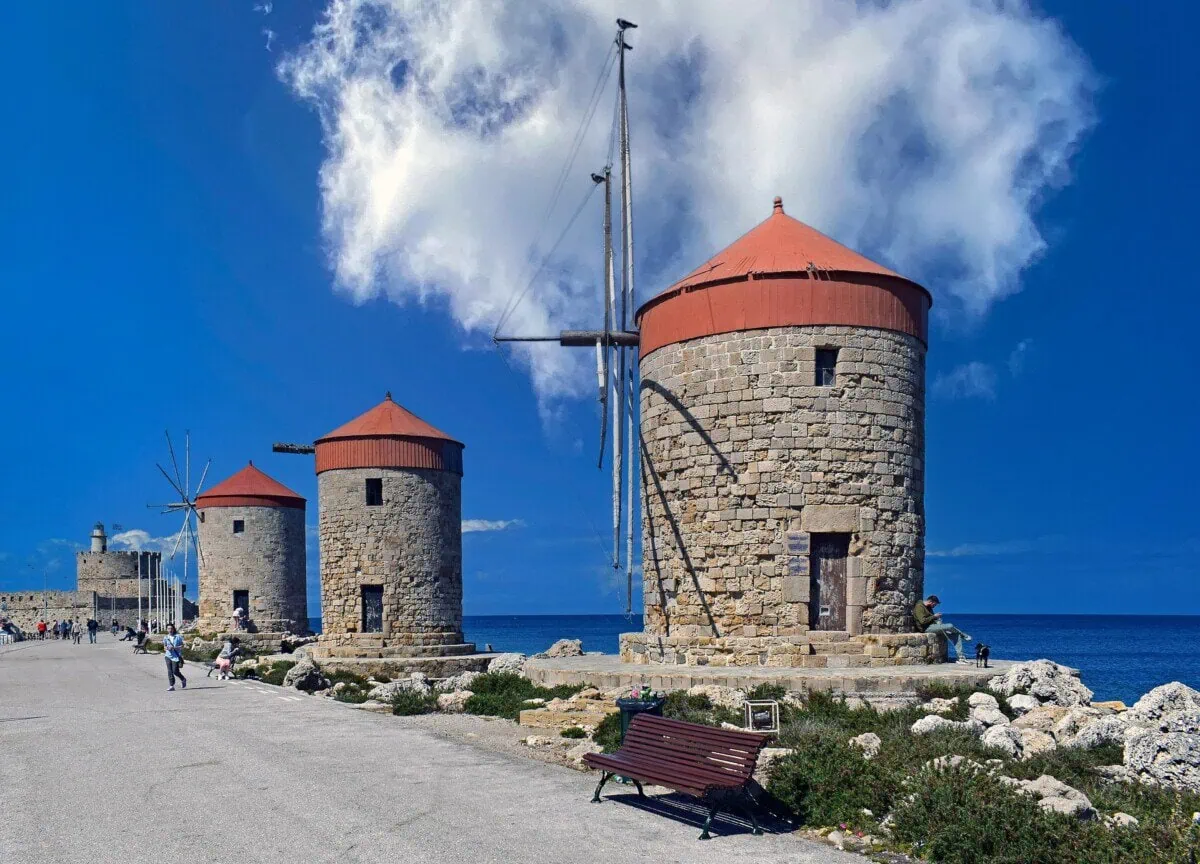
Further along the mole, three restored windmills once ground grain for the city and now serve mainly as a photogenic landmark against the water. At the harbour mouth, the squat fortifications of Fort St Nicholas guard the entrance much as they have since the fifteenth century.
Mandraki also functions as the departure point for day-cruise boats heading to Symi and other nearby islands, covered later in this guide, and it sits close enough to the Old Town and New Town that no bus is really needed to reach it. An early evening walk along the harbour, with the windmills silhouetted against the sunset, is one of the simplest and most rewarding free things to do in Rhodes Town.
A Smaller Catamaran Cruise with Lunch and Drinks
This is a more boutique alternative to the larger BBQ boats, run on a private catamaran that carries a maximum of around twenty-four guests rather than a full party boat’s crowd. It departs Mandraki Harbour at roughly 10am for a six-hour day that visits Anthony Quinn Bay, Ladiko Bay and Kallithea Springs for swimming and snorkelling.
A Mediterranean buffet lunch of grilled chicken, pasta and salads is served on board, alongside a breakfast tortilla and fresh fruit earlier in the day. Snorkelling gear and flotation devices are provided at each stop, so swimmers do not need to bring their own equipment.
Wine and beer flow from midday onward, alongside unlimited soft drinks and water, and the boat carries an outdoor shower for rinsing off between stops. Because numbers are capped well below the bigger cruise boats, the atmosphere tends to feel noticeably calmer.
Prices typically run from around €95 (£81/$104) up to €120 (£102/$130) per person depending on season and demand, reflecting the smaller group size. It suits travellers who would rather pay a bit more for fewer fellow passengers than book the cheapest boat available.
The Acropolis of Rhodes at Monte Smith: Ruins Above the Rooftops
Monte Smith is the hill immediately west of Rhodes Town, named after the British admiral Sir Sidney Smith, who kept watch from here for Napoleon’s fleet in the early 1800s. Long before that, it was the site of the ancient city’s own acropolis, and its ruins remain freely accessible today.
The most striking survival is a restored ancient stadium, its curved seating rows rebuilt during the twentieth century on the original Hellenistic footprint. Next to it sits a small reconstructed theatre, used for athletic training and lectures in antiquity rather than large public performances.
A short walk uphill leads to the remains of the Temple of Pythian Apollo, where a handful of re-erected Doric columns now stand against the skyline. Little of the temple’s original structure survives beyond these columns, but the setting itself makes the climb worthwhile.
Because Monte Smith charges no entrance fee and sees only a fraction of the Old Town’s foot traffic, it tends to be one of the quietest ancient sites on the island. The hill also offers genuinely panoramic views back over Rhodes Town’s rooftops and out towards the sea.
Late afternoon is the best time to visit, both for softer light on the ruins and for the chance to watch the sun set over the town from the temple terrace. There is no dedicated bus route up Monte Smith, but a car or taxi makes the short trip from the centre easiest, and it remains a manageable walk for anyone comfortable with a gentle uphill stretch.
A Hop-On Hop-Off Bus Around Rhodes Town
An open-top sightseeing bus circles a roughly one-hour loop around Rhodes Town, covering twelve stops across both the Old Town and the newer parts of the city. Stops include the Acropolis at Monte Smith, the Aquarium, Elli Beach, the Palace of the Grand Master and the Archaeological Museum, several of which are covered in their own sections of this guide.
A single ticket is valid for the whole day, letting passengers hop off at any stop, explore, and rejoin a later bus without buying a new ticket. Buses run air-conditioned with an onboard audio guide available in ten languages, including English and Greek.
Service runs later into the evening during the summer peak but tends to finish by around 3pm in the shoulder months of March, April and November, so it is worth checking current hours before relying on it as transport. Tickets generally start from around €20 (£17/$23) per adult.
Because the loop stays within Rhodes Town rather than reaching Lindos or the west coast, it works best as an orientation tour on a first day rather than a way to reach the island’s further-flung sights. It suits travellers who would rather sit back and get their bearings than walk the whole city in the heat.
Lindos and Its Acropolis: A Cliff-Top Temple and Village
Lindos sits roughly 50km south of Rhodes Town, close to an hour’s drive along the east-coast road, and it is one of the best-served villages on the island by public transport, with a regular KTEL bus running from the main Rhodes Town station roughly every thirty minutes in high season. The whitewashed village beneath the acropolis, with its narrow lanes and captains’ houses, is a major attraction in its own right.
High above the village, the Acropolis of Lindos occupies a dramatic clifftop roughly 116 metres above the sea. Its centrepiece is the Temple of Athena Lindia, a Doric structure built in the mid-fourth century BC, alongside a Hellenistic stoa and later fortress walls added by the Knights of St John over the ancient remains.
Current admission runs at €20 (£17/$22) for a full adult ticket, with a reduced rate of around €10 (£9/$11) for EU seniors and concessions for some younger visitors, and a timed-entry booking system in place for 2026 to manage numbers. Booking a morning slot a day or two ahead is sensible, since the earliest windows tend to sell out first.
The walk up from the village takes only fifteen to twenty minutes on a stepped path, and traditional donkey rides are still offered for around €10 (£9/$11) for anyone who prefers not to climb. Animal welfare groups have raised real concerns about donkeys working on hot stone paths in summer, so this guide leaves that choice to each visitor’s own judgement rather than recommending it outright.
Bring water and sun protection, since the site itself has no shade and no facilities once inside. Arriving either early morning or in the couple of hours before closing avoids the worst of the midday heat and crowds, and still leaves enough time to take in the views over St Paul’s Bay below.
Travellers who would rather book ahead than queue at the ticket office can pick up a skip-the-line entry ticket for the Acropolis, or join a guided bus day trip that handles the transport and a guided walk together. Both options below suit visitors who prefer to arrange Lindos in advance rather than sort it out on arrival.
Kallithea Springs: Rhodes’ Restored Art Deco Spa
Kallithea Springs sits about 9km south of Rhodes Town, around fifteen minutes by car, on a small cove where people have come for the water’s supposed healing properties since antiquity. What visitors see today, though, is largely the work of the Italian administration of the 1920s rather than an ancient ruin.
Governor Mario Lago commissioned architect Pietro Lombardi to design the complex, and it opened ceremonially in 1929 in the presence of the Italian king. The result blends European Art Deco lines with Ottoman-influenced domes, most strikingly in the white rotunda that anchors the whole site.
Black-and-white pebble mosaics, known locally as chochlaki, line the arched corridors, and bougainvillea now drapes much of the stonework. The spa thrived as an international health resort until the Second World War brought its first period of use to an end.
After decades of decline, a full restoration completed in 2007 returned Kallithea to something close to its original elegance, and the site has since become a popular film location. Entry costs €5 (£4/$5) in the May to October high season and €3 (£3/$3) in winter, with hours generally running from around 8am to 8pm in summer and 8am to 4pm in winter.
Beyond the architecture, Kallithea has a genuinely good small cove for swimming, with clear water and a diving platform built into the rocks, and it sits on the same frequent KTEL bus corridor that serves Faliraki, with departures roughly every twenty minutes in summer. It works well as a half-day trip from Rhodes Town, combining history, photography and a swim in one stop.
Best for solo travellers and anyone watching the budget. Dorm beds and private rooms in the same search.
Browse hostelsBest arranged before you fly rather than after. Covers claim handling, plus lounge access on eligible delays.
Explore AirHelp+Best for a day with a bag and nowhere to put it. Find a storage point near where you already are.
View storageA Dolphin Watching Cruise with a Marine Biologist
This three-hour boat trip departs not from Rhodes Town itself but from Kamiros Skala on the west coast, with return van transport of around forty-five minutes each way usually included in the price. A qualified marine biologist travels on board, explaining local dolphin behaviour and the area’s small-scale fish farming as the boat heads out.
The main draw is the chance to see wild bottlenose dolphins near the small islet of Makri, with operators quoting sighting rates of around ninety percent, though nothing in the wild can ever be guaranteed. The route typically allows two separate viewing passes near the islet before moving on.
A guided snorkelling stop at the protected waters around Stroggyli islet follows the dolphin watching, with equipment provided and a guide on hand to point out marine life closer to the surface. Light refreshments and snacks are usually included for the return leg.
Prices generally start from around €95 (£81/$105) per person, reflecting the smaller boat and the marine biologist’s presence throughout. Because it departs from the west coast rather than Rhodes Town, it suits travellers already exploring Ancient Kamiros or the west side that day rather than a standalone outing.
Butterfly Valley: A Shaded Retreat Built for Summer Moths
Butterfly Valley, known locally as Petaloudes, lies around 26km from Rhodes Town on the island’s western side. Despite the name, the residents are Jersey tiger moths rather than true butterflies, drawn in huge numbers by the scent of the valley’s rare Zitia trees.
The moths are most visible from late June through early September, with numbers peaking in August when thousands cluster along the valley’s shaded streams. Visiting in the early morning or late afternoon gives the best chance of seeing them settled rather than disturbed by midday crowds.
Well-maintained paths wind through the valley alongside small waterfalls and pools, creating a noticeably cooler, more humid microclimate than the surrounding countryside. A small Natural History Museum at the entrance introduces the endemic wildlife found here before visitors head into the trees.
Entry costs €6 (£5/$7) for adults during the July to September peak season, dropping to €3 (£3/$3) in the April to June and October shoulder months, with children under twelve admitted free throughout. Outside the main season the moth population thins considerably, so anyone visiting purely for that spectacle should time a trip accordingly.
Because the valley is shaded and genuinely cool by Rhodes standards, it makes a sensible stop on a hot midsummer afternoon even outside butterfly season, though it sits on the island’s west side where public bus services run far less often than on the east coast, so a hire car, taxi or organised tour is the realistic way to get here. Comfortable shoes help on the uneven stone paths, and the walk suits most fitness levels and ages.
An organised day trip also exists that combines Butterfly Valley with the Valley of Seven Springs in a single guided outing, useful for anyone without a car who wants to see both nature sites in one day. It bundles transport and a guide together rather than requiring two separate visits.
The Valley of Seven Springs: A Cold, Dark Tunnel Walk
The Valley of Seven Springs, or Epta Piges, sits about 25km from Rhodes Town and just 3km from the resort of Kolymbia, which the frequent east-coast KTEL bus to Lindos passes through, though the springs entrance itself still means a further walk or short taxi ride from the main road. Unlike most of the entries on this list, it charges no entrance fee and stays open around the clock.
Seven natural springs emerge here simultaneously from underground, feeding a small, strikingly clear lake before continuing on as the Loutanis River. Plane trees and pines shade the whole valley, creating a genuinely cool, green escape from the coastal heat just a few kilometres away.
The valley’s best-known feature is a roughly 150-metre tunnel running alongside the water, narrow enough that only one adult can pass through at a time. It is unlit except for a single shaft of daylight partway along, and walking it means wading through cold water at ankle depth in near total darkness.
Local legend holds that drinking from the springs brings health and vigour, and that completing the tunnel walk carries its own good fortune. Whether or not either claim holds up, the tunnel is a genuinely memorable, slightly eerie experience that stands apart from anything else on the island.
Bring shoes that can get wet and a torch or phone light as a backup for the darkest stretch of the tunnel. The springs tend to run lower in high summer, so anyone visiting specifically for the water levels may find spring or autumn more rewarding than August.

Ancient Kamiros: Rhodes’ Untouched Hellenistic City
Ancient Kamiros lies around 33km from Rhodes Town on the island’s west coast, making it the furthest of the three ancient city-states, alongside Lindos and Ialysos, that once shared control of Rhodes. Unlike the other two, Kamiros was never significantly built over in later centuries, so its original street plan survives largely intact.
The site is laid out across three distinct levels dating mainly from the third century BC. An acropolis crowns the hilltop, a residential quarter of house foundations occupies the middle terrace, and the lower level holds the agora, a Doric fountain house and the remains of a Hellenistic temple.
Many of the finest artefacts excavated here have long since left the island, now held in the Archaeological Museum of Rhodes as well as the British Museum and the Louvre. What remains on site is still substantial enough to give a genuine sense of daily life in a working Hellenistic town rather than just a single monument.
Adult admission is €10 (£9/$11), broadly in line with the island’s other major archaeological sites, with the site generally open through daylight hours and shorter days in winter. Because Kamiros receives far fewer visitors than the Old Town or Lindos, it is worth checking current opening times locally before making the trip.
There is little shade across the site, and public buses on the west coast run far less frequently than the east-side services to Lindos or Faliraki, so a hat, water and a car or taxi matter more here than at more developed attractions. Combining Kamiros with a stop at Ancient Ialysos or the west-coast beaches makes for a satisfying half-day loop away from the busier east coast.
Filerimos and Ancient Ialysos: A Hilltop Layered With History
Filerimos hill rises above the modern towns of Ialysos and Trianda, around 14km from Rhodes Town, and carries an unusually dense layering of history for a single hilltop, though the hilltop site itself sits well beyond the nearest west-side bus stop, making a car, taxi or tour the practical way up. Long before the Knights arrived, it was the site of ancient Ialysos, one of the three original city-states of Rhodes.
The Knights of St John built a Gothic monastery here in the fifteenth century, a style that feels distinctly out of place among typical Greek religious architecture. It once housed a revered icon of the Virgin Mary, later taken to Montenegro following the Ottoman conquest of 1522.
Scattered around the monastery, the older remains of ancient Ialysos include a cross-shaped Byzantine baptistery and an underground Church of St George decorated with fourteenth-century frescoes. The site was restored during Italian rule in the twentieth century, giving it much of its current, well-kept appearance.
A path known as the Way of the Cross leads from the monastery to a large hilltop cross, passing bronze relief panels depicting the Passion along the route. The climb rewards visitors with sweeping views over Ialyssos Bay and, on a clear day, much of the island’s northwest coast.
Entry is charged at a modest, single-figure euro rate rather than anything close to the island’s headline attractions, and the site is generally quiet even in peak season. Free-roaming peacocks around the grounds are a genuine, if slightly unexpected, feature that regular visitors mention often.
Faliraki: The Island’s Biggest Beach Resort and Water Park
Faliraki sits roughly 10-14km south of Rhodes Town and functions as the island’s largest and liveliest package resort. Its long sandy beach stretches for several kilometres, backed by a strip of bars, restaurants and watersports operators that runs late into the night in high season.
The beach itself costs nothing to use, and its gentle slope into calm water suits families with young children particularly well, especially towards the quieter northern end. The southern end, closer to the main strip, tends to be busier and louder throughout the day and evening.
Faliraki Water Park operates seasonally, typically opening in early May and running through late October, with slides, pools and rides spread across a large hillside site. Adult tickets currently run at around €30 (£26/$33), with reduced pricing for children aged three to twelve and free entry for toddlers.
Park opening hours shift slightly through the season, generally running from 10am to around 6pm in May, September and October and extending to 6:30pm during the peak summer months. Booking online in advance can save money compared with paying at the gate during the busiest weeks of July and August.
Beyond the beach and water park, Faliraki also serves as a convenient base for reaching Anthony Quinn Bay and Tsambika, both covered elsewhere in this guide, and it sits on one of the island’s busiest bus corridors, with KTEL services from Rhodes Town running every twenty to thirty minutes in summer. It suits travellers who want a genuine resort holiday alongside easy access to the island’s history.

Anthony Quinn Bay: A Hollywood-Named Cove for Snorkelling
Anthony Quinn Bay, also known locally as Vagies, lies around 15km south of Rhodes Town and about 4km from Faliraki. The cove takes its English-language name from the actor Anthony Quinn, who spent time filming The Guns of Navarone on Rhodes in the early 1960s.
Exactly how the bay came to carry his name is genuinely disputed. One version holds that Quinn tried to buy the land himself after falling for it, while another suggests the Greek authorities effectively gifted the association in gratitude for the tourism his films generated, and this guide treats both as local stories rather than settled fact.
The bay itself is compact and rocky rather than a stretch of soft sand, with stones and occasional sea urchins meaning sturdy footwear pays off when entering the water. What it lacks in beach comfort, it makes up for in visibility, with strikingly clear water over a rocky reef just offshore.
That reef makes the bay one of the better spots on Rhodes for casual snorkelling, with fish life noticeably richer than at the island’s larger sandy beaches. Divers also use the bay as an easy shore-entry site, since deeper water is reachable within a short swim.
Because the shoreline is narrow and rocky underfoot, Anthony Quinn Bay suits confident swimmers and snorkellers better than families with very young children, and it is one of the few beaches on this list with its own dedicated KTEL bus route from Rhodes Town, though services run only a handful of times a day rather than continuously. Visiting earlier in the day, before the small car park fills, makes it much easier to find a comfortable spot to leave belongings while in the water.
Several small boat operators also run short cruises along this stretch of coast, calling at Anthony Quinn Bay, Ladiko Bay and the nearby sea caves for swimming stops rather than covering the whole island. The options below give a flavour of what is on offer, though it is worth comparing each operator’s exact route before booking, since they vary slightly.
At around €16 per person, this swimming cruise is the cheapest of the three options here and keeps its focus narrow, pairing Anthony Quinn Bay with a stop at Kallithea Springs rather than a longer coastal route. It suits travellers who mainly want a straightforward swim and snorkel outing without paying extra for a trip that covers more ground.
This trip departs from Faliraki itself rather than Rhodes Town or Mandraki Harbour, making it the more convenient pick for anyone already staying on that stretch of coast. At around €49 per person it also covers more ground than the swimming cruise above, taking in the Afantou sea caves, Anthony Quinn Bay and Ladiko Bay in a single outing.
This cruise calls at much the same stops as the Faliraki boat trip above, including Anthony Quinn Bay, Ladiko Bay and the sea caves, but it is pitched as an all-inclusive trip that typically bundles unlimited drinks and light snacks into the price rather than leaving guests to bring their own. At around €55 per person it costs more than the other two options, so it suits travellers happy to pay a bit extra for that on-board refreshment.
Tsambika: A Family Beach Beneath a Pilgrimage Climb
Tsambika combines two genuinely different attractions under one name, roughly 25km south of Rhodes Town and about thirty minutes by car. At sea level, a broad stretch of fine golden sand runs for around 1.5km, sloping gently into the water in a way that suits young children well.
In high season the beach fills with sun loungers, beach bars and watersports operators, including a floating inflatable water park just offshore. Anyone hoping for an undeveloped stretch of coastline should expect something closer to a busy resort beach than a quiet cove during July and August.
High above the sand, on a hilltop reached by a separate road, Tsambika Monastery is one of the island’s most important pilgrimage sites. Visitors climb around 300 steps from a car park at roughly 220 metres to reach the chapel, a shaded but genuinely strenuous ascent in summer heat.
Local tradition holds particular significance for women seeking a blessing for fertility, and the monastery draws steady numbers of visitors for that reason alongside curious travellers after the view. From the top, the panorama across the coastline and beach below makes the climb worthwhile even without any religious motivation.
Because the beach and monastery sit at different access points, visiting both in one trip means allowing extra time and, in most cases, a short drive between the two car parks, since the KTEL bus to Tsambika Beach runs only a few times each morning and does not reach the monastery car park above. Good walking shoes make a real difference on the monastery steps, which are steep and largely unshaded near the top.
A Grand Island Tour Taking in Kamiros and Lindos
For anyone without a hire car who still wants to see the west and east coasts in a single day, a guided minibus tour circles almost the whole island in around eight and a half hours. Small-group pickups run from Faliraki, Kallithea, Rhodes City, Ixia and Ialysos, typically between 7:15am and 8:30am.
The route usually opens with a guided visit and free time at Ancient Kamiros, covered in its own section of this guide, with the site’s entry fee generally included in the tour price. From there it continues to Siana village for a wine and olive oil tasting and on to Monolithos for a photo stop at its clifftop castle.
The day finishes with a guided walking tour of Lindos and around an hour of free time in the village, giving a shorter taste of the site than a dedicated Lindos day trip but pairing it usefully with the west coast in one outing.
Prices generally start from around €47 (£40/$51) per person, making it one of the more affordable ways to reach Kamiros without a rental car. It suits travellers who want a broad overview of the island’s west and east coasts rather than deep time at any single stop.

Prasonisi: Where Two Seas Meet at the Island’s Windsurfing Tip
Prasonisi sits at the very southern tip of Rhodes, roughly 90km from Rhodes Town and around 50km beyond Lindos. It is famous for a narrow sandy tombolo, a natural land bridge, connecting the main island to a small offshore islet.
In summer, falling water levels expose the full sandbar, letting visitors walk between two noticeably different sea conditions at once. One side, commonly described as facing the Aegean, tends to run choppier and wave-driven, while the other, facing the Mediterranean, stays comparatively calm, though the exact oceanographic boundary is more a useful description than a strict scientific line.
That contrast, combined with the reliable Meltemi wind that blows through the area from April to October, has made Prasonisi one of Europe’s best-known windsurfing and kitesurfing destinations. Peak conditions in July and August regularly bring fifteen to thirty knots of wind, with only a handful of genuinely calm days across either month.
Several kite and windsurf schools operate from the beach, offering lessons and equipment hire alongside a small, low-key scattering of tavernas. Beginners typically use the calmer side of the tombolo, while experienced riders head for the choppier, wind-exposed side.
Even for visitors with no interest in watersports, Prasonisi is worth the long drive simply for the scenery and the sense of reaching the island’s edge, though it is genuinely impractical by public transport, since the solitary KTEL bus toward Kattavia runs only once a day on a few days a week and still stops short of the tip itself. May, June, September and October offer less consistent wind than the summer peak, which suits anyone who prefers a calmer beach visit over the busiest kite season.
The Aquarium of Rhodes: Marine Life in an Italian-Era Building
The Aquarium of Rhodes occupies the Hydrobiological Station at the northernmost tip of Rhodes Town, close to Mandraki Harbour. The building itself dates to 1934-35, built under Italian administration with curved lines and circular windows intended to evoke the sea it studies.
Inside, around thirteen larger tanks and fifteen smaller ones display Mediterranean marine life, including sea turtles, seals, sharks and a wide range of local fish species. An underground section cares for injured or newly arrived animals away from public view before they join the main displays.
A small attached museum shows preserved marine specimens alongside interactive displays aimed at younger visitors, including some touchable exhibits. One notable curiosity on show is a roughly 2,000-year-old seal skeleton, found buried in a human grave elsewhere on the island.
Adult admission is €6 (£5/$7), with a reduced rate of €4 (£3/$4) for children, students, seniors and visitors with disabilities. Opening hours run from around 9am to 8pm in summer and 9am to 4pm in winter, and the aquarium closes entirely on Christmas Day, New Year’s Day and Easter Sunday.
Because it sits so close to Mandraki, within easy walking distance of the Old Town and needing no bus at all, the aquarium fits easily into a Rhodes Town morning alongside the harbour and windmills. It is a sensible option on a rainy or excessively hot day, when an outdoor itinerary elsewhere on the island loses its appeal.
A Boat Trip to Symi: Rhodes’ Neoclassical Neighbour
Symi is a small island roughly 50km northeast of Rhodes, reachable by ferry or day-cruise boat from Mandraki Harbour or the main commercial port. The crossing takes anywhere from around fifty minutes to ninety minutes, depending on the vessel and whether it runs direct or calls elsewhere en route.
The island’s main settlement, Symi Town or Gialos, climbs steeply from the harbour in tiers of pastel-coloured neoclassical mansions, most built during a nineteenth-century boom in sponge diving and shipbuilding. It is a genuinely different architectural character from anything in Rhodes Town’s medieval Old Town.
A standard scheduled ferry ticket is relatively affordable, often available from somewhere in the region of €15 to €25 (£13-21/$16-27) one way, though fares vary by operator and season. Organised day-cruise excursions that include a swimming stop and guided time in Symi Town typically cost more, and it is worth comparing both options before booking.
Because Rhodes functions as a hub for the wider Dodecanese, a Symi day trip pairs naturally with the island’s other ferry connections, including the longer Rhodes to Kos ferry route for travellers building a multi-island itinerary. Both routes depart from the same general port area in Rhodes Town.
A single day is enough to see the harbour, wander the backstreets and have a swim at one of the nearby bays, though Symi rewards a slower pace if time allows, and reaching the departure port itself needs no bus since Mandraki and the commercial harbour both sit within walking distance of central Rhodes Town. Booking a morning departure from Rhodes gives the most time on the island before the return crossing.
Both a faster speedboat crossing with free time in Symi Town and a slower cruise option that also calls at Saint George’s Bay are bookable in advance below. Choosing between them mostly comes down to whether more time in Symi Town or an extra swimming stop matters more.

Rupert’s Handy Travel Tips
Rhodes packs an enormous amount into one island, so here’s what I’d plan for before setting off between the Old Town and the coast.
- Book Lindos ahead of time: the Acropolis of Lindos runs a timed-entry system, and the earliest morning slots sell out first, especially in July and August.
- Hire a car for the west coast sites: Kamiros, Filerimos and Butterfly Valley are spread out and awkward on public transport, so a rental car makes a real difference to a single day’s plan.
- Pack proper shoes for the Old Town and the ruins: original medieval cobbles and uneven ancient stone are far more common here than smooth modern paths.
- Visit Monte Smith and Mandraki for free: not every worthwhile sight on Rhodes charges an entrance fee, and both are excellent free additions to a Rhodes Town day.
- Time Butterfly Valley for August if the moths are the point: numbers are far lower outside the June to September window, so check the season before making the drive.
Want to meet the reindeer behind our travel tips? Find out more in our page Who is Rupert?.





Frequently Asked Questions About Things to Do in Rhodes
How many days do you need to see the best of Rhodes?
Four to five days is enough to cover the Old Town, Lindos and a handful of beaches or nature sites comfortably, while a full week allows time for the west coast archaeological sites and a boat trip to Symi as well.
Is the Rhodes Old Town free to visit?
Walking the streets and outer walls of the Medieval City costs nothing, though individual sights inside it, such as the Palace of the Grand Master and the Archaeological Museum, charge their own separate entrance fees.
Do I need a car to see Rhodes properly?
A hire car makes a real difference for reaching spread-out sites such as Ancient Kamiros, Filerimos, Butterfly Valley and Prasonisi, though buses and organised tours can cover Lindos and the main east-coast beaches without one.
How far is Lindos from Rhodes Town?
Lindos sits around 50km south of Rhodes Town, roughly an hour’s drive along the coastal road, which is why most visitors treat it as a half-day or full-day excursion rather than a quick stop.
Is the Colossus of Rhodes still standing?
No, the ancient bronze statue was toppled by an earthquake around 226 BC, and its exact original location is still debated, though the harbour entrance at Mandraki is the spot most commonly associated with the legend today.
When is the best time to see the butterflies at Petaloudes?
The Jersey tiger moths that give Butterfly Valley its name are most visible from late June through early September, with numbers generally peaking during August.
Is Prasonisi worth visiting if I don’t windsurf?
Yes, the sandbar and the contrast between its two sides make it a striking place to visit even without watersports, though it is a long drive of around 90km from Rhodes Town so it suits a dedicated day rather than a quick detour.
Can I visit Symi as a day trip from Rhodes?
Yes, scheduled ferries and organised day-cruise boats both run from Rhodes Town, with crossings typically taking fifty minutes to ninety minutes depending on the vessel, leaving a full day to explore Symi Town and its harbour.
Do I need to book tickets for the Palace of the Grand Master and the Archaeological Museum in advance?
Advance booking is not essential outside the busiest midsummer weeks, though arriving earlier in the day generally means shorter queues and cooler conditions inside both buildings.
Further Reading
Rhodes works well as a base for exploring the wider Dodecanese, and travellers extending their trip beyond the island should look at the dedicated guide to the Rhodes to Kos ferry, which covers timetables, ticket prices and how the crossing compares with flying between the two islands.
For the practical side of a Rhodes trip, our companion guide to Ferry Routes from Rhodes and our separate guide to Rhodes Airport Transfers cover how to reach the island and move on to other parts of the Dodecanese once here.
Anyone planning their sightseeing around opening hours and ticket prices should also check the official Hellenic Ministry of Culture’s site for the most current information on the island’s state-run archaeological sites and museums before travelling, since hours and prices can shift between seasons.