Reviewed by our editorial team Updated
Why Vienna to Bratislava Is One of Europe’s Easiest International Trips
Travelling from Vienna to Bratislava is one of the simplest and most rewarding international journeys in Europe. The route connects the capitals of Austria and Slovakia in well under two hours, allowing travellers to experience two completely different countries in a single day. Few capital to capital routes anywhere in Europe are this short, affordable, and easy to organise, which is why the journey has become hugely popular with tourists, backpackers, rail travellers, river cruise passengers, and weekend visitors exploring the wider Danube region.
One of the biggest advantages of travelling from Vienna to Bratislava is the sheer number of transport choices available. Travellers can choose between fast regional trains, long distance buses, scenic river boats, organised tours, private transfers, or self drive journeys. This flexibility makes the route ideal for almost every type of traveller. Some visitors prioritise speed and convenience, while others want the cheapest possible fare or a scenic journey along the famous Danube River. The good news is that all of these options are realistic and widely available throughout the year.
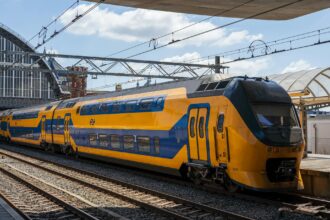
For most travellers, the easiest and most balanced option is the regular train connection between Vienna Hauptbahnhof and Bratislava Hlavná Stanica. Trains run frequently throughout the day and normally take around one hour depending on the service used. Ticket prices are often surprisingly affordable, especially when using special regional fares such as the popular Bratislava Ticket offered by ÖBB. Buses can sometimes be even cheaper when booked in advance through companies such as FlixBus or RegioJet, while the famous Twin City Liner provides one of the most scenic river journeys in Central Europe.
Another reason the Vienna to Bratislava route is so easy is the lack of complicated border procedures. Both countries are members of the Schengen Area, meaning travellers can usually move between them without passport checks or lengthy formalities. This creates a much smoother experience than many other international journeys. In practical terms, travelling from Vienna to Bratislava often feels more like travelling between two neighbouring regions than crossing between separate countries.
The route is also extremely attractive because the two cities complement each other so well. Vienna is famous for its grand imperial architecture, elegant coffee houses, classical music heritage, and monumental boulevards. Bratislava, meanwhile, offers a more compact and relaxed atmosphere with a charming medieval old town, riverside viewpoints, castle panoramas, lively bars, and generally lower prices. Visiting both cities together gives travellers a broader perspective on the history and culture of the former Habsburg Empire and the wider Danube corridor.
Many visitors choose to travel from Vienna to Bratislava as a simple day trip, but the route also works brilliantly as part of a longer Central Europe itinerary. It is very common to combine Vienna, Bratislava, Budapest, and Prague into one rail based journey, particularly for travellers using Interrail or Eurail passes. Because distances between the cities are relatively short, travellers can experience several countries without spending huge amounts of time in transit.
The route is also particularly good for first time visitors to Europe because it is low stress and easy to understand. Stations are modern, signage is generally excellent, online booking systems are straightforward, and transport apps make navigation far easier than it once was. Even travellers who rarely use public transport often find the Vienna to Bratislava journey surprisingly simple to organise independently.
Another major benefit is the wide range of departure points available in Vienna itself. Travellers can depart from Vienna Hauptbahnhof, Wien Meidling, Vienna International Airport, or even from river piers along the Danube Canal depending on the transport mode chosen. On arrival in Bratislava, travellers can reach the compact old town quickly from most stations or transport hubs, making the overall journey highly efficient from city centre to city centre.
For travellers exploring Austria and Slovakia, few routes offer such a strong combination of convenience, scenery, affordability, and flexibility. Whether you choose a fast train, a budget bus, or a scenic river cruise, travelling from Vienna to Bratislava is one of the easiest international journeys you can make in modern Europe.
Best Way to Travel from Vienna to Bratislava
The best way to travel from Vienna to Bratislava depends largely on what matters most to you during the journey. Some travellers prioritise speed and convenience, others focus on budget, while many visitors simply want the most scenic or memorable experience possible. Fortunately, this route offers excellent options across every category, which is one reason it has become such a popular cross border journey in Central Europe.
For most travellers, the overall best option is usually the train. Rail services between Vienna and Bratislava are fast, reliable, affordable, and comfortable. The journey normally takes around one hour, stations are centrally located, and trains run frequently throughout the day. Unlike airports, there are no long security queues or complicated boarding procedures. Travellers can simply arrive at the station, board the train, and travel directly into the centre of Bratislava with minimal stress.
The train also works particularly well for day trips because the overall travel process is so efficient. You avoid motorway traffic, parking concerns, and long boarding times associated with airports or some coach terminals. In many cases, the total door to door journey is actually faster by rail than by car or bus, especially during busy tourist periods or commuter hours.
Budget conscious travellers often choose the bus instead. Operators such as FlixBus and RegioJet frequently offer extremely low fares between Vienna and Bratislava, particularly when tickets are booked in advance. Coaches can sometimes be slightly faster than trains depending on traffic conditions and exact departure points. Many buses also arrive very close to the historic centre of Bratislava, making them attractive for short visits.
For travellers seeking the most scenic and memorable experience, the Twin City Liner river boat is difficult to beat. Travelling along the Danube River creates a completely different atmosphere compared with rail or road travel. The journey itself becomes part of the sightseeing experience, with views of riverside landscapes, modern skylines, and stretches of countryside between the two capitals. However, river services are seasonal, more weather dependent, and significantly more expensive than trains or buses.
Private transfers work well for families, groups, or travellers carrying large amounts of luggage. Many visitors travelling directly from Vienna International Airport to Bratislava choose private transfers because they eliminate connections entirely. The driver collects passengers directly from the airport and transports them to hotels or apartments in Bratislava without requiring station changes or public transport navigation.
In practical terms, most independent travellers should choose the train unless there is a specific reason to select another option. It offers the strongest overall balance of speed, price, frequency, comfort, and simplicity. However, the excellent variety of transport choices means travellers can easily tailor the journey to suit their own budget and travel style.
| Transport Option | Typical Journey Time | Typical Price Range | Best For | Main Advantages | Main Drawbacks |
|---|---|---|---|---|---|
| Train | 1 hour to 1 hour 10 mins | €10 to €25 (£9 to £21 / $12 to $29) | Most travellers | Fast, reliable, comfortable, central stations, flexible tickets | Some services arrive at Bratislava Petržalka rather than the main station |
| Bus | 1 hour to 1 hour 30 mins | €5 to €20 (£4 to £17 / $6 to $23) | Budget travellers | Usually the cheapest option, strong airport links, frequent departures | Traffic delays possible, less spacious than trains |
| Twin City Liner Boat | 1 hour 15 mins | €35 to €70+ (£30 to £60+ / $41 to $81+) | Scenic travellers and day trippers | Excellent Danube views, memorable experience, central arrivals | Seasonal, weather dependent, more expensive |
| Private Transfer | 50 mins to 1 hour 20 mins | €90 to €220+ (£77 to £189+ / $105 to $256+) | Families, groups, airport travellers | Door to door convenience, luggage friendly, direct hotel transfers | Most expensive regular option |
| Rental Car | 1 hour to 1 hour 30 mins | Variable | Road trips and wider Slovakia travel | Maximum flexibility, useful for countryside stops | Parking costs, motorway driving, city traffic |
Best if you want daily housekeeping and a front desk. Filter by area first, then by price.
Check availabilityBest for families, or any stay past about four nights. A kitchen and a washing machine start paying for themselves.
Browse rentalsBest for double-checking. Runs the same Bratislava search across several booking sites so you are not leaving money behind.
Compare pricesVienna to Bratislava by Train
Travelling from Vienna to Bratislava by train is the most popular and practical way to make the journey. Rail services are frequent, reliable, relatively cheap, and simple to use even for travellers unfamiliar with the region. The route is heavily used by commuters, tourists, students, and international travellers, creating a smooth and well established cross border rail connection between Austria and Slovakia.
Most trains depart from Vienna Hauptbahnhof, the city’s main railway station. This large modern station is well connected to the rest of Vienna through the U-Bahn, trams, buses, and regional rail services. Some trains may also stop at Wien Meidling, giving travellers additional boarding flexibility depending on where they are staying inside the city.
The main arrival station in Bratislava is usually Bratislava Hlavná Stanica, the city’s principal railway station. From there, travellers can reach the historic old town in roughly fifteen to twenty minutes on foot, or much faster by tram, taxi, or local bus. Some services instead arrive at Bratislava Petržalka, which is located south of the city centre near the border with Austria. This station is still easy to use but usually requires an additional local transport connection into central Bratislava.
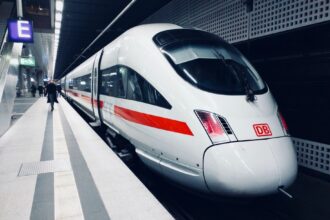
Journey times are typically around one hour, although exact timings depend on the service used. Regional express trains are generally the most common option, but there are also longer distance international trains passing through the corridor towards destinations such as Budapest. The route itself is relatively flat, with stretches of countryside, industrial areas, and suburban scenery between the two capitals.
One of the biggest advantages of travelling by train is the excellent value offered through special tickets. The popular Bratislava Ticket from ÖBB often includes return rail travel plus local public transport within Bratislava, making it particularly attractive for day trippers. This combined ticket structure can work out considerably cheaper than buying separate tickets individually.
Buying tickets is generally straightforward. Travellers can use the official ÖBB app, station ticket machines, online booking systems, or international rail booking platforms. Unlike many high speed rail services elsewhere in Europe, reservations are often not essential on standard regional services between Vienna and Bratislava, giving travellers more flexibility if plans change. Full timetables and tickets are available directly from the official ÖBB website.
The onboard experience is usually comfortable and relaxed. Modern trains normally provide clean seating areas, luggage storage space, toilets, air conditioning, and power sockets on many services. Because the journey is relatively short, most travellers find standard class entirely adequate, although first class upgrades are sometimes available.
For independent travellers, backpackers, couples, and day trippers, travelling from Vienna to Bratislava by train remains the strongest overall transport option thanks to its combination of speed, affordability, flexibility, and city centre convenience.

Check Train Routes for Vienna with Omio
If your plans include travelling by train to or from Vienna, Omio provides a convenient way to search routes and compare ticket options.
Having multiple operators available through one search can make planning easier, particularly for long-distance and international journeys.
Scan to open
on your phone

Vienna to Bratislava by Bus
Travelling from Vienna to Bratislava by bus is one of the cheapest ways to complete the journey, and in some cases it can even be slightly faster than the train depending on traffic conditions and exact departure points. Coaches are particularly popular with budget travellers, backpackers, students, and visitors booking at short notice who want low fares without sacrificing too much convenience.
The dominant operator on the route is usually FlixBus, although other companies such as RegioJet also operate services between the two capitals. Departures are available throughout the day, with especially high frequencies during busy travel periods and weekends. Because demand on the route is consistently strong, travellers normally have multiple departure options available every day.
One major advantage of the bus is the flexibility of departure and arrival locations. In Vienna, buses may depart from locations such as Vienna International Bus Terminal, Erdberg, or directly from Vienna International Airport. This creates particularly useful options for travellers landing at the airport and continuing directly to Bratislava without first entering central Vienna.
In Bratislava, many coach services arrive closer to the historic centre than the main railway station. Depending on the stop used, travellers may find themselves within a relatively short walk of the old town, shopping areas, hotels, and riverside districts. This can occasionally make buses operationally simpler than trains for certain travellers.
Journey times are commonly between one hour and one hour thirty minutes. However, unlike trains, buses are more vulnerable to motorway congestion, border traffic buildup, accidents, or delays during peak commuting hours. While the route is generally reliable, travellers should still allow extra flexibility if heading to airports or time sensitive connections.
Ticket prices are often extremely competitive. Advance fares on FlixBus can sometimes cost only a few euros, making the route one of the best value international coach journeys in Europe. Booking through mobile apps is normally straightforward, and digital tickets are widely accepted without requiring printed copies.
Modern coaches usually offer decent onboard comfort considering the low fares. Many buses provide reclining seats, air conditioning, Wi Fi, charging sockets, and luggage storage underneath the coach. The onboard experience is perfectly manageable for such a short journey, although it lacks the spacious feeling and freedom of movement typically found on trains.
For travellers prioritising low cost transport, travelling from Vienna to Bratislava by bus remains an excellent option. While trains are usually more comfortable overall, buses can offer outstanding value and highly convenient airport connections.
Check Bus Routes for Vienna with Busbud
If your plans include travelling by bus to or from Vienna, Busbud provides a convenient way to search routes and compare tickets.
Instead of checking individual operator websites, you can see several options together and choose the journey that best fits your itinerary.
Vienna to Bratislava by Boat
Travelling from Vienna to Bratislava by boat is easily the most scenic and memorable way to make the journey. Rather than simply travelling between two capitals, passengers experience a journey along the famous Danube River, passing riverside landscapes, modern skylines, wooded riverbanks, and stretches of countryside that many rail and road travellers never see.
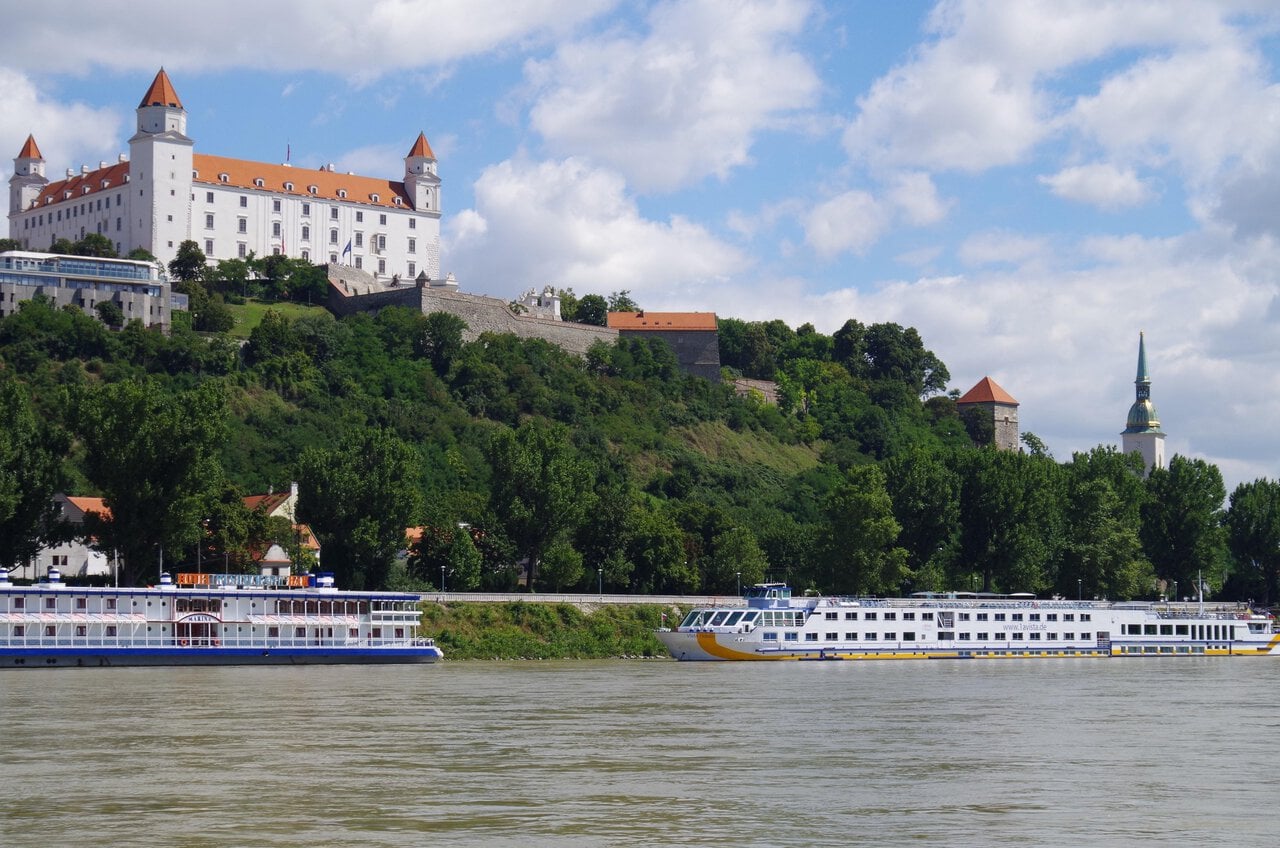
The best known operator on the route is the high speed Twin City Liner, which links central Vienna with central Bratislava using fast catamaran style river vessels. Unlike larger cruise ships, these services are designed specifically for rapid city to city travel while still maintaining a sightseeing atmosphere.
One of the biggest advantages of the boat is the departure location itself. Services normally leave from central Vienna near the Schwedenplatz area along the Danube Canal, placing travellers close to many of the city’s main attractions. Arrivals in Bratislava are similarly convenient, with the river terminal located within easy walking distance of the old town and major sightseeing areas.
The journey typically takes around one hour and fifteen minutes depending on river conditions and seasonal schedules. While this is slightly slower than the train, the experience is far more atmospheric. Large windows allow passengers to enjoy uninterrupted views along the river, creating a completely different feeling from travelling by rail or motorway.
However, the river boat experience does come with some important limitations. Services are generally seasonal and may operate less frequently during colder months or adverse weather conditions. Prices are also significantly higher than trains or buses, meaning the boat is usually chosen for the experience rather than pure practicality.
The onboard atmosphere is generally relaxed and tourism focused. Many travellers use the service as part of a broader sightseeing experience rather than simply transport. Some passengers travel one direction by boat and return by train to enjoy both experiences during the same day trip.
Because the service is popular with tourists, booking ahead is often advisable during busy summer periods, weekends, and holiday seasons. Window seats are particularly desirable because the scenery forms such a major part of the overall journey experience.
For travellers wanting something more memorable than a standard rail or coach journey, travelling from Vienna to Bratislava by boat offers one of the most enjoyable short river journeys in Central Europe.
Vienna Airport to Bratislava
Travelling directly from Vienna International Airport to Bratislava is extremely common, and in many cases it is actually more convenient than travelling first into central Vienna. Because Vienna Airport sits relatively close to the border with Slovakia, many travellers flying into Austria immediately continue onwards to Bratislava, especially when flights to Slovakia itself are more limited or expensive.
One of the reasons this route works so well is the excellent transport infrastructure connecting the airport with Bratislava. Travellers can choose between direct buses, private transfers, rental cars, and rail combinations. The route is heavily used by tourists, airline passengers, business travellers, and backpackers, meaning services are frequent and relatively easy to organise even for first time visitors.
For most travellers, the simplest option is usually the direct airport bus. Companies such as FlixBus and Slovak Lines operate regular coach services directly between Vienna International Airport and Bratislava. These buses are specifically designed for airport connections, making them particularly convenient for travellers carrying luggage. In many cases, buses depart directly outside the arrivals terminal, reducing the amount of navigation required after a flight.
Journey times are usually around one hour to one hour fifteen minutes depending on traffic conditions and exact arrival points inside Bratislava. During quieter periods, the motorway journey can feel surprisingly quick given that the route crosses an international border. Services normally arrive either at Bratislava Nivy Bus Station, which is modern and centrally located, or at other convenient stops near the city centre.
Ticket prices for airport buses are generally affordable, especially when booked in advance online. Digital tickets are widely accepted, and most travellers simply show mobile QR codes when boarding. Because the route is popular, advance booking is still advisable during summer holidays, weekends, and major travel periods.
Private transfers are another highly popular option, particularly for families, business travellers, or groups carrying substantial luggage. Drivers normally meet passengers directly in the arrivals hall and transport them straight to hotels or apartments in Bratislava. While significantly more expensive than buses, private transfers remove almost all complexity from the journey and are especially attractive after long haul flights or late night arrivals.
Train travel from Vienna Airport to Bratislava is possible but usually less straightforward than the bus. Travellers normally need to transfer at Vienna Hauptbahnhof or another station before continuing into Slovakia. While rail connections are efficient, the extra interchange means buses are often operationally easier for airport passengers.
Another major advantage of using Vienna Airport for a trip to Bratislava is the huge range of international flights available. Many airlines serve Vienna with significantly more destinations than Bratislava Airport, making this route a practical gateway into Slovakia for international visitors arriving from across Europe, North America, the Middle East, and Asia.
For travellers arriving in the region for the first time, the airport to city connection is generally smooth and low stress. Signage is good, transport apps work reliably, and cross border procedures are normally seamless because both countries sit inside the Schengen Area. As a result, travelling from Vienna Airport to Bratislava is often far easier than many travellers initially expect.
Private Transfers from Vienna to Bratislava
Private transfers from Vienna to Bratislava are one of the most comfortable and convenient ways to complete the journey, particularly for travellers prioritising simplicity, luggage space, flexibility, or direct hotel to hotel transport. While considerably more expensive than trains or buses, private transfers remove many of the small inconveniences associated with public transport and are especially popular with families, business travellers, groups, and airport passengers.
One of the biggest advantages of a private transfer is the door to door nature of the service. Rather than navigating railway stations, bus terminals, or local transport systems, travellers are collected directly from their hotel, apartment, or airport terminal and driven straight to their destination in Bratislava. This can make a substantial difference after a long flight or during winter weather conditions.
Private transfer services are particularly popular from Vienna International Airport. Many visitors landing in Austria continue directly to Bratislava without spending time in central Vienna, and a private driver makes this process extremely straightforward. Drivers typically monitor incoming flight times, assist with luggage, and adapt to delays if necessary.
Journey times are generally between fifty minutes and one hour twenty minutes depending on traffic, border area congestion, and exact pickup locations. The motorway connection between the two capitals is modern and relatively direct, making the journey smoother than many travellers expect for an international route.
Vehicle quality varies depending on the company and pricing level selected. Standard saloon cars are common for couples and solo travellers, while larger minivans are often used by families or groups carrying multiple suitcases. Luxury executive vehicles are also widely available for business travel or premium transfers.
Pricing is significantly higher than buses or trains, but the economics can improve when travelling as a group. A family of four sharing a private vehicle may find the cost difference less dramatic once multiple rail or coach tickets are added together. The convenience factor can also justify the premium for travellers with tight schedules or heavy luggage.
Another major advantage of private transfers is flexibility during the journey itself. Some operators allow optional stops along the route, including at Designer Outlet Parndorf, one of the largest outlet shopping centres in the region. This creates opportunities to combine shopping and transport within the same journey.
Travellers should still book carefully and use reputable operators with strong reviews and clear pricing structures. Airport scams and unofficial taxi arrangements are far less common than in some major tourist cities, but prebooking through established companies remains the safest and most reliable option.
For travellers who value convenience above all else, private transfers from Vienna to Bratislava provide one of the smoothest and least stressful ways to travel between the two capitals.
Getting from the Airport in Vienna
One option for reaching your accommodation in Vienna is to arrange a private transfer with Welcome Pickups before travelling.
Your airport journey is then organised before arrival, avoiding the need to find a taxi or navigate an unfamiliar transport network immediately after landing.
Compare ways to pre-book your Vienna transfer. You can also check another transfer provider before booking.
Vienna to Bratislava Day Trip Options
A Vienna to Bratislava day trip is one of the easiest and most popular excursions in Central Europe. Because the two capitals sit so close together, travellers can comfortably visit Bratislava for a full day without needing overnight accommodation. This makes the route especially attractive for visitors staying several days in Vienna who want to experience another country without committing to a long journey.
One of the biggest strengths of a Bratislava day trip is the sheer flexibility involved. Trains, buses, and river boats all make day travel realistic, allowing visitors to tailor the experience around their budget and interests. Some travellers prioritise speed and efficiency, while others want the journey itself to become part of the sightseeing experience.
The most common approach is to travel from Vienna to Bratislava by train early in the morning before returning during the evening. Rail services run frequently enough that travellers rarely feel locked into a rigid schedule. This flexibility is especially useful for independent travellers who prefer exploring at their own pace.
Once inside Bratislava, most major attractions are surprisingly compact and walkable. The historic old town is relatively small compared with larger European capitals, meaning visitors can comfortably see many highlights within a single day. Popular attractions include Bratislava Castle, Michael’s Gate, the Old Town Hall, riverside promenades along the Danube, and the famous Čumil street sculpture.
Food and drink are another major reason many travellers enjoy visiting Bratislava. Prices are usually lower than in Vienna, especially for beer, wine, coffee, and traditional Slovak meals. Many visitors appreciate the more relaxed atmosphere and slightly less formal feel compared with the grandeur of the Austrian capital.
For travellers wanting a more scenic experience, it is common to combine transport methods during a day trip. One popular strategy is travelling from Vienna to Bratislava by boat before returning by train during the evening. This allows travellers to enjoy both the Danube River scenery and the speed of the rail network during the same trip.
Organised tours are also widely available. These usually include transport, guided walking tours, and free time within the city. While independent travel is generally very easy on this route, organised tours can appeal to travellers wanting more historical context or a fully structured experience.
A day trip from Vienna to Bratislava also works extremely well for first time visitors to Europe because the logistics are so manageable. There are no complicated border procedures, the journey is short, and English is widely understood in tourism areas. This combination of simplicity and international variety makes the route one of the best short cross border excursions in Europe.
For travellers based in Vienna, visiting Bratislava offers a chance to experience a second capital city, a different language, a distinct culinary culture, and another side of the former Habsburg world all within a single day.
Best if you can move a day either way. Shows how the fare to Bratislava changes across the month.
Compare flightsBest if you want maps and messaging working the moment you switch your phone on.
See eSIM plansBest when public transport has stopped, or when you are travelling with children and bags.
Book a transferWhich Bratislava Station Should You Choose?
One of the most confusing parts of travelling from Vienna to Bratislava is understanding the different arrival stations inside Bratislava itself. Unlike some smaller European capitals that rely on one dominant station, Bratislava uses several transport hubs depending on whether you arrive by train, bus, or river boat. Fortunately, all of the main arrival points are relatively close to the city centre, but choosing the right one can still make your journey much smoother.
For most rail travellers, the primary arrival station is Bratislava Hlavná Stanica, which is the city’s main railway station. This is usually the best option for tourists because it provides relatively easy access to the historic centre and many accommodation areas. While the station itself is functional rather than beautiful, it remains the most practical arrival point for many visitors using regional trains from Vienna.
From Bratislava Hlavná Stanica, travellers can normally reach the old town in around fifteen to twenty minutes on foot depending on luggage and fitness levels. Local trams and buses also connect the station with the city centre, while taxis and rideshare services are widely available outside the station building.
Some rail services from Vienna instead terminate at Bratislava Petržalka, which sits south of the city centre near the border with Austria. This station is often used by certain regional and international services and can initially feel less convenient for tourists unfamiliar with the city. However, the station still has good public transport connections into central Bratislava, particularly through buses and trams crossing the Danube River.
For some travellers, Petržalka can actually be useful because it is operationally simpler for onward journeys towards Hungary or southern districts of the city. However, for visitors focused mainly on sightseeing within the old town, Bratislava Hlavná Stanica is usually the more convenient arrival point overall.
Coach travellers often arrive at Bratislava Nivy Bus Station, one of the newest and most modern transport hubs in the region. The station is integrated into a large shopping and commercial complex, creating a far more polished arrival experience than many older European bus terminals. Many travellers arriving by FlixBus or Slovak Lines use this station.
One major advantage of Nivy Bus Station is its relatively central location. Many hotels, restaurants, shopping areas, and old town attractions are reachable on foot or through short public transport connections. The station also provides excellent facilities including food outlets, luggage storage, toilets, supermarkets, and seating areas.
Travellers arriving by river boat normally use the passenger terminal along the Danube waterfront, which is arguably the most scenic arrival point of all. From here, visitors can often walk directly into the heart of the old town within minutes while enjoying riverside views and historic architecture immediately upon arrival.
For most tourists making the journey from Vienna to Bratislava, the exact station matters less than many people initially assume because the city itself is relatively compact. However, understanding the differences between Hlavná Stanica, Petržalka, Nivy, and the river terminal can help travellers choose the transport option best suited to their itinerary, accommodation, and onward travel plans.
Best Apps for the Vienna to Bratislava Journey
Using the right travel apps can make travelling from Vienna to Bratislava dramatically easier, particularly for first time visitors to Central Europe. Modern transport apps simplify ticket booking, live departure tracking, navigation, translation, currency management, and mobile connectivity, reducing much of the uncertainty that once came with international travel.
For train travellers, the most important app is usually the official ÖBB app from the Austrian Federal Railways. This app allows travellers to search timetables, buy tickets, monitor delays, manage reservations, and access digital boarding passes directly on their phones. Because so many services between Vienna and Bratislava are operated through Austrian rail infrastructure, the app works extremely well for this route.
Coach passengers commonly use the FlixBus app, which provides ticket booking, platform information, live vehicle tracking, and QR code boarding passes. The app is particularly useful because it also covers a huge network across wider Europe, allowing travellers to continue onward journeys towards destinations such as Budapest, Prague, or Kraków.
Navigation apps are especially useful inside both cities. Google Maps works very reliably throughout Austria and Slovakia, including public transport integration for trains, trams, buses, and walking routes. Many travellers are surprised by how accurate and detailed the local transport information is within both capitals.
For offline navigation, Maps.me remains popular among backpackers and independent travellers because maps can be downloaded in advance. This is particularly useful for travellers wanting to avoid roaming charges or preserve mobile data usage while moving between countries.
Translation apps can also be helpful, particularly once outside heavily tourist focused areas. While English is widely spoken in central tourism districts of Vienna and Bratislava, translation apps still make restaurant menus, ticket machines, and local signage easier to understand. Google Translate remains one of the most practical tools for quick translation during the journey.
Currency and payment apps are another major advantage when travelling between Austria and Slovakia, although both countries use the Euro, eliminating one of the biggest traditional travel complications. Contactless card payments are widely accepted in both cities, and mobile banking apps such as Revolut or Wise are commonly used by international travellers.
Connectivity apps and eSIM services are particularly valuable for travellers moving around multiple European countries. Providers such as Airalo, Holafly, Nomad, and Saily allow travellers to activate mobile data plans digitally without changing physical SIM cards. This makes it extremely easy to maintain mobile internet access throughout the journey.
For travellers planning broader regional trips, rail booking platforms such as Omio can also simplify journey comparisons across trains, buses, and ferries. Rather than checking each operator individually, travellers can compare prices and schedules across multiple transport types within one app.
Because the Vienna to Bratislava route is so easy operationally, using just a few well chosen apps can make the entire journey feel remarkably straightforward, even for travellers visiting Europe for the first time.
Tickets, Booking Tips and Money Saving Advice
Travelling from Vienna to Bratislava is generally very affordable compared with many other international routes in Europe, but travellers can still save substantial amounts of money by booking strategically and understanding how regional ticket systems work.
For most travellers using the train, the best value ticket is often the special Bratislava Ticket offered through ÖBB. This regional fare is specifically designed for journeys between Austria and Slovakia and often includes both return rail travel and local public transport inside Bratislava itself. For day trippers especially, this bundled structure can represent excellent value compared with purchasing separate tickets individually.
Another major advantage of the regional rail system is flexibility. Unlike some high speed European routes requiring mandatory reservations and fixed train assignments, many standard services between Vienna and Bratislava allow travellers considerable freedom. This means passengers can often simply board the next available train rather than being locked into one exact departure time.
For bus travel, early booking usually produces the lowest fares. Operators such as FlixBus frequently release very cheap tickets in advance, particularly during quieter travel periods. Prices tend to rise closer to departure dates, especially on Fridays, weekends, and during summer tourism peaks.
Travellers should also pay close attention to departure and arrival locations before booking. Some buses leave directly from Vienna International Airport, while others depart from terminals within the city itself. Similarly, train services may arrive at either Bratislava Hlavná Stanica or Bratislava Petržalka, which can affect onward transport times.
Boat tickets for the Twin City Liner are usually the most expensive option on the route, but booking in advance remains strongly advisable because popular departures can sell out during summer. Window seating areas are particularly desirable because the river scenery forms such a large part of the experience.
Travellers planning wider rail journeys through Europe should also compare standalone tickets with Interrail or Eurail pass coverage. While the route itself is relatively cheap, the economics can change significantly when combined with longer onward journeys towards Budapest, Prague, Munich, or other major cities.
Another useful money saving strategy is travelling slightly outside peak periods. Early morning commuter trains and Friday evening departures are often busier, while midday services can feel quieter and more comfortable. Travelling during shoulder seasons such as spring and autumn can also reduce accommodation costs in both cities.
Food and drink costs are another consideration. Bratislava is generally cheaper than Vienna, particularly for restaurants, beer, and coffee. Some travellers intentionally schedule meals inside Slovakia to take advantage of lower prices while still enjoying a full day trip experience.
Mobile tickets are now widely accepted across nearly all operators on the route. In most cases, travellers no longer need printed paper tickets, which makes spontaneous bookings far easier than in the past. However, travellers should still ensure their phones remain charged throughout the journey because digital ticket inspections are common.
Because the route is so competitive and well served, travellers usually have strong flexibility regardless of budget. Whether prioritising the cheapest coach fare, the fastest train connection, or the most scenic river experience, travelling from Vienna to Bratislava can easily fit both backpacker budgets and premium travel styles.
What to Do When You Arrive in Bratislava
One of the biggest advantages of travelling from Vienna to Bratislava is how quickly visitors can begin sightseeing after arrival. Unlike many larger European capitals, Bratislava is relatively compact and easy to navigate, allowing travellers to see a surprising number of attractions within a short amount of time. This makes the city particularly well suited to day trips and short breaks.
Most visitors naturally begin inside the Bratislava Old Town, which forms the historic heart of the city. The area is filled with narrow medieval streets, colourful buildings, outdoor cafés, historic churches, and lively squares. Because much of the centre is pedestrian friendly, walking is usually the best way to explore.
One of the most famous landmarks is Michael’s Gate, the last surviving medieval city gate in Bratislava. The surrounding streets contain some of the city’s most atmospheric architecture and provide a strong introduction to the historic character of the Slovak capital.
Another major highlight is Bratislava Castle, which sits prominently above the city overlooking the Danube River. The castle complex offers panoramic views across Bratislava, neighbouring Austria, and even parts of Hungary during clear weather. The uphill walk can be steep in places, but the views are among the best in the city.
The riverside area along the Danube is another popular part of the city for visitors arriving from Vienna. Many travellers enjoy simply walking beside the river, stopping for drinks, or watching river traffic move between the capitals. During warmer months, the waterfront atmosphere becomes particularly lively.
Food is another major attraction in Bratislava. Traditional Slovak cuisine is hearty and filling, with dishes often featuring potatoes, dumplings, cheese, pork, and soups. Many visitors specifically seek out bryndzové halušky, one of Slovakia’s best known national dishes. Prices are generally lower than in Vienna, making restaurants and cafés feel comparatively affordable.
Beer culture is also strong within Bratislava, and many visitors appreciate the city’s relaxed bar scene. Compared with larger tourist capitals, the atmosphere often feels less hectic and more manageable, particularly during evenings.
Travellers interested in unusual attractions often visit the city’s famous statues, particularly Čumil, the bronze sewer worker sculpture peeking from a manhole cover. This has become one of the most photographed spots in the city and reflects the playful side of modern Bratislava tourism.
For visitors with extra time, attractions outside the immediate centre include Devin Castle, which sits dramatically above the meeting point of the Danube and Morava Rivers. The site combines panoramic scenery with important regional history and is one of the most impressive excursions near the city.
Because distances inside central Bratislava are relatively short, travellers can comfortably combine sightseeing, food, cafés, riverside walks, and shopping within a single day. This compact layout is one of the biggest reasons why the city works so well as an easy extension to a trip based in Vienna.

Rupert’s Handy Travel Tips
Travelling from Vienna to Bratislava is one of Rupert’s favourite easy international trips in Europe because the journey is short, flexible, and surprisingly scenic along the Danube region.
- Use the ÖBB Bratislava Ticket: This is often the best value option for day trips because it can include return train travel and local public transport inside Bratislava.
- Book the Twin City Liner early: Summer departures on the famous Danube river boat can sell out quickly, especially on weekends and sunny days.
- Do not worry if you arrive at Bratislava Petržalka: Many travellers panic when they see this station name, but public transport connections into the old town are still easy and relatively quick.
- Wear comfortable shoes: The best parts of Bratislava are explored on foot, especially around the old town, castle hill, and riverside promenade.
- Consider travelling one way by boat and the other by train: This gives you both the scenic river experience and the speed and flexibility of the rail network.
Want to meet the reindeer behind our travel tips? Find out more in our page Who is Rupert?.



Frequently Asked Questions About Vienna to Bratislava
How long does it take to travel from Vienna to Bratislava?
Most journeys from Vienna to Bratislava take between one hour and one hour thirty minutes depending on the transport type used. Trains are usually around one hour, buses can vary slightly with traffic, and river boats typically take around one hour fifteen minutes.
What is the cheapest way to travel from Vienna to Bratislava?
The cheapest option is normally the bus, particularly when booking early with operators such as FlixBus or RegioJet. Advance fares can sometimes cost only a few euros.
Is the train from Vienna to Bratislava worth it?
Yes. For most travellers, the train offers the best overall balance of speed, comfort, flexibility, and convenience. Stations are centrally located, services are frequent, and journeys are straightforward even for first time visitors.
Can you do Bratislava as a day trip from Vienna?
Absolutely. A Vienna to Bratislava day trip is one of the easiest international excursions in Europe. The journey is short enough to allow a full day exploring Bratislava before returning to Vienna during the evening.
Do you need a passport to travel from Vienna to Bratislava?
Both Austria and Slovakia are inside the Schengen Area, so border checks are usually minimal or entirely absent. However, travellers should still carry a valid passport or official identification document.
What is the most scenic way to travel from Vienna to Bratislava?
The most scenic option is the Twin City Liner river boat along the Danube River. The journey provides riverside views, skyline panoramas, and a much more memorable experience than road or rail transport.
Which Bratislava station is best for tourists?
For most visitors, Bratislava Hlavná Stanica is usually the most practical railway station because it offers relatively easy access to the old town and major attractions.
Can you travel directly from Vienna Airport to Bratislava?
Yes. Direct buses and private transfers operate regularly between Vienna International Airport and Bratislava, making the route extremely convenient for international travellers.
Is Bratislava cheaper than Vienna?
In general, yes. Restaurants, bars, cafés, and some accommodation options are usually cheaper in Bratislava than in Vienna, although prices in major tourist areas can still be relatively high.
Is Bratislava worth visiting?
Yes. Bratislava offers a compact historic centre, riverside scenery, castle viewpoints, lively cafés, and a more relaxed atmosphere than many larger European capitals. It works particularly well as a short break or day trip destination.
Further Reading & Related Guides
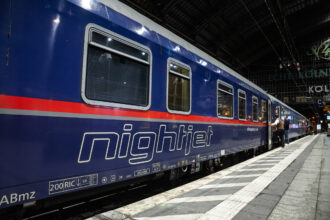
If you are planning a wider Central Europe itinerary, it is worth exploring more of the region beyond simply travelling from Vienna to Bratislava. Travellers continuing deeper into the former Habsburg Empire often combine this route with our guide to European sleeper trains, which explains how overnight rail services are making long distance travel across the continent easier again. If you are building a broader rail itinerary, our train booking apps guide can also help you compare ticket platforms, manage reservations, and track journeys across multiple countries.
For travellers continuing south along the Danube, our wider Budapest transport and travel guides can help you plan onward journeys deeper into Hungary. Meanwhile, travellers exploring shorter regional routes may also find our coverage of European railway journeys useful for inspiration around scenic rail routes, cross border travel, and easy international day trips.
If you are relying heavily on mobile connectivity during your journey, our detailed eSIM apps guide explains the best options for maintaining affordable data access while travelling across multiple European countries. Many travellers moving between Austria, Slovakia, Hungary, and neighbouring states now use eSIMs to avoid roaming complications and physical SIM card changes.
Travellers wanting smoother onward journeys from airports may also benefit from our coverage of airport transfer services, including private pickup options and transport booking platforms commonly used across Europe.