Reviewed by our editorial team Updated
Why the Great Fire of London Still Matters Today
The Great Fire of London was one of the most devastating disasters in British history and remains one of the defining events that shaped the modern city. Between 2 and 6 September 1666, a huge fire tore through the medieval streets of London, destroying homes, churches, businesses, and entire neighbourhoods across the old City of London. By the time the flames were finally extinguished, much of the medieval capital had disappeared.
What makes the story so fascinating for modern visitors is that the fire completely transformed London forever. This was not simply a disaster story. It was the event that forced the city to rebuild itself into something new. Modern building regulations, wider streets, brick construction, organised firefighting, and the redesign of central London all emerged from the destruction caused by the fire.
Today, visitors exploring the Great Fire of London sites can still trace the path of the disaster through the streets of the City. Although modern skyscrapers now dominate parts of the skyline, fragments of pre-fire London survive hidden between office towers, churches, and narrow alleys. Walking through these streets creates one of the most immersive historical experiences in the capital because the geography of the fire remains surprisingly visible.
The story also connects directly to some of London’s most famous landmarks. The destruction of the original St Paul’s Cathedral led to the creation of the magnificent cathedral visitors see today, designed by Sir Christopher Wren. The fire also inspired the construction of The Monument, one of London’s most recognisable historical structures.
For travellers interested in history, architecture, urban planning, dark tourism, or hidden London, the Great Fire of London guide offers far more than a simple historical timeline. It explains how catastrophe reshaped the future of one of the world’s greatest cities.
London transport status
Live from Transport for London.
Powered by TfL Open Data
Live service status for the London Underground, DLR, London Overground, Elizabeth line, London Trams, river buses and the cable car, updated continuously from Transport for London.
Quick Facts About the Great Fire of London
| Category | Details |
|---|---|
| Dates of the Fire | 2 to 6 September 1666 |
| Where the Fire Started | Pudding Lane, City of London |
| Main Cause | Bakery fire belonging to Thomas Farriner |
| Buildings Destroyed | Around 13,000 houses and 87 churches |
| Most Famous Site Today | The Monument |
| Key Landmark Rebuilt | St Paul’s Cathedral |
| Best Starting Point | Monument Station |
| Recommended Walking Time | 2 to 4 hours |
| Best Nearby Areas | St Paul’s, Bank, Fleet Street, Tower Hill |
| Best Time to Visit | Morning or late afternoon for quieter streets |
| Best Museum Addition | London Museum (new Smithfield site, opens fully 28 Nov 2026) |
| Main Historical Figure | Sir Christopher Wren |
| What Survived the Fire | Some medieval streets, churches, and boundary areas |
| Nearest Underground Stations | Monument, Bank, St Paul’s, Tower Hill |
Best for a short trip. Compare rooms by neighbourhood, price and guest rating before you book.
Compare hotelsBest for families, or any stay past about four nights. A kitchen and a washing machine start paying for themselves.
Browse rentalsBest as a last check before booking. Compares London hotel rates across several sites in one search.
Compare ratesHow the Great Fire of London Started
The Great Fire of London began during the early hours of 2 September 1666 inside a bakery on Pudding Lane, close to the River Thames. The bakery belonged to Thomas Farriner, baker to King Charles II. Although fires were common in seventeenth century London, few people realised that this particular blaze would soon destroy much of the city.
The conditions for disaster were already perfect. London had experienced a long dry summer, leaving timber buildings dangerously dry and highly flammable. Much of the city was still medieval in design, with narrow winding streets and tightly packed wooden houses leaning over the roads. Once the flames spread beyond the bakery, the fire quickly became uncontrollable.
Strong easterly winds pushed the flames rapidly westward through the crowded streets of the City of London. Sparks carried through the air ignited rooftops far ahead of the main fire front, while warehouses filled with oil, timber, coal, alcohol, and other flammable goods intensified the destruction. The dense layout of medieval London effectively turned the city into fuel for the growing blaze.
One of the most critical mistakes occurred during the early stages of the disaster. London’s authorities hesitated to create firebreaks by demolishing buildings ahead of the flames. Destroying private property required permission and compensation, causing delays that allowed the fire to spread far beyond the point where it might have been contained.
As panic spread across London, thousands of residents fled with carts, horses, boats, and whatever possessions they could carry. Contemporary accounts describe streets packed with terrified crowds while smoke and ash filled the sky above the city. The fire eventually crossed major streets and spread toward landmarks including St Paul’s Cathedral, which at the time was still the old medieval cathedral rather than the famous Wren structure standing today.
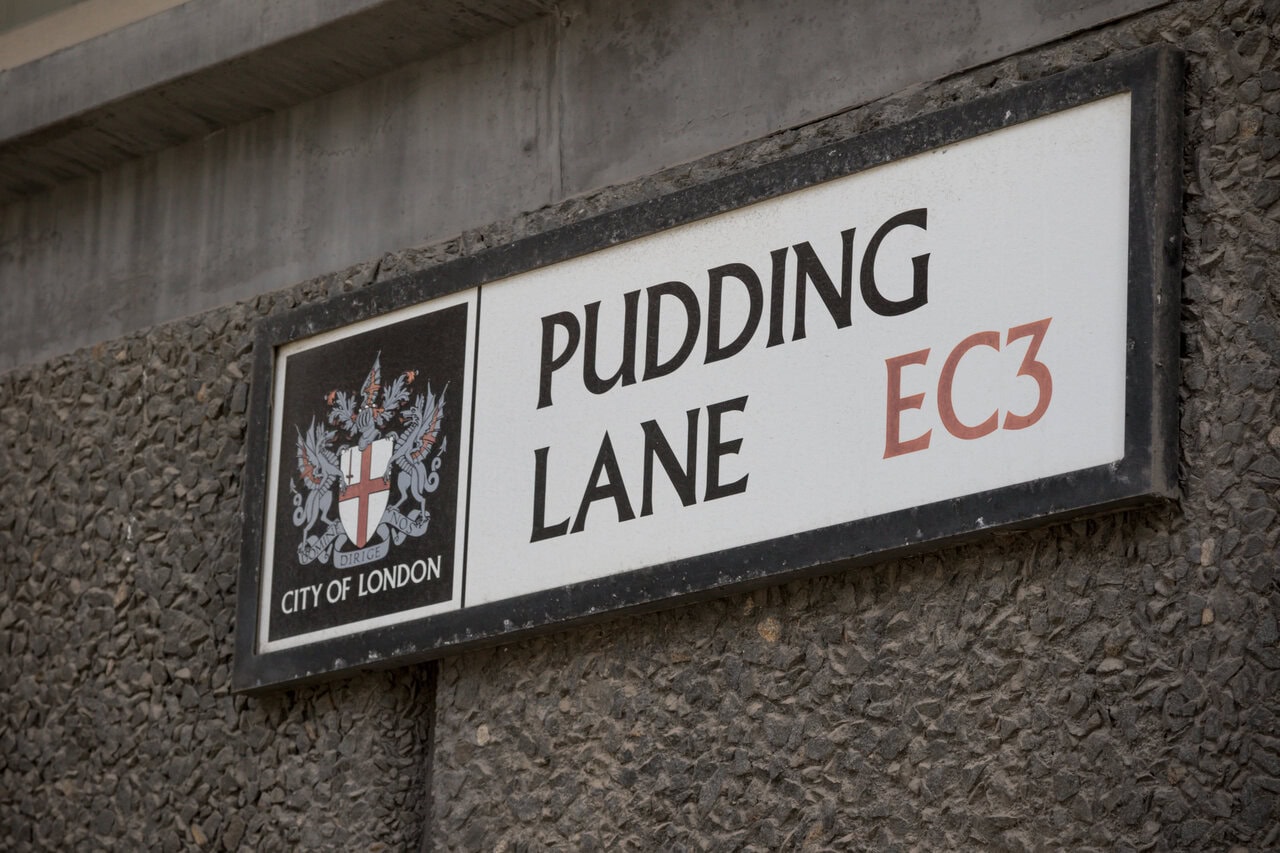
Walking around modern Pudding Lane today, visitors are often surprised by how small and ordinary the street feels. Yet this narrow road became the starting point for one of the most important disasters in London’s history. Although the original bakery no longer exists, the area remains one of the essential stops on any Great Fire of London walking tour.
Why London Burned So Easily
One of the most fascinating aspects of the Great Fire of London history is understanding why the destruction became so extreme. Modern visitors often assume that seventeenth century London must have been similar to the stone and brick city seen today, but the reality was completely different.
Much of medieval London was built almost entirely from timber. Houses featured wooden frames, wooden roofs, wooden interiors, and even upper floors that projected outward above the streets. In many places, buildings on opposite sides of the road nearly touched each other overhead. Once flames entered these cramped streets, the fire spread with terrifying speed.
The narrow medieval layout of the city made the situation even worse. Streets around Pudding Lane, Fish Street Hill, and the old market districts were tightly packed and poorly planned. Warehouses storing highly flammable goods stood beside homes, inns, workshops, and churches. Firefighting equipment was primitive, water access was inconsistent, and organised firefighting services barely existed.
Weather conditions played a major role too. Strong winds continued driving the fire westward through the city, carrying burning debris far beyond the original blaze. Contemporary witnesses described pieces of flaming material flying through the air and igniting rooftops streets away from the main fire front.
The destruction of St Paul’s Cathedral demonstrated just how vulnerable London had become. Many people believed the thick stone walls of the cathedral would stop the fire, but the building was surrounded by wooden scaffolding and packed with flammable materials linked to ongoing repair works. Eventually, the intense heat caused the cathedral roof to collapse dramatically into the structure below.
The disaster also exposed how poorly prepared London’s government was for a major urban emergency. Confusion between local officials, delays in decision making, and uncertainty about responsibility all slowed the response. By the time large scale firebreaks were finally created using gunpowder and demolition, enormous sections of the city had already been destroyed.
Ironically, the destruction ultimately forced London into modernisation. The rebuilding process introduced brick and stone construction, wider streets, improved planning, and stricter building regulations. In many ways, the fire destroyed medieval London but created the foundations of the modern capital visitors experience today.
Timeline of the Great Fire of London
The speed of the Great Fire of London shocked everyone living in the city during September 1666. Within only a few days, huge sections of the medieval capital had vanished beneath smoke, flames, and collapsing buildings. Following the timeline of the disaster helps visitors understand just how quickly the fire overwhelmed London.
During the early hours of Sunday 2 September 1666, flames broke out inside the bakery on Pudding Lane. Initially, many residents believed the fire could be controlled like countless smaller fires before it. However, strong winds and dry conditions rapidly pushed the blaze through the surrounding streets. By sunrise, entire rows of buildings were burning.
As the fire spread westward, panic began growing across the city. Residents loaded possessions onto carts and boats along the River Thames, desperately trying to save valuables before the flames reached their homes. The narrow streets became clogged with fleeing crowds, slowing movement and making firefighting efforts even more difficult.
By Monday 3 September, the fire had intensified dramatically. Huge areas around the old commercial centre were consumed by flames, and attempts to stop the spread through limited demolitions had largely failed. Smoke covered the city skyline while burning debris travelled through the air into new districts ahead of the main blaze.
The situation became catastrophic on Tuesday 4 September, often considered the worst day of the disaster. The flames reached and destroyed the old St Paul’s Cathedral, one of the most important religious buildings in England. Contemporary accounts described molten lead pouring from the cathedral roof while surrounding bookshops and warehouses exploded into flames nearby. Much of the historic heart of London was now burning uncontrollably.
By Wednesday 5 September, authorities finally began creating more effective firebreaks by demolishing entire streets ahead of the advancing flames. Wind conditions also started improving slightly, helping firefighters and soldiers gain some control over the disaster. Gradually, the western spread of the fire slowed.
On Thursday 6 September, the fire was finally brought under control. Large sections of the city still smouldered for days afterwards, but the main destruction had ended. By then, around 13,000 houses, dozens of churches, and most of medieval central London had been destroyed.
Walking through the City today, it is difficult to imagine the sheer scale of devastation. Modern office towers, financial institutions, and rebuilt streets now occupy areas that were once reduced to ashes during those four terrifying days in 1666.
Key Great Fire Sites to Visit Today
Although the original medieval city disappeared during the Great Fire of London, many locations connected to the disaster can still be explored today. In fact, the modern City of London remains one of the best places in Britain for understanding how historical catastrophe reshaped an entire urban landscape.
The most famous location is undoubtedly The Monument, built close to the spot where the fire began on Pudding Lane. Designed by Sir Christopher Wren and Robert Hooke, the towering stone column stands as both a memorial and a scientific structure. Visitors can climb the narrow spiral staircase to enjoy panoramic views across the City of London, making it one of the most rewarding historical viewpoints in central London.
Nearby Pudding Lane itself remains a key stop for visitors following a Great Fire walking route. While the original bakery vanished centuries ago, plaques and historical markers help visitors identify the approximate location where the disaster started. The contrast between the small modern street and the enormous historical consequences of the fire makes the area particularly fascinating.
Another essential stop is St Paul’s Cathedral. The current cathedral, designed by Wren after the fire, stands as one of the greatest architectural symbols of London’s recovery. Exploring the cathedral helps visitors understand how the destruction of medieval London created opportunities for dramatic rebuilding and redesign across the city.
Several churches rebuilt by Christopher Wren after the fire also survive throughout the City. Places such as St Magnus the Martyr, St Bride’s Church, and St Stephen Walbrook provide some of the strongest physical links between modern London and the rebuilding era that followed the disaster. Many visitors overlook these churches despite their enormous historical significance.
The area around Fleet Street, Temple, and the western edge of the City is also fascinating because parts of these districts escaped the flames. Here, visitors can still explore older street patterns and pockets of London that preserve fragments of the pre-fire medieval city.
For visitors interested in photography and atmosphere, St Dunstan in the East is another excellent addition. Although the current ruins result primarily from bombing during the Second World War, the church itself was originally rebuilt after the Great Fire by Wren. The combination of ruined stone walls, gardens, and modern skyscrapers surrounding the site perfectly captures London’s layered historical identity.
The Monument: London’s Great Fire Memorial
Standing at the junction of Monument Street and Fish Street Hill, just north of London Bridge, The Monument is one of the most important landmarks connected to the Great Fire of London. Built between 1671 and 1677, the column was designed to commemorate the disaster while symbolising the rebuilding of the city after the devastation.
Designed by Sir Christopher Wren and scientist Robert Hooke, the structure rises to approximately 62 metres, deliberately matching the distance between the monument itself and the bakery on Pudding Lane where the fire began. This precise measurement reflects the scientific and architectural thinking that shaped much of London’s rebuilding during the late seventeenth century.
Visitors willing to climb the 311 narrow spiral steps are rewarded with excellent panoramic views across central London. Admission is modest by London standards: the Monument to the Great Fire of London, which the City of London owns and manages, charges £7 ($9.50 / €8) for adults and £3.50 ($4.75 / €4) for children. From the viewing platform, it becomes much easier to understand the geography of the old City and the compact area through which the fire spread. Modern skyscrapers now dominate the skyline, but many historical landmarks connected to the rebuilding effort remain clearly visible from above.
The exterior carvings and inscriptions on the monument also reveal how people in the seventeenth century interpreted the disaster. Earlier inscriptions controversially blamed Catholics for the fire, reflecting the intense political and religious tensions of the period. These accusations were eventually removed centuries later as historical understanding improved.
Inside the viewing area, visitors can explore displays explaining the fire, the rebuilding of London, and the monument’s construction. While relatively small compared to major museums, the experience provides an excellent introduction to the disaster and works particularly well as the starting point for a wider Great Fire of London walking tour.
The surrounding streets also contain some of the strongest historical atmosphere in the City. Walking between Monument, Fish Street Hill, and Pudding Lane allows visitors to follow the earliest stages of the fire while standing among the modern financial heart of London. Few locations in the capital demonstrate the contrast between old and new London more effectively.
Christopher Wren and the Rebuilding of London
It is impossible to discuss the Great Fire of London without understanding the enormous role played by Sir Christopher Wren in rebuilding the city afterwards. Following the destruction of medieval London, Wren became one of the central figures responsible for reshaping the capital into a more organised, durable, and modern city.
Before the fire, much of London still followed a chaotic medieval street layout filled with timber buildings, cramped alleys, and overcrowded neighbourhoods. The disaster created a rare opportunity to redesign huge sections of the city from the ground up. Wren proposed ambitious plans featuring wider boulevards, organised public spaces, and grand architectural designs inspired by European cities such as Paris and Rome.
Although many of Wren’s largest redesign ideas proved too expensive or impractical to fully implement, his influence on London was still enormous. Most famously, he designed the current St Paul’s Cathedral, which replaced the medieval cathedral destroyed during the fire. The magnificent dome became one of the defining features of the London skyline and remains one of Britain’s greatest architectural achievements.
Wren also oversaw the rebuilding of dozens of parish churches across the City of London. Churches such as St Bride’s, St Mary-le-Bow, and St Stephen Walbrook helped define the appearance of post-fire London and still form key parts of the city’s historical landscape today.
Beyond architecture, the rebuilding process introduced major safety improvements. New building regulations encouraged the use of brick and stone instead of timber, while wider streets reduced the risk of future fires spreading so rapidly. These changes fundamentally altered the character of London and laid the foundations for the modern city.
For modern visitors, tracing Wren’s rebuilding work becomes one of the most rewarding ways to explore central London. Many of his churches survive hidden among modern office buildings and financial institutions, quietly preserving the story of how London rebuilt itself after one of the greatest disasters in its history.
Best for finding routes the airlines do not sell as a single ticket. Combines carriers to bring the fare down.
Search flightsBest if you want maps and messaging working the moment you switch your phone on.
See eSIM plansBest when public transport has stopped, or when you are travelling with children and bags.
Book a transferSt Paul’s Cathedral and the Great Fire
Few buildings are more closely connected to the Great Fire of London than St Paul’s Cathedral. The cathedral visitors see today exists entirely because the original medieval structure was destroyed during the disaster of 1666, forcing London to rebuild one of its most important religious and architectural landmarks from the ground up.
Before the fire, medieval Old St Paul’s Cathedral had already stood for centuries and dominated the skyline of London. However, by the seventeenth century the building was in poor condition and undergoing repairs. Large sections of wooden scaffolding surrounded the structure, while nearby bookshops and storage areas filled the surrounding streets with flammable materials.
Initially, many Londoners believed the cathedral would survive the fire because of its massive stone walls. People even stored possessions inside the building for protection. This assumption proved disastrous. As the flames intensified around the cathedral on 4 September 1666, the scaffolding and timber roof caught fire. Eventually, the intense heat caused the lead roof to melt and pour through the streets while huge sections of the cathedral collapsed inward.
The destruction of St Paul’s became one of the defining images of the entire disaster. Contemporary witnesses described enormous flames rising above the city skyline while the cathedral’s collapse symbolised the scale of London’s devastation. For many residents, seeing the cathedral burn confirmed that medieval London itself was disappearing.
Following the fire, Sir Christopher Wren was tasked with designing a completely new cathedral. Construction of the current St Paul’s Cathedral began in 1675 and continued for decades, eventually creating one of the most recognisable buildings in Britain. The enormous dome became a symbol not only of London’s recovery from the Great Fire, but also of Britain’s growing global power during the following centuries.
Today, visiting St Paul’s Cathedral remains one of the highlights of any Great Fire of London guide. The cathedral’s architecture, crypts, dome galleries, and historical exhibitions help visitors understand how dramatically London changed after the disaster. Climbing to the upper galleries also provides excellent views across the rebuilt city that emerged from the ashes of medieval London.
Walking around the cathedral district itself reveals the layers of London’s history particularly well. Modern glass office towers stand beside Wren churches, narrow alleys, and remnants of the older street network, creating one of the most visually striking historical areas in the capital.
Hidden Survivals From Pre Fire London
Although the Great Fire of London destroyed much of the medieval city, not everything disappeared. One of the most fascinating aspects of exploring the City today is discovering the small fragments of pre-fire London that somehow survived both the flames of 1666 and centuries of redevelopment afterwards.
One of the best surviving areas lies around Temple and the western edge of the old City. Because the fire was finally brought under control before spreading further west, parts of this district escaped destruction. Walking through the narrow lanes around Middle Temple and Inner Temple still gives visitors glimpses of the older medieval layout that once defined much of London.
Another remarkable survival is the network of hidden alleys and passageways scattered throughout the City. Streets such as Cloth Fair near Smithfield preserve something of the atmosphere of pre-fire London, with older buildings, narrow routes, and irregular street patterns very different from the more organised rebuilding that followed the disaster.
Several churches also contain elements older than the Great Fire itself. While many were rebuilt by Christopher Wren, some retained medieval foundations, crypts, or fragments incorporated into later structures. Exploring these lesser known churches reveals how London often rebuilt itself by layering new history directly on top of the old.
The area around Smithfield Market is particularly important because much of it survived the fire entirely. This means visitors can still explore parts of London that physically resemble the type of streets and urban layout that existed before the disaster. The contrast between Smithfield’s older atmosphere and the rebuilt City nearby helps visitors understand just how dramatically the fire changed London’s appearance.
Fragments of the old city wall also survive in places near the Tower of London and Barbican area. Although these remains are much older than the fire itself, they help demonstrate how layered London’s history truly is. Roman ruins, medieval streets, seventeenth century rebuilding, Victorian infrastructure, wartime scars, and modern skyscrapers all exist within remarkably small distances of each other.
For visitors following a Great Fire of London walking route, these surviving fragments often become some of the most memorable parts of the experience. Rather than simply learning about destruction, travellers can still physically encounter traces of the medieval city that existed before the flames changed London forever.
Great Fire Myths and Misconceptions
Because the Great Fire of London has become such a famous historical event, many myths and misunderstandings have developed around the disaster over the centuries. Modern visitors are often surprised to discover that several commonly repeated stories about the fire are either exaggerated or completely inaccurate.
One of the biggest misconceptions is that huge numbers of people died in the fire. Official historical records suggest that surprisingly few deaths were recorded directly from the disaster itself, although modern historians suspect the true number was probably higher than contemporary reports admitted. Poor record keeping, intense heat, and the destruction of entire neighbourhoods make accurate figures impossible to confirm.
Another widespread myth is that the fire completely destroyed all of London. In reality, the damage was concentrated mainly within the old City of London rather than areas such as Westminster, Southwark, or the outer districts. However, because the City represented the historic and commercial core of London, the destruction still had enormous national importance.
Many people also believe the fire was deliberately started as part of a foreign conspiracy. During the chaotic days of the disaster, rumours spread rapidly blaming Catholics, French agents, or Dutch saboteurs for starting the blaze. These accusations reflected the political paranoia and international tensions of seventeenth century England rather than reliable evidence. The fire almost certainly began accidentally inside the bakery on Pudding Lane.
Another common misunderstanding is that medieval London vanished completely after the fire. While huge areas were destroyed, important sections of the older city survived, particularly around Smithfield, Temple, and some western districts. In fact, one of the most interesting aspects of modern London is how fragments of the medieval city still remain hidden within the rebuilt capital.
Visitors are also sometimes surprised to learn that The Monument originally contained inscriptions blaming Catholics for the fire. These politically motivated accusations remained on the structure for centuries before eventually being removed as attitudes changed and historical understanding improved.
The reality of the Great Fire history is often more fascinating than the myths themselves. Rather than being a simple story about flames and destruction, the fire reveals how politics, fear, misinformation, urban planning, architecture, and social change all shaped the future of London.
Best Museums and Exhibitions About the Great Fire
Visitors wanting to explore the Great Fire of London in greater depth will find several museums and exhibitions across the capital that help bring the story to life. Combining these attractions with a walking tour provides one of the best ways to fully understand the scale and historical importance of the disaster.
The most important institution is the London Museum (renamed from the Museum of London), which has long held extensive collections related to the fire and the rebuilding of the city afterwards. Artefacts recovered from excavations, historical maps, personal belongings, and reconstruction models all help visitors visualise what London looked like before and after the disaster. The museum’s original London Wall site closed in 2022, and its new flagship building at West Smithfield opens fully on 28 November 2026; in the meantime, London Museum Docklands remains open and continues to display Great Fire material.
Inside St Paul’s Cathedral, visitors also find exhibitions and displays explaining the destruction of the medieval cathedral and the creation of Wren’s replacement structure. The crypt and historical interpretation sections provide particularly useful insight into how rebuilding the cathedral became part of London’s wider recovery process.
The Monument itself contains smaller displays focused on the fire and the rebuilding era. While not a large museum attraction, the information panels and panoramic views help visitors understand the geography of the disaster far better than reading about it in isolation.
Several smaller churches rebuilt by Christopher Wren also include historical interpretation material explaining their connection to the fire. Exploring these churches independently often provides a more atmospheric and less crowded experience than larger museums.
For families and younger visitors, temporary exhibitions and interactive displays related to the Great Fire frequently appear across London, especially around educational holidays and anniversary events. The story remains particularly popular because it combines dramatic disaster history with architecture, science, and urban transformation.
Together, these museums and historical sites allow visitors to experience the Great Fire of London not simply as a distant historical event, but as the moment that created much of the modern city visible today.
Great Fire of London Walking Route
Following a dedicated Great Fire of London walking route is one of the best ways to understand how dramatically the disaster reshaped the city. The compact geography of the old City of London means many of the most important locations connected to the fire can still be explored comfortably on foot within a few hours.
The best place to begin is usually Monument Station, located beside The Monument itself. Starting here immediately places visitors close to the heart of the disaster zone and provides useful historical context before exploring the surrounding streets. Climbing The Monument first also helps visitors visualise the scale of the fire and understand how the flames spread across the medieval city.
From here, the route naturally continues toward Pudding Lane, where the fire began inside the bakery of Thomas Farriner during the early hours of 2 September 1666. Although the original buildings disappeared centuries ago, plaques and markers help identify the approximate location where the disaster started. The street itself remains surprisingly narrow, helping visitors understand why the fire spread so rapidly through the tightly packed city.
After Pudding Lane, visitors can continue west toward the area around Fish Street Hill and the old riverside districts where warehouses filled with flammable goods intensified the destruction. Walking these streets reveals how close the medieval city stood to the River Thames and how dependent London’s economy was on crowded dockside commerce.
The route then naturally progresses toward St Paul’s Cathedral, one of the most significant locations connected to the fire. Exploring the cathedral district allows visitors to trace the rebuilding of London after the disaster while also seeing some of the finest surviving work of Sir Christopher Wren. Nearby side streets and alleyways preserve traces of the older medieval street pattern hidden beneath the rebuilt city.
Continuing west toward Fleet Street and Temple provides a fascinating contrast because these districts escaped the flames. Here, visitors can compare surviving older street layouts with the more organised rebuilding patterns that emerged after the fire. The atmosphere changes noticeably as the route moves between areas destroyed in 1666 and those that survived.
For visitors wanting a longer route, extensions toward Smithfield, St Bartholomew the Great, and surviving medieval streets such as Cloth Fair add another layer to the experience. These areas provide some of the best surviving glimpses of pre-fire London and help visitors imagine the type of city that existed before the disaster transformed the capital forever.
Great Fire of London for Families and Children
Despite the scale of the disaster, the Great Fire of London has become one of the most accessible and engaging parts of British history for families and younger visitors. The combination of dramatic storytelling, famous landmarks, rebuilding, and survival makes the subject surprisingly effective for educational trips and family sightseeing around London.
One reason the story works well for children is that the geography remains easy to understand. Visitors can physically walk between Pudding Lane, The Monument, and St Paul’s Cathedral, helping younger travellers visualise how the fire spread across the city. Seeing the locations in person often makes the history far more memorable than reading about it in books alone.
Climbing The Monument is usually one of the biggest highlights for families. The narrow spiral staircase creates a sense of adventure, while the panoramic views across London reward visitors at the top. Children often enjoy spotting landmarks and tracing the rough direction in which the fire travelled through the city.
The rebuilding of London after the fire also introduces broader themes that work well educationally. Families can discuss how cities change over time, why building materials matter, and how disasters sometimes force societies to improve safety and planning. In this sense, the Great Fire becomes not only a story about destruction, but also about recovery and transformation.
Several museums and exhibitions linked to the fire include interactive displays, models, and reconstructed scenes that help bring seventeenth century London to life. Historical maps comparing pre-fire and post-fire London are particularly effective because they clearly show how dramatically the city changed after 1666.
For younger visitors, combining the Great Fire route with nearby attractions such as St Paul’s Cathedral, the Tower of London, or river walks along the Thames creates a much broader family history day out. The compact nature of the City makes it easy to combine multiple historical experiences without needing extensive travel across London.
Importantly, the Great Fire generally feels more educational and architectural than many forms of dark tourism. While it remains a disaster story, the focus is usually on rebuilding, urban change, and survival rather than violence or tragedy, making it suitable for a much wider audience.
Best for a short stop where being central matters more than the room. Dorms and private rooms both listed.
See hostelsBest for anyone flying more than once or twice a year. Handles the compensation claim so you are not chasing the airline.
See AirHelp+Best if your room is not ready yet. Left luggage booked in advance, so you are not hunting for a locker.
Check storageRecommended Apps for Exploring Historic London
Exploring the Great Fire of London sites becomes far easier with the right travel and navigation apps, especially because many important locations are hidden within the dense street network of the modern City of London.
For navigation, Citymapper remains one of the best apps for moving around central London. The app provides extremely accurate real time Underground, bus, and walking directions throughout the city. Visitors travelling between Monument, St Paul’s, Bank, and Tower Hill stations will find it particularly useful because routes constantly update around delays and engineering works.
Google Maps is essential for self guided historical walks. Many surviving alleys, hidden churches, and historical markers connected to the Great Fire are tucked between office buildings and modern developments. Having reliable mapping makes discovering these locations significantly easier, especially for visitors unfamiliar with the complex street layout of the City.
Visitors travelling internationally should also consider setting up an eSIM app before arriving in London. Reliable mobile data is extremely useful while following walking routes, researching historical locations, or accessing museum tickets throughout the day. The City of London also benefits from strong mobile coverage, making digital navigation very reliable across most areas.
Audio guide and podcast apps can greatly improve the experience too. Many visitors now combine self guided walking tours with history podcasts discussing the Great Fire of London, Christopher Wren, or medieval London. Listening while physically exploring the streets creates a far more immersive historical experience than simply reading information panels alone.
Photography apps and weather apps are surprisingly useful as well. The City of London changes dramatically depending on weather and lighting conditions. Early morning fog, evening sunlight reflecting off the glass towers, or rainy conditions around narrow alleyways often create particularly atmospheric views that highlight the contrast between old and new London.
Visitors wanting a broader historical experience should also consider transport apps covering river services along the River Thames. Seeing the City skyline from the river helps visitors understand how central the Thames was during the fire and why the riverside warehouses contributed so heavily to the spread of the disaster.

Rupert’s Handy Travel Tips
Rupert says the best way to experience the Great Fire of London is by exploring the streets on foot. Walking between Pudding Lane, The Monument, and St Paul’s Cathedral makes it much easier to understand how quickly the fire spread through medieval London.
- Start early in the morning: quieter streets around the City of London make it much easier to get better photographs.
- Climb The Monument: do this before beginning the walking route. Rupert thinks the panoramic views help visitors visualise the scale of the disaster far better than maps alone.
- Look out for hidden alleyways and old churches: some of the most interesting historical details throughout the City are tucked between modern office buildings.
- Combine the walk with St Paul’s Cathedral: the rebuilding of the cathedral is one of the most important parts of the Great Fire story.
- Wear comfortable shoes: the City of London involves far more walking than many visitors expect, especially if exploring side streets and hidden historical locations.
Want to meet the reindeer behind our travel tips? Find out more in our page Who is Rupert?.




Frequently Asked Questions About the Great Fire of London
Where did the Great Fire of London start?
The fire began inside a bakery on Pudding Lane during the early hours of 2 September 1666. The bakery belonged to Thomas Farriner, baker to King Charles II.
How long did the Great Fire of London last?
The main fire burned for approximately four days, from 2 to 6 September 1666, although some areas continued smouldering afterwards.
Did St Paul’s Cathedral survive the fire?
No. The original medieval St Paul’s Cathedral was destroyed during the fire. The cathedral visitors see today was designed afterwards by Sir Christopher Wren.
Can you still visit Great Fire of London sites today?
Yes. Visitors can still explore locations including Pudding Lane, The Monument, St Paul’s Cathedral, Wren churches, and surviving medieval streets connected to the disaster.
What is The Monument in London?
The Monument is a large stone column built to commemorate the Great Fire of London. Visitors can climb to the top for panoramic views across the city.
How much of London burned during the Great Fire?
Around 13,000 houses, dozens of churches, and most of the medieval City of London were destroyed during the disaster.
Why did the fire spread so quickly?
The fire spread rapidly because London’s buildings were largely made from timber, the streets were extremely narrow, the weather was dry and windy, and firefighting systems were very limited.
What survived the Great Fire of London?
Parts of areas such as Temple, Smithfield, and some western districts survived the fire. Several medieval streets and older buildings can still be explored today.
Is the Great Fire of London suitable for families?
Yes. The story is widely taught in schools and works very well for family visits because it combines history, architecture, walking routes, and interactive museum experiences.
What is the best way to explore Great Fire of London locations?
A self guided or guided walking tour through the City of London is usually the best way to experience the major historical sites connected to the fire.
Further Reading & Related London Guides
Exploring the Great Fire of London often becomes the starting point for discovering much more of the capital’s hidden history, historic landmarks, and transport network. Visitors interested in darker historical stories across Britain and Europe should continue into our broader Dark Tourism Guide, covering abandoned places, wartime sites, disaster history, Cold War locations, and atmospheric historical destinations.
For travellers fascinated by Victorian crime and East End history, our dedicated Jack the Ripper Walking Tour Guide explores Whitechapel, Spitalfields, historic pubs, and the streets connected to London’s most infamous unsolved murders.
Many of the locations connected to the fire can also be explored without spending large amounts of money, making our Free Things to Do in London Guide especially useful for travellers building a budget friendly itinerary around the City of London and historic central districts.
Because navigating London efficiently makes a huge difference during walking routes and historical exploration, visitors should also read our London Underground Guide, which explains the Tube network, Oyster cards, key interchange stations, and the best transport apps for moving around the capital.
Travellers visiting from abroad may also benefit from our eSIM Guide, helping visitors stay connected while navigating London’s streets, historical sites, maps, museum bookings, and transport apps throughout their trip.
To explore one of the most important buildings connected to the disaster in greater depth, continue into our dedicated St Paul’s Cathedral Guide, covering the cathedral’s rebuilding after the Great Fire, dome climbs, crypts, architecture, and visitor tips.
Finally, travellers planning a shorter visit should also read our London in a Weekend Guide, which combines major landmarks, transport advice, walking routes, and efficient sightseeing strategies for making the most of a limited stay in the capital.