Reviewed by our editorial team Published
Discover the Best Things to Do in Budapest
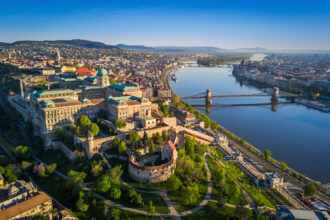
Budapest earns its nickname, the Pearl of the Danube, the moment you see the river split the city in two. On one bank sits hilly, historic Buda, all castle walls, cobbled lanes and long views over the water. On the other lies Pest, flat, grand and buzzing, home to the Parliament, the wide boulevards and most of the restaurants and bars. The two halves were only formally merged in 1873, and that split personality is still what makes Budapest such a rewarding city to explore on foot, by tram or from the deck of a boat.
This guide works through Budapest’s essential sights one by one, from the Hungarian Parliament Building and Buda Castle to the city’s famous thermal baths and its atmospheric Christmas markets, with honest, practical detail rather than a bare checklist. Before you land, it is worth sorting the logistics: our Budapest Airport Transfers guide covers getting from Ferenc Liszt International into the city centre, and the Budapest Card Guide explains whether one of the city’s discount passes will actually save you money on the sights covered below. With that sorted, Budapest is a genuinely easy city to plan around, compact enough to cover on foot in the centre but large enough to reward a proper few days.
Budapest Attractions at a Glance
| Attraction | Time to Allow | Best For |
|---|---|---|
| Hungarian Parliament Building | 1-1.5 hours | Architecture, history, first-time visitors |
| Buda Castle and Castle Hill | 2-4 hours | Museums, views, a full half-day out |
| Fisherman’s Bastion | 30-60 minutes | Photos, sunset views, a quick stop |
| Chain Bridge and a Danube cruise | 1.5-2.5 hours | Views of both banks, evening cruises |
| St Stephen’s Basilica | 45-75 minutes | Church interiors, panoramic dome views |
| Thermal baths (Széchenyi, Rudas) | 2-4 hours | Relaxation, a genuinely local experience |
| Great Synagogue and Jewish Quarter | 1.5-2 hours | History, culture, an afternoon of walking |
| Heroes’ Square and City Park | 1.5-3 hours | Families, museums, a green break from the city |
| Margaret Island | 1.5-3 hours | Walking, cycling, a car-free afternoon |
| Vörösmarty Square Christmas Market | 1-2 hours | Winter visits, food and craft shopping |
| Matthias Church | 45-60 minutes | Architecture, coronation history, pairing with Fisherman’s Bastion |
| RiverRide amphibious bus tour | 50-90 minutes | Families, a novel bus-to-boat sightseeing tour |
| MOL Campus SkyDeck | 45-60 minutes | A different skyline view, smaller crowds |
| Cat Museum Budapest | 60-90 minutes | Cat lovers, families, a quirky quick stop |
| Free and budget sights | Flexible | Longer stays, tighter budgets |
| Shopping in Budapest | 1-3 hours | Souvenirs, malls, flea market finds |
| Food Scene and Food Halls | 1-2 hours | Street food, casual dining |
| Shows and Theatres | Evening (1.5-2 hours) | Opera, ballet, folklore shows |
| Major and Annual Events | Varies by event | Festival-goers, repeat visitors |
| Things to Do in the Rain | Half a day | Wet-weather planning |
Best if you want daily housekeeping and a front desk. Filter by area first, then by price.
Check availabilityBest for longer stays. Whole apartments and houses, so you are not eating out three times a day.
View rentalsBest as a last check before booking. Compares Budapest hotel rates across several sites in one search.
Compare ratesThe Hungarian Parliament Building
The Hungarian Parliament Building, or Országház, is the single image most people picture when they think of Budapest. Completed in 1904 in a sweeping Gothic Revival style, it stretches along the Pest riverbank and is still the largest building in Hungary, with a dome that reaches exactly 96 metres, a number chosen deliberately to match 896, the year the Magyar tribes settled the Carpathian Basin.
Inside, the highlight for most visitors is the Holy Crown of Hungary, displayed under the central dome and guarded around the clock by the Hungarian Guard. Guided tours run around 45 minutes and take in the main staircase, the crown hall and the Old Upper House Hall, though every visitor also passes through an airport-style security check that adds another 10-15 minutes to the visit.
Pricing works on two tiers. EU and EEA citizens pay around 7,000 HUF (~£15/$19/€18) for a standard adult ticket, while visitors from outside the EU pay roughly 14,000 HUF (~£29/$37/€35), with reduced student rates on both. Tours are genuinely popular and can sell out weeks ahead in peak season, so book before you travel rather than turning up on the day and hoping.
For anyone who wants the full backstory rather than just a ticket booking, our dedicated Budapest Parliament Tours guide goes deeper into which tour type suits which visitor, what you will and won’t be allowed to bring inside, and how to reach the building by metro or tram. Photography is banned inside the security checkpoints and around the Crown Jewels, so save your camera for the grand staircase and the riverside facade instead.
Buda Castle and Castle Hill
Across the river and up on the Buda side, Castle Hill is the historic heart of the city, a UNESCO-listed plateau of cobbled streets, baroque townhouses and the sprawling former royal palace itself. The palace complex now houses the Hungarian National Gallery and the Budapest History Museum, and even without going into a single exhibition, wandering the courtyards and ramparts is worth the climb on its own.
The easiest and most enjoyable way up is the Buda Castle Funicular (Budavári Sikló), a short, steep little railway that has been hauling visitors up the hillside since 1870. A one-way ticket costs around 4,500 HUF (~£9/$12/€11) and a return around 5,500 HUF (~£11/$15/€14), with a modest online booking fee on top, and the ride itself takes only a couple of minutes but offers a genuinely lovely view back over the Chain Bridge as you climb.
Once up top, budget at least two hours just for the district itself, longer if a museum visit is part of the plan, since the Castle Hill area easily fills a half-day between Matthias Church, the palace grounds and the Fisherman’s Bastion just beyond it. Parking on the hill is limited and expensive, so most visitors either take the funicular, walk up via the Várkert Bazár gardens, or catch bus 16 from Deák Ferenc tér.
The cobblestones are authentic but uneven, which is worth knowing if you are travelling with a pushchair or have limited mobility, though street-level lifts do connect several points around the district. Come for the golden hour before sunset if you can, when the palace facade and the river below both turn a warm amber that no photo quite does justice to.
Fisherman’s Bastion: Budapest’s Fairy-Tale Terrace Above the Danube
A short walk from the castle, Fisherman’s Bastion (Halászbástya) is the fairy-tale, turreted terrace that appears on more Budapest postcards than almost anywhere else. It was built between 1899 and 1902, not as a real fortification but purely as a decorative viewing terrace, designed by Frigyes Schulek to mark the millennium of Hungarian settlement, with seven conical towers said to represent the seven Magyar tribes.
The good news is that most of it is free. The lower terraces and stairways, stretching around 140 metres along the hillside, are always open at no charge, and only the upper towers and the best photo angle over the Danube require a ticket, currently around 1,700 HUF (~£4/$5/€4) for adults, with discounts for students, children and EU seniors.
Timing your visit well can even make the upper terrace free. Entry to the towers is generally waived before 9am and again in the evening, from around 9pm in summer or 7pm in the rest of the year, as well as on Hungarian national holidays, so an early start rewards you with both fewer crowds and no ticket queue.
Give it 30 to 60 minutes, more if the light is good and you want to linger, and pair it naturally with Matthias Church next door and the statue of St Stephen on horseback that stands between the two. This is one of the few genuinely unmissable Budapest views that costs next to nothing to enjoy properly.
The Chain Bridge and a Danube Cruise
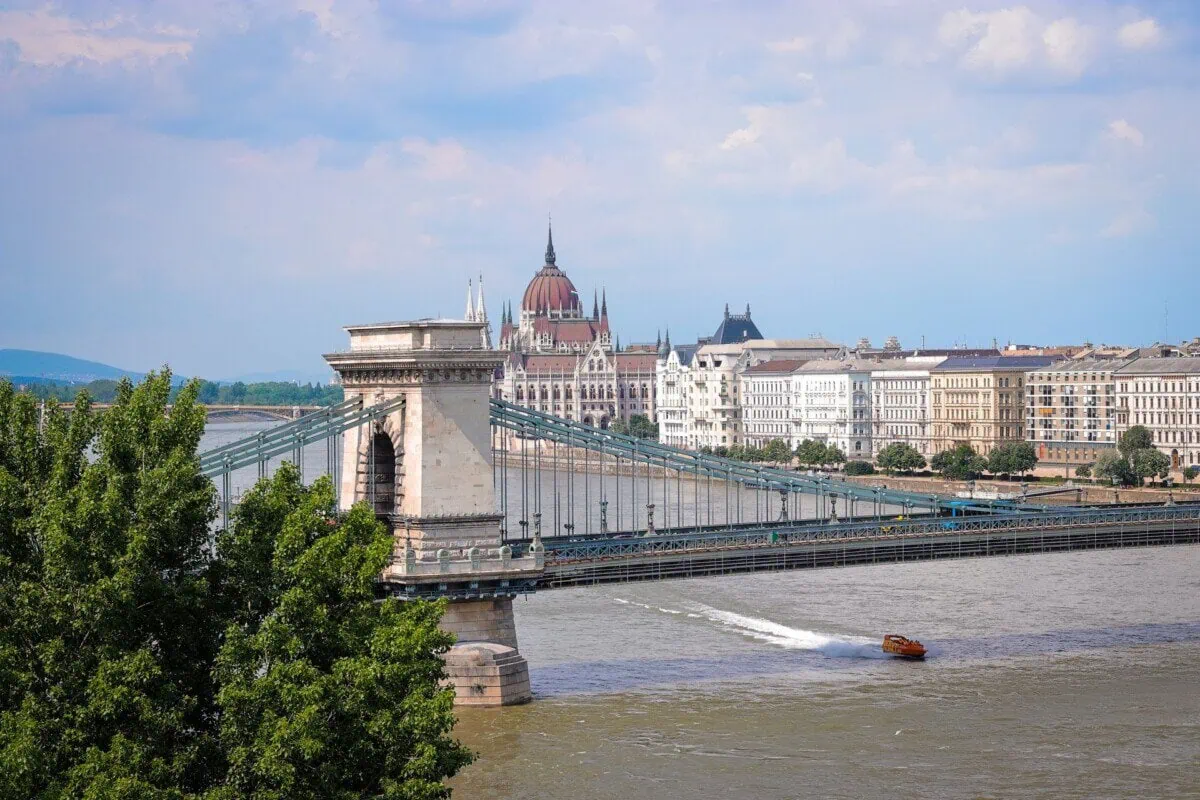
The Széchenyi Chain Bridge was the first permanent crossing ever built over the Danube in Budapest, opened in 1849 and designed by the English engineer William Tierney Clark, with construction overseen locally by Adam Clark, whose name is now given to the roundabout on the Buda side. Its four stone lions, added a little later by sculptor János Marschalkó, have become as much a symbol of the bridge as the ironwork itself.
Walking across it is free and takes about 15 minutes at an easy pace, and it is genuinely one of the best short walks in the city, linking Széchenyi István tér on the Pest side directly to Clark Ádám tér and the base of Castle Hill. At night the whole structure is lit gold, and the view back towards Parliament from the middle of the bridge is one of Budapest’s classic photographs.
Seeing the bridge from the water is a different experience entirely, and a Danube river cruise is one of the most straightforward ways to see Parliament, the Castle and the Chain Bridge all lit up without any walking at all. Daytime sightseeing cruises typically run 40 minutes to an hour, while evening cruises, often paired with a drink or a simple dinner, tend to run 1.5 to 2 hours and are consistently one of the best-value ways to see the whole floodlit riverfront in one sitting.
Our full Budapest River Cruises guide breaks down the different operators, boat sizes and departure points along the Pest embankment, along with honest advice on which cruise is worth paying more for and which is a fair budget option. Book an evening sailing if you can only choose one, since the illuminated skyline is genuinely the highlight of a Budapest trip after dark.
St Stephen’s Basilica: The Holy Right Hand and a 360-Degree Panorama
Named after Hungary’s first king and completed in 1905, St Stephen’s Basilica is deliberately the same 96 metres tall as the Parliament building across the river, a symbolic tie between church and state that neither building was allowed to exceed. Inside, the biggest draw is the Holy Right Hand, the mummified relic of St Stephen himself, kept in the Chapel of the Holy Right just off the main nave.
A standard adult ticket to enter the basilica itself is modest, typically a good deal cheaper than the Parliament tour, and it is best checked on the basilica’s own booking page shortly before you travel since prices and combination-ticket options do change. The interior alone, with its marble columns, gilded mosaics and vast dome, is worth the visit before you even think about going up.
The real reason most visitors climb the tower is the panorama terrace, reachable either by lift or by all 364 of the original stone steps, and it delivers one of the best 360-degree views in the city, taking in Parliament, Buda Castle and the rooftops of Pest in a single sweep. This requires a separate ticket from basic church entry, so budget a little extra if the view is the main reason you are visiting.
Standard visiting hours generally run Monday to Saturday from around 9am to mid-afternoon or later, with more limited Sunday hours around services, and the basilica does close or restrict tourist access during Mass, weddings and major religious holidays. Allow 45 to 75 minutes for a proper visit, longer if you time it around an organ concert, which the basilica hosts regularly and which are genuinely worth seeking out.
Budapest’s Thermal Bath Culture
Budapest sits on a network of natural hot springs, and bathing here is not a novelty spa day but a genuine local institution, with some bathhouses over a century old and still busy with regulars every single morning. This is arguably the city’s single biggest point of difference against most other European capitals, and it deserves real time in any itinerary rather than a rushed hour between sights.
The best-known is Széchenyi Thermal Bath, a grand, yellow, neo-baroque complex in City Park with 15 indoor pools and three large outdoor thermal pools where regulars play chess on floating boards year-round, whatever the weather. A full-day ticket with a locker runs around 13,200 HUF (~£28/$35/€33) on weekdays and 14,800 HUF (~£31/$39/€37) at weekends, with a discounted early-entry option before 9am.
On the Buda side, Rudas Baths offers a very different, more atmospheric experience, with an original 16th-century Ottoman-era octagonal pool under a domed ceiling pierced with coloured glass. A standard day ticket costs around 12,000 HUF (~£25/$32/€30) on weekdays and 15,000 HUF (~£31/$40/€38) at weekends, and Rudas also runs popular late-night bathing sessions on Fridays and Saturdays with music and a rooftop pool overlooking the river.
One important note for 2026: the historic Gellért Baths closed on 1 October 2025 for a major, multi-year renovation and is not expected to reopen until 2028, so it should be left off any current Budapest itinerary despite still appearing on plenty of older travel lists. Our full Budapest Thermal Baths guide covers Széchenyi, Rudas and the city’s other working baths in far more detail, including what to bring, bathing etiquette and which pools suit families versus couples.
Best for finding routes the airlines do not sell as a single ticket. Combines carriers to bring the fare down.
Search flightsBest for short trips. Install the eSIM at home and arrive in Budapest with working data, no shop queue.
Browse eSIMsBest if you would rather not work out the transport on arrival. Book it now and forget it.
View transfersThe Great Synagogue and the Jewish Quarter
The Dohány Street Synagogue, universally known as the Great Synagogue, is the largest synagogue in Europe and one of the largest in the world, built between 1854 and 1859 in a striking Moorish Revival style by the architect Ludwig Förster. Its twin onion domes and richly patterned brickwork make it one of the most distinctive buildings on the Pest skyline, and the interior seats around 3,000 people.
A combined ticket covers the synagogue itself, the attached Jewish Museum, the Heroes’ Temple and the cemetery, and typically runs somewhere in the 9,000-12,000 HUF range (roughly £19-25/$24-32/€23-30) for adults, so it is worth checking the synagogue’s own site for the current price before travelling. Modest dress, covering shoulders, is expected for all visitors regardless of religion.
In the courtyard behind the building stands the Tree of Life memorial, a weeping willow sculpture in steel by Imre Varga, each leaf inscribed with the name of a Hungarian Holocaust victim. Just beyond it, the small Raoul Wallenberg Memorial Park honours the Swedish diplomat credited with saving thousands of Budapest’s Jewish residents during the Second World War.
The surrounding Jewish Quarter is one of Budapest’s most atmospheric neighbourhoods to simply wander afterwards, packed with ruin bars, kosher bakeries and street art layered over crumbling 19th-century courtyards. Allow 1.5 to 2 hours for the synagogue complex itself, and longer again if the quarter’s cafes and bars pull you in for the afternoon.
Heroes’ Square and City Park
At the far end of grand Andrássy Avenue, Heroes’ Square (Hősök tere) opens out into the city’s most formal public space, dominated by the Millennium Monument, a curved colonnade lined with statues of Hungarian kings and the seven Magyar chieftains who founded the nation. It is flanked on either side by the Museum of Fine Arts and the Palace of Art, both worth a stop for anyone with a real interest in either subject.
Behind the square, City Park (Városliget) is Budapest’s largest green space, and the eccentric Vajdahunyad Castle sitting on its lake is one of the city’s odder delights, an early 1900s building deliberately assembled to show off different Hungarian architectural styles side by side rather than a genuine historic fortress. Rowing boats are available on the lake in summer, and the same lake becomes one of Europe’s largest outdoor ice rinks each winter.
City Park is also where Budapest Zoo and the Széchenyi Thermal Bath both sit, making it easy to combine a bath visit, a zoo trip and the park itself into one longer day out, particularly with children in tow. History-focused visitors sometimes add the House of Terror on Andrássy Avenue nearby, a former secret police headquarters turned museum on 20th-century Hungarian oppression, with a standard adult ticket currently around 4,000 HUF (~£8/$11/€10).
Between the square, the castle, the lake and the museums, this whole area easily fills half a day, and it is a short, flat, pleasant metro ride out from the centre on the M1 line, itself the oldest underground railway in continental Europe. Give it at least 90 minutes even on a tight itinerary, since rushing Heroes’ Square rather defeats the point of it.
Margaret Island: Budapest’s Car-Free Park in the Middle of the Danube
Sitting in the middle of the Danube between Buda and Pest, Margaret Island (Margitsziget) is a car-free, 2.5-kilometre park island that locals treat as their own back garden. There is no better antidote to a few days of museums and monuments than an afternoon here, whether that means a slow walk, a run around the island’s famous 5.8-kilometre rubberised jogging track, or simply lying on the grass by the river.
The island’s best-loved attraction is the Musical Fountain, a large singing fountain that performs choreographed water, light and music shows through the warmer months, roughly April to October, entirely free to watch. Nearby, the ruins of a medieval Dominican convent mark the spot where the island’s namesake, Princess Margaret, lived as a nun in the 13th century.
Families tend to gravitate towards the rented four-wheeled pedal carriages, known locally as bringóhintó, which are a genuinely fun way to cover the island’s length, or the Palatinus open-air pool complex for a more traditional swim than the thermal baths offer. A restored 1911 water tower near the island’s centre also has a viewing platform with sweeping views over the treetops and both riverbanks.
Reach the island by tram 4 or 6 across the Margaret Bridge, or by bus, and allow at least 90 minutes to make the crossing worthwhile, longer if the weather is good and a picnic is on the cards. It is one of the easiest ways to slow the pace of a Budapest trip down for an hour or two without leaving the city at all.

Christmas Markets in Budapest
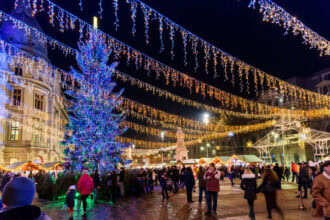
If you are visiting in the run-up to the holidays, Budapest’s Christmas markets are genuinely worth planning a trip around, not just squeezing in as an afterthought. The largest and most central is the Vörösmarty Square market, a dense cluster of wooden chalets selling mulled wine, chimney cake and Hungarian crafts, set against the backdrop of grand Pest architecture just off Váci Street.
A short walk away, the market outside St Stephen’s Basilica pairs its own stalls with a regular light and music show projected onto the basilica’s facade after dark, which draws a genuinely large crowd every evening and is one of the more memorable free things to see in the city in winter. Both markets typically run from mid-November through to the very start of January, though exact dates shift slightly year to year, so it is worth checking closer to your travel dates rather than assuming.
Beyond the stalls themselves, the season brings ice skating in Városháza Park, festive lighting along Andrássy Avenue, and shortened but not suspended hours at most of the thermal baths, so a winter visit does not mean giving up on the bathing culture described above. Several also run a special New Year’s Eve bath party, which pairs well with the general lack of any official municipal fireworks display in the city, since Gellért Hill tends to be the best free vantage point for whatever private displays do go up.
Our dedicated Budapest Christmas Markets guide goes much further into what to eat, when the lights switch on, and how the whole season fits together, including a full breakdown of what stays open over Christmas Day itself and what closes. It is the natural next stop for anyone planning a winter trip around this page.
Major and Annual Events
Beyond the Christmas markets already covered above, Budapest’s calendar fills up with major annual events worth timing a trip around. The biggest is Sziget Festival, a five-day music and arts festival held every August on Óbudai-sziget, the Shipyard Island in the Danube, drawing hundreds of thousands of visitors.
A standard five-day pass runs from around 135,000 HUF (€350/£300/$385), reasonable against five days of camping and dozens of stages with an international lineup. The island sits a short HÉV ride from central Pest, and the city runs at festival capacity throughout.
A gentler, more local alternative is the Budapest Wine Festival, held over four days every September in the courtyards of Buda Castle, pouring more than a thousand wines from Hungarian producers. The Castle District setting makes it one of the more atmospheric food and drink events in the city.
The single biggest date for many Hungarians is 20 August, State Foundation Day, when concerts across the city build toward a large fireworks display fired from barges on the Danube after dark. It is free to watch from the embankments or Gellért Hill, though the best spots fill up hours early.
Motorsport fans should note the Hungarian Grand Prix, held annually in late July at the Hungaroring circuit in Mogyoród, roughly 20km northeast of the city and reachable by shuttle bus on race weekend. It fills hotels across the wider city, so booking accommodation early genuinely matters.
None of these need to derail a first-time visit built around the sights covered earlier in this guide, but checking the calendar before booking flights is worth the five minutes it takes.
Of the four, 20 August is the one worth actually timing a short trip around: unlike Sziget or the Grand Prix, it needs no advance ticket and still delivers the single best evening of the year on the river.
Matthias Church: The Coronation Church with the Colourful Roof
Standing right beside Fisherman’s Bastion on Castle Hill, Matthias Church (Mátyás-templom) is instantly recognisable by its diamond-patterned, multicoloured roof tiles and the tall, asymmetric Béla Tower rising above the rooftops. The church takes its popular name from King Matthias Corvinus, who married here twice in the 15th century, though the building itself dates back almost 800 years.
Its history has not been gentle. During the Ottoman occupation between 1541 and 1686 the church was converted into a mosque and stripped of most of its original decoration, before the architect Frigyes Schulek carried out a sweeping neo-Gothic restoration between 1873 and 1896 that gave the building much of the look it has today.
Despite the rebuild, Matthias Church remains a genuinely significant coronation church, having hosted the 1867 coronation of Franz Joseph I and Elisabeth and the last Habsburg coronation, of Charles IV, in 1916. A combined ticket covering the church interior and the attached Museum of Ecclesiastical Art costs around 2,500 HUF (~£5/$7/€6) for adults.
Climbing the Béla Tower’s bell chamber is a separate, timed ticket at around 2,900 HUF (~£6/$8/€7), with hourly tours capped at 15 people and genuinely good views back over Fisherman’s Bastion and the river beyond. Modest dress is expected inside, meaning shoulders and thighs covered, and hats removed at the door.
Opening hours run roughly Monday to Friday 9am-5pm, Saturday mornings only, and Sunday afternoons around services, so check the church’s own official ticket site before planning around a specific slot. Pair it naturally with Fisherman’s Bastion next door, since both sit within the same short stretch of Castle Hill.
Best if you would rather spend the money on Budapest than on the room. Compare hostels by location and rating.
Search hostelsBest arranged before you fly rather than after. Covers claim handling, plus lounge access on eligible delays.
Explore AirHelp+Best for a day with a bag and nowhere to put it. Find a storage point near where you already are.
View storageRiverRide Amphibious Bus Tour
One of Budapest’s more unusual sightseeing options is the RiverRide amphibious bus tour, a bright yellow vehicle that drives through the city centre on ordinary wheels before rolling straight down a ramp into the Danube and continuing the journey as a boat. It was the first vehicle of its kind in continental Europe, and the moment it splashes into the river is, by a wide margin, the tour’s biggest talking point.
Tours depart from Széchenyi István tér, right by the Chain Bridge on the Pest side, and come in two lengths. The shorter, roughly 50-minute version covers the main city-centre streets and a short stretch of river, while the 90-minute complete tour adds a longer land route past Andrássy Avenue and the State Opera House before cruising as far as the Parliament building on the water.
Pricing runs from around 10,000 HUF (~£21/$27/€25) for the shorter tour and 11,500 HUF (~£24/$31/€29) for the full version, with reduced student and child rates on both. Live commentary is given in English and German, backed up by recorded audio guides in a further eleven languages, and groups are kept small, generally no more than ten passengers per departure.
It’s a genuinely fun way to combine two Budapest staples, a bus tour and a river cruise, into a single ticket, and it appeals especially to families who enjoy the novelty of a bus turning into a boat. Departures run daily except Wednesdays, when the vehicle is off the road for maintenance, so book ahead in peak season.
MOL Campus SkyDeck
On the Pest side of the river, south of the centre, MOL Campus is Budapest’s tallest building and, since 2023, home to the SkyDeck, a glass viewing platform reached by a dedicated panoramic lift roughly 120 metres up the tower. It’s sometimes referred to informally as Budapest’s sky deck, and it is a genuinely different way to see the city than the more traditional dome and hilltop viewpoints.
Rather than the postcard view of Parliament and the Castle, SkyDeck looks out over a less-photographed but still striking stretch of the city, taking in the Rákóczi Bridge, the National Theatre and Ludwig Museum, and the newer stadium built for the 2023 World Athletics Championships. An AR-based app is included with entry, letting visitors point a phone at the skyline to identify buildings and landmarks in real time.
Tickets cost from around 4,900 HUF (~£10/$13/€12) per person and must be bought online in advance, since the venue doesn’t accept card or cash payments on-site. The SkyDeck is open daily from 10am to 7pm, with last entry at 6pm, and closes on the third Monday of every month for maintenance.
It’s wheelchair accessible throughout, and the visit itself, including the lift ride, generally takes under an hour, making it an easy add-on to a day already spent around Heroes’ Square or City Park rather than a destination in its own right. Because it’s a newer attraction, it tends to draw noticeably smaller crowds than the Basilica or Fisherman’s Bastion viewpoints.
Cat Museum Budapest
Tucked away among the boutiques and courtyard bars of District V, Cat Museum Budapest is a small, quirky art and experience space built entirely around cats, rather than a cat café or an animal shelter. Expect cat-themed paintings, sculptures, optical illusion rooms and plenty of deliberately Instagram-friendly photo corners rather than any live animals wandering around.
It’s a relatively recent addition to the city’s more offbeat attractions, created by a group of local artists and self-described cat lovers rather than a long-established institution. Some sessions include an optional acrylic painting workshop alongside the self-guided exhibits, which makes it a slightly more hands-on stop than most museums this size.
Entry is by timed ticket, generally running from around 4,700 HUF (~£10/$13/€12) per person, and a full visit takes roughly an hour to ninety minutes depending on how thoroughly you work through the rooms. It suits families with younger children, committed cat lovers, or anyone looking for a lighter, less formal break between the city’s bigger historic sights.
Because it sits centrally in Pest rather than out on Castle Hill or in City Park, it slots easily into an afternoon that also covers St Stephen’s Basilica or a wander down Váci utca. Booking a slot in advance is worth doing at weekends, when the museum’s small size means entry can otherwise involve a short wait.

Shopping in Budapest
Budapest’s best shopping streets double as sightseeing, so a slow wander is worth building into an itinerary. Váci utca, the pedestrianised strip running from Vörösmarty Square to the Great Market Hall, mixes souvenir shops with grand nineteenth-century facades.
For more retail muscle, Fashion Street along Deák Ferenc utca is where international brands and jewellers cluster, a short walk from the Basilica. It stays busy into the evening, so it slots easily after a day of sightseeing.
Souvenir hunting is best done inside the Great Market Hall, where ground-floor stalls sell paprika, Tokaji wine and Kalocsa embroidery below most gift-shop prices. A tin of paprika costs from around 1,500 HUF (€4/£3/$4), and a bottle of Tokaji Aszú starts from roughly 6,000 HUF (€15/£13/$17).
For one-stop shopping, head to WestEnd City Center, a vast mall beside Nyugati railway station with well over four hundred stores. It is a useful wet-weather option, sitting right on a major metro and tram interchange.
For something more offbeat, the Ecseri flea market in District XIX deals in communist-era memorabilia, old photographs and vintage jewellery, and haggling is normal. It opens daily from around 8am, with shorter weekend hours, so allow two or three hours for the stalls.
These four are spread across the city, so pick one shopping style per day rather than combining the flea market with the central boulevards. Most central shops keep hours of roughly 10am to 7pm, though the Market Hall shuts on Sundays.
If time is tight, skip Váci utca’s souvenir shops altogether: the Great Market Hall sells the same paprika, Tokaji and embroidery for less, and it earns a visit as a sight in its own right rather than just a place to buy things.
Food Scene and Food Halls
Budapest’s food scene works as an attraction in its own right, and the best introductions happen standing at a market stall rather than in a restaurant. The upstairs gallery of the Great Market Hall is the obvious start, with small kitchens turning out lángos and goulash for locals and visitors alike.
A plate of lángos, the fried dough topped with sour cream, cheese and garlic, typically costs from around 1,500 HUF (€4/£3/$4) depending on toppings. A bowl of goulash upstairs runs from roughly 2,000 HUF (€5/£4/$6), with portions generous enough to skip a formal lunch.
For an evening version, Karaván is a permanent street food court on Kazinczy utca in the ruin bar district, next to Szimpla Kert, with around eight food trucks. It runs late into the night, covering everything from Hungarian classics to burgers and bao buns.
Beyond the two halls, the wider food culture ranges from unmarked lángos windows to a small but growing cluster of fine-dining restaurants with international recognition. Locals treat the market stalls as everyday eating, which keeps prices at both venues honest.
The Great Market Hall’s stalls follow the building’s own hours, open from around 6am and shut entirely on Sundays. Karaván, by contrast, is an evening option open into the night, and both take cash as well as card.
Neither venue needs booking, and both sit close enough to other sights to slot into a day built around the Basilica or the Jewish Quarter. Sharing a few small plates between two or three people is the easiest way to try more of the menu.
For a quick lunch between sights, the Great Market Hall’s upstairs gallery is the better stop; save Karaván for an evening when a night in the ruin bar district is already the plan, since a special trip out there just for lunch rarely pays off.
Shows and Theatres
Budapest’s evening entertainment scene is built around one world-class venue, the Hungarian State Opera House on Andrássy út, a gilded 1884 building whose interior alone justifies a ticket. Performances run through most of the year aside from a summer break, mixing opera with ballet.
Tickets are accessible by international opera standards, starting from around 2,000 HUF (€5/£4/$6) for upper gallery seats and rising past 20,000 HUF (€51/£43/$56) on premiere nights. Visitors who would rather see the building without a full performance can join a guided OperaTour instead, from around 3,500 HUF (€9/£8/$10) for roughly 45 minutes.
For something shorter and geared to first-timers, nightly Hungarian folklore shows run at venues including the Danube Palace just behind the Gresham Palace, with tickets from around 5,500 HUF (€14/£12/$15) for a ninety-minute show. These are aimed at tourists rather than locals, but the standard of dancing and live music is genuinely high.
Budapest’s other major stage, the National Theatre, sits on the Pest riverbank near the Rákóczi Bridge and is passed on most Danube boat tours. Its programme is almost entirely in Hungarian, so it matters more for the building than for a non-Hungarian-speaking evening out.
Booking ahead matters more for the Opera House than the folklore shows, since popular performances can sell out weeks ahead while the tourist shows usually have same-day availability. Smart casual dress suits a standard performance, though gala nights lean more formal.
Any of these fill an evening otherwise spent choosing between restaurants, and the Opera House sits close enough to Andrássy Avenue’s boutiques to combine easily with a stroll.
With only one evening free, a folklore show at the Danube Palace is the safer pick over a full Opera performance: same-day tickets are rarely a problem, unlike opera seats that can sell out weeks ahead.

Things to Do in the Rain
Budapest is a genuinely good rainy-day city, since several of its best attractions are indoor by design rather than as a fallback. The city’s thermal baths, covered in full earlier in this guide, are the obvious place to start, since a soak in a steam-filled hall feels just as good under grey skies.
The Great Market Hall is another reliable wet-weather stop, a fully covered nineteenth-century hall where a couple of hours can disappear browsing food and souvenir stalls without stepping outside. Its glass roof and ironwork keep it dry even when the cobbles outside have turned slick.
History-minded visitors have a strong option in the House of Terror on Andrássy út, a sobering museum covering Hungary’s twentieth-century experience under fascist and communist rule, with admission from around 4,000 HUF (€10/£9/$11). It takes two to three hours to work through properly.
For something lighter, the quirky Cat Museum covered earlier in this guide is entirely indoors and takes under ninety minutes, pairing well with an afternoon inside WestEnd City Center. Both sit right on the metro, with little walking needed outside.
Evenings are just as easy to cover indoors, since a performance at the Hungarian State Opera House or one of the folklore shows detailed above turns a washed-out evening into a highlight rather than a disappointment. Neither requires much advance planning if booked the same day.
Rain in Budapest tends to arrive in short, heavy bursts rather than settling in for a full day, so a compact umbrella is worth carrying alongside sturdy shoes for the cobbles around Castle Hill and the Basilica.
If the rain sets in for the whole day, the thermal baths beat everything else on this list: a soak turns bad weather into the actual highlight of the day, rather than just something to wait out indoors.
Passes and City Tours: Budapest Card and Hop-On Hop-Off Buses
Alongside individual tickets, two practical tools are worth considering before working through the attractions above: a Budapest Card and a hop-on hop-off bus ticket. Both can genuinely simplify a Budapest itinerary, though neither suits every type of trip equally.
The Budapest Card bundles free or discounted entry to a long list of museums and attractions with unlimited public transport, and whether it pays for itself depends heavily on how many paid sights you actually plan to tick off in a short window. Our full Budapest Card Guide breaks down current pricing, exactly what’s included, and works through the maths on whether it is worth buying for a typical two or three-day visit.
A hop-on hop-off bus, meanwhile, is less about saving money and more about covering ground quickly on a first visit, with open-top double-deckers looping past most of the major sights on this page and letting you jump off wherever something catches your eye. Our dedicated Budapest Hop-On Hop-Off Bus guide compares the different operators and routes, and is worth reading alongside the RiverRide tour above if a bus-based overview appeals more than walking between sights.
Free and Budget-Friendly Things to Do in Budapest
Budapest rewards a tight budget better than most European capitals, and a genuinely good day here does not have to involve a single paid ticket. Walking the length of the Danube promenade on either bank costs nothing and takes in Parliament, the Chain Bridge and Castle Hill without a single entrance fee, and the same is true of most of Castle Hill’s cobbled streets and courtyards themselves.
The Shoes on the Danube Bank memorial, a simple but moving row of sixty cast-iron shoes on the riverside promenade near Parliament, commemorates Jewish Hungarians murdered on this exact spot in 1944 and is one of the most affecting free stops in the city. Central Market Hall, a grand 19th-century covered market near the Liberty Bridge, is another free wander with excellent, affordable street food if you time a visit around lunch.
For a longer free outing, the lower terraces of Fisherman’s Bastion, the whole of Margaret Island, and City Park’s lakeside paths all cost nothing to enjoy, and Heroes’ Square itself is free to visit even if the flanking museums are not. Budapest’s public transport is also good value by Western European standards, and a short hop-on hop-off tour or a well-planned metro and tram route can cover a huge amount of ground cheaply in a single afternoon.
Even the paid sights have cheaper angles built in, from the free early-morning and late-evening entry windows at Fisherman’s Bastion to the always-free lower promenade beneath it. Building a day around two or three free stops and one paid highlight, rather than trying to pack in every ticketed attraction, is generally the better way to see Budapest without the costs stacking up.

How Long Do You Need in Budapest?
Three full days is the realistic minimum for covering Budapest’s genuine highlights without rushing, and it is the length most first-time visitors settle on. That gives roughly a day for Buda (Castle Hill, Fisherman’s Bastion, Matthias Church), a day for central Pest (Parliament, St Stephen’s Basilica, the Danube promenade), and a day split between a thermal bath, the Jewish Quarter and Heroes’ Square or City Park.
Two days is workable if you are willing to prioritise ruthlessly, typically Parliament, the Castle district and one thermal bath, but it leaves little room for Margaret Island, a proper Jewish Quarter wander or a day trip beyond the city. Four or five days lets you add all of the above comfortably, plus a genuine half-day at somewhere further out.
Budapest also works well as a base for exploring further afield. Our Best Day Trips from Budapest guide covers the most rewarding options within easy reach, and anyone extending a trip onward should look at the Budapest to Vienna guide, since the two capitals pair naturally on a single itinerary.
Whatever length you settle on, spring (April-May) and autumn (September-October) generally offer the most comfortable weather for walking the hills and bridges, while summer is warmest but busiest, and winter brings shorter days offset by the thermal baths’ steamy outdoor pools and the Christmas markets described above.
Accessibility and Children
Budapest’s public transport network is more accessible than its cobbled old-town streets might suggest. Metro Line 4 is fully accessible with lifts at every station, and low-floor trams now run on most of the Grand Boulevard routes, including lines 4 and 6, while the older M1, M2 and M3 metro lines have accessibility at a more limited set of stations rather than all of them.
Among the major sights, Buda Castle has street-level lifts connecting several points around the district, Fisherman’s Bastion’s lower terrace is step-free, and Margaret Island is fully paved and flat throughout, making it one of the easiest attractions in the city for wheelchair users and pushchairs alike. The Castle Hill cobblestones themselves remain a genuine obstacle regardless of lift access, so plan routes with that in mind rather than assuming full step-free coverage once you are up there.
Most of the major thermal baths, including Széchenyi and Rudas, offer accessible changing areas and bath lift chairs for entering the pools, though it is worth calling ahead if a specific accessibility need is essential to your visit. The Parliament tour also welcomes visitors with mobility needs, but this should be arranged when booking rather than assumed on arrival, since the security screening process is the same for every visitor.
For families, Budapest is a genuinely easy city with children. Margaret Island, City Park and its zoo, and the shallower outdoor pools at Széchenyi are all natural places to let energy out, and the novelty of a funicular ride, a river cruise or a singing fountain tends to hold a child’s attention far better than another church interior. Just factor in that many restaurants and older buildings, including some metro stations, still involve stairs, so build a little slack into the day rather than a tightly packed schedule.

Rupert’s Handy Travel Tips
Budapest is one of my favourite cities to potter around in, but a few local quirks catch first-time visitors out every time.
- Bring a swim cap for the baths: some pools at Széchenyi and Rudas require one, and cheap disposable ones are sold at the entrance if you forget.
- Buy metro tickets before boarding: Budapest’s public transport still runs on an honour system with random ticket checks, and a missing ticket brings an on-the-spot fine, so validate before you get on rather than after.
- Skip Gellért Baths until 2028: it is closed for a lengthy renovation, so head to Széchenyi or Rudas instead rather than turning up to a closed door.
- Wear proper shoes for Castle Hill: the cobblestones are charming to look at and much less charming underfoot, especially if it has rained.
- Carry small forint notes: plenty of stalls, toilets and smaller cafes are cash-only or card-reluctant, so a little loose change goes a long way.
Want to meet the reindeer behind our travel tips? Find out more in our page Who is Rupert?.



Frequently Asked Questions
How many days do you need to see Budapest’s main sights?
Three full days covers the essentials comfortably, splitting time between Buda’s castle district, central Pest’s landmarks, and a thermal bath or Jewish Quarter day, though two days is workable if you prioritise Parliament, Castle Hill and one bath.
Is the Gellért Baths still open?
No, Gellért Baths closed on 1 October 2025 for a major renovation and is not expected to reopen until 2028, so visitors should plan on Széchenyi or Rudas instead.
Do I need to book Hungarian Parliament tickets in advance?
Yes, tours regularly sell out weeks ahead in busier months, and every visitor also passes through security screening on arrival, so booking online before you travel is strongly recommended.
Is Budapest a walkable city?
Central Pest is very walkable and largely flat, while Castle Hill in Buda is walkable but steep and cobbled, so a mix of walking, the funicular and the tram or metro network is the most comfortable way to cover both sides.
What is the best time of year to visit Budapest?
Spring and autumn offer the most comfortable weather for sightseeing, summer is warmest but busiest, and winter brings the Christmas markets and steamy outdoor thermal pools at their most atmospheric.
Further Reading
Once the big sights above are sorted, a handful of practical guides make the rest of a Budapest trip much easier to plan. Our Budapest Metro Guide explains how the city’s four lines fit together, including that historic first line out to Heroes’ Square, while anyone who would rather sit back and let someone else handle the driving should look at the Budapest Hop-On Hop-Off Bus guide for a route that strings together most of the attractions on this page in a single ticket. And if a discount pass is still on the fence, our Budapest Card Guide is worth a second look before deciding whether one pays for itself on your specific itinerary.
If Budapest is only one stop on a wider Central European trip, it is worth reading further afield too. The Interrail Hungary Pass Guide is a good starting point for anyone travelling onward by train, and our guide to travelling from Budapest to Vienna covers the fast, frequent rail link between the two capitals in detail.
Travellers with more time on their hands, rather than just a city break, should also take a look at our Best Day Trips from Budapest guide, which covers the strongest options within a couple of hours of the city, and our Debrecen Travel Guide for a look at Hungary’s often-overlooked second city further east.
And if your visit falls anywhere near the festive season, it is worth circling back to the dedicated Christmas markets guide linked earlier in this page before you finalise dates, since market opening windows and the basilica light shows both shift slightly from year to year.