Reviewed by our editorial team Published
Bucharest Christmas markets turn Romania’s capital into one of Eastern Europe’s most underrated festive destinations, and most visitors are genuinely surprised by the scale of it. Four distinct markets run across the city each winter, from the vast, ticket-free spectacle in front of the Palace of Parliament to a quieter artisan fair beside the National Opera, and between them they cover everything from a 36-metre Ferris wheel to a covered ice rink and a genuine open-air light trail through a city park.
Unlike Prague or Vienna, where the whole festive experience clusters around one or two famous squares, Bucharest spreads its markets across the city, which means a visit here rewards a bit of planning rather than a single afternoon of wandering. Piața Constituției is the flagship, drawing the biggest crowds and the biggest tree, while Drumul Taberei Park in Sector 6 gives families and locals a calmer, more spread-out alternative with genuinely extensive light installations. National Opera Esplanade and Băneasa Christmas World fill in the gaps, one compact and central, the other polished and family-oriented on the city’s northern edge.
This guide covers all four markets individually, with opening dates, transport, and what each one actually offers, alongside the food and drink that defines Romanian Christmas markets, a realistic daily budget, and where the festive atmosphere continues beyond the ticketed markets, particularly around the Old Town’s Lipscani streets. It also looks at what else Bucharest offers in December for anyone whose trip involves more than mulled wine and fairground rides, since the city’s museums and the vast Palace of Parliament stay open through the coldest months. Dates shift slightly year to year, so always check current listings closer to your trip, though the pattern below reflects how the city’s season has run for several consecutive winters.
Is Bucharest Worth Visiting at Christmas?
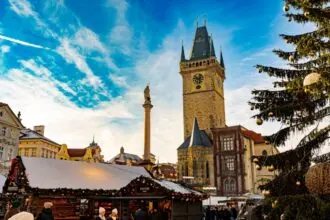
Bucharest is not going to out-Prague Prague or out-Vienna Vienna, and it is worth being honest about that before booking flights purely for the markets. The Old Town has genuine charm but is smaller and less uniformly picturesque than the great Central European capitals, and the city as a whole is a working, sprawling metropolis rather than a compact fairytale centre built for postcard photos.
What Bucharest does offer is scale without the crowds that make December in Prague or Vienna genuinely stressful. Piața Constituției alone is bigger than most single Western European markets, with a 36-metre wheel, a covered ice rink, and well over a hundred stalls, yet you can walk it without the shoulder-to-shoulder crush that builds up around Old Town Square by mid-afternoon. Prices are lower too, since Romania sits outside the eurozone and a mug of mulled wine costs a fraction of what the same drink costs in Germany or Austria.
The honest trade-off is that Bucharest’s festive identity is more spread out and less photogenic in a single frame than the classic market cities, and its communist-era architecture means parts of the city read as grey and utilitarian rather than storybook. For a traveller who wants one unmissable square and nothing else, that is a real downside. For anyone drawn to a genuinely different, more affordable Christmas city with four distinct markets, real Romanian food, and a Ferris wheel lit up in front of the largest civilian building in the world, Bucharest earns its place on a December itinerary rather than needing to apologise for it.
Bucharest’s Christmas Markets at a Glance
Bucharest runs four separate Christmas markets each winter, and knowing the differences before you arrive saves a lot of criss-crossing the city. Entry to every one of them is free, so the table below is about scale, location, and atmosphere rather than cost.
| Market | Location | Typical Dates | Highlights |
|---|---|---|---|
| Piața Constituției | Piața Constituției, in front of the Palace of Parliament | 29 Nov – 28 Dec | Flagship market, 36m wheel, covered ice rink, Santa’s House, daily concerts |
| National Opera Esplanade | National Opera Esplanade, central Bucharest | 6 Dec – 28 Dec | Small children’s ice rink, artisan market, calmest of the major markets |
| Drumul Taberei Park | Drumul Taberei Park, Sector 6 | 30 Nov – 7 Jan | Most extensive light trail, open-air ice rink, carousel, family favourite |
| Băneasa Christmas World | Băneasa Shopping City, northern Bucharest | 27 Nov – 4 Jan | Panoramic wheel, ice rink, carousel, most shopping and family-oriented |
Best for two or three nights. The widest choice of rooms, with filters for free cancellation and included breakfast.
View staysBest for families, or any stay past about four nights. A kitchen and a washing machine start paying for themselves.
Browse rentalsBest as a last check before booking. Compares hotel rates across several sites in one search.
Compare ratesPiața Constituției: Bucharest’s Flagship Christmas Market
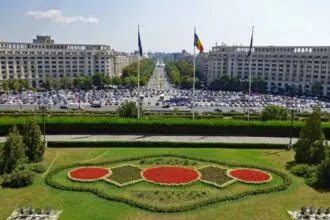
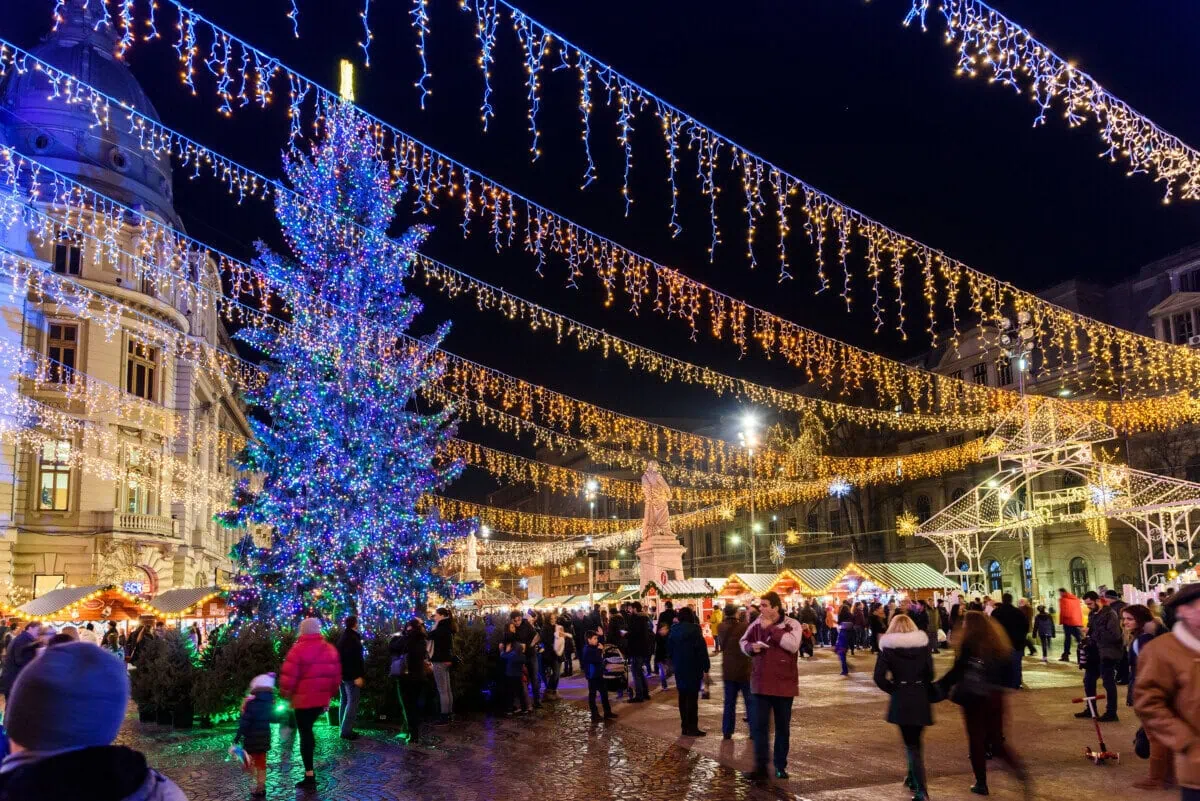
Piața Constituției is Bucharest’s flagship Christmas market and by far the largest of the four, set directly in front of the Palace of Parliament in the square built to face it. The market typically runs from late November to late December, roughly 29 November to 28 December, with stalls open weekdays from midday to 10pm and weekends from 10am to 10pm, and it usually stays open through Christmas Day and Boxing Day itself.
The centrepiece is a 30-metre Christmas tree strung with around 70,000 lights, standing in front of a 36-metre panoramic wheel that gives riders a genuine view over the Palace of Parliament’s illuminated façade. A covered ice rink sits nearby for anyone wanting to skate regardless of the weather, alongside a Venetian carousel, a mini rollercoaster, and a hand-painted Santa’s House where children can meet Santa on set dates in the run-up to Christmas Eve.
More than 120 wooden chalets line the square, selling traditional Romanian food, mulled wine, and handmade crafts, and a daily stage programme brings folk ensembles, choirs, and children’s performances through the evening. Entry to the market itself is free, which is standard across all four Bucharest markets, so the only real cost is food, drink, and any rides you choose to pay for.
The square sits beside Izvor metro station on lines M1 and M3, a short walk from the market entrance, and is also served by several tram and bus routes running along Calea 13 Septembrie. Given its scale and its position as the city’s most photographed festive backdrop, this is the one market worth prioritising if time in Bucharest is limited to a single evening.
National Opera Esplanade: The Calmest of Bucharest’s Christmas Markets
National Opera Esplanade is the calmest of Bucharest’s major markets, set on the open plaza in front of the Bucharest National Opera House rather than a busy central square. It typically runs on a shorter window than Piața Constituției, from around 6 December to 28 December, with hours running midday to 9pm Monday to Thursday and 10am to 10pm from Friday through Sunday.
The market leans into its setting rather than fighting it, with a small ice rink sized for children and beginners, an artisan market selling handmade ornaments and crafts rather than mass-produced souvenirs, and a stage that hosts carol performances and, on some weekends, short excerpts from the Opera’s own repertoire. Creative workshops for children, painting ornaments or making simple decorations, run alongside the stalls, giving families a reason to stop rather than just pass through.
Because it sits away from the tourist-heavy Old Town, Opera Esplanade genuinely feels less crowded even on weekend evenings, and its scale means it can comfortably be seen in under an hour. Entry is free, as with every market on this list, and the food stalls cover the same core Romanian favourites, mulled wine, langoși, and grilled meats, at broadly similar prices to the other markets.
The Esplanade is close to Izvor metro station and within easy walking distance of the University Square area, making it simple to combine with Piața Constituției on the same evening. Its relative quiet also makes it the better choice for visitors who find the flagship market’s crowds and queues genuinely off-putting rather than part of the fun.
Drumul Taberei Park: Bucharest’s Biggest Light Trail
Drumul Taberei Park, in the residential Sector 6 district west of the centre, hosts the most extensive of Bucharest’s Christmas markets in terms of physical footprint, even if it draws fewer international visitors than Piața Constituției. It runs the longest season of the four, typically from around 30 November through to 7 January, with hours generally midday to 10pm on weekdays and 10am to 10pm at weekends, and an extended midnight-to-2am window on New Year’s Eve itself.
Rather than a single dense cluster of stalls, the market spreads illuminated pathways and light installations across a genuinely large stretch of the park, giving it a different, more walkable character than the compact city-centre markets. An open-air ice rink and a classic carousel sit at its heart, alongside a children’s train ride, photo zones built around the light displays, and a Santa’s Workshop running children’s activities through December.
Because the park is large and the market spreads out rather than clustering, Drumul Taberei never feels as tightly packed as the flagship market, even during peak weekend hours, and food prices here tend to run slightly lower than in the city centre. It is genuinely the market locals bring their own children to, rather than the one built primarily around tourist footfall.
The park sits beside Parc Drumul Taberei metro station on line M5, putting it within a short walk of the platform rather than requiring a bus transfer. For visitors staying centrally, it is roughly a 20 to 25-minute metro ride from University Square, making it a realistic half-day outing rather than a full detour.
Băneasa Christmas World: Bucharest’s Most Polished Family Market
Băneasa Christmas World sits inside Băneasa Shopping City on the northern edge of Bucharest, close to Băneasa Airport, and it is the most polished and unmistakably commercial of the four markets. It typically runs from late November to early January, roughly 27 November to 4 January, with daily hours from 11am to 10pm, a reduced schedule on Christmas Eve, and closures on Christmas Day and New Year’s Day itself.
The market’s attractions read like a compact theme park rather than a traditional stall-lined square, with its own panoramic wheel, an ice rink, a classic carousel, and a Santa’s House where children can visit through the season. Costumed mascots and themed shows run through the afternoons and evenings, and a dedicated food truck area supplements the more traditional wooden chalets found elsewhere in the city.
Because it sits inside and around a large shopping centre, Băneasa suits visitors who want to combine the market with retail therapy, or families looking to warm up indoors between rides without leaving the site entirely. It is also the most reliably family-oriented of the four markets, with a layout and pacing clearly built around younger children rather than an evening-out crowd.
Reaching Băneasa requires a bit more effort than the central markets: the nearest metro station is Aviatorilor on line M2, from where bus routes 335 or 301 continue to the shopping centre, or bus route 301 runs directly from Piața Romană. Given the extra journey time, this is the market best paired with a wider day trip to the northern districts rather than a spontaneous evening add-on.
Christmas Market Costs & Budget
Entry to every one of Bucharest’s four Christmas markets is free, which is the single biggest difference between visiting here and visiting many Western European equivalents that now charge for access to their busiest squares. Whatever you spend comes entirely from food, drink, and the paid rides and attractions scattered around each site, which makes Bucharest one of the more affordable Christmas city breaks in Europe once flights and accommodation are covered.
A cup of vin fiert, Romanian mulled wine, typically runs from around 10 to 20 RON (€2–4/£1.70–3.40/$2.20–4.40), and most hot food stalls charge by weight, with items like grilled sausages or pork ribs priced per 100 grams rather than per portion, usually 14 to 17 RON (€2.80–3.40/£2.40–2.90/$3.10–3.75). A generous grazing session across two or three stalls rarely costs more than 80 to 100 RON (€16–20/£13.60–17/$17.60–22) per person.
The rides are where costs add up fastest if you want to do everything. A turn on the panoramic wheel costs around 25 RON at Piața Constituției (€5/£4.25/$5.50) and closer to 30 RON at Drumul Taberei (€6/£5.10/$6.60), while ice rink admission runs around 25 RON for a 90-minute session, with skate hire charged separately at a similar rate.
For a realistic daily budget, allow around 150 to 200 RON (€30–40/£25.50–34/$33–44) per person for a proper evening out covering food, a couple of drinks, and one or two paid rides, on top of whatever else your day in Bucharest involves. Visiting two markets in one evening, most easily Piața Constituției and National Opera Esplanade given their proximity, keeps costs down since you are not paying for rides twice over.
Food & Drink at Bucharest’s Christmas Markets
Vin fiert, Romania’s version of mulled wine, is the drink every stall sells and every visitor ends up trying at least once. It is typically served warm in a paper or plastic cup for around 10 to 20 RON (€2–4/£1.70–3.40/$2.20–4.40), spiced with cinnamon and cloves in much the same way as its German or Czech equivalents, though Romanian versions often lean a little sweeter.
Sarmale is the dish most closely tied to Romanian Christmas tables, cabbage or vine leaves rolled around a filling of minced meat, rice, and onion, then slow-cooked and served with a spoon of sour cream and a side of polenta. It is more commonly found at proper restaurants than market stalls, but several of the food courts at Piața Constituției and Drumul Taberei do serve a version of it alongside the usual grilled meats.
Cozonac, a braided sweet bread filled with a walnut paste and sometimes cocoa or Turkish delight, is the festive equivalent of stollen or panettone and appears on nearly every market stall selling baked goods. Alongside it, look out for langoși, Hungarian-influenced fried dough topped with cheese and sour cream, and kürtőskalács, a cinnamon-dusted chimney cake cooked on a rotating spit, both staples of the wider Eastern European Christmas market circuit.
For something stronger than mulled wine, several stalls sell țuică, a strong Romanian plum brandy traditionally drunk in small glasses, sometimes warmed with sugar and spices in winter. Hot chocolate and non-alcoholic options are widely available too, generally priced similarly to vin fiert, so nobody drinking is left without a warm option to hold while browsing the stalls.
Best if you can move a day either way. Shows how the fare changes across the month.
Compare flightsBest if you want maps and messaging working the moment you switch your phone on.
See eSIM plansBest when public transport has stopped, or when you are travelling with children and bags.
Book a transferOld Town & Lipscani: Bucharest’s Festive Backdrop
Bucharest’s Old Town, centred on Lipscani street and the tangle of pedestrianised lanes around it, is not one of the four organised Christmas markets, but it carries its own festive atmosphere throughout December worth building into any market-focused trip. Strings of lights run the length of Lipscani and the surrounding streets, and the area’s bars and restaurants lean fully into the season with wreaths, window displays, and outdoor heaters keeping terraces usable even in the cold.
Unlike the ticketed markets, there is no set programme or opening hours here, since this is simply Bucharest’s nightlife district dressed for Christmas rather than a dedicated event. That makes it a good stop after visiting Piața Constituției or National Opera Esplanade, both a short walk away, for a proper meal or a drink somewhere with character rather than a market stall.
The Stavropoleos Church, tucked just off Lipscani, is particularly striking after dark in December, its ornate stone carvings picked out against the surrounding lights, and the Macca-Villacrosse Passage nearby, an enclosed yellow-glass arcade, feels especially atmospheric lit up for winter. Caru’ cu Bere, one of the city’s most photographed restaurants, decorates heavily for the season and is worth booking ahead if you want a proper sit-down Romanian meal in a genuinely festive setting.
Because Lipscani sits within walking distance of both Izvor metro station and the Piața Unirii interchange, it slots naturally into an evening that also covers one or two of the organised markets. Treat it as the connective tissue of a Bucharest Christmas trip rather than a destination in its own right, and it earns its place on the itinerary easily.
Bucharest at Christmas with Children
Drumul Taberei Park is the easiest of the four markets to recommend for families, simply because its scale gives children genuine room to run between light installations without the crush of a packed square, and its ice rink and carousel are specifically sized for younger visitors. Băneasa Christmas World runs it close, since being inside and around a shopping centre means warm toilets, cafés, and indoor breaks are always within reach when a child (or a parent) needs to thaw out.
Piața Constituției, by contrast, is manageable with children but needs more planning, since its Santa’s House operates on set time slots rather than a walk-up queue, and the crowds around the wheel and rink build quickly on weekend afternoons. Arriving in the early afternoon on a weekday, before the after-work and evening crowds arrive, gives the calmest window for younger children at any of the central markets.
Pushchair access is generally fine across all four sites, since the markets are built on flat squares or paved park paths rather than cobbled lanes, though Piața Constituției and Lipscani get genuinely crowded once evening sets in, making a pushchair harder to manoeuvre than a carrier. Public toilets are limited at the outdoor markets, so it is worth using facilities at a nearby café or, at Băneasa, inside the shopping centre itself before settling in for the evening.
The quietest windows across every market tend to be weekday mornings and early afternoons, before local families and after-work crowds both arrive, and this is also when Santa’s House queues and ice rink waits are shortest.
What Else to Do in Bucharest in December
The Palace of Parliament, the vast building the flagship Christmas market faces, is open for guided tours daily from 9am to 5pm year-round and makes an obvious daytime pairing with an evening at the market outside it. Standard adult tickets cost around 85 RON (€17/£14.45/$18.70), with reduced rates of 55 RON (€11/£9.35/$12.10) for students and 40 RON (€8/£6.80/$8.80) for children aged 7 to 18, and tickets are sold on-site only, with small groups needing a phone reservation at least a day ahead.
For a break from the cold that does not involve sightseeing at all, Therme Bucharest, a large indoor thermal water and spa complex on the city’s edge, runs year-round regardless of weather and is a genuinely popular local escape during the darkest, wettest weeks of December. It is a taxi or ride-hail journey rather than a central attraction, but worth building into a longer trip as a full afternoon.
Bucharest’s museums cluster conveniently around the centre for a cold or wet day between markets. The National Museum of Art of Romania, housed in the former Royal Palace on Revolution Square, and the Grigore Antipa Natural History Museum both sit within easy reach of the central markets, while the open-air Village Museum, though outdoor by nature, is atmospheric even under a dusting of snow.
The Romanian Athenaeum, Bucharest’s grand concert hall, runs classical performances through December, offering an evening indoors that pairs naturally with an earlier visit to Piața Constituției or National Opera Esplanade, both a short walk away. Between the Palace tour, the museums, and an evening concert, a Bucharest Christmas trip holds up comfortably even on a day when the markets themselves are rained off.

Getting Around & Market Opening Hours
Bucharest’s metro is the most reliable way to move between markets, since three of the four sites sit within a few minutes’ walk of a station: Izvor on lines M1 and M3 serves both Piața Constituției and National Opera Esplanade, while Parc Drumul Taberei on line M5 drops you almost directly at the park’s Christmas market entrance. Only Băneasa requires a bus transfer from the nearest station, Aviatorilor on line M2, or a direct bus from Piața Romană.
A single metro or bus ticket costs a modest flat fare regardless of distance, and day passes are available for anyone planning to hop between two or more markets in a single evening. Trams and buses fill in the gaps between metro lines, particularly useful for reaching Lipscani and the Old Town, which sits between metro stations rather than directly above one.
Opening hours vary market by market and shift around Christmas Eve and New Year’s Eve, so treat the hours given for each market above as a guide rather than a guarantee. Piața Constituției and National Opera Esplanade generally run midday to around 9 or 10pm on weekdays and open earlier, from 10am, on weekends.
Băneasa runs the most consistent daily hours of the four, 11am to 10pm throughout the season, but closes fully on Christmas Day and New Year’s Day rather than staying open through the holiday like the central markets. Because dates and hours do shift slightly year to year, checking current signage or the organisers’ own social media in the days before your visit is worth the two minutes it takes.
Where to Stay for the Christmas Markets
The Old Town around Lipscani is the obvious base for a market-focused trip, putting Piața Constituției, National Opera Esplanade, and the festive bars and restaurants of Lipscani itself all within a short walk or a couple of metro stops. It is also Bucharest’s most touristed and liveliest district, so expect noise into the evening and a wider spread of hotel and apartment prices than the quieter neighbourhoods further out.
Piața Romană, a leafy, elegant area just north of the Old Town, offers a calmer alternative without sacrificing much in the way of convenience, since it sits on the same metro line as Izvor and is a short walk from University Square. It suits couples or anyone who wants central access to the markets without the Old Town’s nightlife spilling under their window at 1am.
For a longer stay or a trip built around more than the markets, Dorobanți and Primăverii, the upscale, tree-lined districts north of the centre, offer a quieter, more residential base close to Herăstrău Park, though they require a metro or taxi journey into the centre for the market evenings. Cotroceni, near the Presidential Palace, is smaller and more boutique in character, a good pick for a slower-paced few days rather than a market-hopping itinerary.
Whichever area you choose, proximity to a metro station matters more than proximity to any single market, since the M1, M2, M3, and M5 lines between them connect every one of the four sites. A hotel within a few minutes of any central metro stop makes the whole cluster of markets realistically reachable across a short trip.
December Weather & What to Pack
Bucharest in December sits firmly in proper winter territory, with daytime highs typically ranging from around 6°C (43°F) early in the month down to 3°C (37°F) by its end, and overnight lows dropping to between 0°C and minus 4°C (31°F to 25°F). It is a cold, sometimes damp climate rather than an extreme one, broadly comparable to a mild Central European winter rather than the harder freezes further north or east.
Cloud cover is persistent through the month, with overcast or mostly cloudy skies for well over half of it, so do not plan a trip around clear blue-sky photos. Rain and snow both feature, with wet days occurring roughly one day in six and snowfall becoming steadily more likely as December progresses, so a trip closer to Christmas has a genuinely better chance of snow on the ground than an early-month visit.
Layering is the most useful packing strategy for evenings spent moving between market stalls: a thermal base layer, a warm jumper, and a properly insulated coat cover most days, with a hat, gloves, and scarf essential given how much standing and walking a market-hopping evening involves. Waterproof boots with real grip matter more than style, since park paths at Drumul Taberei and the paved squares elsewhere turn slick when wet or lightly frosted.
A reusable cup is a small but useful addition if you plan several rounds of vin fiert, since some stalls charge a deposit that is easy to forget to reclaim. Hand warmers are also worth the negligible extra weight, particularly for a full evening spent in ice rink and panoramic wheel queues rather than ducking indoors between stops.
Best for short city stops where being central matters more than the room. Dorms and private rooms both listed.
See hostelsBest for anyone flying more than once or twice a year. Handles the compensation claim so you are not chasing the airline.
See AirHelp+Best for a day with a suitcase and nowhere to put it. Find a storage point near where you already are.
View storageShopping Beyond the Christmas Markets
Beyond the wooden chalets of the four Christmas markets, Bucharest has a genuine shopping scene worth folding into a festive trip. From one of Europe’s grander historic boulevards to the country’s largest shopping centre, there is plenty to browse once the last cup of vin fiert has gone cold.
Calea Victoriei, Bucharest’s oldest and most elegant boulevard, runs from Piața Unirii up towards Piața Victoriei and is lined with boutiques, jewellers, and grand early twentieth-century buildings that make window shopping worthwhile even without buying anything. Independent fashion boutiques and a scattering of international designer names sit alongside historic cafés, so it rewards a slow winter walk rather than a rushed dash between shops.
The Old Town’s souvenir shops, clustered around Lipscani and the streets already covered in this guide’s festive backdrop section, are the easiest place to pick up something genuinely Romanian to take home, from hand-painted ceramics and embroidered textiles to bottles of țuică and jars of local honey. Prices here run noticeably lower than in Western European old towns, and haggling is not expected, so the price on the shelf is generally the price you pay.
For a proper shopping centre rather than a scatter of boutiques, AFI Palace Cotroceni in western Bucharest is Romania’s largest mall, with around 90,000 square metres of retail space and roughly 300 stores under one roof. It sits close to Drumul Taberei, making it a realistic stop either side of an evening at the park’s Christmas market, and it is a genuinely useful escape from the cold on a wet or bitterly cold afternoon.
Băneasa Shopping City, already covered on this page as the home of Băneasa Christmas World, doubles as a serious retail destination in its own right, with a wide mix of Romanian and international high-street brands alongside the market’s rides and stalls. Visiting the market and doing a round of shopping in the same trip out to the northern edge of the city makes good use of the extra journey time getting there.
Anyone extending a trip into the new year should know that Romania’s Winter Sales period typically starts on 26 December and runs through most of January, with discounts of up to 70 percent at malls including AFI Palace Cotroceni and central shopping centres like București Mall and Promenada Mall. It is a genuinely good window for picking up winter clothing or gifts at a lower price than the same shops charge in November.
What Closes Over the Christmas and New Year Holidays
Under Romanian law, 25 and 26 December and 1 and 2 January are all public holidays, and it is worth planning around them rather than assuming Bucharest runs a normal service through the turn of the year. Museums, offices, banks, and a large share of shops close on at least one of these dates, even while the Christmas markets themselves carry on regardless.
The two days that matter most are 25 December and 1 January specifically, when the vast majority of malls, supermarkets, and gyms across the city shut completely rather than running reduced hours. AFI Palace Cotroceni and its Auchan supermarket are a rare exception, staying open from around 2pm to 10pm on both dates, which makes it one of the few reliable options if you need anything on Christmas Day itself.
26 December and 2 January see a full return to normal, usually with extended opening hours as shops reopen after the holiday, while Christmas Eve and New Year’s Eve themselves typically run shortened hours rather than a full closure. Public transport shifts onto a reduced, Sunday-style timetable for the whole stretch from 25 December through to 7 January, so build in extra time for metro and bus journeys during this window.
The good news for anyone visiting specifically for the festive season is that the Christmas markets stay open through the holidays that shut everything else. Piața Constituției’s market typically runs through Christmas Day and Boxing Day before closing on 28 December, and Drumul Taberei Park and Băneasa Christmas World both continue into the new year, giving visitors somewhere to go even when the shops and museums are shut.
Restaurants are more of a mixed picture: some, including Caru’ cu Bere in the Old Town, stay open and even lay on a special festive menu, while others close entirely for one or both of the main holiday dates. Booking ahead is worth it regardless, since the restaurants that do open over Christmas and New Year tend to fill up fast with both locals and visitors.
Assume nothing runs to its normal daily schedule on 25 December or 1 January specifically, and check directly with any attraction, restaurant, or shop that matters to your plans. A little verification a day or two before saves a wasted journey to somewhere that turns out to be shut.
New Year’s Eve in Bucharest
New Year’s Eve in Bucharest is centred on a single official open-air event rather than being spread across the city’s Christmas market squares. In recent years the free public concert and fireworks display has been staged at Piața Alba Iulia, a square not otherwise covered on this page, with live Romanian acts performing from around 7pm until the fireworks at midnight.
It is worth being clear that Piața Constituției itself does not host this event, and its Christmas market typically closes on 28 December, well before New Year’s Eve arrives, so the flagship square will not be lit up and busy that night.
Visitors who want to be at one of this guide’s own markets on 31 December are better served by Drumul Taberei Park, whose Christmas market already runs an extended midnight-to-2am session that night, or by Băneasa Christmas World, which stays open into the new year aside from closing fully on New Year’s Day itself.
The restaurant and bar scene picks up the slack for anyone who prefers a sit-down evening to standing in a crowd. Caru’ cu Bere, already mentioned as one of the Old Town’s most photographed restaurants, runs a dedicated Revelion dinner with live music on the night, and several other central venues put on similarly ticketed evenings that tend to sell out well in advance.
Booking directly with a restaurant rather than turning up on the night is the safer approach if a proper meal matters more than a street party. Table availability drops fast in the two or three weeks before New Year’s Eve, especially at the better-known Old Town addresses.
Crowd and travel practicalities are worth thinking through before heading out. The city typically adds extra night bus services and adjusts metro timetables to cope with the midnight rush, and roads around the main event square close to traffic for several hours either side of the celebration, so allow more time than usual to get home.
As with any large, alcohol-fuelled crowd, keep valuables close and agree a meeting point with anyone you are travelling with in case the group gets separated near midnight. Layering up properly matters just as much on New Year’s Eve as on any other market evening, since a night spent partly outdoors waiting for fireworks gets cold fast.

Rupert’s Handy Travel Tips
I’ve trotted round Piața Constituției with snow on the ground more than once, so here is what I’d want you to know before you go.
- Do Piața Constituției first: it’s the biggest and best backdrop, so see it early in your trip rather than saving it for a rushed last evening.
- Go early or go late: weekday afternoons before 4pm or after 9pm are noticeably calmer than the Saturday evening crush around the wheel and rink.
- Watch the by-weight pricing: meat and sausage stalls often price per 100 grams rather than per portion, so ask the total before you order.
- Take the metro, not a taxi: Izvor covers two markets and Parc Drumul Taberei drops you right at the third, all for a flat fare.
- Return your cup: some vin fiert stalls charge a small deposit on their mugs, refundable if you hand it back rather than walking off with it.
- Layer up properly: Bucharest’s damp cold cuts through a light coat fast, so bring a proper insulated layer even if the forecast looks mild.
Want to meet the reindeer behind our travel tips? Find out more in our page Who is Rupert?.



Frequently Asked Questions
When do Bucharest’s Christmas markets open in 2026?
Piața Constituției typically opens around 29 November and runs to 28 December, National Opera Esplanade from around 6 December to 28 December, Drumul Taberei Park from around 30 November to 7 January, and Băneasa Christmas World from around 27 November to 4 January. Exact dates shift slightly year to year, so check current signage or the organisers’ listings closer to your trip.
Are Bucharest’s Christmas markets free to enter?
Yes. All four markets covered in this guide are free to walk around, and the only costs are food, drink, and any paid rides such as the panoramic wheel or ice rink.
Which Bucharest Christmas market is best for families?
Drumul Taberei Park and Băneasa Christmas World are both strong choices, since Drumul Taberei has space for children to run between light installations and Băneasa offers easy indoor breaks inside the shopping centre it sits within.
How do I get between the four markets?
The metro covers three of the four directly: Izvor for Piața Constituției and National Opera Esplanade, and Parc Drumul Taberei for the park market. Băneasa needs a bus connection from Aviatorilor metro station or a direct bus from Piața Romană.
Is Bucharest worth visiting at Christmas compared to Prague or Vienna?
It depends what you want. Bucharest is less uniformly picturesque and more spread out than the classic Central European market cities, but it is also cheaper, less crowded, and offers four genuinely different markets rather than one famous square.
Do I need to book the Palace of Parliament tour in advance?
Small groups of one to nine people can reserve by phone at least one business day ahead, while groups of ten or more must book by email at least three days in advance. Tickets themselves are sold on-site only and are not available to buy online.
Further Reading
Bucharest’s Christmas markets are only one part of what Romania’s capital has to offer, and our guide to Things to Do in Bucharest rounds out a festive trip with the museums, churches, and communist-era history that stay open all year. Anyone comparing Bucharest against the classic Central European market cities may find it useful to read our guide to Christmas in Prague alongside this one, or our guide to Budapest Christmas Markets, both useful benchmarks for what a Central European festive trip typically involves.
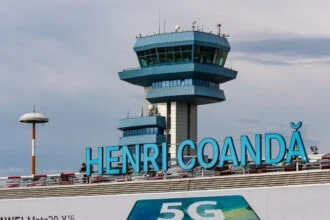
For visitors arriving by air, our guide to Bucharest Airport Transfers covers the bus, taxi, and ride-hailing options for reaching the city centre from Henri Coandă Airport. Anyone with extra days either side of the festive season should also look at our guide to Day Trips from Bucharest, which covers castles and towns within a couple of hours of the capital.
Travellers planning to continue on by rail from Bucharest, whether to the Transylvanian towns of Brașov and Sighișoara or further afield, will find our Interrail Romania Pass guide useful for working out routes and sleeper options. For official listings, opening times, and practical visitor information beyond what this guide covers, the Romania Tourism board’s Bucharest page is a reliable additional source.