Reviewed by our editorial team Published
Landing at Henri Coandă: What This Guide Covers
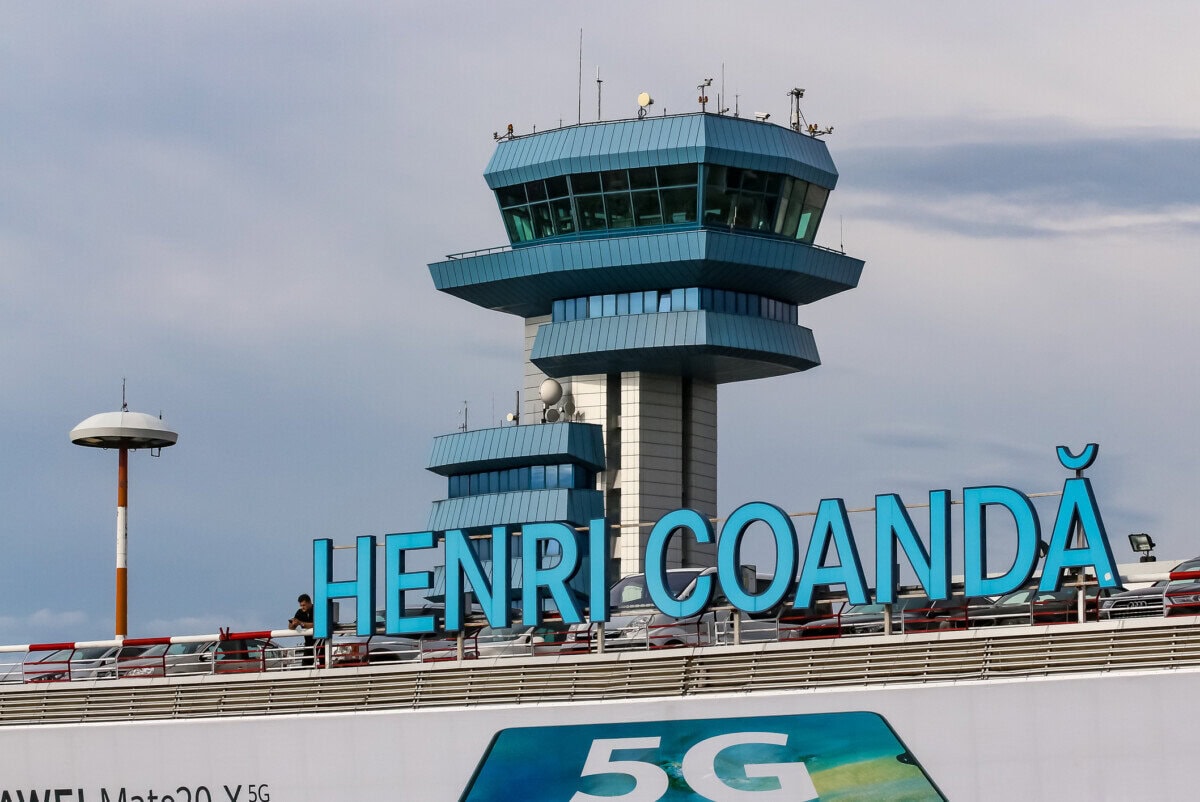
Henri Coandă International Airport, still widely known by its old name Otopeni, sits around 17 kilometres (10.5 miles) north of central Bucharest, close enough that almost every transfer option here takes well under an hour in normal traffic. It is Romania’s busiest airport by a wide margin, handling the country’s international traffic and a growing low-cost network, so arriving here is how most visitors begin a trip to Bucharest, whether the plan is a short city break, a longer tour of Transylvania, or a stopover on the way into Moldova.
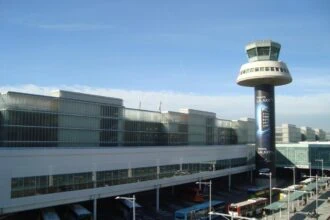
The single terminal building keeps things relatively simple compared with sprawling multi-terminal hubs elsewhere in Europe, and every transfer option covered in this guide, bus, train, taxi, ride-hailing, private transfer or a hire car, starts within a short walk of the arrivals doors. The airport itself has been steadily modernised in recent years, and a dedicated rail link to Bucharest’s main station opened in 2020, giving arriving passengers a genuine alternative to the bus and taxi options that used to dominate the choice.
This guide covers every realistic way of reaching central Bucharest from OTP: the Express Bus 100 to Piața Unirii, the airport train to Gara de Nord, official taxis, Uber and Bolt, a pre-booked private transfer, and picking up a hire car. It also covers what actually happens once through arrivals, where each option’s pickup point physically sits, what changes for a late-night landing, and which option genuinely suits which part of the city.
Prices throughout are given in Romanian lei (RON) first, since that is what every ticket machine, taxi meter and app will actually charge, with approximate euro, pound and dollar conversions alongside using a rate of roughly 1 RON = €0.20 = £0.17 = $0.22. Treat those conversions as a rough guide rather than an exact figure, since exchange rates move daily.
| Transfer Option | Typical Journey Time | Approximate Cost | Best For |
|---|---|---|---|
| Express Bus 100 | 40-60 minutes to Piața Unirii | 3 RON (€0.60/£0.50/$0.65) | Budget travel, light luggage |
| Airport Train | 20-25 minutes to Gara de Nord | 6.50 RON (€1.30/£1.10/$1.45) | Speed, onward rail travel |
| Official Taxi | 25-40 minutes | 60-130 RON (€12-26/£10-22/$13-29) | Door-to-door convenience |
| Uber / Bolt | 25-40 minutes | Similar to taxi, upfront price | Predictable pricing, no cash |
| Private Transfer | 25-40 minutes | From around 130 RON (€26/£22/$29) | Families, guaranteed pickup |
| Car Hire | Flexible | Varies by season | Transylvania road trips |
Finding the Bus, Train and Taxi Once Through Arrivals
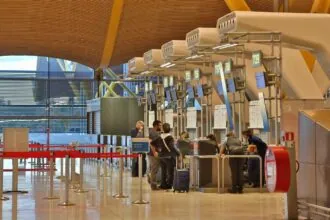
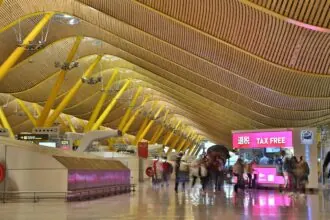
Henri Coandă has a single main terminal, so the genuine confusion for first-time arrivals is less about which building to find and more about which door to walk out of once through passport control and baggage reclaim. All international arrivals funnel out onto the ground floor, and the three main onward options, bus, taxi and train, are spread across the immediate area directly outside rather than hidden away in a separate building.
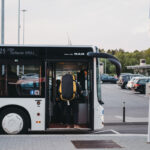
The Express Bus 100 stop sits on the ground floor of the terminal, in the international arrivals area, reached by walking straight out through the arrivals doors and following signage to the right. Red automatic ticket machines stand at the stop itself, which is the easiest way to spot it among the general kerbside activity.
The official taxi rank is the most visible option, positioned directly in front of the terminal building. Rather than simply flagging a driver, most arriving passengers are expected to use one of the yellow touchscreen booking terminals inside the arrivals hall on the ground floor first, which dispatches a specific licensed car and prints a receipt with the driver and fare details before anyone steps outside.
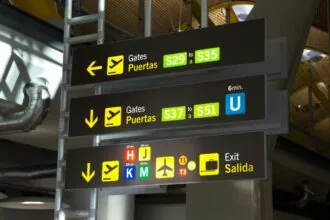
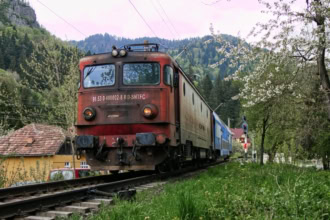
The airport train platform is the one genuinely separate structure, a covered station with a distinctive roof standing just outside the terminal building rather than inside it. Clear rail signage points the way from arrivals, though the airport has been under partial renovation in recent years, so it is worth following the current signs rather than relying on where the platform sat on a previous visit.
Best for two or three nights. The widest choice of rooms, with filters for free cancellation and included breakfast.
View staysBest for families, or any stay past about four nights. A kitchen and a washing machine start paying for themselves.
Browse rentalsBest for double-checking. Runs the same search across several booking sites so you are not leaving money behind.
Compare pricesShops, Lounges and Practical Facilities at Henri Coandă
Henri Coandă keeps arriving and departing passengers well looked after long after the transfer options above, and very little of it shuts down overnight. Several shops trade 24 hours a day, including all five BestValue duty-free outlets split across the landside and airside sections of the terminal, plus newsstands and a few small souvenir stalls for a last-minute gift.
Eating options run just as late. A genuine mix of familiar names and local operators, among them City Grill, Brioche Dorée, Chozen Noodle and Gloria Jean’s, are spread across different zones of the terminal, so there is realistically somewhere to eat whatever time a flight lands or takes off.
Practical services are easy to find too. Multiple currency exchange counters operate throughout the building, several staying open around the clock, and a 2mPharma pharmacy sits in the passageway linking arrivals and departures, open daily from 8am to 9pm for anything from travel sickness tablets to basic first aid.
There is no dedicated left-luggage storage desk inside the terminal itself, which catches a number of travellers out. A baggage-wrapping service is available at check-in in departures for anyone protecting a fragile or valuable case, free trolleys are dotted throughout the building, and third-party storage apps such as Bounce and Radical Storage only list drop-off points in central Bucharest rather than inside the airport.
Connectivity is straightforward. Free WiFi covers the whole terminal via the AIHCB Free network, and charging points are dotted throughout the airside area, with one single zone offering more than 20 sockets for laptops and phones.
Three business lounges operate on a pay-per-use basis from around 180 RON (about €36/£31/$40), so economy passengers are not automatically shut out even without a business ticket. Priority Pass membership also grants access to at least the non-Schengen satellite lounge, making a paid day-pass or an existing membership a genuine option for a longer wait before boarding.
For quieter moments, a small Christian Orthodox chapel sits on the first floor of the departures terminal, landside, open to anyone wanting somewhere calm before a flight. Accessible toilets throughout the building include baby-changing facilities, covering one of the more practical needs for families travelling with young children.
Express Bus 100 to Piața Unirii
The Express Bus 100 is Bucharest’s dedicated airport shuttle, run by the city’s public transport operator STB. It replaced the older route 783 in December 2023 and now runs around the clock, terminating at Piața Unirii in the heart of the city after calling at a handful of major interchange points along the way, including Piața Presei, Piața Victoriei, Piața Romană and Universitate.
A single ticket costs just 3 RON (about €0.60/£0.50/$0.65) and is valid for 90 minutes across the whole STB network, including onward metro, tram and regular bus connections. Buses run every 15 to 20 minutes during the day, dropping to roughly every 20 to 30 minutes overnight, with the full 24-hour service meaning there is no genuine gap even for a very early or very late landing.
Drivers do not sell tickets, which catches out a fair number of first-time visitors. Tickets need buying before boarding from the red automatic machines at the stop, or paid for on the bus itself using a contactless bank card tapped directly on the reader, an STB travel card, or by texting the letter C to the short number 7458. The 24pay app is another option for anyone who would rather sort a ticket before even reaching the stop.
The journey into the centre takes roughly 40 to 60 minutes depending on traffic and how far along the route the destination sits, which is considerably slower than a taxi or the train but genuinely the cheapest option here by a wide margin. It suits travellers with light luggage staying near one of the route’s own stops far better than anyone heading to a hotel that still needs a further walk or connection once off the bus.
The Airport Train to Gara de Nord
Bucharest’s dedicated airport train link has been fully operating since December 2020, running a direct, no-change service between Henri Coandă and Gara de Nord, the city’s main railway station. It is genuinely the fastest way into the centre without a car, covering the roughly 17-kilometre route in around 20 to 25 minutes.
Trains are operated primarily by the state carrier CFR Călători, run roughly every 40 minutes across the whole day, and the service does not stop entirely overnight, which makes it a genuinely useful option even for an awkwardly timed landing. A standard single ticket, without a seat reservation, costs 6.50 RON (about €1.30/£1.10/$1.45); buying the same ticket from the on-board conductor instead doubles the price to 13 lei, so it is always worth buying before boarding rather than assuming it can be sorted on the train.
Tickets can be bought from the small CFR kiosk near international arrivals, from the ticket machine on the platform itself, through the CFR Călători website or app, or by tapping a contactless bank card at the reader on board. A worthwhile detail for planning: Bucharest’s long-promised metro extension, Line M6, will eventually reach the airport directly, but as of late 2026 it remains under construction with a target opening around 2028, so the train, not the metro, is the only rail option here for now.
Arriving at Gara de Nord puts a visitor within a short taxi or metro ride of almost anywhere in central Bucharest, and the station itself connects directly onto the metro network for a final short hop. For anyone travelling light and prioritising speed over a single door-to-door journey, the train comfortably beats every other option covered on this page.
Taking an Official Taxi from Henri Coandă
A taxi remains the simplest genuinely door-to-door option, and Bucharest airport has worked hard in recent years to make the official system harder to scam. Rather than approaching a driver directly, arriving passengers are directed to one of the yellow touchscreen booking terminals inside the international arrivals hall, which dispatch a specific licensed vehicle from an authorised operator such as Meridian or Cristaxi and print a slip confirming the car, driver and expected fare before anyone even steps outside.
Official taxis authorised to work the airport rank charge a transparent per-kilometre rate, among the lowest in Bucharest, and a typical fare to the city centre runs to around 60-130 RON (about €12-26/£10-22/$13-29) depending on the exact destination and traffic. The journey itself normally takes 25 to 40 minutes.
The most important scam-avoidance rule here is simple: never accept an offer from a driver who approaches inside the terminal or car park touting for business directly, no matter how official they look. Genuine licensed drivers wait at the rank for a booking sent through the terminal system rather than soliciting passengers in the hall, and anyone doing the latter is very likely charging well above the metered rate.
Always confirm the meter is running, or that the fare matches the slip printed at the booking terminal, before the car pulls away. Paying by card is generally accepted, though carrying a little cash as a backup is sensible, and a taxi remains the most practical choice for anyone with heavy luggage or a late arrival when the bus and train run less often.
Uber and Bolt at Henri Coandă
Both Uber and Bolt operate freely in Bucharest, and ride-hailing has become one of the most popular ways to leave the airport, largely because the fare is confirmed inside the app before the journey even starts, removing any of the uncertainty that still worries some first-time visitors about taxis abroad. Neither app charges a specific airport surcharge on top of the standard fare shown.
After landing, open the app, enter the destination, and it will direct the passenger to the current designated ride-hailing pickup point, which both operators note can shift depending on ongoing terminal works, so it is worth following the in-app directions rather than assuming last visit’s pickup spot still applies. Signage for ride-hailing pickups is also posted around the terminal’s arrivals level.
Fares are broadly comparable to an official taxi for the same route, typically similar to the 60-130 RON range quoted above, though they can rise during surge periods around busy arrival banks or bad weather. Journey time into the centre is much the same as a taxi, usually 25 to 40 minutes depending on traffic on the main road into the city.
Always double-check the car’s number plate, make and driver’s name shown in the app match the vehicle before getting in, exactly as anywhere else in the world. For solo travellers or anyone without Romanian lei to hand for a metered taxi, ride-hailing is often the single easiest option here, combining fixed pricing with the door-to-door convenience of a taxi.
Booking a Private Transfer for a Guaranteed Pickup
Travellers who want total certainty over their arrival often choose a pre-booked private transfer instead of a taxi or ride-hailing app. Unlike hailing a car on the spot, a private transfer is arranged in advance, and a driver typically waits inside the arrivals hall holding a name board, which removes any uncertainty after a long flight or a late landing.
Because the price is agreed before travel, there is no surprise if the flight is delayed or traffic on the way into the city is heavier than expected; most operators build a reasonable amount of free waiting time into the price. Fixed-price private transfers to central Bucharest typically start from around 130 RON (about €26/£22/$29) for a standard car, reflecting the guaranteed pickup and door-to-door service rather than any real difference in distance covered.
Journey times are broadly similar to a taxi, usually 25 to 40 minutes depending on traffic and the exact drop-off address. The real advantage is certainty rather than speed, and families, anyone travelling with young children, or a group with a lot of luggage tend to find the guaranteed pickup point worth the extra cost over queuing at the rank.
A private transfer is especially worth considering for very early departures or very late arrivals, when the express bus and train frequency both drop right back overnight. Most operators also offer larger vehicles for groups heading straight on to Brașov or another Transylvanian base, avoiding a change of transport partway through the trip.

Compare Airport Transfer Companies
Pre-booking your airport transfer can save time and reduce stress when you arrive. Whether you need a private taxi, shared shuttle or executive transfer, comparing providers can help you find the best price and service for your journey.
We’ve selected three trusted airport transfer companies so you can compare prices, vehicle options, cancellation policies and customer reviews before you travel.
Best for finding routes the airlines do not sell as a single ticket. Combines carriers to bring the fare down.
Search flightsBest for short trips. Install the eSIM at home and arrive with working data, no shop queue.
Browse eSIMsBest when public transport has stopped, or when you are travelling with children and bags.
Book a transferHiring a Car and Driving from Henri Coandă
For anyone planning to explore beyond Bucharest itself, particularly Transylvania’s castles and mountain towns, hiring a car at the airport can be genuinely worthwhile. Major international rental companies, including Avis, Hertz, Sixt, Europcar and Budget, along with several local operators, all keep desks on the arrivals level, making pickup straightforward without a separate shuttle to a distant rental centre.
Rates vary considerably by season, vehicle class and how far ahead the booking is made, and pre-booking online generally beats turning up on the day, particularly during the busy summer months. A valid driving licence, passport and credit card in the driver’s name are standard requirements, and it is worth checking the rental firm’s excess and insurance terms carefully before signing.
Inside Bucharest itself, a car is rarely the best choice for a short city stay. Traffic in the centre can be heavy, some historic streets are narrow or restricted, and street parking is limited and metered, so hiring purely to reach a central hotel then leaving the car parked for the whole visit is an easy way to overspend.
For anyone being dropped off or collecting a hire car instead, the airport connects directly to the A3 motorway and the DN1 road towards the city, with clear signage throughout. A short-stay drop-off zone sits right outside the terminal, and longer-stay parking is available further out, with daily rates running from around 25.60 RON (about €5/£4/$6) up to roughly 54 RON (about €11/£9/$12) for a single day, cheaper for longer bookings made in advance online.

Choose Car Hire for Bucharest
A rental car may be the most practical option if you want to explore areas beyond central Bucharest without being tied to bus or train schedules.
Comparing both Discover Cars and EconomyBookings can help you see a broader range of prices and vehicle options before booking.
Arriving Late at Night: What Still Runs
Henri Coandă handles a genuine number of late and early flights, and the good news is that Bucharest’s transfer options do not simply switch off overnight the way they do at some smaller airports. Both the Express Bus 100 and the airport train technically run around the clock, so neither option disappears entirely after midnight.
In practice, though, frequency drops sharply once the evening rush passes. The bus slows to roughly every 20 to 30 minutes overnight rather than the daytime 15, and while that is still workable for a traveller happy to wait at an empty stop, it is a genuinely different experience from a busy daytime departure, particularly for a solo traveller arriving alone in the small hours. The train’s roughly 40-minute gap between services stays fairly consistent through the night, which in practice makes it the steadier of the two public options after dark.
For most late-night arrivals, a taxi from the official yellow terminal, Uber or Bolt remains the most realistic choice. All three continue operating around the clock, drivers are always available given how busy the airport stays even overnight, and the certainty of a direct, well-lit pickup point matters more after a long day of travel than saving a few lei on a bus fare.
Anyone with a very early departure, particularly before the first buses pick up proper frequency around dawn, should seriously consider a pre-booked private transfer instead, since it guarantees a driver is waiting rather than relying on app availability at an hour when demand can occasionally outstrip supply.
Best Option by Destination: Old Town, Gara de Nord or Beyond
Staying near the Old Town (Lipscani) or Piața Unirii points firmly towards the Express Bus 100, since its terminus sits right at Piața Unirii, a short walk from the Old Town’s cobbled streets. A taxi or ride-hailing car is only worth the extra cost here for late arrivals or heavy luggage, since the bus drops passengers about as close to this part of the city as any option realistically can.
Anyone booked near Gara de Nord itself, or planning onward rail travel to Brașov, Sinaia or elsewhere in Romania, should take the airport train without much hesitation. It delivers directly to the station in 20 to 25 minutes, connects straight onto the metro for a final short hop, and comfortably beats every other option on both speed and price for this specific destination.
For hotels further out, in districts such as Herăstrău, Floreasca or Pipera to the north, or anywhere the bus and train do not conveniently reach, a taxi, Uber, Bolt or private transfer makes far more sense than trying to combine public transport with a second onward journey. These northern districts sit closer to the airport along the same main road, so journey times and fares are often slightly lower than the citywide averages quoted elsewhere on this page.
As a rough rule, use the bus for the Old Town and central squares with light luggage, the train for Gara de Nord and anything continuing by rail, and a taxi, ride-hailing app or private transfer for anywhere else, for families, for heavy luggage, or for a landing late at night when frequency on the cheaper options drops away.

Continuing the Journey from Gara de Nord
For anyone using Bucharest as a stepping stone rather than a final stop, Gara de Nord sits at the centre of Romania’s national rail network, with frequent services fanning out towards Transylvania and the Black Sea coast. The airport train covered earlier in this guide connects directly into this station, so no separate transfer across the city is needed before continuing onward.
Several operators share these routes rather than a single national carrier, including the state-run CFR Călători alongside private operators such as Astra Trans Carpatic, Transferoviar Călători and Regio Călători, so it is worth comparing a couple of departure times across operators on a booking site rather than assuming only one company serves a given route. Bucharest to Brașov alone sees somewhere in the region of 20 to 30 departures a day across all operators combined, with the fastest InterCity services covering the route in a little over two hours.
The table below sets out realistic journey times and typical fares for the destinations travellers most often ask about next. Prices shown are standard second-class InterRegio or InterCity fares without a discount; CFR Călători offers a genuine saving of up to 10% for tickets bought 11 or more days ahead, which is worth building into the plan for a longer Romanian rail trip. It is always worth checking the current timetable before travelling, since schedules and exact fares can shift between seasons.
| Destination | Journey Time | Typical Fare | Direct? |
|---|---|---|---|
| Sinaia | ~1 hour 30 minutes | 33-62 RON (€7-12/£6-11/$7-14) | Yes |
| Brașov | ~2 hours 15 minutes to 2 hours 35 minutes | 69-79 RON (€14-16/£12-13/$15-17) | Yes |
| Sighișoara | ~4-5 hours | From around 80 RON (€16/£14/$18) | Yes, most services |
| Constanța (Black Sea coast) | ~2 hours 15 minutes | From around 60 RON (€12/£10/$13) | Yes |

Rupert’s Handy Travel Tips
Flying into Henri Coandă? Rupert has a few tips that can save both time and money:
- Buy the bus ticket before you board: drivers don’t sell tickets, so use the red machine at the stop, a contactless card tap, or the 24pay app instead.
- Buy the train ticket before boarding, not from the conductor: the same journey costs double if bought onboard rather than at the kiosk or machine.
- Always book taxis through the yellow terminal inside arrivals: never accept an offer from a driver who approaches you directly in the hall.
- Check the app before assuming a fixed Uber or Bolt pickup point: the exact spot can shift while the terminal is under renovation.
- Take the train, not the bus, if heading anywhere near Gara de Nord: it is faster, cheaper, and drops you straight into the rail network.
- Book a private transfer for a very early flight: bus and train frequency both drop back overnight, and a guaranteed driver beats relying on app availability at dawn.
Want to meet the reindeer behind our travel tips? Find out more in our page Who is Rupert?.




Frequently Asked Questions About Bucharest Airport Transfers
What is the fastest way to get from Bucharest Airport to the city centre?
The airport train to Gara de Nord is fastest at around 20 to 25 minutes, followed by a taxi or ride-hailing car at 25 to 40 minutes depending on traffic.
Is there a train from Bucharest Airport to the city?
Yes. A direct rail link to Gara de Nord has operated since December 2020, running roughly every 40 minutes with a journey time of 20 to 25 minutes.
How much does the Express Bus 100 cost?
A single ticket costs 3 RON (about €0.60/£0.50/$0.65), valid for 90 minutes across the wider STB public transport network.
Does the Bucharest metro reach the airport?
Not yet. Metro Line M6 will eventually connect directly to the airport, but as of late 2026 it remains under construction with a target opening around 2028.
Are Uber and Bolt available at Bucharest Airport?
Yes, both operate freely with a designated pickup zone at the terminal, and fares are broadly similar to an official taxi for the same route.
How do I book a safe taxi at the airport?
Use one of the yellow touchscreen booking terminals inside the international arrivals hall rather than accepting an offer from a driver approaching you directly.
Further Reading & Related Guides
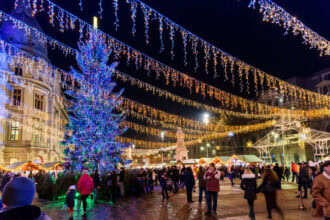
Once through the terminal, our upcoming Things to Do in Bucharest guide rounds up the capital’s landmarks, from the Palace of the Parliament to the Old Town’s Lipscani district, and our upcoming Day Trips from Bucharest guide covers Peleș Castle, Bran and Brașov for anyone with time to explore further afield. Visiting over the festive season instead? Our upcoming Bucharest Christmas Markets guide covers the city’s seasonal markets and festive atmosphere.
For anyone building a wider Romanian rail trip beyond this one airport transfer, our Interrail Romania Pass guide explains how a multi-journey pass can work out cheaper than buying individual tickets for routes like Bucharest to Brașov or Sighișoara, and our broader Interrail Pass Guide covers how the pass works across the wider European network for anyone continuing on from Romania.
Before travelling, it is worth confirming reliable mobile data for tickets, maps and translation apps, particularly for navigating the yellow taxi terminals and the 24pay bus ticketing app on arrival. A working eSIM or local data plan makes every option in this guide considerably less stressful to use on the day.
For the official word on facilities, terminal maps and live flight information, the airport’s own site at bucharestairports.ro is worth bookmarking before departure day.