Reviewed by our editorial team Published
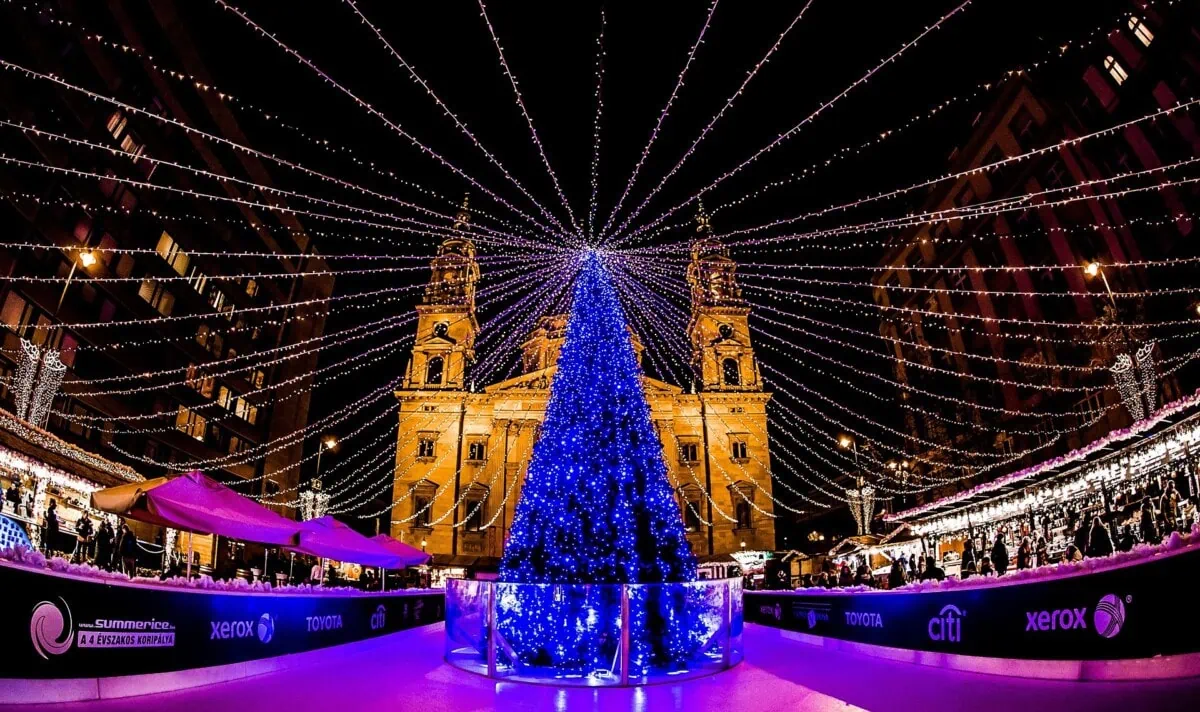
Budapest turns properly magical once the temperature drops. The Hungarian capital runs two headline Christmas markets each winter, both set against some of Europe’s grandest architecture, and both close enough together that visiting them on foot in a single afternoon is entirely realistic. Vörösmarty Square in the heart of the Belváros district is the older, larger of the two, a genuine crafts market with roughly 150 wooden stalls selling handmade decorations, folk textiles and leatherwork. A short walk away, the market outside St Stephen’s Basilica trades scale for atmosphere, wrapping its food stalls and mulled wine bars around the base of Hungary’s largest church.
What makes Budapest genuinely different from most of the big-name European market cities is what happens after the stalls close. The city sits on one of the largest networks of natural thermal springs in the world, and its bathhouses stay open into the evening throughout December. A visitor can spend the afternoon browsing kürtőskalács stands and glühwein queues in near-freezing air, then be soaking in outdoor thermal water under floodlights an hour later. Few other Christmas market cities offer that particular contrast, and it shapes almost every recommendation on this page.
Both markets are free to enter, with costs only applying to food, drink and craft purchases, and both typically run from mid-November through New Year, though exact 2026 opening dates had not yet been published by Budapest’s tourist board at the time of writing. This guide covers where the markets actually are, what to eat and drink while you’re there, how to get between them and the wider city, and how to build an evening bath visit into a market day without the logistics becoming a headache.
Budapest Christmas Markets at a Glance
| Market | Location | Known For | Best For |
|---|---|---|---|
| Vörösmarty Square Christmas Fair | Belváros, central Pest, next to Deák Ferenc utca | Around 150 craft stalls, a central Christmas tree, live folk music | Gifts, crafts, first-time visitors wanting the classic market experience |
| Advent at St Stephen’s Basilica | Szent István tér, roughly 800m from Vörösmarty Square | Free evening 3D light show projected onto the basilica facade | Atmosphere, photography, an evening food and drink stop |
Vörösmarty Square: Budapest’s Main Christmas Market
Vörösmarty Square has hosted Budapest’s principal Christmas market for more than two decades, and it remains the city’s most complete festive shopping experience. The square sits at the top of Váci utca, Budapest’s main pedestrian shopping street, so it’s easy to combine a market visit with browsing the surrounding shops. A large lit Christmas tree anchors the square, and a small stage regularly hosts folk choirs, brass bands and children’s performances through December.
The roughly 150 stalls here are genuinely craft-focused rather than mass-produced, with a jury process that vets traders before they’re allowed to sell. Expect hand-carved wooden toys, embroidered tablecloths, felted slippers and blown-glass ornaments, most priced from around 2,000 to 8,000 HUF (about £4 to £16 / €4.70 to €19 / $5.20 to $21). Stallholders are used to card payments, though small cash amounts still move faster at the busiest food counters.
The nearest metro stop is Deák Ferenc tér, served by all three of Budapest’s metro lines, which makes Vörösmarty Square one of the easiest markets in Europe to reach without a car. Trams 2 and 47/49 also stop within a few minutes’ walk along the Danube embankment. Because the market sits in a genuinely central, well-lit square, it stays comfortable to walk through even on the coldest evenings of the season.
Arrive in the late afternoon if possible, since the square’s own lighting and the surrounding shopfronts make it noticeably more atmospheric after dark than during the day. Weekday mornings are the quietest time to browse without crowds, while weekend evenings draw both locals and tourists in roughly equal measure. Most stalls stay open until around 8pm or 9pm, with food and drink counters often running later.
Because the market is genuinely central, it also works as a natural starting point for exploring the rest of the city on foot. Visitors extending their stay often use it as a base for a Budapest hop-on hop-off bus route, since several stops sit within a few minutes’ walk of the square.
See hotel options and places to stay in Budapest.
Browse hotelsBrowse apartments, holiday homes and self-catering stays in Budapest.
View rentalsCompare hotel deals in Budapest from multiple booking sites.
Compare pricesSt Stephen’s Basilica: Light Shows and Advent Atmosphere
The market at St Stephen’s Basilica is smaller and more food-focused than Vörösmarty Square, built as a horseshoe of stalls around the base of Hungary’s largest and most important church. Its signature draw is a free 3D light show projected onto the basilica’s neo-classical facade most evenings, timed on the hour and running for several minutes at a time. It’s one of the most photographed sights in the city during December for good reason.
Where Vörösmarty leans towards crafts, this market leans towards food and drink, with a noticeably higher ratio of hot-food stalls to gift stalls. Expect goulash served in bread bowls, lángos (fried dough topped with sour cream and cheese), roasted chestnuts and a wide range of mulled wine styles, from the classic forralt bor to fruit-based and spiced brandy variants. A hearty bowl of goulash typically runs from around 2,500 to 3,500 HUF (about £5 to £7 / €5.90 to €8.30 / $6.60 to $9.20).
The market sits on Szent István tér, roughly 800 metres from Vörösmarty Square, an easy 10 to 12 minute walk along Zrínyi utca or through the surrounding side streets. Deák Ferenc tér metro station also serves this market, sitting almost equidistant between the two squares, which is what makes visiting both in one evening so straightforward.
Seating is limited and mostly standing-height barrel tables, so this market suits a stop-and-graze visit rather than a sit-down meal. It’s busiest in the hour either side of sunset, when the light show draws the largest crowds, so arriving slightly earlier secures a better viewing spot. Visitors combining a market evening with sightseeing sometimes add a Budapest Parliament tour beforehand, since the Parliament building is a short tram ride away and also lit for the season.
What to Eat and Drink at Budapest’s Markets
The single most photographed food at both markets is kürtőskalács, a cinnamon-dusted “chimney cake” cooked slowly on a rotating spit until the outside caramelises. A classic version costs around 2,200 HUF (about £4.50 / €5.20 / $5.80), with ice-cream-filled or chocolate-dipped versions running somewhat higher. It’s sold at nearly every stall cluster across both markets, and the cooking process itself, with rows of spits turning over open coals, is worth watching even if you’ve already eaten one.
Forralt bor, Hungarian mulled wine, is the other essential order, typically served in a returnable mug for a small deposit and priced from around 1,500 to 2,000 HUF per cup (about £3 to £4 / €3.60 to €4.70 / $4 to $5.20). Stronger variants spiked with pálinka, Hungary’s fruit brandy, are common and worth asking for by name if a standard mulled wine feels too mild for a genuinely cold evening.
Beyond the two signature items, both markets sell a proper range of savoury food: grilled kolbász sausage, lángos, langosch-style flatbreads, and stuffed cabbage in the colder months. Vegetarian options have expanded significantly in recent years, with most food stalls now offering at least one meat-free version of their core dish. Portions are generous by European market standards, and sharing one main between two people is common practice among locals.
Most stalls at both markets now accept contactless card payments, though a handful of the smallest crafts stalls remain cash-only, so carrying a modest amount of Hungarian forint is still sensible. Prices are set in forint everywhere on-site; card machines occasionally offer to convert to euros or pounds at checkout, and it’s almost always cheaper to decline this and let your own bank handle the conversion.
Getting There and Where to Stay
Both markets sit inside Budapest’s compact, walkable Belváros district, so most visitors don’t need a car or taxi once they’ve arrived in the city. Travellers flying in should plan a straightforward Budapest airport transfer into the centre, either by pre-booked shuttle, the 100E direct airport bus, or a licensed taxi from the official rank, all of which take 30 to 45 minutes depending on traffic. Trains into Budapest arriving at Keleti, Nyugati or Déli stations are all within a short metro or tram ride of Deák Ferenc tér.
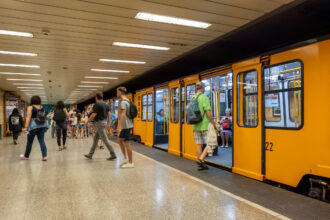
Once in the city, the Budapest metro is the fastest way to move between neighbourhoods, and a short-stay travel card comfortably covers both markets plus any thermal bath visit in the same trip. Deák Ferenc tér is the single most useful stop for this itinerary, sitting on all three metro lines within a few minutes of both squares. A Budapest Card is worth considering for a multi-day stay, since it bundles unlimited public transport with discounted or free entry to several museums and attractions around the city.
For accommodation, staying in District V (Belváros) or District VI (Terézváros) puts both markets within easy walking distance, with plenty of mid-range hotels priced from around £70 to £110 (€82 to €130 / $91 to $144) a night in December. Budget travellers often base themselves near Blaha Lujza tér, a few stops further out on the metro, where prices typically drop by 15 to 20 percent for a similar standard of room.
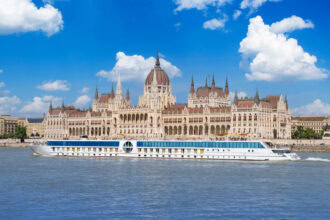
A short Budapest river cruise along the Danube is a popular way to see the illuminated Parliament building and Chain Bridge from the water, and several operators run dedicated evening Christmas-lights sailings through December that pair naturally with a market visit earlier in the day.
Christmas Markets by Day, Thermal Baths by Night
Budapest’s real point of difference in December is being able to combine a market afternoon with an evening thermal bath without either feeling rushed. The city’s bathhouses are genuinely open late throughout winter, and soaking in outdoor thermal pools while snow settles on the water’s surface is one of the more memorable things a traveller can do in Europe in December. It’s a completely different register of “festive” to mulled wine and fairy lights, and it pairs surprisingly well with both.
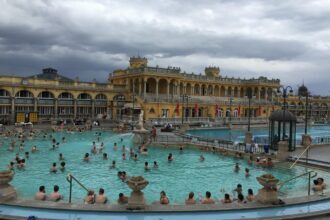
Széchenyi Baths, the largest and most famous, sits in City Park and stays open until 10pm most nights in December, with day tickets typically priced from around 12,000 to 15,000 HUF (about £24 to £30 / €28 to €35 / $31 to $39) depending on the exact package and locker or cabin option chosen. Its outdoor pools, ringed by neo-baroque architecture, are the most photogenic option for an evening visit and the easiest to reach from the Christmas markets by metro.
Gellért Baths, on the Buda side of the river, offers a more Art Nouveau, indoor-focused experience and tends to feel slightly calmer in the evenings than Széchenyi. Rudas Baths, older and more traditionally Ottoman in design, adds a rooftop hot tub with river views that’s particularly striking after dark. Whichever bath is chosen, arriving after 7pm typically means shorter queues than the late-afternoon rush.
The practical sequencing that works best for most visitors is markets first, baths last: browse Vörösmarty Square in the late afternoon, cross to St Stephen’s Basilica for the light show and dinner, then take the metro out to Széchenyi for a two-hour soak before bed. Pack a swimsuit and a spare towel (rentals are available but queue-prone), and budget a full evening rather than trying to compress the sequence into two or three hours.
Things to Do at Budapest’s Christmas Markets
Beyond browsing the stalls, both Budapest markets pack in genuine activities rather than window shopping alone. A small vintage carousel spins throughout December on Szent István tér, giving children and plenty of adults a proper ride rather than just a photo opportunity.
A seasonal ice rink sets up in nearby Városháza Park (City Hall Park), a two minute walk from Deák Ferenc tér. Entry costs around 3,000 HUF (about £6 / €7 / $8), with skate hire priced separately for anyone who hasn’t brought their own.
For a bigger skate, the permanent Városligeti Műjégpálya in City Park is one of Europe’s largest outdoor ice rinks and stays open through the whole winter season. It’s an easy metro ride from either Christmas market, making it simple to combine with an afternoon at the stalls.
Craft demonstrations run throughout December at Vörösmarty Square, where glassblowers, gingerbread decorators and traditional toy-makers work their stalls in real time rather than simply selling finished pieces. Several stalls also run hands-on gingerbread decorating for a small fee, a popular stop for families with younger children.
Live folk performances and choirs take to small stages at both squares most evenings, so it’s worth planning a visit around early evening rather than treating the markets purely as a shopping stop. Weekend afternoons often add children’s performances too, making that slot the most family-friendly time to visit.
The Városháza Park festival area also runs a dedicated kids’ zone with a small train ride and supervised craft tables most weekends in December. It sits right next to the ice rink, so a family visit can combine skating, crafts and the market stalls in one stop.
Christmas Lights, Switch-On and Other Festive Events
Budapest’s official Christmas lighting comes on across the city on the same evening the markets open, historically around 14 November in recent years, when the first candle of the Advent wreath at Városháza Park is lit alongside the wider festive lighting. A firm 2026 switch-on date had not yet been confirmed at the time of writing, so this mid-November pattern is the best available guide.
Andrássy Avenue, Budapest’s grand UNESCO-listed boulevard, gets its own elaborate light display each winter and is worth the short detour from Deák Ferenc tér. It makes a quieter, less crowded alternative to photographing the two main market squares.
The Winter and Advent Festival at Városháza Park runs its own programme alongside the two headline markets, built around a 16 metre Christmas tree and a large Advent wreath. Its schedule includes folk, jazz and puppet-show performances through the season, on top of a craft fair and food stalls of its own.
At Gerbeaud, Budapest’s famous confectionery house on Vörösmarty Square, an Advent calendar reveals a newly decorated window display each day of December, drawing a small crowd most evenings.
A decorated Christmas Light Tram runs a special festive route on tram line 2 along the Danube embankment through most of December, travelling with normal tickets or a Budapest Card rather than needing a separate fare. It doesn’t run on Christmas Eve or New Year’s Eve, so aim for any other evening in the season to catch it.
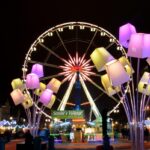
Beyond the two market squares, Budapest Zoo and Botanical Garden in City Park runs its own “Animals of the World” Chinese Lantern Festival each winter, an outdoor evening exhibition of illuminated animal sculptures built by artisans using traditional wire-frame-and-fabric lantern techniques. It has now returned for at least three consecutive winters, running from autumn through into February and open daily over the Christmas and New Year period, with advance adult tickets priced from around 4,400 HUF. Exact 2026/27 dates had not been confirmed at the time of writing, giving visitors an evening option genuinely different from the markets, a short metro ride from Városliget’s ice rink and Széchenyi Baths.
Taken together, these extras mean a market visit can easily expand into a full evening of Christmas activity well beyond the stalls themselves, particularly for a first-time December visitor with more than one evening in the city.
Search routes and flight options for your trip to Budapest.
Search flightsBrowse Airalo eSIM options for convenient travel data.
Check eSIMsHave a private airport pickup arranged before you travel.
Book a transferShop Opening Hours in Budapest During December
Most general shops in Budapest keep fairly standard hours through December, typically opening between 7am and 10am and closing between 6pm and 8pm on weekdays. Shopping malls often stay open later, commonly until around 9pm or 10pm, and Christmas trading only extends these hours slightly in the final run-up to 24 December.
Hungary scrapped its blanket Sunday closing rule back in 2015, so Sunday trading is common in Budapest, though not universal. Larger stores generally open on Sundays with somewhat reduced hours, while a minority of smaller independent shops, particularly outside the tourist centre, still close for the day.
Supermarkets and convenience stores are the most reliable option for Sunday shopping, and most malls in the city, including those near Deák Ferenc tér, run close to their normal weekday hours on Sundays throughout December. This makes topping up on essentials straightforward at almost any point in the week.
Non-stop convenience stores and petrol station shops stay open around the clock throughout the season, including on days when standard retail closes completely. These are worth knowing about for anything needed outside normal hours, especially late in the evening after the markets close.
Pharmacies operate a rota system for late-night and holiday cover, with at least one late-night or 24-hour pharmacy open in each district at all times. The address of the nearest open one is always posted clearly on the door of a closed pharmacy.
None of this changes dramatically for the Christmas markets themselves, which run their own separate hours regardless of what the surrounding shops are doing, covered in more detail below.
Christmas Day, Boxing Day and New Year’s Day: What’s Open in Budapest
The market stalls themselves stay open on both Christmas Eve and Christmas Day, a genuine point of difference from most of the shops and attractions around them. Food markets and general shops typically close by around 2pm on 24 December, then stay fully closed on 25 and 26 December along with most of 1 January.
Budapest’s major museums and the Hungarian Parliament close entirely on 24, 25 and 26 December and again on 1 January, with the Parliament reopening for tours from 27 to 30 December. The Opera House stays closed throughout the whole holiday period.
Thermal baths run shortened hours rather than closing outright, typically 6am to 2pm on 24 to 26 December and 6am to 6pm on New Year’s Eve, with Gellért and Lukács baths extending later on select dates. This makes a bath visit one of the few large attractions reliably open across the Christmas period itself.
Public transport keeps running throughout, switching to the public holiday timetable on 25, 26 December and 1 January, which is reduced but still fully functioning rather than suspended. Christmas Eve itself runs a Saturday-style timetable with several routes finishing earlier than usual in the late afternoon.
Matthias Church holds special services over the period and stays open to visitors for most of the day, and the Budapest Eye Ferris wheel on Erzsébet tér runs extended hours, often until midnight, across the whole season including Christmas Day itself.
Anyone planning a Boxing Day or New Year’s Day visit should build the day around the markets, a thermal bath, and a handful of genuinely open attractions rather than assuming the city runs its normal schedule.
New Year’s Eve in Budapest
Budapest’s Szilveszter (New Year’s Eve) is a decentralised, deliberately chaotic affair rather than one organised city-wide show. There is no official municipal fireworks display, since Budapest’s only state-organised fireworks each year are on 20 August for St Stephen’s Day, so what fills the sky on 31 December is almost entirely private fireworks let off from balconies, street corners and rooftops across the city.
New rules introduced for the 2025/26 season tightened this further, restricting category 2 and 3 consumer fireworks to a window of 8pm on 31 December through 2am on 1 January, and banning them within 50 metres of residential buildings. Firecrackers remain illegal year-round, and parks including Gellért Hill and Margaret Island ban fireworks entirely, every day of the year.
Despite that ban on setting off fireworks there specifically, Gellért Hill remains the best free vantage point in the city for watching the display unfold across Budapest, since its elevated paths give a genuine panoramic view of the fireworks other people are setting off below. The paths are poorly lit and can turn icy, so sturdy boots and a torch are worth packing for anyone heading up.
A heated Danube river cruise is the easiest way to watch the show without the cold or the climb, with several operators running dedicated Szilveszter sailings timed around midnight. Széchenyi Baths also runs a popular New Year bath party in late December, worth booking online well in advance.
Public transport runs through the night on New Year’s Eve, with metro lines, HÉV suburban rail and the main tram and bus routes all continuing until morning. Getting home safely afterwards is rarely an issue, even without a car or taxi booked in advance.
Budapest’s December Weather and What to Pack
December in Budapest sits firmly in genuine winter territory, with average daytime highs of around 5°C (41°F) and overnight lows dropping to about minus 2°C (28°F). Cold conditions tend to persist from morning through evening, so layering matters more than any single heavy coat.
The city sees a fair amount of rain during December, with around 47mm falling across roughly 13 days and a 42 percent average chance of rain on any given day, though a good proportion of this falls as sleet or light snow rather than a heavy downpour. Snowfall is common but rarely deep, so a proper snow-covered market scene isn’t guaranteed every year.
Humidity runs high at around 80 percent, making the cold feel sharper than the temperature alone suggests, particularly once the sun goes down around 4pm. Sunshine is limited to roughly 51 hours across the whole month, so grey, overcast days are the norm.
Wind is generally mild in the city centre, but the Danube embankment and the open squares around both markets can feel noticeably colder than side streets, so a windproof outer layer is worth prioritising over sheer bulk.
Pack thermal base layers, a warm hat and gloves, and waterproof boots with good grip, since cobbled and paved areas around both market squares can turn slippery in wet or icy conditions. A scarf that pulls up over the lower face helps considerably on the coldest evenings, especially queuing outdoors for kürtőskalács or mulled wine.
The thermal baths are a genuine advantage here: however cold the market squares get, an evening soak at around 36°C to 38°C water temperature is always available as a warm-up. It’s not something most other European Christmas market cities can offer their visitors.

Rupert’s Handy Travel Tips
I’ve trotted between Vörösmarty Square and a steaming thermal pool more times than I can count, and there are a few things that make the evening run smoother.
- Bring a swimsuit from home: rental costumes at the baths are available but the queue for them is often longer than the queue for entry itself.
- Do the light show at the top of the hour: the St Stephen’s Basilica projection runs on a timed cycle, so check the schedule board near the market entrance rather than guessing.
- Carry some cash alongside your card: most stalls take contactless, but a handful of the smallest crafts sellers are cash-only, so a little forint avoids a wasted trip to a cashpoint.
- Book bath tickets online in advance: Széchenyi in particular can sell out its evening slots on weekends in December, and online booking is usually cheaper than the gate price.
- Wear layers you can peel off fast: going from a freezing market queue into a warm changing room works much better if you’re not fighting with a bulky coat over swimwear.
- Use Deák Ferenc tér as your anchor point: it’s the one metro stop within easy reach of both markets, making it the easiest place to regroup if your group splits up.
Want to meet the reindeer behind our travel tips? Find out more in our page Who is Rupert?.



Frequently Asked Questions
When do the Budapest Christmas markets open in 2026?
Official 2026 dates had not been announced by Budapest’s tourist board at the time of writing. In recent years both Vörösmarty Square and the St Stephen’s Basilica market have opened in mid-November, typically around 14 to 15 November, with Vörösmarty running through 31 December and the Basilica market continuing to around 1 January. Check budapestinfo.hu closer to the time for confirmed 2026 dates.
Are the Budapest Christmas markets free to enter?
Yes. Both Vörösmarty Square and the St Stephen’s Basilica market are free to walk around, with costs only applying to food, drink and craft purchases.
Which Budapest Christmas market is better, Vörösmarty Square or St Stephen’s Basilica?
They suit different priorities rather than one being simply better. Vörösmarty Square is the stronger choice for genuine craft shopping and a bigger, longer-running market feel, while St Stephen’s Basilica wins on food, drink and the free evening light show. Most visitors comfortably do both in one evening, since they’re roughly 800 metres apart.
Can I visit a thermal bath the same evening as the Christmas markets?
Yes, and it’s one of the best things about a December trip to Budapest. Széchenyi, Gellért and Rudas Baths all stay open into the evening throughout winter, and Deák Ferenc tér metro station puts both markets within a short ride of Széchenyi Baths in particular.
Do I need cash, or do the market stalls take cards?
Most stalls at both markets now accept contactless card payments, but a minority of the smallest crafts stalls are cash-only. Carrying a small amount of Hungarian forint is sensible, and it’s worth declining any on-screen offer to pay in pounds or euros at checkout, since your own bank’s exchange rate is usually better.
How do I get from the Christmas markets to Budapest Airport?
Both markets sit close to Deák Ferenc tér, from where the 100E direct airport bus, a pre-booked shuttle, or a licensed taxi from the official rank will reach Budapest Airport in 30 to 45 minutes depending on traffic. Booking an airport transfer in advance is generally cheaper and less stressful than arranging one on arrival.
Are the Budapest Christmas markets open on Christmas Day?
Yes. Both Vörösmarty Square and the St Stephen’s Basilica market stay open on Christmas Eve and Christmas Day itself, even though most shops, museums and the Hungarian Parliament close completely on 25 and 26 December.
Is there an official fireworks display in Budapest on New Year’s Eve?
No. Budapest’s only state-organised fireworks each year are on 20 August for St Stephen’s Day, so New Year’s Eve fireworks are private displays let off across the city, now restricted to a set time window and kept away from residential buildings under rules introduced for the 2025/26 season.
Further Reading
For a wider view of what else the city offers beyond December, our Budapest thermal baths guide covers every major bathhouse in detail, including which ones suit an evening visit best and how ticket packages compare. Travellers arriving by train rather than plane may also want to look at our guide to Budapest night trains, which is a genuinely comfortable way to reach the city from several other European capitals in time for an evening at the markets.
Once you’ve landed, our Budapest airport transfers guide walks through every option from the 100E bus to pre-booked shuttles, and our Budapest metro guide explains how to use the city’s three metro lines to move quickly between Deák Ferenc tér, City Park and the rest of the centre. If you’re staying more than a couple of days, our Budapest Card guide breaks down whether the bundled transport and attraction discounts are worth it for your specific itinerary.
Beyond the markets themselves, a Budapest river cruise is one of the best ways to see the illuminated Parliament building and Chain Bridge after dark, and a dedicated Budapest Parliament tour is worth booking if you want to see the building’s interior rather than just its floodlit exterior. For getting around efficiently without relying on the metro alone, our Budapest hop-on hop-off bus guide covers routes that pass close to both Christmas markets.
Finally, if Budapest is one stop on a wider winter trip, our European Christmas Markets Guide compares market cities across the continent, from opening dates to what makes each one distinctive, and is a useful starting point for building a longer festive itinerary around this one.