Reviewed by our editorial team Published
Timișoara is not a city many travellers plan a Romania trip around, and that has more to do with how quietly this corner of the country has kept its story than with what actually waits here. Long known as Little Vienna for its grand Habsburg-era squares, ornate facades and café culture, it is the largest city in the Banat region and the unofficial capital of Romania’s western edge, close enough to Serbia and Hungary that its architecture and its history both look two directions at once.
In 2023, Timișoara held the title of European Capital of Culture, a year-long spotlight that funded a wave of restoration across its three historic squares and left the city with an impressive run of museums and public art alongside the baroque architecture already there. The city has long collected firsts of its own making, including becoming the first city in continental Europe with fully electric street lighting in 1884.
None of that, though, is the real reason Timișoara belongs on a serious itinerary. This is the city where the Romanian Revolution of 1989 actually began, days before it reached Bucharest, when a small vigil to protect a pastor from eviction grew into a crowd that filled Piața Victoriei and was fired on by Ceaușescu’s own army. On 20 December 1989, Timișoara declared itself the first city in Romania free of communism, and that history is not tucked away in a single museum here; it runs through the squares, the cathedral steps and the streets this guide walks through in detail.
Beyond the revolution, there is a properly walkable old town of three linked baroque squares, a riverside promenade along the Bega Canal, and a handful of genuinely offbeat museums that reward a slower visit. This guide works through the city’s squares, churches, parks and museums one at a time, with a close eye throughout on the events of December 1989 that make this city different from anywhere else in Romania.
Timișoara’s Squares, Museums and Parks at a Glance
With three historic squares, several riverside stretches and a growing list of museums, it helps to see everything in one place before working out a plan. The table below lines up each attraction covered in this guide against its area and roughly how long it deserves, so a rough itinerary can be sketched out before the walking starts.
| Attraction | Area | Best For | Approx Time Needed |
|---|---|---|---|
| Piața Victoriei & the 1989 Revolution | City centre | Revolution history, orientation | 45 minutes-1 hour |
| The 1989 Revolution Walking Route | City centre | Self-guided history trail | 2-3 hours |
| Piața Unirii | Old town | Baroque architecture, cafés | 45 minutes |
| Piața Libertății | Old town | Garrison-era buildings | 20 minutes |
| Orthodox Metropolitan Cathedral | Piața Victoriei | Neo-Byzantine interior | 30 minutes |
| St. George’s Roman Catholic Cathedral (the Dom) | Piața Unirii | Baroque interior, crypt | 30 minutes |
| National Romanian Opera House | Piața Victoriei | 1989 balcony, performances | 30 minutes-2 hours |
| Huniade Castle & National Museum of Banat | Near old town | Medieval castle, archaeology | 1-1.5 hours |
| Maria Theresia Bastion | Old town edge | Fortifications, bars | 45 minutes |
| Bega Canal | Along the river | Walking, cycling, boat trips | 1-3 hours |
| Botanical Park | South of centre | Japanese garden, greenhouse | 1-1.5 hours |
| Queen Mary Park (Rose Park) | South of centre | Roses, quiet walking | 30-45 minutes |
| Village Museum of Banat | Pădurea Verde | Open-air ethnography | 1.5-2 hours |
| Iulius Town & Iulius Gardens | East of centre | Shopping, family time | 1-2 hours |
| Museum of the Communist Consumer | Elisabetin | Communist-era nostalgia, bar | 45 minutes-1 hour |
Most of what’s listed sits within Timișoara’s compact centre and can be covered comfortably on foot, since the three main squares, both cathedrals and Huniade Castle are all within a ten-minute walk of each other. The Village Museum, the Botanical Park, Queen Mary Park and Iulius Town sit further out and are better reached by tram, which the relevant sections below cover individually rather than repeating the same transport advice for every entry.
A single day is enough to cover the revolution sites and the three central squares without rushing, but a second day is where Timișoara earns its keep, giving proper time to the Bega Canal, the Village Museum and at least one of the smaller museums that a shorter visit tends to skip. Public transport in Timișoara runs on a card or app-based ticketing system through STPT, and a day pass is worth buying the moment plans extend beyond the old town, since the tram network reaches Pădurea Verde, Iulius Town and the routes covered in a separate airport transfers guide.
What Makes Timișoara Different From the Rest of Romania
For most travellers planning a Romania trip, the honest answer is yes, and increasingly so since the European Capital of Culture year put real money into restoring the city’s historic core. Timișoara offers a genuinely different Romania to the one most visitors expect, closer in feel to Vienna or Budapest than to the fortified Saxon towns of Transylvania, with wide baroque squares, painted facades and a pace that rewards sitting in a café as much as sightseeing.
The city works equally well as a standalone city break or as a stop on a wider Romania or Balkans route, since it sits within easy reach of both Belgrade and the Transylvanian towns of Sibiu and Hunedoara. Direct flights connect Timișoara to a growing list of European cities, and the airport itself is covered in a separate Timișoara Airport Transfers guide, making the city more accessible independently than it might first appear.
What sets Timișoara apart from a typical old-town city break is the weight of its recent history. The 1989 Revolution did not happen somewhere else and simply get remembered here; it happened in the squares and streets that visitors actually walk through, and the city has not flattened that story into a single sanitised exhibit the way some destinations do with difficult history.
That said, Timișoara is not trying to be a theme park of revolution tourism, and most of a visit here is simply an enjoyable, walkable city break with good food, striking architecture and a relaxed riverside. Anyone drawn to cities that reward genuine curiosity over checklist sightseeing, and who wants a European city with a real, lived story behind its beauty, will find two or three days here well spent.
Best for two or three nights. The widest choice of rooms, with filters for free cancellation and included breakfast.
View staysBest for families, or any stay past about four nights. A kitchen and a washing machine start paying for themselves.
Browse rentalsBest if you have already picked a hotel. Checks the big booking sites for the same room and shows who is cheapest.
Check dealsOne Day in Timișoara
A single day in Timișoara is enough to see the historic core properly if the morning starts early and the pace stays brisk. Begin in Piața Victoriei, the long pedestrian square that was the epicentre of the 1989 Revolution, walking its full length between the Orthodox Cathedral and the Opera House before the rest of the city’s squares get busy.
From there, follow the short walk into Piața Unirii, Timișoara’s baroque showpiece, taking in the Catholic Dom, the Serbian Orthodox Cathedral and the Baroque Palace before continuing to the smaller, more austere Piața Libertății, home to the old Garrison Command and the former City Hall. These three squares sit close enough together that the whole loop takes under two hours at an unhurried pace, including a coffee stop.
Midday leaves time for either Huniade Castle and its National Museum of Banat, or a walk along the Bega Canal promenade, depending on whether the mood is for history or fresh air; both are a ten-minute walk from Piața Unirii. Lunch is easiest found around Piața Victoriei or Piața Unirii, where a wide choice of restaurants spans traditional Banat cooking to more contemporary menus.
The afternoon is best spent on the 1989 Revolution walking route described later in this guide, which ties together the sites already seen with a handful of others a short walk beyond the main squares. A single day inevitably means leaving out the Village Museum, the Botanical Park and Iulius Town, all of which sit further from the centre and are covered properly under the two-day plan instead.
Two Days in Timișoara
Two days is the sweet spot for Timișoara, giving enough time to slow down in the old town on day one and properly explore the wider city on day two rather than rushing between sights. Day one follows the one-day plan above: the three central squares, the cathedrals, Huniade Castle and the 1989 Revolution walking route, finishing with dinner somewhere around Piața Unirii.
Day two is the day to leave the immediate centre. A morning at the Village Museum of Banat in Pădurea Verde forest gives a completely different side of the region’s history, followed by lunch back in the centre or, for something different, at one of the restaurants inside Iulius Town, a short tram ride to the east.
The afternoon works well split between the Botanical Park, with its Japanese garden and greenhouse, and Queen Mary Park, known locally for its rose beds and quieter paths, both reachable on foot or by a short tram hop from the centre. Anyone with a specific interest in the communist era should build in time for the Museum of the Communist Consumer, a small, unusual collection that rewards the detour.
With two days covered this way, the only realistic gaps are a boat trip along the Bega Canal, best treated as a bonus for a third day or a particularly relaxed itinerary, and any of the day trips covered separately, from Hunedoara’s Corvin Castle to Belgrade itself. Two days genuinely does justice to Timișoara without needing to skip the revolution sites that make this city worth visiting in the first place.
Piața Victoriei & the 1989 Revolution
Piața Victoriei is the wide pedestrian boulevard that runs between the National Opera House and the Metropolitan Orthodox Cathedral, and it is, without much competition, the single most important public space in modern Romanian history. Until 1990 it was called Piața Operei, Opera Square, and it was here, in the final days of December 1989, that a local protest over the eviction of a small-town pastor turned into the uprising that ended Nicolae Ceaușescu’s dictatorship.
The spark came a few streets away, at the Reformed Church on Piața Maria, where ethnic Hungarian pastor László Tőkés had defied an order forcing him out of his parish over sermons critical of the regime. When security forces moved to evict him on 15 and 16 December 1989, his congregation formed a vigil outside the church that grew within hours from a few dozen people into a crowd of over a thousand, and by the afternoon of 16 December the protest had stopped being only about Tőkés at all, with demonstrators marching toward the city centre chanting “Down with Ceaușescu!” for the first time anywhere in Romania.
On 17 December, the army opened fire. Soldiers shot into crowds around the county party headquarters, along Calea Lipovei and Calea Girocului, and on the steps of the Orthodox Cathedral itself, where witnesses described the first victims falling within an hour of the shooting starting; more than sixty people were killed in Timișoara that single evening, with hundreds more wounded and arrested. The secret police then tried to erase the evidence entirely, in an operation later known as Operation Rose, trucking dozens of bodies to Bucharest overnight to be cremated and their ashes disposed of, a cover-up that only deepened the fury once it came to light.
By 20 December, the army had withdrawn and tens of thousands filled what was still called Opera Square. A committee of revolutionaries read a formal proclamation from the Opera House balcony, and Timișoara declared itself the first city in Romania free of communism, days before the uprising reached Bucharest and Ceaușescu fled the capital on 22 December. Ceaușescu and his wife Elena were captured, tried and executed on 25 December 1989, and within days the regime that had ruled Romania since 1965 was gone.
Today the square carries that history quietly rather than dramatically. Memorial crosses and plaques mark where people died along its length, the former Garrison Headquarters now houses the Memorial of the Revolution museum, with photographs, personal testimonies and artefacts from those December days, and the square itself, renamed Piața Victoriei, Victory Square, in 1990, remains the natural starting point for any visit to Timișoara precisely because of what happened here. Standing at either end, looking down the same sightline the crowds and the soldiers once shared, is the closest most visitors will come to understanding what December 1989 actually felt like on the ground.
The 1989 Revolution Walking Route
Beyond Piața Victoriei itself, Timișoara’s revolution sites form a genuine self-guided route of roughly 2.5 kilometres, taking around two to three hours at a gentle pace with stops to read the memorial plaques along the way. The trail starts where the whole uprising began, not in the main square at all, but outside the Reformed Church on Piața Maria, a short walk northwest of the centre, where the vigil to protect Pastor László Tőkés first gathered on 15 December 1989.
From the church, the route follows Calea Girocului and Calea Lipovei, two of the arterial streets where the earliest confrontations between demonstrators and security forces took place on 16 and 17 December, before the crowds pushed on toward the city centre. Walking these streets today, lined with ordinary shops and apartment blocks, it takes a genuine effort of imagination to picture the tear gas, water cannon and eventually live rounds that met the marchers here, which is part of what makes the walk worthwhile.
The route then reaches Piața Victoriei, where the Orthodox Cathedral steps at the square’s southern end mark one of the worst sites of the 17 December shootings, and continues the length of the square to the Opera House at the northern end. It was from the Opera House balcony that the committee of revolutionaries read Timișoara’s declaration of freedom on 20 December, and standing beneath it today, looking back down the square toward the cathedral, ties the two ends of the story together in a single view.
The final stop is the Memorial of the Revolution museum, housed in the former Garrison Headquarters just off the square, where photographs, recovered documents and recorded testimony from participants fill out the detail that plaques alone cannot. The museum keeps modest opening hours and a small entry fee, and is worth timing for the middle of the walk rather than the very end, since it closes earlier than the streets and squares around it stay open.
Piața Unirii (Union Square)
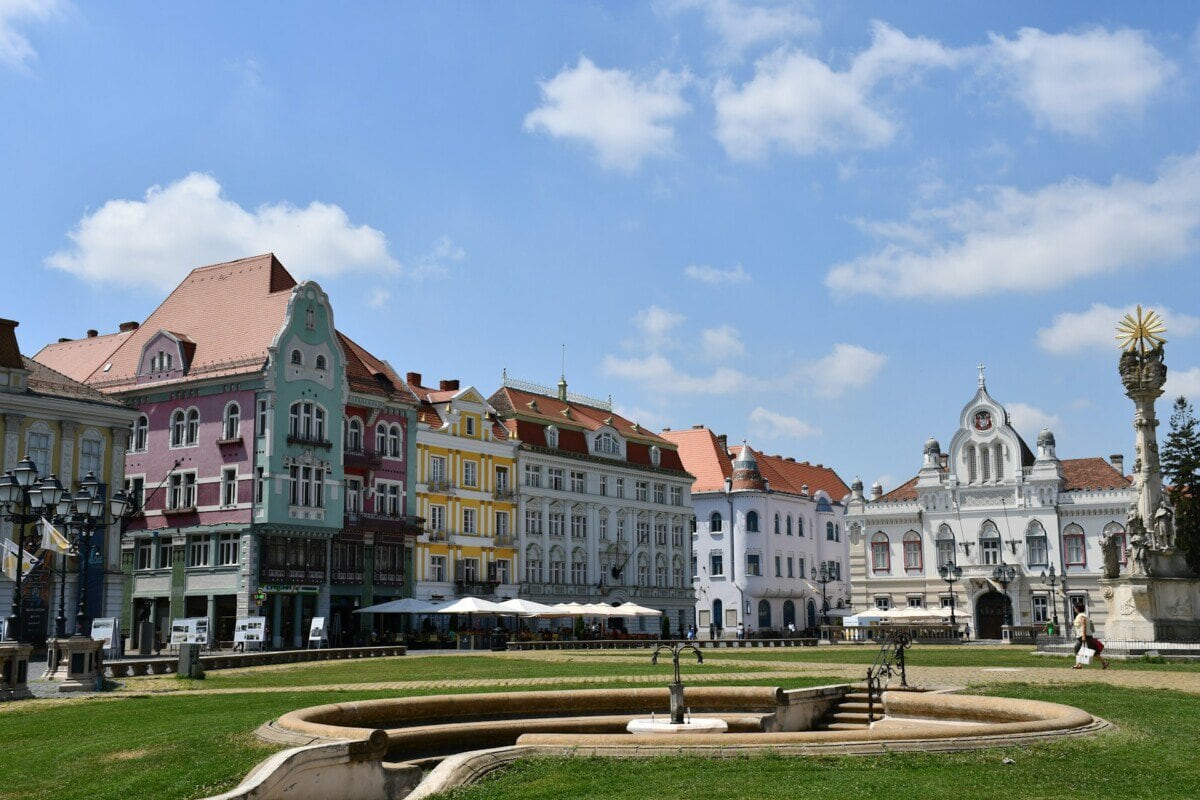
Piața Unirii is Timișoara’s baroque showpiece, a long rectangular square rebuilt after Habsburg forces retook the city from Ottoman rule in 1716, and it remains the most photogenic corner of the old town. At its centre stands the Holy Trinity Column, a plague monument raised in 1740 to mark the end of an epidemic and, with it, the start of the city’s baroque rebuilding.
The square is unusual for how many faiths sit within a few steps of each other. St. George’s Roman Catholic Cathedral, known locally as the Dom, anchors one end, the Serbian Orthodox Cathedral sits close by with one of the finest iconostases in the Banat region, and the square historically held Protestant and Jewish places of worship too, a genuine record of Timișoara’s multicultural Habsburg-era population.
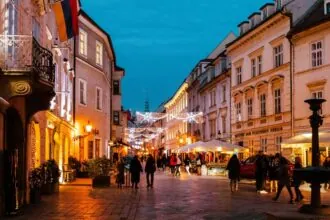
Around the edges, the long façade of the Baroque Palace, now home to an art museum, faces the old City Hall’s clock tower across the cobblestones, while merchant houses in soft pastel colours complete the square’s perimeter. Cafés and restaurants occupy many of the ground floors, making this as good a place as any to sit and take the architecture in slowly rather than rushing through.
Piața Unirii sits a five-minute walk from Piața Victoriei, connected by a short pedestrian street lined with more of the same painted facades, so the two squares are easily combined into one loop. Evening is a particularly good time to visit, when the buildings are floodlit and the square’s cafés fill with locals rather than day-trippers.
Piața Libertății (Liberty Square)
Piața Libertății is the oldest and least polished of Timișoara’s three central squares, and that rougher, more military character is precisely what makes it worth the short detour from Piața Unirii. Known in the early 1700s as Paradeplatz, the parade ground, and later as Prince Eugene Square after the Habsburg general who took the city from Ottoman control, it has carried its current name, Liberty Square, since 1848, marking that year’s revolutions across the Habsburg Empire.
The square is lined with buildings that reflect its original garrison function rather than civic grandeur. The old City Hall, built between 1731 and 1734, stands alongside the former Garrison Command and War Chancellery, and the Military Casino still shows traces of its original baroque and rococo facade beneath later classicist additions from the early 1900s.
A 2015 renovation gave the square its current red-brick paving, laid out in concentric circles, along with new lawns and seating that make it a genuinely pleasant place to pause rather than just pass through. Unlike Piața Unirii’s cafés and Piața Victoriei’s revolution history, Liberty Square’s appeal is quieter, closer to stumbling on a well-preserved military garrison town than a tourist set piece.
It takes barely twenty minutes to see properly, and sits within a couple of minutes’ walk of both Piața Unirii and the Maria Theresia Bastion, making it an easy add-on to either rather than a destination in its own right. Visiting in the early morning, before the rest of the old town wakes up, gives the best sense of how the square would have felt as a working parade ground centuries ago.
Best for long or awkward journeys. Builds one itinerary out of separate flights.
View flightsBest for short trips. Install the eSIM at home and arrive with working data, no shop queue.
Browse eSIMsBest if you would rather not work out the transport on arrival. Book it now and forget it.
View transfersThe Orthodox Metropolitan Cathedral
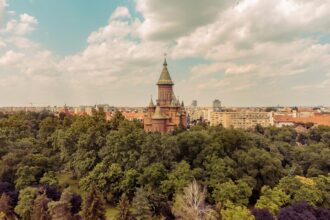
The Metropolitan Orthodox Cathedral closes the southern end of Piața Victoriei, its tall, colourfully tiled roof and neo-Byzantine towers visible from almost anywhere in the square. Built between 1936 and 1946 in a style that deliberately echoes Moldavia’s historic monastery churches, it is one of the largest Orthodox cathedrals in Romania and was designed to give the mostly Catholic, Protestant and Habsburg-influenced city a distinctly Romanian Orthodox landmark of its own.
The interior is covered almost entirely in fresco, painted across the vaults and walls in the same neo-Byzantine tradition as the exterior, and the effect on stepping inside from the bright square outside is genuinely striking, even for visitors who have already seen several of Romania’s painted churches. A small museum in the crypt holds religious artefacts and vestments, though it keeps limited hours and is easy to miss without asking at the entrance.
The cathedral’s steps carry their own weight in Timișoara’s history, since they were among the sites where the army fired on demonstrators on 17 December 1989, and a memorial plaque near the entrance marks that specific event rather than leaving it as an unspoken footnote. Visitors following the 1989 Revolution walking route described earlier in this guide will already have stopped here, but the cathedral rewards a second, unhurried look at the interior once the historical context has settled in.
Entry to the cathedral itself is free, though a modest donation is appreciated, and modest dress, covered shoulders and knees, is expected as at any working Orthodox church. It is open daily, generally from early morning until early evening, though services take priority over sightseeing and visitors should be ready to wait quietly at the back during one.
St. George’s Roman Catholic Cathedral (the Dom)
Known locally simply as the Dom, St. George’s Roman Catholic Cathedral anchors one end of Piața Unirii and ranks as the second-largest baroque religious building in southeastern Europe after the cathedral in Oradea. Construction began in 1736 under a design credited to the Viennese architect Johann Jakob Schellbauer, stalled for a year during the Austro-Turkish War, and was not formally consecrated until 1803, nearly seventy years after the foundation stone was laid.
The cathedral’s scale is easy to underestimate from outside; inside, its cross-shaped floor plan stretches 55 metres long beneath a 35.5-metre dome, built on wooden pilings because of the marshy ground beneath the old town. Nine rococo and baroque altars, carved by sculptor Johannes Müller, line the interior, and the main altar painting, completed in 1754 by Michelangelo Unterberger, remains one of the most significant baroque artworks in the region.
A crypt beneath the cathedral holds the remains of several bishops and military commanders from the city’s Habsburg era, a reminder that the Dom served both religious and civic functions for much of its history, briefly even as a military supply depot in the late 1780s. The current organ, installed in 1907 and modelled on the instrument at Paris’s Saint-Sulpice, is still used for services and occasional concerts today.
The cathedral is open to visitors outside service times, generally free to enter with donations welcomed, and pairs naturally with a visit to the Serbian Orthodox Cathedral a short walk across the same square, given how directly the two buildings illustrate Timișoara’s layered religious history. Photography is usually permitted inside, though flash and tripods are best avoided out of respect for anyone praying.
The National Romanian Opera House
The National Romanian Opera House, housed inside the grand Palace of Culture at the northern end of Piața Victoriei, is as important to Timișoara’s history as it is to its cultural life. Built between 1871 and 1875 by the Viennese firm of Fellner and Helmer, who designed dozens of theatres and opera houses across the old Austro-Hungarian Empire, the building originally combined a 1,200-seat auditorium with a hotel, a ballroom and shopfronts on the ground floor.
Fire gutted parts of the building twice, in 1880 and far more seriously in 1920, and the reconstruction that followed, overseen by Romanian architect Duiliu Marcu, rebuilt the main facade and auditorium in a neo-Byzantine style while leaving the original eclectic detailing on the side elevations. Today the auditorium seats 686 beneath a domed ceiling painted in 1926 with scenes from Romanian history and folklore, lit by a 1,200-kilogram chandelier fitted during the building’s 1888 electrification.
Beyond opera itself, the Palace of Culture uniquely houses four separate resident companies, the National Opera, the National Theatre, and dedicated Hungarian and German-language theatres, a legacy of Timișoara’s multi-ethnic population that few other Romanian cities can match. It was also, decisively, the building from whose balcony the 1989 revolutionary committee declared Timișoara free of communism on 20 December 1989, a detail that gives every performance staged here today an extra layer of significance.
Tickets for opera, theatre and concert performances are sold at the box office or online, with prices generally starting from around 40 RON (about €8/£7/$8.80) for opera and considerably less for spoken theatre, though programming and prices should always be checked directly given how much they vary by production. Even without booking a performance, the exterior and the square in front of it are worth lingering over, especially once the building is floodlit after dark.
Huniade Castle & the National Museum of Banat
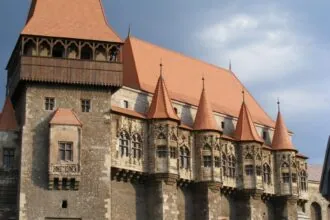
Huniade Castle, a short walk from Piața Unirii, is Timișoara’s oldest surviving building of real scale, built on the orders of Hungarian king Charles Robert of Anjou in the 1300s and later rebuilt in Gothic style under John Hunyadi in the 15th century, from whom it takes its name. What stands today is largely a 19th-century reconstruction after the original fell into ruin, but the castle’s silhouette, complete with a moat and drawbridge approach, still reads convincingly as a medieval stronghold in the heart of a baroque city.
Inside, the castle houses the National Museum of Banat, whose collection ranges from prehistoric and Roman archaeology through medieval weaponry to a substantial natural history section covering the region’s flora and fauna. The archaeology galleries are the strongest reason to visit, with genuine Dacian and Roman artefacts excavated from sites across the Banat region, though the museum’s slightly old-fashioned display style will not be to every visitor’s taste.
The museum keeps limited opening hours, Wednesday to Sunday, roughly 10:00 to 18:00, and is closed on Mondays and Tuesdays, so it is worth checking before building it into a tight itinerary. Ticket prices are modest by regional museum standards and typically include access to temporary exhibitions running alongside the permanent collection, though exact current pricing is best confirmed on arrival since it changes periodically.
Even for visitors who skip the museum itself, the castle grounds and the small square in front of it are worth a look, and the building occasionally hosts a medieval festival in summer with reenactors, craft stalls and demonstrations that bring the fortress back to life for a weekend. Combined with a visit to Piața Unirii next door, Huniade Castle fits naturally into the second half of a morning spent in the old town.
The Maria Theresia Bastion
The Maria Theresia Bastion is the single largest surviving piece of Timișoara’s Habsburg-era fortress walls, and its survival is something of an accident of practicality rather than design. Built between 1732 and 1734, originally as a ravelin used to store food, it was absorbed into the main fortification wall and renamed in 1744 after Archduchess Maria Theresa of Austria, whose reign shaped much of the city’s baroque character.
When Timișoara demolished almost all of its fortifications around the turn of the 20th century to allow the city to expand, the bastion alone was spared, simply because its thick walls contained usable rooms that were too practical to knock down. Over the following century it served in turn as a diocese headquarters, workshops, a riding school, a printing house, and eventually archive storage, a genuinely varied working life for a structure originally built for defence.
A major restoration between 2008 and 2010 stripped away later concrete repairs, preserved beams that are close to 300 years old, and converted the attic space into galleries and conference rooms. Today the bastion functions as a public passage through to the streets beyond, lined with restaurants, bars and small shops built into its thick walls, alongside two permanent exhibitions from the National Museum of Banat and the Village Museum’s ethnography collection.
It sits at the edge of the old town, within easy reach of both Piața Libertății and Piața Unirii, and the passage through it makes a genuinely atmospheric shortcut between the two rather than a detour. Evenings are the liveliest time to visit, when the bars built into the old walls fill up and the bastion’s mix of history and nightlife is at its most obvious.
The Bega Canal by Boat, Bike or on Foot
The Bega Canal, engineered in the 18th century to drain the marshland that once surrounded Timișoara and connect the city to the Danube, now runs through the centre as one of its most pleasant public spaces. A landscaped promenade follows both banks through the city, shaded by mature trees and dotted with benches, and it makes an easy, flat walk linking the old town to the Botanical Park and Queen Mary Park further south.
For those who would rather cover more ground, a dedicated cycle path runs the full length of the canal within the city and continues well beyond it, forming part of what is now the longest cycle route in Romania, stretching all the way to the Serbian border. Bikes can be rented from several points along the route, and the path is flat and well-surfaced enough to suit casual riders as much as serious cyclists.
On the water itself, the electric passenger boat Ventura, based at Splaiul Tudor Vladimirescu, runs regular one-hour cruises along the central stretch of the canal, with fares from around 50 RON (about €10/£8.50/$11) for adults and 35 RON (about €7/£6/$7.70) for children. Separately, the city’s public transport operator STPT runs occasional longer excursions from the Cathedral dock all the way to Serbia and back, a five-hour journey each way that runs only on selected summer weekends and needs booking in advance.
Whichever way it’s covered, the canal is at its best in the early evening, when the water reflects the floodlit buildings along Piața Victoriei and the promenade fills with locals rather than tourists. A gentle stroll from the old town down to the Botanical Park takes about twenty-five minutes on foot, making the canal a genuinely useful connector between sights as well as an attraction in its own right.
Best for short city stops where being central matters more than the room. Dorms and private rooms both listed.
See hostelsBest for anyone flying more than once or twice a year. Handles the compensation claim so you are not chasing the airline.
See AirHelp+Best if your room is not ready yet. Left luggage booked in advance, so you are not hunting for a locker.
Check storageThe Botanical Park
Timișoara’s Botanical Park covers around 8.4 hectares south of the old town, and while the idea for a botanical garden here dates back to 1877, the park in its current form only opened to the public in 1986, designed by architect Silvia Grumeza after she studied Bucharest’s own botanical garden for inspiration. It remains one of the city’s most popular green spaces, especially in spring and early summer when its rose beds and flowering trees are at their peak.
The park is divided into eight distinct planting zones, moving from ornamental flowerbeds and native Romanian vegetation through Mediterranean, American and Asian sections to a dedicated medicinal plant collection. More than 1,650 species were planted here between the park’s opening in 1986 and 1990 alone, and several of them cannot be found anywhere else in the city, making it as much a working collection as a place to stroll.
The park’s standout feature is a genuine Japanese garden, complete with a traditional teahouse, added in 2008 and easily the most photographed corner of the whole site. A greenhouse holds a smaller tropical collection for visitors keen to escape the Romanian climate for twenty minutes, and shaded benches throughout the park make it a genuinely restful stop after a morning spent on cobblestones in the old town.
The park is reached on foot from the centre in around twenty-five minutes, or more quickly by tram, and entry is inexpensive, typically a few lei at the gate, though hours shift seasonally and it is worth checking ahead outside the main spring and summer months. Pairing it with nearby Queen Mary Park makes for a relaxed half-day away from the historic squares.
Queen Mary Park (Rose Park)
Queen Mary Park, still commonly known by its older name, Parcul Rozelor or Rose Park, sits a short walk from the Botanical Park and offers a quieter, more locally used alternative to Timișoara’s busier green spaces. Named after Queen Marie of Romania, who reigned during the years the Banat region joined Romania after the First World War, the park has long been associated with its extensive rose collection rather than any single dramatic feature.
The layout is straightforward and unhurried: wide gravel paths wind between rose beds, mature trees and open lawn, with none of the sculpted formality of the Botanical Park’s zoned sections further along. It is a genuinely popular spot with Timișoara families at weekends, and visiting on a weekday morning is the best way to see it at its most peaceful.
Roses bloom here from late May through the summer, and the park is worth timing a visit around if flowers are the main draw, though it remains a pleasant, shaded place to walk at any time of year given the density of mature trees. Unlike several of Timișoara’s other parks, there is little in the way of formal infrastructure here beyond benches and paths, which is precisely the appeal for anyone looking for a break from sightseeing rather than another attraction to tick off.
The park sits close enough to both the Botanical Park and the Bega Canal promenade to combine easily into one longer walk, and it makes a sensible stop for anyone staying in the southern part of the city centre rather than a special-trip destination on its own. Entry is free and the park is open around the clock, though it is at its most atmospheric in the late afternoon light.
The Village Museum of Banat
The Village Museum of Banat, set inside the Pădurea Verde forest on the city’s eastern edge, is an open-air museum bringing together more than 30 original peasant houses and farm buildings relocated here from villages across the Banat region, most dating from the 19th century. Unlike a reconstruction, these are genuine historic structures, dismantled and rebuilt on site complete with period furniture, tools and textiles, giving a far more tactile sense of rural Banat life than any indoor exhibition could.
Alongside the houses, the museum includes a wooden village school, a small church, workshops for trades like weaving and pottery, and windmills, spread out across enough ground that a proper visit genuinely takes an hour and a half or more. Costumed demonstrations and craft events run periodically, particularly around traditional festivals, and are worth checking for in advance since they add considerably to what is otherwise a self-guided walk between buildings.
Admission runs to around 24 RON (about €4.80/£4.10/$5.30) for adults and 6 RON (about €1.20/£1/$1.30) for students, with preschoolers and school pupils admitted free, making this one of the better-value museum visits in the city given how much ground it covers. It ranks among Timișoara’s most highly regarded museums by visitors precisely because it offers something none of the baroque squares can, a direct look at the rural world that existed alongside the city’s grand architecture.
The museum sits within Pădurea Verde, a genuine forest popular with local joggers and cyclists, so it is easy to combine a visit with a longer walk through the woods either side. It is reached from the centre by tram in around twenty minutes, and while it sits further out than most of this guide’s other entries, it rewards the extra journey with a side of Timișoara that the old town alone does not show.

Iulius Town & Iulius Gardens
Iulius Town, east of the city centre at Piața Consiliul Europei, is a large mixed-use development combining a shopping mall, offices and a landscaped public park, and while it lacks the historic weight of the old town, it has become one of Timișoara’s most visited modern attractions in its own right. The centrepiece is Iulius Gardens, a green space built directly on top of an underground car park, which sounds unpromising but works surprisingly well in practice.
The gardens hold around 1,400 mature trees, some reaching 13 metres tall, alongside more than a hundred varieties of flowering shrubs including azaleas, hydrangeas and wisteria, arranged around a small lake and open lawns. A double-decker children’s carousel, shaded seating areas and wide promenades make it a popular spot for families in a way the more formal Botanical Park and Queen Mary Park are not.
Inside Iulius Mall, the shopping centre at the heart of the development, visitors will find a broad mix of international and Romanian retail alongside a wide choice of restaurants and cafés, useful on a day when the old town’s more traditional options don’t appeal. It is a genuinely useful stop for practical needs, a phone charger, weather-appropriate clothing or a pharmacy, as much as it is a leisure destination.
Iulius Town sits a short tram or taxi ride from the centre and works best as a half-day addition to a longer stay rather than a priority stop on a single tight day, given that everything here is modern rather than historic. Families travelling with children, or anyone simply wanting a change of pace from cobblestones and cathedrals, will get the most out of it.
The Museum of the Communist Consumer
The Museum of the Communist Consumer, tucked into a building in the Elisabetin district alongside the Scârț Loc Lejer bar and the Auăleu independent theatre, is one of Timișoara’s most distinctive small museums and a natural companion piece to the 1989 Revolution sites elsewhere in this guide. Opened in 2015 as Romania’s first museum of its kind, it recreates a typical 1970s Romanian apartment, bedroom, kitchen and bathroom included, using more than 500 genuine household objects from the communist era.
Founder Ovidiu Mihăiță spent over four years collecting the collection’s contents from friends, flea markets, basements, attics and even rubbish clearances, and the result feels far more like a lived-in time capsule than a formal exhibition. Familiar communist-era brands, packaging and appliances fill every surface, and for anyone who grew up under the regime, the museum tends to provoke genuine nostalgia rather than detached historical curiosity.
The museum shares its building with Scârț, a quirky, mismatched-furniture bar that has become something of a local institution in its own right, so a visit here naturally extends into a drink or a coffee afterwards rather than a quick in-and-out stop. According to the founder, the crowd skews toward foreign visitors during the week and local families at weekends, which makes either time worth choosing depending on which experience is preferred.
Admission is free, and the museum is open daily, making it one of the easiest additions to slot into an itinerary that already includes the revolution sites, since together they offer two very different, equally genuine views of life under Romanian communism. It sits a short walk or tram ride from the centre, in a quieter residential part of the city that is worth seeing in its own right.
Things to Do in Timișoara With Kids
Timișoara works well as a family city break, since its baroque squares are genuinely walkable with a pushchair and the heaviest of its 1989 Revolution history sits alongside plenty that is simply fun for younger visitors. Between the roses of Queen Mary Park, the Japanese garden inside the Botanical Park and the carousel already covered in the Iulius Gardens section, families rarely run short of green space to let children run around in.
For a dedicated children’s venue, Energy Kids Family Center inside Iulius Town is billed as the largest indoor play space in Romania, with soft-play structures, slides and separate zones for toddlers and older children under one roof. It sits a short walk from the Iulius Gardens carousel already described elsewhere in this guide, making the two an easy pairing for a family afternoon that doesn’t depend on the weather.
Younger children with any patience for sitting still are well served by the Merlin Children’s and Youth Theatre, a dedicated puppet and fairy-tale theatre that has staged shows for Timișoara’s youngest audiences for decades and hosted an international children’s theatre festival during the city’s 2023 European Capital of Culture year. Performances typically run as late-morning matinees rather than evening slots, and the theatre leans on visual storytelling and puppetry that works even for children too young to follow spoken Romanian closely.
The Bega Canal promenade, described in full earlier in this guide, doubles as one of the easiest stretches of the city for families, flat, shaded and free of the cobblestones that make pushchairs harder work around Piața Unirii and Piața Libertății. The Ventura boat cruise along the canal, with its own reduced children’s fare, is a genuinely relaxed way to see the city from the water without asking young legs to walk the whole route.
Public transport is straightforward for families too, since Timișoara’s tram network reaches every attraction in this section and a day pass through the STPT app works out considerably cheaper than paying per journey for a group. Where a full day is being planned around children specifically, mornings suit the Village Museum and the Memorial of the Revolution better, leaving Energy Kids Family Center or one of the parks free for a calmer, energy-burning finish to the afternoon.

Things to Do in Timișoara When It Rains
Timișoara has enough genuinely indoor attractions that a wet day here is more an inconvenience than a lost day, especially once the city’s museums are combined with a couple of options this guide hasn’t covered elsewhere. Between the National Museum of Banat, the Museum of the Communist Consumer and the Memorial of the Revolution, all detailed earlier in this guide, a rainy morning alone could be filled without repeating a single venue.
For something more active than another museum, Timișoara has a genuine cluster of escape rooms scattered around the centre, typically run for groups of two to six people over roughly an hour of puzzle-solving. Prices at the more established venues run from around 85 RON (about €17/£14.50/$18.70) per person, and booking a slot in advance is worth doing on a wet weekend when demand from other rain-dodging visitors spikes.
Iulius Mall, inside the Iulius Town development covered earlier in this guide, has its own Cinema City multiplex with twelve screens and just over 2,000 seats, including a handful of VIP auditoriums with wider reclining seats. It’s a straightforward option for an afternoon that needs filling regardless of the weather, since major releases usually run in their original language with Romanian subtitles rather than dubbed.
Timișoara’s other large retail complex, Shopping City on Calea Șagului, goes further again, pairing its own thirteen-screen Cinema City, complete with IMAX and 4DX screens, with a semi-Olympic swimming pool, a fitness centre and a food court under one roof. It sits further from the centre than Iulius Town and needs a tram or taxi to reach, but between the pool and the cinema alone it can absorb the better part of a rainy day.
For a rainy evening rather than a wet afternoon, the National Romanian Opera House, already covered in detail earlier in this guide, remains one of the best indoor options in the city, and a wet night is as good an excuse as any to check its programme before travelling. Between the museums, the two malls and a show at the Opera House, Timișoara has enough covered ground that a full day of rain rarely has to interrupt a visit.
Shopping and Markets
Timișoara’s shopping runs from a genuine morning market to two large modern malls, and while Iulius Town, covered in detail earlier in this guide, remains the obvious first stop for international retail, it is far from the only option worth knowing about. For a more local flavour, or simply a second mall with a different mix of stores, a few spots away from the old town squares are worth the short tram ride.
The most genuinely local option is Piața 700, a working market on the western edge of the old fortress district named for the 700th anniversary of Timișoara’s first documented mention in 1266. Stalls here sell fresh produce brought in directly by farmers from across the Banat region, alongside homemade cheeses, cured meats, honey and baked goods, and mornings are when the market is busiest and most atmospheric.
Back in the centre, Strada Alba Iulia is Timișoara’s main pedestrian shopping street, a car-free stretch lined with independent shops, cafés and a mix of local and international brands that makes for an easy browse between the main squares. It sits close enough to Piața Unirii and Piața Victoriei to fold naturally into a walking loop of the old town, rather than needing its own separate trip.
For a fuller shopping trip, Shopping City on Calea Șagului, already described in the rainy-day section of this guide for its cinema and pool, also holds a large Carrefour hypermarket and a Dedeman DIY store among its roughly 110 shops. It’s a genuinely different experience to the more curated Iulius Mall, closer to a suburban retail park than a city-centre shopping trip, and better suited to a specific errand than a leisurely browse.
Anyone after a more traditional souvenir rather than a shopping trip should look inside the Opera House itself, where a small gift stall sells Romanian crafts, pottery and postcards without needing a separate detour from the sights already covered in this guide. Between the market, the pedestrian street and the two malls, Timișoara covers most of what a visitor could reasonably want to buy without ever feeling like a city built primarily around shopping.
Nightlife
Timișoara’s nightlife runs noticeably deeper than its size suggests, helped along by two large universities that keep a genuine student population in the city year-round rather than just during term-time events. The result is a craft beer and bar scene that punches well above what most visitors expect from a Romanian regional city, spread across the old town, the riverside and a dedicated student district worth knowing about specifically.
Timișoara has developed a real craft beer culture in recent years, with taprooms like OneTwo Taproom and Bereta Taproom & Bottleshop pouring small-batch beers well beyond the usual Romanian lagers, often flavoured with fruit or local ingredients rather than sticking to standard styles. The Scotland Yard, closer to a traditional pub in feel, pairs its own craft selection with bar food, an easy stop for anyone who wants a proper meal alongside the drinking rather than just a bar snack.
D’Arc, a small bar group with several distinct locations around the city, runs a vintage industrial spot inside an 1821 building near Piața Unirii as well as a floating bar on the Bega, both worth seeking out for atmosphere as much as the drinks list. The bars built into the Maria Theresia Bastion, already described earlier in this guide, are another obvious stop for an evening drink, since the passage through the old walls turns naturally lively after dark.
For a genuinely different side of the city’s nightlife, Complexul Studențesc, the dedicated student district south of the Bega Canal that houses West University and Politehnica University’s dormitories, is worth the tram ride out. Its main pedestrian walkway, known locally as Aleea Studenților, Students’ Alley, is lined with bars, pubs and clubs aimed squarely at the students who live there, and it runs later and cheaper than anywhere in the old town.
Anyone who has already visited the Museum of the Communist Consumer, covered earlier in this guide, will have walked straight past Scârț, the mismatched-furniture bar that shares its building, and it remains one of the more distinctive places in the city for a first or last drink of the evening. Between the bastion’s bars, the craft beer taprooms and the genuinely separate scene out at Complexul Studențesc, a night out in Timișoara has more range to it than the city’s size would suggest.

Rupert’s Handy Travel Tips
Timișoara rewards a bit of local know-how, so here are a few things worth knowing before you set off exploring:
- Time the revolution walking route for the morning: the Memorial of the Revolution museum keeps shorter hours than the squares around it, so building the museum visit into the start of the walk avoids arriving after closing.
- Carry small RON notes for museum entry: several of Timișoara’s smaller museums, including the Village Museum and Huniade Castle, charge modest cash-friendly entry fees rather than accepting card payment at the gate.
- Wear proper shoes for the old town: the cobblestones around Piața Unirii and Piața Libertății are more uneven underfoot than they look in photographs, especially after rain.
- Check the Opera House programme before travelling: a performance ticket is one of the best-value evenings in the city, and popular shows can sell out days in advance during the autumn and spring seasons.
- Book Ventura’s Bega boat trips ahead in summer: the boat only seats 37 passengers, and weekend departures fill up quickly once the weather turns warm.
- Combine Piața Unirii and the Maria Theresia Bastion in one loop: walking through the bastion’s passage links the two without doubling back, and its bars make a natural stop between sightseeing and dinner.
Want to meet the reindeer behind our travel tips? Find out more in our page Who is Rupert?.





Frequently Asked Questions About Things to Do in Timișoara
Why is Timișoara important to the 1989 Romanian Revolution?
Timișoara is where the uprising against Ceaușescu actually began, when a vigil protecting pastor László Tőkés from eviction grew into mass protests on 16 December 1989, days before unrest reached Bucharest; the city declared itself free of communism on 20 December, before Ceaușescu fled the capital.
How many people died in Timișoara during the revolution?
More than sixty people were killed on the evening of 17 December 1989 alone, with hundreds more injured and arrested, and further deaths followed in the days after as the crackdown and later unrest continued.
Is Piața Victoriei the same place as Opera Square?
Yes, Piața Victoriei was called Piața Operei, Opera Square, until 1990, when it was renamed Victory Square to mark the revolution that began around it.
How many days do you need in Timișoara?
One focused day covers the historic centre and the main revolution sites, but two days allow proper time for the Village Museum, the Botanical Park and at least one of the city’s smaller museums.
Is Timișoara worth visiting if I’ve already been to Bucharest?
Yes, Timișoara offers a genuinely different city, closer in architectural feel to Vienna or Budapest, with a revolution history that is arguably more directly tied to its own streets and squares than Bucharest’s.
Can Timișoara be visited as a day trip from Belgrade or elsewhere?
It’s possible from Belgrade given the roughly three-hour drive across the Serbian border, though the city has enough to fill at least one full day and rewards an overnight stay rather than a rushed visit.
Further Reading
Flying into Traian Vuia Airport before any of the sights above? Our separate Timișoara Airport Transfers guide, part of this same Romania cluster, works through the express bus, taxis and every other realistic way of reaching the centre from TSR. For the wider journey into or beyond Romania, our Interrail Romania Pass: Carpathian Routes and Sleepers guide explains whether a rail pass beats buying single tickets across the country, a genuinely useful comparison for anyone combining Timișoara with Transylvania or Bucharest.
Ready to explore beyond the city itself? Our separate Day Trips from Timișoara guide covers Hunedoara’s Corvin Castle, Sibiu and the wider Banat region, including the practicalities of a day trip across the border to Belgrade. Anyone continuing on into Serbia by rail rather than road should also read our Belgrade to Bar Train guide, which covers one of the most scenic sleeper routes in the Balkans.
Timișoara’s baroque squares and coffeehouse culture invite an obvious comparison, and anyone curious how the city measures up should read our Things to Do in Vienna guide or our Things to Do in Budapest guide, both former Habsburg cities whose architecture Timișoara borrowed heavily from.
For deeper background on the events covered in this guide, Timișoara’s tourism board maintains a dedicated 1989 Revolution Trail page, with additional detail on each stop along the route and the wider historical context behind December 1989.