
Reviewed by our editorial team Updated
Why the Interrail Hungary Pass Is Worth It
The Interrail Hungary Pass is a strong choice for travellers who want to explore Central Europe at a relaxed pace while keeping rail costs predictable. Hungary has a compact but useful rail network, with routes radiating from Budapest towards historic cities, lakeside resorts, spa towns, wine regions, and border areas. That makes the pass especially helpful if you want to see more than the capital without constantly buying separate tickets.
One of the biggest reasons to choose the pass is affordability. Hungary is already one of the cheaper countries in the Interrail network, and the pass gives you a flexible way to turn that low-cost rail system into a simple travel plan. You can use it to combine Budapest, Lake Balaton, Debrecen, Szeged, Pécs, Eger, Győr, and Sopron, creating a much broader trip than a city break alone.
The pass works particularly well because Hungary’s rail system is centred around Budapest, making routes easy to understand. From the capital, you can travel west towards Lake Balaton and Austria, east towards Debrecen and the Great Hungarian Plain, south towards Szeged and Pécs, or north towards historic towns and wine regions. This spoke-style layout makes planning straightforward, especially for first-time visitors.
Flexibility is another major advantage. The Hungary Pass is a Flexi Pass, so you only use travel days when you are actually moving between destinations. This means you can spend several days enjoying Budapest’s architecture, thermal baths, ruin bars, and Danube views, then activate a pass day for a longer journey to another region. You are not wasting pass value on days when you are sightseeing in one place.
The pass is also useful for travellers combining Hungary with a wider European journey. Budapest has strong rail links towards Vienna, Bratislava, Prague, Zagreb, Bucharest, and beyond, so the Hungary Pass can work well before or after a broader Interrail route.
For travellers who want low-cost flexibility, easy rail planning, and access to Hungary beyond Budapest, the Interrail Hungary Pass is a practical and good-value way to explore the country by train.
Quick Facts and Pass Overview
The Interrail Hungary Pass gives you unlimited train travel within Hungary on a set number of travel days during a one-month period. It is designed for travellers who want to explore several parts of the country without buying individual tickets for every journey.
The pass is available as a Flexi Pass, with options for 3, 4, 5, 6, or 8 travel days within one month. On each active travel day, you can take as many eligible train journeys as you like within Hungary. This makes it possible to combine a long-distance journey with shorter connections on the same day, which can be useful when travelling between Budapest, regional cities, and smaller towns.
Coverage is centred on MÁV-START, Hungary’s national railway operator, but it is not the only operator that counts. The pass is also valid on GYSEV, known in Austria as Raaberbahn, the joint Hungarian-Austrian company that runs the line between Győr and Sopron. Between them, the two operators cover most long-distance and regional services, including InterCity trains, regional trains, and many useful domestic routes. This gives access to major destinations such as Budapest, Debrecen, Szeged, Pécs, Győr, Sopron, Miskolc, Eger, and Lake Balaton.
The pass is available for Youth travellers aged 12 to 27, Adults aged 28 to 59, and Seniors aged 60 and over. Children under 12 can often travel free when accompanied by an adult pass holder, which can make the pass especially attractive for families planning several domestic journeys.
All passes are managed digitally through the Interrail Rail Planner app. This is where you store the pass, activate travel days, add journeys, and show your ticket during inspections. The mobile format keeps everything in one place and removes the need for paper tickets.
The key thing to remember is that many InterCity trains in Hungary require seat reservations, even though the extra cost is usually low. Regional trains are generally more flexible and rarely need reservations.
Overall, the Hungary Pass is a simple, mobile-first rail pass that works best for travellers who want to explore multiple regions while keeping their itinerary flexible.
| Travel Days | Youth (12–27) | Adult (28–59) | Senior (60+) |
|---|---|---|---|
| 3 days in 1 month | €79 (£69 / $85) | €105 (£91 / $113) | €94 (£82 / $102) |
| 4 days in 1 month | €97 (£84 / $105) | €129 (£112 / $139) | €117 (£102 / $126) |
| 5 days in 1 month | €114 (£99 / $123) | €152 (£132 / $164) | €137 (£119 / $148) |
| 6 days in 1 month | €131 (£114 / $141) | €175 (£152 / $189) | €158 (£137 / $171) |
| 8 days in 1 month | €162 (£141 / $175) | €216 (£188 / $233) | €194 (£169 / $210) |
Prices are approximate and shown for guidance only. Interrail pricing can shift slightly by season and promotion, so it is always worth confirming the exact fare at checkout before booking.
See hotel options and places to stay in Hungary.
Browse hotelsExplore holiday homes and apartments around Hungary.
See holiday homesCompare hotel deals in Hungary from multiple booking sites.
Compare pricesKey Operators and Rail Network Size
The Interrail Hungary Pass is mainly valid on services operated by MÁV-START, Hungary’s national rail company. MÁV-START runs the vast majority of the country’s passenger trains, including long-distance InterCity services, regional routes, and local stopping trains. One other operator matters, though. GYSEV, known in Austria as Raaberbahn, runs the western lines including Győr to Sopron, and Interrail Passes are accepted on its Hungarian services as well. That keeps the pass easy to understand, because between MÁV-START and GYSEV almost every journey a visitor is likely to make is covered.
Hungary’s rail network covers roughly 7,500 kilometres of track, giving the country a broad and practical railway system for its size. The layout is strongly centred on Budapest, with main lines spreading out from the capital towards every major region. This makes Budapest the natural hub for domestic rail travel and the easiest base for day trips or multi-city itineraries.
The main long-distance routes connect Budapest with cities such as Debrecen, Szeged, Pécs, Győr, Miskolc, Nyíregyháza, and Sopron. These routes are particularly useful for travellers because they cover many of the country’s main cultural, university, spa, and wine destinations.
Regional trains add another layer of coverage. They connect smaller towns, rural areas, and tourist regions, including places around Lake Balaton, the Danube Bend, and historic towns such as Eger, Esztergom, and Kecskemét. These services are usually slower than InterCity trains, but they are useful for reaching destinations that are not on the main fast routes.
Some private, heritage, and narrow-gauge tourist railways are not included in the pass. These are usually specialist services rather than core transport routes, so they rarely affect standard itineraries, but they may matter if you are planning a very specific scenic or heritage rail trip.
On longer services, InterCity trains usually offer more comfortable seating, air conditioning, and faster journey times, but they often require a low-cost reservation. Regional trains are simpler, slower, and more spontaneous, making them useful for short-distance travel and flexible side trips.
Taken together, Hungary’s rail network is compact, affordable, and wide-reaching, making the Interrail Hungary Pass a practical way to explore the country beyond Budapest.
Transport Hubs and Major Routes
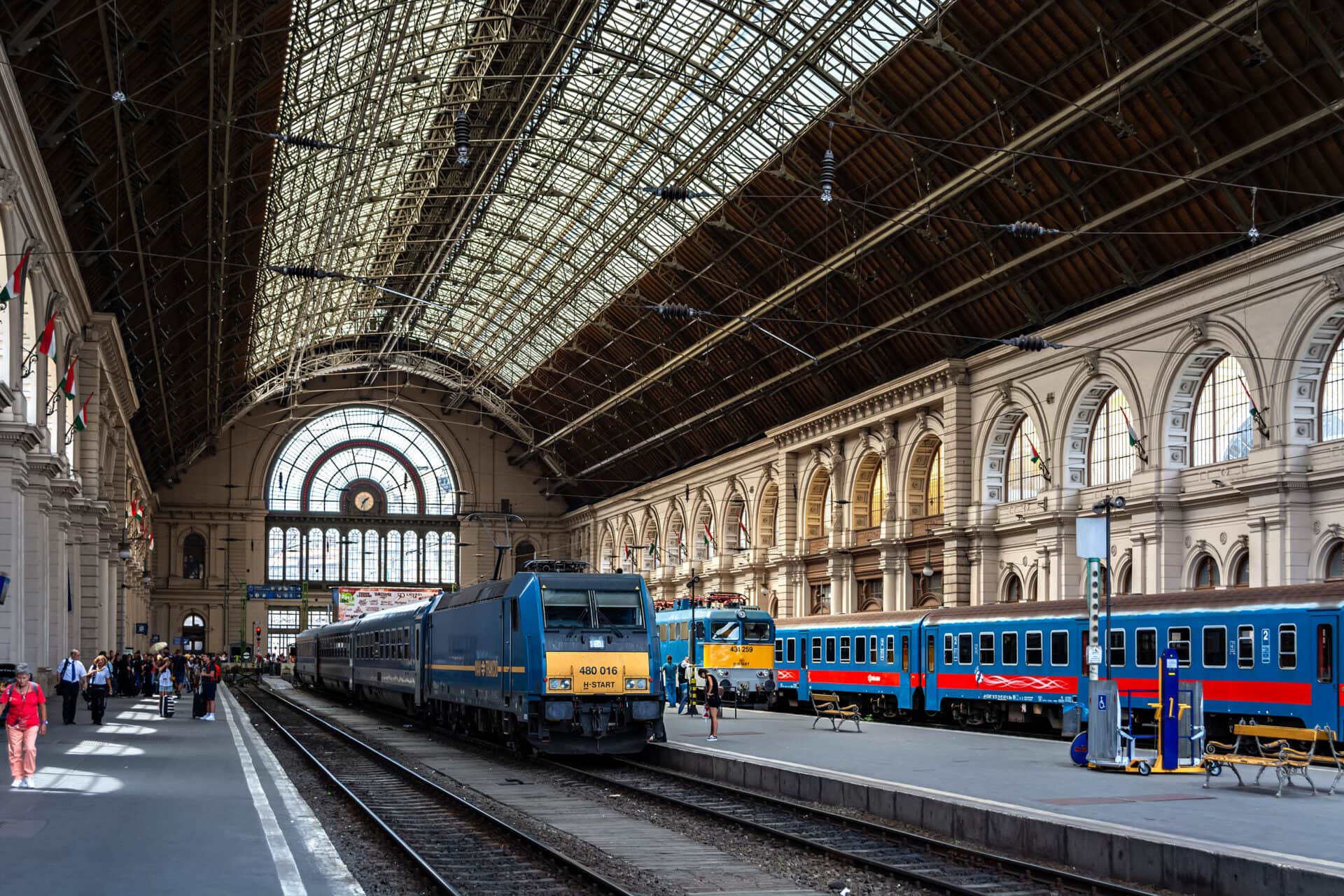
Hungary’s rail system is built around Budapest, which functions as the country’s main transport hub. The capital has several major railway stations, with Keleti, Nyugati, and Déli handling different domestic and international routes. For most Interrail travellers, Budapest will be the natural starting point, whether arriving from elsewhere in Europe or beginning a Hungary-focused itinerary.
Budapest Keleti is one of the most important stations for long-distance and international trains, with routes towards eastern Hungary, Transylvania, Austria, Slovakia, and other Central European destinations. Budapest Nyugati serves important domestic routes, including services towards Debrecen, Szeged, and the Great Hungarian Plain, while Budapest Déli is especially useful for journeys towards Lake Balaton and western Hungary.
One of the most popular domestic routes is from Budapest to Lake Balaton, often called the Hungarian Sea. Trains run towards lakeside destinations such as Siófok, Balatonfüred, and Keszthely, making the route especially important in summer. The pass is useful here because it allows you to combine lake towns without repeatedly buying separate tickets.
Other key routes include Budapest to Debrecen, which links the capital with Hungary’s second-largest city and the eastern plains, and Budapest to Szeged, a lively university city known for food, architecture, and southern character. The route from Budapest to Pécs is also valuable, taking travellers to a city known for Roman history, Ottoman heritage, wine, and a warmer, more Mediterranean feel.
Western routes are important too. Trains from Budapest towards Győr and Sopron connect travellers with attractive historic cities near the Austrian border, while also linking Hungary with wider Central European rail routes. This makes the pass useful not only for domestic exploration but also for positioning yourself before onward international travel.
The network’s hub-and-spoke structure makes Hungary easier to plan than it first appears. With Budapest at the centre and frequent routes to major destinations, the Interrail Hungary Pass allows you to explore the country through a mix of city breaks, lake trips, wine regions, spa towns, and border cities.
Budapest Night Trains and International Rail Connections
Budapest is one of the most important night train hubs in Central Europe, making the city especially valuable for travellers planning wider Interrail journeys across the continent. Overnight sleeper services connect Budapest with destinations such as Vienna, Munich, Berlin, Bucharest and Zurich, allowing travellers to cover large distances while saving valuable daytime hours for sightseeing and exploration.
Most international sleeper services depart from Budapest Keleti railway station, which functions as Hungary’s primary long-distance and international rail hub. The station plays a major role in routes linking Western Europe, the Balkans and Eastern Europe, making Budapest a natural interchange point for travellers moving between different parts of the continent.
Night trains are especially attractive for Interrail travellers because they combine transport and accommodation into a single journey. Instead of spending an entire day travelling, passengers can board in the evening, sleep onboard and arrive in another country the following morning. This makes longer European itineraries far more efficient and often reduces accommodation costs at the same time.
It is important to understand that the Interrail Hungary Pass only covers domestic rail travel within Hungary. While the pass remains valid as far as Hungarian border stations, international journeys beyond Hungary normally require either an Interrail Global Pass or separate international rail tickets. Travellers planning to continue towards countries such as Austria, Germany, Romania or Slovakia should check carefully which pass type they actually need before travelling.
Even with a Global Pass, most European sleeper trains still require additional seat reservations, couchette supplements or sleeping cabin fees. International Railjet and EuroCity services may also require reservations on some routes, particularly during busy summer periods when demand increases significantly.
Travellers using overnight services should also remember that popular sleeper routes from Budapest can become heavily booked during peak travel seasons, especially trains towards Vienna, Munich and Berlin. Booking sleeper accommodation in advance is strongly recommended if you want private cabins or more comfortable couchette options.
For detailed route breakdowns, sleeper types, reservation advice and onboard expectations, read our full Budapest Night Trains Guide, which explains how to use Budapest as a major overnight rail hub for Central and Eastern Europe.

Example Ticket Prices vs Pass Value
The Interrail Hungary Pass can offer good value because Hungary’s rail fares are low, but repeated journeys still add up quickly. The pass is not just about beating one expensive ticket. It is about giving you predictable costs, flexible travel days, and the freedom to explore beyond Budapest without checking prices every time you move.
A typical one-way Budapest to Debrecen InterCity ticket often costs around €13 to €18 (£11 to £16 / $14 to $19, roughly 5,135 to 7,110 HUF), which means a return journey can reach roughly €26 to €36 (£23 to £31 / $28 to $39, roughly 10,270 to 14,220 HUF). A return from Budapest to Szeged can add another €14 to €20 (£12 to £17 / $15 to $22, roughly 5,530 to 7,900 HUF), while a longer journey towards Pécs can cost around €16 to €22 one way (£14 to £19 / $17 to $24, roughly 6,320 to 8,690 HUF). On their own, these fares are manageable, but they become more meaningful once you combine several cities in one trip.
Lake Balaton is a good example of where the pass can also add convenience. Tickets from Budapest to Siófok or Balatonfüred are usually inexpensive, often around €7 to €10 each way (£6 to £9 / $8 to $11, roughly 2,765 to 3,950 HUF), but travellers often make several journeys around the lake or combine the lake with other cities. In that case, the pass reduces the need to keep buying individual tickets and makes the itinerary easier to manage.
The pass becomes most useful when you plan three or more longer domestic journeys within a short period. A trip that combines Budapest, Debrecen, Szeged, Pécs, Lake Balaton, and Győr can quickly approach or exceed the price of a shorter pass, especially once you factor in return journeys and regional connections.
Flexibility is also part of the value. If you want to adjust your plans because of weather, local events, train times, or a recommendation you pick up during the trip, the pass gives you room to do that without restarting the ticket-buying process.
In practical terms, the Hungary Pass works best for travellers who want to explore several regions, not those staying mostly in Budapest. If you are making only one short day trip, ordinary tickets may be cheaper. If you want a flexible rail-based itinerary across the country, the pass becomes much easier to justify.
Interrail Hungary Pass Prices and Options
The Interrail Hungary Pass is available as a Flexi Pass, giving you a set number of travel days to use within one month. On each travel day, you can take unlimited eligible train journeys within Hungary, which makes the pass useful for both long-distance travel and multi-stop regional days.
There are five main options. The 3-day pass within one month costs around €79 Youth (£69 / $85, about 31,205 HUF), €105 Adult (£91 / $113, about 41,475 HUF), and €94 Senior (£82 / $102, about 37,130 HUF), making it a practical choice for travellers combining Budapest with two or three other destinations. The 4-day pass is priced at approximately €97 Youth (£84 / $105, about 38,315 HUF), €129 Adult (£112 / $139, about 50,955 HUF), and €117 Senior (£102 / $126, about 46,215 HUF), while the 5-day pass costs around €114 Youth (£99 / $123, about 45,030 HUF), €152 Adult (£132 / $164, about 60,040 HUF), and €137 Senior (£119 / $148, about 54,115 HUF) respectively.
For longer itineraries, the 6-day pass costs around €131 Youth (£114 / $141, about 51,745 HUF), €175 Adult (£152 / $189, about 69,125 HUF), and €158 Senior (£137 / $171, about 62,410 HUF), giving enough flexibility to combine major cities with Lake Balaton or wine regions. The 8-day pass is the most extensive option, costing approximately €162 Youth (£141 / $175, about 63,990 HUF), €216 Adult (£188 / $233, about 85,320 HUF), and €194 Senior (£169 / $210, about 76,630 HUF), and is best suited to travellers planning a broader rail journey across the country.
The best choice depends on how widely you plan to travel. A shorter pass works well if you want to add Lake Balaton, Debrecen, or Szeged to a Budapest stay. A mid-range pass is better if you want to include Pécs, Eger, Győr, or Sopron. The longest option makes most sense if you want to explore Hungary in depth and move across several regions at a relaxed pace.
Children under 12 can often travel free when accompanied by an adult pass holder, which can make the pass especially good value for families. However, it is still worth checking the latest child travel rules before booking.
Overall, the Hungary Pass is one of the more affordable Interrail One Country Passes and is best viewed as a low-cost flexibility product for travellers who want to see more than Budapest.
How the Hungary Pass Works
The Interrail Hungary Pass is designed to make domestic rail travel easier by replacing multiple individual tickets with one digital pass. After purchase, the pass is stored in the Interrail Rail Planner app, where you manage travel days, add journeys, and show your ticket during inspections.
The pass is valid for one month from activation, and within that month you can use the number of travel days you selected. A travel day runs from midnight to midnight, and during that period you can take as many eligible trains as you like within Hungary. This means you could travel from Budapest to Debrecen, continue to another eastern destination, and return later the same day if the timetable works.
Before boarding, you add your train journey to the app and activate the relevant travel day. The app then generates a QR code, which conductors scan on board. This keeps the process simple and removes the need to carry paper tickets.
The pass covers most services operated by MÁV-START, including long-distance InterCity trains and regional services. The main point to remember is that many InterCity trains require a seat reservation, which is separate from the pass. These reservations are usually inexpensive, often around €1 to €3 (£1 to £3 / $1 to $3, roughly 395 to 1,185 HUF), but they are important because travelling without one on a compulsory-reservation service can cause problems.
Regional trains are usually easier to use spontaneously. They rarely require reservations, so they are useful for shorter trips, small-town visits, and flexible day journeys. This makes the pass work best when you combine planned InterCity travel with more relaxed regional exploration.
The Hungary Pass also covers domestic journeys to border stations, but it does not cover onward international travel beyond Hungary. For that, you would need a Global Pass or a separate ticket.
In practice, the pass works as a simple digital travel tool for exploring Hungary by rail, giving you structure where needed and flexibility where possible.
Search flights and useful route combinations for your trip.
View flightsUse an eSIM to get online without hunting for a local SIM after arrival.
See eSIM optionsArrange a private airport pickup for your trip to Hungary.
Check transfersWhere You Can Travel with the Hungary Pass
The Interrail Hungary Pass gives access to most of Hungary’s national rail network, making it possible to explore far beyond Budapest. Because the network radiates from the capital, it is easy to build trips that start in Budapest and branch out towards lakes, historic towns, wine regions, and border cities.
One of the most popular areas covered by the pass is Lake Balaton, Hungary’s best-known summer destination. Trains run from Budapest towards Siófok, Balatonfüred, and Keszthely, giving access to both the southern and northern shores. This is especially useful in summer, when the lake becomes one of the country’s main holiday regions.
Eastern Hungary is also well connected. The pass covers routes to Debrecen, Hungary’s second-largest city, as well as onward destinations such as Nyíregyháza and the Great Hungarian Plain. These journeys show a different side of the country, with wider landscapes, thermal spa culture, and fewer international crowds.
To the south, the pass can take you to Szeged, known for its food culture, Art Nouveau architecture, and university atmosphere, as well as Pécs, a city with Roman ruins, Ottoman heritage, vineyards, and a more relaxed southern feel. Both destinations are strong choices for travellers who want to balance Budapest with regional culture.
In western Hungary, routes to Győr and Sopron are useful for both sightseeing and onward travel. These cities have attractive historic centres and sit close to Austria, making them practical stops before or after a wider Central European journey.
Smaller destinations such as Eger, Esztergom, and Kecskemét can also be reached by rail, giving you access to wine, religious heritage, traditional architecture, and quieter local experiences.
Overall, the Hungary Pass allows you to build a varied itinerary that includes Budapest, Lake Balaton, regional cities, spa towns, wine regions, and border connections, all under one flexible rail pass.
How to Buy the Interrail Hungary Pass
Buying the Interrail Hungary Pass is a straightforward digital process and can be completed in just a few minutes. The simplest option is to purchase directly from the official Interrail website, where you will always find the latest prices, pass options, and any seasonal promotions. Once your purchase is complete, you receive a confirmation email along with a pass code that can be loaded into the Rail Planner app.
You can also buy the pass through authorised resellers such as Rail Europe or ACP Rail, which sometimes bundle passes with additional travel services. Pricing is usually similar, so the main difference comes down to whether you want to combine the pass with other bookings at the same time.
The Hungary Pass is issued as a mobile ticket, meaning there is no paper version to collect. After loading it into the app, your ticket is stored on your device and displayed as a QR code during ticket inspections. This makes the pass easy to manage and removes the risk of losing physical tickets while travelling.
When purchasing, you select your fare category and number of travel days, ranging from 3 to 8 days within one month. The pass does not need to be used immediately, as it can be activated within 11 months of purchase, giving you flexibility when planning ahead.
Payment is simple, with most major credit cards, debit cards, and PayPal accepted. Refunds and exchanges are generally possible before activation, although policies vary depending on where you buy the pass.
Buying in advance ensures you arrive in Hungary ready to travel, with time to plan routes, check timetables, and arrange any required reservations for InterCity trains.

Explore Europe by Train with Rail Passes
Travelling by train in Europe can quickly become expensive if you book individual tickets. Rail passes offer a flexible way to travel across one or multiple countries with a single ticket, making it easier to plan your journey.
Rail Europe allows you to compare and buy a wide range of rail passes, including Interrail-style options, helping you choose the best pass for your route and travel style.
Top Routes and Itineraries with the Hungary Pass
The Interrail Hungary Pass is best used to build itineraries that combine Budapest with regional exploration, rather than focusing on just one destination. The network is compact enough to allow multiple cities to be covered in a relatively short time.
A classic itinerary begins in Budapest, followed by a trip to Lake Balaton. Travellers can head to Siófok or Balatonfüred for lakeside relaxation, then continue around the lake to Keszthely before returning to the capital. This route is especially popular during the summer months.
Another strong option focuses on eastern Hungary. Travelling from Budapest to Debrecen, and possibly onward to Nyíregyháza, offers a look at the Great Hungarian Plain, with thermal spas, local cuisine, and a more traditional atmosphere compared to the capital.
For a cultural route, heading south to Szeged and Pécs provides a different perspective. Szeged offers a vibrant student atmosphere and strong food culture, while Pécs is known for its Roman ruins, Ottoman heritage, and wine regions. This combination works particularly well for a mid-length pass.
Wine-focused travellers can build a route through Eger and Tokaj, both known for their historic vineyards and regional character. These destinations are slightly quieter than the main cities and offer a strong contrast to Budapest.
Western Hungary also provides useful routes. Travelling from Budapest to Győr and Sopron gives access to attractive historic towns near the Austrian border, making it easy to combine Hungary with wider Central European travel.
The key to using the Hungary Pass effectively is to combine a small number of well-chosen destinations, rather than trying to cover everything. This approach allows you to enjoy both the journeys and the destinations at a comfortable pace.
Seat Reservations and Supplements
The Interrail Hungary Pass is easy to use, but it is important to understand how seat reservations work, particularly on long-distance trains.
Most regional trains in Hungary do not require reservations. You can simply board with your activated pass, find an available seat, and show your ticket when asked. This makes regional travel highly flexible and well suited to spontaneous day trips.
InterCity trains are different. These services connect Budapest with major cities such as Debrecen, Szeged, Pécs, and Miskolc, and they usually require a seat reservation. The cost is low, typically around €1 to €3 per journey (£1 to £3 / $1 to $3, roughly 395 to 1,185 HUF), but it is compulsory. Travelling without a reservation on these services can result in a fine or being asked to move.
Reservations can be made through MÁV, at station ticket offices, or online depending on availability. Booking in advance is recommended for busy routes, particularly during weekends and summer travel periods.
Trains to Lake Balaton now have their own tiered reservation system during the peak summer season, running roughly from late June to late August. MÁV-START charges a small, comfort-based fee rather than a flat rate, so a standard second-class seat costs less than a first-class or premium air-conditioned seat, and this applies even to services that would otherwise not require a reservation outside peak season. It is worth checking the MÁV app or a station office for the current Balaton fee before travelling in summer, since it can catch pass holders out if they assume regional trains are always reservation-free.
Additional supplements within Hungary are minimal. Standard travel is included in the pass, and there are no major high-speed surcharges like those found in some Western European countries. If you choose to travel in first class, you may need to pay a small upgrade fee, but this is optional.
Night trains within Hungary are limited, but if used, they may require extra payment for couchettes or sleeping berths. These are optional upgrades rather than mandatory costs.
Overall, the Hungary Pass remains one of the simpler Interrail options, with low reservation costs and very few additional fees, making it easy to budget for your trip.
Benefits of the Interrail Hungary Pass
The Interrail Hungary Pass offers a combination of affordability, flexibility, and ease of use that makes it particularly attractive for travellers exploring Central Europe.
One of the biggest advantages is cost. Hungary is already a low-cost rail country, and the pass allows you to turn that into a structured and predictable travel plan. For travellers making several journeys, the pass often represents good value compared to buying multiple individual tickets.
Flexibility is another key strength. With travel days spread across a month, you can explore Budapest at your own pace, then use the pass to reach other destinations when it suits your itinerary. This makes it easier to balance sightseeing days with travel days without wasting value.
Coverage is also strong. The pass works across most of the MÁV-START network, giving access to major cities, lake destinations, wine regions, and smaller towns. This allows you to build a varied itinerary without needing to plan every detail in advance.
Convenience plays an important role as well. The pass is fully digital, stored in the Rail Planner app, and easy to activate. This removes the need to queue for tickets, deal with language barriers, or manage multiple bookings.
The Hungary Pass is also well suited to wider European travel. Because Budapest is a major rail hub, the pass can be combined with international journeys to neighbouring countries, making it a useful part of a larger itinerary.
Overall, the Hungary Pass delivers low-cost flexibility, simple travel planning, and broad coverage, making it a strong option for travellers who want to explore Hungary beyond the capital.
Drawbacks and Limitations
The Interrail Hungary Pass offers strong value, but it is not the perfect fit for every type of trip. The most noticeable limitation is the requirement for seat reservations on most InterCity trains. While the cost is low, typically around €1 to €3 (£1 to £3 / $1 to $3, roughly 395 to 1,185 HUF), it does add a small layer of planning, especially on busy routes where trains can fill up.
Another consideration is that the pass is most effective when you are travelling between multiple destinations. If your itinerary is centred mainly on Budapest with only one short day trip, individual tickets will often be cheaper. Hungary’s domestic fares are already low, so the pass becomes worthwhile only when you begin to combine several journeys.
Coverage is strong, but not complete. The pass applies to services operated by MÁV-START and GYSEV, and it does not include heritage railways, narrow-gauge tourist lines, or other non-standard transport. Some destinations, particularly in rural or tourist-heavy areas, may require bus connections or separate tickets to complete the journey.
The size of the network is also a factor. Hungary is relatively compact, and most major routes take two to three hours. This is convenient, but it means you do not get the same variety of long-distance or dramatic rail journeys found in countries such as Switzerland or Italy. Travellers looking for extended scenic train experiences may find the network more functional than spectacular.
Seasonal demand can affect travel as well. Routes to Lake Balaton can become very busy in summer, which makes reservations more important. At other times of year, some services may run less frequently, particularly on regional lines.
In practical terms, the Hungary Pass works best when you treat it as a tool for multi-destination travel across the country, rather than a necessity for short or single-city trips.
Compare hostels and lower-cost places to stay in Hungary.
Search hostelsAccess compensation support, eligible lounge benefits and faster payouts when flights go wrong.
See the benefitsArriving before check-in or leaving later? Store your luggage and make more of your time in Hungary.
Store your bagsWho the Interrail Hungary Pass Is Best For
The Interrail Hungary Pass is best suited to travellers who want to go beyond Budapest and explore several regions within a single trip. It works particularly well for those who value flexibility and prefer not to manage multiple individual tickets.
Youth travellers and backpackers are among the strongest beneficiaries. With discounted pricing and a flexible structure, the pass allows them to move between Budapest, Lake Balaton, Debrecen, Szeged, Pécs, and other cities without needing to pre-book every journey. This makes it ideal for a more spontaneous style of travel.
The pass is also a good fit for seniors, who benefit from reduced fares and the ability to travel at a more relaxed pace. With journeys typically lasting only a few hours, it is easy to combine cultural cities, spa towns, and wine regions without long or tiring travel days.
Families can also find value, particularly because children under 12 often travel free when accompanied by an adult. This makes multi-city travel more affordable and simplifies logistics when moving between destinations.
Travellers combining Hungary with neighbouring countries can use the pass as part of a wider plan. Budapest’s strong rail connections to Vienna, Bratislava, and beyond mean the Hungary Pass can be used alongside a broader Interrail itinerary or as a focused segment within a longer journey.
The pass is less suited to travellers who plan to stay in Budapest only, or those making just one or two short trips. In those cases, individual tickets are usually more cost-effective.
Overall, the Hungary Pass is best for travellers who want flexible, multi-stop exploration across Hungary, rather than a single-destination visit.
Practical Tips for Using the Hungary Pass
Getting the most from the Interrail Hungary Pass comes down to using it in a way that balances planning with flexibility. The network is reliable, but a few simple habits can make your journey smoother.
Booking seat reservations early is important for InterCity trains. While they are inexpensive, they are compulsory on many routes, and popular services between Budapest and cities such as Debrecen, Szeged, and Pécs can fill up. Reserving a seat in advance avoids last-minute issues and ensures you travel at your preferred time.
Regional trains are useful for maintaining flexibility. They usually do not require reservations, making them ideal for shorter journeys and spontaneous trips to towns such as Eger or Esztergom. They are slower than InterCity services, but they allow more freedom in your daily plans.
Using your travel days strategically helps maximise value. It makes sense to use pass days for longer or more expensive journeys, while shorter routes can sometimes be cheaper with individual tickets. This approach allows you to stretch the value of the pass across your trip.
Travelling outside peak commuter hours can improve comfort. Trains tend to be busiest in the early morning and late afternoon, so choosing mid-morning or early afternoon departures often results in quieter carriages and a more relaxed journey.
Exploring beyond the main highlights is another advantage of the pass. While Budapest and Lake Balaton are popular, destinations such as Sopron, Kecskemét, or smaller regional towns offer a different experience with fewer crowds.
Finally, it is worth preparing for longer journeys by bringing food and water. While some InterCity trains offer catering, regional services often do not, and having supplies on hand makes travel more comfortable.
With these simple adjustments, the Hungary Pass becomes a flexible and efficient way to explore the country.
Essential Apps for Train Travel in Hungary
Using the right apps alongside the Interrail Hungary Pass makes travelling easier, particularly when managing schedules, reservations, and local transport connections.
The Rail Planner app is essential, as it stores your pass, allows you to activate travel days, and generates the QR code used for ticket inspections. It also provides timetable information, making it the core tool for planning your journeys.
For real-time updates and local information, the MÁV app is extremely useful. It offers detailed schedules, platform information, and updates on delays within Hungary’s rail network. This complements the Rail Planner app by providing more localised detail.
For broader trip planning, apps such as Google Maps help you connect train journeys with walking routes, public transport, and local navigation, especially within Budapest.
Booking and comparison platforms like Trainline and Omio can also be useful, particularly when arranging seat reservations or comparing options for international journeys beyond Hungary.
For local transport in Budapest, dedicated city transport apps can help you navigate metro, tram, and bus networks, which are not covered by the Interrail pass but are essential for moving between stations and attractions.
Using a combination of these tools ensures your journey is well planned, flexible, and easy to manage, whether you are travelling between major cities or exploring smaller destinations.


App availability and prices vary by country. Some of these may not appear in your local App Store or Google Play.

Rupert’s Handy Travel Tips
I’ve hopped around Hungary a few times now, and here’s what I’d want you to know before you set off.
- Base yourself in Budapest: almost every line radiates out from the capital, so it’s the easiest place to sleep while you day trip or take longer loops out to the regions.
- Don’t skip Lake Balaton: it’s an easy train ride from Budapest and makes a brilliant one or two day break from the city, especially if you catch it outside the busiest weekends.
- Book your InterCity seat early: MÁV-START reservations are cheap, but the popular routes to Debrecen, Szeged and Pécs do fill up, so sort it a day or two ahead if you can.
- Try a spa town detour: Hungary’s thermal bath culture isn’t just a Budapest thing, smaller towns along the network have their own quieter baths worth a stop.
- Save a day for wine country: Eger and Tokaj are both reachable by rail and give you a completely different pace from the cities, cellar visits and all.
Want to meet the reindeer behind our travel tips? Find out more in our page Who is Rupert?.


Frequently Asked Questions about the Interrail Hungary Pass
Do I need to reserve seats on Hungarian trains?
Yes, for most InterCity trains, seat reservations are mandatory and cost around €1 to €3 (£1 to £3 / $1 to $3, roughly 395 to 1,185 HUF). Regional trains usually do not require reservations, so you can just board with your pass.
Can I use the pass for international journeys?
The Hungary Pass covers only domestic routes within Hungary. You can travel as far as border stations, but onward international travel (e.g., to Austria or Slovakia) requires a separate ticket or a Global Pass.
Is the pass available in paper format?
No. The Hungary Pass is issued only as a mobile pass via the Interrail Rail Planner App. This makes it easy to activate travel days, add trips, and show your ticket digitally.
What age groups qualify for discounts?
Youth travellers (12–27) and seniors (60+) receive discounted rates. Children under 12 often travel for free when accompanied by an adult, but it’s best to confirm before booking.
How many journeys can I make in one travel day?
As many as you like, provided they are within Hungary. A travel day lasts from midnight to midnight, so you could take multiple regional and long-distance trains on the same day.
When is the best time to use the Hungary Pass?
The pass is valid year-round, but the most popular season is summer, especially for trips to Lake Balaton. Spring and autumn are quieter and often more comfortable for travel.
Further Reading & Related App Guides
Planning a trip to Budapest or exploring more of Hungary? These guides cover transport, major attractions, day trips and travel planning to help you make the most of your visit. For getting around, the Budapest Metro Guide covers the underground network, while the Budapest Airport Transfers Guide compares transport options from the airport. If you’re heading onward, the Budapest Hop-On Hop-Off Bus Tours Guide is a handy way to explore the city, and the Budapest to Vienna Travel Guide covers travel between two Central European capitals.
For Budapest’s top attractions and experiences, the Budapest Parliament Tours Guide covers the Hungarian Parliament building, the Budapest River Cruises Guide shows you the city from the Danube, and the Budapest Thermal Baths Guide explores Hungary’s famous thermal spas. To see whether it’s worth bundling several of these together, check the Budapest Card Guide.
Looking further afield, Best Day Trips from Budapest rounds up the best excursions outside the city, and the Debrecen Travel Guide introduces Hungary’s second largest city.











