Reviewed by our editorial team Updated
Why Travel with Leo Express
Leo Express trains occupy a unique position in the European rail market. While many private operators focus on a single country, Leo Express has quietly built a network spanning Germany, Czechia, Slovakia, and Poland, creating direct international journeys that would have required multiple tickets and several changes only a few years ago.
For travellers, the biggest advantage is simplicity. A passenger can board at Frankfurt Airport, travel through Dresden, Prague, Olomouc, and Ostrava, before continuing to Kraków or even Przemyśl near the Ukrainian border without changing trains. Few operators in Europe offer such a long direct route crossing three countries and linking major tourist destinations along the way.
The network is particularly useful for travellers exploring Central Europe. Instead of relying on flights between cities such as Prague, Bratislava, Kraków, Warsaw, or Košice, passengers can travel directly between city centres while enjoying modern trains, onboard Wi-Fi, power sockets, and multiple travel classes. The result is a rail network that feels designed for travellers rather than commuters.
What makes Leo Express especially interesting is that it serves routes often overlooked by larger operators. The company connects visitors directly to the High Tatras, eastern Slovakia, southern Poland, and smaller Czech cities that frequently require additional changes when using national railway networks. For many travellers, that convenience alone makes the operator worth considering.
| Feature | Details |
|---|---|
| Operator | Leo Express |
| Founded | 2010 |
| Headquarters | Prague, Czechia |
| Countries Served | Germany, Czechia, Slovakia, Poland |
| Main Hub | Prague |
| Key Interchange | Ostrava |
| Longest Direct Route | Frankfurt Airport – Przemyśl |
| Capital Cities Served | Prague, Bratislava, Warsaw |
| Major Tourist Cities Served | Kraków, Dresden, Leipzig, Košice |
| High Tatras Access | Yes (via Poprad-Tatry) |
| Airport Served | Frankfurt Airport |
| Travel Classes | Economy, Economy Plus, Business, Premium |
| Mobile App | Yes |
| Wi-Fi Available | Yes |
| Power Sockets | Yes |
| Food & Drink Service | Yes |
| Interrail Accepted | Yes (reservations may apply) |
| Best For | Central Europe rail travel |
| Website | leoexpress.com |
Network Map For Leo Express
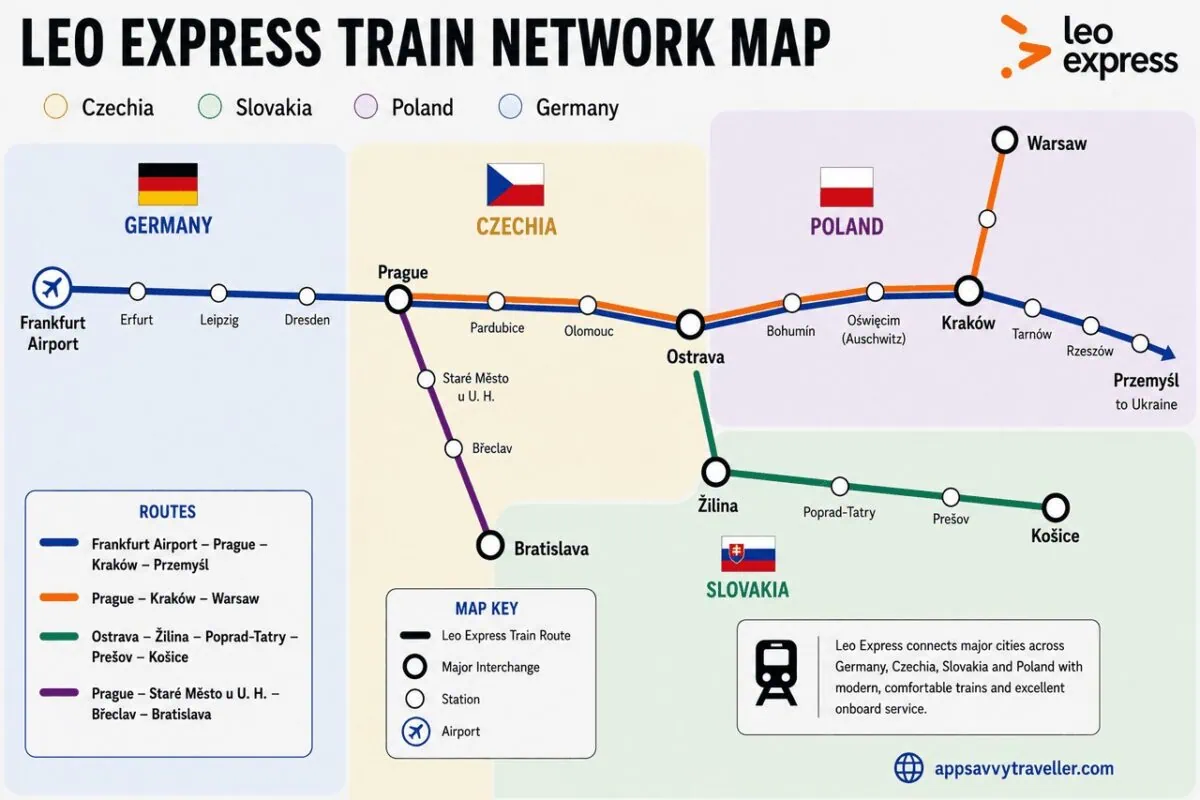
The western edge of the network begins at Frankfurt Airport, one of Europe’s largest aviation hubs. From there, trains pass through Erfurt, Leipzig, and Dresden before reaching Prague, the operational heart of the network. Beyond Prague, routes spread east towards Ostrava, which functions as the system’s most important interchange point.
From Ostrava, travellers can continue north-east towards Kraków, Warsaw, and Przemyśl, or head south-east towards Žilina, Poprad-Tatry, Prešov, and Košice. A separate branch links Prague with Bratislava, while regional services operate within Slovakia itself. The result is a network that effectively covers much of Central Europe’s most popular travel corridor.
The map also highlights something many timetables fail to show clearly. Several routes overlap for long distances, meaning passengers often benefit from multiple daily departures along key sections. The corridor between Prague and Ostrava is particularly well served, making it one of the most flexible parts of the network for spontaneous travel.
Browse hotels and accommodation for your journey.
View staysExplore holiday homes and apartments for your trip.
See holiday homesCompare prices from multiple hotel booking sites.
Check dealsRoutes Worth Knowing
The flagship journey is undoubtedly Frankfurt Airport to Przemyśl, one of the longest direct services operated by any private rail company in Europe. Travelling through Germany, Czechia, and Poland, the train links major cities, international airports, tourist destinations, and regional centres in a single journey. It operates overnight, with air-conditioned couchette compartments available for the full route, making it possible to sleep through most of the crossing rather than sitting up for the entire 1,300 km journey. For travellers heading towards eastern Europe, it offers a genuinely unique alternative to flying.
Equally important is the route between Prague and Kraków, which has become one of the most popular international rail journeys in Central Europe. The train connects two of the region’s most visited cities and avoids the hassle of airports, baggage restrictions, and lengthy transfers. For tourists planning a multi-country itinerary, it is often one of the easiest routes to incorporate.
The service between Prague and Warsaw extends this concept further. Direct trains link the Czech and Polish capitals while serving important intermediate destinations including Kraków. Meanwhile, travellers heading for the mountains can use services to Poprad-Tatry, providing direct access to the High Tatras without complicated connections.
The route to Bratislava deserves special mention. While there are several ways to travel between the Czech and Slovak capitals, Leo Express provides a comfortable direct option that also serves destinations such as Olomouc, Přerov, Staré Město, and Břeclav. For many travellers, it offers one of the most straightforward ways to move between the two countries.
| Route | Approximate Journey Time | Highlights |
|---|---|---|
| Frankfurt Airport – Przemyśl | 17h 56m | Germany, Czechia & Poland on one train |
| Prague – Warsaw | 9h 22m | Two capitals plus Kraków |
| Prague – Bratislava | 5h 33m | Direct Czech–Slovak capital connection |
| Ostrava – Košice | 6h 18m | High Tatras and eastern Slovakia |
Frankfurt Airport to Przemyśl
At approximately 17 hours 56 minutes, the route between Frankfurt Airport and Przemyśl is the longest service on the Leo Express network and one of the most remarkable journeys operated by any private rail company in Europe. Crossing Germany, Czechia, and Poland, the train links major airports, capital cities, tourist destinations, and regional hubs without requiring passengers to change trains.
The journey begins beneath the terminals of Frankfurt Airport, one of Europe’s busiest aviation hubs. From there, trains head east through Fulda, Erfurt, Leipzig, and Dresden before crossing into Czechia. After serving Prague, the route continues through Pardubice, Olomouc, and Ostrava, following the backbone of the Czech rail network towards Poland.
East of Ostrava, the train serves Kraków, one of the most visited cities in Central Europe and a destination that alone attracts millions of travellers each year. However, the journey does not end there. Continuing across southern Poland, the train reaches Przemyśl, a historic city close to the Ukrainian border that has become an increasingly important gateway to Eastern Europe.
For travellers arriving from long-haul flights into Frankfurt, this service offers something unique. Instead of transferring to another flight or navigating multiple rail operators, passengers can board a single train and travel deep into Central Europe while enjoying comfortable seating, Wi-Fi, and spectacular scenery along the way. It is a route that feels less like transport and more like a cross-continental rail adventure.
Prague to Warsaw
Taking approximately 9 hours 22 minutes, the route between Prague and Warsaw connects two of Central Europe’s most important capitals while also linking several of the region’s most significant cities. It is one of the easiest ways to travel between the Czech Republic and Poland without dealing with airports, baggage restrictions, or lengthy transfers.
After departing Prague, trains head east through Pardubice, Olomouc, and Ostrava, passing through the heart of Czechia before crossing the border into Poland. The route then continues via Kraków, allowing travellers to combine two of Central Europe’s most popular city-break destinations on a single journey.
The section between Kraków and Warsaw provides access to Poland’s political, economic, and cultural centre. For international visitors, this makes the route particularly attractive because it combines several major destinations on one direct service. A traveller could easily spend time in Prague, continue to Kraków, and finish in Warsaw without needing to learn multiple booking systems or navigate complex connections.
Although flying may appear quicker on paper, the train offers a city-centre-to-city-centre experience that often proves far more convenient. With the ability to work, relax, move around freely, and enjoy the changing scenery, many travellers find the journey itself becomes an enjoyable part of the trip rather than simply a means of reaching their destination.

Prague to Bratislava
With a journey time of approximately 5 hours 33 minutes, the route between Prague and Bratislava is one of the simplest and most convenient international rail journeys in Central Europe. Linking the capitals of Czechia and Slovakia, it remains an important route both for business travellers and tourists exploring the region.
Leaving Prague, trains travel through Pardubice, Olomouc, and Přerov before turning south towards Staré Město, Hodonín, and Břeclav. The final section crosses the Czech-Slovak border before arriving in Bratislava, Slovakia’s compact capital on the banks of the Danube.
The route is particularly attractive because it connects two cities that complement each other perfectly. Prague offers world-famous architecture, historic squares, castles, and museums, while Bratislava provides a more relaxed atmosphere, a charming Old Town, riverside walks, and excellent access to neighbouring Vienna and Budapest.
Unlike many international journeys, there is very little complexity involved. Passengers simply board in one capital and arrive in another without changing trains. Combined with multiple daily departures, comfortable onboard facilities, and competitive fares, it remains one of the strongest routes within the Leo Express network.
Ostrava to Košice
Typically taking around 6 hours 18 minutes, the route between Ostrava and Košice provides access to some of the most beautiful landscapes served by Leo Express. While it receives less attention than the routes to Kraków or Warsaw, it is arguably the most scenic corridor on the entire network.
After departing Ostrava, trains cross into Slovakia and call at Žilina, one of the country’s most important railway hubs. The route then continues through Poprad-Tatry, the principal gateway to the High Tatras, before serving Prešov and finally reaching Košice, Slovakia’s second-largest city. The line itself is managed by Železnice Slovenskej republiky, Slovakia’s national rail infrastructure manager, which publishes live train positions and engineering work across the network.
For many travellers, Poprad-Tatry is the highlight. The station provides access to mountain resorts, hiking trails, lakes, ski areas, and the narrow-gauge railways that serve the High Tatras National Park. Whether visiting during the snowy winter season or the hiking months of summer, this section of the route opens the door to one of Europe’s most underrated mountain regions.
The journey ends in Košice, a city known for its impressive historic centre, lively café culture, and beautiful architecture. Combined with the mountains, regional towns, and dramatic scenery encountered along the way, the route offers far more than a simple transport connection. It provides a genuine introduction to eastern Slovakia and some of the most rewarding destinations in the country.
How the Network Works
At first glance the Leo Express network can appear surprisingly complex, particularly once routes split towards Poland, Slovakia, and Bratislava. In reality, the system is remarkably easy to understand because almost everything revolves around two cities: Prague and Ostrava. Once you understand those hubs, the entire network begins to make sense.
The western side of the network starts at Frankfurt Airport, with trains passing through Erfurt, Leipzig, and Dresden before reaching Prague. From there, services continue east through Pardubice and Olomouc before arriving at Ostrava, the most important interchange on the network. Travellers heading for Kraków, Warsaw, or Przemyśl remain on the northern corridor, while passengers bound for Žilina, Poprad-Tatry, Prešov, or Košice switch to the Slovak branch.
The route to Bratislava works slightly differently. Instead of passing through Ostrava, trains head south from Prague via Staré Město, Břeclav, and the Czech-Slovak border before reaching the Slovak capital. This creates a separate corridor linking two capital cities while still connecting numerous regional destinations along the way.
One of the biggest strengths of the network is that many routes overlap. The corridor between Prague, Olomouc, Ostrava, and Kraków carries multiple services throughout the day, giving travellers more flexibility than a simple route map might suggest. Rather than operating isolated trains, Leo Express has created a network where several routes reinforce each other, making the most important sections particularly well served.
Compare routes and fares for your next trip.
Compare flightsChoose an Airalo eSIM and arrange mobile data before you arrive.
Browse eSIMsBook a private airport transfer in advance and have your ride planned before you arrive.
Check transfersTravel Classes Explained
Unlike many European rail operators that offer only first and second class, Leo Express trains provide four distinct travel classes designed to suit different budgets and travel styles. Whether you are looking for the cheapest possible fare or a more premium long-distance experience, there is usually an option that fits.
Economy Class is the entry-level product and remains one of the best-value ways to travel around Central Europe. Seats are comfortable, Wi-Fi is available, and passengers still receive access to the same modern trains used throughout the network. For most leisure travellers, Economy provides everything required for journeys between cities such as Prague, Kraków, Bratislava, and Košice.
Stepping up to Economy Plus generally provides additional space and improved seating locations. It appeals particularly to travellers planning longer journeys, such as the routes from Frankfurt Airport to Prague or Kraków, where extra comfort becomes more valuable as journey times increase.
Business Class adds a more premium environment with larger seats and additional onboard benefits. This class is popular with business travellers moving between major cities including Prague, Ostrava, Warsaw, and Bratislava, offering a quieter and more productive travel experience.
At the top of the range sits Premium Class, the flagship offering within the Leo Express fleet. With generous seating and the highest levels of onboard comfort, it transforms long journeys into something far more relaxing than a short-haul flight. On routes lasting eight, ten, or even fifteen hours, the additional comfort can be well worth the upgrade.
| Class | Best For |
|---|---|
| Economy | Budget-conscious travellers |
| Economy Plus | Extra comfort without a major price increase |
| Business | Frequent travellers and professionals |
| Premium | Maximum comfort on long journeys |
What to Expect Onboard
One of the reasons Leo Express trains have developed a loyal following is the onboard experience. The company deliberately positions itself as a modern alternative to both airlines and traditional railway operators, and that philosophy is evident throughout its trains.
Passengers can expect Wi-Fi, power sockets, air-conditioned coaches, and modern interiors across the fleet. These features may sound standard today, but they become increasingly valuable on longer international journeys where passengers may spend several hours travelling through multiple countries. Being able to work, stream entertainment, charge devices, and stay connected throughout the journey significantly improves the experience.
Food and drink services are available onboard, making it possible to complete journeys such as Prague to Kraków, Prague to Košice, or Frankfurt Airport to Prague without worrying about station stops. On longer routes, this convenience becomes particularly important. Rather than carrying supplies for an entire day of travel, passengers can purchase refreshments while onboard.
Luggage policies are generally straightforward and considerably less restrictive than flying. Travellers can bring suitcases, backpacks, and smaller personal items without the complex baggage rules that often accompany budget airlines. For visitors touring multiple countries, this flexibility can be a major advantage.
Accessibility has also been incorporated into the design of the fleet. While facilities can vary slightly between train types, Leo Express aims to provide accessible travel options across its network. Passengers requiring assistance should always check requirements before travelling, particularly on international journeys where station facilities may differ between countries.
Buying Tickets
Purchasing Leo Express tickets is generally simple, whether you are booking months in advance or arranging travel at short notice. The company’s digital-first approach means most passengers will never need to visit a ticket office, with the majority of bookings completed online.
The official website remains the easiest place to search routes, compare fares, and view available travel classes. It is particularly useful for international journeys because it displays the full network in a single booking system. Whether travelling from Frankfurt Airport to Prague, Kraków, Warsaw, or Košice, passengers can usually book the entire journey in one transaction.
The mobile app provides a similarly straightforward experience and is particularly useful for storing tickets, checking reservations, and reviewing journey information while travelling. For passengers moving between several countries, having everything available on a smartphone makes the travel experience significantly smoother.
Third-party booking platforms may also sell tickets for some routes. However, the widest range of fares and travel class options is typically found through Leo Express itself. This is especially important on international services where certain promotional fares may only be available through official sales channels.
One of the advantages of booking early is access to lower fares. Like many modern rail operators, Leo Express uses demand-based pricing. Popular departures between Prague, Kraków, Warsaw, and Bratislava can become more expensive closer to departure, while travellers who plan ahead often secure significantly better deals. For long-distance journeys across Central Europe, booking early can result in savings substantial enough to fund an extra night in a hotel or an additional sightseeing excursion.

Understanding Fares
One of the reasons Leo Express trains have become increasingly popular is the operator’s competitive pricing model. On many routes, particularly within Czechia and between Czechia, Slovakia, and Poland, fares can be surprisingly affordable when booked in advance. This often places the company in direct competition not only with national railways but also with low-cost airlines and long-distance coaches.
Like many modern rail operators, Leo Express uses dynamic pricing. The cheapest fares are generally released first, with prices increasing as trains fill up and departure dates approach. Travellers planning popular journeys such as Prague to Kraków, Prague to Bratislava, or Prague to Košice can often secure significantly lower fares by booking several weeks ahead rather than waiting until the last minute.
The difference between travel classes can also be smaller than many passengers expect. Upgrading from Economy to Economy Plus or even Business Class is sometimes surprisingly affordable, particularly on less busy departures. For longer journeys lasting five hours or more, the additional comfort can represent excellent value for money.
International services tend to command higher prices than domestic routes, but they frequently remain competitive when compared with flying. Once airport transfers, baggage charges, security procedures, and time spent travelling to and from airports are considered, rail travel can often provide better overall value while delivering passengers directly into city centres.
Travelling with Interrail
For holders of an Interrail Germany Pass, an Interrail Czech Republic Pass, or a Eurail Pass, Leo Express provides another useful option for exploring Central Europe. Many travellers automatically focus on national railways when planning routes, but private operators such as Leo Express can sometimes offer more convenient services or better timings between major destinations.
On some routes, Interrail pass holders can travel on Leo Express services, although reservations may be required depending on the route and availability. Because reservation policies can change, it is always sensible to check the latest requirements before travelling. This is particularly important on popular international services linking Prague, Kraków, Warsaw, Bratislava, and Košice, and it is worth reviewing alongside dedicated resources such as the Interrail Czech Republic Pass guide before travelling.
The operator works especially well as part of a broader Central European Interrail itinerary. A traveller could use a pass to reach Prague, continue to Kraków, head north to Warsaw, then return south through Slovakia towards the High Tatras and Bratislava. The network neatly complements many of the most popular Interrail routes through the region.
One of the biggest advantages for pass holders is access to destinations that are not always easy to reach using a single national operator. The combination of Poland, Slovakia, Czechia, and Germany within one network makes Leo Express a particularly useful tool for building efficient multi-country rail itineraries, and it pairs naturally with resources such as the Interrail Czech Republic Pass guide and the Czech Republic Rail Tickets Explained guide for planning fares and reservations in more detail.
From Frankfurt Airport Across Central Europe
The route beginning at Frankfurt Airport is arguably the most impressive service operated by Leo Express. While many train companies terminate at city-centre stations, Leo Express serves one of Europe’s busiest airports directly, allowing passengers to move seamlessly from air travel to rail travel without changing operators.
From Frankfurt Airport, trains travel through Fulda, Erfurt, Leipzig, and Dresden before reaching Prague. This alone creates an excellent alternative to short-haul flights, particularly for travellers arriving from North America, Asia, or the Middle East who wish to continue deeper into Europe by rail.
The route becomes even more interesting east of Prague. Continuing through Pardubice, Olomouc, and Ostrava, passengers can remain on the same train all the way to Kraków. The flagship service then continues further east to Przemyśl, creating a direct rail link between western Germany and eastern Poland that few travellers realise exists.
For travellers carrying luggage, travelling with family, or simply wishing to avoid airports after a long flight, this service can be remarkably attractive. Rather than dealing with additional check-ins, baggage restrictions, or transfers, passengers simply board the train and settle in for the journey. The result feels less like a transport connection and more like a rolling tour of Central Europe.
Compare hostels and lower-cost accommodation for your trip.
Search hostelsGet help with compensation, eligible lounge access and disruption support.
Explore AirHelp+Leave your luggage somewhere convenient and explore hands-free.
View storageReaching the High Tatras by Train
The High Tatras are among the most spectacular mountain regions in Europe, yet many international visitors still overlook how easy they are to reach by rail. Through its services to eastern Slovakia, Leo Express provides direct access to one of the continent’s premier hiking, skiing, and outdoor destinations.
The key station for most visitors is Poprad-Tatry, located on the route between Žilina, Prešov, and Košice. From Poprad, local railways and buses connect travellers to famous mountain destinations including Štrbské Pleso, Tatranská Lomnica, and Starý Smokovec. This makes the station one of the most important gateways to the mountains.
The route itself is highly scenic. After leaving the Czech Republic, trains pass through parts of northern Slovakia before reaching the foothills of the Tatras. As the mountains begin to dominate the horizon, the journey becomes an attraction in its own right. Travellers arriving from Prague often find the final section particularly memorable, with dramatic landscapes replacing the flatter countryside seen earlier in the trip.
During winter, the route is popular with skiers heading for Slovakia’s leading resorts. During summer, hikers use the service to access mountain trails, lakes, and national parks. Unlike many alpine destinations that require complicated transfers or expensive airport connections, the High Tatras can be reached comfortably by rail, making them one of the most accessible mountain regions in Europe.
RegioJet or Leo Express?
Travellers researching rail travel in Czechia, Slovakia, and Poland will quickly discover that RegioJet and Leo Express are often competing for the same passengers. Both companies are private operators, both challenge traditional state railways, and both have developed strong reputations for affordable long-distance travel. However, there are some important differences.
RegioJet generally operates a larger network and serves more destinations. The company has expanded aggressively across Czechia, Slovakia, Austria, Hungary, and beyond, offering a mixture of trains and long-distance coaches. This broader footprint often gives passengers more route choices and more frequent departures.
Leo Express, meanwhile, focuses on a smaller but highly strategic network. The operator’s strength lies in linking key Central European destinations through direct international services. Routes such as Frankfurt Airport to Kraków, Frankfurt Airport to Przemyśl, and Prague to Košice give the company a unique position that is difficult to replicate.
The onboard experience is often comparable, with both operators offering modern trains, Wi-Fi, power sockets, and multiple travel classes. In practice, many travellers simply choose whichever operator offers the most convenient timetable for a particular journey. If your destination lies directly on the Leo Express network, there is every chance it will provide one of the easiest and most comfortable travel options available.
| Feature | Leo Express | RegioJet |
|---|---|---|
| Countries Served | 4 | Multiple |
| Frankfurt Airport Service | Yes | No |
| Warsaw Service | Yes | Limited |
| High Tatras Access | Yes | Yes |
| Travel Classes | 4 | Multiple |
| Network Size | Smaller | Larger |
| Best For | Direct international routes | Wider network coverage |
Czech Railways or Leo Express?
The comparison between České dráhy (ČD) and Leo Express is slightly different because one is the national railway operator while the other is a private company. As a result, they often serve different purposes despite operating on some of the same corridors.
ČD provides the backbone of the Czech rail network. It serves hundreds of destinations ranging from major cities to rural branch lines, making it essential for comprehensive domestic travel. If you want to reach smaller towns and villages across the country, you will almost certainly use ČD at some point.
Leo Express takes a more focused approach. Rather than attempting to cover every corner of the country, it concentrates on key intercity and international routes where modern trains and competitive pricing can attract passengers away from cars, coaches, and airlines.
For journeys between major cities such as Prague, Olomouc, and Ostrava, both operators are viable choices. The decision often comes down to timetable convenience, ticket prices, and personal preference. However, when travelling internationally towards Kraków, Warsaw, Bratislava, or Košice, Leo Express can offer direct routes that simplify the overall journey.
Many experienced travellers use both operators during the same trip. Leo Express handles the long-distance international sectors, while ČD fills in the gaps elsewhere. Viewed this way, the companies complement rather than replace one another.
Train or Plane?
For many of the destinations served by Leo Express, the most realistic alternative is flying. On paper, air travel may appear faster. In practice, the comparison is often much closer than travellers expect.
Take Prague to Kraków as an example. A flight itself may only last around an hour, but travellers must also factor in transport to the airport, check-in procedures, security screening, boarding time, baggage collection, and onward transport at the destination. Suddenly, a short flight can consume half a day.
By comparison, the train departs from the centre of Prague and arrives in the centre of Kraków. Passengers can keep luggage with them, move around freely, use electronic devices throughout the journey, and enjoy continuous views of the countryside rather than spending hours in airport terminals.
The argument becomes even stronger on routes such as Prague to Bratislava, Prague to Košice, and Frankfurt Airport to Kraków. In these cases, rail travel often provides a smoother and less stressful experience while also reducing environmental impact. For travellers already arriving at Frankfurt Airport, the ability to continue directly by train without another flight is particularly attractive.
Rail travel will not always be the fastest option, but it frequently proves to be the most enjoyable. For many passengers, that combination of comfort, convenience, and simplicity outweighs a modest saving in journey time.
The Advantages
The greatest strength of Leo Express trains is the network itself. The operator has built direct links between destinations that travellers genuinely want to visit, including Prague, Kraków, Warsaw, Bratislava, Košice, and Frankfurt Airport. Rather than forcing passengers through multiple changes, many journeys can be completed on a single train.
Another major advantage is the modern onboard experience. Comfortable seating, Wi-Fi, power sockets, air conditioning, and multiple travel classes create an environment that feels far more contemporary than many travellers expect. On longer routes, these features significantly improve the journey.
The company’s international focus also deserves praise. While national railways naturally prioritise domestic services, Leo Express has developed a network specifically designed to cross borders. This makes it particularly useful for travellers exploring several countries during the same trip.
Finally, there is the value proposition. Advance fares are often highly competitive, and upgrades to higher classes can be surprisingly affordable. Combined with city-centre stations, straightforward booking, and excellent access to destinations such as the High Tatras, the overall package is difficult to ignore.
The Drawbacks
No rail operator is perfect, and Leo Express trains are no exception. While the company excels on a number of international corridors, travellers should understand its limitations before planning an itinerary around the network.
The most obvious drawback is network size. Compared with national operators such as České dráhy, PKP Intercity, or Železničná spoločnosť Slovensko, Leo Express serves a relatively limited number of destinations. If your final destination lies away from the main corridors linking Prague, Ostrava, Kraków, Warsaw, Bratislava, or Košice, you will often need to connect onto another operator.
Frequency can also be lower than on major national routes. While popular sections such as Prague to Ostrava benefit from multiple departures, some international services operate only a handful of times each day. Missing a train may therefore result in a longer wait than passengers would experience on heavily served domestic routes.
International services can also be vulnerable to delays. A train travelling from Frankfurt Airport through Germany, Czechia, and Poland covers a considerable distance and passes through several railway systems. While most journeys operate smoothly, delays accumulated earlier in the route can occasionally affect later sections.
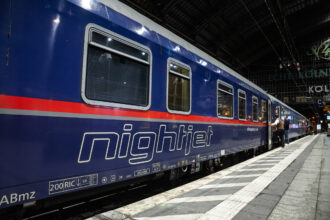
Finally, travellers expecting extensive overnight accommodation should note that most Leo Express services remain seated, day-network trains rather than dedicated sleeper products. The exception is the flagship Frankfurt Airport to Przemyśl service itself, which now runs overnight with air-conditioned couchette compartments, including women-only options, on the western end of the route. Beyond that single service, Leo Express is not designed as a network-wide alternative to dedicated night train operators such as Nightjet or the European Sleeper.

Who Should Use These Trains?
Leo Express trains are particularly well suited to independent travellers exploring Central Europe. Anyone planning to visit multiple countries during a single trip will appreciate the direct international routes and straightforward booking process.
The network is especially attractive for travellers combining destinations such as Prague, Kraków, Warsaw, Bratislava, and Košice. Rather than navigating multiple national booking systems and complicated connections, passengers can often complete substantial portions of their journey using a single operator.
The trains are also ideal for visitors arriving via Frankfurt Airport. Instead of booking another flight, travellers can continue directly into the heart of Central Europe by rail. For those carrying luggage, travelling with children, or simply wishing to avoid additional airport procedures, this can be a significant advantage.
Outdoor enthusiasts should also take note. The route through Žilina and Poprad-Tatry provides excellent access to the High Tatras, making Leo Express a useful option for hikers, skiers, and mountain travellers. Meanwhile, city-break travellers benefit from direct services linking some of the most popular urban destinations in the region.
In short, Leo Express is best suited to travellers who value convenience, direct routes, and comfortable international rail travel over sheer network size.

Rupert’s Handy Travel Tips
Planning a journey with Leo Express? Rupert has a few tips that can make your trip even smoother:
- Book early for the best fares: Leo Express uses demand-based pricing, and the cheapest tickets often disappear well before departure.
- Consider upgrading: The jump from Economy to Economy Plus or Business can sometimes be surprisingly affordable, particularly on longer journeys.
- Use Prague and Ostrava as your planning hubs: Most routes pass through one or both cities, making them the easiest places to build multi-country itineraries.
- Don’t overlook Poprad-Tatry: This station provides direct access to the spectacular High Tatras and is one of the easiest mountain gateways in Central Europe.
- Arriving at Frankfurt Airport: Check whether a direct Leo Express service could replace a short-haul flight and save yourself another airport experience.
Want to meet the reindeer behind our travel tips? Find out more in our page Who is Rupert?.




Frequently Asked Questions About Leo Express Trains
Which countries do Leo Express trains serve?
Leo Express currently operates services in Germany, Czechia, Slovakia, and Poland, connecting major cities and several important regional destinations.
Does Leo Express serve Frankfurt Airport?
Yes. One of the company’s flagship routes begins at Frankfurt Airport, providing direct rail connections towards Prague, Kraków, and Przemyśl.
Can I travel from Prague to Kraków on a direct train?
Yes. Leo Express operates direct services between Prague and Kraków, making it one of the easiest ways to travel between the two cities.
Does Leo Express go to Warsaw?
Yes. Selected services continue beyond Kraków to Warsaw, providing a direct connection between the Czech and Polish capitals.
Can I reach the High Tatras using Leo Express?
Yes. Trains serve Poprad-Tatry, the main rail gateway to the High Tatras, making the mountains easily accessible from both Prague and other destinations on the network.
Are there different travel classes?
Yes. Leo Express offers Economy, Economy Plus, Business, and Premium classes, allowing passengers to choose the level of comfort that best suits their budget and journey length.
Is Wi-Fi available onboard?
Yes. Most services provide onboard Wi-Fi, along with power sockets and modern passenger facilities.
Can Interrail pass holders use Leo Express?
In many cases, yes. However, reservation requirements may apply on certain services, so passengers should check the latest guidance before travelling.
Is Leo Express better than flying?
For routes such as Prague to Kraków, Prague to Bratislava, and Prague to Košice, many travellers find rail travel more convenient because it avoids airport procedures and provides city-centre-to-city-centre journeys.
What is the longest route operated by Leo Express?
The flagship route runs from Frankfurt Airport through Prague, Ostrava, and Kraków to Przemyśl in eastern Poland, making it one of the most impressive international services operated by a private European rail company.
Further Reading & Related Guides
If you’re planning a wider rail adventure across Central Europe, our RegioJet Trains Guide provides a useful comparison with Leo Express and covers many of the same destinations across Czechia, Slovakia, and neighbouring countries. Travellers exploring private rail operators should also read our WESTbahn Trains Guide, while those planning longer European journeys may benefit from our Guide to European High-Speed Trains.
For travellers considering a rail pass, our Interrail Germany Pass Guide explains how a Germany-focused pass compares with wider Interrail options and where Leo Express fits into a broader itinerary. If your journey continues overnight, our Night Trains in Europe Guide highlights some of the continent’s most useful sleeper services.
Finally, anyone travelling through the mountains of Slovakia should explore our coverage of the High Tatras, which pairs particularly well with Leo Express services to Poprad-Tatry, Prešov, and Košice. For a broader look at Germany itself, our Germany Travel Guide rounds up the country’s best apps and planning tips.