Reviewed by our editorial team Updated
Why European High-Speed Rail Is a Game-Changer
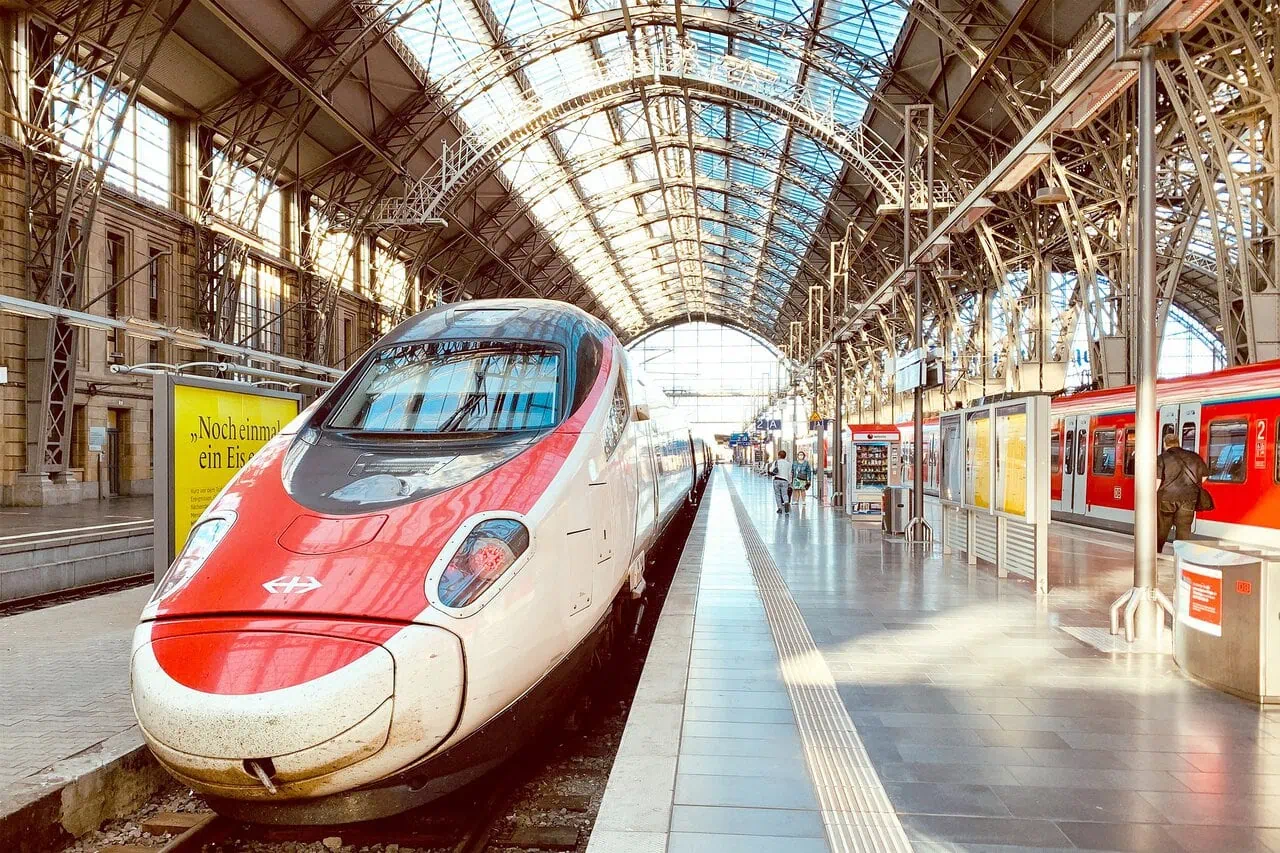
European high-speed rail has fundamentally changed how you travel across the continent. Instead of planning around airports, long transfers, and waiting times, you move directly between city centres with speed, consistency, and far less friction.
The key advantage is not just how fast the trains are. It is how efficiently they fit into your journey. High-speed trains connect major cities like Paris, Madrid, Rome, and London without the need for long check-in times or remote airport transfers. You arrive in the centre, board quickly, and step off exactly where you need to be.
For journeys of up to three hours, high-speed rail is often faster than flying when you factor in the full travel process. Even on longer routes, the overall experience is more comfortable and predictable, with fewer delays and less disruption.
There is also a practical advantage that becomes clear once you use it. Trains offer more space, easier luggage handling, and the ability to move freely during the journey, which makes a noticeable difference compared to short-haul flights.
This combination of speed, convenience, and comfort is what makes high-speed rail such a powerful option. It is not just an alternative to flying. In many cases, it is the better choice.
What Counts as High-Speed Rail in Europe
Not every fast train in Europe qualifies as high-speed rail, and understanding the difference helps you make better travel decisions.
In general, high-speed rail refers to trains operating on dedicated or upgraded lines at speeds of 250 km/h or higher, with some services reaching up to 320 km/h. These trains are designed for long-distance travel between major cities, rather than short regional journeys.
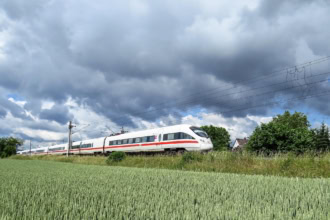
Europe has several major high-speed systems, each with its own network and characteristics. France’s TGV is one of the most extensive, linking Paris to cities across the country and beyond. Spain’s AVE network is one of the newest and fastest, connecting Madrid with destinations across the Iberian Peninsula. Germany’s ICE focuses on flexibility and frequency, while Italy’s Frecciarossa combines speed with strong competition between operators.
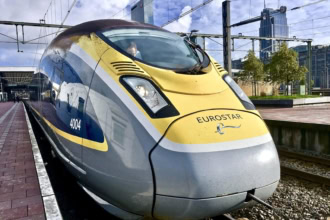
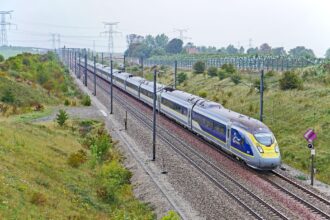
International services also play a major role. Eurostar connects the United Kingdom with mainland Europe, offering high-speed travel between London and cities such as Paris and Brussels.
Understanding these systems allows you to recognise which routes offer true high-speed performance and which are simply fast regional services. That distinction becomes important when planning longer journeys or comparing travel options.
Best if you want daily housekeeping and a front desk. Filter by area first, then by price.
Check availabilityBest for groups who want one address and separate bedrooms rather than three hotel rooms.
See holiday homesBest as a last check before booking. Compares hotel rates across several sites in one search.
Compare ratesMap of Europe’s High-Speed Rail Network
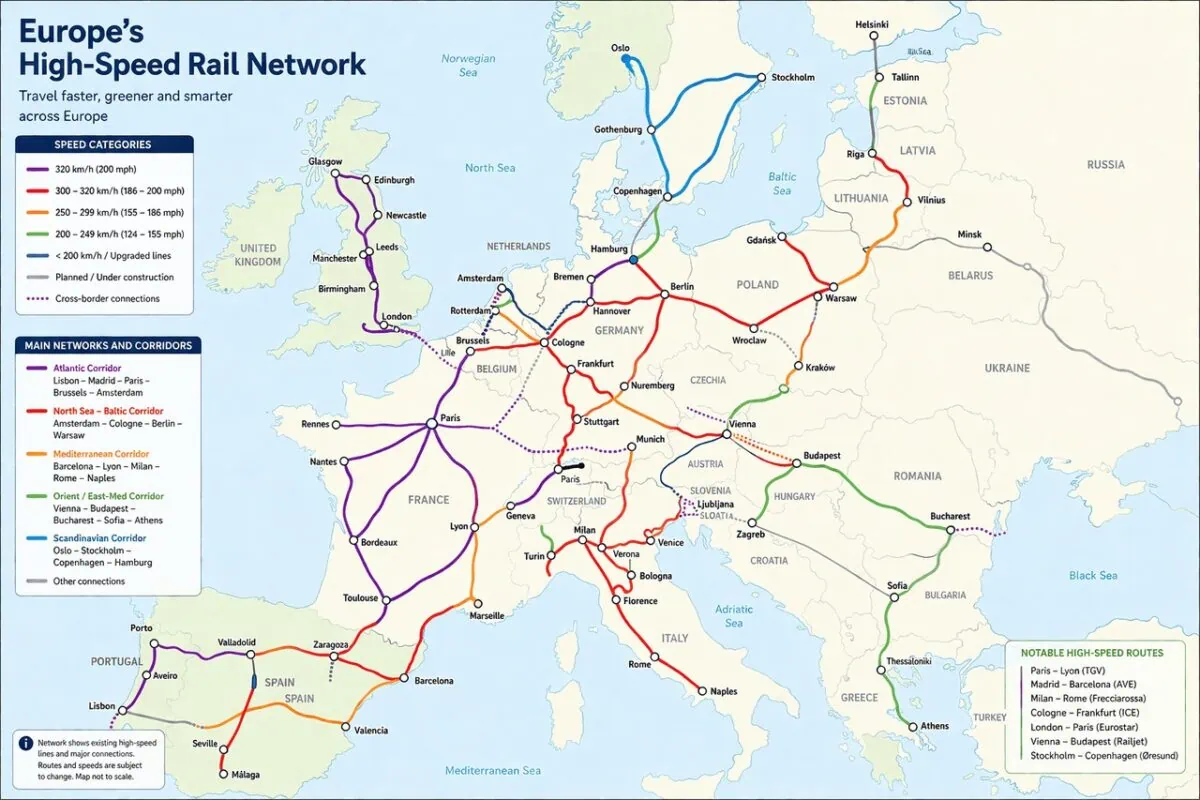
Europe’s high-speed rail network is not evenly spread across the continent. Instead, it is built around a series of major corridors connecting key economic and cultural centres.
The strongest coverage is found in Western and Southern Europe. France acts as a central hub, with high-speed lines radiating out from Paris to cities across the country and into neighbouring regions. Spain has developed a highly modern network centred on Madrid, linking it efficiently with coastal and regional destinations.
Italy’s network runs along a clear north to south axis, connecting Milan, Florence, and Rome with frequent high-speed services. Germany’s network is more distributed, with key routes linking cities such as Berlin, Frankfurt, and Munich, although not all lines operate at maximum high-speed levels.
Cross-border connections are also a major strength. Routes such as London to Paris and onward into mainland Europe allow you to move between countries without switching to air travel.
While Eastern Europe currently has more limited high-speed infrastructure, expansion is ongoing, and connections continue to improve over time.
Understanding where high-speed rail is strongest helps you plan journeys that maximise speed and minimise unnecessary transfers.
Fastest and Most Important High-Speed Routes
Some high-speed rail routes stand out because they combine speed, frequency, and real-world usefulness. These are the journeys where trains consistently compete with or outperform flights.
The route between Paris and Lyon is one of the best examples. With journey times of around 2 hours, it connects a major capital with a key regional city quickly and reliably, making it a core part of France’s transport network.
In Spain, the connection between Madrid and Barcelona is one of the busiest high-speed routes in Europe. The journey takes approximately 2.5 to 3 hours, and high-frequency services make it a strong alternative to flying.
Italy offers another standout route between Rome and Milan, where high-speed trains cover the distance in around 3 hours. Competition between operators has also helped keep prices competitive, making this one of the most efficient intercity routes in Europe.
Internationally, the connection between London and Paris via high-speed rail remains one of the most well-known routes. With journey times of just over 2 hours, it demonstrates how effectively rail can replace short-haul flights when infrastructure supports it.
These routes matter because they show where high-speed rail delivers its full value. They are fast enough to replace flights, frequent enough to offer flexibility, and well-connected enough to form the backbone of European travel.
Understanding these key routes helps you identify where high-speed rail will have the greatest impact on your journey.
High-Speed Rail in Spain
Spain has one of the most advanced high-speed rail networks in Europe, built around the AVE system. Unlike older rail networks that evolved gradually, Spain’s network was designed with high-speed travel in mind from the start, which is why it feels fast, modern, and highly efficient.
The network is centred on Madrid, with high-speed lines extending in multiple directions to cities such as Barcelona, Valencia, and Seville. This radial structure means most long-distance journeys are quick and direct, with minimal need for transfers.
What makes Spain stand out is consistent high speeds of up to 300–310 km/h, combined with strong competition between operators. This has improved pricing and made high-speed rail accessible, even on major routes.
For many journeys within Spain, particularly between major cities, high-speed rail is not just an option. It is the most practical and efficient way to travel.
| Route | Approx Journey Time | Why It Matters |
|---|---|---|
| Madrid → Barcelona | 2h 30m – 3h | One of Europe’s busiest routes, strong alternative to flying |
| Madrid → Seville | 2h 30m | Classic AVE route, fast north–south connection |
| Madrid → Valencia | 1h 50m | Quick access to the coast |
| Barcelona → Zaragoza | 1h 30m | Key regional high-speed link |
| Madrid → Málaga | 2h 45m | Connects capital to southern coast |

High-Speed Rail in France
France’s high-speed rail network, built around the TGV, is one of the most established in the world. It combines very high speeds with extensive national coverage, making it a core part of everyday travel.
The system is structured around Paris, with major lines radiating outward to cities such as Lyon, Marseille, and Bordeaux. This hub-and-spoke model makes Paris one of the best-connected rail hubs in Europe.
Trains regularly operate at 300 to 320 km/h, allowing long distances to be covered quickly. The network also integrates well with international routes, linking France to neighbouring countries across Western Europe.
For travellers moving between major cities, the TGV is often faster and more convenient than flying, particularly once airport time is considered.
| Route | Approx Journey Time | Why It Matters |
|---|---|---|
| Paris → Lyon | ~2h | One of Europe’s fastest and most efficient routes |
| Paris → Marseille | ~3h | Connects capital to Mediterranean coast |
| Paris → Bordeaux | ~2h 15m | Major westward high-speed corridor |
| Paris → Lille | ~1h | Important northern connection and Eurostar link |
| Lyon → Marseille | ~1h 40m | Key southern high-speed route |
High-Speed Rail in Germany
Germany’s high-speed network, operated by ICE, is built around flexibility and connectivity rather than pure speed.
Unlike Spain or France, Germany relies on a combination of dedicated high-speed lines and upgraded conventional tracks. This means speeds can vary, but the network offers excellent coverage and frequent services between cities such as Berlin, Frankfurt, and Munich.
The strength of the German system lies in how easily you can move between cities without relying on a single main corridor. Connections are frequent, routes are varied, and the network integrates well with regional services.
While it may not always match the top speeds seen elsewhere, it delivers a highly practical and flexible travel experience, especially for multi-stop journeys.
| Route | Approx Journey Time | Why It Matters |
|---|---|---|
| Berlin → Munich | ~4h | Major north–south route |
| Frankfurt → Cologne | ~1h | Very fast and frequent connection |
| Frankfurt → Munich | ~3h | Key business and travel route |
| Berlin → Hamburg | ~1h 45m | Efficient northern connection |
| Cologne → Düsseldorf | ~30m | Short but high-frequency route |
High-Speed Rail in Italy
Italy’s high-speed rail network is one of the most competitive and user-friendly in Europe, centred around systems such as Frecciarossa.
The network runs along a clear north–south corridor, connecting major cities including Milan, Florence, Rome, and Naples. This makes it ideal for multi-city travel with minimal planning.
One of Italy’s biggest advantages is competition between operators, which has helped improve both pricing and service quality. Trains are modern, comfortable, and frequent, making long-distance travel simple.
The system is designed to be both fast and accessible, which is why it is often one of the easiest networks for visitors to use.
| Route | Approx Journey Time | Why It Matters |
|---|---|---|
| Milan → Rome | ~3h | Core national route |
| Rome → Florence | ~1h 30m | One of the most popular routes |
| Milan → Florence | ~2h | Connects north to central Italy |
| Rome → Naples | ~1h 10m | Fast southern connection |
| Turin → Milan | ~1h | Key northern route |
Best for long or awkward journeys. Builds one itinerary out of separate flights.
View flightsBest for short trips. Install the eSIM at home and arrive with working data, no shop queue.
Browse eSIMsBest after a long flight or a late landing. Price agreed before you travel, and no taxi queue.
Check transfersHigh-Speed Rail in Benelux (Belgium, Netherlands, Luxembourg)
The Benelux region does not operate a large standalone high-speed network, but it plays a crucial role as a connector between major European systems.
Countries like Belgium and Netherlands are integrated into international high-speed routes, linking cities such as Brussels and Amsterdam with the wider European network.
Rather than long domestic high-speed corridors, the region benefits from frequent cross-border connections, particularly on routes linking France, Germany, and the United Kingdom.
This makes Benelux one of the most important transit regions in Europe, even if it is not defined by domestic high-speed travel.
| Route | Approx Journey Time | Why It Matters |
|---|---|---|
| Brussels → Paris | ~1h 25m | Key international connection |
| Brussels → Amsterdam | ~2h | Major cross-border route |
| Amsterdam → Paris | ~3h 20m | Strong alternative to flying |
| Brussels → Cologne | ~2h | Links Benelux to Germany |
| Amsterdam → Rotterdam | ~40m | High-speed domestic link |
High-Speed Rail vs Flying in Europe
One of the biggest advantages of European high-speed rail is how often it outperforms flying once you look at the full journey, not just the headline travel time. While flights may appear faster on paper, the reality is very different when you factor in airport transfers, security, boarding times, and delays.
For journeys of up to three hours by train, rail is almost always the better choice. You travel city centre to city centre, avoid long check-in processes, and board with minimal friction. Routes such as Paris to Lyon or Madrid to Barcelona consistently demonstrate how efficient high-speed rail can be in real-world conditions.
Comfort also plays a major role. Trains offer more space, easier luggage handling, and the ability to move freely, which makes longer journeys far more manageable. There are no strict baggage rules, no liquid restrictions, and no need to arrive hours in advance.
That said, flying still has a place. For longer distances, particularly beyond four to five hours by train, flights can become more practical, especially when crossing multiple countries or travelling to regions with less developed rail infrastructure.
The decision is straightforward. If the journey is short enough, high-speed rail is often faster, easier, and significantly more comfortable.
How to Book High-Speed Trains in Europe
Booking high-speed trains in Europe is straightforward, but using the right platform can make a noticeable difference to both price and convenience.
For most travellers, the easiest approach is to use a single platform that allows you to compare routes across multiple countries. Tools such as Omio simplify the process by bringing together different operators, routes, and departure times in one place. This is particularly useful when planning multi-city journeys or cross-border travel, where navigating separate national systems can become complicated.
Another widely used option is Rail Europe, which focuses specifically on international rail travel and provides a more structured booking experience for visitors.
Timing is one of the most important factors. High-speed rail tickets are often priced dynamically, meaning costs increase as demand rises. Booking early can result in significantly lower fares, particularly on popular routes such as London to Paris.
Seat reservations are another key consideration. In countries such as France and Spain, they are usually mandatory on high-speed services, while in Germany they are optional but recommended during busy periods. Understanding this difference helps avoid unnecessary complications when travelling.
A well-planned booking approach ensures better prices, confirmed seats, and a smoother overall journey.

Find Train Tickets for your destination with Omio
Rather than checking individual railway websites for your trip to or from your destination, you can use Omio to compare available train journeys in one place.
Search results make it easier to compare departure times and journey options before choosing the service that works best for your plans.
Scan to open
on your phone


Do You Need a Rail Pass? Interrail vs Tickets
Choosing between a rail pass and individual tickets depends on how structured your travel plans are and how frequently you intend to move between cities.
Rail passes, such as Interrail, are designed for flexibility across multiple journeys, allowing you to travel without booking each individual ticket in advance. This can be particularly useful if your itinerary is not fully fixed or if you want the freedom to adjust plans as you go.
However, high-speed rail introduces additional considerations. Many high-speed trains require seat reservations even when using a pass, and these reservations can add both cost and complexity. On busy routes, availability may also be limited, which reduces the flexibility that a pass is designed to provide.
For travellers making a small number of direct, high-speed journeys, individual tickets are often the more efficient option. They provide clear pricing, guaranteed seats, and fewer restrictions, particularly on popular routes.
Rail passes become more valuable when travel is more frequent or less predictable. If you are moving regularly between cities, combining high-speed and regional trains, or prioritising flexibility over fixed plans, a pass can offer better overall value.
The key is to match the option to your travel style. Structured trips tend to favour tickets, while flexible itineraries benefit from a pass.
Tips for Using High-Speed Trains in Europe
Using high-speed trains in Europe is straightforward, but understanding a few key details can make the experience noticeably smoother.
Arrival times are much simpler than at airports. In most cases, arriving 20 to 30 minutes before departure is sufficient, even at major stations. This reduces the stress and waiting time that often comes with air travel and makes rail journeys feel more efficient from the start.
Luggage handling is another advantage. There are generally no strict baggage limits, and you can carry your bags directly onto the train without additional fees. Storage areas are available within the carriage, which keeps everything accessible throughout the journey.
Seat reservations vary depending on the country and service. In France and Spain, they are typically required, while in Germany they are optional but useful during busy periods. Being aware of these differences helps avoid confusion when boarding.
One of the biggest advantages of rail travel is the location of stations. They are usually positioned in central urban areas, allowing you to step off the train and immediately access your destination without additional transfers.
Finally, it is important to stay aware of platform information. In larger stations, platforms are sometimes announced shortly before departure, so keeping an eye on updates ensures you can board smoothly without unnecessary delays.
Understanding these details allows you to travel with confidence and take full advantage of what high-speed rail offers.
Common Mistakes to Avoid When Using High-Speed Rail in Europe
High-speed rail in Europe is easy to use, but a few common mistakes can quickly reduce the quality of the experience if you are not aware of them.
One of the most frequent issues is booking too late. High-speed train tickets are typically priced dynamically, and popular routes can increase significantly in price as departure dates approach. Travellers who leave booking until the last minute often end up paying far more than necessary or struggling to find seats on the most convenient services.
Another mistake is assuming all trains are the same. Not every fast train operates on a true high-speed line, and this can affect both travel time and comfort. Understanding the difference between standard intercity services and systems such as TGV or AVE helps you choose the right option.
Seat reservations are also frequently overlooked. In countries like France and Spain, they are often mandatory, and failing to secure one in advance can lead to unnecessary complications or even prevent you from boarding certain services.
Many travellers also underestimate the importance of station location. High-speed rail works best because it connects city centres directly. Ignoring this advantage and defaulting to flights can result in longer overall journey times, even if the flight itself is shorter.
Finally, there is a tendency to overcomplicate travel plans. High-speed rail is designed to be simple and efficient. Trying to optimise every connection or build overly tight schedules often creates stress rather than improving the journey.
Avoiding these mistakes ensures that high-speed rail delivers its full benefit, which is fast, straightforward, and comfortable travel across Europe.

Rupert’s Handy Travel Tips
Rupert prefers high-speed trains across Europe because they remove most of the stress that comes with flying, especially on shorter routes between major cities.
- Book early for the best prices, as high-speed rail tickets can rise quickly on popular routes.
- Choose trains under 3 hours, as these are often faster door-to-door than flying.
- Check if seat reservations are required, especially in countries like France and Spain.
- Arrive 20–30 minutes before departure, as stations are much quicker to navigate than airports.
- Use one booking platform to compare routes and operators without switching between different national systems.
Want to meet the reindeer behind our travel tips? Find out more in our page Who is Rupert?.




Best for solo travellers and anyone watching the budget. Dorm beds and private rooms in the same search.
Browse hostelsBest arranged before you fly rather than after. Covers claim handling, plus lounge access on eligible delays.
Explore AirHelp+Best for the gap between checking out and your train. Drop bags at a shop or hotel nearby and carry on.
Store your bagsFrequently Asked Questions About European High-Speed Rail
What is the fastest train in Europe?
The fastest trains in Europe operate at speeds of up to 320 km/h, with systems such as the TGV and Frecciarossa leading the way on dedicated high-speed lines.
Is high-speed rail faster than flying in Europe?
For many routes under three hours, high-speed rail is often faster when you consider total travel time, including airport transfers and waiting times.
Which countries have the best high-speed rail networks?
Countries such as Spain, France, and Italy offer the most extensive and efficient networks, while Germany provides strong connectivity through a more flexible system.
Do I need to book high-speed trains in advance?
Booking in advance is strongly recommended. Prices tend to rise closer to departure, and popular routes can sell out, particularly during peak travel periods.
Are seat reservations required on high-speed trains?
This depends on the country. Reservations are usually mandatory in France and Spain, while in Germany they are optional but recommended during busy times.
Further Reading & Related Guides
If you are planning a wider journey across Europe, high-speed rail works best when it is part of a broader rail travel strategy rather than a single journey. Many travellers combine fast intercity routes with cross-border services, making it worth understanding how options like the Eurostar fit into longer itineraries, particularly when travelling between the United Kingdom and mainland Europe.
For those looking to reduce costs or add flexibility, exploring ticket options such as Eurostar Snap deals can be a useful way to access lower fares, especially if your travel dates are flexible. At the same time, understanding the full European rail network helps you connect high-speed routes with regional and international services more effectively.
If your journey extends beyond daytime travel, European sleeper trains offer another dimension to rail travel, allowing you to cover longer distances overnight while saving time on accommodation. For multi-country trips, it is also worth comparing individual tickets with a broader Interrail Pass, particularly if you are planning to travel frequently over a short period.
Finally, staying connected while travelling is essential for checking platform updates, live schedules, and route changes, especially when moving between countries and operators. Using a reliable travel eSIM ensures you can manage your journey in real time without relying on public WiFi or local SIM cards.
Bringing these elements together allows you to build a flexible, efficient, and well-connected European rail itinerary, rather than treating each journey in isolation.