Reviewed by our editorial team Updated
Discover Sardinia Without Renting a Car
Sardinia has a reputation as a car-dependent island, and for good reason: much of its interior and its best beaches sit well away from any railway line. But that reputation oversells the difficulty. If your trip centres on the three biggest hubs, Cagliari, Olbia and Alghero, and their surrounding coastline, a combination of Trenitalia trains, ARST buses and short ferry hops covers a surprising amount of ground.
This guide breaks down exactly what runs where, how reliable it is, and which parts of Sardinia genuinely need a hire car. We cover the island’s train backbone, the regional bus network run by ARST, the ferries that hop between coastal towns and offshore islands, and city-by-city verdicts.
The short version: Cagliari, Olbia and Alghero themselves are easy to explore on foot and by local bus. Getting between them by train or bus is workable but slower than driving, often 2-4 hours for journeys a car covers in half the time. Reaching smaller coastal resorts, the Costa Smeralda’s satellite villages, or inland Barbagia villages without your own wheels is far harder.
We also look at whether a national rail pass makes sense for a Sardinia-only trip, since two products, the Trenitalia Pass and the Italia in Tour Pass, sometimes get recommended without anyone checking if they actually apply here.
If your itinerary also involves getting to Sardinia in the first place, our Sardinia Ferry Routes hub covers crossings from mainland Italy, France and Corsica. This guide picks up once you’ve already arrived and need to move around the island itself.
Think of the rest of this guide as a practical decision tool: for each mode of transport and region of the island, we’ll flag whether it’s genuinely workable car-free, workable with extra planning, or realistically a hire car or organised tour job.
Before diving into each mode of transport in detail, here’s how the main options compare on cost, coverage and convenience for a typical visitor without a car.
| Transport | Best For | Typical Cost | Coverage |
|---|---|---|---|
| Trenitalia trains | Cagliari-Oristano-Sassari-Olbia backbone | €8-20 (£7-17 / $9-22) per journey | Main towns only, limited daily departures |
| ARST buses | Coastal resorts, smaller towns, Costa Smeralda | €2-9 (£2-8 / $2-10) per journey | Widest network, but infrequent outside summer |
| City buses (CTM, AF Bus) | Getting around Cagliari, Olbia, Alghero themselves | €1-2 (£1-2 / $1-2) per ride | Excellent within city limits |
| Ferries | La Maddalena archipelago, Sant’Antioco, offshore islands | €10-20 (£9-17 / $11-22) per person | Short hops only, not coastal cabotage |
| Taxis / private transfers | Airport transfers, last-mile connections | €15-60+ (£13-52+ / $16-65+) depending on distance | Anywhere, at a premium |
Sardinia’s Train Network: The Backbone
Trenitalia operates Sardinia’s main-line trains, arranged in a rough Y-shape across the island. The core route runs from Cagliari in the south up to Olbia and on to Golfo Aranci in the northeast, with a second branch from Sassari down to Cagliari and a spur out to Porto Torres.
Most long-distance journeys require a change at Chilivani (Ozieri), the junction where the two branches meet. A handful of direct services run once or twice daily on the busiest routes, but plan on 3-4 hours for Cagliari to Olbia by rail, against roughly half that by road.
Fares are inexpensive by northern European standards: expect €8-15 (£7-13 / $9-16) for a one-way Cagliari-Sassari or Cagliari-Olbia ticket, and as little as €1 (£1 / $1) for short suburban hops such as Cagliari to Elmas airport.
Regionale trains don’t require seat reservations, but paper tickets must be validated at the small green or yellow machines on the platform before boarding; skipping this step can mean an on-the-spot fine even with a valid ticket. Trains run less frequently on Sundays and public holidays.
Trains are the most comfortable way to cover long distances without a car, but they only connect a limited set of towns. Anywhere off that Y-shaped line, and that’s most of the coastline, needs a bus, taxi or ferry to finish the journey.
To make that Y-shape concrete: picture Cagliari anchoring the southern base of the letter, with a single trunk line running north through Oristano and Macomer to the junction at Chilivani, where the line forks into two arms. One arm climbs northwest to Sassari and on to Porto Torres; the other runs northeast to Olbia and its final stop at Golfo Aranci. The three tables below break the journey down leg by leg: the shared trunk first, then each branch beyond Chilivani.
Cagliari to Chilivani: The Shared Trunk
Every train on the island’s Y-shaped network, whichever branch it’s ultimately heading for, runs along this same southern trunk first, making it by far the busiest and most frequent stretch of line in Sardinia.
| From | To | Approx. Duration | Approx. Frequency |
|---|---|---|---|
| Cagliari | Oristano | ~1h10 | Around 15-16 trains daily |
| Oristano | Macomer | ~50 min | Around 10-11 trains daily |
| Macomer | Chilivani (Ozieri) | ~40 min | Up to 8 trains daily |
| Cagliari | Chilivani (full trunk) | ~2h30-2h45 | Several trains daily |
Chilivani to Olbia and Golfo Aranci: The Northeast Branch
This is the tip of the Y’s eastern arm, running through Oschiri, Berchidda and Monti before reaching Olbia, then continuing on a short, frequent shuttle to its true terminus at Golfo Aranci.
| From | To | Approx. Duration | Approx. Frequency |
|---|---|---|---|
| Chilivani | Olbia | ~1h15-1h30 | Around 7 trains daily |
| Olbia | Golfo Aranci | ~25 min | Around 9 trains daily |
| Chilivani | Golfo Aranci (full branch) | ~1h40-1h55 | Several trains daily, most continuing straight through Olbia |
Chilivani to Sassari and Porto Torres: The Northwest Branch
The western arm is the shorter of the two branches, reaching Sassari in under an hour and continuing on to the port town of Porto Torres, though not every Sassari service carries straight through.
| From | To | Approx. Duration | Approx. Frequency |
|---|---|---|---|
| Chilivani | Sassari | ~40 min | Around 10 trains daily |
| Sassari | Porto Torres | ~15 min | Around 5 trains daily |
| Chilivani | Porto Torres (full branch) | ~55 min-1 hour | Several trains daily |
These are approximate, since Regionale timetables shift a little season to season, and a wait for the connecting service at Chilivani can add to the total, so check the current timetable close to your travel dates for the exact departures on your route.
Rolling stock varies by route: older diesel units on some rural lines, newer air-conditioned carriages on the busier Cagliari-Sassari corridor, but all are comfortable enough for a multi-hour journey with space for a suitcase or two.
Best if you want daily housekeeping and a front desk. Filter by area first, then by price.
Check availabilityBest for longer stays. Whole apartments and houses, so you are not eating out three times a day.
View rentalsBest as a last check before booking. Compares Sardinia hotel rates across several sites in one search.
Compare ratesARST Buses: Sardinia’s Real Public Transport Workhorse
If trains are the backbone, ARST (Azienda Regionale Sarda Trasporti) is the muscle. Its dark blue coaches with a red stripe reach far more of the island than rail ever will, linking coastal resorts, inland villages and the towns the trains skip entirely.
ARST also runs narrow-gauge regional trains on a few short lines, including Sassari-Alghero and Macomer-Nuoro, separate from the main Trenitalia network. Bus tickets typically cost €2-9 (£2-8 / $2-10) depending on distance and are sold at tobacconists, newsagents and bus station ticket booths.
The catch is frequency. Outside the June-to-September peak, many rural routes run just one or two services a day, often timed around school hours rather than tourist convenience. A missed morning bus can mean waiting until the following day, so always check timetables (posted at stops, though the ARST website itself is clunky) before planning a day trip around one.
Summer sees a noticeable expansion: seasonal routes link Olbia to Costa Smeralda villages like Porto Cervo and Baja Sardinia, and beach-shuttle services multiply around Alghero and Cagliari. If you’re travelling June through September, ARST coverage is genuinely useful; outside that window, expect far thinner service.
Staff at bus stations are generally happy to confirm departure times in person, which is often more reliable than the website. Photographing the timetable posted at your stop is a sensible backup for anywhere without reliable mobile signal.
Coaches are generally comfortable for the distances involved, with air conditioning standard on most routes and enough luggage space for holiday-sized bags, though some smaller rural minibuses are noticeably more basic.
Route numbers and destination boards are usually only in Italian, so having the name of your destination town written down, or saved as a photo, helps avoid confusion at busy interchange stations like Sassari or Olbia.
Ferries and Island Hopping Within Sardinia
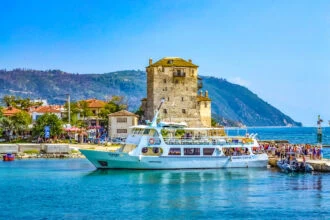
Beyond the ferries that bring visitors to Sardinia from the mainland, a few short local crossings matter for getting around once you’re here. The most useful for most travellers is the hop from Palau to La Maddalena, a 15-minute crossing that opens up the whole La Maddalena Archipelago National Park without needing a car on the mainland side.
Further south, Delcomar also runs a genuine year-round ferry to Isola di San Pietro, the island whose main town is Carloforte, with sailings from both Calasetta on Sant’Antioco and Portovesme on the mainland. Smaller, genuinely seasonal operators run boats from towns near Cagliari out to nearby islets, and these tend to be tourist-season only, weather-dependent, and best booked a day or two ahead in July and August.
There’s no real coastal cabotage service linking, say, Alghero to Cagliari by sea for passengers, so ferries in Sardinia are best thought of as short island-hopping links rather than an alternative to trains and buses for covering long distances up and down the coast.
The Palau-La Maddalena crossing runs frequently, often every 30-45 minutes in summer, with two main operators, Delcomar running year-round and the seasonal Maddalena Lines adding extra sailings from April to October, and tickets are generally bought at the small kiosks lining the Palau waterfront rather than online in advance.
Here’s how the main local ferry hops compare, covering both the archipelago crossing and the routes out to Isola di San Pietro in the southwest.
| Route | Operator | Approx. Duration | Approx. Frequency |
|---|---|---|---|
| Palau to La Maddalena | Delcomar (year-round); Maddalena Lines (seasonal, Apr-Oct) | ~15-20 min | Every 20-45 min in season; roughly every 45-60 min in winter |
| Calasetta to Carloforte (Isola di San Pietro) | Delcomar | ~30 min | Multiple sailings daily, year-round |
| Portovesme to Carloforte (Isola di San Pietro) | Delcomar | ~40 min | Up to around 17 sailings daily, year-round |
Once on La Maddalena itself, local buses and rental bikes cover the main island reasonably well, but reaching the smaller outer islands of the archipelago, such as Caprera or Spargi, usually means joining an organised boat tour rather than relying on scheduled ferries.
A car isn’t necessary on La Maddalena itself; most visitors explore the main town and nearest beaches on foot or by bike, saving the boat tour budget for the archipelago’s more remote coves instead.
If your plans include La Maddalena, our dedicated Sardinia Ferry Routes guide has the full detail on operators, timetables and fares for that crossing and others serving the island.
The Trenino Verde: A Scenic Bonus, Not a Practical Option
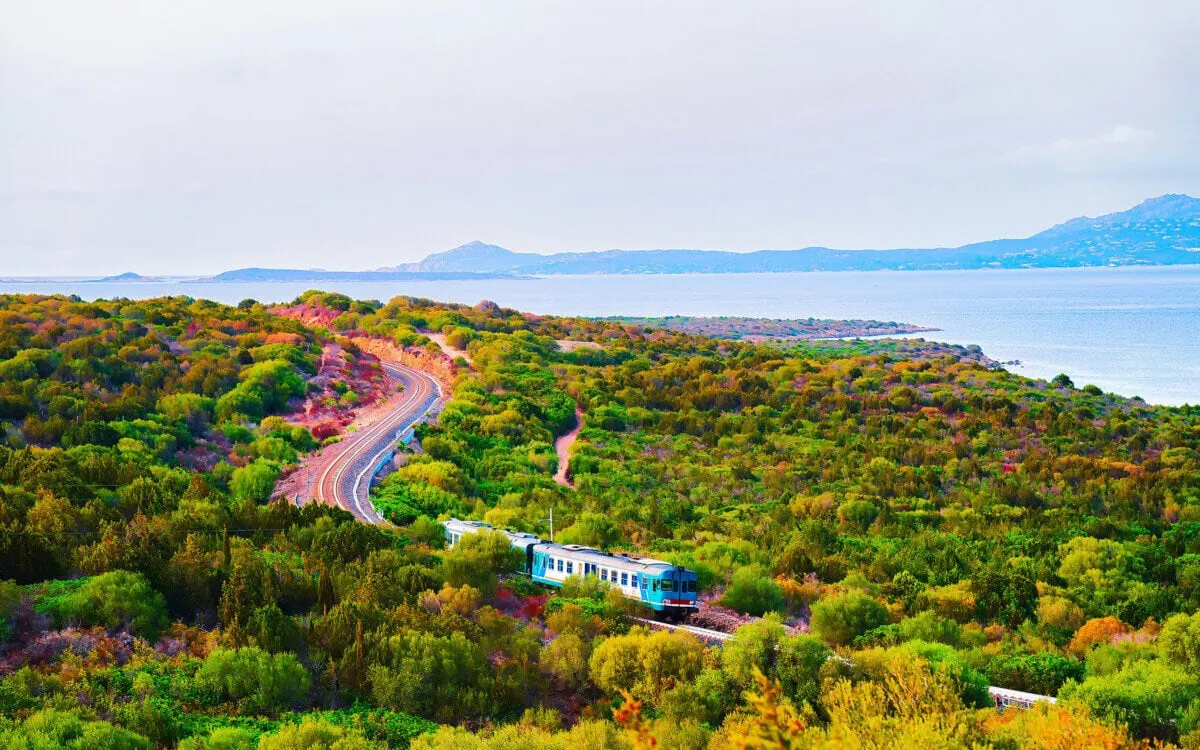
Sardinia’s Trenino Verde (“little green train”) is a network of narrow-gauge heritage lines run seasonally by ARST, threading through some of the island’s most dramatic scenery, gorges, forests and mountain villages that regular transport never reaches.
The network has shrunk a good deal from its historic reach. The classic Mandas-Arbatax route that first put the Trenino Verde on the map has been suspended for years over bridge and viaduct safety work, and no longer runs as a single end-to-end journey.
What’s left today are a handful of shorter, genuinely scheduled seasonal lines rather than one continuous route across the island, each detailed individually below with its own stations, distance and duration.
Treat the Trenino Verde as a half-day or full-day excursion in its own right, worth booking if the schedule fits, rather than a substitute for ARST buses or Trenitalia trains when you need to reach a destination on time.
Tickets and current seasonal timetables are published directly by the operator closer to departure, since routes and days of operation change year to year depending on funding and track maintenance.
Prices are modest for what’s essentially a scenic rail excursion, typically in the €15-30 (£13-26 / $16-33) range depending on route length, and some sections run open-sided carriages in peak summer, so bring sun protection and expect a leisurely pace measured in hours, not minutes.
Here’s what’s genuinely running as scheduled seasonal excursions in 2026, rather than the full historic network the Trenino Verde name might suggest.
| Line | Route | Distance | Approx. Duration | Typical Season |
|---|---|---|---|---|
| Mandas-Sadali | Mandas, Orroli, Villanovatulo, Esterzili, Sadali | ~58 km | ~2-2.5 hours one-way | Spring-autumn, selected days |
| Macomer-Bosa Marina | Macomer, Tresnuraghes, Tinnura, Bosa Marina | ~46 km | ~3-4.5 hours one-way | Spring-autumn, selected days |
| Arbatax-Lanusei | Arbatax, Tortolì, Lanusei | ~34 km | ~1.5-2 hours one-way | Summer, selected days |
| Tempio Pausania-Luras | Tempio Pausania, Luras | ~15 km | ~45 minutes one-way | Spring, selected weekends |
Mandas to Sadali: The Sarcidano Remnant
Of the once-continuous line to Arbatax, only the western stretch from Mandas to Sadali still runs a genuine public timetable, threading through Sarcidano villages including Orroli, Villanovatulo and Esterzili on its way into the Gennargentu foothills.
The full run covers roughly 58 km and takes something like 2-2.5 hours one-way at the train’s deliberately unhurried pace, with adult one-way fares typically €15 (£13 / $16) and a same-day return closer to €22 (£19 / $24).
What makes it worth the time is the scenery itself: limestone gorges, oak woodland and stone villages that no road trip covers quite the same way, with the train slowing for photo stops at several viewpoints along the route.
It runs on selected days through spring, summer and autumn rather than daily, so check the current year’s calendar with the operator before building a day around it.
Macomer to Bosa Marina: Marghine to the Coast
This line runs from the inland town of Macomer down to the seaside resort of Bosa Marina, passing through Tresnuraghes and Tinnura on a route that drops from the Marghine plateau toward the coast.
At around 46 km, it’s a genuinely leisurely ride, typically 3-4.5 hours one-way with stops, priced similarly to the Sarcidano line at roughly €15 (£13 / $16) one-way and €22 (£19 / $24) return.
The pay-off is the shift in landscape: rolling farmland and the pretty village of Tinnura, known for its painted murals, give way to sea views as the line nears Bosa Marina, making the final approach the most rewarding stretch.
Like the Sarcidano line, it operates on selected days rather than a daily schedule, and only in the warmer months, so confirm the exact dates before travelling.
Arbatax to Lanusei: Ogliastra’s Mountain Run
The historic line once continued from Arbatax all the way to Gairo, but only the shorter first stretch to Lanusei, via the port town of Tortolì, currently operates a scheduled service.
It covers roughly 34 km of the original 62 km line, taking around 1.5-2 hours one-way, with adult tickets typically €12 (£10 / $13) one-way and €16 (£14 / $17) return.
The route climbs steadily from the coast into the Ogliastra mountains, giving passengers sweeping views back down toward the Tyrrhenian Sea, a shorter but genuinely scenic taste of the line’s original ambition.
It’s a summer-season service on selected days, so it suits travellers already based on the east coast around Cala Gonone or Santa Maria Navarrese rather than a special detour.
Best if you can move a day either way. Shows how the fare to Sardinia changes across the month.
Compare flightsBest if you want maps and messaging working the moment you switch your phone on.
See eSIM plansBest when public transport has stopped, or when you are travelling with children and bags.
Book a transferTempio Pausania to Luras: Gallura’s Spring Line
Furthest north, this short line links Tempio Pausania to the small town of Luras, the surviving fragment of a much longer historic route that once continued all the way to Palau.
At around 15 km and roughly 45 minutes one-way, it’s the shortest and quickest of the currently running lines, with adult fares around €8 (£7 / $9) one-way and €12 (£10 / $13) return.
The line runs through Gallura’s cork-oak woodland and granite countryside, a gentler, shorter introduction to the Trenino Verde experience than the longer Sarcidano or Ogliastra runs.
It typically operates over a handful of spring weekends rather than across the whole summer season, so it needs more deliberate planning if it’s the one you want to catch.
Cycling and E-Bikes: A Car-Free Alternative for Short Distances
For visitors comfortable on two wheels, bike rental fills some of the gaps buses and trains leave behind, particularly for beaches and viewpoints just outside a town centre that sit awkwardly between a short walk and a full bus journey.
Cagliari, Olbia and the resort town of San Teodoro all have established bike and e-bike rental shops, with daily rates typically around €10-25 (£9-22 / $11-27) depending on whether you choose a standard bike or an electric-assist model.
Flat coastal stretches, such as the promenade toward Poetto Beach from central Cagliari, are genuinely pleasant by bike and often faster door-to-door than waiting for a bus, especially outside peak summer service hours.
Inland routes are a different story: Sardinia’s interior is hilly and the August heat is intense, so cycling between towns rather than within one is best left to experienced touring cyclists with the right gear.
Several rental shops also offer one-way drop-off within the same town, useful for combining a bike ride out to a beach with a bus or taxi back, rather than retracing the same route twice.
Cycling won’t replace trains and buses for covering the island’s length, but it’s a genuinely useful, low-cost way to extend your range around any of the three hub towns without booking a car.
Cagliari on Foot and by Bus
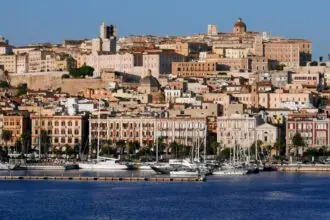
Cagliari is by far the easiest Sardinian city to visit car-free. The historic Castello district, Roman amphitheatre, seafront and main shopping streets are all walkable from most central hotels, and the local CTM bus network fills in the gaps efficiently.
A single CTM ride costs around €1 (£1 / $1), with a day pass closer to €3 (£3 / $4), both sold at tobacconists and ticket machines around Piazza Matteotti, the transport hub next to the train and bus stations. Cagliari also has a small tram-like metro line for outlying suburbs.
Beaches are easy too: Poetto Beach, Cagliari’s main city beach, sits about 8 km from the centre and is served by frequent summer bus routes running roughly every 5-10 minutes in peak season.
Cagliari-Elmas Airport connects to the centre by both train and bus, each taking around 10-15 minutes and costing roughly €1-2 (£1-2 / $1-2), making Cagliari one of the few Sardinian cities where you genuinely never need to touch a taxi meter.
Central Cagliari is genuinely walkable between neighbourhoods once you’re prepared for the hills: Marina, Villanova and the Castello district connect by streets, staircases and a couple of free public lifts that save the steepest climbs.
For a full rundown of what to see once you’ve arrived, our Things to Do in Cagliari guide covers the Castello district, museums, markets and boat trips in depth.

Olbia: A Compact Gateway to the Costa Smeralda
Olbia itself is compact and manageable on foot, with its archaeological sites, historic centre and harbour all within a comfortable 15-20 minute walking radius of most accommodation near the town centre.
Where Olbia gets trickier is its role as gateway to the Costa Smeralda. Seasonal ARST buses run from Olbia to Porto Cervo, Baja Sardinia and other resort villages in summer, typically taking 45-75 minutes, but frequency drops sharply outside June to September.
Olbia Airport sits close to the centre, roughly a 10-minute bus or taxi ride away, with ARST airport buses connecting to the town and onward to some Costa Smeralda resorts in peak season.
Olbia is also the launch point for the Palau-La Maddalena ferry route, though Palau itself requires a bus connection of roughly an hour from Olbia, so factor that extra leg into any island-hopping day trip.
Olbia’s compact grid layout, with the main pedestrianised shopping street running straight from the harbour toward the historic centre, makes it an easy place to get your bearings within an hour of stepping off a train or bus.
See our Things to Do in Olbia guide for the town’s sights, beaches and boat trip options in full.
Alghero’s Walkable Old Town
Alghero’s walled old town, harbour and city beaches make it another strong car-free base. The historic centre is tiny and entirely walkable, and local buses cover the modern town and nearby beaches like Le Bombarde and Lido di Alghero reliably in summer.
An ARST narrow-gauge train connects Alghero to Sassari in around 35-40 minutes, giving car-free travellers a link into the wider Trenitalia network for onward journeys toward Porto Torres or Cagliari.
Neptune’s Grotto, one of the region’s signature attractions, is reachable by seasonal excursion boat directly from Alghero’s port, a scenic and genuinely car-free way to see it, though the alternative overland route down the cliff staircase does require a car or organised tour.
Reaching Bosa or Stintino/La Pelosa without a car is possible by ARST bus but slow, often 1-1.5 hours each way with limited departures, making these better suited to an organised day tour if you’re not driving.
The old town’s Catalan-influenced architecture and ramparts make Alghero one of the most rewarding Sardinian towns to simply wander on foot, with the historic core comfortably covered in a couple of unhurried hours.
Full details on the old town, beaches and boat trips are in our Things to Do in Alghero guide.
Costa Smeralda and Its Villages: Doable, But Plan Ahead
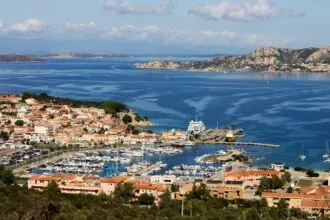
The Costa Smeralda was built around driving, and it shows. Its villages, from Porto Cervo to Cala di Volpe, are spread along a coastline designed for private cars and hire cars, not public transit.
That said, summer ARST bus routes from Olbia reach the main villages, and many upscale hotels run their own private shuttles for guests. If you’re staying at a resort rather than trying to hop between beaches independently, car-free is genuinely workable from June to September.
The specific beaches that made the Costa Smeralda famous, tucked into coves off minor roads, are the hardest part to reach without a car or a private boat transfer, since buses stick to the main coast road.
A private transfer or half-day taxi hire is a realistic compromise here: pricier than a bus, but far cheaper than a multi-day car rental if you only need to reach one or two specific coves.
Booking a boat excursion directly from Porto Cervo or Baja Sardinia is another effective workaround, since many of the coastline’s best beaches, including Capriccioli and Liscia di Vacca, are as easily reached by water as by road.
Some hotels along this stretch offer complimentary shuttles to their beach clubs, worth asking about at booking stage since these often reach coves that no public bus route covers at all.
High season also brings more taxi ranks and informal shuttle services around the main hotels, so asking your accommodation directly about transport before arrival often turns up choices no official timetable lists.
Best for solo travellers and anyone watching the budget. Dorm beds and private rooms in the same search.
Browse hostelsBest for anyone flying more than once or twice a year. Handles the compensation claim so you are not chasing the airline.
See AirHelp+Best for a day with a bag and nowhere to put it. Find a storage point near where you already are.
View storageThe East Coast: Cala Gonone and the Gulf of Orosei
Sardinia’s east coast, home to the dramatic Gulf of Orosei and beaches like Cala Luna and Cala Goloritze, is genuinely one of the hardest parts of the island to reach without a car.
Getting to Cala Gonone, the main base for boat trips into the gulf, typically requires a train to Nuoro or Macomer followed by an ARST bus connection, a journey that can run to 3-5 hours with limited daily departures.
Once there, though, the beaches themselves are reachable without a car via the excursion boats that run daily from Cala Gonone’s harbour, since most of the gulf’s famous coves have no road access at all.
For most visitors without a hire car, an organised day tour from Olbia or Cagliari covering the overland transfer is far more realistic than piecing together public transport alone.
Boat trips into the gulf typically run half-day or full-day excursions from Cala Gonone, stopping at Cala Luna, Cala Sisine and sometimes the famous Bue Marino caves, with prices generally in the €25-45 (£22-39 / $27-49) range depending on duration and operator.
An alternative base is Santa Maria Navarrese further south, which has slightly better bus links via Lanusei and its own excursion boats, though it still involves a multi-hour overland journey from either Cagliari or Olbia to reach without a car.
Either base rewards patience with some of Sardinia’s most striking coastal scenery, limestone cliffs dropping into turquoise water, so travellers happy to trade a long transfer day for a spectacular one or two days generally find it worthwhile.
Barbagia and the Interior: Where Public Transport Runs Out
The mountainous Barbagia region at Sardinia’s heart, home to villages like Orgosolo and Fonni, sees the thinnest public transport coverage on the island, often just one bus a day, if that, on weekdays only.
This is genuinely a region where a hire car or organised tour is the only realistic option for most travellers on a fixed schedule; relying on ARST buses here means building enormous flexibility into your itinerary.
If Barbagia’s traditions, murals and mountain scenery are a priority, a one- or two-day guided tour departing from Nuoro, Olbia or Cagliari is far more efficient than attempting the connections independently.
Nuoro, the region’s main town, is at least connected by a handful of daily ARST coaches from both Olbia and Cagliari, each taking roughly 2-2.5 hours, so it works reasonably well as a base for exploring the wider Barbagia area over a couple of days.
From Nuoro itself, though, onward connections to individual villages thin out fast, and taxis are scarce outside the town centre, so pre-arranging a driver for the final leg is usually the only dependable option.
Airport Transfers Without a Car
All three of Sardinia’s main airports, Cagliari-Elmas, Olbia Costa Smeralda and Alghero-Fertilia, have workable public transport links into their respective towns, so arriving without a pre-booked car isn’t a problem in itself.
Cagliari-Elmas has the best connections of the three, with both a train and a bus reaching the centre in around 10-15 minutes for roughly €1-2 (£1-2 / $1-2). Olbia Airport is a similarly short hop by bus or taxi, usually under 15 minutes into town.
Alghero-Fertilia Airport sits further out, around 10 km from the old town, with ARST buses taking roughly 20-30 minutes and running to a timetable that thins out in the evenings, when a taxi becomes the more practical choice.
If you’re heading onward to Costa Smeralda resorts rather than Olbia town itself, private transfers booked in advance are often more comfortable than piecing together bus connections with luggage.
Landing at a different airport than your final destination is also worth considering: some travellers fly into Alghero and out of Olbia (or vice versa) to avoid backtracking, which pairs neatly with the car-free routes covered later in this guide.
Whichever airport you land at, arriving with cash in small denominations for the first bus or taxi ride is sensible, since not every transport desk or driver accepts card payment for short local journeys.

Are Trenitalia Pass or Italia in Tour Pass Worth It Here?
Two Trenitalia products get recommended for Italy-wide train travel, and it’s worth being precise about which, if either, actually helps on Sardinia’s regional network before buying one for this trip.
The Trenitalia Pass covers high-speed Frecce, Intercity and Intercity Night services. Sardinia’s internal trains are all Regionale services, a category this pass does not include, so it offers no real benefit for island-hopping around Sardinia itself.
The Italia in Tour Pass is a different product: it covers unlimited travel on Trenitalia’s Regionale and Regionale Veloce trains nationwide for a fixed number of days, with a short list of regional exclusions that does not mention Sardinia. That means it should, in principle, cover Sardinia’s Cagliari-Oristano-Sassari-Olbia-Porto Torres network.
Two caveats matter here. First, this pass covers Trenitalia services only, not the separate narrow-gauge lines run by ARST, such as Sassari-Alghero, so it won’t get you everywhere. Second, given how limited Sardinia’s Trenitalia timetable already is, a 3- or 5-day unlimited pass only pays for itself if you’re making several long Trenitalia journeys within that window, rather than one or two.
For most itineraries mixing Cagliari, Olbia and Alghero with day trips, buying individual point-to-point tickets as you go will likely work out cheaper and simpler than a multi-day pass; do the maths first.
Both passes are worth checking again close to your travel dates, since Trenitalia periodically updates terms and exclusions, and a route not covered today could be added, or an included one dropped, before your trip.
A Sample Car-Free Week
A realistic car-free itinerary might run: 2-3 nights in Cagliari exploring the Castello district, Poetto beach and a boat trip, followed by a train to Olbia (around 3-4 hours) for 2 nights including a Costa Smeralda bus excursion.
From Olbia, a bus to Palau and the ferry across to La Maddalena makes for an easy day trip or overnight stop, before returning to the mainland side for onward travel toward Alghero via Sassari, roughly 2.5-3 hours combined.
This kind of loop skips the interior and east coast entirely, trading them for a reliable, low-stress week built around three well-connected bases, exactly the trade-off most car-free visitors end up making.
If you’d rather see everything, including the parts this itinerary skips, our Road Trip Around Sardinia guide lays out the full driving route for comparison.
Travellers with an extra two or three days can extend this loop with a guided day tour from Olbia or Nuoro into Barbagia or the Gulf of Orosei, filling in the two regions a purely public-transport itinerary otherwise has to skip.
Booking accommodation close to the train or bus station in each base city saves real time and effort, particularly in Olbia and Sassari, where the stations sit a short walk from most central hotels.
Which Destinations Are Easiest and Hardest Without a Car?
Easiest: Cagliari, Olbia and Alghero, along with their nearest city beaches, are all comfortably manageable without a car thanks to reliable local buses, walkable centres and reasonable airport links.
Moderate: Costa Smeralda villages, Sassari, Porto Torres and La Maddalena are workable with some planning, particularly in the June-to-September high season when bus frequency and ferry sailings both increase.
Hardest: The Gulf of Orosei coast, Barbagia’s mountain villages, and isolated beaches reached only by unpaved side roads are genuinely difficult without a hire car or an organised tour, whatever the season.
A hybrid approach, basing yourself car-free in a hub city and booking a day or two of guided tours or a short car rental for the harder-to-reach spots, is often the most practical middle ground.
Seasonality shifts this picture considerably: a village unreachable by bus in March might have three daily departures in August, so always check the current month’s timetable rather than relying on general advice alone.
Travellers with mobility needs should factor in that many rural bus stops and older train stations lack ramps or lifts, making the three main hub cities the more comfortable choice regardless of itinerary preferences.

Public Transport vs Renting a Car: A Cost Comparison
A week of trains, buses and the odd taxi will almost always come in cheaper on paper than a rental car, but the comparison isn’t quite that simple once you factor in time, flexibility and missed connections.
Budget roughly €100-150 (£87-130 / $109-164) per person for a week of trains and buses covering three hub cities and a couple of day trips, versus €150-300 (£130-261 / $164-327) for a week-long compact car rental plus fuel, which in Sardinia currently runs around €2 (£2 / $2) per litre.
Where the car pulls ahead is time saved and access gained: a rental unlocks the Gulf of Orosei, Barbagia and every hidden cove along the coast in a single week, journeys that would otherwise need several separate guided tours.
For a couple or family of four travelling together, splitting a car rental often works out cheaper per person than four sets of train and bus tickets, especially once airport transfers are added to the public transport side of the ledger.
Solo travellers and couples on a tighter budget, by contrast, usually come out ahead with public transport plus the occasional taxi or organised tour, without sacrificing much beyond extra planning time.
The honest middle ground for many visitors is a short 2-3 day car rental bolted onto an otherwise public-transport-based trip, timed specifically around the days you plan to explore the interior or east coast, which limits both cost and the hassle of city-centre parking.
When Guided Tours Make More Sense Than Public Transport
For a handful of Sardinia’s best-known sights, an organised day tour is simply more efficient than working out bus and train connections yourself, even for travellers otherwise happy navigating independently.
Multi-stop excursions covering archaeological sites, inland villages and viewpoints around Cagliari are a good example: a single guided day out can cover ground that would otherwise take two or three separate bus journeys with long waits in between.
Our Day Trips from Cagliari guide covers the beaches, archaeological sites and historic towns best reached this way, many of which have thin or non-existent direct bus links from the capital.
The same logic applies to boat-based excursions into the Gulf of Orosei or around the La Maddalena Archipelago, where the destination itself is only reachable by water regardless of how you get to the departure port.
Guided tours also solve the language and logistics barrier for travellers less comfortable navigating an unfamiliar ticketing system in Italian, and many operators include hotel pickup, removing the first-mile problem entirely.
Weigh the price of a tour against the combined cost and time of independent public transport for the same route; for anything involving more than one transfer, the tour often wins on both counts.
Practical Tips for Car-Free Travel in Sardinia
Download the ARST and Trenitalia apps before you travel; both let you check live timetables and buy tickets, which matters given how patchy the ARST website can be to navigate on a phone.
Validate paper tickets before boarding regional trains, and carry small change or a card for bus tickets, since not every rural stop has a working ticket machine or nearby tobacconist.
Build in buffer time between connections, especially outside summer, when a single missed bus can mean a multi-hour wait rather than a quick next departure.
Consider a short one- or two-day car rental to bolt onto an otherwise car-free trip if your itinerary includes the Gulf of Orosei, Barbagia, or a specific Costa Smeralda cove; it’s often cheaper than several taxi transfers.
Finally, always have a backup plan for the last bus or train of the day; Sardinia’s rural services do not run late into the evening, even in high season.
Pack layers even in summer: coastal buses and trains are air-conditioned, but exposed waits at rural stops in midday heat, or breezy evening ferry crossings, call for a bit more preparation than a beach holiday might suggest.
Keep a printed or offline copy of your accommodation address and key phone numbers, since patchy rural signal can leave you without maps or messaging right when you most need to confirm a connection.

Useful Apps for Getting Around Sardinia
A handful of apps make car-free travel in Sardinia noticeably easier, and it’s worth installing the right ones before you land rather than hunting for them at a bus stop with patchy mobile signal. Between them, these apps cover the island’s train network, its regional and city buses, and the short ferry hops linking the mainland to its offshore islands.
The official Trenitalia app covers the island’s Regionale train backbone from Cagliari through to Sassari and Olbia, letting you check live departures and buy point-to-point tickets directly on your phone. It’s the same app used right across mainland Italy, so there’s nothing Sardinia-specific to learn if you’ve already travelled by train elsewhere in the country.
ARST’s own website can be slow and fiddly on a small screen, but the operator sells electronic bus, coach and narrow-gauge train tickets through a dedicated app called DropTicket, covering urban, regional and rail services alike. It’s worth downloading before a rural bus day, though tobacconists and bus station ticket booths remain a reliable fallback anywhere the app or a signal isn’t cooperating.
In Cagliari specifically, the official CTM BusFinder app adds real-time bus tracking, route planning and in-app ticket purchase for the city’s local network. It’s genuinely useful for timing a return trip from Poetto Beach or the train station precisely, rather than guessing at a printed schedule.
For the Palau-La Maddalena ferry hop, operators such as Delcomar take advance bookings through their own websites rather than a dedicated app, though most travellers still buy on the spot at the small kiosks lining the Palau waterfront. Booking ahead online is worth doing in July and August, when the crossing can genuinely sell out.
Ride-hailing is far more limited in Sardinia than on mainland Italy. Uber has only recently arrived on the island, and even then only as a way to hail a licensed local taxi in Cagliari, Quartu and Olbia rather than the private-driver service common elsewhere, so a taxi rank or a hotel-arranged pickup remains the more dependable option almost everywhere else.

Rupert’s Handy Travel Tips
Here’s what I’ve learned about hopping around Sardinia without ever picking up a rental key.
- Screenshot the timetable: Mobile signal drops out in rural Sardinia, so photograph your bus timetable before you set off rather than relying on live data.
- Travel light between towns: Not every rural stop has a step-free platform or luggage space, so a soft bag beats a big suitcase for train and bus days.
- Book island tours in advance: Popular Gulf of Orosei boat trips and Barbagia day tours sell out in July and August, so reserve a few days ahead.
- Keep coins handy: Some rural ticket machines and small-town tobacconists don’t take cards, so carry a few euros in change for bus fares.
Want to meet the reindeer behind our travel tips? Find out more in our page Who is Rupert?.




Frequently Asked Questions
Can you see Sardinia without renting a car?
Yes, if you focus on Cagliari, Olbia and Alghero and their surrounding coastline. Trains, ARST buses and short ferries cover these well, though the interior and east coast are much harder without a car.
How do you get between Cagliari, Olbia and Alghero without a car?
By Trenitalia train or ARST bus. Expect around 3-4 hours between Cagliari and Olbia, and roughly 2.5-3 hours between Cagliari and Alghero via Sassari.
Does the Trenitalia Pass cover Sardinia’s regional trains?
No. The Trenitalia Pass covers Frecce, Intercity and Intercity Night services, and Sardinia’s internal network is entirely Regionale trains, which this pass excludes.
Is the Italia in Tour Pass useful in Sardinia?
It should cover Trenitalia’s Regionale trains on the island, since Sardinia isn’t listed among its exclusions, but it won’t cover ARST narrow-gauge lines, and it’s only worthwhile if you’re making several long train journeys within the pass’s validity window.
Is the Costa Smeralda reachable by public transport?
Yes, in summer. ARST buses connect Olbia to Porto Cervo and other resort villages from roughly June to September, though frequency drops sharply outside that window.
What’s the hardest part of Sardinia to reach without a car?
The Gulf of Orosei coast and the mountainous Barbagia interior, both of which have very limited bus service, often just once a day where any service exists at all.
Do I need cash for buses and trains in Sardinia?
It helps. Many rural ticket points, tobacconists and machines are cash-friendly but not always card-friendly, so carry small change as a backup.
Is it cheaper to use public transport than rent a car in Sardinia?
Usually yes for solo travellers and couples on a short trip, though a rental car often works out cheaper per person for groups of three or more, or for anyone visiting the interior and east coast.
Can you reach Neptune’s Grotto near Alghero without a car?
Yes, via the seasonal excursion boat that runs directly from Alghero’s port, which is generally easier than the overland route down the cliff staircase for car-free travellers.
Further Reading
If your route into Sardinia is still undecided, our Sardinia Ferry Routes hub covers every major crossing from mainland Italy, France and Corsica, including the ports this guide references for onward island travel.
For the three hub cities covered here in more depth, see Things to Do in Cagliari, Things to Do in Olbia and Things to Do in Alghero, each with full sightseeing detail beyond the transport logistics discussed here.
And if you decide the car-free approach isn’t for you after all, our Road Trip Around Sardinia guide maps out a full driving loop covering everything from Cagliari to the Costa Smeralda.
Whichever way you choose to explore, weighing up the routes in both guides before you book flights and accommodation will help you settle on a base, or sequence of bases, that matches your travel style.
Many visitors end up mixing the two approaches over a longer trip: a car-free first half based in Cagliari and Alghero, followed by a short rental for the final days to reach the Costa Smeralda or the east coast before flying home.