Reviewed by our editorial team Updated
Discover the Best Day Trips from Cagliari
Cagliari makes an excellent base for exploring southern Sardinia, with beaches, Roman ruins and Bronze Age monuments all within an hour or two of the capital. A hire car opens up the most ground, but buses and organised tours reach many of the same places.
To the south, the coastline around Pula and Chia holds some of Sardinia’s finest beaches alongside the Phoenician-Roman ruins at Nora. Further east, Villasimius and the Costa Rei offer a livelier resort scene with protected coves and clear water.
Inland, the UNESCO-listed nuraghe at Barumini is Sardinia’s best-preserved Bronze Age monument, while smaller towns like San Sperate and the wine estates around Serdiana reveal a quieter, rural side of the island rarely seen by beach-focused visitors.
This guide covers the best day trips from Cagliari by category: beaches, archaeological sites, historic towns and natural landscapes, along with organised tour options for anyone travelling without a car.
Most destinations here are reachable in under 90 minutes each way, making them genuinely feasible as day trips rather than overnight detours. If you’re arriving from elsewhere, see our guide to Things to Do in Cagliari for the city itself first.
| Destination | Distance/Time from Cagliari | Highlights | Best For |
|---|---|---|---|
| Nora (Pula) | 40 min drive (ARST bus ~50 min) | Roman theatre, Temple of Tanit, ancient mosaics, small beach | Ancient history with a beach attached |
| Su Nuraxi, Barumini | 45 min drive (ARST bus ~1hr50, once daily) | UNESCO Bronze Age nuraghe, guided tour, Casa Zapata museum | Prehistory and archaeology, families |
| Chia & Su Giudeu | ~1 hour drive (ARST bus ~1hr15) | Su Giudeu beach and tidal island, dunes, flamingo lagoon | Sardinia’s best beaches |
| Villasimius | ~1 hour drive (ARST bus ~1hr20) | Punta Molentis, Porto Giunco, snorkelling, Isola dei Cavoli boat trips | Beaches and watersports |
| Costa Rei | ~1 hour drive (ARST bus ~2hrs, a few daily) | 8km sandy beach, Piscina Rei lagoon, windsurfing and kayaking | Long, quieter beach days |
| San Sperate | 20 min drive (ARST bus ~30 min, hourly) | Open-air murals, Pinuccio Sciola’s Sound Garden | A quick art-focused half-day stop |
| Serdiana | 30 min drive (car or tour only) | Argiolas winery, Cannonau and Vermentino tastings | Wine lovers and couples |
| Dolianova | 20 min drive (ARST bus ~25 min, every ~2hrs) | Cathedral of San Pantaleo, olive oil museum | An easy add-on to a Serdiana wine day |
| Sa Spendula Waterfall | 45 min drive (car only) | Three-tier waterfall, natural pools, wooded gorge | Cooling off and easy walks, best in spring |
| Villacidro | 45 min drive (ARST bus ~1hr15 to town) | Fruit orchards and preserves, Art Nouveau centre | Off-beat culture and local flavours |
| Monte Arcosu Nature Reserve | 45 min drive (car essentially only) | Mediterranean forest, Corsican red deer, hiking trails | Hikers and wildlife spotters |
| Sant’Antioco & Southwest Coast | 90 min drive (ARST bus ~1hr to town) | Phoenician-Punic-Roman ruins, Pan di Zucchero sea stack, Porto Flavia | A full day of history and coastal scenery |
Sardinia’s south rewards a mix of transport choices depending on the destination and your appetite for planning. Beaches close to Cagliari, such as those around Chia and Villasimius, are well served by summer bus routes and organised day tours that handle the driving for you. Archaeological sites like Nora and Barumini are reachable by public bus with a little more planning, though a hire car or guided tour saves time and lets you combine two or three stops in a single day. Wine estates and inland towns generally require a car or a specialist tour, since public transport there is limited and infrequent. As a rule of thumb, destinations under an hour away work well as half-day trips paired with a relaxed morning or evening back in Cagliari, while anything over an hour is best treated as a full day out.
Nora: Phoenician-Roman Ruins by the Sea
Nora, near the town of Pula, is one of Sardinia’s most rewarding archaeological sites, an ancient city founded by the Phoenicians and later expanded by Rome, with much of it now sitting right at the water’s edge.
Highlights include Sardinia’s only known Roman theatre, the atmospheric Temple of Tanit on a headland with panoramic sea views, and the Tetrastyle Atrium House, whose mosaic floors depicting sea creatures are remarkably intact after two thousand years.
Look out too for the partially submerged Christian basilica near the shoreline and the old Roman bathhouse, both reminders that Nora was continuously inhabited for well over a thousand years before finally being abandoned.
The site is open daily, with seasonal hours roughly 9:00am to 5:00pm in winter and extending to 8:00pm in peak summer. Adult entry costs approximately €8 (£7 / $9), with guided tours in English included in the ticket price.
By car, Nora is a straightforward 40-minute drive south from Cagliari on the SS195. Without a car, ARST bus 129 runs from Cagliari to Pula in around 50 minutes, with a local shuttle covering the final stretch to the site.
Parking near the site costs roughly €1-2 (£1-2 / $1-2) per hour and sits a short walk from the visitor centre, so budget a few extra minutes if you’re driving during the busier midday hours in summer.
A small beach sits immediately beside the ruins, so pack swimwear if you’d like to cool off after exploring. Summer visitors should aim for early morning or late afternoon, since the site offers little shade and can get uncomfortably hot at midday.
The town of Pula itself, just a few minutes from the site, has a pleasant historic centre and a good choice of restaurants, making it a natural lunch stop before or after visiting the ruins.
Combining Nora with a visit to nearby Chia makes for one of the best all-round day trips from Cagliari, pairing ancient history with some of the region’s finest beaches in a single outing.
Best for two or three nights. The widest choice of rooms, with filters for free cancellation and included breakfast.
View staysBest for groups who want one address and separate bedrooms rather than three hotel rooms.
See holiday homesBest if you have already picked a hotel. Checks the big booking sites for the same room and shows who is cheapest.
Check dealsSu Nuraxi, Barumini: A UNESCO World Heritage Site
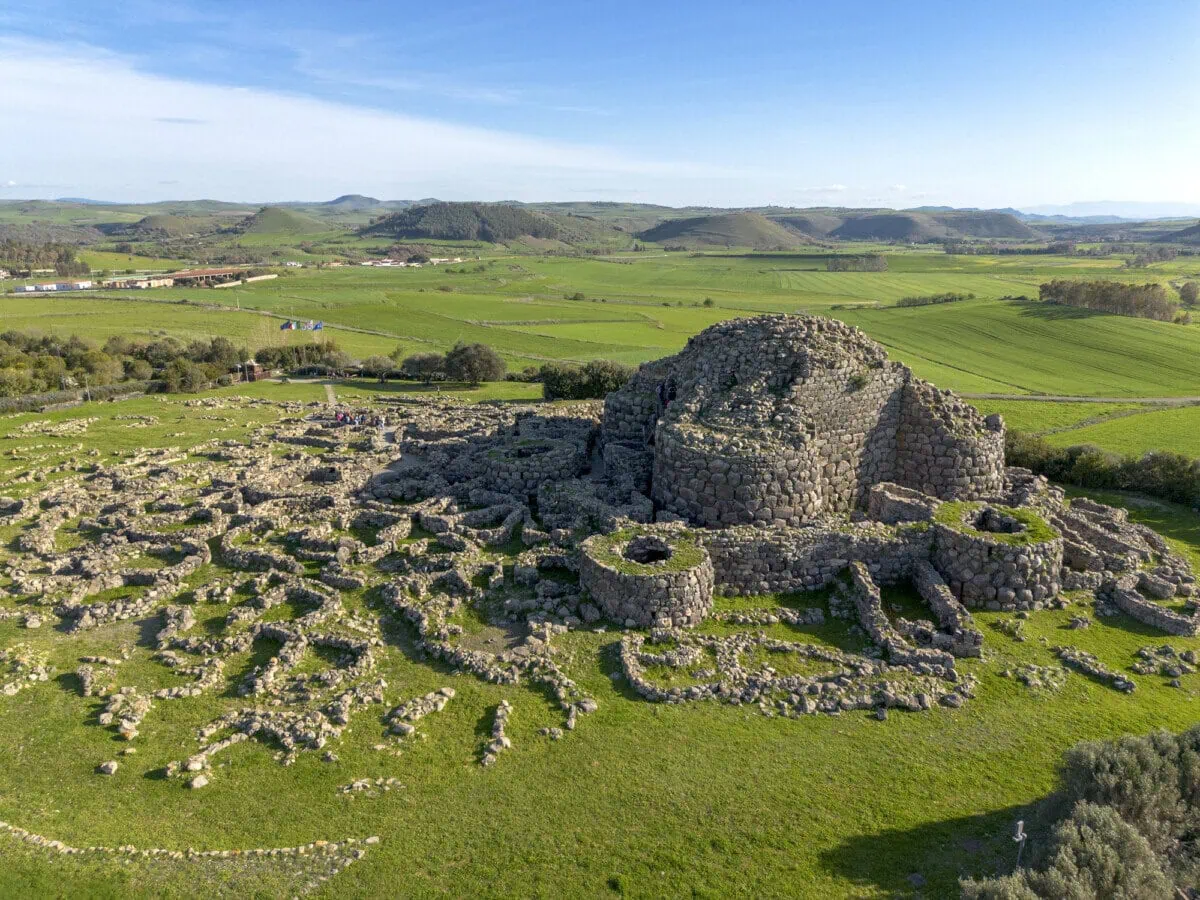
Su Nuraxi at Barumini is Sardinia’s most important Bronze Age monument and a UNESCO World Heritage Site, a fortified complex of stone towers built by the mysterious Nuragic civilisation more than 3,000 years ago.
The central tower once stood several storeys tall, and the surrounding settlement of stone huts gives a genuine sense of daily life in prehistoric Sardinia. Entry is strictly by guided tour, included in the ticket price and running roughly every half hour.
Adult tickets cost approximately €15 (£13 / $16), with reduced rates for children, and admission also covers the nearby Casa Zapata museum, built over further nuraghe remains, and the Giovanni Lilliu Cultural Heritage Centre.
Barumini sits around 45 minutes from Cagliari by car via the SS131 and SS197. Public transport is possible but slow, so most independent visitors either hire a car or join one of the organised day tours that run directly from Cagliari.
Specifically, ARST route 436 runs from Cagliari to Barumini, but only once a day and taking around 1 hour 50 minutes, more than double the driving time, so it suits travellers with a genuinely flexible schedule rather than a tight day-trip itinerary.
Combine the visit with nearby Parco della Giara, a volcanic plateau home to Sardinia’s small, semi-wild horses, if you have time to extend the trip into a full day rather than a half day.
Opening hours vary by season, running roughly 9:00am to 5:00pm in winter and extending to 8:00pm in the height of summer, so it’s worth checking the current schedule before setting out.
The village of Barumini itself is small and easy to combine with lunch after the tour, with a handful of trattorias serving hearty Sardinian country cooking rather than tourist-focused menus.
Photography is generally permitted throughout the site, though flash photography and touching the ancient stonework are discouraged to help preserve the monument for future visitors.
Wheelchair access is limited in places due to the uneven, ancient stonework, so travellers with mobility needs should contact the site in advance to check current arrangements.
Chia and Su Giudeu: Beaches and Dunes
The beaches around Chia, roughly an hour southwest of Cagliari, rank among Sardinia’s best, with turquoise water, powdery sand and dramatic dunes backing much of the coastline.
Su Giudeu beach is the standout, a wide crescent of sand facing a small tidal island you can wade or swim out to when conditions allow. Shallow water and gentle currents make it popular with families as well as sunset photographers.
The wider Chia coastline also includes a lagoon that attracts pink flamingos for part of the year, and several low hiking trails through the dunes for those who want to combine beach time with a short walk.
Watersports operators along the beach rent kayaks and paddleboards through summer, and a scattering of beach bars means you don’t need to pack a full picnic to spend the whole day here.
Organised beach tours from Cagliari run in high season, typically combining Chia with the nearby Tuerredda beach for around half a day, a good option if you’d rather not drive. Independent travellers should note that summer parking near the best beaches fills up by mid-morning.
Neighbouring Tuerredda beach, a little further along the coast, is smaller but equally striking, with a tiny offshore islet you can swim to; many day tours pair the two beaches together for variety.
By car, the drive from Cagliari takes around an hour via the SS195, and free roadside parking exists further from the beach for those happy to walk a little further to save money.
Without a car, ARST bus 129, the same route serving Pula and Nora, continues on to Chia (the Bar Tabacchi stop in Domus de Maria) in around 1 hour 15 minutes from Cagliari, though departures run only every few hours and the best stretches of sand are still a walk from the village stop.
Sun loungers can be hired at a handful of spots along the coastline for roughly €20-40 (£17-35 / $22-44) per day depending on the season, rising higher during the busiest August weeks, though much of Chia remains genuinely wild, with long stretches of dune backing the sand rather than built-up development.
Stick to marked paths through the dune system rather than cutting across, since the fragile vegetation helps hold the sand in place and is protected in several areas.
Villasimius: Protected Coves and Punta Molentis
East of Cagliari, Villasimius is around an hour’s drive and offers some of Sardinia’s most photographed coastline, including the protected cove of Punta Molentis and the long sandy sweep of Porto Giunco, backed by a small lagoon.
Without a car, ARST bus 135 runs directly from Cagliari to Villasimius in around 1 hour 20 minutes, with departures roughly every few hours, a realistic option for anyone happy to trade some flexibility for not driving.
Punta Molentis now requires advance online booking and a €10 (£9 / $11) per-person entry fee, introduced to manage visitor numbers and protect the cove following wildfire damage in 2025, so plan ahead and book your slot if this is your priority. Porto Giunco, by contrast, is larger and easier to access without pre-booking, with clear, shallow water ideal for swimming.
Snorkelling and diving are popular here thanks to a nearby marine protected area, and several dive centres in the town run trips for both beginners and experienced divers; a beginner-friendly discover scuba dive typically costs around €85 (£74 / $93) per person including equipment.
The town of Villasimius itself has a lively summer scene, with restaurants, gelaterias and small boutiques lining the main street, making it a pleasant stop for lunch between beach visits.
Boat trips departing from the small marina explore the wider coastline and the nearby Isola dei Cavoli nature reserve, typically running €54-64 (£47-56 / $59-70) per person for a half-day trip with snorkelling included, a worthwhile add-on if you’re spending a full day in the area rather than just a few hours.
Restaurants overlooking the water in Villasimius serve excellent fresh seafood, generally at a slightly lower price point than equivalent spots along the more exclusive Costa Smeralda further north.

Costa Rei: Sardinia’s Longest Stretch of Sand
Further along the coast from Villasimius, the Costa Rei beaches offer a longer, quieter stretch of sand, popular for watersports like windsurfing and kayaking, with the small town of Castiadas and its former prison building nearby for a change of pace.
The main beach runs for around 8 kilometres of flat, fine white sand backed by low-rise hotels and holiday apartments rather than the older village core found in Villasimius. Behind parts of the beach, the Piscina Rei lagoon attracts a range of wading birds, especially outside the busiest summer months.
The drive from Cagliari takes a little under an hour, and Costa Rei is best visited with a car, since bus connections run infrequently and don’t reach the more remote coves. The same ARST routes serving Villasimius continue on to Costa Rei a handful of times a day, but the journey stretches to nearly two hours, so organised beach tours are a more realistic alternative if driving isn’t an option.
The resort’s beachfront bars and restaurants cater heavily to summer visitors, and a handful of watersports operators rent kayaks, sailing dinghies and paddleboards along the calmer stretches of sand, making it an easy base for an active beach day rather than just sunbathing.
Sunscreen and a hat are worth carrying regardless of which stretch of Costa Rei you choose, since shade is limited across most of this coastline outside the handful of beach bar umbrellas.
San Sperate: Sardinia’s Open-Air Art Village
Around 20 minutes north of Cagliari, the small town of San Sperate is an unexpected highlight for art lovers, its streets and building facades covered in colourful murals painted by both local and international artists.
ARST bus 111 also runs from Cagliari to San Sperate in around 30 minutes, with a roughly hourly service, making this one of the easiest destinations on this list to reach without a car.
The tradition began in the 1960s under sculptor Pinuccio Sciola, whose open-air studio and famous Sound Garden, a collection of carved stones that produce musical tones when touched, remains one of the town’s most visited attractions.
The murals themselves are free to view and easily explored on foot in an hour or two, making San Sperate an easy add-on to a half-day itinerary rather than a destination requiring a full day.
Its proximity to Cagliari also makes it a natural pairing with the wine estates around Serdiana, covered next, for visitors keen to see more of the Campidano plain beyond the beaches.
New murals are added periodically during summer art festivals, so the town’s appearance genuinely changes from one visit to the next, unlike most historic attractions that stay fixed in time.
A handful of small cafes around the centre make a pleasant coffee stop, and it’s worth asking locally about which murals are newest, since the town continues to add fresh work most years.
San Sperate makes a relaxed half-day trip on its own, or an easy morning stop before continuing on to the wineries around Serdiana in the afternoon.
The murals cover themes ranging from local folklore to social commentary, and a printed map from the tourist information point helps make sense of the town’s layout on a first visit.
Serdiana: Wine Country
The countryside around Serdiana, roughly 30 minutes from Cagliari, is home to some of Sardinia’s best-known wine producers, including the well-regarded Argiolas winery.
Tastings typically focus on Cannonau and Vermentino, Sardinia’s signature red and white grapes, often paired with local cheeses and cured meats. Advance booking is recommended, particularly for guided cellar tours.
A car is close to essential for this trip, since the wineries are spread across the countryside with limited public transport. Several Cagliari-based tour operators run half-day wine tours that include transport and tastings for those without one.
Most wineries welcome visitors without a booking for a simple tasting, though a reserved cellar tour usually adds more context and often a better selection of wines to try.
Expect to pay roughly €15-25 (£13-22 / $16-27) for a guided tasting with several wines and a small food pairing, generally better value than similar experiences in more heavily touristed wine regions elsewhere in Italy.
Designate a driver in advance if tasting is on the agenda, since Sardinian roads through the countryside are narrow in places and best driven with full attention.
Many estates also sell bottles directly, often at better prices than you’ll find in Cagliari shops, making it worth setting aside a little luggage space if wine is on your souvenir list.
Best if you can move a day either way. Shows how the fare changes across the month.
Compare flightsBest for short trips. Install the eSIM at home and arrive with working data, no shop queue.
Browse eSIMsBest if you would rather not work out the transport on arrival. Book it now and forget it.
View transfersDolianova: Romanesque Churches and an Olive Oil Museum
A short drive from Serdiana and around 20 minutes from Cagliari, the town of Dolianova adds a scattering of medieval Romanesque churches and a small olive oil museum, giving the area more to see beyond the vineyards if you’re spending a full morning or afternoon here.
The standout is the Cathedral of San Pantaleo, a Romanesque-Pisan church built between 1160 and 1289 that has served as a bishop’s seat since the 14th century; its weathered facade and columned interior are typical of the Pisan-influenced churches built across Sardinia during this period.
The town’s olive oil museum, known locally as Sa Mola de su Notariu, occupies a former marchioness’s villa and explains the region’s centuries-old olive oil production through historic pressing equipment and exhibits, a low-key stop that pairs well with a wine-focused day nearby.
Beyond the town centre, the surrounding countryside holds Roman-era remains at Sa Cora and several prehistoric nuragic structures and giant’s tombs, evidence that this stretch of the Campidano plain was settled long before the vineyards that now define it.
Without a car, ARST buses run from Cagliari to Dolianova roughly every two hours, with the journey taking around 25 minutes, a genuinely workable option if you’re pairing the town with a Serdiana wine visit by taxi rather than driving yourself.
Dolianova has around 8,000 residents and a compact centre that’s easy to combine with lunch or a nearby wine estate visit, making it a natural half-day add-on rather than a standalone destination.
Sa Spendula Waterfall
For a change from beaches and ruins, the Sa Spendula waterfall near Villacidro, around 45 minutes from Cagliari, tumbles down in three tiers through a lush, wooded gorge, an unexpectedly green corner of an island best known for its coastline.
Natural pools at the base of the falls are popular for a cooling dip in summer, and a network of shaded paths makes for an easy walk suitable for most fitness levels and families with older children.
A car is the only practical way to reach the falls, as public transport options are limited and the final stretch involves country roads not well served by buses.
The falls flow most impressively in spring, following winter rains, and can slow to a trickle by late summer, so time your visit accordingly if seeing the waterfall at its best matters to you.
The site is free to visit and rarely crowded, a pleasant contrast to some of the busier coastal attractions covered elsewhere in this guide, particularly on summer weekends.
Sturdy shoes with good grip are worth wearing here, since the paths near the falls can be slippery where water splashes across the rock.
A small cafe near the entrance serves coffee and snacks, useful for refuelling before or after the short walk up to the main viewing points.
Villacidro: Orchards, Preserves and a Literary Legacy
Villacidro itself is known regionally for its fruit orchards and preserves, and small local shops sell homemade jams worth picking up as a souvenir that isn’t the usual ceramics or filigree jewellery.
The town’s roots reach back to the Neolithic era, with nuragic and Roman remains found in the surrounding countryside, though the historic centre as it stands today largely dates from the 15th century onward, when the Rione Castangias district was first settled.
Villacidro passed through Pisan, Aragonese and finally Spanish rule, and briefly served as a provincial capital in the 19th century. Its oldest quarter still holds narrow, twisting lanes and small stone houses climbing the hillside, a contrast to the grander Liberty-style buildings added along Via Roma during the town’s later 19th-century prosperity.
The novelist Giuseppe Dessì, one of Sardinia’s best-known writers, was born here, and the town’s elegant Art Nouveau architecture, including the Caffè Letterario, reflects the more prosperous era that shaped it.
Villacidro town itself is actually reachable by ARST bus (route 211) from Cagliari, taking around 1 hour 15 minutes with fairly frequent daily departures, genuinely workable for a visit to the town on its own. The Sa Spendula waterfall a little further out remains a car job, though, since no bus continues past the town centre onto the country roads leading there.
Monte Arcosu Nature Reserve
Just outside Cagliari, the Monte Arcosu Nature Reserve protects one of the largest surviving areas of Mediterranean forest in Sardinia, home to a population of rare Corsican red deer.
Two well-marked trails, the Perdu Melis and Sa Canna routes, offer roughly two-hour walks through cork oak woodland with a reasonable chance of spotting deer, especially early in the morning or towards dusk.
More demanding routes climb further into the hills for experienced hikers, with rewarding views back towards Cagliari and the gulf on clear days.
The reserve is best reached by car, and it’s worth checking opening days in advance, since access can be restricted during periods of high fire risk in the driest summer months.
The reserve sits around 45 minutes from Cagliari by car. A seasonal ARST bus (route 130) reaches nearby Capoterra, but no service continues on to the reserve entrance itself, so a car or pre-booked taxi for the final stretch is genuinely the only reliable way in.
Sturdy walking shoes and plenty of water are essential, and it’s worth bringing binoculars if you’re hoping to spot the reserve’s deer population, which tends to stay well hidden during the warmer parts of the day.
Entry is typically free or very low cost, and the reserve is a worthwhile half-day option for anyone who wants a break from beaches and archaeological sites without travelling too far from Cagliari.
Guided walks with a local ranger run periodically and are worth booking ahead if you’d like better odds of spotting wildlife than a self-guided walk typically offers.
Insect repellent is worth packing in warmer months, since the woodland trails can be humid, particularly near any streams or water sources within the reserve.
Sant’Antioco and the Southwest Coast
For a longer day out, the island of Sant’Antioco, connected to the mainland by a causeway, sits around 90 minutes from Cagliari and holds a rich mix of Phoenician, Punic and Roman history.
The town’s archaeological museum costs €6 (£5 / $7) to enter, with the Punic necropolis a further €5 (£4 / $5), or a combined ticket covering several of the town’s archaeological areas for around €10 (£9 / $11); allow a couple of hours to see them properly. The surrounding coastline includes the scenic swimming spot known as Arco dei Baci, a natural rock arch popular for cliff jumping among confident swimmers.
Nearby, the former mining region around Nebida and Masua includes dramatic clifftop walks and the striking Porto Flavia mining facility, along with the iconic Pan di Zucchero sea stack visible from the Masua beach.
Given the distance, this is best treated as a full day trip rather than combined with anything else. ARST buses run from Cagliari to Sant’Antioco town in around an hour, a workable option if the museum and necropolis are your main goal, but a car is essential for the mining region around Nebida and Masua, since those sights are spread along the coast with no bus service reaching them.
Sant’Antioco is also known for its traditional sea silk weaving, a rare craft using byssus fibres from a type of mollusc, and a small museum in town explains the process for anyone curious to learn more.
If you’re short on time, prioritise either the archaeological museum and necropolis or the mining region around Nebida rather than trying to fit both into a single visit.
A causeway connects Sant’Antioco directly to the Sardinian mainland, so there’s no ferry required, just a straightforward drive along the coast road.
Fresh seafood restaurants line the small harbour in Sant’Antioco town, a pleasant spot to end the day before the drive back to Cagliari.
Give yourself a reasonable buffer for the return drive, since the last stretch of the SS130 back into Cagliari can be slower during the early evening commute.
Fuel prices along this stretch are broadly similar to the rest of Sardinia, though it’s sensible to top up before the drive rather than relying on finding a station along quieter rural roads.
Organised Tours from Cagliari
For travellers without a hire car, organised day tours from Cagliari cover most of the destinations in this guide, typically running from spring through autumn when demand is highest.
Beach-focused tours to Chia and Villasimius usually run as half-day trips, with pickup from central Cagliari and a few hours of free time at the beach itself, often for €35-55 (£30-48 / $38-60) per person.
Archaeology-focused tours to Barumini and Nora tend to run as full-day trips combining both sites, since they sit in different directions from Cagliari, with prices typically in the €60-90 (£52-78 / $65-98) range including guiding and transport.
4×4 tours combining mountain scenery with a beach stop are popular for travellers who want a bit of everything in a single day, usually departing early morning and returning by early evening.
Booking a day or two in advance is generally sufficient outside peak August dates, when the most popular tours can sell out, particularly for smaller group sizes.
Most tours include hotel or central Cagliari pickup, removing the need to find your own way to a meeting point, and drivers typically speak enough English to handle basic questions along the route.
Smaller group tours in minivans tend to offer a more flexible pace than large coach excursions, useful if you’d rather linger at one stop than rush through several on a fixed schedule.
Read reviews before booking, since quality varies between operators, and a knowledgeable guide can make a significant difference to how much you get out of an archaeology-focused tour in particular.
Confirm what’s included before booking, since some tours cover entry fees to sites like Barumini and Nora while others expect you to pay separately on arrival.
Cancellation policies vary too, so check the terms if you’re booking well in advance, particularly during shoulder season when Sardinian weather can occasionally be unpredictable.
Group sizes range from large coaches carrying dozens of passengers to minivans with eight or fewer, and smaller groups generally allow more time at each stop along the way.
Best if you would rather spend the money on the trip than on the room. Compare hostels by location and rating.
Search hostelsBest for anyone flying more than once or twice a year. Handles the compensation claim so you are not chasing the airline.
See AirHelp+Best for the gap between checking out and your train. Drop bags at a shop or hotel nearby and carry on.
Store your bagsFamily-Friendly Day Trips from Cagliari
Travelling with children changes the calculus for day trips, since long drives and unshaded ruins can wear younger visitors out faster than adults. Beach days generally work best, with Chia and Villasimius both offering shallow, calm water.
Su Giudeu near Chia is a particular favourite with families, thanks to its gentle slope into the water and the novelty of wading out to the small tidal island just offshore.
For history-minded families, Barumini works better than most archaeological sites, since the guided tour format keeps things moving and children often enjoy exploring the maze-like stone passages of the nuraghe itself.
San Sperate’s murals are an easy win for families too, requiring minimal walking and offering plenty of colourful, photogenic scenes that keep younger children engaged without much persuasion needed.
Longer trips like Sant’Antioco or the Monte Arcosu reserve ask more of young children in terms of driving time and walking, so they’re better suited to families with older kids or teenagers.
Whatever the destination, pack more water and snacks than you think you’ll need; shops and cafes can be sparse once you’re away from the main towns and beach resorts.
Booster seats are not always available with hire cars or tour operators, so travelling families should confirm requirements in advance if travelling with very young children.
Shaded picnic spots are limited at most archaeological sites, so families planning a full day out are often better served bringing a light lunch to eat in the shade of a cafe rather than outdoors.
Car seats for younger children should be booked directly with your hire company well ahead of arrival, since availability is limited during the busiest summer weeks.
Combining Multiple Day Trips
With a hire car and a few free days, it’s possible to combine several of these destinations into an efficient loop rather than returning to Cagliari after every stop, saving both time and fuel.
Nora and the Chia beaches sit close enough together, both south of Cagliari, to combine into a single day: ruins in the morning before the midday heat, then the beach for the afternoon.
Barumini and San Sperate both sit north of Cagliari and can be combined into a single day trip, with the art village serving as a light, low-effort stop either before or after the more demanding nuraghe tour.
Wine tasting around Serdiana pairs naturally with a late lunch, making it a good choice for an afternoon-only excursion rather than a full day, especially if you’ve already had a busy morning elsewhere.
Avoid combining Sant’Antioco or the mining region around Nebida with anything else in a single day; the distances involved mean you’re better off dedicating a full day to the southwest coast alone.
Whatever combination you choose, build in some flexibility. Sardinian roads are generally good but can be slower than expected through smaller towns, and it’s easy to underestimate how long a relaxed lunch stop actually takes.
Fuel up and check tyre pressure before setting out on a multi-stop day, since it’s easy to cover 150 kilometres or more once several destinations are combined.
Two-day combinations work well too: a history-focused day covering Nora and Barumini, followed by a pure beach day at Chia or Villasimius to recover before heading home.
Whichever combination you choose, leave the last stop as the most flexible one, since it’s easier to cut a beach afternoon short than to rush a guided tour with a fixed schedule.
Best Time of Year for Day Trips from Cagliari
May, June and September are the sweet spot for day trips around Cagliari, offering warm, reliable weather without the peak-summer crowds or the most intense heat of July and August.
Archaeological sites like Nora and Barumini are noticeably more comfortable to explore in these shoulder months, when temperatures rarely climb much above the mid-20s Celsius during the day.
July and August bring the best swimming conditions and the liveliest atmosphere at beach resorts like Villasimius, but also the highest prices, busiest roads and longest queues at popular sites.
Winter is generally too cool for beach days but can still work well for archaeological sites, wine tasting and inland towns like San Sperate, all of which are enjoyable regardless of swimming weather.
Public transport schedules, particularly rural ARST bus routes, tend to run less frequently outside the summer season, so travellers relying on buses should double-check timetables carefully if visiting in winter.
Whatever the season, an early start makes the most of any day trip, both to beat the heat at exposed archaeological sites and to secure parking at the more popular beaches before it fills up.
Public holidays can also affect opening hours at smaller sites and museums, so it’s worth checking the Italian calendar if your trip falls around Easter or other national holidays.
Shoulder season also means better availability for organised tours and hire cars, without the need to book weeks in advance that peak summer sometimes demands.

What to Pack for a Day Trip
A well-packed day bag makes a real difference on these excursions, since shops and facilities thin out quickly once you’re away from the main towns and resorts covered in this guide.
For beach days at Chia or Villasimius, bring swimwear, a towel, reef-safe sun cream and plenty of water; sunbed and umbrella hire is available at some spots but not guaranteed everywhere.
For archaeological sites like Nora and Barumini, sturdy closed-toe shoes are worth the extra weight in your bag, since uneven stone surfaces and gravel paths are common at both.
A printed or downloaded offline map is a sensible backup for rural drives, since mobile signal can be patchy in the countryside around Barumini, Villacidro and the Monte Arcosu reserve.
Cash in small denominations is useful for parking fees, small trattorias and market stalls in smaller towns, some of which don’t accept card payments as readily as businesses in central Cagliari.
Finally, a light jacket or layer is worth packing even in summer, since coastal breezes and air-conditioned museum interiors can catch out visitors dressed only for beach weather.
A portable phone charger is a small but worthwhile addition too, particularly if you’re relying on your phone for navigation across a full day of driving between stops.
A small first aid kit and any regular medication are sensible additions too, given how far some of these destinations sit from the nearest pharmacy or medical centre.
Which Day Trip Is Right for You?
If you only have time for one day trip, choose based on your interests: Nora for ancient history with a beach attached, Barumini for Sardinia’s most significant prehistoric site, or Chia for the island’s best sand and water.
Travellers with a hire car and two free days should pair a beach day at Chia or Villasimius with a history-focused day covering Nora and Barumini, both feasible without excessive driving if planned sensibly.
Families with young children generally get the most from beach days, since ruins and museums ask more of younger attention spans; save Barumini and Nora for slightly older children with an interest in history.
Travellers without a car should prioritise destinations with reliable public transport or organised tours, namely Nora, Barumini and the closer beach resorts, rather than the more remote wine estates or nature reserves.
If your trip extends beyond a few days in the south, our Road Trip Around Sardinia guide plots a wider route taking in Alghero and the Costa Smeralda alongside Cagliari‘s surroundings.
There’s no need to see everything on a single trip. Sardinia rewards repeat visits, and leaving some destinations for next time is a perfectly reasonable way to keep each day trip relaxed rather than rushed.
Solo travellers and couples often find it easiest to build a flexible day around one main destination, adding a second stop only if time and energy allow once there.
Whatever your travel style, booking your first two or three day trips before arrival takes the pressure off, leaving the rest of your itinerary open to decide once you’re already in Cagliari.
Practical Tips for Day Trips from Cagliari
A hire car gives by far the most flexibility for these day trips, and rates from Cagliari Elmas Airport are generally reasonable outside the peak August fortnight; book ahead if you’re travelling in high summer.
Fill up with fuel before setting out, since petrol stations thin out once you’re away from the main towns, and some rural stations keep limited hours or close entirely on Sundays.
Archaeological sites like Nora and Barumini offer little shade, so summer visitors should carry water, a hat and sun cream, and consider timing visits for the cooler morning or early evening hours.
If you’re relying on public transport, check ARST bus schedules in advance, since rural routes run less frequently on Sundays and public holidays, and the last return service can be earlier than expected.
For a broader sense of getting around the island without a car, our Getting Around Sardinia Without a Car guide covers train and bus links across the wider region.
Finally, pack a swimsuit even on history-focused days: several archaeological sites, Nora especially, sit right beside excellent beaches, and it would be a shame to miss the chance to swim.
Mobile signal is generally reliable across southern Sardinia, but it’s still worth downloading offline maps as a backup before heading into more rural areas.
Toll roads are rare in Sardinia, so budgeting for a day trip mostly comes down to fuel, parking and any entry fees, making it a relatively affordable way to see the island.
A reusable water bottle is worth packing too; many towns have free public fountains, and refilling saves money over buying bottled water at every stop.
If you’re travelling between multiple destinations, keep a printed copy of any tour booking confirmations, since mobile signal can drop out in the more remote countryside stretches.

Rupert’s Handy Travel Tips
A few things I picked up exploring the countryside and coastline around Cagliari that might help with your planning.
- Book Barumini’s guided tour slot ahead in summer: tours run every 30 minutes and can fill up on busy August afternoons.
- Visit Nora early or late: the site has little shade, so plan around the cooler parts of the day in summer.
- Reserve Punta Molentis in advance: this protected Villasimius cove requires pre-booking during peak season.
- Fill the tank before rural drives: petrol stations are sparse once you’re off the main roads around Barumini and Villacidro.
Want to meet the reindeer behind our travel tips? Find out more in our page Who is Rupert?.




Frequently Asked Questions
What is the best day trip from Cagliari?
It depends on your interests: Nora combines ancient ruins with a beach, Barumini is Sardinia’s most important prehistoric site, and Chia offers some of the island’s best sand and water.
Do I need a car to visit these day trips?
A car offers the most flexibility, but Nora, Barumini and the closer beaches are reachable by ARST bus or organised tour with a little planning.
How far is Barumini from Cagliari?
Su Nuraxi at Barumini is around 45 minutes from Cagliari by car, or reachable via a guided day tour that includes transport.
Can I combine Nora and Barumini in one day?
Yes, though it makes for a full day given they sit in different directions from Cagliari. Several organised tours combine both sites for exactly this reason.
Which beaches near Cagliari are best for families?
Su Giudeu near Chia and Porto Giunco near Villasimius both offer shallow, calm water well suited to children.
Is Punta Molentis worth the advance booking?
Yes, it’s one of the most striking coves in the area, though its popularity means booking ahead is necessary in peak summer.
What’s the best time of year for these day trips?
May, June and September offer warm weather without peak-summer crowds or heat, making sightseeing and driving more comfortable.
How much should I budget for a day trip from Cagliari?
Independent trips mainly cost fuel, parking and entry fees, often under €40 (£35 / $44) per person for a beach day or archaeological site. Organised tours typically range from €35-90 (£30-78 / $38-98) depending on distance and inclusions.
Further Reading
Before heading out on any of these day trips, make sure you’ve covered the city itself; our Things to Do in Cagliari guide covers the Castello district, Roman amphitheatre and Poetto beach in full.
Arriving by air or sea? See our Cagliari Airport Transfers guide for getting into the city, or our Cagliari Cruise Port Guide if you’re arriving by ship.
Planning to explore further afield? Our Getting Around Sardinia Without a Car guide explains island-wide train and bus links, while our Road Trip Around Sardinia guide plots a driving route covering Alghero and the Costa Smeralda as well as the south.