Reviewed by our editorial team Published
Tartu is the city Estonians themselves tend to describe as the country’s true heart, even though Tallinn holds the title of capital. Home to the University of Tartu since 1632, it carries an unmistakably academic, slightly bohemian atmosphere that feels quite different from the medieval tourist trail of the capital. Students make up close to a fifth of the population, and their presence shapes everything from the cafe culture on Raekoja plats to the mix of serious museums and playful public art scattered around town.
Estonia’s second city sits on the Emajõgi river in the south of the country, roughly two hours from Tallinn by train. It is compact enough to explore almost entirely on foot, with the wooded slopes of Toome Hill, the pastel townhouses of the Old Town and the striking modern architecture of the Estonian National Museum all within a comfortable walk of each other.
What makes Tartu genuinely worth building into an Estonia itinerary, rather than treating as an afternoon add-on, is the sheer range packed into a small area. There is serious history in the cathedral ruins and terracotta-covered church facades, world-class hands-on science at AHHAA, and a repurposed factory quarter that has become one of the most interesting creative spaces in the Baltics.
This guide covers how to actually get there from Tallinn and beyond, then works through the attractions that make Tartu worth at least a full day, ideally two. Genuine detail on prices and opening patterns is included throughout, and where something could not be independently confirmed, that is said plainly rather than guessed at.
| Attraction | What It’s For / Why Visit | Roughly How Long to Spend There |
|---|---|---|
| Raekoja Square and the Kissing Students Fountain | Tartu’s central square and its bronze fountain, the city’s best-known symbol | 15-20 minutes, though most people pass through more than once |
| University of Tartu Main Building | Neoclassical university landmark with a preserved 19th-century student prison in the attic | 15-20 minutes exterior, longer with a guided tour |
| Tartu Cathedral Ruins and Toome Hill | Atmospheric medieval cathedral ruin and wooded hilltop park with rooftop views | At least 1 hour |
| Angel’s Bridge and Devil’s Bridge | Two contrasting footbridges linking Toome Hill’s paths to the streets below | A few minutes for both |
| AHHAA Science Centre | The Baltic states’ biggest hands-on science museum, with a planetarium and live shows | 2-3 hours |
| Estonian National Museum | Striking glass-and-steel museum covering Estonian and Finno-Ugric history in depth | 3-6 hours self-guided, or around 90 minutes on a guided tour |
| Tartu Art Museum and the Leaning House | Estonia’s largest art museum outside Tallinn, inside a visibly tilting 18th-century townhouse | 30-45 minutes |
| St John’s Church and Its Terracotta Figures | Brick Gothic church famous for its facade of medieval terracotta figures | At least 20 minutes |
| University of Tartu Botanical Garden | The Baltic states’ oldest botanical garden, with free outdoor grounds and paid greenhouses | 30 minutes outdoors, longer with the greenhouses |
| Emajõgi Riverside and the Freedom Bridge | Riverside paths and a lit modern bridge, best for an unhurried stroll | 30-60 minutes |
| Aparaaditehas Creative City | A former factory turned creative quarter of shops, galleries and restaurants | At least 1 hour, longer if eating |
| KGB Cells Museum | A sobering former Soviet-era prison basement documenting occupation-era repression | 30-45 minutes |
| Vanemuine Theatre | Estonia’s first Estonian-language theatre, staging drama, opera and ballet across three venues | A full evening for a performance |
How to Get There
Almost everyone reaches Tartu from Tallinn, and the most comfortable way to do it is the Elron train. Estonia’s national rail operator runs direct services on this route roughly every one to two hours through the day, with the fastest journeys covering the 185 kilometres in just over two hours and slower services taking closer to two and a half.
One-way fares typically run from €15 to €20 (£13-17/$16-22), with a return closer to €30-35 (£26-30/$32-38), in line with what our Interrail Estonia Pass guide already confirms for this exact route. Elron’s modern FLIRT trains carry wifi, power sockets and air conditioning, and seat reservations are never required, so you simply turn up and board.
Since January 2026, Elron and Latvia’s Vivi have also run a once-daily direct Tallinn-Tartu-Riga service, useful if Tartu is a stop on a wider Baltic loop rather than a there-and-back day trip. It is a single daily departure in each direction rather than a frequent option, so it suits a specific onward plan more than spontaneous travel.
Coach travel is the budget alternative, and it is genuinely competitive on this route. Both Lux Express and FlixBus run frequent daily departures between Tallinn and Tartu, with journeys taking around two to two and a half hours and one-way fares often starting from €7-12 (£6-10/$8-13) when booked ahead, undercutting the train on price if not on comfort.
Tartu Airport exists but is not a realistic gateway for most visitors. The only scheduled passenger route currently operating is a Finnair service to Helsinki, run under a public service contract with the City of Tartu through the end of 2027, with around a dozen flights a week and a flight time of roughly 45 minutes. There is no meaningful direct international network beyond that single link, so travellers flying into Estonia should still plan to arrive via Tallinn Airport and continue overland.
Driving is straightforward if you have a car already, since the Tallinn-Tartu highway (Route 2) is a well-maintained dual carriageway for most of its length and the trip takes around two hours outside rush periods. For a first visit without a car, the train remains the easiest and most comfortable option, with the bus as a cheaper backup when timings suit better.
Raekoja Square and the Kissing Students Fountain
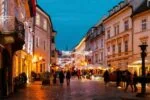
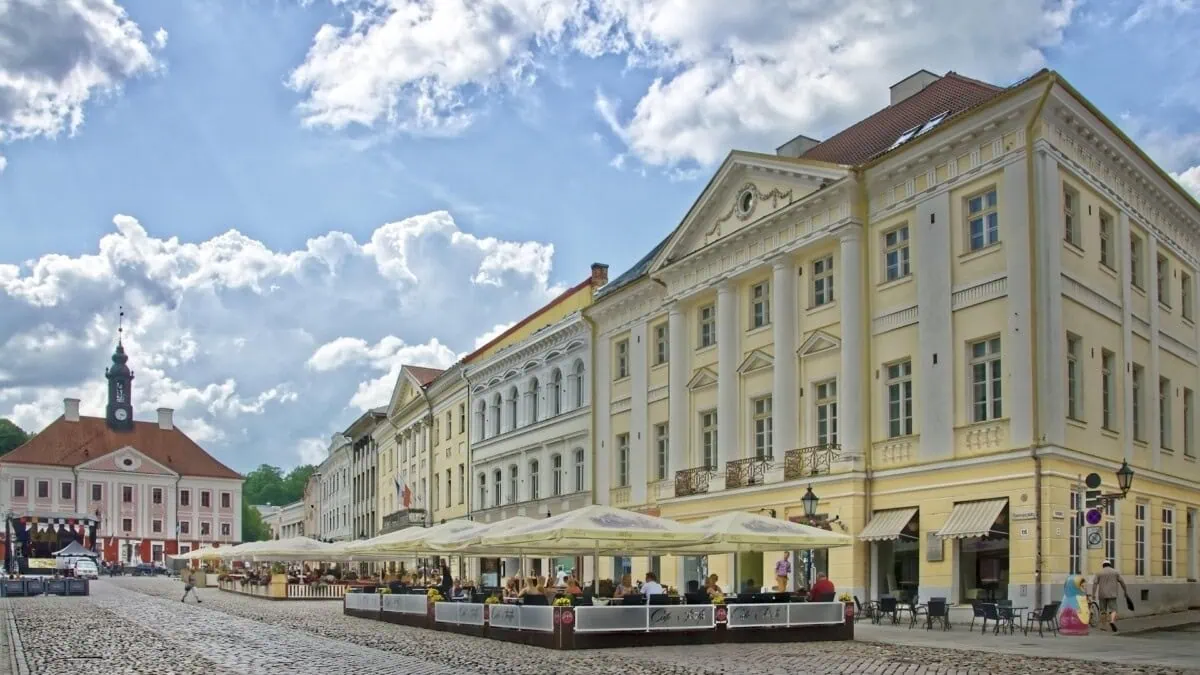
Raekoja plats, Tartu’s Town Hall Square, is the natural starting point for exploring the city and the closest thing it has to a single defining scene. The square slopes gently down toward the river and is lined with pastel-painted 18th and 19th-century buildings, most of them now cafes, bars and small shops rather than the merchant houses they once were.
At its centre stands the pink and white Tartu Town Hall, a late 18th-century Baroque-Classicist building that still functions as the seat of city government. Directly in front of it sits the square’s most photographed feature, the Kissing Students fountain, a bronze sculpture of two students sheltering under an umbrella that has become one of the most recognisable symbols of the city.
The fountain itself dates only to 1998, the work of Estonian sculptor Mati Karmin, though it sits on the site of an older fountain built in 1948 that newlyweds already visited for good luck. Today it functions as an unofficial mascot for Tartu’s identity as Estonia’s student city, a role the university’s presence has shaped since the 17th century.
The square works well at almost any time of day. Mornings are quiet enough for photographs without the fountain surrounded by other visitors, while evenings bring a proper buzz of student life to the surrounding bars, especially once the university term is underway from September.
It costs nothing to visit and there are no opening hours to work around, since it is simply an open public square. Most people naturally pass through it several times during a day in Tartu, since it sits directly between the riverside, the Old Town’s shopping streets and the path up to Toome Hill.
Best for two or three nights. The widest choice of rooms, with filters for free cancellation and included breakfast.
View staysBest for longer stays. Whole apartments and houses, so you are not eating out three times a day.
View rentalsBest if you have already picked a hotel. Checks the big booking sites for the same room and shows who is cheapest.
Check dealsUniversity of Tartu Main Building
A short walk from Raekoja plats stands the University of Tartu’s main building, arguably the single most important structure in the city given the university’s role in Tartu’s identity. Designed by architect Johann Wilhelm Krause and completed in 1809, its columned Neoclassical facade has become a genuine symbol of the city, appearing on postcards and, at various points, Estonian currency.
The university itself was originally founded in 1632 under Swedish rule, making it one of the oldest in Northern Europe, though it has closed and reopened several times through wars and occupations since. The current building has hosted every major university ceremony since 1809, and its ornate White Hall remains in use today for concerts, graduations and formal events.
One of the building’s more unusual features is the student prison tucked into its attic, used until the early 20th century to punish students for offences like drunkenness or duelling under the university’s own internal disciplinary system. It has been preserved largely as it was, complete with graffiti left by the students who served time there, and offers a genuinely odd glimpse into 19th-century academic life.
The building also houses the University of Tartu Art Museum, a small collection of plaster cast reproductions of classical sculpture used historically for teaching. Access to the interior, including the White Hall and the student prison, is generally through guided tours arranged with the museum rather than free wandering, so it is worth checking current tour times before turning up.
Even without going inside, the building’s exterior and the small square in front of it are worth the few minutes it takes to see them properly. It anchors the upper part of the Old Town and sits directly on the route between Raekoja plats and Toome Hill, so it rarely needs a special detour.
Tartu Cathedral Ruins and Toome Hill
Rising above the Old Town, Toome Hill was once a pagan Estonian stronghold before being seized in the 13th century and gradually turned into the site of a great Gothic cathedral. Today the hill is a landscaped park, and its centrepiece is the impressive brick ruin of Tartu Cathedral, one of the largest and most atmospheric medieval ruins anywhere in the Baltics.
Construction of the cathedral began in the late 13th century, but the building suffered badly during the Reformation, the Livonian War and a fire in the 1620s, and by the 18th century its towers had been cut down and turned into a cannon platform. Roughly a third of the structure survives intact today, with the rest carefully stabilised rather than restored, leaving bare brick walls open to the sky.
The restored section now houses the University of Tartu Museum, which displays historical scientific instruments, rare books and university artefacts inside the old choir. Climbing the cathedral’s surviving tower also gives one of the better rooftop views over Tartu’s red roofs and the Emajõgi valley beyond.
Toome Hill itself is worth exploring beyond the cathedral, with shaded paths, a small observatory building and several monuments to figures from the university’s history scattered through the trees. It makes an easy, free extension to a cathedral visit and is a pleasant place to slow down after a morning in the busier Old Town streets below.
The park is open and free to wander at any time, though the museum inside the cathedral ruins keeps set hours, so check before making the walk up specifically for the interior. Either way, allow at least an hour to properly take in both the ruins and the wider hilltop park.
Angel’s Bridge and Devil’s Bridge
Two footbridges on opposite sides of Toome Hill have become minor landmarks in their own right, and most visitors end up crossing at least one of them on the walk between the cathedral ruins and the surrounding streets. Inglisild, or Angel’s Bridge, is the older and more delicate of the pair, a slender arched crossing first built in wood between 1814 and 1816 to designs by the same architect responsible for the university’s main building.
The bridge carries a portrait relief of Georg Friedrich Parrot, the university’s first rector after its 1802 reopening, along with a Latin inscription that translates roughly as leisure renews the powers. It suffered arson damage in 2012 but was repaired and remains open today as a pedestrian route across a small ravine on the hill.
On the other side of Toomemägi stands Kuradisild, or Devil’s Bridge, a heavier concrete structure built to mark the 300th anniversary of the Romanov dynasty in 1913 and now a protected heritage site. Its two arches, decorative panels and stone seating recesses give it a much more solid, monumental feel than its lighter counterpart.
Nobody is entirely sure why it earned the devil’s name, though local guides tend to offer two explanations: its dark colouring set against Angel’s Bridge, or a pun on the surname of the German engineer who oversaw its construction. Either way, the pairing of the two bridges is one of the more charming small details of a walk around Toome Hill.
Both bridges are free, unrestricted public crossings with no opening hours to plan around. They add only a few minutes to a Toome Hill walk but are easy to miss if you stick strictly to the main cathedral path, so it is worth deliberately looping around to see both.

AHHAA Science Centre
Down by the river, the AHHAA Science Centre is the single biggest draw in Tartu for families and genuinely one of the best hands-on science museums anywhere in the Baltic states. It bills itself as the most entertaining science centre in the region, and the scale backs that up, with multiple floors of interactive exhibits spread across a striking modern building on Sadama street.
Exhibits cover physics, biology and technology through genuinely hands-on demonstrations rather than glass cases, alongside a live planetarium showing fulldome films and a science theatre running chemistry and physics shows throughout the day. There is also a small aquarium, an observation ant colony and, somewhat unexpectedly, a chicken enclosure as part of the centre’s biology displays.
Admission runs at approximately €20 (£17/$22) for adults and €15 (£13/$17) for students, with preschool-age children entering free and a family ticket available at around €45 (£39/$49), though it is worth checking current pricing before visiting since museum rates change periodically. The centre opens at 10:00 daily, closing at 19:00 Monday to Thursday and Sunday, and 20:00 on Fridays and Saturdays.
Realistically, this is not a quick stop. Families with children should budget at least two to three hours to get proper value from the exhibits, planetarium and shows, and it is easily the kind of attraction that can anchor an entire afternoon in Tartu on its own.
Because it draws visitors from across the region and beyond, booking planetarium show times in advance during busy periods such as school holidays is a sensible precaution. Outside those peak windows, turning up and buying tickets on the day is normally straightforward.
Estonian National Museum
On the edge of the city, the Estonian National Museum is one of the most architecturally striking buildings in the Baltics, a vast glass and steel structure built directly on the site of a former Soviet military airfield. The design deliberately uses the old runway as its axis, a symbolic gesture that turns a site of Soviet occupation into a home for Estonian national identity.
Inside, the museum’s two main permanent exhibitions are genuinely substantial. Encounters traces Estonian history chronologically from prehistory to independence, with dedicated sections on language and traditional cuisine, while Echo of the Urals explores the wider Finno-Ugric peoples that Estonians are historically and linguistically connected to.
There is also a rotating temporary exhibition programme and a dedicated children’s area called the Magical Forest, making the museum reasonably family-friendly despite its serious subject matter. A restaurant and shop are built into the same 6,000 square metre building, so it is easy to make a half-day of the visit without leaving.
The museum sits roughly a 30-minute walk from central Tartu, or a short ride on local bus number 7 from the Tasku shopping centre or the Market Hall. Opening hours run 10:00 to 18:00, closed on Mondays, and a proper self-guided visit through both permanent exhibitions realistically takes three to six hours if you want to read everything.
For visitors short on time, a guided tour covering the highlights can be done in around 90 minutes. Either way, this is not a museum to squeeze into a half-hour gap between other plans, and it deserves to be treated as a genuine centrepiece of a Tartu visit rather than an afterthought.
Tartu Art Museum and the Leaning House
Right on Raekoja plats stands one of Tartu’s most quietly famous buildings, a townhouse from 1793 known locally as the Leaning House because of a visible tilt caused by uneven foundation materials used during its original construction. It has become an unofficial Tartu landmark almost as recognisable as the Kissing Students fountain a few metres away.
The building originally belonged to the noble Barclay de Tolly family before later restoration work, carried out by Polish specialists, actually stabilised the structure so it no longer continues to tilt further. The lean itself remains visible and is very much the building’s calling card, even though the structural risk it once implied has long since been resolved.
Since 1988 the building has served as the main exhibition space for the Tartu Art Museum, Estonia’s largest art institution outside Tallinn, holding around 23,000 works spanning the 18th century to the present. The three-storey building itself hosts rotating temporary exhibitions rather than a single permanent collection, alongside an education room and a specialist art bookshop.
The museum was originally established in 1940 by artists connected to the influential Pallas art school, which shaped much of 20th-century Estonian visual art and still lends its name to a local art college today. Exhibitions here have occasionally sparked genuine public debate, giving the museum a reputation for showing contemporary work with a bit more edge than a typical civic gallery.
Given its location directly on the main square, this is an easy add-on to a Raekoja plats visit rather than a separate trip. Exhibitions and opening hours change regularly, so it is worth checking what is currently showing before planning a visit around a specific piece of work.
Best for finding routes the airlines do not sell as a single ticket. Combines carriers to bring the fare down.
Search flightsBest for anyone whose home plan charges by the megabyte abroad. Pay a fixed price up front.
Check eSIMsBest when public transport has stopped, or when you are travelling with children and bags.
Book a transferSt John’s Church and Its Terracotta Figures
A short walk from the main square, St John’s Church is a Brick Gothic Lutheran church whose origins reach back to at least the 14th century, with some evidence suggesting a wooden predecessor stood on the site even earlier. It survived the Great Northern War, a devastating city fire in 1775 and heavy damage during the Second World War, and remains an active parish church today.
What sets it apart from any other church in the Baltics is its extraordinary collection of terracotta figures set into niches across the exterior facade. Originally there were more than a thousand individually made figures, each subtly different from the next, and while time and war have reduced the surviving number to roughly 200, what remains is still an unusually rich piece of medieval sculpture.
Historians still debate exactly who the figures represent, since some wear crowns that suggest royalty while others appear to be ordinary Tartu citizens or religious figures from the period. That uncertainty is part of the appeal, and it is worth taking a slow walk around the exterior specifically to pick out as many individual faces as possible.
Inside, the church has been restored following its wartime damage, with Baroque chapels dating from the 1740s and 1769 still intact alongside newer additions, including bells installed in 1999 and named for the city’s patron saints. The interior is generally quieter and less visited than the exterior figures suggest, giving it a genuinely contemplative feel.
The church is open to visitors around regular service times and welcomes those interested purely in the architecture and sculpture, though it is worth checking current hours locally since these can shift with the church calendar. Either way, allow at least twenty minutes just for a proper circuit of the exterior figures.
University of Tartu Botanical Garden
Close to the Old Town, the University of Tartu Botanical Garden is the oldest botanical garden in the Baltic states, established in the early 19th century and still operating on precisely the same site more than two centuries later. It was originally laid out by the botanists Ledebour and Bunge, and the garden’s core structure has changed remarkably little since.
The collection today runs to more than 10,000 species and varieties of plants, spread across outdoor beds and a series of greenhouses. Highlights inside the glasshouses include a tropical rainforest section, a desert house full of cacti and succulents, and a dedicated alpine garden, while outdoor areas cover heath planting, a moss garden and a small children’s play space.
The outdoor gardens are free to walk through, which makes this an easy, low-cost stop to fold into a wider Old Town walk. The greenhouses require a separate paid ticket, and while exact current pricing is worth checking on the day, it has historically been a modest amount compared to the city’s larger paid attractions.
Opening hours run year-round from 10:00 to 17:00, seven days a week, making it one of the more flexible attractions in Tartu to fit around a changeable itinerary. It tends to be genuinely quiet even in peak season, since it sits slightly off the main tourist route compared with the square and the museums.
Given the location, it pairs naturally with a walk that also covers the nearby Old Town streets, and the outdoor sections alone are worth thirty minutes even for visitors who would not normally seek out a botanical garden. Gardening enthusiasts and families with young children in particular tend to linger considerably longer.
Emajõgi Riverside and the Freedom Bridge
The Emajõgi river curves gently around the edge of Tartu’s Old Town, and the paths along both banks make for one of the most pleasant, unhurried ways to spend an hour in the city. Wide grassy stretches and a paved promenade attract joggers, students and families in roughly equal measure, especially on a warm afternoon.
The most visible crossing is the Freedom Bridge, or Vabadussild, a modern arched structure opened in 2009 that replaced a long line of earlier bridges dating back to a first recorded crossing in 1554. Earlier versions were destroyed and rebuilt repeatedly through fires and the upheavals of the 20th century, including demolition by retreating Soviet forces in 1941 and again by German forces in 1944.
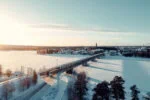
The current bridge is roughly 90 metres long and carries both road traffic and pedestrians, its arch lit up with coloured lights after dark, which makes an evening riverside walk noticeably more atmospheric than a daytime one. It is a genuinely photogenic spot to pause, particularly looking back toward the Old Town skyline.
In summer, the riverside area comes alive with outdoor cafes, occasional open-air events and, on the right day, small boats and paddle craft available to rent from operators along the bank. It is a low-key contrast to the more structured sightseeing of the Old Town and Toome Hill above it.
There is no cost and no schedule to work around here, since it is simply open public riverside space. It works well as a way to link the Old Town with the Estonian National Museum on foot, or simply as somewhere to unwind between the city’s more structured attractions.
Aparaaditehas Creative City
A short walk from the centre, Aparaaditehas is a former industrial complex that has been turned into one of the most genuinely interesting creative quarters anywhere in the Baltic states, comparable in spirit to Tallinn’s better-known Telliskivi. The name translates roughly as apparatus factory, a nod to the site’s manufacturing past.
The old factory buildings now house a mix of independent restaurants, cafes and a bakery, alongside small design shops, galleries and studios rented out to local artists, designers and other creative businesses. The TYPA Printing and Paper Arts Centre, a working museum of traditional printing techniques, is one of the more unusual tenants worth seeking out specifically.
Rather than functioning as a single ticketed attraction, Aparaaditehas is best treated as a district to wander through, popping into whichever shops, galleries or cafes catch your eye. There is no admission charge for the site itself, and browsing the courtyards and buildings costs nothing beyond whatever you choose to buy.
The complex hosts a genuinely active events calendar, including its own annual festival, regular Gallery Nights, concerts and seasonal fairs, so checking what is on before a visit can turn a casual wander into something more substantial. Individual shops and cafes keep their own hours, though the district as a whole is generally liveliest from late morning through the evening.
This is a natural stop for anyone who has already covered the Old Town’s historic core and wants a sense of Tartu’s more contemporary, creative side. Allow at least an hour, longer if you plan to eat there, since the food and drink options are genuinely one of the highlights.
KGB Cells Museum
Tucked into a grey building on Riia hill, the KGB Cells Museum occupies the basement of a house that functioned as an NKVD and later KGB pre-trial prison through the 1940s and 1950s. It is a small, sobering counterpoint to the rest of Tartu’s cheerful student-city image, and one of the more direct places in Estonia to confront the reality of Soviet occupation.
The preserved sections include the original prison corridor and a number of solitary and shared cells, kept largely as they were rather than reconstructed for effect. Exhibition panels, available in Estonian, English, Russian and Finnish, explain the day-to-day operation of the facility and the fate of many of the people held there.
A newer addition to the permanent exhibition covers the Forest Brothers, the Estonian partisans who continued armed resistance against Soviet rule from forest hideouts well into the 1950s, adding useful context to the cells themselves. The museum sits within the wider Tartu City Museum network rather than operating as a fully separate institution.
This is a small museum, realistically taking 30 to 45 minutes to see properly, and it is not the kind of place that needs a long visit to leave an impression. It pairs naturally with an interest in 20th-century Baltic history, and travellers who have already visited Tallinn’s own Soviet-era sites will find it a worthwhile, more intimate companion piece.
Current opening hours and admission pricing are worth checking directly before visiting, since small municipal museums like this one sometimes adjust their schedules seasonally. Anyone building a Baltic dark tourism itinerary alongside Tallinn’s own Soviet-era sites, covered in our Tallinn Dark Tourism Guide, should treat this as a natural addition.
Vanemuine Theatre
Vanemuine, founded in 1870, holds the distinction of being the first Estonian-language theatre, and it played a genuine role in the country’s 19th-century national awakening at a time when Estonian culture had little formal institutional support. The name comes from a figure in Estonian folklore associated with song and music.
More than 150 years later, it remains Estonia’s only three-genre theatre, staging drama, opera and ballet productions across three separate venues in the city, known as the Grand Building, the Small Building and the Harbour Theatre. That range means there is usually something running regardless of when you visit, from serious drama to lighter musical productions.
For visitors without Estonian, ballet and opera performances are naturally the easiest to enjoy without a language barrier, while drama productions will obviously depend on translation or surtitles where available. Checking the current programme in advance is worth doing regardless, since performance schedules vary considerably through the year.
Even for visitors who do not attend a performance, the theatre’s presence is part of what gives Tartu its cultured, slightly serious reputation relative to Tallinn’s more tourist-oriented atmosphere. Ticket prices vary significantly by production and seating, so it is best to check the current listings directly rather than assume a fixed range.
Booking ahead is sensible for anything popular, particularly opera and ballet, since seating in the Grand Building is more limited than in a typical large city venue. For a genuine sense of Tartu’s cultural life beyond its museums, an evening here is hard to beat.
Best if you would rather spend the money on Estonia than on the room. Compare hostels by location and rating.
Search hostelsBest arranged before you fly rather than after. Covers claim handling, plus lounge access on eligible delays.
Explore AirHelp+Best for the gap between checking out and your train. Drop bags at a shop or hotel nearby and carry on.
Store your bagsThings to Do in Tartu in the Rain
Tartu’s weather can turn quickly, and because this is fundamentally a museum city built around a centuries-old university, a wet day here rarely means a wasted one. The AHHAA Science Centre alone could fill a rainy afternoon, its planetarium and science theatre running regardless of the sky outside.
The Estonian National Museum works just as well in bad weather, since its exhibitions sit inside one vast enclosed building on the edge of town. Between the two attractions, a determined visitor could spend most of a wet day without stepping outside more than once.
Several smaller museums covered earlier double up nicely on a rainy itinerary. The University of Tartu Museum, inside the old cathedral choir, and the KGB Cells Museum on Riia hill are both compact indoor stops that fit between one downpour and the next.
Two further indoor options are worth knowing about even though they do not get their own section here. The Estonian Sports and Olympic Museum, one of the larger interactive museums of its kind in the Baltics, and the smaller Tartu Toy Museum both offer genuinely wet-weather-proof alternatives.
Not everything on this page suits bad weather, and it is worth being honest about that. Toome Hill’s cathedral ruins, the botanical garden’s outdoor beds, the two footbridges and the riverside walk are all outdoor-first experiences that lose much of their appeal under heavy rain.
The Tartu Market Hall, a covered indoor market close to the centre, gives a useful in-between option, with stalls of fresh produce and local snacks under a solid roof and small cafes to shelter in properly. Aparaaditehas also holds up well, since most of it sits under cover.
Food Scene and Food Halls
Tartu’s food scene reflects its identity as a university city as much as anything else, with a genuinely lively mix of student-budget spots and increasingly ambitious kitchens sitting within a few streets of each other. The dining scene has grown well beyond simple cafe culture.
The Tartu Market Hall, a covered indoor market close to the centre, is the best starting point for a genuine taste of local produce rather than a tourist menu. Traders sell fresh vegetables, cured meats, cheeses and traditional Estonian snacks, with small cafes built into the hall itself.
For something more polished, Restaurant Hõlm, inside the Lydia Hotel in the Old Town, has built a genuine reputation for contemporary Estonian cooking around locally sourced ingredients, and it has been recognised in the Michelin Guide’s Baltic listings. It is worth booking ahead rather than turning up on the night.
Rüütli Street, running through the heart of the Old Town, is where much of Tartu’s everyday dining clusters, offering everything from Estonian comfort food to more international menus within easy walking distance of Raekoja plats. It rewards simply wandering and picking whatever looks busiest.
Traditional Estonian food is still very much on the menu here. Dishes like verivorst (blood sausage) and hearty mulgikapsad (sauerkraut and pork stew), alongside dense rye black bread, remain genuine local staples rather than novelty items aimed purely at visitors.
Aparaaditehas, covered in detail earlier on this page, doubles as one of the city’s best food destinations, its converted factory buildings holding independent restaurants, a bakery and cafes that lean more creative than the Old Town’s more traditional offerings. It is worth timing a visit there around a meal rather than simply passing through.
Nightlife and After Dark
Tartu earns its reputation as Estonia’s liveliest student city honestly, with roughly a fifth of the population enrolled at the university and term-time evenings noticeably busier than the daytime crowd. The atmosphere leans unpretentious and cheap rather than glossy.
Raekoja plats, the main square covered earlier on this page, is the natural first stop after dark, with its surrounding cafes and bars filling up once lectures finish for the day. It works well for an early drink before moving on somewhere livelier.
Genialistide Klubi, a long-running cultural and nightlife venue with its own concert hall, cinema screenings and club nights, is one of the genuine institutions of Tartu’s after-dark scene and has operated in various forms for decades. It draws a mixed crowd of students, artists and long-time regulars.
For more historic atmosphere, Püssirohukelder, the Gunpowder Cellar, occupies a genuine 18th-century vaulted powder store beneath the Old Town and is reportedly one of the tallest pub ceilings anywhere in the world. It works equally well as an early dinner spot or a later, atmospheric drink.
The Karlova district, just south of the centre, has a quieter, more bohemian evening scene built around its wooden houses and small bars. It is worth exploring for visitors who would rather avoid the busiest student nights near the square.
As with most university towns, the atmosphere shifts with the academic calendar. Tartu’s nightlife is at its liveliest from September through the exam periods either side of Christmas, and noticeably quieter outside term time.

Shopping and Markets
Tartu’s shopping is modest compared with Tallinn, but it covers the everyday essentials well and rewards a bit of local knowledge rather than a big-name shopping trip. Locals do most of their everyday shopping at a handful of central malls rather than one obvious high street.
Tasku Shopping Centre, built directly above the main train and bus terminal, is the most convenient stop for visitors, combining everyday retailers with a food court and a cinema under one roof. Its location makes it a natural first or last stop on a rail-based trip.
The historic Tartu Kaubamaja department store, on the edge of the Old Town, has been a fixture of the city’s retail scene for decades and remains the more traditional option for clothing and household goods. It sits close enough to Raekoja plats to fold into an Old Town walk.
For a bigger shopping trip, Lõunakeskus is a larger shopping and recreation centre on the southern edge of the city, bringing together a wider range of international retailers alongside leisure facilities. It requires a short bus or car journey to reach rather than being walkable from the centre.
For something more distinctive than a mall, the Old Town’s smaller streets hold genuine handicraft and artisan shops, along with the gift shop attached to the A. Le Coq Beer Museum for a specifically Tartu souvenir. Browsing these beats the malls for anyone after something more local.
The Tartu Market Hall, already covered as a food destination on this page, doubles as a genuine shopping stop too. Stalls sell fresh produce, local snacks and the odd non-food item worth picking up before heading home.

Rupert’s Handy Travel Tips
I’ve done Tartu as both a rushed day trip and a proper overnight stay, and the second is genuinely worth arranging if you can, so here’s what I’d pass on before you go.
- Take the train, not the bus, if timing allows: it costs a bit more but the Elron service is comfortable, has wifi and power sockets, and drops you closer to the centre than some bus stops.
- Give AHHAA and the Estonian National Museum their own half-days: both are genuinely large attractions, and trying to squeeze either into a spare hour will leave you frustrated.
- Walk Toome Hill in one loop: start at the cathedral, cross Angel’s Bridge, and come back over Devil’s Bridge, rather than backtracking the same path twice.
- Stay overnight if you can manage it: Tartu’s riverside and Aparaaditehas both feel noticeably better in the evening than as a rushed afternoon stop before the last train back.
- Don’t skip St John’s Church for the facade alone: the terracotta figures are best seen slowly, and it’s easy to walk past without realising how many there actually are.
Want to meet the reindeer behind our travel tips? Find out more in our page Who is Rupert?.




Frequently Asked Questions about Things to Do in Tartu
How do I get from Tallinn to Tartu?
The most comfortable option is the direct Elron train, taking just over two hours with one-way fares typically €15-20 (£13-17/$16-22). Lux Express and FlixBus coaches run frequently too, often slightly cheaper, in a similar journey time.
Is Tartu worth visiting as a day trip from Tallinn?
Yes, though a single day only really allows time for the Old Town, Toome Hill and one major museum. Staying overnight gives a far better sense of the city, especially its riverside and creative quarter after dark.
Can I fly directly into Tartu?
Only from Helsinki, via a limited Finnair service running around a dozen times a week. Most travellers should still fly into Tallinn Airport and continue to Tartu by train or bus.
How many days do you need in Tartu?
A single full day covers the essential Old Town sights, but two days allows time for AHHAA, the Estonian National Museum and a proper visit to Aparaaditehas without rushing.
Is Tartu suitable for families with children?
Very much so. AHHAA Science Centre is one of the best family attractions in the Baltics, and the Botanical Garden works well for younger children too, with plenty of outdoor space to run around.
Further Reading
Tartu combines naturally with a wider Estonia itinerary, and our Interrail Estonia Pass guide is worth reading if you plan to combine Tartu with Narva, Viljandi or the Latvian border by rail using a flexible pass rather than single tickets. For the capital itself, our Best Things to Do in Tallinn guide covers the medieval Old Town in the same depth as this page covers Tartu, and our Day Trips from Tallinn guide places Tartu alongside other options such as Lahemaa National Park and Pärnu for anyone still deciding how to structure their time.
Travellers continuing south into the wider Baltics will find our Things to Do in Riga and Best Things to Do in Vilnius guides useful for comparing all three Baltic capitals against a university city with a very different character. Our Rail Baltica Explained guide is also worth a look if you are curious about how the region’s rail network is set to change once the new high-speed line eventually opens.
Before you set off, our eSIM Apps Guide is worth checking to stay connected throughout Estonia and the wider Baltics, and our Travel Insurance Apps Guide covers making sure your trip is properly protected before you go.