Reviewed by our editorial team Published
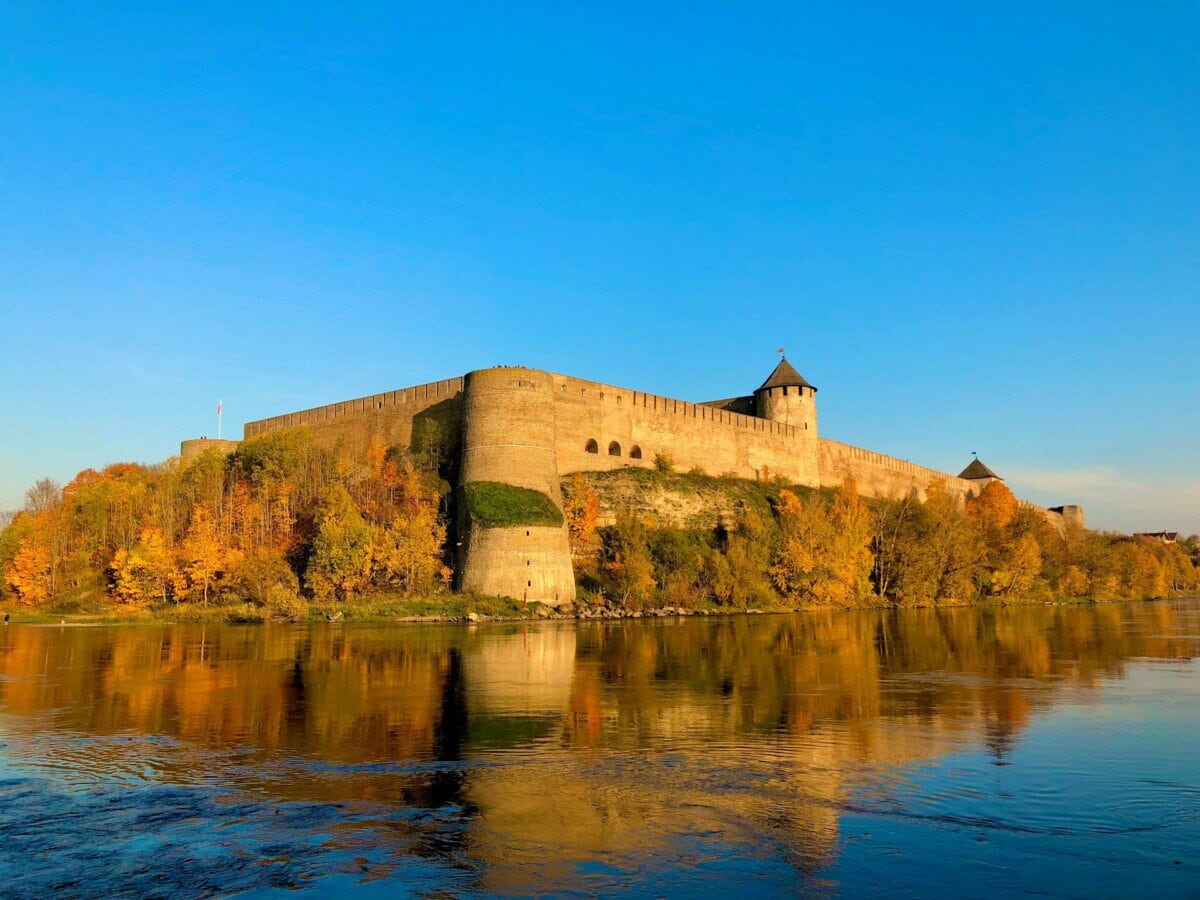
Narva is Estonia’s third largest city, sitting on the eastern bank of the Narva River exactly where the European Union and NATO end and Russia begins. Facing it across a few hundred metres of water is Ivangorod, a near mirror image Russian fortress town, and the two medieval castles that dominate each riverbank make Narva one of the most visually and politically striking border towns anywhere in Europe.
This is not a detour from Tallinn’s medieval charm so much as its opposite. Narva is a working, largely Russian-speaking industrial city rebuilt almost entirely after being levelled in 1944, where Baroque townhouses, Soviet apartment blocks and a vast derelict 19th-century textile mill all sit within a few minutes’ walk of each other.
That mix gives Narva a genuine identity of its own rather than making it merely a curiosity for people who already know Tallinn. Hermann Castle’s tower gives one of the best cross-border views anywhere in Europe, while the rebuilt Town Hall, the twin Lutheran and Orthodox cathedrals and the enormous Kreenholm manufacturing complex tell three overlapping stories about Swedish, Tsarist and Soviet Narva.
Narva-Jõesuu, the seaside resort at the mouth of the river, and Narva College’s striking modern riverside building show that the city stretches well beyond its historic core, and both earn a proper place in a visit rather than a passing mention. This guide covers how to actually get there, since Narva has no airport of its own, then works through the two questions every visitor actually wants answered, what the view of Russia looks like and whether the bridge itself is open, before covering the city’s castles, churches, industrial heritage and cultural venues at the depth a genuine visit deserves.
| Attraction | What It’s For / Why Visit | Roughly How Long to Spend |
|---|---|---|
| View of Russia | Standing on the castle ramparts or riverside promenade for a direct view across the river to Ivangorod Fortress | 30-45 minutes |
| Crossing the Bridge to Russia | Seeing the Friendship Bridge border crossing point (not crossing it) and understanding the current rules | 15-20 minutes |
| Hermann Castle and the Narva Museum | Medieval fortress and city history museum, with the best tower view of the Russian side | 1.5-2 hours |
| Narva Town Hall | Restored Baroque civic building housing the tourist information centre | 20-30 minutes |
| Alexander’s Cathedral | Nineteenth-century Lutheran cathedral with a rescued, still-active congregation | 20-30 minutes |
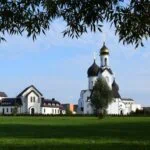
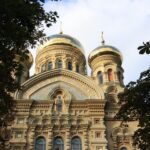
| The Resurrection of Christ Orthodox Cathedral | Neo-Byzantine cathedral built for Kreenholm’s workforce, one of the few buildings to survive 1944 intact | 20-30 minutes |
| The Kreenholm Manufacturing Complex | Vast derelict nineteenth-century textile mill, mainly viewed from outside | 45 minutes-1 hour |
| Narva Art Residency | Contemporary art studios and exhibitions inside former mill buildings | 30-45 minutes |
| Peetri Plats | Old town square with surviving Baroque townhouses and cafes | 20-30 minutes |
| The Narva Bastions | Swedish-era earthwork fortifications with underground casemate tours | 45 minutes-1 hour |
| Vaba Lava Narva | Contemporary theatre venue inside a converted factory building | Varies with programme |
| Narva College | Striking modern riverside university building, worth seeing as architecture | 15-20 minutes |
| Narva-Jõesuu Beach | Seaside resort with a long sandy beach, 14 kilometres from the city | Half a day |
How to Get There
Narva has no airport of its own, so every visitor arrives overland, usually starting from Tallinn Airport or the Estonian capital itself. The journey east follows the same route Estonia’s rail and road network has used for a century, running past Jõhvi and the oil-shale towns of Ida-Viru County before reaching the river.
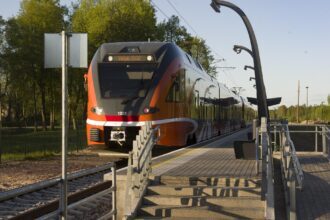
The most comfortable option is the Elron train from Tallinn’s Baltic Station, which covers the roughly 195-kilometre route in around two and a half to three hours depending on the specific service. Several direct trains run daily between early morning and early evening, with one-way fares typically running from about €10 to €20 (£9 to £17/$11 to $22), and no change of train required.
Long-distance coaches cover the same route and are often slightly faster and more frequent than the train, which can be useful when a schedule does not line up with Elron’s timetable. Coach operators serving eastern Estonia run several departures a day from Tallinn’s central bus station, and the journey time by road is broadly similar to the train, traffic permitting.
Travellers already holding an Interrail Estonia Pass can use it directly on the Elron route without buying a separate ticket, which makes Narva an easy add-on for anyone already exploring the country by rail. Our wider guide to day trips from Tallinn covers Narva alongside other options, though the distance genuinely suits an overnight stay better than a rushed same-day return.
Travellers who would rather not plan trains and timings themselves have a guided day tour option that packages the journey with a local guide’s context, which matters given how much of what makes Narva interesting is genuinely political and historical rather than purely visual.
GetYourGuide – From Tallinn: Narva and “A View of Russia” Day Trip
View of Russia
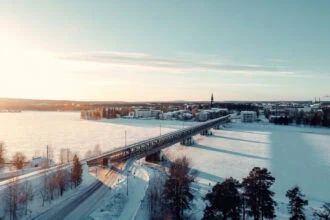
The view across the Narva River is the single most talked-about reason to visit the city, and it earns the reputation. From the ramparts of Hermann Castle, or from the riverside promenade below, visitors look directly at Ivangorod Fortress, a Russian stronghold built in 1492 specifically to answer Narva’s own defences on the opposite bank.
The two fortresses were built by rival powers within a few hundred metres of each other, and centuries later they still face off across a river that now happens to be the external border of the European Union and NATO. Few places anywhere let a visitor stand on one side of a modern geopolitical fault line and look straight across it at a near mirror image of where they are standing.
The best photographs come from the top of Pikk Hermann tower in the morning or late afternoon light, when the two castles and the river between them are lit from the side rather than washed out by overhead midday sun. The riverside promenade beneath the castle gives a lower, closer angle that puts the water itself in the foreground.
On the Russian side, Ivangorod’s own walls and towers mirror Narva’s in scale and style deliberately, since both fortresses were rebuilt and reinforced over the centuries specifically to outmatch whichever power controlled the opposite bank at the time. That architectural rivalry, frozen in stone, is what makes the view feel historically loaded rather than simply scenic.
Binoculars are worth packing if you have them, since flags, church domes and individual buildings on the Russian side become much clearer from the tower than they appear to the naked eye. Even without them, the sheer directness of the view, two fortress towns staring at each other across a few hundred metres of water, is the image most visitors leave Narva remembering.
Best if you want daily housekeeping and a front desk. Filter by area first, then by price.
Check availabilityBest for groups who want one address and separate bedrooms rather than three hotel rooms.
See holiday homesBest if you have already picked a hotel. Checks the big booking sites for the same room and shows who is cheapest.
Check dealsCrossing the Bridge to Russia
The Friendship Bridge (Sõprussild in Estonian) carries the border crossing point between Narva and Ivangorod, and it is the detail most visitors actually want to know before they arrive. As of research for this guide in September 2026, the crossing remains open to pedestrians during daytime hours only, while vehicle crossing has been suspended since February 2024.
Estonia’s Police and Border Guard Board has stated plainly that reopening the bridge to cars and lorries is not a decision tied to construction or infrastructure, even though reconstruction work on the Russian side was reported to be nearing completion through 2026. Officials have said reopening to vehicle traffic depends on the political and security situation connected to Russia’s war in Ukraine, not on the physical state of the crossing point itself.
Pedestrian crossing hours have also been tightened over the past two years, with the checkpoint closed overnight and running shorter hours outside the summer months. Anyone requiring a vehicle crossing into Russia is currently directed to the Koidula or Luhamaa crossing points further south instead, both of which operate their own separate hours.
None of this makes the bridge a normal tourist crossing. Schengen visa rules make it very difficult for most Western travellers to obtain a Russian visa at all in the current climate, and Estonian authorities have said openly that they see no reason to make travel into Russia easier while the war continues, so the practical reality for most readers is viewing the bridge from the Estonian side rather than walking across it.
Border rules at this specific crossing have changed several times in the past few years and could change again with little warning, so it is worth checking current guidance from Estonia’s Police and Border Guard Board directly rather than assuming an older rule still applies at the time of your visit.
Hermann Castle and the Narva Museum
Hermann Castle is the reason most people come to Narva in the first place, a stone fortress begun by Danish rulers in the 13th century and expanded over the following two centuries into the imposing bastion that dominates the riverbank today. Its tallest tower, known as Pikk Hermann, rises to just over 50 metres and gives the single best vantage point over the river and the Russian side beyond it.
Inside the castle walls, the Narva Museum occupies the fortress’s historic rooms and tells the story of the city from its medieval trading days through Swedish and Russian rule to the near total destruction of 1944. Exhibits cover everything from archaeological finds to detailed models of the Baroque old town that existed before the war levelled it.
Climbing the Pikk Hermann tower is the highlight for most visitors, since the platform at the top looks directly across the narrow stretch of river to Ivangorod Fortress on the Russian side, a view found nowhere else in Europe in quite the same form. Allow an hour and a half to two hours to see the museum properly and still have time on the tower without feeling rushed.
The castle courtyard and grounds host occasional markets, medieval-themed events and open-air exhibitions through the summer season, adding a reason to visit beyond the museum itself. Exact opening hours and admission prices can vary by season, so it is worth checking the Narva Museum’s own listings before travelling rather than relying on older guides.
Because the castle sits directly on the border, security around the grounds is understandably more visible than at a typical Estonian heritage site, with clear signage about where visitors can and cannot go. None of this detracts from the visit, and if anything it adds to the sense that this is a genuinely different kind of Baltic castle experience.
Narva Town Hall: A Restored Baroque Survivor Among Soviet Blocks
The Baroque Town Hall on Town Hall Square is one of only a handful of pre-war buildings left standing in Narva’s old town, and its survival makes it disproportionately important to the city’s sense of its own history. Built between 1668 and 1671 to a design by Georg Teuffel, it represents the prosperous Swedish-era Narva that existed before Peter the Great’s siege and the devastation of the Second World War.
A seven million euro restoration (€7m/£6m/$7.7m), completed in 2023, returned the building to something close to its original appearance while quietly modernising it inside, and it now houses a tourist information centre and a restaurant alongside its ceremonial civic rooms. The contrast between the Town Hall’s pale Baroque facade and the Soviet-era apartment blocks surrounding the square is one of the starkest architectural juxtapositions anywhere in the Baltics.
Guided tours of the building are sometimes available through the tourist information centre based inside it, and staff there can also point visitors towards bastion tours and museum openings elsewhere in the city. Dropping in here early in a visit is a sensible way to get current, accurate information rather than relying on anything printed in advance.
The square itself is worth a slow walk rather than a quick photo stop, since the surrounding streets hint at how the whole old town would have looked before 1944 destroyed almost everything else around it. Standing next to the one surviving fragment of Baroque Narva gives real context to how much of the rest of the city had to be rebuilt entirely from nothing.
Because the Town Hall sits only a short walk from both the castle and the river, it fits naturally into the same short loop as the rest of Narva’s historic core rather than requiring a special trip of its own.

Alexander’s Cathedral
Alexander’s Cathedral, a Lutheran church rather than the Orthodox cathedral elsewhere in the city, was built between 1881 and 1884 and named after Tsar Alexander II following his assassination in 1881. It gained formal cathedral status only in 2000, when it was designated under then-president Lennart Meri, making it a relatively recent addition to Estonia’s list of cathedrals despite its 19th-century origins.
The building’s history has not been entirely smooth. Its congregation declared bankruptcy in 2015 after struggling to fund reconstruction work on the church tower, and the building came close to being sold at auction before the Estonian state and the Estonian Evangelical Lutheran Church jointly purchased it for €375,000 (£320,000/$395,000) in 2016 specifically to keep it in public and religious use.
That rescue matters because it reflects something true of Narva more broadly, a city with more historic buildings than it currently has the resources to maintain on its own, dependent on national government support to keep landmarks standing. Alexander’s Cathedral is a working example of that dynamic rather than an abstract statistic.
The cathedral’s setting on rising ground gives it a visibility across the city that its relatively plain exterior might not otherwise earn, and it remains a functioning Lutheran parish church today rather than a museum piece. Opening times for casual visitors can be limited outside services, so checking locally on the day is more reliable than assuming it will be open.
Visiting both this church and the Orthodox cathedral elsewhere in Narva on the same day gives a genuinely useful sense of how the city’s religious landscape shifted through Swedish, Russian and Soviet rule, in a way that reading about it never quite manages.
The Resurrection of Christ Orthodox Cathedral
Built between 1890 and 1896 to serve the thousands of workers at the nearby Kreenholm textile mills, the Resurrection of Christ Cathedral is a Neo-Byzantine building on a Greek-cross layout, with four equal arms meeting under a central dome. Its foundation stone was laid in 1890 in the presence of Tsar Alexander III and Empress Maria Feodorovna, underlining how directly Kreenholm’s industrial wealth funded the city’s grandest religious buildings.
Designed by architect Pavel Alis and built from local red brick, the cathedral can hold up to 2,000 worshippers, a scale that reflects how large Kreenholm’s workforce genuinely was at its peak. The bell tower reaches almost 29 metres, and inside, a carved iconostasis and icons by Mikhail Dickarev survive largely intact.
Remarkably, the cathedral remained standing through the 1944 destruction that flattened most of central Narva, making it one of the few buildings in the city that connects directly back to the pre-war Tsarist-era city rather than being a post-war reconstruction. A major renovation for its centenary in 1996 kept the interior in genuinely good condition.
The cathedral belongs to the Estonian Orthodox Church of the Moscow Patriarchate and remains an active place of worship, so visiting respectfully around service times matters more here than at a purely secular monument. Its congregation is a direct link to the Russian-speaking industrial workforce that Kreenholm brought to the city in the 19th century and that still shapes Narva’s population today.
Set slightly apart from the castle and old town on the approach to Kreenholm itself, the cathedral works well as a stop on the way to or from the mill complex rather than a separate special trip, since the two sites share so much of the same history.
The Kreenholm Manufacturing Complex
Kreenholm was once one of the largest textile factories in the world, founded on an island in the Narva River in 1856 by German industrialist Ludwig Knoop and expanded over the following decades into a sprawling complex of red-brick mills, workers’ housing and warehouses. At its height it employed thousands of workers and effectively built the surrounding city around itself.
Production finally stopped and the site fell derelict around 2010, leaving behind one of the largest surviving pieces of 19th-century industrial architecture anywhere in Northern Europe, now sitting largely empty on its own island. Walking or cycling around the complex’s exterior gives a genuine sense of scale that photographs struggle to convey.
Not all of Kreenholm has been left to decay. Parts of the site have found new life as the Narva Art Residency, hosting international artists and exhibitions inside former factory buildings, and there is ongoing local discussion about wider redevelopment of the complex for cultural and creative use.
Much of the interior remains off-limits or unsafe to enter without an organised tour, so casual visitors should expect to appreciate Kreenholm mainly from the outside and via any guided access running at the time. The waterfalls beside the mill buildings, originally harnessed to power the factory, remain a striking natural feature in their own right.
For anyone interested in industrial heritage or Baltic economic history, Kreenholm is arguably as important a Narva landmark as the castle itself, even though it receives far less attention in general Estonia travel guides. It rewards a slower, more curious visit than a quick drive-past.
Best if you can move a day either way. Shows how the fare to Estonia changes across the month.
Compare flightsBest for short trips. Install the eSIM at home and arrive in Estonia with working data, no shop queue.
Browse eSIMsBest when public transport has stopped, or when you are travelling with children and bags.
Book a transferNarva Art Residency
Operating inside part of the former Kreenholm textile complex, the Narva Art Residency has become one of the more unexpected cultural draws in the city, hosting international artists for extended stays and turning former industrial space into studios, exhibition rooms and event venues. Its presence is part of a wider, gradual attempt to give Narva a cultural identity beyond its industrial and border-town reputation.
Exhibitions and open studio events run through the year, and the exact programme changes regularly as artists rotate through residencies, so checking current listings before a visit is more useful than relying on a fixed description. The setting inside the old mill buildings is as much a part of the experience as whatever happens to be on display.
The residency sits within walking distance of the Resurrection of Christ Cathedral and the wider Kreenholm site, making it easy to combine with a broader look at the industrial complex rather than treating it as a separate stop. Visitors interested in contemporary art alongside Soviet and Tsarist-era history will find the combination genuinely rewarding.
Because the residency operates on a smaller, less commercial scale than a major city gallery, opening hours can be limited and events are not always signposted clearly from outside. Asking at the Narva Museum or Town Hall tourist information centre before heading over saves a wasted trip if nothing happens to be running that day.
The project is one of the clearest signs that Narva’s identity is shifting from a purely industrial and military history towards something more forward-looking, even as the surrounding factory buildings remain largely as they were left when production stopped.
Peetri Plats and the Old Town’s Surviving Baroque Houses
Peetri plats, or Peter’s Square, sits at the heart of what remains of Narva’s historic centre and takes its name from Peter the Great, whose forces besieged and captured the city from Sweden in 1704. The square and its surrounding streets are the closest thing Narva has to a genuine old town core outside the castle and Town Hall Square themselves.
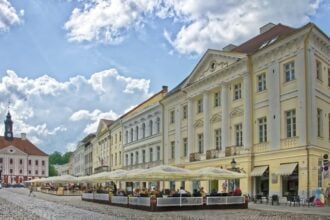
A handful of restored townhouses around the square hint at the Baroque streetscape that once covered much of central Narva before it was almost entirely destroyed in 1944, giving a sense of what a much larger, intact old town would have looked like. Cafes and small shops occupy some of the ground floors today, giving the square a genuine, unforced local atmosphere rather than a purely curated tourist one.
The contrast between these restored Baroque facades and the plainer Soviet-era buildings nearby is a running theme across the whole city centre, and Peetri plats is one of the clearest places to see it in a single view. It works well as a short stop on a walk between the Town Hall and the castle rather than a destination in its own right.
Local events and small markets sometimes use the square during warmer months, adding some life to what can otherwise be a fairly quiet corner of the city outside peak visiting hours. It is a useful place to sit down with a coffee and get a feel for everyday Narva rather than only its headline monuments.
Because so little of the pre-war old town survives, every remaining Baroque building around Peetri plats carries more historical weight than it might elsewhere in Europe, and it is worth pausing here rather than walking straight past on the way to the castle.
The Narva Bastions
In the 17th century, when Narva sat directly on the border between Sweden and Russia, Swedish military engineer Erik Dahlberg designed a ring of earthwork bastions around the city to strengthen its defences. Seven were eventually built, named Honor, Gloria, Victoria, Fama, Triumph, Fortuna and Spes, alongside one earlier bastion renamed Paks.
Remarkably, all but one of these bastions have survived into the present day, making the Narva Bastions one of the most complete surviving examples of Swedish-era fortification anywhere in the Baltic states. Victoria Bastion in particular is open to visitors, with guided tours through its restored underground casemates giving access to a part of the defences most cities of this age have long since lost.
Walking the grassed-over ramparts above the bastions gives a different, quieter perspective on the city than the castle or riverside promenade, with views back towards the Old Town and out over the surrounding streets. The scale of the earthworks is easy to underestimate from ground level and becomes clearer once you are standing on top of them.
The bastions saw real use in more than one siege, most notably during Peter the Great’s capture of the city in 1704, and walking their perimeter connects directly to that history rather than being a purely scenic stop. Combining a bastion walk with a visit to the castle gives a much fuller picture of how the whole city was built to be defended, not just the fortress at its centre.
Casemate tour timings can be limited, particularly outside summer, so checking with the Town Hall’s tourist information centre before planning a route around them is worth the extra few minutes.
Vaba Lava Narva
Vaba Lava is a network of purpose-built contemporary theatre venues that Estonia’s Ministry of Culture developed to support independent theatre outside Tallinn, and the Narva venue was built specifically to fill what officials openly described as a complete absence of professional theatre space in the city. It opened inside the former Baltijets factory building, giving the venue an industrial setting that fits neatly with the rest of Narva’s converted heritage sites.
The building holds a black-box style theatre hall seating around 220 people, alongside a cafe and gallery space, and it hosts touring productions, festivals and locally produced work through the year. Programming is generally bilingual or Russian-language given Narva’s demographics, which makes it genuinely accessible to the city’s own residents rather than existing purely for outside visitors.
For travellers, dropping into whatever exhibition or event happens to be running in the gallery space is often more realistic than planning a visit around a specific performance, since touring schedules are not fixed months in advance. Checking the venue’s own listings shortly before travelling is the most reliable way to see what is actually on.
The venue’s existence says something about Narva’s wider cultural ambitions, part of a deliberate push, alongside the Art Residency and various Kreenholm redevelopment projects, to build a genuine creative scene in a city still primarily known for its border and industrial history. It is a small but real counterweight to that reputation.
Vaba Lava sits a short distance from the Old Town rather than directly beside the castle, so it works best as a separate stop on a second day in Narva rather than squeezed into a single fast-paced visit built entirely around the border and the fortress.
Narva College of the University of Tartu
Narva College is a division of the University of Tartu, Estonia’s oldest and most prestigious university, established in the city in 1999 to bring higher education directly into the country’s most Russian-speaking region. Its striking modern glass building on the riverside is one of the few genuinely contemporary architectural landmarks in a city otherwise defined by medieval, Baroque and Soviet-era structures.
The college runs programmes across academic divisions covering civic studies, psychology, pedagogy and language education, deliberately designed to serve local students who might otherwise have to leave the region entirely for a Tartu-standard university education. That mission matters in a city that has struggled economically since Kreenholm’s decline, giving Narva’s younger residents a reason to build a future locally rather than move away.
Visitors are not the college’s main audience, but its riverside building is worth seeing simply as architecture, a deliberately modern counterpoint to the castle and cathedrals nearby, and its public spaces sometimes host talks, concerts or exhibitions open to non-students. Checking the college’s public event listings before a visit can turn up something worth attending.
The building’s large windows and open riverside setting give unusually good, unobstructed views along the Narva River, rivalling the castle’s own outlook in a quieter, less crowded spot. It is an easy, short addition to a walk that already takes in the Town Hall and the bastions nearby.
Narva College is a useful reminder that the city is not purely a museum of its own past, with a genuine, functioning institution investing in its future sitting only a few minutes from the medieval fortress that draws most visitors here in the first place.
Narva-Jõesuu Beach
Narva-Jõesuu, roughly 14 kilometres from central Narva at the point where the river meets the Baltic Sea, is a genuine seaside resort town with one of the longest sandy beaches in Estonia. Wooden villas, pine forests and a distinctly relaxed, slower pace make it feel like a completely different destination from the industrial border city just up the river.
The town developed as a fashionable spa resort in the 19th century, and many of its wooden villas from that period survive today, giving the seafront a genuinely elegant, old-fashioned character quite unlike anything in Narva itself. A wide, level promenade runs along the top of the beach, popular for walking and cycling well beyond the short summer swimming season.
Summer is unsurprisingly the best time to visit, when the beach itself becomes usable and the town’s cafes and small guesthouses are properly open, though the pine forests behind the dunes make for a pleasant walk in cooler months too. Public transport connects Narva-Jõesuu with central Narva by local bus, and the journey takes well under half an hour each way.
Because it sits so close to Narva itself, Narva-Jõesuu works naturally as a half-day addition rather than requiring its own separate overnight trip, particularly for travellers visiting during the warmer months when the contrast between the two towns is at its sharpest. It is easy to underestimate how different the atmosphere feels only a short bus ride from the border city.
For anyone building an Estonia itinerary around coastline as much as history, Narva-Jõesuu is a genuinely worthwhile stop in its own right rather than merely an afterthought tacked onto a Narva day trip.
Best for solo travellers and anyone watching the budget. Dorm beds and private rooms in the same search.
Browse hostelsBest arranged before you fly rather than after. Covers claim handling, plus lounge access on eligible delays.
Explore AirHelp+Best if your room is not ready yet. Left luggage booked in advance, so you are not hunting for a locker.
Check storageThings to Do in Narva in the Rain
Narva sits in an exposed river-plain setting, so a wet day is worth planning around rather than hoping away. Almost every landmark that anchors a visit here, from the castle’s own museum to its two cathedrals, was built with real shelter in mind, not merely to be admired from outside.
The obvious anchor for bad weather is Hermann Castle itself, since the Narva Museum sits entirely inside the fortress walls and covers hours of ground without stepping outside. Climbing Pikk Hermann tower still works in the rain, though the cross-border view softens in low cloud, so a clearer day suits the climb better.
Both of the city’s cathedrals offer genuine cover alongside their own history, and Alexander’s Cathedral and the Resurrection of Christ Orthodox Cathedral each shelter visitors under a full roof rather than an open courtyard. Opening times for casual visitors can be limited outside services, so treat a look inside as a bonus rather than a certainty.
Kreenholm’s cultural offshoots give wet weather somewhere proper to go, since both the Narva Art Residency and the Vaba Lava theatre operate entirely indoors inside converted mill and factory buildings. The derelict mill exterior and its waterfalls, by contrast, are outdoor-only and lose most of their appeal in the rain.
The view of Russia from the ramparts and the promenade near the Friendship Bridge are both genuinely outdoor experiences that no amount of planning turns into something you can do from cover. When rain sets in properly, the Astri Centre on Tallinna maantee is a practical fallback, with a cinema, bowling and a wide run of shops all under one roof.
Food Scene and Food Halls
Narva’s food scene mirrors the city itself, a genuine mix of Estonian and Russian-speaking culinary traditions rather than one cuisine sitting thinly on top of the other. Menus routinely combine hearty dishes like pelmeni dumplings and borscht with Estonian staples such as smoked fish and pike-perch pulled straight from the Narva River.
Narva Turg is the city’s main market and the closest thing to a proper food hall, with stalls selling home-preserved vegetables, fresh dill, local honey and seasonal produce through most of the week. It is a useful stop for tasting the kind of ingredients that actually turn up on local menus, rather than a market dressed up for visitors.
Inside Hermann Castle itself, Restaurant Rondeel occupies a sixteenth-century artillery tower and built its reputation on lampreys as the house speciality, alongside a substantial list of domestic craft beers. At the time of writing it appears to be operating for private bookings and events rather than regular walk-in dining, so it is worth checking directly before planning a meal around it.
For a proper sit-down meal, the restaurant at King’s Hotel serves regional and Estonian cuisine with vegetarian options alongside pike-perch and other Narva River fish, in a setting several notches more formal than the market stalls. It suits travellers wanting a full dinner rather than a quick bite between sightseeing stops.
Casual dining leans towards pubs rather than fine dining, with Goodwin Grill a straightforward option for meat and fish dishes and Sadama Baar, set inside an attractive old red-brick building, specialising in smoked fish, sausage and cheese alongside its own beer list. Restoran Parl sits at the pricier end for a proper meat-focused dinner paired with local brewery beers.
Nightlife and After Dark
Narva is not a nightlife destination in any conventional sense, and setting expectations accordingly makes for a far better evening than arriving expecting a capital city’s bar scene. What the city does offer is a handful of genuine, unpretentious pubs rather than clubs, better suited to a relaxed drink than a big night out.
A cluster of themed pubs gives the evening scene most of its character, with the German Pub and the Irish Embassy Pub both offering the familiar, international atmosphere found in border towns across the region. Neither aims for anything more ambitious than good beer and a comfortable room, which suits Narva’s own low-key evening rhythm well.
For something with a slightly more contemporary edge, Art Club Ro-Ro and Pub OK Modern lean towards a younger crowd than the traditional pubs nearby, while Geneva pairs its bar with a dining menu for anyone wanting food alongside a drink. None of these venues run especially late, so it is sensible to check current hours locally rather than assume a capital-city finish.
Because Narva is a working border city rather than a resort town, evening streets outside the old town core turn genuinely quiet once shops and cafes close, and that is a normal feature of a smaller Estonian city rather than a safety concern in itself. Visitors after a livelier night out are generally better served treating Tallinn as the base and Narva as a daytime excursion.
For a different kind of evening, it is worth checking whether Vaba Lava Narva has a performance running, since a show inside the converted factory hall gives an evening genuine substance where after-dark options are otherwise honestly limited. That single venue, more than any bar, is the city’s real answer to what to do once the sun goes down.

Shopping and Markets
Shopping in Narva is a practical, everyday affair rather than a trail of souvenir stalls, and that is arguably part of its appeal for anyone curious how a working border city actually functions. Two large shopping centres anchor most retail activity, while smaller streets around the old town offer a slower, more local alternative.
Astri Centre on Tallinna maantee is the city’s biggest retail complex, combining more than ninety shops and services with a cinema, a bowling alley and a run of cafes under one roof. It works as much as a social hub for Narva residents as a shopping destination, and it is a genuinely useful stop for anything from everyday essentials to a rainy afternoon.
Fama Centre occupies the site of the old Fama bastion, one of the Swedish-era fortifications described earlier in this guide, and its name is a direct nod to the fortress cleared to make way for it. Inside, it holds a mix of clothing shops, a children’s play area and a handful of casual dining options.
An open-air market sets up beside Fama Centre on Sundays, drawing traders selling clothing and footwear from across the wider region rather than local food or crafts, and it gives a genuinely unvarnished look at how Narva’s cross-border trade still shapes everyday commerce. It is worth a browse if your visit falls on the right day, though not something to plan a trip around.
For something smaller and more characterful, Pushkin Street in the old town holds a handful of independent shops, including a long-standing antiques and handicrafts store worth a browse for vintage jewellery or local artwork. Combined with the small shops already dotted around Peetri plats, it rounds out a picture of genuine, unforced local commerce rather than one built purely for tourists.

Rupert’s Handy Travel Tips
Rupert recommends treating Narva as a place that rewards a slower, more curious visit rather than a rushed same-day dash from Tallinn. The border, the castle and the industrial heritage all deserve proper time rather than a quick photo stop.
- Climb the tower early: the light on Pikk Hermann tower is best in the morning or late afternoon, and the view of Ivangorod is far clearer than at midday.
- Check the bridge rules before you travel: crossing arrangements at the border have changed several times in recent years, so confirm current guidance rather than assuming an older rule still applies.
- Stay overnight if you can: the journey from Tallinn is long enough that Narva rewards an overnight stay far more than a rushed same-day return.
- Bring binoculars: the details on the Russian side of the river become far clearer from the castle tower with a decent pair.
- Pair it with Narva-Jõesuu: the beach resort is a short bus ride away and shows a completely different, more relaxed side of the region.
Want to meet the reindeer behind our travel tips? Find out more in our page Who is Rupert?.




Frequently Asked Questions
Can you visit Narva as a day trip from Tallinn?
Yes, though the round trip involves five to six hours of travel alone, so an overnight stay makes for a far less rushed visit.
Is the bridge between Narva and Ivangorod open to tourists?
Pedestrian crossing is currently permitted during daytime hours, but vehicle crossing has been suspended since February 2024 and practical visa restrictions mean most Western travellers cannot cross into Russia at all.
Does Narva have an airport?
No, Narva has no airport of its own, so all visitors travel overland from Tallinn by train or coach.
What is the best view of Russia from Narva?
The top of Pikk Hermann tower at Hermann Castle gives the clearest and most photographed view across the river to Ivangorod Fortress.
Is Narva safe to visit?
Yes, Narva is a normal functioning Estonian city that welcomes visitors, though it is sensible to follow official border guidance closely given the sensitivity of its location.
How long should I spend in Narva?
A full day covers the castle, the view of Russia and the Old Town, while two days allows time for Kreenholm, the bastions and a trip out to Narva-Jõesuu as well.
Further Reading
Travellers combining Narva with the rest of the country should read our wider guide to day trips from Tallinn, which places Narva alongside other realistic excursions from the capital and helps decide how it fits into a broader Estonia itinerary. Rail travellers planning to cover several Estonian towns by train will also want our dedicated Interrail Estonia Pass guide, which explains how the pass works on routes including the Tallinn to Narva line.
Anyone spending time in the capital before or after visiting Narva should read our detailed guide to the best things to do in Tallinn, which covers the city’s medieval Old Town and wider attractions in full depth. For the official word on current opening hours, events and bastion tours, the Visit Narva tourism board’s own website is worth checking directly before travelling, since local details can change faster than any guide can keep up with.
Travellers connecting Narva to a wider Baltic trip should also consider how the city fits alongside Estonia’s other regional centres, since its Russian-speaking character and industrial history make it a genuinely different stop from Tartu, Pärnu or the western islands. Building in enough time to see Narva properly, rather than treating it as a rushed detour, is what makes the difference between a memorable visit and a wasted long day on a train.
The Friendship Bridge is not Estonia’s only unusual meeting point with Russia. Our guide to the Saatse Boot covers a stranger, quieter border anomaly deep in the Setomaa region, where an ordinary rural road once ran briefly through Russian territory before its permanent closure in October 2025.