Reviewed by our editorial team Published
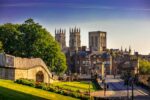
Liepāja is Latvia’s third-largest city, a working port on the Baltic coast around three hours from Riga, and one of the country’s most rewarding places to spend a slow few days away from the capital. Locals nickname it “the city where the wind is born,” and anyone who has stood on its beach on a breezy afternoon understands exactly why.
The city built its wealth on trade and shipping through the nineteenth century, and that prosperity left behind one of the densest concentrations of Art Nouveau buildings anywhere in Europe, spread across streets that still carry their original wooden doors and decorative plasterwork. A separate, stranger layer of history sits north of the centre in Karosta, a former Tsarist and Soviet naval base that was sealed off from ordinary Latvians for most of the twentieth century.
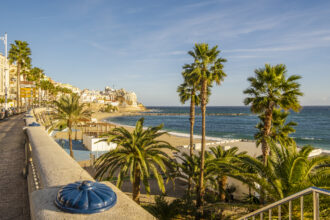
Liepāja’s beach is genuinely one of the best on the Baltic, an eight-kilometre run of pale, fine sand that earns its Blue Flag every summer. Music matters here too, from the striking Great Amber Concert Hall on the waterfront to the resident symphony orchestra that has performed in the city for well over a century.
This guide starts with the practical question of how to actually reach Liepāja, since the city sits some distance from Latvia’s other main tourist routes. It then works through the sights that make it worth the detour, from the beach and the Art Nouveau old town to Karosta’s prison, cathedral and coastal forts, before covering a couple of the city’s quieter, less-touristed museums and gardens.
Expect a genuinely different pace and character here compared with Riga or Vilnius. Liepāja is a lived-in city with a real fishing and shipbuilding industry rather than a preserved museum piece, and that authenticity is a large part of its appeal.
Liepāja Attractions at a Glance
| Attraction | What It’s For / Why Visit | How Long to Spend |
|---|---|---|
| Liepāja Beach and Seaside Park | Blue Flag beach with fine sand and a shaded pine park behind it | 2-3 hours |
| Art Nouveau and Wooden Architecture on Graudu Street | Ornate stone facades and carved timber houses for an unhurried wander | 1-2 hours |
| Great Amber Concert Hall | Striking modern concert hall with harbour views and a resident symphony orchestra | 1 hour, longer for a tour or concert |
| St. Anne’s Evangelical Lutheran Church | Liepāja’s oldest church, with a huge Baroque altar and a climbable steeple | 30-45 minutes |
| Holy Trinity Cathedral | Grand Baroque cathedral holding Latvia’s largest mechanical organ | 30-45 minutes |
| Rose Square | The city’s civic heart, with formal rose beds and free summer walking tours | 20-30 minutes |
| Karosta Prison | Guided tour through a former military and Soviet-era prison | 1-1.5 hours |
| Naval Cathedral of St Nicholas | Restored Russian Orthodox naval cathedral with a striking domed interior | 30-45 minutes |
| The Northern Forts | Half-collapsed coastal artillery ruins scattered along the dunes | About 1 hour |
| Liepāja Museum | City history museum covering everything from the Stone Age to the shipping era | 1-1.5 hours |
| Pūt Vējiņi Open-Air Concert Garden | Open-air concert venue inside the Seaside Park | 30 minutes, longer for a show |
How to Get There
Liepāja has no major airport of its own with scheduled passenger flights, so almost everyone arrives overland from Riga. Riga International Airport is the practical entry point for international visitors, with onward travel to Liepāja covered separately below.
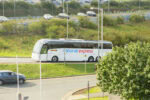
The bus is the most frequent and flexible option. Around twenty daily services run the roughly 220-kilometre route between Riga’s international bus station and Liepāja, operated by companies including Lux Express alongside local carriers, with a journey time of about three to three and a half hours and one-way fares typically starting from around €7 (£6/$8) when booked ahead.
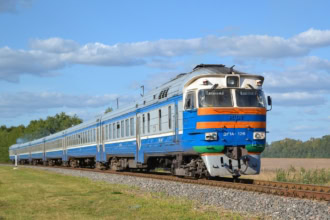
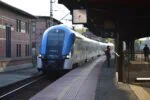
Liepāja is also reachable by train, which is worth checking since rail links to smaller Latvian cities have changed over the years. A daily Vivi service currently runs between Riga and Liepāja, taking around three hours and fifteen minutes each way, with fares from about €9 (£7.80/$10.50); departures are limited to one train a day in each direction (two on Sundays), so the bus remains the more practical choice for anyone needing flexible timing.
Liepāja International Airport itself is worth mentioning only to manage expectations. It currently has no regular scheduled passenger airline service, functioning instead as a base for private charters, business flights and airBaltic’s pilot training academy, and a short-lived 2024 summer service was explicitly not continued because the route wasn’t considered commercially viable.
For drivers, Liepāja sits on the A9 and A11 highways and is roughly a two-and-a-half to three-hour drive from Riga depending on traffic, with the route also connecting south to Klaipėda in Lithuania. Our Riga Airport Transfers guide covers getting from the airport into central Riga before continuing on to Liepāja by bus or train.
Best if you want daily housekeeping and a front desk. Filter by area first, then by price.
Check availabilityBest for longer stays. Whole apartments and houses, so you are not eating out three times a day.
View rentalsBest as a last check before booking. Compares hotel rates across several sites in one search.
Compare ratesTake the Ferry to Germany
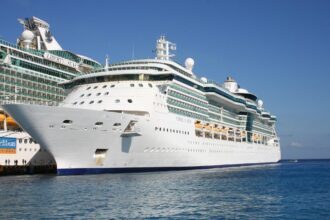
Liepāja is a genuine working port, and one of the more memorable ways to experience that is to actually take a ferry out of it. Stena Line operates a long-standing international route connecting Liepāja directly with Travemünde, near Lübeck on Germany’s Baltic coast, running year-round rather than as a seasonal service.
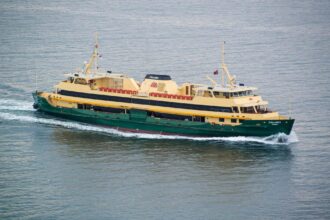
The crossing is a proper overnight sea voyage rather than a short hop, taking roughly 21 to 24 hours depending on conditions and direction, and it runs several times a week with a near-daily frequency in busier months. Two Stena Line vessels, the Stena Flavia and Stena Horizon, share the route and both carry cars, freight and foot passengers together.
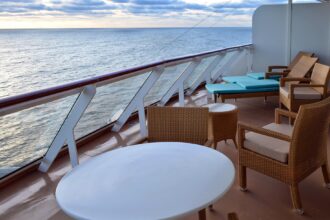
This is not a car-only or freight-only service. Both ships carry cabins, reclining seat lounges, a restaurant, a café and a shop, so a foot passenger travelling without a vehicle can book on comfortably, with one-way fares for a foot passenger starting from around €48 (£41/$56) and rising to around €83 (£71/$97) depending on the cabin or seat type chosen.
Given the length of the crossing, most travellers treat it as a genuine overnight sailing rather than a day trip, booking a cabin and waking up on the other side of the Baltic. It’s a striking way to appreciate Liepāja’s identity as a functioning port city rather than just a seaside destination, watching the naval and commercial harbour slide past as the ship heads out.
Sailing schedules and fares shift with the season, so it’s worth checking Stena Line’s own booking pages directly before planning around a specific date rather than relying on a fixed weekly pattern. Vehicle fares for a car and driver typically start from around €80 (£69/$92) each way on top of any passenger fare, which is worth factoring in for anyone driving onward into Germany.
Liepāja to Travemünde Ferry Times & Departures
Use Ferryhopper to check live sailings between Liepāja and Travemünde in both directions. Select your travel date to compare scheduled ferry departures, sailing times and available tickets.
Select the date you want to travel. The times shown on the right-hand side are the scheduled departure and arrival times for each ferry.
Availability can change quickly, particularly during weekends and the summer season. Some sailings may stop accepting bookings a few hours before departure. If a timetable is blank, there may be no available sailings for today. Try moving to a later date to check future services.
This is the timetable for the outward direction. Use it to check sailings from Liepāja to Travemünde for the date you plan to travel.
This is a separate timetable for the opposite direction. It does not select a return ticket for the journey above. Use it to check sailings from Travemünde to Liepāja.
Want to compare different routes and other ferry options?
Compare routes, operators, sailing times and prices with Ferryhopper or Direct Ferries.
Liepāja Beach and the Seaside Park
Liepāja’s beach is the single biggest reason many Latvians rate the city above Jūrmala for a genuine seaside day out. It runs for roughly eight kilometres along the coast, with a wide band of pale, unusually fine sand that can stretch fifty to eighty metres from the dunes to the water.
The central section flies a Blue Flag every summer, a formal marker of clean water and well-managed facilities, and it’s genuinely set up for a proper day at the beach rather than a quick photo stop. A wooden boardwalk crosses the dunes for easier wheelchair access, and there’s a dedicated changing room for parents with young children.
Different stretches are informally zoned for different uses, so kitesurfers and windsurfers tend to cluster where the wind and space suit them, while quieter, more sheltered patches further along are better for families or anyone who just wants to read undisturbed. Dogs are allowed on a leash in a designated section near the fishermen’s memorial, which is worth knowing before turning up with a pet in tow.
Behind the beach, the Seaside Park (Jūrmalas parks) runs along the dune line as a proper landscaped pine park rather than a strip of grass, laid out originally in the late nineteenth century when Liepāja first developed as a resort town. It’s a pleasant, shaded walk or cycle between the beach and the town centre, and several of the city’s other attractions sit within or just off it.
After a strong southwesterly wind, it’s worth a slow walk along the shoreline since genuine amber occasionally washes up after storms. Take care to distinguish it from the rare but real risk of old white phosphorus fragments that can also wash ashore in this part of the Baltic, and avoid picking up anything unfamiliar rather than testing it.
Art Nouveau and Wooden Architecture on Graudu Street
Liepāja’s Art Nouveau heritage genuinely surprises first-time visitors, since in absolute numbers the city has more surviving Art Nouveau buildings than many far larger European cities. The style arrived on the back of the shipping and trade boom of the early twentieth century, when Liepāja’s merchants and shipowners had the money to commission architecturally ambitious homes.
The heritage concentrates almost entirely along two streets, Graudu iela and Lielā iela, where dozens of facades in a row show off carved stonework, decorative plasterwork and elaborate wrought-iron balconies. A marked walking route of around 6.3 kilometres links roughly three dozen individual buildings across the wider old town for anyone who wants the fuller version.
Several buildings stand out even to a casual walker, including the former Karl Stephen house and the old “Palass” cinema on Graudu iela, and the Swedish consul’s former mansion on Dzintaru iela. Many retain original interior details too, from carved wooden stairwells and doors to decorative fireplaces, even where the buildings themselves are now split into ordinary flats and offices.
What makes Liepāja distinctive alongside the stonework is its parallel tradition of ornate wooden architecture, with entire streets of nineteenth-century timber houses carrying carved gables, decorative shutters and elaborate window surrounds rarely seen at this scale elsewhere in the Baltics. Together the two traditions give the old town a genuinely different visual character from Riga’s stone Art Nouveau district.
The whole area rewards an unhurried, self-guided wander rather than a checklist approach, ideally with a coffee stop along the way. Early morning or late afternoon light is particularly kind to the carved facades, and traffic on Graudu iela is light enough to actually stop and look up without much disruption.

Great Amber Concert Hall
The Great Amber Concert Hall is the single most striking piece of modern architecture in Liepāja, a glass-and-concrete waterfront building whose golden-tinted facade is a deliberate visual nod to the amber that regularly washes up on the city’s beaches. It opened in 2015, finally realising a concert hall the city council had first proposed back in 1896.
Designed by the Austrian architect Volker Giencke, the building holds two performance spaces: a 972-seat Great Hall built for orchestral concerts, theatre and conferences, and a smaller 180-seat Chamber Hall for more intimate performances. Acoustics and lighting were engineered by specialist German and Austrian consultants, and the results have earned the building genuine international architectural recognition.
It’s home to the Liepāja Symphony Orchestra, one of the oldest continuously performing orchestras in the Baltic region, so checking the concert calendar before a visit is worth doing even for travellers who wouldn’t normally seek out classical music. A café and restaurant inside make it an easy stop even outside performance times.
Guided tours run through the Great Hall, backstage areas and performance spaces, and typically finish with a walk up to the seventh-floor viewing platform, which gives one of the better panoramic views over the harbour and old town roofline. Tour availability varies by season, so it’s sensible to check ahead rather than turning up expecting one on the day.
The building sits directly on Radio iela, close enough to the beach and Seaside Park to combine easily with either in the same visit. For full opening hours, current tour times and the concert programme, the Great Amber Concert Hall’s own listing is the most reliable source, since hours shift between the summer and winter seasons.
St. Anne’s Evangelical Lutheran Church
St. Anne’s is the oldest church building in Liepāja, first recorded in 1508, though what stands today is largely the result of later rebuilding rather than an unbroken medieval structure. The current steeple dates to a nineteenth-century reconstruction that made it, briefly, the tallest building in the city.
The real draw inside is the enormous Baroque wooden altar, carved in 1697 by the Baltic German woodcarver Nicolas Sefrens and standing an imposing 9.7 metres high by 5.8 metres wide. It’s widely regarded as the finest and most valuable piece of Baroque wood sculpture anywhere in Latvia, and photographs genuinely undersell how large it feels in person.
The church also holds Latvia’s third-largest organ, outranked only by the instruments at Liepāja’s own Holy Trinity Cathedral and Riga’s Dome Cathedral, so a visit that happens to coincide with a recital or Sunday service is worth prioritising. Visitors can also climb the steeple itself, looking out over the old town through a series of small windows on the way up.
St. Anne’s sits on E. Veidenbauma iela, a short walk from the Art Nouveau streets and easy to fold into the same loop around the old town. Opening hours run Monday to Friday from 9am to 5pm and Saturday from 10am to 4pm, with the church generally closed to casual visitors on Sundays for services.
Entry is generally free or by small donation, making it an easy addition to a walking day rather than a planned, ticketed stop. It pairs naturally with Holy Trinity Cathedral below as a short “two churches” detour for anyone interested in Liepāja’s German Baltic religious history.
Holy Trinity Cathedral and Its Giant Organ
Holy Trinity Cathedral is Liepāja’s grandest Lutheran church, commissioned from the Königsberg architect Johann Christoph Dorn and consecrated in 1758 for the city’s German merchant community. A major nineteenth-century rebuild raised its tower to nearly 55 metres, and it still serves today as the seat of the Bishop of Liepāja.
Inside, the late Baroque interior is genuinely lavish, with Rococo detailing, gilded wood carving and a 13-metre altar that dominates the nave. It’s a working cathedral rather than a museum piece, and it regularly hosts concerts and art exhibitions alongside its religious calendar.
The headline attraction, though, is the organ, built by Heinrich Andreas Contius in 1779 and still the largest mechanical organ in Latvia today. With 131 stops, four manuals and over 7,000 pipes, it was recognised at various points as the largest mechanical organ in the world, and hearing it played during a concert is a genuinely different experience from simply reading about its statistics.
Visitors can climb the tower for one of the best rooftop views over Liepāja’s old town, and organ recitals and classical concerts run through the year, particularly in summer. Checking the cathedral’s own events listing before travelling is the most reliable way to catch a performance rather than relying on a fixed weekly schedule.
The cathedral sits centrally enough to combine easily with St. Anne’s Church and the Rose Square area in one old-town walk. Entry to look around is generally free, with a small charge for tower access and any ticketed concert.
Best for long or awkward journeys. Builds one itinerary out of separate flights.
View flightsBest if you want maps and messaging working the moment you switch your phone on.
See eSIM plansBest after a long flight or a late landing. Price agreed before you travel, and no taxi queue.
Check transfersRose Square and Liepāja’s Rose-Growing Tradition
Rožu laukums, or Rose Square, is Liepāja’s genuine civic heart, a small central plaza that has been given over to formal rose beds for well over a century. The site was originally the city’s main market until it relocated in 1910, and the square took on its current form and name the following year.
The planting follows a strict geometric layout, with a central rose bed and symmetrical paths radiating outward, and the flowers change with the seasons rather than sitting still. Crocuses and daffodils open the year in spring, tulips follow, and by midsummer the square is at its showiest with roses in full bloom.
In winter the beds are cleared and the square is decorated instead as a small Christmas island, which has become one of the more charming seasonal touches in the city centre. A mature Manchurian walnut tree of recognised national significance also grows nearby, alongside markers noting Liepāja’s sister cities set into the edging of the rose bed itself.
Rose Square functions as the city’s default meeting point and the natural starting spot for a walk into the old town, with the Holy Trinity Cathedral, Great Amber and the Art Nouveau streets all within easy reach. Between June and August, local guides gather here daily at noon to lead walking tours of the city, a genuinely useful option for anyone who wants context rather than a self-guided wander.
The two-little-towered buildings still standing on one side of the square are a leftover from its market days, when they housed the old butcher’s stalls. It’s a small, unassuming square by capital-city standards, but it’s the kind of stop that rewards knowing its backstory rather than just passing through.
Karosta: The Former Soviet Naval Port District
Karosta is easily the strangest and most distinctive district in Liepāja, a purpose-built naval town on the city’s northern edge that occupies roughly a third of Liepāja’s entire area. It began life in the 1890s as “Port of Alexander III,” a fortified base built for the Tsarist Baltic fleet, complete with its own barracks, church and coastal batteries.
Under Soviet rule, Karosta became a genuinely closed military zone, sealed off with checkpoints from the rest of Liepāja and home at its peak to more than 20,000 people connected to the Soviet Baltic Fleet. Ordinary Latvians living in the rest of the city had no access to it at all for most of the twentieth century.
When Soviet forces withdrew from Latvia in 1994, Karosta emptied out almost overnight, leaving behind crumbling barracks, abandoned mansions and a difficult decade of unemployment and decline through the 1990s. That derelict, half-abandoned atmosphere is still very much part of the district’s appeal today rather than something that’s been tidied away.
Karosta now draws a steady stream of visitors curious about its Soviet and Tsarist layers, anchored by three genuinely significant sights covered individually below: the former military prison, the Orthodox naval cathedral, and the coastal Northern Forts. An artists’ collective, K@2, has also taken over part of the former base since 2000, adding studios and exhibitions to the district’s more sombre history.
Karosta sits a short bus or taxi ride north of central Liepāja, and a half-day is realistic for covering its main sights without rushing. It’s a genuinely unusual place to walk around, mixing lived-in Soviet-era housing blocks with grand czarist-era buildings and open coastline, and it rewards going with at least a rough plan rather than wandering in blind.
Karosta Prison and the Behind Bars Tour
Karosta Prison is Liepāja’s best-known single attraction and one of the more genuinely unusual stops anywhere in the Baltics. Built originally as a military hospital before being converted into a prison, it held Tsarist, then Latvian, then Soviet and German military prisoners across almost a century of continuous use, right up until 1997.
The prison can only be visited with a guide, and cells, corridors and a former punishment block are all still intact rather than restored into something softer. The signature “Behind Bars” experience walks visitors through the building’s history while genuinely conveying what conditions were like for the men held here across its different regimes.
For anyone wanting more than a guided walk-through, the prison also runs an overnight “night in prison” stay and an escape-room-style experience inside the actual cell block, both genuinely popular with visitors rather than a gimmick added purely for tourists. Regular guided tours run roughly hourly through the day without needing to book ahead as an individual.
Standard adult admission runs around €8 (£6.90/$9.30), with reduced rates for students at roughly €5 (£4.30/$5.80) and for children and seniors at around €3.50 (£3/$4). Opening hours shift significantly by season, running long daily hours through summer but dropping to weekends-only or by-appointment visits in the depths of winter.
Given how much the schedule changes across the year, it’s worth checking the Karosta Prison’s official website directly before travelling rather than assuming summer hours apply. It sits within easy walking distance of the Naval Cathedral below, and the two make a natural pair on the same Karosta visit.
The Naval Cathedral of St Nicholas
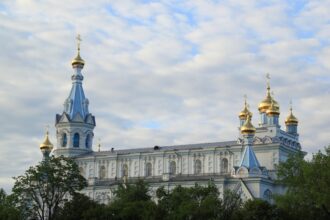
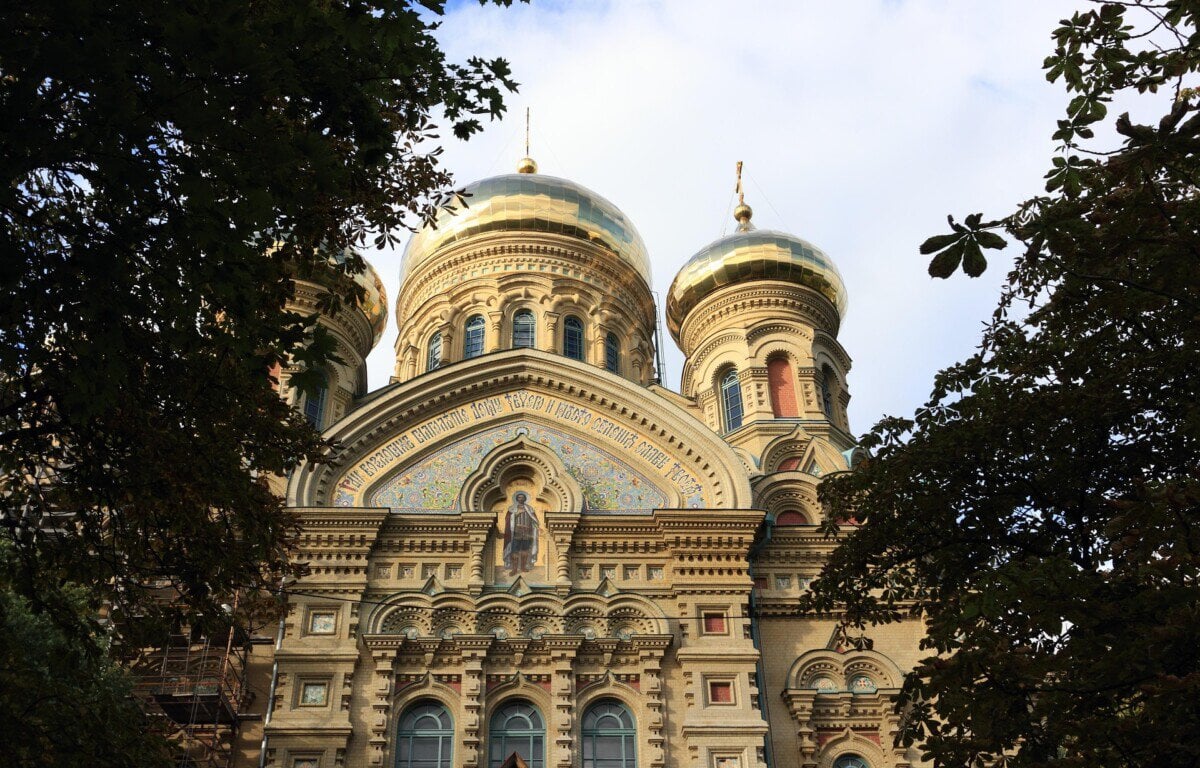
The St. Nicholas Naval Cathedral is Karosta’s visual centrepiece, a grand Russian Orthodox church built for the Tsarist navy between 1900 and 1903 with Tsar Nicholas II himself present at both the foundation and the consecration. Its design follows traditional seventeenth-century Russian church architecture, with one large central dome and four smaller domes representing the four evangelists.
After Latvia’s independence in 1918 the building briefly served as a Lutheran naval church, but its history took a much darker turn under Soviet occupation from 1944, when the cathedral was stripped of its religious purpose entirely and repurposed as a gymnasium and a cinema for military personnel. The interior dome was even sealed off to improve the acoustics for film screenings, a detail that still surprises most visitors.
Religious use only returned after the Soviet withdrawal in 1991, with the first Orthodox service held again that same December, and the cathedral has functioned as an active place of worship under the Latvian Orthodox Church ever since. Much of the original mosaic work, iconostasis carving and interior painting has been restored, giving the interior a richness that belies the building’s rough recent history.
Visiting is generally free, though it remains a working church, so quiet, respectful behaviour matters more here than at a purely secular museum. Modest dress is expected, and it’s worth timing a visit to avoid clashing with an active service unless attending one is genuinely of interest.
The cathedral sits within easy walking distance of Karosta Prison, making the two a natural single-visit pairing. Together they give a far more complete picture of Karosta’s layered history than either sight manages on its own.
The Northern Forts Along the Coast
The Northern Forts are the most visually dramatic remnant of Karosta’s military past, a line of coastal artillery batteries built in the late nineteenth century to defend the naval base from a seaward attack. What survives today is a genuinely atmospheric mix of half-collapsed concrete bunkers, tunnels and old powder stores scattered along the dunes.
The fortifications were deliberately demolished by explosion in 1908, only a few years after completion, once military planners decided the whole battery had been a strategic mistake. Rather than being cleared away, the wreckage was simply left where it fell, and more than a century of Baltic weather and coastal erosion has since worn the concrete into the jagged, half-buried ruins visitors see today.
Some sections carry street art and murals painted over the decades, adding an unofficial, slightly surreal layer to the ruins that photographers in particular tend to appreciate. The site is freely accessible with no ticket or set opening hours, and a picnic area sits nearby for anyone wanting to make an afternoon of it.
Genuine care is needed here, since the coastline is actively eroding and sections of the ruins can collapse without warning; walking directly underneath or on top of the crumbling structures is explicitly discouraged rather than a theoretical risk. Sticking to the marked paths and looking rather than climbing is the sensible approach, particularly with children in tow.
The forts sit on Jātnieku iela in Karosta, an easy add-on to a visit that already includes the prison and cathedral. Allow around an hour for a proper look, longer if the light is good and the coastline itself is the real draw rather than just the ruins.
Liepāja Museum: City History, Wood Sculpture and Traditional Costume
The Liepāja Museum is the city’s main history museum, holding over 130,000 items that trace Liepāja’s story from the Stone Age through to the nineteenth century. It’s a solid, unhurried way to put everything else in this guide into context, particularly the city’s rise as a trading and shipping port.
Alongside the archaeological and historical collections, the museum holds a notable body of work by the twentieth-century wood sculptor Miķelis Pankoks, plus a rotating programme of contemporary art exhibitions that keeps repeat visits worthwhile. A dedicated Kurzeme National Costume Information Centre inside also covers the region’s distinctive traditional dress in more depth than most visitors expect to find.
The museum sits at Kūrmājas prospekts 16/18, an easy walk from the Seaside Park and not far off the route between the beach and the old town. Standard adult admission to the permanent exhibition is around €5 (£4.30/$5.80), with reduced rates for students and seniors and a family ticket covering two adults and two children for about €8 (£6.90/$9.30).
Opening hours run Wednesday to Sunday from 10am to 6pm outside the summer months, extending to every day at the same hours across June, July and August. It’s a manageable hour-to-ninety-minute visit rather than an all-day museum, which makes it easy to slot in around a bigger day of sightseeing.
Temporary exhibitions carry their own separate admission, typically ranging from around €2 up to €15 (£1.70-£13/$2.30-$17.50) depending on scale, and a combined ticket covering all of the museum’s branches across the city is available for around €15 (£13/$17.50) for anyone planning a deeper dive into local history.
Best if you would rather spend the money on the trip than on the room. Compare hostels by location and rating.
Search hostelsBest for anyone flying more than once or twice a year. Handles the compensation claim so you are not chasing the airline.
See AirHelp+Best if your room is not ready yet. Left luggage booked in advance, so you are not hunting for a locker.
Check storagePūt Vējiņi Open-Air Concert Garden
Pūt, vējiņi! is Liepāja’s open-air concert venue inside the Seaside Park, and its name (loosely, “Blow, Little Wind!”) is a fitting nod to the city’s own windy reputation. The site’s performance tradition actually dates back to 1875, when the architect Paul Max Bertschy designed a small wooden stage here for the resort town’s earliest spa visitors.
The current venue is a thorough modern rebuild rather than the original nineteenth-century structure, led by the architect Mikus Lejnieks and completed with acoustic panelling designed to modern concert standards. It now seats around 1,400 people, including 34 wheelchair-accessible spaces, with a two-storey backstage and dressing room building added behind the main stage.
It functions as a genuine working venue rather than a static landmark, hosting concerts, festivals and public events through the warmer months in particular. The setting inside the pine-shaded Seaside Park gives outdoor concerts here a genuinely different atmosphere from an indoor hall, closer to a festival field than a formal auditorium.
What’s actually on varies through the year, so checking the venue’s own event listings before travelling is far more useful than assuming there will be something on a given date. Ticket prices depend entirely on the individual event rather than following any fixed venue rate, so treat this as a stop to plan around a specific show rather than a walk-in attraction.
Even with nothing scheduled, the venue and its surrounding park make a pleasant stop on the walk between the beach and the town centre. It sits close enough to the Great Amber Concert Hall that music-focused visitors can reasonably combine both in the same trip.
Things to Do in Liepaja in the Rain
Liepāja’s sea breeze can turn into proper rain with little warning outside the summer months, but the city has enough indoor sights to fill a genuinely satisfying wet day. Several of the attractions already covered in this guide work just as well, if not better, once the weather turns.
Karosta Prison is the most reliable rainy-day pick on this list, since the entire guided tour runs indoors through cells, corridors and the old punishment block. The nearby Naval Cathedral of St Nicholas is equally sheltered and pairs naturally with the prison on the same damp afternoon.
St. Anne’s Church and Holy Trinity Cathedral both offer warm, covered interiors in the old town, complete with soaring altars and organs to admire while the rain passes outside. The Great Amber Concert Hall works just as well, with a café and restaurant inside for anyone waiting out a downpour rather than rushing between sights.
The Liepāja Museum is an easy hour or two indoors, tracing the city’s history from the Stone Age through its shipping boom without needing decent weather to enjoy it. Peter’s Market, the covered pavilion at Kuršu iela, is also worth a wet-morning visit, since its indoor hall keeps the fish and produce stalls dry year-round.
Not everything here travels well into bad weather. The beach, the Seaside Park, the Northern Forts and the Art Nouveau walk along Graudu iela are genuinely outdoor experiences that lose most of their appeal in driving rain, and the open-air stage at Pūt Vējiņi is no use at all without a show scheduled.
Food Scene and Food Halls
Liepāja’s food scene reflects its identity as a working port and fishing city rather than a food-tourism destination, so expect honest, affordable cooking over fine-dining ambition. That said, a handful of kitchens and one proper market hall make it worth eating with intent rather than just refuelling between sights.
The dish to look for is Liepājas menciņi, a Southern Kurzeme farmhouse recipe of smoked cod, potatoes, onion and cream baked together in a ceramic pot, typically priced around €15 (£13/$17.50). It turns up on menus across the city and is the closest thing Liepāja has to a signature plate.
Peter’s Market, housed in a pavilion built in 1910 on Kuršu iela, is Liepāja’s largest market and reportedly Latvia’s second largest, with an indoor hall for fish, dairy and rye bread alongside outdoor stalls for flowers and produce. Weekend mornings are the best time to go, when stallholders sell smoked fish straight onto fresh bread.
Restaurants cluster along Lielā iela in the centre, the old harbour frontage at Vecā ostmala, and the small courtyard at Juliannas Sēta, with seasonal beach bars adding a few more options right on the sand in summer. Libava, a seafood restaurant set inside a former fish market building, is one of the more distinctive places to eat given the city’s maritime setting.
MO Liepāja, tucked into the same Juliannas courtyard, has picked up a Michelin recommendation and is worth booking ahead for in July and August when tables disappear fast. Across the city, a casual meal generally runs under €10 (£8.60/$11.60), a proper sit-down dinner closer to €10-€20 (£8.60-£17/$11.60-$23), and the handful of upscale kitchens land around €25-€40 (£21.50-£34/$29-$46) per person.

Nightlife and After Dark
Liepāja carries a genuine reputation as Latvia’s rock music capital, a title that goes well beyond marketing copy. The legendary band Līvi came from here, and a musical Ghost Tree monument in the Seaside Park plays their songs to anyone who walks close enough to trigger it.
The best expression of that reputation is Fontaine Palace, a converted harbourside warehouse on Dzirnavu iela that hosts live alternative and rock concerts most weekends. Its main floor has a large dance floor built over old timbers in front of the stage, while a separate downstairs bar offers DJs and a quieter spot to talk.
Liepāja’s musical pedigree runs deeper than any single venue, with composers Imants Kalniņš and Zigmars Liepiņš among its native sons and festivals such as Summer Sound and the VIA Baltica Festival keeping the scene active through the summer. An older festival, Liepājas Dzintars, ran from 1964 to 2006 and helped establish the city’s musical identity long before Latvian independence.
For a quieter evening, BIG7 is a straightforward dance-floor nightclub, Windcity is a dedicated karaoke bar for anyone wanting to sing rather than just listen, and Elpub offers cocktails in a calmer, conversation-friendly setting. Beachfront cafés and bars such as CukurFabrik add DJ sets and a seaside crowd through the summer months.
Liepāja is a small city, though, so treat its nightlife as genuinely good rather than expecting capital-city scale. Midweek evenings outside summer can be quiet even at the better-known venues, so it’s worth checking a venue’s own listings before heading out on a specific night rather than assuming there will always be a queue.
Shopping and Markets
Shopping in Liepāja is modest by capital-city standards, but that suits a place better known for its markets and independent craft shops than department stores. Locals do most of their everyday shopping along Lielā iela and at a couple of small shopping centres just off it.
Peter’s Market pulls double duty here, since alongside its food stalls the outdoor section sells flowers, local crafts and souvenirs, making it as much a shopping stop as a place to eat. It’s open daily except Sunday afternoon, so it’s easy to fold into a morning walk around the old town.
For something more specific than a souvenir magnet, the House of Craftsmen gathers work from around sixteen regional makers under one roof, and a scatter of small specialist shops nearby cover everything from a dedicated vinyl record store to a candle maker and an art and design gallery. It’s a better source of a genuine gift than anything found at the airport.
For more conventional retail, Lielā iela itself holds the Kurzeme shopping centre, and the Ostmala centre a short distance away adds a supermarket and a wider run of everyday shops. Neither is a destination in its own right, but both are useful for anything forgotten on the way down from Riga.
Liepāja is not the place for a dedicated shopping trip, and it’s worth being upfront about that rather than overselling what’s on offer. The real appeal here is local and small-scale: smoked fish and rye bread from the market, a piece of amber jewellery, or a record from a Latvian rock band rather than anything resembling a big-city shopping district.

Rupert’s Handy Travel Tips
Liepāja is compact enough to see on foot but spread out enough that a bit of planning pays off, so here are a few tips before setting off.
- Book the bus rather than the train if your timing matters: the daily train is convenient but limited to one or two departures a day, while buses run roughly every hour or two.
- Check Karosta Prison’s opening hours before travelling: its schedule shrinks sharply in winter, dropping to weekends-only or by-appointment visits.
- Pair Karosta Prison with the Naval Cathedral: both sights sit within walking distance of each other, so plan a single half-day around them rather than two separate trips.
- Bring proper shoes for the Northern Forts: the ground is uneven and the ruins are genuinely crumbling, so trainers or walking shoes beat sandals.
- Time a beach visit around the wind, not against it: Liepāja’s breeze is part of the appeal, so a windbreak or a warmer layer makes a real difference even in summer.
- If booking the Stena Line ferry, check the current timetable directly: sailing frequency and fares shift with the season, so don’t rely on a fixed weekly pattern.
Want to meet the reindeer behind our travel tips? Find out more in our page Who is Rupert?.




Frequently Asked Questions About Things to Do in Liepaja
How many days do I need in Liepāja?
Two full days covers the beach, the Art Nouveau old town and a half-day in Karosta comfortably, though a third day gives more breathing room for the museum and Pūt Vējiņi if there’s a concert on.
Is there a passenger train from Riga to Liepāja?
Yes, a daily Vivi service currently runs between Riga and Liepāja taking around three hours and fifteen minutes, though departures are limited to one train a day in each direction, so the more frequent bus is often more practical.
Does Liepāja International Airport have scheduled flights?
No, the airport currently has no regular scheduled passenger airline service and is used mainly for private charters, business flights and pilot training, so Riga International Airport remains the practical entry point for most visitors.
Can you take a ferry from Liepāja?
Yes, Stena Line runs a year-round route between Liepāja and Travemünde in Germany, an overnight crossing of roughly 21 to 24 hours that carries foot passengers, cars and freight together.
What is Liepāja known for?
Liepāja is known for its wide Baltic beach, its dense concentration of Art Nouveau and wooden architecture, and Karosta, the former closed Soviet naval district that now draws visitors to its prison, cathedral and coastal forts.
Why is Liepāja called the city where the wind is born?
The nickname comes from the near-constant Baltic breeze that sweeps across the city’s open beach and coastline, a genuine local weather pattern rather than just a marketing phrase.
Is Karosta Prison suitable for children?
Older children and teenagers generally handle it fine since it’s a guided historical tour rather than a graphic experience, though the subject matter and some of the tour’s staged elements are worth considering for younger children.
Further Reading
Travellers planning a wider Baltic itinerary that takes in Latvia’s capital as well as Liepāja may find our Things to Do in Riga guide useful for comparing the capital’s own Art Nouveau district and Old Town against what Liepāja offers on a smaller, quieter scale.
Latvia’s other secondary city worth knowing about is Things to Do in Daugavpils, an inland city near the Belarusian border with its own Russian Imperial fortress and Mark Rothko connection, a genuinely different side of the country from Liepāja’s coastal, port-city character.
Anyone routing through Riga on the way to or from Liepāja by air should check our Riga Airport Transfers guide first, since it covers the bus, taxi and car hire options for getting from the airport into the city before continuing onward.
For train travellers exploring Latvia more broadly by rail pass, our Interrail Latvia Pass guide covers rail connections around the country, including the Baltic coast route that runs through Liepāja.
For the most current sailing times and fares on the international ferry route out of the city, the official Stena Line Travemünde-Liepāja route page keeps its schedule and pricing up to date.