
Discover a City Shaped by Centuries of History
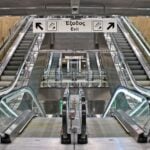
Thessaloniki is a city that makes more sense the longer you walk through it. At first glance, it can seem like a busy modern Greek city wrapped around a wide bay, but almost every few streets reveal another part of its story. Roman palaces sit beside apartment blocks, Byzantine churches rise above shopping streets, Ottoman buildings survive between cafés, and archaeological remains have even been incorporated into the city’s metro stations.
This is not a place where sightseeing means rushing between a handful of famous landmarks. Some of the best things to do in Thessaloniki involve following the different layers of the city, moving from the Roman monuments around the Arch of Galerius to the Byzantine churches of the centre, the old streets of Ano Poli and the markets and restaurants that have helped make Thessaloniki one of Greece’s great food cities.
The waterfront gives the city a completely different character. The long promenade beside the Thermaic Gulf is where Thessaloniki comes to walk, cycle, meet friends and watch the sun disappear behind the mountains. The White Tower may be the city’s most recognisable landmark, but the real experience comes from continuing along the water and seeing how closely the seafront is woven into everyday life.
History here is also more complex than a simple journey from ancient Greece to the modern country. Thessaloniki was an important city of the Roman, Byzantine and Ottoman worlds, while its large Sephardic Jewish community once played such a central role in city life that Thessaloniki became known as the Jerusalem of the Balkans. Understanding those different communities is essential to understanding the city itself.
The good news is that most of central Thessaloniki is easy to explore on foot. The metro now makes longer journeys across the city easier, while buses and taxis can save a steep climb when visiting Ano Poli and the city walls. You do not need to plan every hour before arriving; Thessaloniki is one of those cities where leaving time to wander is part of the experience.
Whether you are here for a weekend or using the city as a base for a longer stay in northern Greece, the best approach is to combine its major sights with the neighbourhoods, markets, waterfront and viewpoints between them. Thessaloniki rewards curiosity far more than box-ticking.
Things to Do in Thessaloniki at a Glance
There is no single correct route through Thessaloniki. The city is easier to understand when you explore it by area and historical theme, rather than trying to follow a rigid list of attractions.
| Experience | Area | Time to Allow | Best For |
|---|---|---|---|
| White Tower and Waterfront | Seafront | 2 to 3 hours | First-time visitors |
| Roman Thessaloniki | City centre | Half a day | Ancient history |
| Byzantine Churches | Across the centre | Half to full day | History and architecture |
| Ano Poli | Upper Town | Half a day | Views and old streets |
| Markets and Food | Central Thessaloniki | 2 to 3 hours | Local atmosphere |
| Jewish Heritage | City centre | 2 to 3 hours | Modern history |
| Museums | Central and waterfront areas | Half to full day | Culture and archaeology |
For a first visit, the waterfront, Roman monuments, Byzantine churches and Ano Poli give the clearest introduction to the city. They reveal four very different versions of Thessaloniki without requiring you to travel far.
The main mistake is trying to see everything in geographical order. Some of the city’s most interesting stories stretch across several neighbourhoods. The Roman sites make more sense when visited together, as do the Byzantine churches, while the markets and food districts are better explored slowly rather than squeezed between museum visits.
If you only have a day, concentrate on the centre and waterfront. With two or three days, you can begin to explore Thessaloniki’s museums, Jewish heritage and Upper Town properly without turning the trip into a race.
Compare hotels and other places to stay in Thessaloniki.
Check availabilityBrowse apartments, homes and self-catering accommodation in Thessaloniki.
Browse rentalsCompare hotel deals in Thessaloniki from multiple booking sites.
Compare pricesStart at the White Tower and Waterfront
For a first introduction to Thessaloniki, it is difficult to beat the White Tower and the waterfront. The tower stands at the point where the historic centre opens onto the Thermaic Gulf, making it an easy place to understand the shape of the city before heading into its older streets.
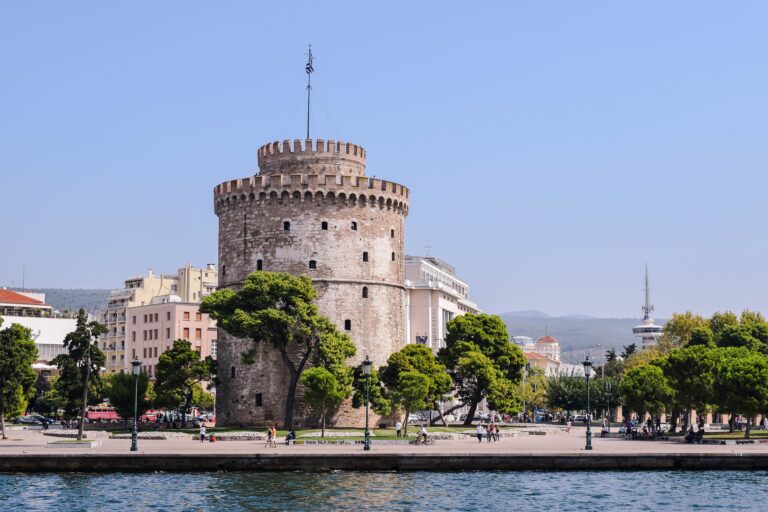
The White Tower of Thessaloniki is the city’s best-known landmark. Although its exact origins remain debated, the present structure dates from the Ottoman period and once formed part of the city’s defensive walls. Its history has not always been peaceful: the tower served as a prison and became associated with executions before later being whitewashed and transformed into the symbol of modern Thessaloniki.
Inside, a museum exhibition introduces the history of the city as you move upwards through the tower. The experience is as much about the building and the journey to the top as it is about individual exhibits. At the upper level, the reward is a panoramic view across the waterfront, city centre and Thermaic Gulf.
The White Tower is only the beginning. From here, the seafront promenade stretches eastwards beside the water, passing one of Thessaloniki’s most photographed modern landmarks: The Umbrellas, created by Greek sculptor George Zongolopoulos. The installation is particularly striking in the late afternoon and around sunset, when the metal umbrellas are silhouetted against the gulf.
Continue beyond the sculpture and the waterfront becomes wider, greener and less dominated by the historic centre. This newer section of the promenade is used by walkers, runners and cyclists, and it is one of the best places to see how Thessaloniki actually lives rather than simply moving between its monuments.
Walking in the opposite direction from the White Tower takes you towards Aristotelous Square, the port and the older commercial centre. This route is busier, with cafés, restaurants and city streets opening directly onto the water.
The waterfront is worth experiencing more than once. Visit during the day to see the city clearly, then return around sunset when the light changes across the gulf and the promenade fills with people. Few European cities have a public waterfront that feels so central to everyday life.
See More of Thessaloniki on the Sightseeing Bus
Thessaloniki is a walkable city, but not every important sight sits on flat ground. A hop-on hop-off sightseeing bus can be particularly useful for first-time visitors who want an overview of the city or an easier way to reach the higher ground around the Byzantine walls.
The route begins at the White Tower and connects several of the places covered throughout this guide, including the Archaeological Museum, Church of Saint Demetrius, Arch of Galerius, Aristotelous Square, the port and the Byzantine Castles. You can leave the bus at the stops that interest you and rejoin a later service, or stay aboard for a complete circuit.
The biggest advantage is not necessarily the central stops. Most visitors can comfortably walk between the White Tower, Roman monuments and Aristotelous Square. The bus becomes more valuable when you want to see the shape of Thessaloniki quickly or avoid tackling the steep climb towards the Upper Town.
From the open upper deck, you also get a different perspective on a city that can feel dense at street level. Audio commentary provides background as you travel, making the full circuit a useful orientation experience near the beginning of a trip.
A sightseeing bus will not replace exploring Thessaloniki on foot. The markets, smaller churches, old streets and waterfront are all best experienced slowly. It works better as a companion to independent sightseeing, particularly if you have limited time, reduced mobility or simply want to see the main areas before deciding where to spend longer.
The ticket is valid for one day, allowing you to get on and off along the route. Services are generally more frequent during the main visitor season, while winter departures can be considerably less frequent, so it is worth checking the timetable for your travel date before planning a day around it.
For many visitors, the best strategy is to take the bus early in the trip, use it to reach one of the more distant or elevated stops, and then continue exploring on foot. That gives you the wider overview without spending the whole day looking at Thessaloniki through a bus window.
See the Highlights on the No. 50 Cultural Route Bus
If you would like an introduction to Thessaloniki before exploring on foot, consider riding the No. 50 Cultural Route. Operated by OASTH, this specially equipped sightseeing bus departs from the White Tower and completes a 50-minute circular tour of the city’s most important historic districts. On board, audio commentary in both Greek and English explains the landmarks as you pass them, making it an excellent first activity for anyone visiting Thessaloniki for the first time.
The route links many of the attractions featured in this guide. After leaving the White Tower, it passes the Archaeological Museum and Museum of Byzantine Culture before continuing to the Palace of Galerius, Arch of Galerius, Church of Hagia Sophia, Aristotelous Square and the Church of Saint Demetrius. It then climbs into Ano Poli, stopping near the Trigonion Tower, Vlatadon Monastery, Pasha Gardens and the Eastern Walls, before descending past the Rotunda and returning to the White Tower.
The bus is designed as a cultural tour rather than a normal city service. The vehicles are decorated to make them easy to recognise, attendants distribute information leaflets, and the commentary helps explain how the Roman, Byzantine and Ottoman monuments fit together in the city’s history.
Tickets for the No. 50 Cultural Route can be purchased directly from the route attendants before boarding at the White Tower or from OASTH ticket offices across the city centre, including Aristotelous Square, Kamara and Mitropoleos Street. If you already have an unlimited OASTH travel pass, it is also valid on the Cultural Route, so no additional ticket is required.
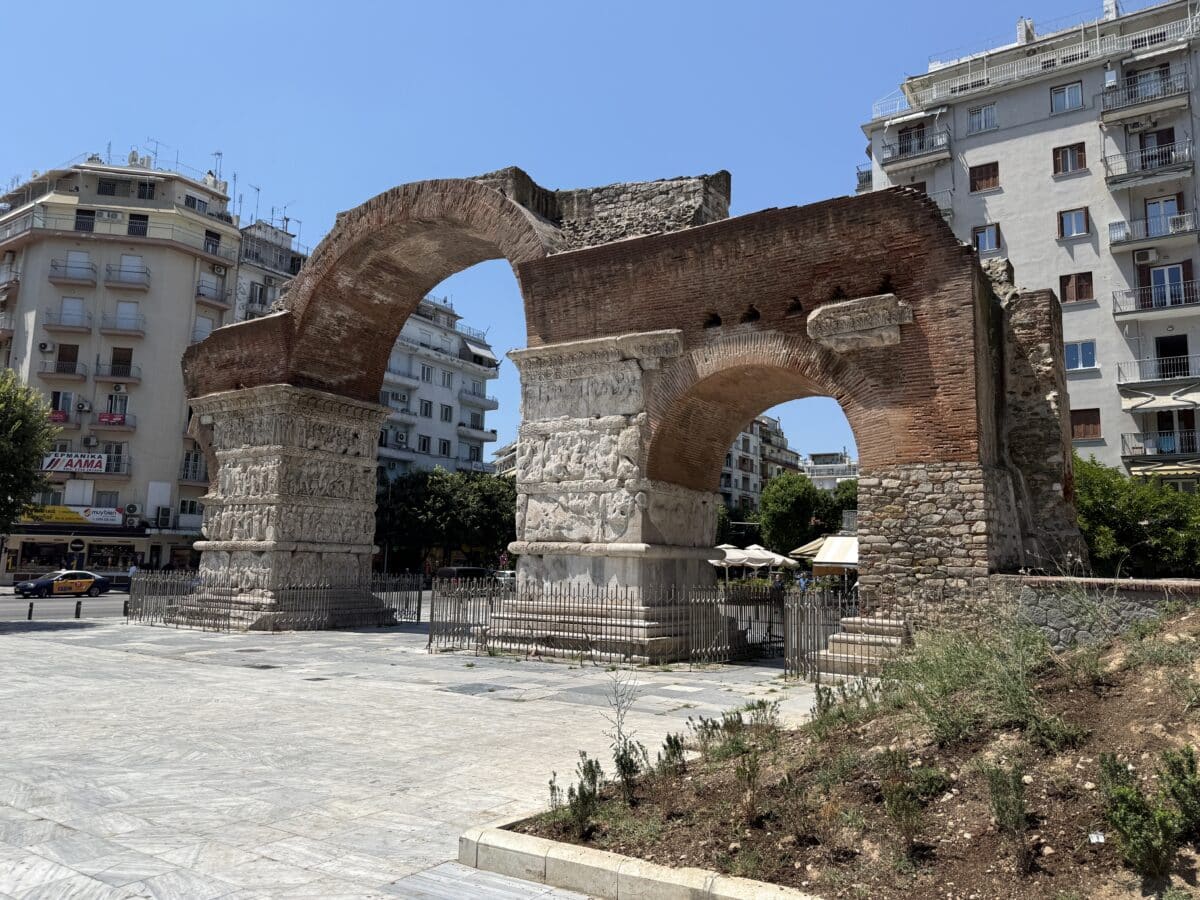
Discover Roman Thessaloniki
Modern Thessaloniki was built directly over one of the most important cities of the Roman world. You do not have to enter a museum to find that history. Roman monuments still stand beside apartment blocks, shopping streets and busy junctions, while other remains lie below the pavements and buildings of the modern centre.
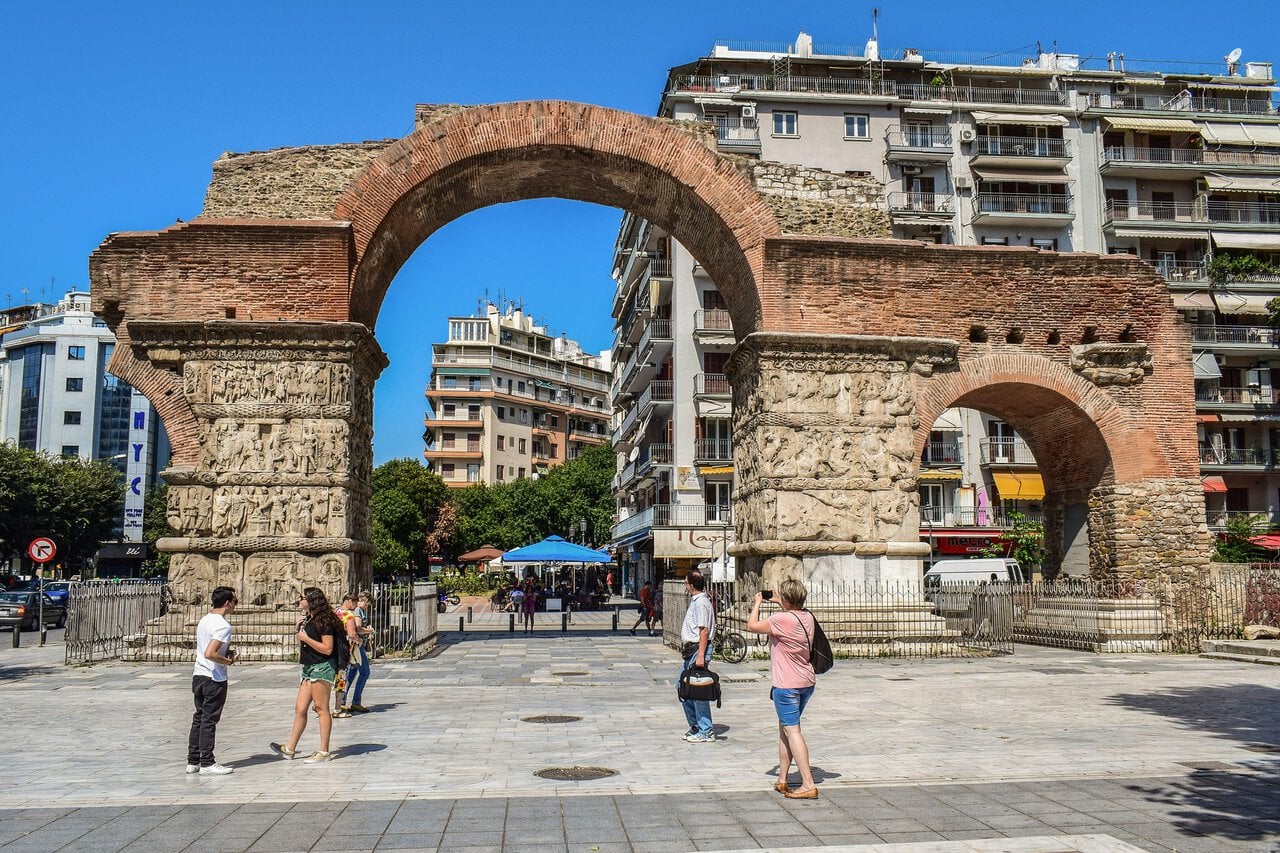
The best place to begin is the Arch of Galerius, usually known locally as the Kamara. The surviving arch once formed part of a much larger monumental complex created for the Roman Emperor Galerius in the early fourth century. Today, it rises above one of the busiest meeting points in Thessaloniki, with people passing beneath carvings that have survived for more than 1,700 years.
Look closely at the surviving relief panels and you can still see scenes celebrating Galerius and his military campaigns. The arch was not an isolated monument. It stood on a ceremonial route connecting the emperor’s palace with the extraordinary circular building now known as the Rotunda.
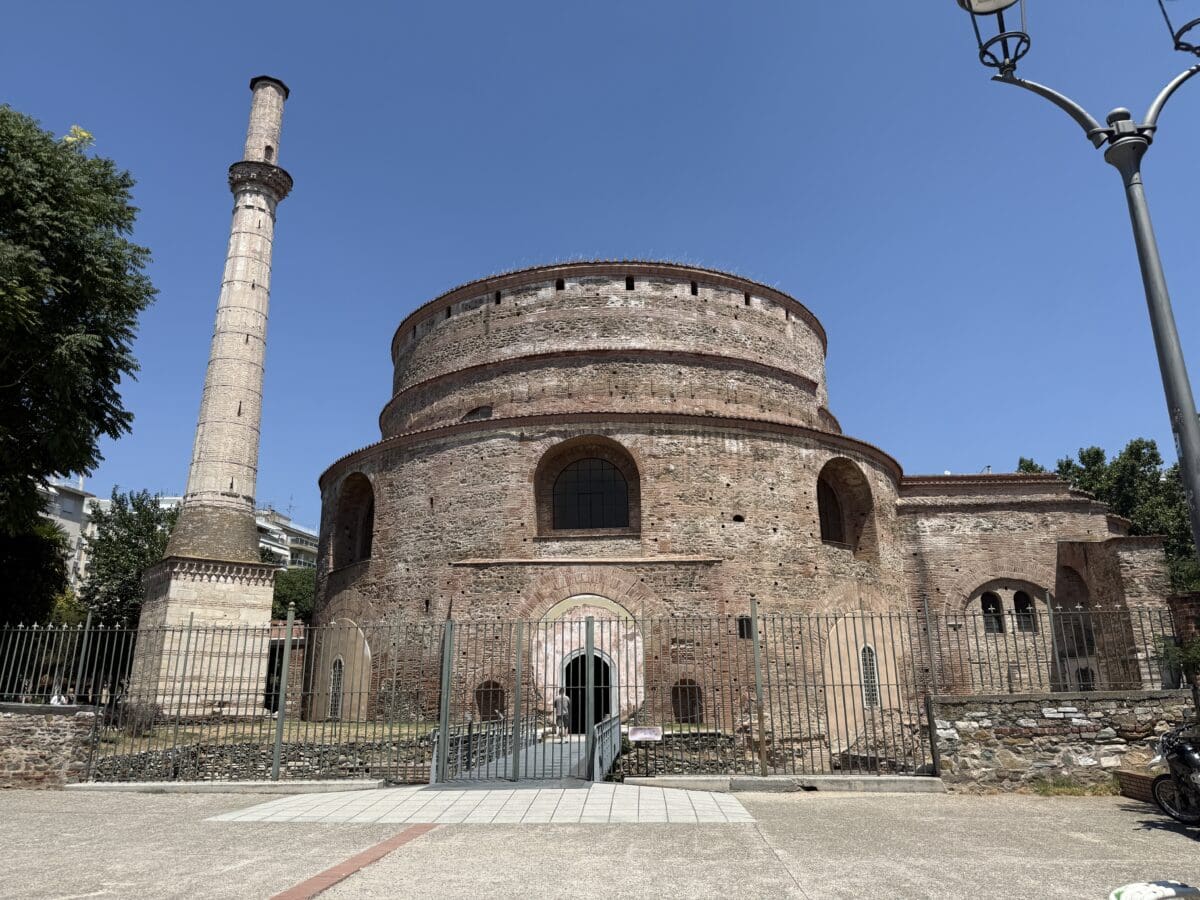
The Rotunda is one of the most remarkable buildings in Thessaloniki. Originally constructed during the reign of Galerius, its intended purpose is still debated, with theories ranging from an imperial mausoleum to a temple. It later became a Christian church, was converted into a mosque during the Ottoman period and eventually returned to use as a monument and occasional place of worship.
Its enormous brick dome is one of the largest surviving Roman domes anywhere in the world, a remarkable feat of Roman engineering that has stood for more than 1,700 years. Inside, Early Christian mosaics survive high above the enormous circular interior, while the Ottoman minaret still stands outside as a reminder of the city’s later history. Few places in Thessaloniki demonstrate the city’s layers of history as clearly as the Rotunda. Admission is €10 per person, and it is one of the city’s most rewarding historic attractions.
Walk south from the Arch of Galerius and you reach the remains of the Galerius Palace complex around Navarinou Square. The surviving ruins once formed part of an enormous imperial residence that included ceremonial halls, courtyards and the Octagon, an impressive building believed to have been intended as a throne room.
The palace ruins are easy to overlook because modern Thessaloniki has grown around them. Cafés, apartment buildings and busy streets now surround a site that was once at the centre of imperial power. That contrast is part of what makes Roman Thessaloniki so interesting: the ancient city is not separated from modern life but embedded within it.
Further west, the Roman Forum of Thessaloniki reveals another side of the Roman city. This was the civic and commercial heart of ancient Thessaloniki, with public buildings, a theatre and underground galleries. The site was rediscovered in the twentieth century when construction work exposed the ruins.
Admission to the Roman Forum is also €10 per person. If you would rather not pay to enter, many of the excavated ruins can still be viewed from the surrounding streets and pavements, giving you an excellent impression of the scale of the ancient city. However, entry is required to explore the theatre, underground galleries and the archaeological remains within the site itself.
These monuments are best explored as parts of the same story. Galerius built an imperial quarter around the eastern side of the Roman city, while the Forum served the wider population. Visiting them together turns a collection of ruins into a much clearer picture of Roman Thessaloniki as a major political, commercial and strategic centre, while also showcasing some of the best-preserved Roman architecture anywhere in Greece.
Take a Harbour Cruise Along Thessaloniki’s Waterfront
One of the most enjoyable ways to experience Thessaloniki is from the water. Along the city’s famous seafront, between the White Tower and the Royal Theatre, you’ll find several sightseeing boats offering short harbour cruises throughout the day and evening. Unlike organised excursions that require advance booking, these boats are permanently moored along the promenade, allowing you to simply walk up, compare the different vessels and buy a ticket for the next available sailing.
Although each boat follows a similar circular route around Thessaloniki’s waterfront, they each offer a different experience. Whether you’re travelling with children, looking for a unique piece of maritime history or simply want to enjoy a drink while watching the sunset, there is a cruise to suit almost every visitor.
Arabella Pirate Ship
The Arabella is much more than a themed pirate ship. Built on the Greek island of Samos in 1935, she served during World War II before later becoming a minesweeper for the Hellenic Navy, remaining in service until 1949. Today she has been preserved as an important part of Greece’s maritime heritage and is officially recognised as both a traditional vessel and a protected historic monument.
Visitors can enjoy a 30-minute harbour cruise, combining excellent views of Thessaloniki’s skyline with the opportunity to sail aboard one of the city’s most historic vessels. Adult tickets currently cost €7, while children under 12 pay €4.
At the time of our visit, departures were advertised at 10:00, 11:30, 13:00, 14:30, 16:00, 17:30, 19:00, 20:30, 22:00, 23:30 and 00:30.
Black Pearl Pirate Ship
The Black Pearl offers a completely different experience, combining a pirate-themed atmosphere with music, drinks and panoramic views across the Thermaic Gulf. The 30-minute cruises are designed as a fun adventure rather than a historical experience and are especially popular with families and younger visitors.
Unlike the other boats, there is no admission charge to board the Black Pearl. Instead, passengers are required to spend a minimum of €10 per person at the onboard bar during the cruise. If you were already planning to enjoy a drink, this can represent good value while allowing you to experience one of Thessaloniki’s most recognisable pirate ships.
During our visit, departures were advertised at 11:00, 12:30, 14:00, 15:30, 17:00, 18:30, 20:00, 21:30, 23:00, 00:30, 02:00 and 03:30.
Kilo Tiki Boat
If you’re looking for something more relaxed, the Kilo Tiki Boat offers a completely different atmosphere. Rather than pirate themes or maritime history, this colourful floating tiki bar combines a 30-minute harbour cruise with music, cocktails, snacks and one of the most affordable boat trips on Thessaloniki’s waterfront.
The cruise currently costs €5 per person, making it excellent value if you simply want to enjoy the city from the water. At the time of our visit, departures were advertised at 12:00, 13:30, 15:00, 16:30, 18:00, 19:30, 21:00, 22:30 and 00:00, with additional sailings also operating during the afternoon.
Happy Hour runs between 2 pm and 6 pm, offering 2-for-1 beers, while the onboard menu includes beers, wines, cocktails, spirits, coffees, smoothies, snacks, sandwiches and light meals.
The route follows a gentle circular cruise along Thessaloniki’s waterfront, providing excellent views of the Port of Thessaloniki, Aristotelous Square, the White Tower and the famous Umbrellas sculpture before returning to the departure point.
Which Cruise Should You Choose?
All three boats depart from virtually the same stretch of promenade between the White Tower and the Royal Theatre, making it easy to compare them before deciding which experience is right for you.
The Arabella is the best choice for visitors interested in maritime history and sailing aboard an authentic historic vessel. The Black Pearl provides a fun pirate-themed experience that is particularly popular with families and younger children, while the Kilo Tiki Boat is ideal for couples, groups of friends and anyone looking to enjoy drinks, music and a relaxing cruise at a very reasonable price.
Whichever boat you choose, these short harbour cruises offer one of the best opportunities to admire Thessaloniki’s skyline from the sea, particularly during the late afternoon and around sunset.
Step Aboard the Historic Destroyer Velos
One of Thessaloniki’s most fascinating museums doesn’t stand on land at all. Permanently moored in Thessaloniki Port, the Destroyer Velos (Α/Τ Βέλος) is a genuine naval warship that has been transformed into a floating museum, allowing visitors to explore a real World War II destroyer while learning about one of the most important chapters in modern Greek history.
Originally launched in 1942 in Boston as the USS Charrette, the ship served with the United States Navy during the Second World War, earning thirteen battle stars for operations in the Pacific. In 1959, she was transferred to Greece, renamed Velos, and entered service with the Hellenic Navy, where she remained in active service until 1991.
The ship became internationally famous in 1973 when, during a NATO exercise, her commanding officer and much of the crew sailed to Italy and requested political asylum in protest against Greece’s military dictatorship. The incident drew worldwide attention and made the vessel an enduring symbol of Greece’s struggle for democracy.
Today, visitors can explore much of the ship, including the bridge, officers’ quarters, crew accommodation, operations rooms and gun positions. Throughout the vessel, displays explain both her wartime service and her later role in modern Greek history, making the experience equally interesting for military enthusiasts and visitors wanting to understand more about Greece’s recent past.
The Destroyer Velos is berthed at Pier A in Thessaloniki Port, just a pleasant walk from the city’s waterfront attractions. It combines particularly well with a visit to the Museum of Photography, the Cinema Museum and the harbour area, making it easy to spend several hours exploring this part of the city.
Admission is €2 for adults, with reduced tickets available for €1 and free entry for several visitor categories, including children under 18. The museum is normally closed on Mondays and open Tuesday to Sunday from 10:00 to 14:00 and again from 16:00 to 19:00, although opening hours may vary throughout the year.
While many visitors walk past without realising they can climb aboard, the Destroyer Velos is one of Thessaloniki’s most distinctive attractions. Whether you are interested in naval history, military engineering or modern Greek politics, it offers a unique experience that perfectly complements a stroll around the city’s historic waterfront.
Compare routes and fares for your journey to Thessaloniki.
Compare flightsUse an eSIM to get online without hunting for a local SIM after arrival.
See eSIM optionsCheck private pickup options and plan your onward journey before arrival.
View transfersStep Inside the City’s Byzantine Churches
Thessaloniki contains one of the most important collections of Byzantine monuments anywhere in the world. Its churches are not simply attractive buildings scattered around the centre. Together, they document more than a thousand years of religious art, architecture and city history.
Many form part of the UNESCO-listed Paleochristian and Byzantine Monuments of Thessaloniki, but you do not need to be an expert in Byzantine history to appreciate them. The contrast between their often understated exteriors and the mosaics, frescoes and vast interiors inside is one of the great pleasures of exploring the city.
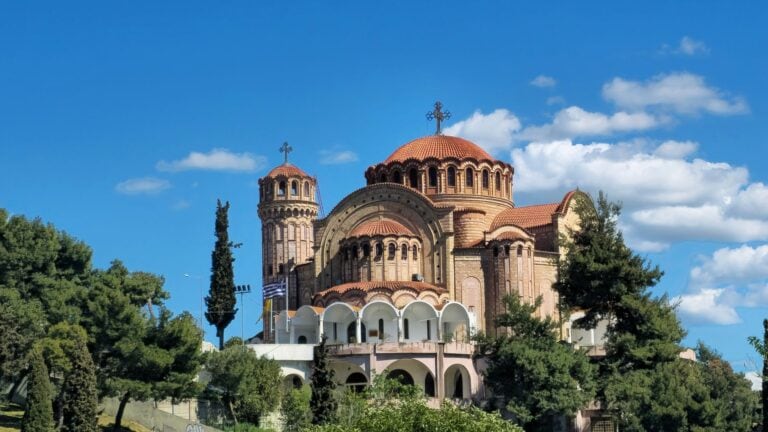
The most important starting point is the Church of Saint Demetrius, dedicated to Thessaloniki’s patron saint. The present basilica incorporates centuries of history, while the crypt below is associated with the site of Saint Demetrius’s imprisonment and martyrdom.
Inside, surviving mosaics and architectural details reveal only part of the church’s story. The building was converted into a mosque during Ottoman rule and suffered devastating damage in the Great Fire of 1917 before being reconstructed. Despite those changes, it remains one of the spiritual and historical centres of Thessaloniki.
The Hagia Sophia of Thessaloniki offers a different experience. Inspired by the great church of the same name in Constantinople, it has stood at the heart of the city for centuries. Its dome, mosaics and long history make it one of the most important Byzantine buildings in Greece.
The Church of the Acheiropoietos is older still. Dating from the fifth century, it is one of the best surviving examples of an early Christian basilica and gives visitors a sense of what Thessaloniki’s religious buildings looked like before the later Byzantine period.
Some of the most rewarding churches are found away from the busiest streets. In Ano Poli, the small Church of Hosios David contains exceptional mosaics and frescoes, while the Church of Saint Nicholas Orphanos is known for its remarkably preserved fourteenth-century wall paintings.
Trying to visit every historic church in Thessaloniki can quickly become exhausting. A better approach is to choose two or three contrasting examples. Saint Demetrius gives you scale and city history, Hagia Sophia demonstrates the grandeur of Byzantine Thessaloniki, while one of the smaller Upper Town churches offers a more intimate experience.
Even visitors who rarely seek out churches should make time for this part of the city. Thessaloniki’s Roman ruins are impressive, but its Byzantine heritage is what makes the city genuinely exceptional. There are few places where so much of the Byzantine world survives within a modern, walkable city centre.
Explore the Old Streets and Views of Ano Poli
Above the dense modern centre, Ano Poli feels like a different city. The Upper Town escaped much of the destruction caused by the Great Fire of 1917, allowing old streets, traditional houses and sections of Thessaloniki’s historic walls to survive.
The difference becomes obvious as you climb. Apartment blocks give way to narrow lanes, small squares, colourful houses and unexpected views across the city. The streets are quieter, the layout is less regular and the Thermaic Gulf appears between buildings as you move through the neighbourhood.
One of the main reasons to visit is the surviving city walls. Thessaloniki was once protected by an extensive system of fortifications, and the Upper Town contains some of the most impressive remaining sections. Around the Trigonion Tower, the city opens out below you, with views stretching across rooftops towards the waterfront and gulf.
This is one of the best places in Thessaloniki for sunset, but the views are impressive throughout the day. From above, you can clearly see how the modern city descends towards the sea and how tightly its different neighbourhoods have grown together.
Continue exploring and you will find the Vlatadon Monastery, a historic Byzantine monastery still in use today. Its elevated position provides another excellent viewpoint, while its quieter surroundings offer a contrast to the busy centre below.
Ano Poli is also home to smaller Byzantine churches, Ottoman-era traces and streets that reward aimless wandering. This is not an area where every interesting building needs to appear on a checklist. The neighbourhood itself is the attraction.
The steep terrain does require some planning. Walking uphill from the centre is possible, but the climb can be tiring, particularly in hot weather. For most visitors, the easier option is to take a bus or taxi uphill and explore Ano Poli while walking back down towards the centre.
That approach also creates a more natural sightseeing route. You can begin around the walls and viewpoints, wander through the old streets, visit one of the smaller Byzantine churches and gradually descend towards Saint Demetrius and the central city.
The easiest way to explore Ano Poli is to start at the Trigonion Tower. Take a taxi or local bus to the Upper Town, saving yourself the steep climb from the city centre. From the tower, follow the Byzantine city walls west towards the Heptapyrgion Fortress before wandering through the narrow streets, traditional houses and quiet squares that make Ano Poli so distinctive. Continue downhill via the Vlatadon Monastery and the smaller Byzantine churches before finishing at the Church of Saint Demetrius, where you rejoin the modern city.
This downhill route allows you to enjoy the best viewpoints first before gradually discovering the neighbourhood itself. Along the way you’ll find cafés, hidden courtyards, Ottoman-era buildings and panoramic views across the Thermaic Gulf. The neighbourhood itself is the attraction, rewarding anyone who takes the time to wander rather than rushing between individual landmarks.
Our Thessaloniki Public Transport Guide explains the best ways to reach the Upper Town and move around the wider city.
Walk Through the Markets and Food Districts
Thessaloniki’s history is found in its monuments, but much of the city’s character is found around its markets, food shops, cafés and restaurant districts. This is widely regarded as one of Greece’s great food cities, shaped by influences from the Balkans, the Ottoman world, Asia Minor and the communities that have called Thessaloniki home.
The Kapani Market is the place to experience the traditional commercial heart of the city. Its narrow lanes are filled with shops and stalls selling meat, fish, spices, olives, cheese and other everyday ingredients. This is a working market rather than a carefully polished visitor attraction, and that is exactly why it is worth exploring.
Nearby, the Modiano Market offers a more contemporary experience. The historic market building has been restored and transformed into a modern food hall, with places to eat and drink alongside food retailers. It feels very different from Kapani, so visiting both is not repetitive.
Kapani shows the older rhythm of central Thessaloniki, while Modiano is better suited to stopping for food and seeing how the city has reinvented one of its historic commercial spaces.
Around Athonos Square, the atmosphere changes again. Small shops, tavernas and tables spread through the surrounding streets, making this a good area to slow down after exploring the markets. It feels less like a single attraction and more like a neighbourhood that happens to revolve around eating and meeting.
Closer to the waterfront, Ladadika occupies a former commercial and warehouse district near the port. Its colourful historic buildings are now filled with restaurants and bars. The area becomes particularly lively in the evening, although it is worth walking through during the day when the architecture is easier to appreciate.
Food is part of the Thessaloniki experience from the beginning of the day. A local bougatsa, with its crisp pastry and sweet or savoury filling, is one of the city’s best-known breakfasts, while koulouri bread rings are closely associated with Thessaloniki. The city is also an excellent place to explore meze, seafood and dishes shaped by the arrival of refugees from Asia Minor in the twentieth century.
You do not need a long list of restaurants to experience this side of the city. Walk through the markets, stop when somewhere looks interesting and leave enough space in the day for meals to take longer than planned. In Thessaloniki, food is not something to fit around the sightseeing; it is part of the sightseeing.

Step Into a World of Illusions
After several sections filled with Roman emperors, Byzantine churches and historic neighbourhoods, the Museum of Illusions Thessaloniki offers something completely different. This is a hands-on attraction built around perception, optical tricks and interactive exhibits rather than traditional museum displays.
The museum contains around 40 visual and interactive illusions, with rooms and installations designed to demonstrate how easily the brain can be confused by what the eyes appear to see. It is playful, but there is also an educational element behind many of the exhibits, particularly those exploring perspective, scale and visual perception.
Among the best-known experiences is the Infinity Room, where mirrors create the impression of a space stretching far beyond the walls. The Reverse Room plays with gravity and orientation, while the Ames Room uses forced perspective to make people appear to grow or shrink depending on where they stand.
Photography is a major part of the experience. Many of the illusions are specifically designed to create unusual pictures, so this is one attraction where spending time taking photographs is actively encouraged rather than discouraged.
The museum works particularly well for families, couples and groups of friends, but it can also be useful when the weather disrupts outdoor sightseeing plans. Unlike Thessaloniki’s archaeological and Byzantine museums, you do not need any background knowledge before arriving.
It is best treated as a fun break from the city’s heavier historical attractions rather than an essential introduction to Thessaloniki. If you only have one day, the Roman monuments, Byzantine heritage and waterfront should take priority. With a longer stay, however, the Museum of Illusions adds some welcome variety.
Admission is for a selected entry time, but once inside you can explore at your own pace. The museum is also wheelchair accessible, making it one of the easier indoor attractions to include in an accessible Thessaloniki itinerary.
Understand Thessaloniki’s Jewish History
For centuries, Thessaloniki was home to one of the most important Jewish communities in Europe. At its height, the city had such a large and influential Sephardic population that it became known as the Jerusalem of the Balkans.
This history began long before the arrival of the Sephardic Jews, but the city changed dramatically after 1492, when Jews expelled from Spain settled across the Ottoman Empire. Thessaloniki became a major centre of Sephardic culture, commerce, publishing and religious life, with Ladino widely spoken across the city.
The community became so central to Thessaloniki that the port traditionally stopped work on the Jewish Sabbath. Jewish businesses, schools, synagogues and neighbourhoods formed an essential part of the city for generations.
Much of that physical world disappeared before the Second World War. The Great Fire of 1917 destroyed large areas of central Thessaloniki, including Jewish neighbourhoods, while the rebuilding of the city transformed the old urban landscape.
The catastrophe became almost total during the Holocaust. In 1943, the Nazi occupation authorities began deporting Thessaloniki’s Jewish population to extermination camps, primarily Auschwitz-Birkenau. The overwhelming majority of those deported were murdered.
The Jewish Museum of Thessaloniki is the most important place to understand the community that existed before the Holocaust. Its collections explore religious life, everyday culture, commerce and the destruction of a community that had shaped Thessaloniki for centuries.
Near the waterfront, the Holocaust Memorial commemorates the tens of thousands of Jewish residents murdered during the Holocaust. Its central location is significant: this history is not separate from the story of Thessaloniki but part of the story of the city itself.
The old railway station is also connected with the deportations. Trains carrying Thessaloniki’s Jewish population left from here in 1943, beginning journeys from which very few returned.
This is one of the most important parts of Thessaloniki’s history, and it deserves more than a brief mention between ancient ruins and museums. Understanding what the city once was, what was destroyed and what survives today changes the way you see modern Thessaloniki.
See the Archaeological Treasures of Macedonia
The Archaeological Museum of Thessaloniki is one of the city’s essential museums, particularly if you want to understand the wider region of Macedonia rather than only the monuments visible around the centre.
Its collections span a vast period of history, from prehistoric Macedonia through the classical, Hellenistic and Roman eras. The museum helps place Thessaloniki within the wider world that developed around it, connecting the modern city with ancient settlements, kingdoms and trade networks across northern Greece.
One of the major highlights is the museum’s collection of ancient Macedonian gold. Jewellery, wreaths, coins and burial objects demonstrate the extraordinary craftsmanship and wealth of the region, while the wider exhibitions explain how these objects fitted into ancient society.
The museum is particularly valuable after exploring Roman Thessaloniki. The Arch of Galerius, Rotunda and Roman Forum show you the surviving city, while the museum provides the objects, archaeology and historical context that are harder to understand from ruins alone.
Allow at least a couple of hours if archaeology is one of your main interests. Visitors with less time can still concentrate on the principal galleries, but this is not a museum that needs to be rushed simply to say you have visited.
Its location also makes it easy to combine with the Museum of Byzantine Culture, which stands nearby. Together, the two museums create one of the strongest museum half-days in Thessaloniki, moving from ancient Macedonia and the Roman world into the Byzantine civilisation that later defined the city.
For visitors with a serious interest in history, both museums are worth seeing. If you have to choose only one, the Archaeological Museum is the better fit for those interested in ancient Greece, Macedonia and Roman Thessaloniki.
Compare hostels and budget-friendly accommodation around Thessaloniki.
Browse hostelsAccess compensation support, eligible lounge benefits and faster payouts when flights go wrong.
See the benefitsUse convenient luggage storage around Thessaloniki between arrival, check-in and departure.
Check storageExplore the Byzantine World Beyond the Churches
Thessaloniki’s Byzantine churches are extraordinary, but they only reveal part of the story. The Museum of Byzantine Culture brings together the objects, art and everyday history needed to understand the civilisation behind the buildings.
The museum covers the long Byzantine period through mosaics, frescoes, icons, sculpture, coins, ceramics and burial objects. Rather than presenting Byzantine history as a succession of emperors and battles, the exhibitions also explore religion, daily life, death and the changing society of the empire.
This makes it particularly useful after visiting some of Thessaloniki’s historic churches. Details that can be difficult to interpret inside a dimly lit building begin to make more sense once you understand how Byzantine art developed and why particular images, materials and architectural forms were used.
The museum is modern, spacious and easier to navigate than many large archaeological collections. You can move through the galleries chronologically, following the transformation of the Roman world into the Byzantine Empire and the later development of Byzantine culture.
Visitors who are not usually drawn to religious art may be surprised by how varied the collection is. The museum is not simply a gallery of icons. It explains an entire civilisation that shaped Thessaloniki for more than a thousand years.
Because the Archaeological Museum is nearby, the two can easily be combined. Visit the archaeological collections first and the Byzantine museum second, and you can follow the history of the region across centuries without crossing the city.
Allow around half a day for both museums if you want to explore them properly. On a rainy day, they are also among the best places in Thessaloniki to spend several hours without feeling that you have settled for a second-choice plan.
Just a short walk away is the Byzantine Bathhouse (Bey Hamam), the only surviving Byzantine bathhouse in Thessaloniki and one of the few remaining anywhere in Greece. Dating from the late thirteenth century, it offers a fascinating glimpse into everyday life rather than religion or imperial history. Entry is free, making it an easy addition to your itinerary if you are exploring the city’s Byzantine landmarks or visiting the nearby museums.
Experience the Archaeology Inside the Metro
Thessaloniki’s metro is more than a way to move around the city. During its construction, archaeologists uncovered such extensive remains beneath the streets that parts of the finished network became archaeological sites in their own right.
The scale of the discoveries should not be surprising. The modern metro tunnels pass directly beneath a city that has been continuously inhabited for more than two thousand years. Construction exposed streets, buildings, workshops, burial grounds and hundreds of thousands of objects from different periods of Thessaloniki’s history.
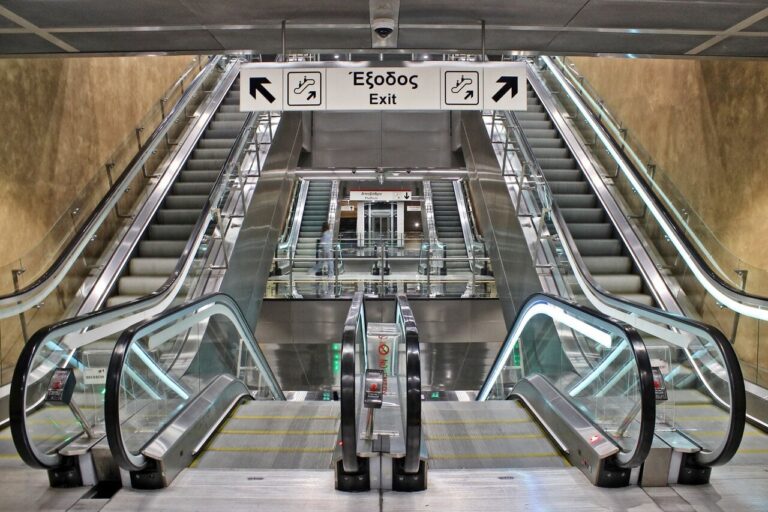
The most impressive results can be seen at Venizelou station. Here, a section of the Byzantine city has been preserved and incorporated into the station, creating one of the most unusual public transport spaces in Europe.
The remains include part of a major paved street that once ran through Byzantine Thessaloniki, together with the junction of another important route. Shops and other buildings developed around these streets, creating a busy commercial area beneath what is now the modern city centre.
What makes the experience remarkable is the setting. You are not visiting a conventional archaeological site behind the walls of a museum. Passengers move through the station beside the remains of the city used by people who lived here centuries earlier.
The archaeology also helps explain something that can be difficult to appreciate at street level: modern Thessaloniki sits directly on top of its predecessors. Roman, Byzantine and later layers survive beneath streets that remain among the busiest parts of the city today.
Other stations also display archaeological finds and information uncovered during construction, but Venizelou is the one to prioritise if you only have time to see one. It can easily be incorporated into a day exploring the markets, Roman sites and central city.
You do not need a special sightseeing ticket to experience the metro archaeology. It is part of the transport network, making an ordinary journey through Thessaloniki part of the sightseeing experience.
Our Thessaloniki Public Transport Guide explains how to use the metro, buses and other transport around the city.
Take to the Water from Thessaloniki’s Waterfront
The Thermaic Gulf shapes the entire character of Thessaloniki, but most visitors experience it from the promenade. Taking a short trip onto the water gives you a completely different view of the city and offers a welcome break from churches, ruins and museums.
Sightseeing and leisure boats operate from the central waterfront, with departures typically taking passengers on a short cruise into the Thermaic Gulf before returning to the city. From the water, you can see how Thessaloniki stretches along the coastline and how dramatically the dense city rises towards Ano Poli.
These are not long excursions or formal day cruises. The experience is generally relaxed and social, with many boats operating more like floating cafés or bars than conventional sightseeing vessels. The attraction is the combination of sea views, music, drinks and a different perspective on the waterfront.
A typical trip is short enough to fit easily into a day of sightseeing. This makes the boats particularly easy to combine with the White Tower, waterfront promenade or an evening around Aristotelous Square and Ladadika.
The experience changes with the time of day. Daytime departures give you clearer views of the city, while late-afternoon and evening trips can be far more atmospheric. Sunset over the Thermaic Gulf is the obvious time to aim for if the weather and departure schedule cooperate.
It is worth understanding what you are booking before boarding. These boats are usually about the atmosphere and views rather than detailed guided commentary, and arrangements can differ between vessels. Some operate with a fare, while others may use a minimum drink purchase or similar system.
Departure points and operating schedules can also vary with the season and weather, so check the current arrangements along the waterfront rather than assuming a particular boat will run at a fixed time throughout the year.
If you are staying in Thessaloniki for more than a day, a short trip onto the gulf is one of the easiest ways to add something lighter to a history-heavy itinerary. The city looks very different once you leave the promenade behind and see it from the sea.

Watch Thessaloniki Turn Beneath You at the OTE Tower
The OTE Tower offers one of the most unusual views in Thessaloniki. Rather than simply climbing to an observation deck, visitors can sit inside the tower’s rotating Skyline café-bar while the city slowly moves around them.
The tower rises above the Thessaloniki International Exhibition Centre and is one of the most recognisable structures on the city skyline. From the top, the views stretch across the waterfront, Thermaic Gulf and dense urban centre, with the higher neighbourhoods of Thessaloniki rising in the distance.
The viewing area completes a 360-degree rotation approximately once every hour. The movement is slow enough that you may barely notice it at first, but landmarks gradually appear and disappear as your table changes direction.
This makes the OTE Tower a very different experience from the viewpoints around Ano Poli. The Upper Town gives you the classic panorama of Thessaloniki descending towards the sea, while the tower places you above the modern city and closer to the waterfront.
Bookable experiences combine the rotating view with a light meal and drink. Options can include a cheese and cold-cuts platter with wine or a club sandwich with beer or another refreshment, depending on the package selected.
The experience works particularly well towards the end of a sightseeing day. A daytime visit gives you the clearest view of individual landmarks, but sunset is the standout time to book if you can find a suitable slot. You can watch the light change across the gulf while the tower slowly rotates.
Evening visits have a different atmosphere, with the city lights replacing the long-distance views. Live piano music is also offered on some evenings, adding to the feeling that this is an experience rather than simply a viewpoint.
The OTE Tower is particularly good for couples, groups and visitors who want to combine sightseeing with food and drinks. It is not the cheapest way to see Thessaloniki from above, and the free viewpoints around Ano Poli remain essential, but the rotating setting makes this much more than a substitute for them.
If you are choosing between the two, do both for different reasons. Explore Ano Poli during the day for the walls, old streets and sweeping city views, then visit the OTE Tower around sunset for a completely different perspective on Thessaloniki and the Thermaic Gulf.
Spend an Evening in Ladadika
Ladadika appears earlier in this guide as one of Thessaloniki’s food districts, but the neighbourhood changes character after dark. What was once a commercial area close to the port is now one of the city’s busiest places for restaurants, bars and evening entertainment.
The district takes its name from the oil merchants and warehouses that once operated here. Many of the surviving buildings are relatively low and colourful, creating a streetscape that feels very different from the apartment blocks covering much of central Thessaloniki.
During the day, it is easier to appreciate the architecture and old commercial layout. In the evening, tables spread across the streets, restaurants fill and the area becomes much louder and livelier.
There is no point pretending Ladadika is an undiscovered local secret. It is one of the best-known nightlife areas in Thessaloniki and firmly established on the visitor map. Prices and atmosphere can vary considerably between venues, and the busiest streets can feel touristy.
That does not make the area worth avoiding. The historic buildings, central location and concentration of places to eat and drink make Ladadika an easy choice for a first evening in the city, particularly if you have arrived without making detailed plans.
It is also well placed for continuing the night elsewhere. The waterfront and port are nearby, while the bars and restaurants of the wider city centre are within easy walking distance.
For the best experience, do not treat Ladadika as a single restaurant destination. Walk through the surrounding streets first, look at where the atmosphere suits you and choose somewhere rather than automatically stopping at the first busy terrace.
Thessaloniki is a city that stays active late into the evening, and Ladadika provides one of the easiest introductions to that side of it. Visit once for the atmosphere, then use the rest of your stay to discover how much further the city’s food and nightlife scene extends beyond its most famous district.
Discover More of Thessaloniki’s Museums
The Archaeological Museum and Museum of Byzantine Culture may be Thessaloniki’s two heavyweight historical museums, but they are only the beginning. The city has an unusually varied collection of smaller and specialist museums covering war, modern Greek history, contemporary art, photography, cinema, the Olympic movement, science and technology.
You certainly do not need to visit them all. The value of this wider museum scene is that you can choose somewhere that matches your interests rather than spending an entire trip moving between archaeological collections. Several also explore parts of Thessaloniki’s story that are only briefly visible elsewhere in the city.
For modern Greek and military history, the War Museum of Thessaloniki is one of the strongest additions. Its collections cover conflicts and political events that shaped Greece in the nineteenth and twentieth centuries, using weapons, uniforms, photographs, documents, medals and other military objects.
The museum is particularly useful if you want to understand the period after the centuries of Roman, Byzantine and Ottoman history that dominate many of Thessaloniki’s better-known attractions. The Balkan Wars, First World War, Second World War and later periods of Greek military history all help explain how Thessaloniki and northern Greece became the places they are today.
The Museum of the Macedonian Struggle explores another crucial part of that transition. Its exhibitions focus on the political and armed struggle over Ottoman Macedonia during the late nineteenth and early twentieth centuries, before Thessaloniki became part of the modern Greek state.
This is a more specialised museum, but it fills an important gap in the city’s historical story. If you have already explored Roman Thessaloniki, the Byzantine churches and the surviving traces of the Ottoman city, the museum helps explain how the region moved into the modern era.
Another place closely connected with Thessaloniki’s Ottoman past is the Atatürk Museum. Mustafa Kemal Atatürk, the founder of the modern Republic of Turkey, was born in Thessaloniki in 1881, when the city was still part of the Ottoman Empire.
The museum occupies the house associated with his birthplace and is particularly significant for visitors interested in Ottoman history, modern Turkey and the enormous political changes that transformed the region during the early twentieth century. It also serves as a reminder that Thessaloniki’s history cannot be understood solely through a modern national lens.
Art lovers have several very different choices through the city’s MOMus museum network. The Museum of Contemporary Art focuses on modern and contemporary Greek and international work, making it the clearest alternative for visitors who want a complete break from archaeology and historical collections.
The MOMus Museum of Modern Art – Costakis Collection is even more distinctive. Its internationally important collection of Russian avant-garde art gives Thessaloniki a museum experience that few visitors would expect to find in northern Greece. For anyone interested in twentieth-century art, it can be one of the most surprising cultural attractions in the city.
At the port, the MOMus Thessaloniki Museum of Photography focuses on Greek and international photography and visual culture. Its location makes it particularly easy to combine with the waterfront, Ladadika and the wider port area rather than building an entire day around museum visits.
The port is also home to the Thessaloniki Cinema Museum. This is a natural fit for a city with such a strong connection to film and the Thessaloniki International Film Festival. Exhibitions explore the history of Greek cinema through posters, photographs, equipment, costumes and other material connected with filmmaking and the development of the industry.
Together, the photography and cinema museums make the port one of the best areas for visitors interested in visual culture rather than ancient history. They can also provide an excellent alternative when poor weather makes a long waterfront walk less appealing.
Sport has its own museum in Thessaloniki. The Olympic Museum explores the history and ideals of the Olympic movement, with exhibitions connected to the ancient and modern Games, Greek athletes and the development of Olympic sport.
It is a more specialist choice than the city’s major historical museums, but it can work particularly well for families, sports fans and anyone interested in Greece’s connection with the Olympic Games. It also adds another genuinely different option to a museum scene that might otherwise appear dominated by archaeology and religion.
For families, science enthusiasts and visitors prepared to travel beyond the compact historic centre, NOESIS Science Center and Technology Museum offers one of the biggest changes of pace. Located outside central Thessaloniki, it combines science and technology exhibitions with large-scale visitor experiences.
The complex is known for attractions including its planetarium and technology-focused displays, making it a much more interactive choice than the traditional museums in the centre. Because of its location, it requires more planning and should be treated as a dedicated trip rather than something to squeeze between two central attractions.
The best museum for you depends entirely on your interests. Choose the War Museum or Museum of the Macedonian Struggle for modern Greek history, the Atatürk Museum for Ottoman and twentieth-century history, the MOMus museums for art and photography, the Cinema Museum for visual culture, the Olympic Museum for sport or NOESIS for science and a more family-focused experience.
Thessaloniki’s museum scene is much broader than it first appears. You could spend several days visiting museums without repeating the same subject, which is another reason the city works so well for longer stays and visits outside the main summer season.

What to Do in Thessaloniki When It Rains
Rain does not have to ruin a day in Thessaloniki. The city has an unusually strong collection of museums, covered markets, historic churches and indoor archaeological spaces, making it much easier to adapt your plans than in destinations where most of the major attractions are outdoors.
For a full museum day, the easiest combination is the Archaeological Museum of Thessaloniki and the Museum of Byzantine Culture. They stand close to one another and together cover an enormous sweep of the region’s history, from ancient Macedonia and the Roman world to the civilisation that shaped Thessaloniki for centuries.
The city’s Byzantine churches are another good option, although they work best when combined rather than used to fill an entire wet day. Saint Demetrius, Hagia Sophia and the Rotunda are all substantial enough to spend time inside, and moving between them creates a historical route through the centre.
Thessaloniki’s markets can also provide shelter without abandoning the atmosphere of the city. The restored Modiano Market is the easiest place to settle in for food and drinks, while the surrounding commercial streets make it possible to explore in shorter bursts between showers.
The metro adds another unusual possibility. Head to Venizelou station to see the Byzantine street and archaeological remains preserved within the transport network. You can then use the metro to move across the centre without spending the whole day walking in poor weather.
For something lighter, the Museum of Illusions is an easy alternative to another conventional museum. Its interactive rooms and optical exhibits work particularly well for families and groups, and you can explore the attraction entirely indoors.
A rainy afternoon is also a good excuse to experience Thessaloniki through its food. Stop for bougatsa, spend longer over lunch, explore Modiano Market or settle into one of the city’s cafés. Thessaloniki is a city where eating and socialising are part of the experience, not emergency substitutes for sightseeing.
If the forecast shows several hours of continuous rain, save Ano Poli, the waterfront and the boat trips for another day. The Upper Town loses much of its appeal when the views disappear, while wet, steep streets can make exploring less enjoyable.
With a little flexibility, poor weather can actually help create a more balanced itinerary. Use the rain for museums, churches, markets and metro archaeology, then return outside when the sky clears.
Enjoy Thessaloniki Without Spending Anything
Some of the best experiences in Thessaloniki cost nothing. You can see a substantial part of the city’s history, walk one of its greatest public spaces and enjoy some of its finest views without buying an admission ticket.
The waterfront promenade is the obvious place to begin. Walking from the port and Aristotelous Square past the White Tower, The Umbrellas and along the newer seafront can fill several hours, particularly if you stop to watch the activity around the gulf.
Ano Poli is another of the city’s great free experiences. You can wander through the old streets, follow surviving sections of the walls and enjoy panoramic views across Thessaloniki and the Thermaic Gulf without paying to enter a viewpoint.
Many of the city’s historic churches can also be visited without an admission charge. This makes it possible to experience some of Thessaloniki’s most important Byzantine heritage even on a tight budget. Remember that these are active religious sites as well as historic monuments, so dress and behave respectfully.
Roman Thessaloniki is surprisingly accessible from the street. The Arch of Galerius stands in the middle of the modern city, while parts of the Galerius Palace complex can be seen around Navarinou Square. Even when you do not enter every archaeological site, walking between the monuments reveals how deeply the ancient city is embedded in the modern one.
The markets are free to explore too. You do not have to buy anything to walk through Kapani Market, see the restored interior of Modiano Market or wander through the streets around Athonos Square.
The metro archaeology adds another unusual free or very low-cost experience, depending on whether you are already making a journey. The archaeological displays at stations such as Venizelou turn an ordinary trip across the city into part of the sightseeing.
Thessaloniki is also a good city for simply wandering. Aristotelous Square, the port area, university district and streets around the Roman monuments all reveal different sides of the city without requiring a ticket.
You could easily spend a day combining the waterfront, Roman monuments, Byzantine churches, markets and Ano Poli while paying very little beyond transport and food. The museums and paid attractions add depth and variety, but they are not required to enjoy the city.
How Many Days Do You Need in Thessaloniki?
You can see the main sights of Thessaloniki in a day, but two or three days gives the city the time it deserves. The centre is compact, yet the number of historical layers means a rushed visit can quickly become a sequence of churches, ruins and museums without enough time to understand how they fit together.
With one day in Thessaloniki, concentrate on the waterfront and historic centre. Begin around the White Tower, walk part of the promenade, explore the Arch of Galerius and Rotunda, visit one major Byzantine church and leave time for the markets and food districts. This gives you a strong introduction without trying to cross the entire city.
With two days, add Ano Poli and explore Thessaloniki’s Byzantine heritage in more depth. Take a bus or taxi uphill, visit the walls and viewpoints, then walk back down through the Upper Town. The second day also gives you more time for Saint Demetrius, Hagia Sophia and the smaller streets between the major sights.
A three-day stay allows the city to breathe. You can add the Archaeological Museum, Museum of Byzantine Culture and Jewish heritage sites, while still leaving time for a boat trip, the Museum of Illusions or the OTE Tower. You can also return to the waterfront in the evening rather than treating it as a single sightseeing stop.
Four days or longer changes the possibilities. Instead of trying to find more attractions in the centre, use Thessaloniki as a base for exploring northern Greece. Archaeological sites, beaches, Mount Olympus, monasteries and nearby cities can all be reached on day trips.
Our Day Trips from Thessaloniki Guide covers the best options and helps you decide which journeys work independently and which are easier as organised excursions.
For most first-time visitors, three nights is the sweet spot. That gives you two or three useful sightseeing days, depending on arrival and departure times, without forcing you to choose between the city’s history and its more relaxed side.

Getting Around the Sights
Most of the attractions covered in this guide are within walking distance of central Thessaloniki. The waterfront, White Tower, Roman monuments, markets, Aristotelous Square and several major Byzantine churches can all be connected on foot.
The metro is useful for longer journeys across the centre and for reaching areas that would otherwise require more walking. It also has the unusual advantage of being a sightseeing experience itself, thanks to the archaeological remains incorporated into stations such as Venizelou.
Buses remain important for places not directly served by the metro. They are particularly useful for reaching Ano Poli and the higher sections of the city, where the steep climb can be tiring in warm weather.
For the Upper Town, the easiest strategy is usually to travel uphill by bus or taxi and walk back down. This allows you to enjoy the walls, viewpoints, churches and old streets without beginning the visit with a long climb.
A car is unnecessary for sightseeing in central Thessaloniki and can create more problems than it solves. Traffic and parking make driving less convenient than walking and public transport for most city visits.
Our Thessaloniki Public Transport Guide explains how to use the metro and buses, buy tickets and plan journeys around the city.
Plan a Day Trip Beyond Thessaloniki
Thessaloniki is one of the best bases in northern Greece for exploring beyond the city. Stay for four days or longer and you can begin adding ancient archaeological sites, beaches, mountains, monasteries and smaller cities without changing hotels.
History-focused visitors have some of the strongest options. The royal tombs at Vergina, ancient Pella and the archaeological site of Dion all reveal parts of Macedonia that cannot be understood from Thessaloniki alone. Each offers a very different experience, from royal burials and extraordinary treasures to the remains of an ancient city beneath Mount Olympus.
For landscapes and outdoor experiences, Mount Olympus is the obvious choice. You do not have to attempt a serious mountain climb to enjoy the area; shorter walks, villages and viewpoints make it possible to experience the region on a more relaxed day trip.
The Halkidiki peninsula opens up another side of northern Greece. Its beaches and clear water can provide a complete change from urban sightseeing, although journey times and transport options vary considerably depending on exactly where you want to go.
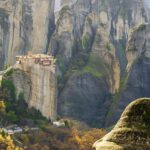
Longer journeys can take you to the monasteries of Meteora, while nearby cities and towns provide alternatives for visitors who prefer independent rail and bus trips. The important thing is not to treat every destination as equally easy. Some work well by public transport, while others are considerably simpler with a car or organised excursion.
Our Day Trips from Thessaloniki Guide compares the strongest options, explains how long they take and helps you decide which trips are realistic for the time you have available.
Choose the Right Thessaloniki Experience for Your Trip
There is far too much in Thessaloniki to approach the city with a rigid checklist. The best itinerary depends on why you came, how long you have and which parts of the city’s story interest you most.
For a first visit, prioritise the waterfront, Roman Thessaloniki, two or three Byzantine churches and Ano Poli. Together, they reveal the city’s geography and its most important historical layers. Add time around the markets and food districts, and you have a much better introduction than you would get from racing between every museum.
History-focused visitors should follow the city chronologically. Begin with the Roman monuments around Galerius, explore the archaeological collections, move into the Byzantine churches and Museum of Byzantine Culture, then make time for Thessaloniki’s Ottoman and Jewish history. Few European cities allow you to follow so many different periods within such a compact area.
For a more relaxed weekend, spend less time inside museums and more time around the waterfront, markets and neighbourhoods. Explore the centre on foot, take the sightseeing bus if you want an easy overview, visit Ano Poli and leave space for long meals rather than filling every hour.
Families and groups may want to break up the historical sights with the Museum of Illusions, a boat trip or the rotating experience at the OTE Tower. These attractions add variety without taking you away from the central city.
A longer stay allows you to combine both approaches. See the major monuments, explore the museums properly, spend an evening in Ladadika and then use Thessaloniki as a base for a day trip into northern Greece.
The most important thing is to avoid treating Thessaloniki as a smaller version of Athens. Its appeal comes from the way history, food, neighbourhoods and the waterfront overlap. Give yourself time to explore those connections and the city becomes far more interesting than a simple collection of attractions.

Rupert’s Handy Travel Tips
Planning your time in Thessaloniki? Here are a few useful tips to help you make the most of the city:
- Travel uphill and walk back down: Ano Poli is one of the best parts of Thessaloniki, but the climb from the centre can be tiring. Take a bus or taxi uphill, explore the walls and old streets, then walk back towards the centre.
- Explore the city by historical layer: Visit the Roman sites together, then do the same with the Byzantine churches. Thessaloniki makes much more sense when its monuments form part of a story rather than a checklist.
- Leave time for the waterfront: Do not treat the White Tower as a quick photo stop. Continue along the promenade towards The Umbrellas and return around sunset to see a completely different side of the city.
- Use the weather to shape your plans: Save Ano Poli, the waterfront and boat trips for clear days. The museums, markets, churches and metro archaeology make Thessaloniki unusually easy to explore when it rains.
- Do not overfill your itinerary: Long meals, market stops and unplanned walks are part of the Thessaloniki experience. Two or three well-chosen areas in a day will usually be more rewarding than racing between every attraction.
Want to meet the reindeer behind our travel tips? Find out more in our page Who is Rupert?.
Frequently Asked Questions
What is Thessaloniki best known for?
Thessaloniki is best known for its Roman monuments, Byzantine churches, waterfront, food culture and layered history. The city was shaped by Roman, Byzantine, Ottoman, Jewish and modern Greek communities.
Is Thessaloniki worth visiting?
Yes. Thessaloniki is particularly rewarding for visitors interested in history, food and walkable city breaks. It has fewer globally famous landmarks than Athens, but its historic layers and waterfront atmosphere make it a very different destination.
How many days do you need in Thessaloniki?
Two days is enough for the main sights, but three days is ideal for most first-time visitors. This gives you time for the waterfront, Roman monuments, Byzantine churches, Ano Poli, markets and at least one major museum.
What should I not miss in Thessaloniki?
On a first visit, do not miss the White Tower and waterfront, Roman monuments around Galerius, at least two Byzantine churches and the views from Ano Poli.
Is Thessaloniki a walkable city?
Yes. Most attractions in the centre can be reached on foot. The main exception is Ano Poli, where the steep climb makes travelling uphill by bus or taxi and walking back down the easier option.
What can you do in Thessaloniki for free?
You can walk the waterfront, explore Ano Poli, see the Arch of Galerius, wander through the markets, visit many historic churches and experience parts of the city’s metro archaeology.
What is the best area to explore in Thessaloniki?
First-time visitors should explore the area between the waterfront, Roman monuments, central markets and Aristotelous Square. Ano Poli should then be visited separately because of its elevated location.
Can you visit Ano Poli on foot?
Yes, but the climb from the centre is steep. Most visitors will have a more enjoyable experience by taking a bus or taxi uphill and walking back down through the old streets.
Are Thessaloniki’s museums worth visiting?
Yes. The Archaeological Museum of Thessaloniki and Museum of Byzantine Culture are particularly strong and can easily be combined into a museum-focused half day.
What can you do in Thessaloniki when it rains?
Visit the archaeological and Byzantine museums, explore Modiano Market, see the metro archaeology at Venizelou station, visit historic churches or spend time at the Museum of Illusions.
Do you need a car in Thessaloniki?
No. A car is unnecessary for sightseeing in the city centre. Walking, the metro, buses and occasional taxis are more convenient for most visitors.
Can you take day trips from Thessaloniki?
Yes. Thessaloniki is a strong base for trips to ancient Macedonian sites, Mount Olympus, Halkidiki, Meteora and other destinations across northern Greece.
Further Reading
Getting around Thessaloniki is straightforward once you understand how the different parts of the network fit together. Our Thessaloniki Public Transport Guide explains the metro, buses and tickets, including the easiest way to reach Ano Poli without tackling the steep uphill walk. If you have not yet arrived in the city, the Thessaloniki Airport Transfers Guide compares the practical ways to travel between the airport and the centre.
Thessaloniki is also an excellent base for exploring more of northern Greece. Our Day Trips from Thessaloniki Guide covers the best places to visit beyond the city, from ancient Macedonian sites and Mount Olympus to beaches and monasteries. For a longer journey south, the Thessaloniki to Athens Guide explains the different ways to travel between Greece’s two largest cities.
The city also has direct passenger ferry connections, making it possible to continue your journey by sea. Our Ferry Routes from Thessaloniki Guide covers the destinations you can currently reach directly, while our wider Greek Ferries Guide explains how ferry travel works across Greece and what to expect when booking.
Finally, if you need mobile data during your trip, our eSIM Apps Guide compares the main options for getting connected without relying on expensive roaming. It is particularly useful if Thessaloniki is only one stop on a longer trip through Greece or the rest of Europe.