
Reviewed by our editorial team Updated
Greek Ferries Explained: How to Travel Between the Islands
Travelling by ferry is the backbone of transport in Greece, and for many visitors, it becomes one of the most memorable parts of the journey. With hundreds of inhabited islands spread across the Aegean and Ionian Seas, ferries are not just an alternative to flying. In many cases, they are the most practical and enjoyable way to move between destinations.
The system itself is straightforward once you understand how it works. Ferries connect major hubs such as Athens (Piraeus Port) with island groups like the Cyclades, as well as larger destinations such as Crete. From there, inter-island routes allow you to move between places like Santorini, Paros, Naxos, and Milos, creating flexible island-hopping itineraries.
One of the biggest advantages of Greek ferries is flexibility. Unlike flights, you are not restricted by strict luggage limits or long airport procedures. Boarding is typically quicker, and with e-tickets, you can move from arrival at the port to boarding with minimal friction.
For first-time visitors, ferries may feel unfamiliar at first, but the experience is generally well organised. Ports are clearly signposted, routes are well established, and operators run regular services during the main travel season. Once you have taken your first journey, the system quickly becomes easy to navigate.
Key Greek Ferry Regions and Island Groups
Understanding the main ferry regions of Greece is essential when planning your trip. Each group of islands offers a different experience, and ferry routes are structured around these regional clusters.
The Cyclades Islands are the most popular group for first-time visitors. This region includes Santorini, Mykonos, Paros, Naxos, and Milos, all connected by frequent ferry services. The Cyclades are known for their whitewashed villages, beaches, and strong island-hopping routes, making them the easiest area to explore by ferry.
Crete sits slightly apart due to its size and location. It is Greece’s largest island, with major ports in Heraklion and Chania. Ferries connect Crete to Athens as well as selected Cyclades islands, creating an important bridge between regions.
Closer to the mainland, the Saronic Islands are the most accessible islands from Athens. Destinations such as Aegina, Hydra, Poros and Agistri can all be reached relatively quickly from Piraeus Port, making them ideal for day trips, short breaks and first-time ferry experiences.
This region is also one of the easiest areas for travellers wanting to combine islands with quieter mainland destinations. For example, ferries from Athens also connect towards Methana, a lesser-known volcanic peninsula famous for thermal springs, hiking and a much calmer atmosphere than the Cyclades. Travellers interested in slower-paced routes can read our full Athens to Methana ferry guide for transport advice, ferry timings and planning tips.
These shorter Saronic routes are particularly popular with travellers who want a Greek island experience without committing to long crossings or complex island-hopping itineraries.
By understanding these regions, it becomes much easier to build a logical route. Most itineraries focus on one area, such as the Cyclades, before extending to destinations like Crete or nearby island groups.
| Route | Typical Travel Time | Ferry Type | Frequency (Summer) |
|---|---|---|---|
| Athens → Santorini | 2h – 8h | High-speed & Conventional | Very frequent (5–10 daily) |
| Athens → Mykonos | 2h 30m – 5h | High-speed & Conventional | Very frequent |
| Athens → Paros | 3h – 4h | Mostly High-speed | Frequent |
| Athens → Naxos | 3h 30m – 5h 30m | Mixed | Frequent |
| Athens → Milos | 2h 30m – 7h | Mixed | Moderate |
| Santorini → Paros | 1h 45m – 3h | High-speed | Frequent |
| Naxos → Paros | 45m – 1h | High-speed | Very frequent |
| Milos → Paros | 1h 45m – 4h | Mixed | Moderate |
| Santorini → Crete (Heraklion) | ~1h 40m | High-speed | Daily |
| Athens → Aegina | 40m – 1h 15m | High-speed & Conventional | Very frequent |
Compare hotels and other places to stay in Athens.
Check availabilityBrowse apartments, homes and self-catering accommodation in Athens.
Browse rentalsSee hotel prices from multiple booking sites in one search.
Compare ratesMajor Greek Islands You Can Reach by Ferry
Greece is home to hundreds of islands, but a handful stand out as the most popular and accessible ferry destinations. These islands form the backbone of most itineraries and are all well connected by regular ferry routes from Athens and between each other.
Understanding what each island offers makes it much easier to decide where to go and how to build your route.
Santorini: Greece’s Most Iconic Ferry Destination
For many travellers, Santorini is the island that inspires the entire trip. Rising dramatically from the remains of an ancient volcanic caldera, the island delivers some of the most spectacular scenery anywhere in the Mediterranean. Arriving by ferry is an experience in itself, with ships approaching towering cliffs topped by the famous whitewashed villages of Fira, Oia and Imerovigli.
Santorini is one of the most important hubs in the Greek ferry network, with regular services connecting the island to Athens (Piraeus), Mykonos, Paros, Naxos, Milos, Ios and Crete. Because of these extensive connections, it is often used as either the starting point or grand finale of a Greek island-hopping itinerary.
Beyond the famous sunsets, visitors can explore unique volcanic beaches, ancient archaeological sites such as Akrotiri, traditional wineries and spectacular cliffside walking trails. While Santorini is undeniably one of Greece’s busiest and most expensive islands, the scenery is unlike anything else in the country.
Travellers seeking dramatic landscapes, unforgettable photographs and a true bucket-list destination will find that Santorini more than justifies its reputation.
Mykonos: The Cyclades’ Social and Nightlife Capital
Few islands in Europe possess the global reputation of Mykonos. Known for its vibrant nightlife, beach clubs and cosmopolitan atmosphere, the island attracts visitors from around the world looking for sunshine, entertainment and a lively social scene.
However, Mykonos is far more than just a party destination. The maze-like streets of Mykonos Town, the famous waterfront windmills, charming churches and picturesque harbour create one of the most attractive urban environments in the Cyclades. During the day, visitors can relax on beaches ranging from lively party hotspots to quieter stretches of sand on the island’s less-developed coastline.
The island is exceptionally well connected by ferry, with routes operating to Athens, Paros, Naxos, Santorini, Ios, Syros and numerous other Cycladic destinations. Its central position makes it one of the easiest islands to include in a multi-island itinerary.
Mykonos also serves as the gateway to Delos, one of the most important archaeological sites in Greece and a UNESCO World Heritage Site. This combination of history, beaches and nightlife gives the island far broader appeal than many first-time visitors expect.
For travellers looking for energy, atmosphere and world-class people-watching, Mykonos remains one of the highlights of the Greek ferry network.
Paros: The Best All-Round Island for Most Travellers
If there is one island that consistently wins over experienced travellers, it is Paros. Often described as the perfect balance between Santorini’s scenery and Mykonos’ atmosphere, Paros offers a little bit of everything without the overwhelming crowds found on some of Greece’s more famous islands.
Its location in the heart of the Cyclades makes it one of the most important ferry hubs in the region. Frequent connections link Paros with Athens, Naxos, Mykonos, Santorini, Milos and numerous smaller islands, making onward travel exceptionally straightforward.
Visitors can spend their days exploring traditional villages, relaxing on excellent beaches, discovering hidden coves or dining in the beautiful harbour town of Naoussa, which many consider one of the most attractive destinations in the Cyclades. The capital, Parikia, combines historic churches, waterfront cafés and ferry connections that place the entire island group within easy reach.
Paros appeals to couples, families, solo travellers and island-hoppers alike. If you’re unsure which island to choose, Paros is often the safest recommendation because it offers such a well-rounded Greek island experience.
Naxos: Authentic Greece with Room to Explore
As the largest island in the Cyclades, Naxos offers something increasingly difficult to find in the Greek islands: space. While neighbouring islands attract enormous visitor numbers, Naxos remains refreshingly authentic, combining beautiful beaches with mountain villages, fertile valleys and a strong local culture.
Ferries connect Naxos with Athens, Paros, Mykonos, Santorini and many smaller Cycladic islands, making it one of the easiest destinations to incorporate into an island-hopping route. Despite its excellent transport connections, the island retains a noticeably more relaxed atmosphere than many of its neighbours.
The island’s most famous landmark is the Portara, a huge marble gateway overlooking the harbour that greets visitors arriving by ferry. Beyond the coast, travellers can explore traditional mountain villages, ancient temples, Venetian castles and some of the best food in the Cyclades.
Naxos is particularly popular with travellers looking for a more traditional Greek experience. It offers many of the advantages of Santorini and Mykonos while avoiding much of the congestion and high prices associated with those islands.
For visitors seeking authenticity, scenery and excellent value, Naxos is often one of the most rewarding stops on any Greek ferry itinerary.
Milos: Extraordinary Landscapes and Hidden Beaches
Of all the islands in the Cyclades, Milos is perhaps the most visually unique. Formed by volcanic activity, the island features dramatic coastal scenery, colourful fishing villages and some of the most unusual beaches in Greece.
The island’s most famous attraction is Sarakiniko Beach, a striking landscape of smooth white volcanic rock that resembles the surface of the moon. However, Milos offers far more than a single viewpoint. Boat trips reveal sea caves, hidden coves and remote beaches that cannot be reached by road, making the island particularly appealing to adventurous travellers.
Ferry services connect Milos with Athens, Paros, Santorini and other Cycladic destinations, although services are generally less frequent than those serving the busiest islands. As a result, Milos often feels quieter and less commercial than nearby alternatives.
The charming fishing villages of Klima, Mandrakia and Firopotamos provide some of the most photogenic scenes in Greece, while the island’s slower pace makes it ideal for travellers looking to escape crowds.
For nature lovers, photographers and travellers seeking something different from the traditional Greek island experience, Milos is often the standout destination of an island-hopping adventure.
Search routes and flight options for your trip to Athens.
Search flightsBrowse Airalo eSIM options for convenient travel data.
Check eSIMsArrange a private airport pickup for your trip to Athens.
Check transfersCrete: A Destination That Deserves a Trip of Its Own
While many Greek islands can be explored in a few days, Crete is large enough to feel like a country in its own right. As Greece’s largest island, it combines spectacular beaches, mountain scenery, ancient history, vibrant cities and a distinctive culture that differs noticeably from the rest of the country.
Ferry services connect Heraklion, Chania and other ports with Athens, while popular seasonal routes also link Crete with Santorini and parts of the Cyclades. These connections make Crete a common extension to island-hopping itineraries, although many visitors ultimately discover it deserves much more time.
The island is home to Knossos, one of the most important archaeological sites in Greece, as well as dramatic landscapes such as the Samaria Gorge, the pink sands of Elafonissi Beach and the turquoise waters of Balos Lagoon. The food is also widely regarded as some of the best in Greece.
Because of its size, Crete appeals to almost every type of traveller. History enthusiasts, hikers, beach lovers, foodies and families can all find enough attractions to fill several weeks of exploration.
For visitors looking to combine ferry travel with deeper cultural experiences, Crete offers one of the richest and most diverse destinations anywhere in the Mediterranean.
Aegina and the Saronic Islands: The Easiest Greek Islands to Reach from Athens
Not every Greek island adventure requires a long ferry journey across the Aegean. The Saronic Islands, located just off the coast of Athens, offer some of the quickest and most convenient ferry trips in the entire country. For travellers with limited time, they provide an opportunity to experience authentic Greek island life without committing to a full island-hopping itinerary.
The most popular of these islands is Aegina, which can be reached from Piraeus Port in as little as 40 minutes by high-speed ferry. Frequent departures throughout the day make Aegina one of the easiest day trips from Athens and an excellent choice for visitors wanting a taste of the islands without spending hours at sea.
Aegina is famous for its relaxed atmosphere, attractive waterfront, traditional tavernas and pistachio groves, which produce some of Greece’s finest pistachios. Visitors can explore the lively harbour town, visit local beaches or discover one of the island’s most important attractions, the remarkably preserved Temple of Aphaia. Perched on a hilltop overlooking the sea, the temple is one of the best-preserved ancient Greek sites outside Athens and offers spectacular views across the Saronic Gulf.
Beyond Aegina, the Saronic Islands include several other excellent ferry destinations. Hydra is perhaps the most distinctive, famous for its complete ban on private cars and motorbikes. The island’s elegant stone mansions, narrow streets and picturesque harbour create an atmosphere unlike anywhere else in Greece. Many visitors consider Hydra one of the most beautiful islands in the country despite its small size.
Nearby Poros offers a more traditional island experience, with a charming waterfront town, pine-covered hills and a laid-back atmosphere that makes it particularly appealing for couples and slower-paced holidays. Agistri, meanwhile, is known for its crystal-clear waters, pine forests and relaxed beaches, attracting visitors looking to escape the crowds.
Ferry services between Athens, Aegina, Hydra, Poros and Agistri operate frequently throughout the year, allowing travellers to combine multiple islands in a single trip if desired. Unlike many Cyclades routes, these ferry journeys are relatively short and less dependent on weather conditions, making them particularly reliable.
For travellers spending a few days in Athens, the Saronic Islands provide one of the easiest and most rewarding introductions to the Greek islands. Whether you choose the historic attractions of Aegina, the car-free charm of Hydra, the waterfront beauty of Poros or the peaceful beaches of Agistri, these islands deliver much of the magic of Greece without requiring extensive travel.
Most Popular Ferry Routes in Greece
Some ferry routes in Greece are used far more frequently than others, forming the backbone of most island-hopping itineraries. These routes connect major entry points with the most visited islands, making them the most important to understand when planning your journey.
Routes from Athens (Piraeus Port) are the starting point for many travellers. The Athens to Santorini ferry is one of the busiest and most searched routes, offering both high-speed and conventional options. Similarly, the Athens to Mykonos ferry, Athens to Paros ferry, and Athens to Naxos ferry provide direct access to the heart of the Cyclades.
Within the Cyclades, inter-island connections are just as important. Routes such as the Santorini to Paros ferry, Naxos to Paros ferry, and Milos to Paros ferry allow travellers to move easily between islands without returning to Athens. These connections are key to building efficient multi-island itineraries.
There are also important cross-region routes. The Santorini to Crete ferry, connecting to Heraklion, is one of the most valuable links between the Cyclades and Crete, allowing travellers to combine two very different destinations within a single trip.
For shorter journeys, particularly from Athens, routes like the Athens to Aegina ferry and Athens to Agistri ferry provide quick access to nearby islands, making them ideal for day trips or short stays.
These routes form the foundation of most ferry-based travel in Greece. By focusing on them, you can build a reliable and flexible itinerary without needing to navigate more complex or less frequent connections.
Greek Ferry Operators: Who Runs the Routes
Greek ferry travel is operated by a number of well-established companies, each offering slightly different experiences depending on the route, vessel type, and level of service.
Seajets is one of the most recognisable operators, particularly for high-speed ferries across the Cyclades. These services are designed to reduce travel time, making them a popular choice for travellers who want to move quickly between islands such as Santorini, Paros, and Mykonos.
Blue Star Ferries focuses more on conventional ferries, which are slower but often more stable and spacious. These vessels are commonly used on longer routes, including connections from Athens to major islands, and are often preferred by travellers looking for a more relaxed journey.
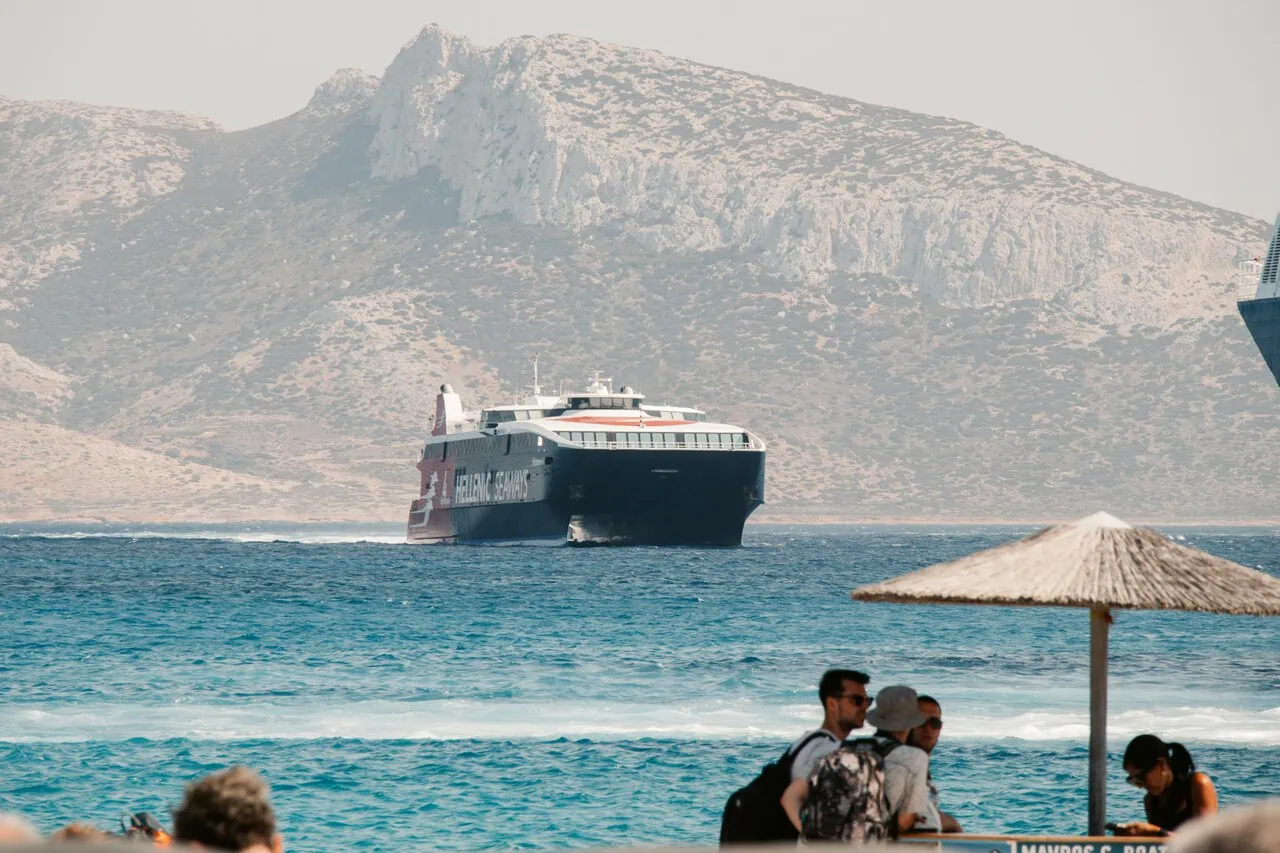
Hellenic Seaways operates a mix of services, including both high-speed and standard ferries, while Minoan Lines is particularly active on routes involving Crete, offering larger vessels and overnight crossings.
Choosing the right operator often depends on your priorities. If speed is your main concern, high-speed operators like Seajets are the best option. If you prefer more space, lower prices, or a calmer journey, conventional ferries operated by companies like Blue Star may be more suitable.
High-Speed vs Conventional Ferries: What’s the Difference
One of the most important decisions when booking a Greek ferry is choosing between high-speed and conventional services. Each option offers different advantages, and the best choice depends on your travel style, budget, and itinerary.
High-speed ferries are designed to minimise travel time. They are ideal for routes such as Athens to Santorini or inter-island connections within the Cyclades. These vessels are modern, efficient, and significantly faster, often cutting journey times by several hours. However, they are typically more expensive and can be more affected by rough sea conditions.
Conventional ferries, on the other hand, offer a slower but often more comfortable experience. They provide larger seating areas, outdoor decks, and sometimes cabins, making them better suited to longer journeys or overnight routes. They are also generally more stable in windy conditions and often more affordable.
For shorter routes or tight itineraries, high-speed ferries are usually the preferred choice. For longer journeys or travellers who value space and comfort, conventional ferries provide a more relaxed alternative.
Understanding the difference between these two options allows you to make better decisions when planning your journey, ensuring that your ferry experience matches your overall travel style.
How to Book Greek Ferry Tickets
Booking Greek ferry tickets is straightforward, but doing it well can save both time and money, especially during the busy travel season.
The most important factor is timing. For popular routes such as Athens to Santorini, Santorini to Paros, or Athens to Mykonos, tickets can sell out quickly during July and August. Booking in advance ensures you secure your preferred departure time and avoids being forced onto less convenient options.
Most ferry tickets are now issued as e-tickets, meaning you can board directly without collecting physical tickets at the port. This makes the process significantly easier compared to older systems where ticket collection was required.
Flexibility is another key advantage. Many travellers choose to book one-way tickets, allowing them to build their itinerary step by step rather than committing to fixed return dates. This is particularly useful when island hopping across the Cyclades.
If your itinerary includes multiple islands, it is often best to book your key routes first, especially longer crossings or connections involving Santorini or Crete, and then fill in shorter routes later.

Organise Your Greek Islands Ferry Journey with Direct Ferries
You can use Direct Ferries to research ferry travel for Greek Islands, check sailing schedules and compare operators before booking.
Having the available crossings together can make it easier to build your itinerary around the most convenient departure and arrival times.
Want to compare ferry prices? You can also check Ferryhopper and FerryScanner before booking.
Browse hostels and budget-friendly stays around Athens.
See hostelsGet help with compensation, eligible lounge access and disruption support.
Explore AirHelp+Use convenient luggage storage around Athens between arrival, check-in and departure.
Check storageFerry Schedules, Frequency and Seasonality
Ferry travel in Greece is highly seasonal, and understanding this is essential when planning your trip.
During the summer months (May to September), ferry frequency increases significantly. Popular routes between islands such as Santorini, Paros, Naxos, and Mykonos may run multiple times per day, giving you a high level of flexibility.
In the shoulder seasons (April and October), services are still available but less frequent. This can actually be an advantage, as ports are quieter and journeys feel more relaxed, but it does require slightly more planning.
Outside of these periods, particularly in winter, ferry schedules become more limited, and some inter-island routes may not operate at all.
Weather is another important factor. The Meltemi winds, which are common in summer, can occasionally affect ferry schedules, particularly for high-speed ferries. While cancellations are not frequent, delays can happen, so it is always wise to allow some flexibility in your plans.
Understanding seasonality helps you avoid common mistakes and ensures your itinerary remains realistic and achievable.
How to Plan a Greek Island-Hopping Itinerary
Planning a Greek island-hopping itinerary is one of the most exciting parts of organising your trip, but it is also where many travellers make mistakes.
The key is to focus on logical routes, rather than trying to visit too many islands. Most successful itineraries stay within a single region, such as the Cyclades, before extending to destinations like Crete.
A classic route for first-time visitors might include Athens to Santorini, followed by Santorini to Paros, and then Paros to Naxos, before returning to Athens. This creates a smooth flow between islands without unnecessary backtracking.
For shorter trips, focusing on two or three islands is often the best approach. This allows you to experience each destination properly without spending too much time in transit.
Longer trips can include additional stops or extend into Crete, using routes such as Santorini to Heraklion to add variety.
The most important principle is balance. Combine islands that offer different experiences, such as pairing the dramatic landscapes of Santorini with the more relaxed and varied atmosphere of Paros or Naxos.
By planning your route carefully, ferry travel becomes a seamless and enjoyable part of your journey rather than a logistical challenge.
7-Day Classic Cyclades Itinerary
If you have one week in Greece, this itinerary offers the best balance of iconic sights, variety, and efficient ferry travel. It focuses on the Cyclades, where connections are frequent and travel times are manageable.
Start in Athens, where you will take the Athens to Santorini ferry, one of the most popular routes in Greece. This journey sets the tone for your trip, taking you from the mainland into the heart of the islands. Spend 2 to 3 days in Santorini, exploring Oia, Fira, and the caldera, as well as enjoying the island’s beaches and sunset views.
From Santorini, continue your journey with the Santorini to Paros ferry. This route is fast and well served, making it an ideal next step. Paros offers a more relaxed and balanced atmosphere, with a mix of beaches, restaurants, and traditional towns. Spend 2 to 3 days here, using Naoussa or Parikia as your base.
Next, take a short crossing on the Paros to Naxos ferry, which typically takes under an hour. This is one of the easiest inter-island routes in the Cyclades. Naxos provides a more authentic and spacious experience, with long sandy beaches, mountain villages, and a slower pace. Spend your final 1 to 2 days exploring Naxos, enjoying its mix of coastline and inland culture.
Return to Athens via the Naxos to Athens ferry, completing a smooth loop that avoids backtracking.
This itinerary works because it combines three distinct island experiences while keeping ferry journeys short, logical, and well connected.

10–14 Day Balanced Greece Itinerary
With more time, you can build a deeper and more varied itinerary that combines the Cyclades with Crete, giving you a broader view of Greece.
Begin in Athens, then take the Athens to Santorini ferry. Spend 2 to 3 days in Santorini, taking in its iconic scenery and atmosphere. This is often the most intense part of the trip, so it works well at the beginning.
From Santorini, travel onward via the Santorini to Paros ferry. Spend 3 to 4 days in Paros, giving yourself time to explore both Naoussa and Parikia, as well as nearby beaches and villages. This is where your trip starts to feel more relaxed and flexible.
At this point, you can add short inter-island trips such as the Paros to Naxos ferry, allowing you to explore additional Cyclades islands without major travel time. Spending 1 to 2 days in Naxos adds variety and depth without disrupting the flow.
The biggest upgrade in this itinerary comes next. Take the Santorini to Crete ferry, arriving in Heraklion. This route connects the Cyclades with a completely different type of destination. Spend 3 to 5 days in Crete, exploring historical sites like Knossos, local cuisine, and the wider island.
To finish, return to Athens using an overnight ferry from Crete, which is both efficient and comfortable, allowing you to save time on travel.
Short Trip or First-Time Island Experience (3–5 Days)
If you are visiting Greece for a shorter period, the biggest mistake is trying to do too much. Instead, it is better to focus on one strong destination or a very simple route.
The most popular option is to travel from Athens to Santorini using the Athens to Santorini ferry, spend 2 to 3 days on the island, and return via the same route. This allows you to experience one of Greece’s most famous destinations without rushing.
Alternatively, if you prefer something closer and more relaxed, the Saronic Islands offer an excellent option. Routes such as the Athens to Aegina ferry or Athens to Agistri ferry take less than an hour, making them perfect for short trips or even day visits.
These islands provide a quieter and more traditional experience, with beaches, small towns, and local food, without the scale or intensity of the Cyclades.
For first-time visitors, this type of itinerary is often the best introduction to Greek ferry travel, allowing you to understand how the system works before attempting longer or more complex routes.
What to Expect Onboard a Greek Ferry
The onboard experience on Greek ferries varies depending on the type of vessel, but there are some consistent features that most travellers can expect.
Seating is usually available in air-conditioned lounges, with comfortable seats designed for both short and long journeys. On larger or slower ferries, you may also find outdoor decks, allowing you to enjoy the sea views and fresh air during the crossing.
Most ferries include a café or bar, offering drinks, snacks, and light meals. This is particularly useful on longer routes, such as journeys between Athens and the islands or crossings to Crete.
Luggage handling is generally simple. You can bring larger bags without the strict limits imposed by airlines, making ferry travel especially convenient for longer trips.
On conventional ferries, additional options such as cabins or quiet areas may be available, particularly on overnight routes.
Overall, the experience is designed to be practical and comfortable, with the added benefit of travelling through the Aegean Sea, which often becomes a highlight of the journey itself.

Important Travel Tips and Common Mistakes to Avoid
While ferry travel in Greece is straightforward, there are a few common mistakes that can easily be avoided with a little preparation.
One of the most frequent issues is arriving too late at the port. Even though boarding is efficient, it is important to arrive at least 30 minutes before departure, especially at busy ports like Piraeus or Athinios.
Another mistake is underestimating travel time to the port. In places like Santorini, access roads can be narrow and busy, so allowing extra time is essential.
Packing is another area where travellers often go wrong. While ferries allow more generous luggage, it is still best to keep essential items in a small, easily accessible bag, particularly for shorter crossings.
Booking too late during peak season can also limit your options. Popular routes can fill up quickly, so securing your tickets in advance is always recommended.
Finally, it is important to remain flexible. Weather conditions, particularly strong winds, can occasionally affect schedules. Allowing some flexibility in your plans ensures that these situations do not disrupt your trip.
Who Greek Ferries Are Best For
Travelling by Greek ferries suits a wide range of travellers, but it is particularly appealing to those who value flexibility, variety, and the experience of travel itself.
For island hoppers, ferries are essential. They allow you to move naturally between destinations such as Santorini, Paros, Naxos, and Mykonos, without needing to return to Athens or rely on flights. This makes it possible to build efficient, multi-island itineraries.
For budget-conscious travellers, ferries often provide better value than flying, especially when factoring in luggage allowances and avoiding airport transfers. Conventional ferries in particular offer a cost-effective way to travel longer distances.
For couples and relaxed travellers, ferry journeys add a slower, more enjoyable rhythm to the trip. Instead of rushing through airports, you spend time on the Aegean Sea, often with views that become a highlight in themselves.
Even for first-time visitors, ferries are easier than many expect. With e-tickets, clear boarding processes, and frequent routes, the system is straightforward once you have taken your first journey.
Overall, Greek ferries are best suited to travellers who want to experience more than one destination and enjoy the journey as part of the trip.

Rupert’s Handy Travel Tips
Planning to explore the Greek islands by ferry? Rupert has a few tried-and-tested tips to help you travel smarter and avoid common pitfalls.
- Book your main ferry routes early, especially in peak summer months.
- Arrive at the port at least 30 minutes before departure to avoid last-minute stress.
- Keep essentials in a small day bag, as larger luggage is stored separately.
- Choose between high-speed and conventional ferries based on your schedule and comfort preferences.
- Allow some flexibility in your plans in case of weather-related delays, especially during windy periods.
Want to meet the reindeer behind our travel tips? Find out more in our page Who is Rupert?.


Frequently Asked Questions About Greek Ferries
How do you book Greek ferry tickets?
Most travellers book Greek ferry tickets online, receiving an e-ticket that can be used for direct boarding. It is recommended to book in advance for popular routes.
Are Greek ferries reliable?
Yes, Greek ferries are generally reliable, especially during the main travel season. However, weather conditions, particularly strong winds, can occasionally cause delays.
What is the difference between high-speed and conventional ferries?
High-speed ferries are faster and ideal for short travel times, while conventional ferries are slower but offer more space, stability, and often lower prices.
How early should you arrive at the port?
It is recommended to arrive at least 30 minutes before departure, or earlier for busy ports such as Piraeus or Santorini.
Do Greek ferries have luggage limits?
Ferries typically allow larger luggage allowances than airlines, often around 50 kg per passenger, making them convenient for longer trips.

Plan Your Trip: Further Reading & Related Guides
Once you understand how Greek ferries work, the next step is to start building your route. Many travellers begin with major connections such as Athens to Santorini or Athens to Mykonos, before continuing with shorter crossings between islands.
If you are planning a multi-island trip, consider routes such as Santorini to Paros, Paros to Naxos, or Milos to Paros, which are all well connected and easy to combine. For those looking to extend beyond the Cyclades, the Santorini to Crete ferry provides a natural next step, opening up a completely different side of Greece.
You can explore our detailed route guides to compare travel times, ferry types, and booking strategies, helping you move from planning to booking with confidence.











