Reviewed by our editorial team Updated
Direct Ferries from Thessaloniki
Thessaloniki is not one of Greece’s largest ferry hubs, but the routes that do operate from the city are far more varied than many travellers expect. Direct ferries connect northern Greece with the Sporades, islands across the North and East Aegean, Samos and Piraeus, allowing you to begin a Greek island journey without travelling south to Athens first.
The network is also unusual because it combines two very different types of ferry travel. During the summer, seasonal services head south from Thessaloniki through the Sporades, creating direct connections with Skiathos, Skopelos and Alonissos before continuing to Mantoudi on Evia.
The longer Aegean sailings are a completely different experience. These services travel much further, linking Thessaloniki directly with Lemnos, Lesbos, Chios, Ikaria, Fourni and Samos. The same long-distance network also provides a direct ferry journey to Piraeus.
For travellers used to the enormous choice of departures from Piraeus, the most important difference is frequency. Many ferries from Thessaloniki do not operate every day, while the Sporades routes are seasonal. The longest Aegean connections may require you to build part of your itinerary around a particular sailing rather than simply turning up at the port and choosing from several departures.
That limited timetable is balanced by the convenience of travelling directly from northern Greece to the islands. A ferry from Thessaloniki can remove the need to travel hundreds of kilometres south to Athens, cross the city to Piraeus and then begin another journey by sea.
Some of the routes also create unusual opportunities for a wider Greek itinerary. You can combine a city break in Thessaloniki with the Sporades, travel slowly through the Aegean towards Piraeus, or use one of the long-distance ferries as part of a journey involving several islands.
This guide covers only currently operating direct ferries from Thessaloniki. Connecting itineraries, suspended routes and destinations that require a change of vessel are not included.
Ferry Routes from Thessaloniki at a Glance
The direct network reaches destinations across several parts of Greece. The shortest and most frequent summer journeys are generally found on the seasonal Sporades route, while the long-distance Aegean services continue much further south.
| Destination | Island or Region | Sailing Duration | Type of Route | Typical Operation |
|---|---|---|---|---|
| Skiathos | Sporades | Around 3h 10m | Seasonal summer ferry | Summer |
| Skopelos (Chora) | Sporades | Around 4h | Seasonal summer ferry | Summer |
| Alonissos | Sporades | Around 4h 30m | Seasonal summer ferry | Summer |
| Mantoudi | Evia | Around 6h | Seasonal summer ferry | Summer |
| Lemnos (Myrina) | North Aegean | Around 3h 30m | Long-distance ferry | Limited frequency |
| Mytilene | Lesbos | Around 10h to 13h | Long-distance ferry | Limited frequency |
| Chios | North Aegean | Around 17h 15m | Long-distance ferry | Limited frequency |
| Evdilos | Ikaria | Around 20h to 24h | Long-distance ferry | Limited frequency |
| Fourni | North Aegean | Around 24h | Long-distance ferry | Limited frequency |
| Karlovasi | Samos | Around 25h | Long-distance ferry | Limited frequency |
| Vathi | Samos | Around 27h | Long-distance ferry | Limited frequency |
| Piraeus | Athens | Around 31h | Long-distance ferry | Limited frequency |
A direct route does not necessarily mean that the ferry sails non-stop between Thessaloniki and your destination. On many of the longer journeys, the vessel calls at several islands along the way. You remain on the same ferry throughout, so no change of vessel is required.
This distinction is particularly important when looking at online booking results. Ferry search engines can sometimes display destinations that are only available by combining separate sailings. We have excluded those journeys and concentrated on routes where you can board in Thessaloniki and remain on the same vessel until your destination.
The network also changes considerably according to the time of year. Skiathos, Skopelos, Alonissos and Mantoudi belong to the summer network, while the long-distance routes operate to a very different timetable.
Always search for your exact travel date before building an itinerary around a ferry from Thessaloniki. A destination may have a direct connection, but that does not mean a suitable sailing operates on the day you want to travel.
Browse hotels and accommodation for your visit to Thessaloniki.
View staysBrowse apartments, homes and self-catering accommodation in Thessaloniki.
Browse rentalsCompare prices for Thessaloniki hotels across multiple booking sites.
Check dealsUnderstanding the Thessaloniki Ferry Network
Looking at a list of destinations can make Thessaloniki appear to have a collection of separate ferry routes heading in every direction. In reality, the network is much easier to understand when you look at the journeys made by the ferries themselves.
The first part of the network is the seasonal Sporades service. During its operating season, the ferry leaves Thessaloniki and travels south through the islands before continuing to the Evia mainland.
The route follows the pattern:
Thessaloniki → Skiathos → Skopelos → Alonissos → Mantoudi
This service provides the simplest way to begin an island trip directly from Thessaloniki. You can leave northern Greece and reach the Sporades without travelling to another mainland ferry port first.
Each stop serves a different purpose. Skiathos, Skopelos and Alonissos are island destinations, while Mantoudi is a mainland port on Evia. Travellers need to pay particular attention to the final destination when booking, as Mantoudi should not be treated as another island stop.
The second part of the network consists of long-distance Aegean sailings. These are slower, less frequent and considerably longer than the summer Sporades journeys. The ferries call at a chain of destinations as they travel through the Aegean, creating direct links between Thessaloniki and islands that would otherwise often require travel through Athens or another ferry port.
This is why journey times increase so dramatically between destinations. A passenger travelling to Lemnos leaves the ferry much earlier than someone continuing to Lesbos, Chios, Ikaria or Samos. The more distant islands are later stops on a long through journey rather than separate express routes from Thessaloniki.
For the longest sailings, the experience is closer to an overnight sea journey than a short ferry crossing. Cabins, sleeping arrangements, food and the choice of accommodation on board become much more important when you are spending many hours on the same vessel.
Understanding these two networks also helps when choosing the right ticket. The summer Sporades services and the long-distance Aegean ferries are operated differently, and the Interrail Greek Islands Pass does not apply across the entire Thessaloniki network.
Where Ferries Leave from in Thessaloniki
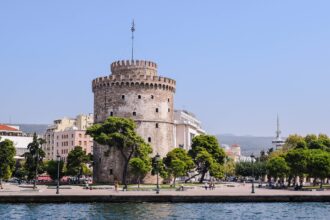
One of the biggest advantages of beginning a ferry journey in Thessaloniki is the location of the port. Unlike many large transport terminals that sit well outside the centre, the passenger port is beside the heart of the city, making it relatively easy to reach from central accommodation.
The waterfront stretches along the western side of central Thessaloniki, close to the lively areas around Ladadika and Aristotelous Square. For travellers staying in the centre, reaching the port can be much simpler than making an early journey to an outlying airport or intercity coach station.
Walking may be practical if you are staying nearby and travelling with manageable luggage. The exact time will depend on your accommodation and the departure point used for your sailing, so check the berth and passenger instructions on your booking rather than simply navigating to the general port area.
Public transport can be useful from accommodation further away, while a taxi is the simplest option when travelling with large bags, children or during the early morning and late evening. Our Thessaloniki Public Transport Guide explains the city’s metro and bus network in more detail.
Arrive with enough time to find the correct departure area and complete any required check-in. Thessaloniki may have fewer passenger ferry departures than Piraeus, but the port itself is a large working harbour, and you should not assume that finding your vessel will take only a few minutes.
Your booking confirmation should show the information needed for departure. Check whether you can board with a digital ticket or whether any additional check-in step is required before going to the vessel.
For a seasonal summer sailing, arriving early also gives you time to deal with queues and other passengers travelling with luggage. The same advice becomes even more important when taking a vehicle, as cars and motorcycles normally need to be ready for the loading process before foot passengers complete boarding.
The central location makes Thessaloniki one of the easier Greek ferry ports to build into a city break. You can spend time exploring the city before departure and then begin the next stage of your journey without first travelling across Athens or making a lengthy transfer to another mainland port.
Summer Ferries to the Sporades
The summer service to the Sporades provides the easiest direct island escape from Thessaloniki. Rather than travelling south overland before boarding a ferry, you can leave directly from the city and sail to three of Greece’s most attractive island destinations.
The route operates in a clear sequence:
Thessaloniki → Skiathos → Skopelos → Alonissos → Mantoudi
For the 2026 summer season, the service is scheduled to operate from 27 June to 6 September. The seasonal nature of the route is important. Outside the operating period, you cannot simply turn up in Thessaloniki and expect to find an alternative ferry to the Sporades.
SeaJets operates the route, using a fast ferry rather than the large conventional vessels found on the long-distance Aegean services. This creates a very different travel experience from the journeys towards Lemnos, Lesbos, Chios and Samos.
Skiathos is the first island reached from Thessaloniki, followed by Skopelos and Alonissos. The ferry then continues to Mantoudi on Evia, giving the service a useful mainland connection at its southern end.
The route works particularly well for travellers who want to combine a visit to Thessaloniki with an island stay. Instead of returning to Athens or travelling to another port, you can spend several days in the city and then continue directly into the Sporades by sea.
It also creates possibilities for island hopping. You could begin in Thessaloniki, travel to Skiathos and then continue through the Sporades using local ferry connections. Another option is to remain on the route as far as Alonissos before gradually travelling back through Skopelos and Skiathos.
The main limitation is the timetable. A seasonal ferry network requires more planning than travelling from one of Greece’s busiest ports, particularly if you have fixed accommodation dates. Check the sailing days for your exact travel period before booking hotels around the route.
Direct Ferries to Skiathos
Skiathos is the first island stop on the summer ferry from Thessaloniki, making it the shortest and simplest of the direct Sporades journeys.
The ferry arrives at Skiathos Town, the island’s main port and transport centre. This is a particularly convenient arrival point because you step off the ferry directly into the heart of the island’s main settlement.
Accommodation, restaurants and shops are concentrated around the town, while local buses provide onward connections to many of the beaches along the southern side of Skiathos. Travellers staying outside the town should check how they will complete the final part of the journey before arriving, particularly if the ferry reaches the island later in the day.
The direct sailing is particularly valuable for anyone combining a Thessaloniki city break with a beach holiday. Without it, reaching Skiathos from northern Greece can involve a longer overland journey to another ferry port or a flight.
Skiathos also makes an excellent starting point for a wider Sporades trip. The island has the busiest transport connections in the group, and onward ferries allow travellers to continue towards Skopelos and Alonissos.
A day trip from Thessaloniki is not a sensible use of the route. Even where the timetable might appear to make a short visit possible, ferry schedules are designed for transport between destinations rather than sightseeing excursions. Skiathos deserves at least a few nights, particularly if you want to explore beyond the port town.
The direct route is best viewed as the beginning of an island stay rather than a quick excursion from Thessaloniki. For travellers already exploring northern Greece, it provides a rare opportunity to move directly from a major city into the Sporades without returning south towards Athens.
Check Ferry Tickets from Thessaloniki to Skiathos
Use the live Ferryhopper timetable below to check sailings from Thessaloniki to Skiathos. Choose today or a future travel date to see available departures and scheduled arrival times.
Select the date you want to travel. The times shown on the right-hand side are the scheduled departure and arrival times for each ferry.
It is important to be aware that availability can change quickly, particularly during weekends and the summer season. Some sailings may also stop accepting bookings a few hours before departure, so leaving it too late can limit your options. If the timetable box is blank, there may be no available sailings for today. Try moving to a later date to check future services.
Want to compare more ferry options?
Compare routes, operators and prices with Direct Ferries.
Compare with Direct FerriesSailing Directly to Skopelos
Skopelos is the second island reached on the seasonal route from Thessaloniki, following the call at Skiathos. The direct ferry is a useful option for travellers who want to reach the island without changing vessels or arranging a separate connection.
The Thessaloniki service calls at Skopelos Town, also known as Chora. This distinction matters because Skopelos has more than one ferry port, and booking websites may show different arrival points depending on the route and operator.
Skopelos Town sits on the eastern side of the island and is one of its main centres for accommodation, restaurants and local transport. If you are staying elsewhere, check the distance from the port before booking. A hotel described simply as being on Skopelos may be a considerable distance from Skopelos Town.
The journey from Thessaloniki takes longer than the crossing to Skiathos because the ferry calls there first. You remain on the same vessel throughout, so there is no need to collect luggage or make a connection between ferries.
For travellers planning a single-island holiday, the direct sailing removes one of the complications of reaching Skopelos. The island does not have an airport, so many visitors normally arrive via Skiathos or another mainland ferry port. The summer Thessaloniki service provides a direct alternative from northern Greece.
Skopelos also fits naturally into a longer island-hopping journey. You can begin in Thessaloniki, spend time on Skiathos and then continue to Skopelos, or travel directly to Skopelos before moving onwards to Alonissos.
The correct port is one of the most important details to check when arranging accommodation and onward transport. For this direct route from Thessaloniki, the destination to look for is Skopelos or Chora, rather than assuming every service shown for the island arrives in the same place.
Search flights and useful route combinations for your trip.
View flightsUse an eSIM to get online without hunting for a local SIM after arrival.
See eSIM optionsHave a private airport pickup arranged before you travel.
Book a transferContinuing Through the Sporades to Alonissos
Alonissos is the furthest island stop on the seasonal Sporades route from Thessaloniki. By the time the ferry reaches the island, it has already called at Skiathos and Skopelos.
The ferry arrives at Patitiri, the main port of Alonissos. The settlement is the island’s principal arrival point and provides access to accommodation, restaurants, local transport and onward boat trips.
Staying in Patitiri is convenient for travellers who want easy access to the ferry, but many visitors continue to other parts of the island. The Old Village of Alonissos, beaches and smaller settlements require onward travel, so it is worth arranging the final part of the journey before arrival.
The direct ferry is particularly attractive because Alonissos is the most distant of the three main Sporades islands served from Thessaloniki. Reaching it by other routes can involve a combination of overland travel and additional ferry connections.
Alonissos also has a different character from busier Skiathos. The island is closely associated with the National Marine Park of Alonissos and Northern Sporades, and many visitors come for its quieter atmosphere, walking, swimming and boat trips.
As with Skiathos and Skopelos, this is not a practical day trip from Thessaloniki. The sailing should be used as part of a proper island stay or a wider journey through the Sporades.
For a longer itinerary, Alonissos works well as the furthest point of the island-hopping route. You can travel directly from Thessaloniki, spend time on the island and then work your way back through Skopelos and Skiathos rather than retracing the entire journey in one day.
The direct connection makes Alonissos much easier to combine with northern Greece than its location might suggest. The trade-off is that the route is seasonal, so your entire itinerary needs to be planned around the summer sailing schedule.
Find Ferry Tickets from Thessaloniki to Alonissos
Planning a ferry from Thessaloniki to Alonissos? Select your travel date below to compare available sailings, departure times and scheduled arrival times.
Select the date you want to travel. The times shown on the right-hand side are the scheduled departure and arrival times for each ferry.
It is important to be aware that availability can change quickly, particularly during weekends and the summer season. Some sailings may also stop accepting bookings a few hours before departure, so leaving it too late can limit your options. If the timetable box is blank, there may be no available sailings for today. Try moving to a later date to check future services.
Looking for another ferry comparison?
Compare routes, operators and prices with Direct Ferries.
Compare with Direct FerriesThe Ferry to Mantoudi and Evia
After calling at Skiathos, Skopelos and Alonissos, the seasonal ferry continues to Mantoudi on the island of Evia. This final stop gives the summer route a very different purpose from a simple ferry service between Thessaloniki and the Sporades.
Mantoudi is not a resort island port in the same sense as Skiathos Town, Skopelos or Patitiri. It is a gateway to northern Evia, and travellers need to think carefully about how they will continue after leaving the ferry.
The port itself is at Kymasi, close to Mantoudi, rather than in one of Evia’s larger tourist centres. This makes onward planning particularly important. Accommodation described as being on Evia may be a considerable distance from the ferry terminal, and public transport is unlikely to offer the same convenience as arriving in a compact island town.
For travellers with a car, the route becomes much more interesting. Evia is a large island connected to mainland Greece by bridges further south, so you can use the ferry to create a one-way journey through the Sporades and Evia rather than returning to Thessaloniki by the same route.
Mantoudi can also work as the southern end of an island-hopping trip. You could travel from Thessaloniki through the Sporades, continue to Evia and then make your way towards Athens overland.
This is not the route we would choose simply because Mantoudi appears as the final destination on a booking search. Have a clear plan for the next stage of the journey before booking, particularly if you are travelling without a car.
Compare Ferry Tickets from Thessaloniki to Mantoudi, Evia
Check upcoming ferries between Thessaloniki and Mantoudi, Evia using the live timetable below. Change the date to view services for the day you plan to travel.
Select the date you want to travel. The times shown on the right-hand side are the scheduled departure and arrival times for each ferry.
It is important to be aware that availability can change quickly, particularly during weekends and the summer season. Some sailings may also stop accepting bookings a few hours before departure, so leaving it too late can limit your options. If the timetable box is blank, there may be no available sailings for today. Try moving to a later date to check future services.
Want to check fares with another provider?
Compare routes, operators and prices with Direct Ferries.
Compare with Direct FerriesLong-Distance Ferries Across the Aegean
Beyond the seasonal Sporades service, Thessaloniki has a second and much more unusual ferry network. Long-distance sailings head across the Aegean, creating direct connections with islands that are hundreds of kilometres from northern Greece.
These journeys are very different from a short summer crossing. The ferry calls at several ports along the way, with passengers joining and leaving as the vessel continues south through the Aegean.
Direct destinations include Lemnos, Lesbos, Chios, Ikaria, Fourni and Samos, while the same long-distance network continues towards Piraeus.
The main advantage is the ability to travel without changing vessels. A passenger heading to one of the more distant islands can board in Thessaloniki, settle in for the journey and remain on the same ferry until the correct port is reached.
The trade-off is time. These are long sea journeys, and the more distant destinations can require spending a substantial part of a day or night on board. For the longest routes, the type of accommodation you book becomes almost as important as the sailing itself.
Frequency is another major consideration. Unlike the large number of daily departures from Piraeus, long-distance ferries from Thessaloniki operate on a much more limited timetable. Your preferred destination may have a direct connection, but the sailing day can determine the shape of your entire itinerary.
These routes work best for travellers who value direct travel, slow travel and the experience of crossing the Aegean by sea. They are not always the fastest way to reach an island, but they can remove complicated journeys through Athens and create a much more memorable start to an island stay.
Reaching Lemnos from Northern Greece
Lemnos is the first major island reached on the long-distance Aegean network, making it one of the most practical island destinations served directly from Thessaloniki.
The ferry arrives at Myrina, the island’s capital and main passenger port. This is a convenient arrival point, with accommodation, restaurants and other services close to the waterfront.
For travellers beginning in northern Greece, the direct connection avoids a much longer journey south to another ferry port. Instead of travelling towards Athens before heading back into the northern Aegean, you can cross directly from Thessaloniki to Lemnos.
The island is also a more natural destination for a ferry journey of this length than some of the ports much further south. You still need to plan around the limited timetable, but the journey is shorter than continuing through the Aegean towards Lesbos, Chios, Ikaria or Samos.
Myrina itself is worth allowing time to explore. The town spreads around two bays beneath its castle, and arriving by sea gives you an immediate view of one of the island’s most distinctive landscapes.
Lemnos works particularly well as a standalone island stay. The limited frequency of the long-distance service means it is less suited to spontaneous island hopping, but it can form part of a carefully planned journey through the northern Aegean.
Check the return sailing before booking accommodation. With an infrequent route, choosing your arrival date without confirming how you will leave the island can create unnecessary problems later in the trip.
Check Thessaloniki to Lemnos Ferry Times & Tickets
Compare ferry times from Thessaloniki to Lemnos below. Select today or a future date to see the sailings currently available for that journey.
Select the date you want to travel. The times shown on the right-hand side are the scheduled departure and arrival times for each ferry.
It is important to be aware that availability can change quickly, particularly during weekends and the summer season. Some sailings may also stop accepting bookings a few hours before departure, so leaving it too late can limit your options. If the timetable box is blank, there may be no available sailings for today. Try moving to a later date to check future services.
Compare this route with another ferry booking provider.
Compare routes, operators and prices with Direct Ferries.
Compare with Direct FerriesBrowse hostels and budget-friendly stays around Thessaloniki.
See hostelsAccess compensation support, eligible lounge benefits and faster payouts when flights go wrong.
See the benefitsArriving before check-in or leaving later? Store your luggage and make more of your time in Thessaloniki.
Store your bagsThe Direct Sailing to Lesbos
Continuing beyond Lemnos, the long-distance ferry reaches Mytilene on the island of Lesbos. This is a considerably longer journey from Thessaloniki and needs to be planned as an extended sea voyage rather than a short transfer.
The ferry arrives directly in Mytilene, the island’s capital and largest town. For travellers staying in the city, this is a convenient arrival point, with accommodation and local services close to the port.
Lesbos is a large island, so your journey may not end when you leave the ferry. Popular destinations are spread across different parts of the island, and onward travel can take considerably longer than visitors expect.
The length of the sailing makes onboard comfort more important. Ordinary seating may be perfectly adequate for some travellers, but a cabin can transform a long or overnight journey, particularly if the timetable means spending sleeping hours at sea.
Travelling directly from Thessaloniki can still be more appealing than heading south through mainland Greece before boarding another ferry. You avoid changing transport in Athens and remain on the same vessel throughout the sea journey.
The route is best suited to travellers who are comfortable building their itinerary around a limited sailing schedule. A direct ferry does not necessarily mean a frequent ferry, and the available departure day may influence how long you spend in Thessaloniki or on Lesbos.
For a slower journey through Greece, however, the connection is unusually attractive. You can leave the country’s second-largest city and travel directly by sea to one of its largest islands without passing through Athens at all.
Compare Thessaloniki to Lesbos (all ports) Ferry Times & Tickets
Use the timetable below to plan your Thessaloniki to Lesbos (all ports) ferry. The times shown on the right are the scheduled departure and arrival times for each sailing.
Select the date you want to travel. The times shown on the right-hand side are the scheduled departure and arrival times for each ferry.
It is important to be aware that availability can change quickly, particularly during weekends and the summer season. Some sailings may also stop accepting bookings a few hours before departure, so leaving it too late can limit your options. If the timetable box is blank, there may be no available sailings for today. Try moving to a later date to check future services.
Want to see another set of ferry options?
Compare routes, operators and prices with Direct Ferries.
Compare with Direct FerriesTravelling by Ferry to Chios
Chios lies further south on the long-distance Aegean route, making the direct sailing from Thessaloniki a substantial journey rather than a simple ferry crossing.
The vessel reaches Chios after earlier calls in the northern Aegean. Passengers remain on board throughout, so there is no need to change ferries or manage luggage during an intermediate connection.
Arrival is at Chios Town, the island’s capital and main passenger port. The central location is convenient for travellers staying in the town, although many of the island’s best-known villages and beaches require onward transport.
Chios is a large island, and choosing accommodation without checking its location can add a lengthy journey after arrival. The medieval villages of the south, the mastic-producing areas and the beaches around the island are spread well beyond the port.
On a journey of this length, the sailing time should form part of your accommodation decision. A cabin can be worth the extra cost if the timetable places sleeping hours at sea, while ordinary seating may be sufficient when most of the journey takes place during the day.
The direct connection is particularly useful for travellers who want to avoid travelling through Athens. Reaching Chios from northern Greece by other routes can involve a flight or a long overland journey before another ferry crossing.
Limited frequency remains the main drawback. Build the itinerary around the confirmed sailing date rather than assuming you can simply extend or shorten your stay and catch another ferry the following day.

View Ferry Times from Thessaloniki to Chios (all ports)
Looking for ferry times from Thessaloniki to Chios (all ports)? Pick your travel date below to see available crossings and their scheduled departure and arrival times.
Select the date you want to travel. The times shown on the right-hand side are the scheduled departure and arrival times for each ferry.
It is important to be aware that availability can change quickly, particularly during weekends and the summer season. Some sailings may also stop accepting bookings a few hours before departure, so leaving it too late can limit your options. If the timetable box is blank, there may be no available sailings for today. Try moving to a later date to check future services.
Still comparing crossings and prices?
Compare routes, operators and prices with Direct Ferries.
Compare with Direct FerriesThe Long Journey to Ikaria
Reaching Ikaria directly from Thessaloniki involves one of the longer journeys on the Aegean network. The ferry continues south through earlier island stops before arriving at Evdilos on the northern side of Ikaria.
The arrival port matters. Ikaria has more than one ferry port, and the direct service from Thessaloniki should not be confused with sailings to Agios Kirykos on the other side of the island.
Evdilos is a small port town and a useful base for exploring northern Ikaria. Travellers staying elsewhere should check the onward journey before booking, as the island’s mountainous landscape means distances can take longer to cover than they appear on a map.
By the time the ferry reaches Ikaria, passengers have spent many hours at sea. This is a journey where booking the right onboard accommodation can make a major difference, particularly when a significant part of the sailing takes place overnight.
The direct route suits travellers who prefer a slower journey and want to avoid changing transport in Athens or at another island. Once on board in Thessaloniki, you can remain on the same vessel until Evdilos.
Ikaria is not a destination to add casually to a tightly packed itinerary. The limited ferry frequency and long journey mean it works best when you have enough time to stay on the island and can plan the next stage before arriving.
For travellers with that flexibility, the direct sailing creates an unusual connection between northern mainland Greece and one of the eastern Aegean’s most distinctive islands.
Find Ferries from Thessaloniki to Ikaria (all ports)
The live Ferryhopper timetable below shows services from Thessaloniki to Ikaria (all ports). Select a date to check today’s timetable or plan travel for a future day.
Select the date you want to travel. The times shown on the right-hand side are the scheduled departure and arrival times for each ferry.
It is important to be aware that availability can change quickly, particularly during weekends and the summer season. Some sailings may also stop accepting bookings a few hours before departure, so leaving it too late can limit your options. If the timetable box is blank, there may be no available sailings for today. Try moving to a later date to check future services.
Check this journey with another ferry specialist.
Compare routes, operators and prices with Direct Ferries.
Compare with Direct Ferries
Direct Ferries to Fourni
Fourni is one of the smallest and most unusual destinations connected directly with Thessaloniki. The island group lies between Ikaria and Samos, and the ferry call forms part of the long route through the Aegean.
The service arrives at Fourni Town, the main settlement and port. Unlike the much larger islands elsewhere on the route, the scale here is compact, with the harbour forming the centre of local life.
A direct connection from Thessaloniki is remarkable, but frequency is more important than convenience when planning this journey. An infrequent sailing can make Fourni easy to reach on one particular day and surprisingly difficult to leave at the end of your stay.
Confirm both sides of the journey before booking accommodation. This is particularly important if you need to connect with a flight, international journey or fixed reservation later in the trip.
The long sailing also means that Fourni is unlikely to suit travellers looking for the fastest route from northern Greece. Its appeal lies in the ability to board one ferry in Thessaloniki and remain on board until reaching a much smaller Aegean island.
For a carefully planned slow-travel itinerary, that can be a major advantage. Fourni can also be combined with nearby Ikaria or Samos, although onward island hopping needs to be planned around the available ferry schedules rather than treated as a spontaneous journey.
The direct route is best for travellers with time and flexibility. The connection exists, but the timetable needs to shape the itinerary.
Compare Ferry Sailings from Thessaloniki to Fourni (all ports)
Check the latest available sailings for Thessaloniki to Fourni (all ports) below. Choose your travel date, then compare the departure and arrival times shown for each ferry.
Select the date you want to travel. The times shown on the right-hand side are the scheduled departure and arrival times for each ferry.
It is important to be aware that availability can change quickly, particularly during weekends and the summer season. Some sailings may also stop accepting bookings a few hours before departure, so leaving it too late can limit your options. If the timetable box is blank, there may be no available sailings for today. Try moving to a later date to check future services.
Want another way to compare this ferry route?
Compare routes, operators and prices with Direct Ferries.
Compare with Direct FerriesChoosing Between the Two Samos Ports
Samos is unusual because the long-distance ferry network gives travellers two different direct arrival points on the same island. Choosing the correct one can save a significant amount of onward travel after a very long journey from Thessaloniki.
The two ports are Karlovasi and Vathi, and they serve different parts of the island.
Karlovasi lies on the northwestern side of Samos. It is the better arrival point for accommodation and destinations in the western and northwestern parts of the island.
The town is one of the island’s main population centres and has local services close to the port. Travellers staying elsewhere should still check the final transfer, but arriving at Karlovasi can avoid crossing a large part of Samos after leaving the ferry.
Vathi, often shown in booking systems as Samos or Vathi, lies on the northeastern side of the island. The port serves the island’s capital area and is more convenient for accommodation in and around Samos Town.
Passengers continuing to Vathi remain on the long-distance route beyond earlier stops. This makes it one of the furthest direct ferry journeys available from Thessaloniki.
Do not choose between the two ports based only on the sailing time or ticket price. Check the location of your accommodation first, then book the port that leaves you with the simplest final journey.
After spending so many hours travelling from northern Greece, discovering that your hotel is on the opposite side of the island is an avoidable mistake.

Check Ferry Tickets for Karlovasi, Samos to Vathy, Samos
Use the live timetable to check ferry options from Karlovasi, Samos to Vathy, Samos. Move between dates to compare the sailings available for your planned journey.
Select the date you want to travel. The times shown on the right-hand side are the scheduled departure and arrival times for each ferry.
It is important to be aware that availability can change quickly, particularly during weekends and the summer season. Some sailings may also stop accepting bookings a few hours before departure, so leaving it too late can limit your options. If the timetable box is blank, there may be no available sailings for today. Try moving to a later date to check future services.
Want to compare more ferry options?
Compare routes, operators and prices with Direct Ferries.
Compare with Direct FerriesTaking the Ferry All the Way to Piraeus
Remaining on the long-distance ferry beyond the island stops eventually brings passengers to Piraeus, creating a direct sea journey between Thessaloniki and the main port serving Athens.
This is a very different proposition from taking the train, coach or a domestic flight. The ferry is not the fastest or most practical everyday way to travel between Greece’s two largest cities, and anyone simply trying to reach Athens should compare the alternatives before booking.
Our Thessaloniki to Athens Guide looks at the direct train, frequent KTEL coaches, flights and driving in detail. The train takes just over five hours, while the ferry follows a much longer route through the Aegean.
There are still good reasons to consider travelling by sea. The journey can appeal to travellers who enjoy slow travel, want to experience the full Aegean route or prefer spending a long journey on a ferry rather than sitting on a coach or train.
Arriving at Piraeus can also be useful when your next journey is another ferry. Instead of reaching central Athens and then travelling back towards the coast, you finish the Thessaloniki sailing at Greece’s largest passenger port.
A long ferry journey should never be compared with the train based on ticket price alone. The onboard accommodation, departure time and total length of the sailing all matter. If much of the journey takes place overnight, a cabin may add considerably to the cost but also make the experience far more comfortable.
For most travellers heading directly to Athens, we would choose the train when its limited timetable works or the KTEL coach when more flexibility is needed. The Piraeus ferry is the interesting option rather than the efficient one, and that distinction should be clear before you book.
Find Ferry Tickets for Thessaloniki to Athens (all ports)
Find current ferry options between Thessaloniki and Athens (all ports) below. Select the date you want to travel to see scheduled departures and arrivals.
Select the date you want to travel. The times shown on the right-hand side are the scheduled departure and arrival times for each ferry.
It is important to be aware that availability can change quickly, particularly during weekends and the summer season. Some sailings may also stop accepting bookings a few hours before departure, so leaving it too late can limit your options. If the timetable box is blank, there may be no available sailings for today. Try moving to a later date to check future services.
Looking for another ferry comparison?
Compare routes, operators and prices with Direct Ferries.
Compare with Direct Ferries
What to Expect on Ferries from Thessaloniki
The experience on board depends heavily on which part of the ferry network you are using. A summer journey to the Sporades is very different from spending many hours travelling across the Aegean towards Chios, Ikaria, Samos or Piraeus.
SeaJets operates the seasonal Sporades service as a fast ferry journey. These sailings are designed to move passengers quickly between Thessaloniki, the islands and Mantoudi, so the experience is closer to travelling on a high-speed transport service than settling into a ship for an overnight voyage.
The long-distance Aegean ferries are much larger conventional vessels. Passengers can move around during the journey, use the onboard facilities and choose between different types of seating and accommodation.
Food and drink are available on the larger vessels, although prices and the range of options can vary. For a very long sailing, it is sensible to bring anything you particularly need rather than assuming every product will be available on board.
Luggage arrangements are generally less restrictive than flying, but you still need to be able to manage your belongings through the terminal and onto the vessel. Keep passports, money, medication, electronics and other valuables with you rather than leaving them in an unattended luggage area.
Outdoor deck space can be one of the pleasures of travelling on a conventional ferry. The experience of leaving Thessaloniki and crossing the Aegean is part of the attraction of choosing the sea route, particularly when compared with spending the same journey inside an airport or coach.
Weather can affect the experience. Even in summer, exposed deck areas can become windy after sunset, while rougher conditions may make a fast ferry journey uncomfortable for passengers who are sensitive to motion.
The most important thing is to match your expectations to the vessel and the length of the journey. Ordinary seating may be perfectly adequate for a summer trip to the Sporades, while a very long or overnight sailing across the Aegean deserves much more thought.
Choosing a Cabin for a Long Ferry Journey
A cabin is unnecessary for many shorter ferry journeys from Thessaloniki, but it can completely change the experience of travelling to the more distant Aegean islands.
The decision should be based on how long you will be on board and which hours of the day are spent at sea. A long daytime sailing can be manageable in a lounge or reserved seat. Spending most of the night trying to sleep in the same position is a very different experience.
Private cabins provide the greatest comfort and privacy. Having a proper bed and a space where you can close the door can make a long journey feel more like an overnight trip than an endurance test.
Shared cabin accommodation can reduce the cost while still providing access to a bed. The exact options depend on the vessel and sailing, so check what is actually being offered before booking.
Reserved aircraft-style seating is the middle ground. It costs less than a cabin and gives you a specific place for the journey, but it should not be confused with having a proper sleeping space.
The cheapest accommodation may be perfectly suitable if most of the sailing takes place during the day. It becomes less attractive when the timetable means you would normally be asleep for several hours of the journey.
For the longest routes towards Chios, Ikaria, Fourni, Samos and Piraeus, we would compare the cabin price before automatically choosing the cheapest ticket. The extra cost may be worthwhile if it allows you to arrive rested enough to enjoy the first day at your destination.
Cabins can also sell out before ordinary passenger spaces, particularly on busy sailings. If a bed is important to you, book the accommodation you want rather than relying on an upgrade being available after boarding.
Taking a Car on Ferries from Thessaloniki
Bringing a vehicle can make some direct ferry routes much more useful, particularly when the destination is difficult to explore without your own transport.
A car is less important for a short stay based around a compact port town, but it can be valuable on larger islands where beaches, villages and archaeological sites are spread over a wide area.
Vehicle spaces need to be booked as part of the ferry reservation. You will normally need to provide information about the vehicle, and the fare is added separately from the passenger ticket.
Arrive earlier than you would as a foot passenger. Vehicles need to be organised for loading, and staff may direct cars into the ship in a particular order. Follow the instructions given for your sailing rather than assuming you can arrive shortly before departure.
Once the vehicle is parked on board, access to the car deck may be restricted during the journey. Take everything you will need with you before leaving the vehicle, including medication, chargers, warm clothing and anything required for children.
The car can be especially useful when travelling to Mantoudi and exploring Evia. Instead of depending on onward public transport from the port, you can continue directly through the island and potentially build a one-way road trip towards Athens.
A vehicle can also make sense on larger islands such as Lesbos, Chios and Samos, where attractions and accommodation can be spread far beyond the arrival port.
For the Sporades, the calculation is more complicated. Island roads, parking and local transport vary, and taking a car is not automatically the best choice simply because vehicle spaces are available.
Compare the vehicle fare with the cost of hiring locally, and think about what you will actually do after arrival. Taking a car is most worthwhile when it gives you genuine freedom at the destination rather than simply adding another cost to the ferry ticket.
Using an Interrail Greek Islands Pass from Thessaloniki
An Interrail Greek Islands Pass can be used on some direct ferries from Thessaloniki, but not across the entire network. The deciding factor is the ferry operator rather than the destination itself.
Long-distance services operated by Blue Star Ferries are part of the Attica Group network covered by the Greek Islands Pass. This means eligible sailings towards destinations such as Lemnos, Lesbos, Chios, Ikaria, Fourni and Samos can potentially form part of a pass journey.
The summer Sporades route is different. SeaJets is not included in the Interrail Greek Islands Pass, so direct ferries from Thessaloniki to Skiathos, Skopelos, Alonissos and Mantoudi require a separate ticket.
Having a pass does not mean you can simply arrive at the port and board. Reservations are still required, and the journey uses one of the ferry travel days included with the pass. Availability can also matter on busy sailings, particularly when you want a specific type of accommodation.
The standard included accommodation is not the same as booking a private cabin. If you are planning one of the longest journeys from Thessaloniki, check the available upgrades before reserving. Paying extra for a bed may be worthwhile when a large part of the sailing takes place overnight.
This is where the pass can become particularly interesting. Instead of treating Thessaloniki as the end of a rail journey through Europe, you can arrive by train and continue directly into the Aegean by ferry without first travelling to Athens.
The value depends on the wider itinerary. Using a ferry travel day for a long direct journey to Samos may offer much more value than using the pass for a short crossing elsewhere, but the limited Thessaloniki timetable means the route needs to fit your travel dates.
Our Interrail Greek Islands Guide explains how the pass works, which ferry operators participate and how to make the required reservations.
Island Hopping from Thessaloniki
The easiest island-hopping journey from Thessaloniki follows the summer route through the Sporades. Skiathos, Skopelos and Alonissos form a natural sequence, with each island offering a noticeably different experience.
Skiathos provides the busiest starting point, with a lively port town, extensive accommodation and some of the best-known beaches in the Sporades. Skopelos feels greener and less developed, while Alonissos offers a quieter atmosphere and access to the surrounding marine park.
A simple itinerary could begin with the direct ferry from Thessaloniki to Skiathos, continue to Skopelos and finish on Alonissos. From there, you could work your way back through the islands or continue according to the available ferry timetable.
Another possibility is to travel south through the Sporades and finish at Mantoudi. This creates a one-way journey rather than forcing you to return to Thessaloniki, with the option of continuing through Evia and towards Athens.
Island hopping on the long-distance Aegean network requires much more planning. The direct ferry may call at several islands, but an infrequent through service does not automatically create an easy island-hopping timetable.
Leaving the ferry at Lemnos, Lesbos or Chios means your next journey depends on the services operating from that island. You may find excellent onward connections, but you should check them before booking the first stage from Thessaloniki.
The same principle applies further south. Ikaria, Fourni and Samos are close enough to form an attractive island itinerary, but sailing days and arrival times need to work together.
The Sporades are the easiest choice for a straightforward island-hopping holiday from Thessaloniki. The long-distance Aegean routes are better suited to travellers who enjoy slower journeys and are willing to build the itinerary around the ferry timetable.
Book Ferries from Thessaloniki
With routes ranging from summer crossings to the Sporades to long journeys across the Aegean, comparing the available sailings before booking is particularly important from Thessaloniki.
Use the Direct Ferries booking grid below to compare routes, sailing dates, journey times and current fares. The grid is especially useful for checking seasonal availability, as not every destination operates throughout the year and some of the longest direct routes have a very limited frequency.
Book Your Ferry Tickets
Ready to book? Compare ferry operators, departure times, crossing times and the latest ticket prices with Direct Ferries, one of Europe’s leading ferry booking platforms. You can visit the full Direct Ferries website using the button below, or compare routes instantly using the booking widget.
Book Direct with Direct Ferries
Prefer to compare routes first? Simply enter your departure port, destination and travel dates below to see live sailings, prices and availability.
Search using your actual travel date rather than relying on a general route list. A direct ferry may operate from Thessaloniki, but that does not mean there will be a sailing on the day you want to travel.
Summer journeys to Skiathos, Skopelos and Alonissos are worth booking ahead once your plans are fixed. The operating season is limited, and popular dates can attract strong demand.
For long-distance journeys, look beyond the cheapest passenger fare. The departure time, arrival time and onboard accommodation can have a much greater effect on the experience than a small difference in ticket price.
Cabins deserve particular attention. If a large part of the journey takes place overnight, waiting until the last minute can leave you with fewer accommodation choices even when ordinary passenger tickets remain available.
Vehicle spaces can also be more limited than foot-passenger capacity. Anyone taking a car should enter the correct vehicle details during the booking process and follow the operator’s instructions about arrival time at the port.
Check the destination port carefully before paying. This is especially important for Skopelos, Ikaria and Samos, where the name of the island alone may not tell you where the ferry actually arrives.
After booking, check the final operator information before travelling. Ferry timetables can change because of seasonal adjustments, operational decisions and weather conditions, so keep the contact details on your reservation up to date.
Combining Thessaloniki with Athens and the Greek Islands
Thessaloniki can form the beginning of a much wider journey through Greece rather than a destination you visit separately before returning south.
One option is to spend several days in the city before taking the seasonal ferry into the Sporades. From Skiathos, Skopelos or Alonissos, you can continue through the islands before returning to the mainland.
A longer journey can use one of the direct Aegean ferries to travel south from Thessaloniki. Depending on the timetable, you could stop on one or more islands before eventually continuing towards Piraeus and Athens.
Travellers with an Interrail Greek Islands Pass have another possibility. A rail journey through mainland Europe can finish in Thessaloniki before continuing by an eligible Blue Star ferry into the Aegean. This creates a natural connection between rail travel and island travel without requiring an immediate journey to Athens.
The alternative is to travel overland from Thessaloniki to Athens and use the much larger ferry network from Piraeus. This will often provide more destinations and a far wider choice of departure times than waiting for an infrequent long-distance sailing from Thessaloniki.
Our Thessaloniki to Athens Guide compares the direct train, KTEL coach, flights and driving between the two cities. For travellers continuing by sea, our Greek Ferries Guide explains the wider ferry network and what to expect when travelling between the mainland and the islands.
There is no single best route through Greece. The summer Sporades ferry is ideal for a simple city-and-islands itinerary, the long-distance Aegean sailings suit slower journeys, and travelling overland to Athens gives you the greatest choice of onward ferries.
Deciding Whether a Ferry from Thessaloniki Is Worth Taking
A direct ferry from Thessaloniki can remove a great deal of unnecessary travel, but the best choice depends on the destination and the type of journey you want.
For the Sporades, the case for travelling by ferry is particularly strong. The seasonal service allows you to leave northern Greece and sail directly to Skiathos, Skopelos or Alonissos without first making a long overland journey to another port.
This can turn a visit to Thessaloniki into the beginning of an island holiday. The ferry is not simply transport between two points. It creates a natural connection between a city break and the Sporades.
The longer Aegean routes require a different calculation. Travelling directly to Lemnos, Lesbos, Chios, Ikaria, Fourni or Samos can save you from heading south through mainland Greece before beginning another journey by sea.
However, direct does not mean fast. Some of these sailings take many hours, and the limited timetable can force you to build a large part of the itinerary around a single departure.
For travellers who enjoy slow travel, that can be part of the appeal. A long ferry journey gives you space to move around, spend time on deck and watch the route unfold through the Aegean. The journey becomes part of the trip rather than time that simply needs to be endured.
Piraeus is the clearest exception. If your only aim is to travel from Thessaloniki to Athens, the train, KTEL coach or a direct flight will usually make much more sense. The ferry is best chosen because you want the sea journey itself or because it fits into a wider island itinerary.
The strongest reason to use the Thessaloniki ferry network is the ability to continue travelling without retracing your route through Greece. The Sporades service can carry you south towards Evia, while the long-distance ferries open up islands that would otherwise require additional transfers.
For the Sporades, we would seriously consider the direct ferry whenever the seasonal timetable fits. For the longer Aegean routes, the ferry is most rewarding when the journey itself appeals to you as much as the destination.

Rupert’s Handy Travel Tips
Taking a ferry from Thessaloniki? Here are a few useful tips to make your journey smoother:
- Check the operating season before booking accommodation: The direct Sporades ferries are seasonal, while long-distance routes may operate only on limited days.
- Book the correct port, not just the correct island: Skopelos, Ikaria and Samos all require particular attention when choosing your arrival point.
- Consider a cabin for the longest journeys: Saving money on accommodation is less appealing if you arrive exhausted after spending sleeping hours in an ordinary seat.
- Plan both sides of an infrequent ferry journey: Confirm how you will leave the island before booking your arrival, particularly for Fourni and other destinations with limited services.
- Leave a generous margin before separate connections: Weather and operational changes can affect ferry schedules, so avoid tight connections with separate flights, trains or ferries.
Want to meet the reindeer behind our travel tips? Find out more in our page Who is Rupert?.
Frequently Asked Questions
Where do ferries leave from in Thessaloniki?
Passenger ferries leave from the Port of Thessaloniki, close to the city centre and the waterfront areas around Ladadika and Aristotelous Square. Check the exact departure point shown on your booking before travelling.
Which Greek islands can you reach directly from Thessaloniki?
Direct ferries currently connect Thessaloniki with Skiathos, Skopelos, Alonissos, Lemnos, Lesbos, Chios, Ikaria, Fourni and Samos. The network also includes direct sailings to Mantoudi on Evia and Piraeus.
Are there ferries from Thessaloniki to Skiathos?
Yes. A seasonal summer ferry connects Thessaloniki directly with Skiathos before continuing through the Sporades.
Can you take a direct ferry from Thessaloniki to Skopelos?
Yes. The seasonal service calls at Skopelos Town, also known as Chora, after visiting Skiathos.
Is there a direct ferry from Thessaloniki to Alonissos?
Yes. Alonissos is the furthest island stop on the seasonal Sporades route before the ferry continues to Mantoudi.
Can you travel from Thessaloniki to Lesbos by ferry?
Yes. Long-distance ferries connect Thessaloniki directly with Mytilene on Lesbos without requiring a change of vessel.
Is there a direct ferry from Thessaloniki to Samos?
Yes. The long-distance ferry network serves both Karlovasi and Vathi, so check which port is closest to your accommodation before booking.
Can you travel from Thessaloniki to Athens by ferry?
A direct long-distance ferry continues to Piraeus, but the train, KTEL coach or a flight will normally be more practical if your only aim is to reach Athens.
Are ferries from Thessaloniki seasonal?
Some are. The direct Sporades route operates during the summer season, while the long-distance Aegean services follow a different and more limited timetable.
Can you take a car on ferries from Thessaloniki?
Vehicle spaces are available on suitable services, but they need to be booked in advance. Taking a car can be particularly useful for exploring Evia and larger islands.
Do ferries from Thessaloniki have cabins?
The large conventional ferries used on long-distance Aegean routes offer different types of seating and accommodation, including cabins on suitable vessels. Fast summer ferries to the Sporades provide a different onboard experience.
Can you use an Interrail Greek Islands Pass from Thessaloniki?
The pass can be used on eligible services operated by participating Attica Group companies, including Blue Star Ferries. It cannot be used on the SeaJets summer service to the Sporades, and reservations are still required.
Can you go island hopping from Thessaloniki?
Yes. The easiest option is the summer Sporades route through Skiathos, Skopelos and Alonissos. Island hopping on the long-distance Aegean network requires much more careful planning because services are less frequent.
How far ahead should you book a ferry from Thessaloniki?
Book once your plans are fixed if you are travelling during the summer, taking a vehicle or want a cabin on a long-distance journey. Flexible foot passengers may find availability closer to departure, but the limited timetable makes advance planning sensible.
Further Reading
Planning to use more ferries during your trip? Our Greek Ferries Guide explains how the wider network works, including ports, tickets, boarding and what to expect on board.
Travellers deciding whether to continue south by land or sea should read our Thessaloniki to Athens Guide, which compares the direct train, KTEL coach, flights and driving.
If the ferry forms part of a rail journey through Greece, our Interrail Greek Islands Guide explains the ferry pass, participating operators and reservation rules.
For getting to the port and travelling around the city before departure, our Thessaloniki Public Transport Guide covers the metro, buses, tickets and important transport connections.