Reviewed by our editorial team Updated
Why the Southwest Chief Is One of Amtrak’s Great Historic Routes
The Southwest Chief connects Chicago, Illinois with Los Angeles, California, following a large stretch of the original Route 66 corridor through Kansas, Colorado, New Mexico and Arizona. Amtrak’s predecessor on this line, the Atchison, Topeka and Santa Fe Railway’s famous Super Chief, once carried Hollywood stars and dignitaries across the same desert landscapes.
Covering roughly 2,265 miles (3,645 km), the Southwest Chief is one of Amtrak’s longest routes and takes passengers through some of the most historically significant landscapes in the American West, from the high plains of Kansas to the Sangre de Cristo Mountains and the deserts of New Mexico and Arizona.
Unlike the California Zephyr’s mountain-heavy route or the Coast Starlight’s coastal scenery, the Southwest Chief’s appeal lies in its sense of history and its passage through genuine Route 66 towns, Native American nations and landscapes that shaped the popular image of the American Southwest.
The train crosses Kansas in daylight for most departures, climbs the Raton Pass into New Mexico, and passes close to Santa Fe, Albuquerque, the Navajo Nation and the Painted Desert before descending into California through the Mojave Desert.
Amtrak operates the Southwest Chief daily using Superliner equipment, the same double-decker cars used on the California Zephyr, Empire Builder and Coast Starlight. Passengers can choose between Coach seating and private sleeper cabins, with a dining car, cafe and Sightseer Lounge included as standard.
This guide covers the full route, the towns and landscapes along the way, onboard facilities and how the Southwest Chief compares to Amtrak’s other options for reaching the West Coast from Chicago.
It’s also one of four great western long-distance trains, alongside the California Zephyr, Coast Starlight and Empire Builder, all of which can be combined on a single Amtrak USA Rail Pass itinerary for travellers planning a longer trip across the country.
Whether you’re a rail enthusiast tracing the old Santa Fe Railway, a Route 66 fan, or simply looking for a scenic and relaxed way to cross the American Southwest, the Southwest Chief offers a genuinely different experience from Amtrak’s other transcontinental routes.
Southwest Chief Route at a Glance
Before boarding, it helps to see the whole journey summarised in one place. The table below sets out the key facts about the Southwest Chief, from distance and journey time to the onboard facilities you can expect throughout the trip, so you know roughly what to expect before you book.
| Feature | Details |
|---|---|
| Route | Chicago, Illinois to Los Angeles, California |
| Distance | Approximately 2,265 miles (3,645 km) |
| Journey Time | Around 43 hours |
| States Crossed | Illinois, Iowa, Missouri, Kansas, Colorado, New Mexico, Arizona and California |
| Major Cities | Chicago, Kansas City, Albuquerque, Flagstaff, Los Angeles |
| Eastern Terminus | Chicago Union Station |
| Western Terminus | Los Angeles Union Station |
| Sleeper Accommodation | Yes – Roomettes, Bedrooms, Family Bedrooms and Accessible Bedrooms |
| Dining Car | Yes, primarily for sleeper car passengers |
| Sightseer Lounge | Yes |
| Frequency | Daily |
| Most Scenic Sections | Raton Pass, Santa Fe country, Painted Desert, Mojave Desert |
| Connections | Bus to Santa Fe from Lamy, bus or tour to Grand Canyon from Flagstaff |
Best for two or three nights. The widest choice of rooms, with filters for free cancellation and included breakfast.
View staysBest for longer stays. Whole apartments and houses, so you are not eating out three times a day.
View rentalsBest for double-checking. Runs the same search across several booking sites so you are not leaving money behind.
Compare pricesRoute and Major Stops
The Southwest Chief links the American Midwest with the Southwest and Southern California, connecting some of the country’s largest cities with small desert towns that are otherwise difficult to reach without a car. Although the train makes over thirty stops, several stand out as key points along the journey.
The journey begins at Chicago Union Station, shared with the California Zephyr and Empire Builder, before heading southwest across Illinois towards Galesburg and a brief clip of Iowa at Fort Madison, then into Missouri and Kansas City.
From Kansas City, the route crosses the full width of Kansas via Lawrence, Topeka, Newton, Hutchinson, Dodge City and Garden City, before entering Colorado and climbing towards Trinidad and the Raton Pass.
In New Mexico, the train calls at Raton, Las Vegas, Lamy (the connection point for Santa Fe) and Albuquerque, before continuing west to Gallup near the Arizona border.
Arizona stops include Winslow, Flagstaff and Kingman, before the train crosses into California at Needles and continues through the Mojave Desert via Barstow and Victorville towards the Los Angeles basin.
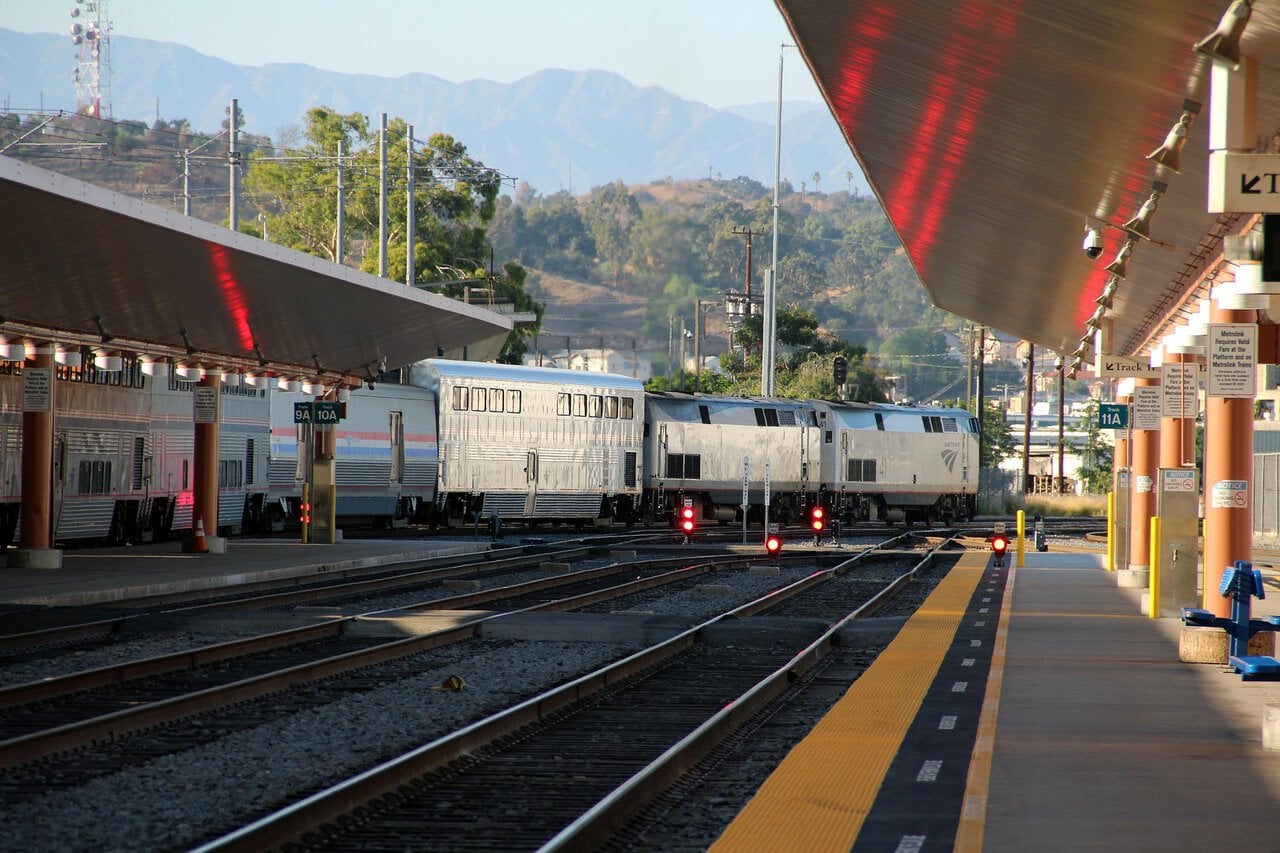
The final approach passes San Bernardino, Riverside and Fullerton before arriving at the historic Los Angeles Union Station, shared with the Coast Starlight and Sunset Limited.
Because the route covers eight states and passes through several dramatically different landscapes, no two sections of the Southwest Chief feel alike, which is part of why the journey rewards passengers who stay in the Sightseer Lounge rather than remaining in their seat for the whole trip.
Chicago to Kansas City: Illinois, Iowa’s Corner and Missouri
The Southwest Chief departs Chicago Union Station and heads southwest through Chicago’s suburbs before reaching Naperville, Mendota and Princeton, passing through the flat farmland typical of northern Illinois.
The train continues to Galesburg, an important rail junction town, before briefly crossing into Iowa at Fort Madison, where the route crosses the Mississippi River on the historic Fort Madison Toll Bridge, one of the longest double-deck swing-span bridges in the world.
From there, the Southwest Chief cuts through a corner of Missouri via the small town of La Plata before arriving at Kansas City Union Station, a grand early twentieth century terminal and an important stop for passengers connecting to other regional services.
This opening stretch is usually completed overnight on westbound departures from Chicago, meaning many passengers wake up somewhere in Kansas rather than seeing the Illinois and Missouri countryside in daylight.
For passengers who prefer to see this section rather than sleep through it, spending the early evening in the Sightseer Lounge before turning in is the best way to catch the Illinois farmland and the Mississippi crossing at Fort Madison in fading light.
Eastbound passengers, by contrast, typically see this section in the final hours of their journey, watching the Midwestern farmland roll past before arriving back into Chicago’s skyline.
The Fort Madison Toll Bridge crossing is worth watching for specifically, since it’s one of relatively few Mississippi River crossings still used by long-distance passenger trains, and the swing-span mechanism is a genuine piece of American railway engineering history.
Across the Kansas Plains: Topeka to Garden City
West of Kansas City, the Southwest Chief calls at Lawrence, home to the University of Kansas, and Topeka, the state capital, before the landscape opens into the vast, flat plains that define much of central Kansas.
The train continues through Newton and Hutchinson, home to the Kansas Underground Salt Museum, before reaching Dodge City, one of the most famous names from the era of cattle drives and the Wild West frontier.
Beyond Dodge City, the Southwest Chief calls at Garden City before crossing into the westernmost part of Kansas, where wheat fields and grazing land stretch to the horizon in every direction.
Because most westbound schedules put this section in daylight, Kansas is actually one of the more reliably scenic stretches of the entire route, even though it lacks the dramatic mountains and canyons found further west.
Grain elevators, cattle yards and small-town main streets punctuate the journey through Kansas, offering a genuine window into rural American life that’s easy to miss when travelling by air or interstate highway.
Many first-time passengers are surprised by how much they enjoy this stretch, since the sheer scale of the open plains gives a genuine sense of the size of the American interior before the mountains begin.
Dodge City in particular draws attention from history-minded passengers, since the town’s name is inseparable from the mythology of the American frontier, even though the modern town itself is now a quiet agricultural centre rather than a Wild West outpost.

Turn the Southwest Chief into a Route 66 Rail Trip
The Southwest Chief isn’t simply a train that happens to cross the American Southwest. For much of its journey, it follows the same broad corridor as historic Route 66, making it possible to build a railway holiday around some of the towns associated with America’s most famous road.
Chicago provides the obvious starting point because Route 66 traditionally begins in the city before heading west towards California. The railway and highway don’t follow one another continuously, but their stories repeatedly overlap as both make their way across the centre of the country.
Further west, Kansas and New Mexico bring the train into classic Santa Fe Railway territory, while Gallup remains one of the great Route 66 towns of the Southwest. Its historic neon signs, trading posts and roadside architecture provide exactly the sort of Americana many visitors associate with the old highway.
In Arizona, Winslow is particularly easy to incorporate because the Southwest Chief stops directly in town. The beautifully restored La Posada Hotel, built alongside the Santa Fe Railway, makes Winslow especially appropriate for a rail-based Route 66 stopover.
Flagstaff and Kingman provide further opportunities to leave the train and explore surviving sections of the old road. Kingman in particular remains strongly associated with Route 66 and can work as a base for exploring some of the best-preserved stretches in Arizona.
Eventually, both journeys lead towards Los Angeles, giving you the unusual opportunity to experience the story of Route 66 without actually driving its entire length. You won’t reproduce the classic road trip mile by mile, but the Southwest Chief provides a fascinating alternative way to explore many of the landscapes and communities that grew alongside it.
Colorado and Raton Pass: Lamar to the Sangre de Cristo Mountains
Crossing into Colorado, the Southwest Chief calls at Lamar and La Junta, gateway towns to the Santa Fe Trail, before the landscape begins climbing towards the foothills of the Sangre de Cristo Mountains.
The train reaches Trinidad, a historic coal mining town set against a dramatic mountain backdrop, before beginning the climb over Raton Pass, one of the most significant mountain crossings on the entire route and a historic gateway used by traders, settlers and the original Santa Fe Trail.
Raton Pass sits at over 7,800 feet and marks the boundary between Colorado and New Mexico. The climb involves sweeping curves through pine forest and open grassland, with views back across the plains the train has just crossed.
This stretch of track also preserves some of the last surviving mechanical semaphore signals still in regular use on the American rail network, a reminder of just how historic this section of railway really is.
The line over Raton Pass carries relatively little freight traffic compared with other parts of the BNSF network, which is part of why Amtrak has continued to invest in maintaining this historic alignment rather than rerouting the Southwest Chief further south.
Several states, local governments and BNSF have jointly funded track improvements over the years specifically to keep the Southwest Chief running on this historic Raton Pass alignment, underlining how much local support exists for preserving this particular routing.
Watch for the surviving semaphore signals between Raton and Wagon Mound in particular; these mechanical arms, rather than modern colour-light signals, are among the last of their kind still guiding trains anywhere on the American rail network.
Santa Fe Country: Las Vegas, Lamy and Albuquerque
After descending from Raton Pass, the Southwest Chief calls at Raton, New Mexico, before continuing to Las Vegas, a historic railway town with a well-preserved late nineteenth century downtown that predates its more famous Nevada namesake by decades.
The train then reaches Lamy, a small station that serves as the connection point for Santa Fe, New Mexico’s state capital, roughly eighteen miles away. A connecting bus service links the two, since the main rail line bypasses Santa Fe’s city centre.
From Lamy, the Southwest Chief continues to Albuquerque, New Mexico’s largest city, where the station platform often features Native American vendors selling jewellery and crafts during the train’s extended station stop, a genuinely distinctive Southwest Chief tradition.
The surrounding high desert scenery around Albuquerque, framed by the Sandia Mountains to the east, is one of the most photographed sections of the entire route, particularly at sunset on westbound departures.
Albuquerque’s station stop is usually longer than most others on the route, giving passengers a genuine window to stretch their legs on the platform and browse the vendors before the train continues west towards Gallup.
Travellers planning to combine a Southwest Chief trip with a Santa Fe stopover should check current Lamy bus connection times in advance, since schedules can be adjusted and the bus service doesn’t always run for every train.
Santa Fe itself is well worth the detour for travellers with a flexible schedule, with its adobe architecture, art galleries and Southwestern cuisine offering a natural complement to a couple of nights spent riding the train.
Best for finding routes the airlines do not sell as a single ticket. Combines carriers to bring the fare down.
Search flightsBest if you want maps and messaging working the moment you switch your phone on.
See eSIM plansBest if you would rather not work out the transport on arrival. Book it now and forget it.
View transfersHow to Visit Santa Fe from the Southwest Chief
One of the slightly confusing things about the Southwest Chief is that it doesn’t actually stop in Santa Fe. The main line passes through Lamy, a small community southeast of the city, which acts as the rail gateway for passengers heading to New Mexico’s capital.
If Santa Fe is an important part of your trip, don’t simply book to Albuquerque assuming you’ll need to travel back north afterwards. Instead, check the current connection options from Lamy for the date you’re travelling and plan the transfer into Santa Fe before you arrive.
Santa Fe is worth treating as a proper stopover rather than a rushed excursion. Its historic centre, adobe architecture, museums, galleries and distinctive New Mexican food scene make it one of the most interesting destinations anywhere along the Southwest Chief route.
The simplest itinerary is to leave the Southwest Chief at Lamy, spend one or more nights in Santa Fe and then continue your rail journey on a later date. Because the Southwest Chief runs daily, this is considerably easier to organise than stopovers on Amtrak’s three-times-weekly routes.
Another possibility is to combine Santa Fe and Albuquerque. You can spend time in Santa Fe before travelling between the two New Mexico cities separately and rejoining the Southwest Chief from Albuquerque, rather than necessarily returning to Lamy.
Whichever arrangement you choose, check the latest transfer and railway schedules before booking the different pieces of the trip. Lamy is not central Santa Fe, and treating the transfer as part of your itinerary rather than an afterthought will make the stop considerably easier.
Navajo Nation and the Painted Desert: Gallup to Flagstaff
West of Albuquerque, the Southwest Chief passes through Gallup, a major trading centre for Navajo and Zuni art and jewellery, close to the border of the vast Navajo Nation, the largest Native American reservation in the United States.
Crossing into Arizona, the train passes near the Painted Desert and the Petrified Forest National Park, with colourful eroded badlands visible from the train, even though there’s no direct station stop at either landmark.
The train calls at Winslow, made famous by the Eagles song “Take It Easy” and home to the beautifully restored La Posada Hotel, one of the last great Harvey House hotels built alongside the original Santa Fe Railway.
The route continues to Flagstaff, a high-elevation university town surrounded by ponderosa pine forest and the San Francisco Peaks, and the most useful station on the entire route for onward connections to the Grand Canyon.
From Flagstaff, the South Rim of the Grand Canyon is roughly a ninety minute drive, and several bus and guided tour operators run day trips timed to connect with Southwest Chief arrivals and departures, though it’s worth booking these in advance.
An alternative for rail purists is the separately operated Grand Canyon Railway, which runs from Williams, a short distance south of Flagstaff, directly to the South Rim, though this requires its own booking and isn’t included with an Amtrak ticket.
Many travellers choose to break their Southwest Chief journey entirely at Flagstaff, spending a night or two exploring the Grand Canyon before rejoining a later train to continue towards Los Angeles, rather than trying to fit everything into a single day trip.
How to Visit the Grand Canyon from the Southwest Chief
The Southwest Chief is one of the most useful Amtrak trains for incorporating the Grand Canyon into a longer American rail journey, but the train itself doesn’t travel to the national park. For most passengers, Flagstaff is the key station.
Flagstaff sits roughly 80 miles from the South Rim, so you’ll need onward transport after leaving Amtrak. Depending on your plans, that could mean a pre-arranged shuttle, rental car or organised tour. Don’t arrive expecting the Grand Canyon to be immediately outside the railway station.
For a proper visit, we’d strongly favour breaking your Southwest Chief journey rather than attempting to see the canyon between trains. Spend at least one night in the area and you’ll have far more flexibility to explore viewpoints, walk part of the rim and experience sunrise or sunset without constantly watching the clock.
There is also a much more railway-focused alternative. The Grand Canyon Railway operates between Williams and the South Rim, allowing you to combine two very different American train journeys. You still need to arrange the connection between the Southwest Chief and Williams, and the Grand Canyon Railway requires a separate ticket.
A longer itinerary could therefore look something like Chicago → Southwest Chief → Flagstaff/Williams → Grand Canyon → Flagstaff → Southwest Chief → Los Angeles. Alternatively, continue exploring Arizona before rejoining Amtrak later in your trip.
The important thing is to plan the Grand Canyon as a destination in its own right, rather than assuming it’s a quick attraction beside the Southwest Chief. Done properly, it can become one of the highlights of the entire Chicago to Los Angeles journey.

The Mojave Desert: Kingman to Los Angeles
Beyond Flagstaff, the Southwest Chief descends towards Kingman, Arizona, a classic Route 66 town, before crossing the Colorado River into California at Needles, marking the start of the long haul across the Mojave Desert.
This stretch is stark and remote, with vast stretches of open desert, distant mountain ranges and very little sign of human activity for long periods, offering a genuine sense of isolation rarely found elsewhere on Amtrak’s network.
Depending on the time of year and direction of travel, this section can pass either in daylight or overnight, so it’s worth checking your specific timetable if experiencing the full scale of the Mojave Desert matters to you.
The train calls at Barstow and Victorville before the landscape begins to change again as the Southwest Chief approaches the outer edges of the Los Angeles metropolitan area.
Final stops include San Bernardino, Riverside and Fullerton, all useful jumping-off points for Southern California destinations, before the train completes its journey into the heart of Los Angeles.
The journey concludes at the historic Los Angeles Union Station, an Art Deco and Mission Revival landmark that also serves as the departure point for the Coast Starlight and Sunset Limited, making it a genuine hub for onward western rail travel.
After the emptiness of the Mojave Desert, the sudden transition into the density of the Los Angeles basin is one of the more striking contrasts on the entire route, and a reminder of just how much ground has been covered since leaving Chicago.
Booking Southwest Chief Tickets with Omio
You can search for Southwest Chief tickets through Omio, which is particularly useful if you’re planning a wider American trip and want to keep rail and other transport bookings together in one place.
Enter the actual journey you want to make, rather than relying only on the Southwest Chief name. That could be Chicago to Los Angeles for the complete route, or shorter journeys such as Chicago to Kansas City, Albuquerque to Flagstaff or Flagstaff to Los Angeles.
This is particularly useful on the Southwest Chief because you don’t necessarily need to travel the entire route. The train can form part of a much bigger itinerary incorporating Santa Fe, Albuquerque, Route 66 or the Grand Canyon, with separate journey segments booked around your stopovers.
For the complete Chicago to Los Angeles journey, check the accommodation type carefully before paying. The Southwest Chief involves two nights aboard the train, making the difference between a Coach seat and a private Roomette or Bedroom considerably more important than it would be on a short daytime journey.
If you’re planning several Amtrak journeys, also compare the combined price of individual tickets with the Amtrak USA Rail Pass. The Southwest Chief can form an excellent backbone for a larger rail itinerary, particularly when combined with another long-distance route from Chicago or Los Angeles.

Book Amtrak Tickets and Sleeper Trains
Travelling by train in the United States can be a memorable way to cover long distances, especially on scenic routes and overnight journeys. Amtrak lets you book rail tickets, long-distance services, and sleeper train journeys across the country.
It is ideal for city-to-city travel, cross-country rail trips, and travellers who want a slower, more comfortable alternative to flying. Sleeper trains can also make long journeys easier by combining transport and overnight accommodation.
Roomettes and Bedrooms on the Southwest Chief
Since the complete Southwest Chief journey lasts around 43 hours, involving two nights onboard, many passengers find that upgrading from Coach to a private sleeper cabin significantly improves comfort over the length of the trip.
The most popular option is the Roomette, suited to one or two passengers, with two seats that convert into a bed at night and a second bunk folding down from above. Roomette fares include dining car meals, bedding and access to shared shower facilities.
Passengers wanting more space can book a Bedroom, which includes a private toilet and shower. Family Bedrooms, located on the lower level of the Superliner sleeper cars, suit parents travelling with children, while Accessible Bedrooms offer extra space for passengers with reduced mobility.
All sleeper fares include full dining car meals, a genuine saving given that two nights and the best part of two days onboard would otherwise mean buying every meal individually from the cafe car.
For shorter daytime segments, such as Albuquerque to Flagstaff, Coach seating is perfectly comfortable. For the complete Chicago to Los Angeles route, however, most experienced travellers consider a Roomette well worth the extra cost.
Sleeper passengers also benefit from priority boarding and, on many long-distance routes, access to station lounges where available, which can make a real difference during longer station stops such as Albuquerque.
Booking a sleeper well in advance also matters more on the Southwest Chief than it might seem, since cabins on this route are shared with connecting itineraries built around the Grand Canyon and Santa Fe, both of which draw steady demand throughout the year.
Best for solo travellers and anyone watching the budget. Dorm beds and private rooms in the same search.
Browse hostelsBest if you have ever given up on a claim. AirHelp checks whether the flight qualifies and pursues it for you.
See the benefitsBest for a day with a suitcase and nowhere to put it. Find a storage point near where you already are.
View storageDining on the Southwest Chief
Dining is a genuine highlight of the Southwest Chief experience. Sleeper passengers have all meals included and dine in the traditional Dining Car, generally at shared tables, which is a great opportunity to meet fellow travellers over the course of two days onboard.
The dining car menu features American classics such as steak, chicken, pasta and burgers, alongside salads and vegetarian options, with breakfast, lunch and dinner service announced over the intercom at set times.
Coach passengers can use the Cafe Car, which offers sandwiches, snacks, pizza, beer, wine and coffee without needing a reservation, making it a flexible option for anyone travelling without a sleeper cabin.
Because the dining car is primarily reserved for sleeper passengers, Coach travellers on the Southwest Chief should plan their meals around the cafe car menu rather than expecting a full sit-down dining car experience.
If you have dietary requirements, Amtrak can usually accommodate vegetarian, vegan and gluten-free diets, though notifying staff when booking is recommended so the kitchen can plan accordingly.
Mealtimes double as a natural opportunity to meet fellow passengers, since dining car seating is shared rather than private, and conversations over dinner somewhere near Albuquerque or breakfast crossing the Mojave are often remembered as highlights of the trip.
Life in the Sightseer Lounge
The Sightseer Lounge is the best place onboard to watch the Southwest Chief’s scenery unfold, with floor-to-ceiling windows curving into the roof of the carriage for uninterrupted views of the desert and mountain landscapes outside.
This car is particularly popular through Raton Pass and the approach to Albuquerque, where the Sandia Mountains and high desert scenery draw passengers away from their assigned seats to enjoy the view.
Comfortable lounge seating replaces the usual rows found in Coach, and the lower level houses the Cafe Car, making it easy to grab a drink or snack without missing the scenery for long.
Because the lounge is open to all passengers regardless of ticket type, it can fill up quickly during the most scenic stretches, so arriving early for the Raton Pass crossing or the Painted Desert section is a sensible strategy.
For photographers, the lounge’s elevated seating and wide windows make it far easier to capture the Sangre de Cristo Mountains, the Painted Desert and the vast open spaces of the Mojave Desert than a standard Coach window allows.
Onboard staff will often make announcements ahead of major landmarks such as Raton Pass or the Albuquerque approach, giving passengers a useful heads-up to head to the lounge before the best scenery arrives.
Southwest Chief vs Sunset Limited vs Texas Eagle: Which Way to the West Coast?
The Southwest Chief isn’t the only way to travel between Chicago and the West Coast by train. The Texas Eagle runs daily from Chicago to San Antonio, and three times a week it continues through as a combined service with the Sunset Limited all the way to Los Angeles, taking a completely different southern route.
The biggest practical difference is frequency. The Southwest Chief runs daily in both directions, while the through Chicago to Los Angeles connection via the Texas Eagle and Sunset Limited only operates three days a week, since the Sunset Limited itself is a three-times-weekly service.
The scenery is also very different. The Southwest Chief passes through Kansas, Colorado’s Raton Pass, New Mexico and northern Arizona, while the Texas Eagle and Sunset Limited combination travels through Texas Hill Country, San Antonio, El Paso and the Arizona desert further south, including Tucson.
Journey time also differs. The Southwest Chief covers Chicago to Los Angeles in around 43 hours, while the combined Texas Eagle and Sunset Limited routing takes considerably longer overall, partly due to a layover in San Antonio between the two services.
If your priority is a fast, daily, historically rich route through the classic Southwest, the Southwest Chief is the better choice. If you’re more interested in Texas, the Rio Grande borderlands and a slower, more flexible multi-stop adventure, the Texas Eagle and Sunset Limited combination is worth considering instead.
It’s also worth noting that the Texas Eagle runs daily as far as San Antonio even outside the three days a week it connects through to the Sunset Limited, so travellers interested purely in the Texas portion of that route have more flexibility than the full Chicago to Los Angeles combination suggests.
For travellers who simply want the fastest, most reliable Chicago to Los Angeles rail option without worrying about weekly schedules, the daily Southwest Chief remains the more practical default choice for most itineraries.
The table below summarises the key differences between the three services for travellers deciding how to cross from Chicago to the West Coast.
| Feature | Southwest Chief | Texas Eagle + Sunset Limited |
|---|---|---|
| Frequency | Daily | 3 times weekly (Sunset Limited leg) |
| Route | Kansas, Colorado, New Mexico, northern Arizona | Texas, El Paso, southern Arizona |
| Key landmarks | Raton Pass, Santa Fe, Painted Desert | San Antonio, Rio Grande, Tucson |
| Journey time (Chicago–LA) | Around 43 hours | Longer, includes San Antonio layover |
| Best for | Fast, reliable, historic Route 66 scenery | Texas exploring, flexible multi-city trip |

Best Time of Year to Ride the Southwest Chief
The Southwest Chief operates every day of the year, and the desert and mountain landscapes it crosses change dramatically with the seasons, from spring wildflowers to summer heat and winter snow on Raton Pass.
Spring brings milder temperatures across New Mexico and Arizona, along with wildflowers in bloom across parts of the high desert, making it a popular time to combine the train with a Grand Canyon side trip from Flagstaff.
Summer is the busiest season, though desert temperatures in Arizona and the Mojave can be extremely hot, so travellers planning to explore stations on foot during longer stops should plan accordingly and carry water.
Autumn offers comfortable temperatures and generally settled weather across most of the route, making it a favourite among experienced rail travellers who want to avoid both summer heat and winter mountain delays.
Winter can bring snow to Raton Pass and occasional weather-related delays, but it also transforms the Sangre de Cristo Mountains into a dramatic, snow-covered backdrop that many photographers consider the most striking time to cross the pass.
Winter is also generally the quietest season for fares and availability, making it a good option for travellers who don’t mind cooler desert nights in exchange for lower prices and quieter trains throughout the journey.
The table below summarises what to expect in each season, though the desert scenery remains impressive whenever you choose to travel.
| Season | What to Expect | Best For |
|---|---|---|
| Spring | Mild temperatures, desert wildflowers | Grand Canyon side trips, fewer crowds |
| Summer | Extreme desert heat, long daylight | First-time visitors, longer daylight views |
| Autumn | Comfortable temperatures, settled weather | Quieter trains and scenic colour |
| Winter | Snow on Raton Pass, dramatic mountain light | Photography, off-peak fares |
Is the Southwest Chief Worth It?
For travellers interested in the history and culture of the American Southwest, the Southwest Chief offers something a flight simply cannot: a slow, genuine introduction to Route 66 towns, Native American nations and landscapes that shaped the popular image of the West.
The biggest draws are the Raton Pass crossing, the Santa Fe connection at Lamy, the Native American vendors at Albuquerque and the easy Grand Canyon connection from Flagstaff, giving the route several genuine highlights rather than one single centrepiece.
It’s also a convenient way to combine several Southwest destinations, from Santa Fe to Albuquerque, Flagstaff and the Grand Canyon, in a single trip without multiple flights or long desert drives.
That said, it isn’t the fastest option. Flying between Chicago and Los Angeles takes a few hours rather than nearly two days, so travellers on a tight schedule may prefer to fly and save the Southwest Chief for a leg where they have time to enjoy it.
For anyone with the time, though, the Southwest Chief remains one of the best ways to experience the classic American Southwest, and its Route 66 heritage gives it a genuinely different character from Amtrak’s other western trains.
Families and first-time visitors to the United States often find the Southwest Chief particularly rewarding, since the mix of frontier history, Native American culture and dramatic desert scenery offers a genuinely different picture of America than the coastal cities most itineraries focus on.
The ability to combine the train with stopovers in Santa Fe, Albuquerque and the Grand Canyon also makes the Southwest Chief unusually flexible compared with routes where the onboard scenery is the only real attraction along the way.
Is the Amtrak USA Rail Pass Worth Adding to a Southwest Chief Trip?
If the Southwest Chief is one leg of a larger American rail trip, it’s worth looking at the Amtrak USA Rail Pass before booking tickets individually, particularly if you’re planning to see more than one region of the country by train.
The Rail Pass allows travel on multiple Amtrak routes within a set validity period. Many travellers combine the Southwest Chief with the California Zephyr, Coast Starlight or Empire Builder to build a longer western loop.
Since the Southwest Chief shares both Chicago Union Station and Los Angeles Union Station with several other long-distance routes, it’s straightforward to plan a wider itinerary without needing to backtrack across the country.
Remember that the Rail Pass covers eligible Coach travel only. Private sleeper accommodation isn’t included and is booked as a separate charge, which matters more on the Southwest Chief given the two overnight stretches involved.
Our full Amtrak USA Rail Pass Guide explains exactly how the pass works, what’s included and who is most likely to benefit from buying one before you start planning your itinerary.
Before committing to a pass, it’s worth pricing up your planned individual tickets as a comparison. If you’re only travelling the Southwest Chief and not combining it with other long-distance routes, a single ticket may work out simpler and cheaper than the pass.

Practical Tips for Riding the Southwest Chief
A journey of around 43 hours rewards a bit of planning. Small choices before boarding can make a real difference to comfort over two nights onboard, particularly given the extreme desert temperatures the route can encounter.
Book sleeper cabins early, especially for peak season and Grand Canyon connections. Roomettes and Bedrooms are limited in number and can sell out well in advance.
Book Santa Fe or Grand Canyon connections ahead of time. Both the Lamy to Santa Fe bus and Flagstaff to Grand Canyon tours have limited capacity and don’t run for every single train.
Pack for extreme temperature swings. Nights on Raton Pass can be cold even in summer, while daytime desert stretches in Arizona and California can be extremely hot.
Download entertainment before boarding. Mobile signal and Wi-Fi are unreliable across large stretches of Kansas, New Mexico and the Mojave Desert.
Finally, allow flexibility for onward connections. Long-distance Amtrak trains share tracks with freight traffic and can occasionally run late, so avoid booking especially tight connections in Los Angeles or Chicago.
Bring a portable charger and some cash. Power outlets are available at most seats, and having small bills handy is useful for the vendors selling jewellery and crafts during the Albuquerque station stop.

Rupert’s Handy Travel Tips
If you’re planning to ride the Southwest Chief, here are a few tips to help you make the most of the journey:
- Book your Grand Canyon connection early: Flagstaff tours and buses fill up fast, especially in summer.
- Watch for Native American vendors in Albuquerque: The station stop here is a great chance to browse authentic jewellery and crafts.
- Sit in the Sightseer Lounge for Raton Pass: It’s one of the most historic mountain crossings on the entire Amtrak network.
- Check the Lamy to Santa Fe bus schedule ahead: It doesn’t run for every train, so confirm times before you travel.
Want to meet the reindeer behind our travel tips? Find out more in our page Who is Rupert?.




Frequently Asked Questions
How long does the Southwest Chief take?
The full journey between Chicago and Los Angeles takes approximately 43 hours, covering around 2,265 miles (3,645 km) across eight states.
Does the Southwest Chief stop in Santa Fe?
Not directly. The train calls at Lamy, roughly eighteen miles away, where a connecting bus service runs into downtown Santa Fe.
Can you visit the Grand Canyon from the Southwest Chief?
Yes. Flagstaff is the closest station, with several bus and guided tour operators offering day trips to the South Rim, roughly ninety minutes away by road.
Are meals included on the Southwest Chief?
Meals are included for passengers travelling in Sleeper accommodation. Coach passengers can buy food and drink from the Cafe Car throughout the journey.
What’s the difference between the Southwest Chief and the Sunset Limited?
The Southwest Chief runs daily via Kansas, Colorado and New Mexico, while the Sunset Limited runs three times a week via Texas and the southern desert, connecting with the Texas Eagle at San Antonio for through Chicago to Los Angeles travel.
Can you break your journey and continue later?
Yes, many passengers stop at Albuquerque, Flagstaff or Santa Fe before continuing on a later train, though this typically needs to be booked as separate ticket segments.
Is Wi-Fi available on the Southwest Chief?
Wi-Fi is offered onboard but can be unreliable, particularly across Kansas, New Mexico and the Mojave Desert, so it’s sensible to download entertainment before boarding.
Can you use the Amtrak USA Rail Pass on the Southwest Chief?
Yes, the Southwest Chief can be included in a Rail Pass itinerary in Coach, subject to availability. Sleeper cabins are booked separately and are not covered by the standard pass.
What equipment does the Southwest Chief use?
The train runs with Superliner bilevel cars, the same equipment family used on the California Zephyr, Coast Starlight and Empire Builder, giving all four western long-distance trains broadly similar cabin types.
Why is the Southwest Chief associated with Route 66?
The train follows much of the same corridor once served by the Atchison, Topeka and Santa Fe Railway’s Super Chief, running parallel to sections of the historic Route 66 highway through Kansas, New Mexico and Arizona.
Is the dining car available to Coach passengers?
The dining car is primarily reserved for sleeper passengers, so Coach travellers should generally plan to use the Cafe Car for meals and snacks throughout the journey.
Can you smoke on the Southwest Chief?
No, the train itself is entirely smoke-free for the whole Chicago to Los Angeles journey, e-cigarettes included. Amtrak’s system-wide policy allows platform smoking only at longer, crew-announced stops, and Albuquerque’s extended stop, already the best chance on this route to stretch your legs among the trackside vendors, is generally the most workable opportunity. Stay right next to the train and be ready to reboard the moment the horn sounds, since the stop can be shortened or dropped altogether if the Chief is running late.
Further Reading
If you’re planning a rail trip through the American Southwest or beyond, these guides can help you plan the rest of your journey and decide which other routes fit your itinerary.
Our Amtrak Routes Guide compares every major long-distance route across the country, while our Amtrak Sleeper Train Guide explains the different cabin types in more detail. If you’re combining several journeys, our Amtrak USA Rail Pass Guide shows how the pass works and who benefits most from buying one.
The Southwest Chief is one of four great western long-distance trains bookable together on a Rail Pass itinerary. Read our guides to the California Zephyr, Coast Starlight and Empire Builder to see how they could combine into a longer American rail adventure.
If you’re weighing up the alternative southern route to Los Angeles, our guides to the Texas Eagle and Sunset Limited explain how that combined service works and what makes it different from the Southwest Chief.
Each of our Amtrak guides covers the scenery, onboard facilities and practical tips you need to plan your own journey, whether you’re travelling for a single overnight trip, a Grand Canyon getaway or crossing the entire country by train over several weeks.
Together, these guides should give you everything you need to plan a wider Southwest or cross-country rail itinerary, whether the Grand Canyon and Santa Fe are your main destinations or simply two stops among several on a longer American adventure.