Reviewed by our editorial team Updated
Why the Cardinal Is Amtrak’s Most Underrated Scenic Journey
The Cardinal connects New York and Chicago by a route unlike any other Amtrak long-distance train, cutting south through Washington DC, Virginia and West Virginia before turning west across Ohio, Kentucky and Indiana. It’s a detour many travellers have never heard of, and that’s exactly why rail enthusiasts rate it so highly.
Covering 1,146 miles (1,844 km) in around 26 hours and 30 minutes, the Cardinal is best known for one thing above all else: it operates only three days a week in each direction, rather than daily like most of Amtrak’s other long-distance services.
That limited frequency is a genuine trade-off, but it buys you access to scenery few other trains in the eastern United States can match, most notably the dramatic New River Gorge in West Virginia, a landscape so striking it’s now protected as a national park.
The Cardinal traces its roots to the George Washington and James Whitcomb Riley, two named trains that ran daily before Amtrak’s creation in 1971. The Cardinal name itself dates from 1977, and the current three-times-weekly pattern has been in place since the early 1980s.
Despite decades of advocacy from rail groups pushing for daily service, funding and equipment constraints have kept the Cardinal on its reduced schedule. For now, that means planning your trip carefully around the days it actually runs.
This guide walks the full route from the Northeast Corridor to the Midwest, explains exactly how to plan around the three-times-weekly timetable, covers the Viewliner sleeper cabins and flexible dining onboard, and compares the Cardinal directly with the Lake Shore Limited as an alternative way to link Chicago and New York.
Whether you’re a hiker planning a trip to the New River Gorge, a rail enthusiast drawn to one of Amtrak’s more obscure routes, or simply weighing your options between New York and Chicago, the sections below cover everything from booking strategy to onboard life.
Cardinal Route Overview
Unlike some Amtrak routes that run in a fairly straight line between two cities, the Cardinal takes a genuinely roundabout path. From New York Penn Station it follows the busy Northeast Corridor south through Philadelphia, Wilmington and Baltimore to Washington DC, territory shared with dozens of other daily Amtrak services.
South of Washington, the route leaves the busy corridor entirely and heads into rural Virginia, calling at Manassas, Culpeper and Charlottesville before climbing into the Blue Ridge Mountains. This is where the Cardinal stops feeling like a typical East Coast train and starts feeling like a genuine scenic journey.
Beyond the mountains, the train drops into West Virginia, following the New River through some of the most rugged terrain served by any Amtrak train east of the Mississippi, calling at small communities like Hinton and Thurmond that have no other realistic public transport connection.
From there the Cardinal continues through Huntington and across the Ohio River into Cincinnati, then on through Indianapolis before finishing in Chicago Union Station. In total the route touches nine states, more than almost any other single Amtrak long-distance service.
Because so much of the route runs through mountainous, sparsely populated terrain, journey times can vary more than on flatter routes, and the schedule builds in some padding to absorb the inevitable slow sections through the gorge and surrounding hills.
Unlike the Lake Shore Limited’s more direct link between the Midwest and Northeast, the Cardinal’s roundabout path through Virginia and West Virginia is really the whole point of the trip for many riders, not an inconvenience to be endured.
Top speeds along the route also vary considerably, reaching up to 125 mph on the electrified Northeast Corridor section before slowing to a much more modest pace through the twisting mountain grades of West Virginia.
The train’s locomotive also changes partway through the trip: an electric unit handles the Northeast Corridor as far as Washington, where it’s swapped for a diesel locomotive to cover the remainder of the route through to Chicago.
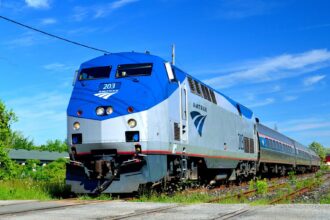
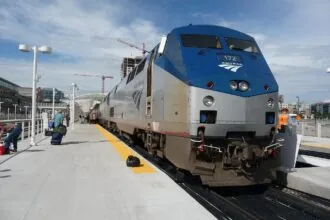
Modern ACS-64 electric locomotives haul the Cardinal north of Washington, while P42DC or ALC-42 diesel units take over for the long haul through the Appalachians and across the Midwest to Chicago.
Best for two or three nights. The widest choice of rooms, with filters for free cancellation and included breakfast.
View staysBest for groups who want one address and separate bedrooms rather than three hotel rooms.
See holiday homesBest if you have already picked a hotel. Checks the big booking sites for the same room and shows who is cheapest.
Check dealsNew York to Washington: Sharing the Northeast Corridor
The Cardinal begins its journey at New York Penn Station, sharing tracks with Acela and Northeast Regional trains for the busiest stretch of the entire route. This section is fully electrified and among the fastest and most heavily used rail corridors anywhere in the country.
Stops at Newark, Trenton and Philadelphia follow in quick succession, giving passengers a chance to settle into their seats or sleeper rooms before the train reaches open countryside further south.
Continuing through Wilmington, Delaware, and Baltimore, Maryland, the Cardinal follows exactly the same tracks used by dozens of daily Northeast Corridor services, meaning this early section rarely offers anything scenically distinctive compared with the rest of the journey.
Arrival into Washington Union Station marks the last major city stop before the Cardinal leaves the busy corridor entirely. This is also where the train’s electric locomotive is swapped for a diesel unit for the remainder of the trip toward Chicago.
Many passengers boarding further south, in Virginia or West Virginia, use Washington as their gateway to the Cardinal, making the DC stop one of the busiest boarding points on the entire route.
Travellers connecting from other Amtrak services in New York or along the Northeast Corridor generally have a wide choice of earlier trains, giving some flexibility for reaching the Cardinal’s starting point even if an earlier connection runs a little late.
Washington to Charlottesville: Virginia’s Piedmont
Leaving Washington DC, the Cardinal turns away from the Northeast Corridor and heads southwest into Virginia’s rolling Piedmont region, a landscape of horse farms, vineyards and small historic towns quite different from the urban sprawl further north.
The train calls at Manassas, site of a significant Civil War battlefield, before continuing to Culpeper, a small town that retains much of its nineteenth-century character along the rail corridor.
Arrival into Charlottesville, home to the University of Virginia, brings the first proper mountain views of the journey, with the Blue Ridge visible on the western horizon as the train prepares for the climb ahead.
Charlottesville is a popular boarding and alighting point in its own right, and the station sits within easy reach of the historic downtown area, making it a sensible place to break a longer journey if your schedule allows.
This stretch is where daylight visibility really starts to matter for scenery-focused travellers, since eastbound and westbound trains pass through the Virginia Piedmont at noticeably different times depending on the day’s schedule.
The Piedmont’s horse farms and vineyards give this section a genuinely different character from either the Northeast Corridor behind you or the mountains ahead, a quiet transitional landscape that’s easy to overlook but worth watching for.
Charlottesville to Clifton Forge: Into the Blue Ridge
West of Charlottesville, the Cardinal begins a genuinely dramatic climb through the Blue Ridge Mountains, following a historic route built by the Chesapeake and Ohio Railway more than a century ago, complete with tunnels and sweeping curves cut directly into the hillsides.
The train calls at Staunton, in the heart of the Shenandoah Valley, a broad, fertile valley flanked by mountains on both sides that has been farmed continuously since the eighteenth century.
Continuing to Clifton Forge, the scenery becomes progressively more rugged, with the train winding along river valleys and through increasingly forested terrain as it approaches the West Virginia state line.
This section is a genuine highlight for railfans, since the engineering involved in threading a railway through this terrain is as much a part of the appeal as the views themselves, particularly the tunnels bored directly through the mountainsides.
Autumn colours through the Shenandoah Valley and Blue Ridge foothills are a major draw for this stretch, with the forested slopes turning shades of orange and red typically peaking in mid to late October.
The historic Chesapeake and Ohio Railway line that the Cardinal follows through here was originally built to move coal out of the mountains, and much of that original nineteenth-century engineering is still visible in the tunnels and grades used today.

The New River Gorge: The Cardinal’s Signature Scenery
If there’s one reason to book the Cardinal specifically, it’s the New River Gorge, a spectacular canyon in southern West Virginia now protected as New River Gorge National Park and Preserve, home to the longest and deepest river gorge in the eastern United States.
The train calls at White Sulphur Springs, Alderson, Hinton and Prince as it follows the gorge closely, with the New River visible far below the tracks for extended stretches and the forested canyon walls rising steeply on either side.
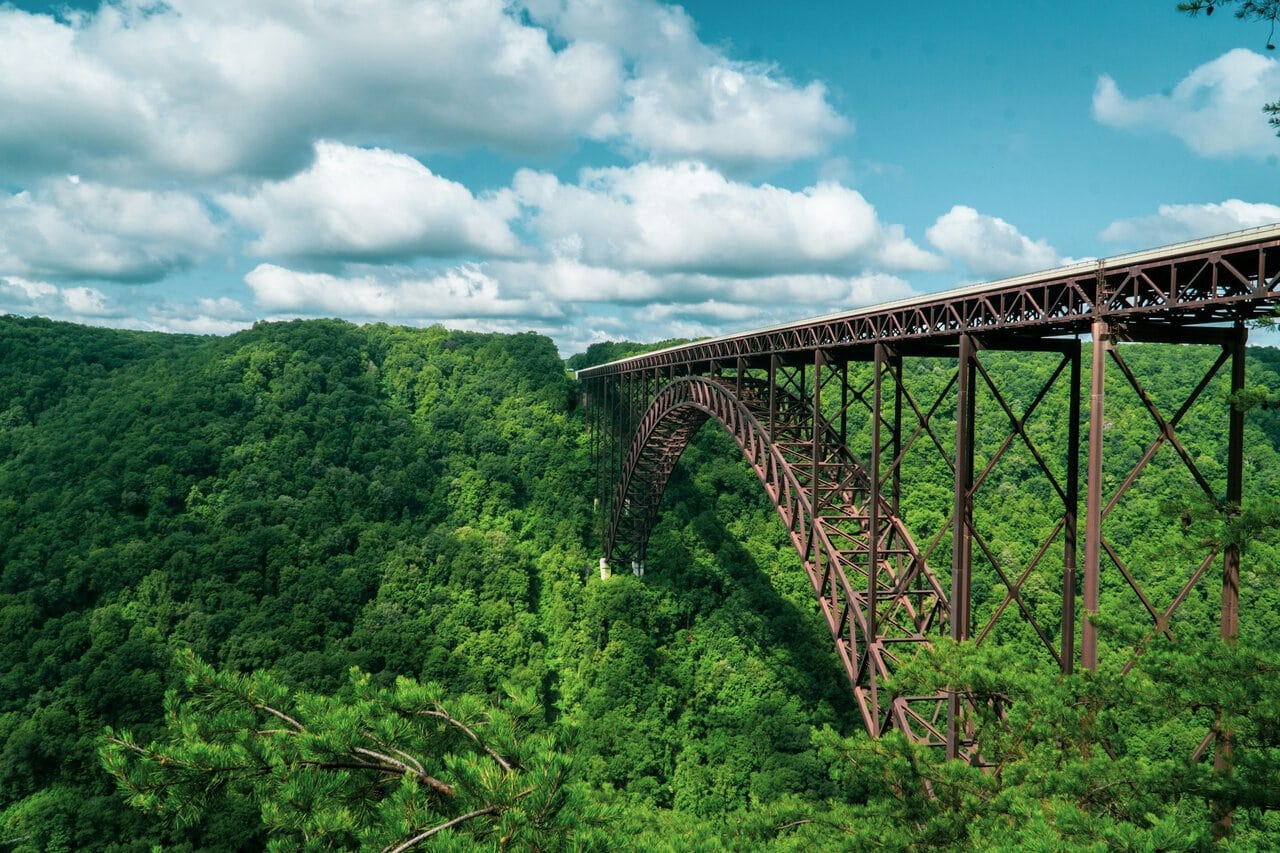
Near Thurmond, once a thriving coal town and now largely a ghost town preserved by the National Park Service, the Cardinal passes beneath the towering New River Gorge Bridge, one of the highest bridges in the country and a genuine engineering marvel.
This region is also a major destination for white-water rafting and rock climbing, and many hikers and outdoor enthusiasts specifically choose the Cardinal to reach trailheads and river access points that are difficult to get to any other way.
Because the schedule varies by direction and day, whether you catch the gorge in daylight depends heavily on which of the three weekly departures you choose, something worth checking carefully before booking if scenery is your main priority.
Continuing past Montgomery, the train reaches Charleston, West Virginia’s state capital, before the terrain gradually flattens on the approach toward the Ohio River valley.
This entire stretch through the gorge is widely regarded as the single best reason to ride the Cardinal, and it’s the section most guides and photographers reference when describing the route’s appeal.
Rafting outfitters and outdoor tour companies based around Fayetteville and the surrounding area are well used to picking up train passengers from the small stations along this stretch, though advance coordination is essential given how limited local transport options are.
The gorge itself was carved over millions of years by the New River, one of the oldest rivers in North America, and the resulting canyon walls tower hundreds of feet above the water at their most dramatic points along the route.
The National Park Service manages much of the land the Cardinal passes through here, and the area draws visitors year-round for hiking and photography even outside the peak rafting and climbing seasons.
Which Side of the Cardinal Has the Best New River Gorge Views?
If the New River Gorge is the main reason you’re riding the Cardinal, choosing where to sit can make a noticeable difference. For much of the journey through southern West Virginia, the railway runs directly alongside the New River, with the best views switching as the tracks curve through the gorge.
Unlike routes with a long, straight coastline, there isn’t a single side of the Cardinal that provides uninterrupted views throughout the entire scenic section. The river changes position relative to the train, while bends in the gorge reveal cliffs, bridges, forests and former mining communities from different directions.
That means the best strategy is not necessarily to obsess over securing one particular seat when booking. Instead, pay attention as the train approaches the gorge and be prepared to look from both sides of the carriage. If you’re travelling in a Roomette, stepping into the corridor can sometimes provide a completely different view from the window inside your room.
One landmark worth watching for is the enormous New River Gorge Bridge, which crosses high above the valley near Fayetteville. The train travels far below road level, providing a completely different perspective of the structure from the familiar viewpoints above the gorge.
Because the Cardinal doesn’t have a Sightseer Lounge, getting a good view requires slightly more effort than aboard western Amtrak trains. That’s another reason to be awake and ready before the train enters the most scenic portion of West Virginia rather than waiting until you realise you’ve reached it.
Huntington to Cincinnati: The Ohio River Valley
West of Charleston, the Cardinal calls at Huntington, a former railroad and manufacturing hub sitting right on the banks of the Ohio River, before crossing into Kentucky briefly on its way toward Cincinnati.
Small stops at Ashland, South Portsmouth and Maysville serve rural communities along the river that otherwise have very limited intercity transport options, making the Cardinal a genuine lifeline service for parts of this corridor.
This part of the route runs close enough to the Ohio River for occasional glimpses of barge traffic, a reminder that the river remains a working transport corridor for freight even as passenger rail has declined in the surrounding towns.
Arrival into Cincinnati Union Terminal is a highlight in itself for architecture enthusiasts, with its grand Art Deco rotunda ranking among the most striking railway buildings still in regular use anywhere in the country, and a good place to stretch your legs during the stop.
This stretch typically falls overnight for at least one direction of travel, so passengers who specifically want to see the Ohio River valley in daylight should check which of the three weekly schedules works best for their trip.
Cincinnati is also a useful reference point for gauging progress on the route, marking roughly the two-thirds point of the journey and the last major city before the train turns fully west into Indiana.
Best for finding routes the airlines do not sell as a single ticket. Combines carriers to bring the fare down.
Search flightsBest if you want maps and messaging working the moment you switch your phone on.
See eSIM plansBest if you would rather not work out the transport on arrival. Book it now and forget it.
View transfersCincinnati to Chicago: Indiana Farmland
Leaving Cincinnati, the Cardinal crosses into Indiana, calling at Connersville before reaching Indianapolis, the state capital and one of the larger cities served anywhere along the route.
From Indianapolis, the scenery shifts to flat, open farmland as the train continues through Crawfordsville, Lafayette and Rensselaer, a landscape that contrasts sharply with the mountains and river gorges seen earlier in the trip.
This final stretch through Indiana usually falls in the very early morning or late evening depending on direction, so most passengers use it to catch some final rest before the Chicago arrival rather than watching the scenery closely.
Onward connections from Chicago Union Station are plentiful, whether you’re heading further west on the Southwest Chief and Empire Builder or connecting to regional Midwest services back toward Indiana and Michigan.
A final stop at Dyer, Indiana, precedes the approach into Chicago, where the Cardinal terminates at the same Union Station used by the Lake Shore Limited, California Zephyr and several other long-distance trains.
This final leg is generally the least scenic part of the journey, but it’s a useful stretch to pack up, grab a final coffee from the café car and prepare for arrival after more than a full day onboard.
Arrival into Chicago Union Station gives travellers easy same-station connections to the western long-distance network, useful for anyone continuing their trip toward Denver, Seattle or the West Coast.
Only Three Days a Week: Planning Around the Cardinal’s Schedule
Unlike almost every other Amtrak long-distance train, the Cardinal does not run daily. It operates three times a week in each direction, which means booking a trip on this route requires more planning than simply picking any date on the calendar.
Trains depart New York on Sundays, Wednesdays and Fridays, while westbound trains depart Chicago on Tuesdays, Thursdays and Saturdays. Missing your intended day can mean waiting two or three full days for the next available departure.
This limited frequency exists largely due to funding constraints and equipment availability rather than low demand; rail advocacy groups have pushed for years to expand the Cardinal to daily service, so far without success.
The practical upshot is that the Cardinal works best as the centrepiece of a trip planned around its schedule, rather than a spontaneous booking. If your travel dates are flexible, check the weekly calendar before firming up any other plans.
Travellers connecting from other Amtrak services should build in a comfortable buffer, since a delayed connecting train could mean missing the Cardinal entirely and having to wait several days for the next departure in your direction.
Because of this schedule, the Cardinal tends to attract a particular kind of traveller: people specifically seeking the New River Gorge scenery or planning a rail trip well in advance, rather than commuters or last-minute bookers.
It’s also worth remembering that the Cardinal shares equipment and crews with other services, so schedule disruptions elsewhere on the network can occasionally ripple into the Cardinal’s already limited weekly slots, adding another reason to build in buffer time.
Here’s the weekly pattern at a glance, useful for sketching out a trip before you start looking at specific fares and cabin availability.
| Direction | Departure Days | Journey Time |
|---|---|---|
| New York to Chicago | Sundays, Wednesdays, Fridays | Approximately 26 hours 30 minutes |
| Chicago to New York | Tuesdays, Thursdays, Saturdays | Approximately 26 hours 30 minutes |
If you’re combining the Cardinal with another train in either direction, always confirm your connection against this weekly pattern first, since it’s easy to accidentally plan an itinerary around a day the Cardinal simply doesn’t run.
Booking well ahead of your intended travel date is doubly important on the Cardinal: not only does it help secure a sleeper cabin, it also gives you time to rearrange other plans if your preferred weekly departure later shows a schedule change.
Breaking Your Journey in the New River Gorge
One of the most interesting ways to use the Cardinal is to get off in West Virginia rather than simply watching the New River Gorge through the window. The railway serves several small communities within or close to the national park region, making the Cardinal one of the relatively few long-distance trains in America that can form part of a national park holiday.
Hinton is one of the most useful stops, particularly for visitors interested in the southern end of the gorge and outdoor activities along the New River. Prince is another remarkably isolated station, surrounded by forest and mountain scenery rather than the urban development normally associated with an Amtrak stop.
The big complication is onward transport. These aren’t stations where you should expect to step outside and find a line of taxis waiting. If you’re staying locally, arrange your accommodation transfer, rental vehicle or outdoor-activity pickup before travelling.
The Cardinal’s three-times-weekly timetable also makes a stopover very different from hopping off a daily train. Depending on your itinerary, leaving the train can mean spending several nights in West Virginia before the next Cardinal arrives in your direction.
For hikers, rafters and outdoor travellers, however, that can actually work extremely well. Rather than treating the gorge as scenery viewed through a train window, the Cardinal can become the transport link at either end of a proper New River Gorge National Park stay.
Booking Cardinal Tickets with Omio
The Cardinal can also be searched and booked through Omio, which is particularly useful for international visitors who already use the platform for trains, buses and other transport during a wider trip.
Rather than searching for the train by name, enter the journey you actually want to make, such as New York to Chicago, Washington to Chicago, Charlottesville to Chicago or New York to Cincinnati. Available Amtrak options for your chosen date can then be compared before booking.
The Cardinal’s unusual timetable makes checking dates particularly important. Because the service operates only three times each week in each direction, moving your journey by a single day can mean the Cardinal isn’t operating at all.
Pay close attention to the fare and accommodation being offered before purchasing. Coach and private sleeper accommodation provide very different experiences on an overnight journey of this length, and travellers specifically wanting a Roomette or Bedroom should check that their preferred accommodation is actually available.
For a more complicated American rail holiday, Omio can also be useful for keeping different transport bookings together, particularly if the Cardinal forms only one part of a longer itinerary.
Book Amtrak Tickets and Sleeper Trains
Travelling by train in the United States can be a memorable way to cover long distances, especially on scenic routes and overnight journeys. Amtrak lets you book rail tickets, long-distance services, and sleeper train journeys across the country.
It is ideal for city-to-city travel, cross-country rail trips, and travellers who want a slower, more comfortable alternative to flying. Sleeper trains can also make long journeys easier by combining transport and overnight accommodation.
Could the Amtrak USA Rail Pass Save You Money on the Cardinal?
If the Cardinal is part of a longer American rail journey, it’s worth comparing individual ticket prices with the Amtrak USA Rail Pass before booking. The pass can be particularly useful if you’re combining several long-distance trains rather than simply travelling from New York to Chicago and finishing your journey there.
The Cardinal connects particularly well with the wider Amtrak network at New York, Washington and Chicago. From Chicago, for example, you could continue west aboard trains such as the California Zephyr, Empire Builder or Southwest Chief, making the Cardinal one leg of a much larger coast-to-coast itinerary.
There is an important limitation: the USA Rail Pass is primarily designed around Coach travel. It shouldn’t be treated as a way of getting a discounted Roomette or Bedroom on the Cardinal. If your priority is travelling overnight in a private sleeper, compare the cost and conditions of booking that accommodation separately rather than assuming the Rail Pass will be the cheapest option.
The Cardinal also requires more careful Rail Pass planning than most Amtrak routes because it operates only three times each week in each direction. A multi-train itinerary that looks straightforward on a map can fall apart if you arrive in Chicago or New York on a day when the Cardinal isn’t running.
For travellers happy to use Coach, however, combining the Cardinal with several other Amtrak journeys can make the pass worth investigating. Our Amtrak USA Rail Pass Guide explains the current validity rules, how journey segments work and when buying the pass makes more sense than purchasing individual tickets.
Sleeper Cabins on the Cardinal
The Cardinal uses single-level Viewliner equipment, the same family of cars used on the Lake Shore Limited and other eastern long-distance trains, rather than the bi-level Superliners used on western routes like the California Zephyr.
Accommodation options include the Roomette, a private space for one or two people with fold-down bunks, and the Bedroom, offering more space, its own seating area and an en-suite toilet and shower for greater privacy.
An Accessible Bedroom is also available for passengers with mobility needs, along with an occasional Bedroom Suite, a larger configuration created by combining two connecting rooms for families or small groups travelling together.
Compared with other long-distance trains, the Cardinal typically carries a shorter consist with fewer sleeping cars, so sleeper capacity is more limited and rooms can sell out faster relative to demand, especially on peak autumn foliage departures.
Coach seating remains available at a lower fare, with reclining seats and power outlets, though without the privacy or included meals of a sleeper cabin, an important consideration for a journey lasting well over a full day.
Given the shorter consist and limited weekly departures, booking a Roomette or Bedroom for the New River Gorge stretch generally needs to happen well in advance, particularly if you want a specific direction of travel through the gorge in daylight.
A dedicated car attendant looks after each sleeping car for the entire trip, converting rooms for the night, handling requests and generally smoothing over the practical side of an overnight journey lasting well over 24 hours.
Luggage space inside a Roomette is limited, so pack a smaller overnight bag where possible and use the racks near the sleeping car entrance for larger suitcases rather than trying to squeeze them into your room.
As with other Viewliner routes, Roomette passengers share a single shower per sleeping car, while Bedroom occupants enjoy their own private en-suite facilities as part of the higher fare.
| Feature | Coach | Roomette | Bedroom |
|---|---|---|---|
| Private accommodation | ❌ | ✅ | ✅ |
| Beds for sleeping | ❌ (reclining seat) | ✅ Upper & lower bunks | ✅ Larger bunks |
| Meals included | ❌ | ✅ | ✅ |
| Private toilet & shower | ❌ | ❌ (shared facilities) | ✅ |
| Café/lounge access | Included | Included | Included |
| Best for | Budget travellers | Couples & solo travellers | Families & maximum comfort |
Best for short city stops where being central matters more than the room. Dorms and private rooms both listed.
See hostelsBest for anyone flying more than once or twice a year. Handles the compensation claim so you are not chasing the airline.
See AirHelp+Best for the gap between checking out and your train. Drop bags at a shop or hotel nearby and carry on.
Store your bagsWhat It’s Like Sleeping on a Single-Level Viewliner
The Cardinal provides a noticeably different overnight experience from Amtrak’s famous western trains because it uses single-level Viewliner sleeping cars rather than the double-deck Superliners found on routes such as the California Zephyr.
One of the most noticeable differences is the feeling inside a Viewliner Roomette. The accommodation is compact, but the design includes windows positioned relatively high in the room, helping retain some sense of the outside world even when the beds have been prepared for the night.
During the day, two passengers sit facing one another beside the window. At night, the seats convert into the lower bed while an upper berth folds down above, allowing two people to sleep in the same small private compartment.
Bedrooms provide considerably more space and include private toilet and shower facilities, making them the more comfortable choice for couples who value privacy on a journey lasting more than a full day.
The single-level design also gives the Cardinal a very different atmosphere from a Superliner. There is no staircase between levels and no enormous panoramic observation carriage, resulting in a train that feels smaller and more intimate than Amtrak’s western long-distance services.
If you’ve already travelled on the California Zephyr, Empire Builder or Coast Starlight, the Cardinal is therefore interesting not just because of its route. It provides an opportunity to experience Amtrak’s eastern long-distance sleeper format as well.
Dining and the Café-Lounge Car
Unlike the Lake Shore Limited, the Cardinal has not had traditional dining car service restored. Instead, sleeper passengers receive Flexible Dining, a system of pre-prepared, restaurant-quality meals delivered directly to seats or rooms rather than served at a table.
Meal patterns vary by direction: eastbound passengers typically receive dinner, breakfast, lunch and dinner across the journey, while westbound travellers get breakfast, lunch, dinner and a final breakfast before arrival in Chicago.
Coach passengers can buy food from the café service, which offers grab-and-go sandwiches, snacks, hot and cold drinks and light meals, similar in style to the café cars used on other eastern Amtrak routes.
There’s no traditional dining car and no Sightseer Lounge on the Cardinal; the Amfleet II café/lounge car serves as the main shared space onboard for both Coach and sleeper passengers looking to stretch their legs.
Given the shorter consist used on this route, don’t expect the same social, sit-down dining atmosphere found on routes like the California Zephyr or the newly restored Lake Shore Limited; the experience here is more practical than ceremonial.
That said, the Flexible Dining menu has improved in recent years, with hot entrees, salads and desserts that are perfectly satisfying for a journey of this length, even if the presentation is simpler than a full table-service meal.
Special dietary requirements can generally be accommodated with advance notice, so flag anything important when booking rather than hoping the limited onboard selection happens to cover your needs.
Payment onboard the café/lounge car is typically card-only, and alcohol including beer and wine is available for purchase throughout the daytime hours, similar to the arrangement on other eastern long-distance trains.
Business Class passengers, a coach-level upgrade offering extra legroom and complimentary non-alcoholic drinks, also gain access to the Metropolitan Lounge at Chicago Union Station with the purchase of a single-visit lounge pass.
Cardinal or Lake Shore Limited: Which Route Between Chicago and New York?
Travellers looking to connect Chicago and the New York area actually have two very different Amtrak options. The Lake Shore Limited runs daily via the Great Lakes and Hudson Valley, while the Cardinal takes a completely different southerly path through the Appalachians.
Frequency is the biggest practical difference. The Lake Shore Limited departs every day, making it far easier to slot into a flexible itinerary, while the Cardinal’s three-times-weekly schedule demands more advance planning around specific departure days.
Scenery is where the Cardinal pulls ahead for many travellers. Nothing on the Lake Shore Limited compares with the dramatic New River Gorge and the mountain crossings through the Blue Ridge, landscapes that feel closer to a western national park than a typical eastern rail corridor.
Dining also differs meaningfully: the Lake Shore Limited offers full, table-service dining for sleeper passengers, while the Cardinal relies on Flexible Dining delivered to your seat or room, a more modest experience overall.
If your priority is a guaranteed, dependable schedule, the Lake Shore Limited is the safer bet. If you’re specifically chasing mountain and gorge scenery and can plan your trip around a fixed weekly departure day, the Cardinal is well worth the extra planning.
Both routes terminate at Chicago Union Station, so travellers connecting onward to the western long-distance network, including the Southwest Chief or Empire Builder, can choose whichever eastern route suits their scenery preferences and travel dates.
Some rail enthusiasts deliberately ride both routes on separate trips specifically to compare them, since the two trains offer genuinely different experiences of the same broad Chicago-to-Northeast corridor despite sharing similar Viewliner equipment.

Best Time of Year to Ride the Cardinal
Autumn is the standout season for the Cardinal, and it’s not close. The forested slopes of the Blue Ridge Mountains and New River Gorge turn brilliant shades of red, orange and gold, typically peaking from mid to late October.
This is genuinely the busiest time of year to book, and sleeper cabins on the three weekly departures closest to peak foliage weeks often sell out well ahead of the actual travel dates.
Spring brings a different kind of scenery to the same landscape, with wildflowers and fresh green growth returning to the Appalachian hillsides, along with generally milder weather and thinner crowds than autumn.
Summer offers the longest daylight hours, increasing your odds of seeing the entire New River Gorge stretch in good light regardless of which of the three weekly departures you book.
Winter travel through the mountains can be more unpredictable, with occasional weather-related delays through the higher sections of West Virginia, so travellers with tight connections should build in some flexibility if riding between December and February.
Whichever season you choose, remember that the Cardinal’s three-times-weekly schedule means you can’t simply pick your preferred season and any date within it; the specific day of the week still has to line up with your travel plans.
Riding the Cardinal During Fall Foliage Season
Autumn deserves more than a paragraph on this particular route. The Cardinal is one of Amtrak’s strongest candidates for a dedicated fall foliage train journey, with enormous areas of deciduous forest surrounding the railway through Virginia and West Virginia.
The transformation becomes particularly impressive through the Blue Ridge Mountains and New River Gorge, where steep forested slopes can turn shades of yellow, orange and red on both sides of the train. The combination of river, cliffs, mountains and autumn colour gives this part of the route an entirely different appearance from summer.
Timing is the difficult part. Peak colour varies according to elevation, temperature and weather conditions, so there isn’t a guaranteed week when the entire route will look its best. Higher Appalachian areas can begin changing before lower valleys further along the railway.
The Cardinal’s limited timetable adds another complication. With only three departures each week in each direction, you have far fewer opportunities to target a particular foliage window than you would on a daily train.
If an autumn Cardinal journey is high on your list, we’d therefore prioritise securing the train and sleeper accommodation first rather than waiting for a precise foliage forecast. Roomettes can become particularly desirable during the most popular autumn weeks.
This is one route where travelling at the right time of year can genuinely transform the journey, making October one of the most compelling periods to experience the Cardinal.
Is the Cardinal Worth It?
For travellers willing to plan around a three-times-weekly schedule, the Cardinal offers some of the most rewarding scenery of any Amtrak route east of the Mississippi, condensed into a single, genuinely memorable day-and-night journey.
The New River Gorge alone justifies the trip for many rail enthusiasts, offering a view of Appalachian wilderness that’s simply unavailable from any road, and difficult to fully appreciate from anywhere except the train itself.
It’s less well suited to travellers who need guaranteed flexibility or a same-day booking, given how restrictive the three-day weekly schedule can be if your plans change at short notice.
Outdoor enthusiasts heading to the New River Gorge National Park for rafting, climbing or hiking are among the route’s most dedicated regular riders, often building an entire trip around the Cardinal’s limited schedule rather than treating it as an afterthought.
If dependable daily service matters more to you than dramatic mountain scenery, the Lake Shore Limited or a connecting flight will likely suit your needs better than the Cardinal.
Overall, the Cardinal rewards travellers who treat the journey itself as the destination, rather than simply a means of getting from New York to Chicago as quickly as possible.
For photographers and railfans in particular, few Amtrak routes east of the Mississippi offer as concentrated a dose of dramatic mountain and gorge scenery within a single continuous journey.
Business travellers with rigid schedules will generally find the Lake Shore Limited or a flight more practical, but for a leisure trip built around scenery, the Cardinal’s limitations become far less important than what it delivers in return.
Ultimately, the Cardinal occupies a genuine niche within Amtrak’s long-distance network: part practical transport, part scenic experience, and entirely worth the extra planning for the right kind of traveller.
Solo travellers and couples looking for a self-contained scenic getaway, without the need to plan an elaborate itinerary around it, often find the Cardinal’s single overnight journey through the Appalachians is satisfying enough as a standalone trip.

Practical Tips for Riding the Cardinal
Always check the current weekly schedule before locking in any other travel plans; missing your intended Cardinal departure day can mean waiting two or three days for the next available service in your direction.
Book sleeper cabins as far ahead as possible, especially for autumn departures, since the Cardinal’s shorter consist means fewer Roomettes and Bedrooms are available compared with daily long-distance trains.
If scenery through the New River Gorge is your priority, research which of the three weekly departures passes through the gorge in daylight for your chosen direction, since this can vary noticeably between the Sunday, Wednesday and Friday departures.
The Cardinal can be included in a Coach-class Amtrak USA Rail Pass itinerary, though the limited weekly departures mean it needs more careful scheduling than daily routes when planning a multi-train trip.
Pack entertainment and snacks for the café car’s more limited selection, and don’t expect the same full dining car experience found on the Lake Shore Limited or other restored-dining routes.
Mobile signal is patchy through the mountains of Virginia and West Virginia, so download anything you need before boarding, particularly through the New River Gorge stretch where coverage disappears almost entirely.
If you’re planning to hike, raft or climb near the New River Gorge, coordinate your outfitter or accommodation pickup carefully around the Cardinal’s specific arrival time at Hinton or Prince, since onward transport in this rural area is limited.
Keep your phone charger and any medication in your carry-on rather than checked luggage, since a journey of this length occasionally runs behind schedule, and having essentials close at hand makes any delay far easier to manage.
Sign up for real-time status alerts through the Amtrak app well before departure day, since knowing exactly where the Cardinal is running relative to schedule is especially useful given the route’s mountainous, sometimes unpredictable middle section.

Rupert’s Handy Travel Tips
A few things I’ve picked up from riding the Cardinal through the New River Gorge and beyond.
- Check the day first: The Cardinal only runs three days a week in each direction, so confirm the schedule before planning anything else.
- Book early for autumn: Sleeper cabins near peak foliage weeks in October sell out quickly given the shorter consist.
- Sit on the gorge side: Choose a window seat facing the New River for the best views through West Virginia.
- Download entertainment first: Mobile signal disappears almost entirely through the mountains, so prepare before boarding.
Want to meet the reindeer behind our travel tips? Find out more in our page Who is Rupert?.




Frequently Asked Questions
How often does the Cardinal run?
The Cardinal operates only three days a week in each direction: departing New York on Sundays, Wednesdays and Fridays, and departing Chicago on Tuesdays, Thursdays and Saturdays.
Why doesn’t the Cardinal run daily like other Amtrak trains?
The reduced schedule dates back to funding and equipment constraints from the early 1980s. Despite ongoing advocacy for daily service, the Cardinal has kept its three-times-weekly pattern for decades.
How long does the Cardinal take?
The full journey between New York and Chicago takes approximately 26 hours and 30 minutes, covering 1,146 miles through nine states.
What is the New River Gorge?
It’s a dramatic canyon in southern West Virginia, now protected as a national park, featuring the longest and deepest river gorge in the eastern United States and a towering bridge visible from the train near Thurmond.
Does the Cardinal have a dining car?
No, unlike the Lake Shore Limited, the Cardinal uses Flexible Dining, with pre-prepared meals delivered to sleeper passengers rather than table service in a dedicated dining car.
Is there a Sightseer Lounge on the Cardinal?
No. The Cardinal uses single-level Viewliner equipment and an Amfleet II café/lounge car, rather than the bi-level Superliner Sightseer Lounge found on western routes.
What if I miss my scheduled Cardinal departure day?
Because the train only runs three times a week, missing your day typically means waiting until the next scheduled departure, which could be two or three days later depending on direction.
Which direction has better views of the New River Gorge?
This varies by season and schedule, since daylight timing through the gorge shifts throughout the year. Check the current timetable for your specific travel dates before booking.
Can I use the Amtrak USA Rail Pass on the Cardinal?
Yes, the Cardinal can be included in a Coach-class USA Rail Pass itinerary, though its limited weekly departures require more careful planning than daily routes.
Is the Cardinal good for reaching the New River Gorge for rafting or hiking?
Yes, stations like Hinton and Prince put you within reach of major outdoor recreation areas, though onward transport from these small, rural stations is limited, so arrange pickups in advance.
What equipment does the Cardinal use?
The Cardinal runs single-level Viewliner sleeping cars and an Amfleet II café/lounge car, the same general equipment family used on the Lake Shore Limited, rather than bi-level Superliner cars.
How many sleeping cars does the Cardinal carry?
Typically fewer than other long-distance trains, since the Cardinal runs a shorter consist. This means sleeper capacity is more limited, so booking early is especially important on this route.
Can I break my journey along the Cardinal’s route?
Yes, stopovers at stations such as Charlottesville, Hinton or Cincinnati are generally possible, though this typically means booking separate ticketed segments rather than one continuous fare.
Can you smoke on the Cardinal?
No, smoking is banned throughout the train and inside every station it serves, including e-cigarettes. The Cardinal’s longer stops, such as the one at Cincinnati Union Terminal, are sometimes announced by crews as a chance for a platform smoke break if the schedule allows, but you’re expected to stay within sight of the train and back on board the instant the horn sounds. Given the Cardinal’s reduced three-times-weekly schedule leaves less slack for delays, don’t count on a specific stop offering the chance.
Further Reading
For a daily alternative between Chicago and the Northeast, read our Lake Shore Limited Guide, which covers a very different, Great Lakes and Hudson Valley routing with daily departures.
Our Amtrak Routes Guide compares every major long-distance service across the country, while our Amtrak Sleeper Train Guide explains cabin types and whether a Roomette or Bedroom is worth the extra cost.
If you’re combining the Cardinal with other long-distance trains during a wider USA rail trip, our Amtrak USA Rail Pass Guide explains how the pass works and whether it could save you money.
Travellers arriving in Chicago may also want to continue their trip westward; our California Zephyr Guide covers the classic route onward to the San Francisco Bay Area for anyone building a coast-to-coast itinerary.
If the New River Gorge has sparked an interest in outdoor recreation destinations reachable by train, our growing collection of Amtrak route guides covers scenic journeys across the country, each written with the same emphasis on real stations, honest journey times and practical advice.
And if the idea of a train that runs only three days a week feels unusual, remember it isn’t the only Amtrak service with a quirky schedule; part of the appeal of long-distance rail travel in America is discovering routes like this one.