Reviewed by our editorial team Updated
Why the Coast Starlight Is One of Amtrak’s Great Scenic Journeys
The Coast Starlight is one of Amtrak’s most celebrated long-distance trains, running the length of the West Coast between Seattle, Washington and Los Angeles, California. Covering roughly 1,377 miles (2,216 km), the route links three states in a single overnight journey, threading together mountains, farmland, forest and coastline that few other trains manage to combine in one continuous trip, making it a firm favourite with both first-time visitors and seasoned rail travellers.
Where the California Zephyr and Southwest Chief head east across the continent, the Coast Starlight travels north to south, hugging the Pacific edge of the country for much of its route. The full journey takes around 34 to 35 hours, so most passengers spend one night onboard, watching Washington’s evergreen forests give way to Oregon’s Willamette Valley, then California’s mountains, farmland and finally its famous sun-drenched coastline near the journey’s end.
The train’s name nods to two very different landscapes: the rugged, cloud-swept Pacific Northwest at its northern end, and the sun-drenched Southern California coast it reaches by the end of the trip. Along the way, passengers pass beneath the slopes of Mount Shasta, cross the fertile Sacramento Valley, skirt San Francisco Bay and ride directly alongside the ocean between San Luis Obispo and Santa Barbara, a stretch that has few equals anywhere on the American rail network.
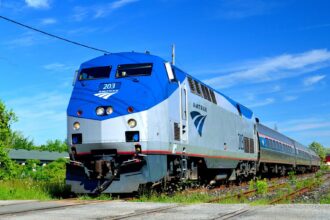
Amtrak operates the Coast Starlight daily in both directions using Superliner equipment, the same double-decker cars used on the California Zephyr, Empire Builder and Southwest Chief. Passengers can choose between Coach seating and private sleeper cabins, with a dining car, cafe car and the glass-walled Sightseer Lounge all included as standard onboard facilities throughout the entire journey, regardless of which class of ticket you have booked.
For many travellers, the appeal isn’t just the destination cities but the sheer variety of scenery packed into one overnight trip. Few routes anywhere in North America shift so dramatically from misty coastal forest to snow-dusted volcanic peaks to golden hillsides and crashing Pacific surf within a single continuous journey, all without ever having to change trains, check bags again or deal with airport security.
Whether you’re travelling the full route from Seattle to Los Angeles or joining for a shorter stretch such as Portland to San Francisco, the Coast Starlight offers a relaxed, scenic alternative to flying and remains one of the best ways to experience the West Coast at ground level. This guide walks through the entire route, the onboard experience and everything you need to plan your own trip.
Coast Starlight Route at a Glance
Before boarding, it helps to see the whole journey summarised in one place. The table below sets out the key facts about the Coast Starlight, from distance and journey time to the onboard facilities you can expect throughout the trip, so you know roughly what you’re signing up for before you book.
| Feature | Details |
|---|---|
| Route | Seattle, Washington to Los Angeles, California |
| Distance | Approximately 1,377 miles (2,216 km) |
| Journey Time | Around 34 to 35 hours |
| States Crossed | Washington, Oregon and California |
| Major Cities | Seattle, Portland, Sacramento, Oakland, Santa Barbara, Los Angeles |
| Northern Terminus | Seattle King Street Station |
| Southern Terminus | Los Angeles Union Station |
| Sleeper Accommodation | Yes – Roomettes, Bedrooms, Family Bedrooms and Accessible Bedrooms |
| Dining Car | Yes, for sleeper car passengers |
| Sightseer Lounge | Yes |
| Coach Seating | Yes |
| Frequency | Daily |
| Most Scenic Sections | Cascade Range, Mount Shasta, San Francisco Bay, Central Coast between San Luis Obispo and Santa Barbara |
| Best Time to Travel | Summer and early autumn for clear coastal views, winter for dramatic mountain scenery |
Best for two or three nights. The widest choice of rooms, with filters for free cancellation and included breakfast.
View staysBest for longer stays. Whole apartments and houses, so you are not eating out three times a day.
View rentalsBest as a last check before booking. Compares hotel rates across several sites in one search.
Compare ratesSeattle to Portland: Puget Sound and the Cascade Foothills
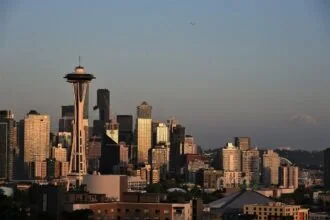
Southbound journeys begin at Seattle’s King Street Station, a beautifully restored terminal in the heart of the city with a clock tower modelled on Venice’s Piazza San Marco. Shortly after departure, the train hugs the edge of Puget Sound, offering passengers water views and glimpses of ferries and container ships before turning inland towards Tacoma, one of the first major stops of the journey.
From Tacoma, the Coast Starlight continues south through Olympia-Lacey, close to Washington’s state capital, before rolling through Centralia and Kelso-Longview. This stretch passes through dense evergreen forest, dairy farmland and small timber towns that have long depended on the railway for trade and transport, giving an early sense of the Pacific Northwest’s logging heritage.
On clear days, particularly heading northbound, passengers are often treated to distant views of Mount Rainier, the towering volcanic peak that dominates the skyline south of Seattle and rises to over 14,000 feet. It’s one of several major Cascade volcanoes visible at different points along the route, and a favourite subject for photographers riding in the Sightseer Lounge.
The train crosses the Columbia River on the approach to Vancouver, Washington, before arriving into Portland, Oregon. This crossing marks the boundary between Washington and Oregon and is one of the more memorable river crossings on the entire route, with wide views up and down the river in both directions from the bridge.
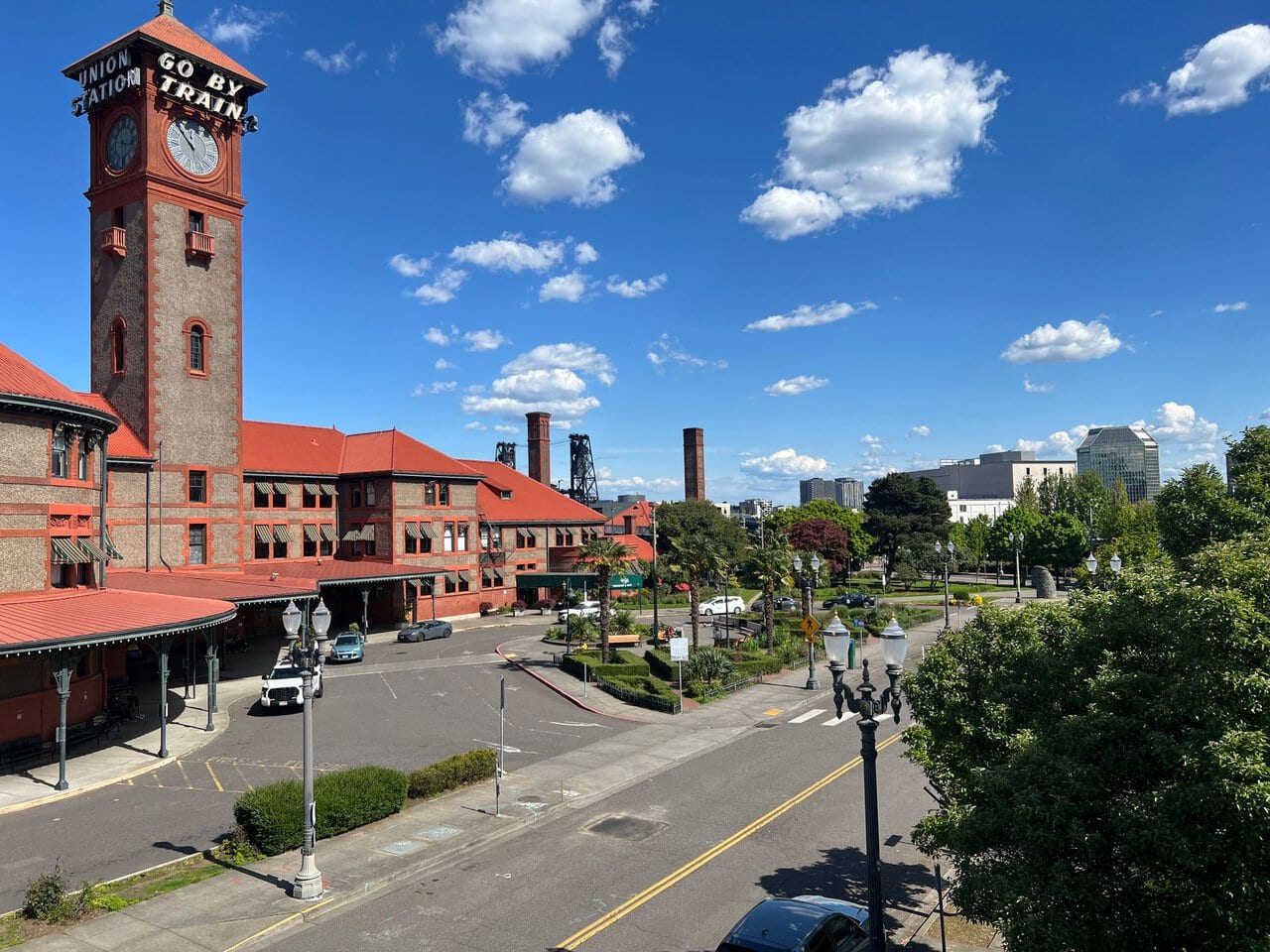
Portland’s Union Station, with its illuminated “Go By Train” sign visible for blocks around, is one of the most photogenic stops on the whole journey. Many passengers use Portland as a natural break in their trip, exploring the city’s food scene, bridges and parks before continuing south the following day on a later departure.
This opening section sets the tone for the entire journey: a gentle introduction of forested hills, wide rivers and small-town Pacific Northwest scenery before the landscape begins to change more dramatically further south. It’s a good stretch to settle in, unpack your bag and get to know your surroundings for the next day and a half.
Amtrak has periodically explored restoring a more direct route along Point Defiance south of Tacoma to shave time off this section, though the current alignment through inland Washington remains the standard routing for the Coast Starlight at the time of writing.
Portland to Eugene: The Willamette Valley
South of Portland, the Coast Starlight enters the Willamette Valley, one of Oregon’s most productive agricultural regions and the state’s main wine-growing area, home to hundreds of small vineyards producing internationally recognised Pinot Noir. The pace of the scenery slows noticeably here, with vineyards, orchards and open farmland replacing the forested hills further north.
The train calls at Oregon City, historically the end of the Oregon Trail and the site of one of the first hydroelectric plants in the United States, before continuing to Salem, Oregon’s state capital, and then Albany, a small city known for its well-preserved Victorian-era historic downtown district.
Throughout this section, the Willamette River appears repeatedly alongside the tracks, winding through farmland dotted with grazing sheep and cattle. Spring brings blossoming orchards and wildflowers to the valley floor, while autumn transforms the vineyards into shades of gold and deep red, making it a particularly attractive time of year to travel this stretch.
The valley narrows as the train approaches Eugene, home to the University of Oregon and one of the larger stops between Portland and the California border. Many passengers joining or leaving the Coast Starlight partway through their trip use Eugene as a starting point, and it’s also a useful base for exploring the nearby Oregon coast by connecting bus.
Beyond Eugene, the landscape begins to change again as the flat valley floor gives way to rolling foothills, a signal that the climb into the Cascade Range is not far away. The vineyards and orchards gradually thin out, replaced by denser stands of Douglas fir as the elevation begins to increase.
This gentler middle section of the journey is often underrated, offering a relaxed contrast between the dramatic mountain crossings that come before and after it, and a good opportunity to enjoy a leisurely meal in the dining car while the scenery unfolds at an easy pace outside the window.
Wildlife sightings are also common through this stretch, with deer and wild turkeys occasionally visible in the fields close to the tracks, particularly in the early morning or late afternoon when animals are most active near the valley’s farmland.
Eugene to Dunsmuir: Crossing the Cascades and Mount Shasta
South of Eugene, the Coast Starlight begins one of its most dramatic climbs, crossing the Cascade Range via Chemult and Klamath Falls. The train gains significant elevation here, winding through dense pine forest and volcanic terrain typical of central Oregon, with lava fields visible in places close to the tracks.
Depending on the direction and time of year, this stretch can take place in daylight or after dark, though southbound winter services sometimes reveal snow-covered forest around Chemult, close to Crater Lake National Park, one of the snowiest inhabited places in the United States most winters.
Crossing into California, the route’s undoubted highlight of this section is Mount Shasta, a towering 14,000-foot volcanic peak that dominates the horizon for over an hour as the train winds around its lower slopes. Northbound trains typically pass this stretch in daylight, making it one of the most photographed moments of the entire journey for passengers riding on this side.
The train then descends steeply towards Dunsmuir, a small mountain town nestled in a forested canyon along the upper Sacramento River, once an important stop for steam locomotives to take on water and coal. The descent involves sharp curves and dramatic drops in elevation as the railway drops out of the mountains towards the valley floor.
This part of the route is among the least visited by car, since the railway follows a corridor with few parallel roads and long tunnels that a highway simply couldn’t replicate. For many rail enthusiasts, the Cascade and Shasta crossing genuinely rivals the scenery found on the California Zephyr’s Rocky Mountain crossing further east.
Because the exact timing depends on the season and any delays along the route, it’s worth keeping a camera to hand throughout this stretch rather than assuming you’ll know exactly when Mount Shasta will come into view. Announcements from the train crew often give advance warning as the mountain approaches.
The lakes and reservoirs around Shasta Lake further south add another layer of scenery to this section, particularly in spring when snowmelt keeps water levels high and the surrounding forest at its greenest.

Sacramento Valley and the San Francisco Bay Area
After Dunsmuir, the Coast Starlight descends into California’s Sacramento Valley, passing through Redding and Chico as the mountain scenery gives way to flat, fertile farmland. Orchards, rice fields and irrigation canals stretch out on both sides of the train for mile after mile, a landscape that feeds much of the country.
The train reaches Sacramento, California’s state capital, where the beautifully restored Sacramento Valley Station also serves the California Zephyr and several regional California services. It’s a useful reminder that several of Amtrak’s great western routes share key stations along their journeys, making onward connections relatively straightforward.
From Sacramento, the route continues through Davis, home to a well-regarded University of California campus, before turning towards the San Francisco Bay Area, calling at Martinez and Richmond as it skirts the northern edge of the bay along the shoreline.
The Coast Starlight calls at Emeryville, the same station used by the California Zephyr, where connecting Amtrak buses run into downtown San Francisco, including a stop at the Salesforce Transit Center. Some services also stop at Oakland’s Jack London Square, giving passengers another gateway into the Bay Area with easy access to BART.
For many travellers, the Bay Area stop marks a natural break in the journey, whether for a full stopover in San Francisco or simply a chance to stretch their legs before the final stretch south towards Los Angeles begins the following morning.
Depending on the direction of travel, this section often passes in the evening or overnight, meaning it’s worth checking the timetable in advance if seeing the Bay Area in daylight matters to you, since schedules can shift slightly between seasons.
If you’re combining the Coast Starlight with the California Zephyr as part of a longer rail trip, the shared Emeryville and Sacramento stations make it easy to plan a stopover in the Bay Area between the two journeys rather than travelling both routes back to back.
Can You Visit San Francisco on the Coast Starlight?
One slightly confusing feature of the Coast Starlight is that although the route serves the San Francisco Bay Area, the train itself does not travel into central San Francisco. Instead, passengers heading for the city normally leave the train on the eastern side of the bay and complete the final part of their journey using local or connecting transport.
Emeryville is one of the most useful stations for San Francisco-bound passengers and is also used by the California Zephyr. From here, travellers can continue across the bay into San Francisco rather than needing to travel south with the Coast Starlight towards Oakland and San Jose. If San Francisco is your destination rather than simply somewhere you’re passing, it can therefore make sense to treat Emeryville as the end of that particular rail segment.
Another option is Oakland Jack London Square, which places you much closer to Oakland’s city centre and gives you access to the wider Bay Area transport network. Which station makes most sense depends on where you’re staying, so it’s worth checking your accommodation location before automatically choosing one over the other.
San Francisco also makes an excellent stopover on a longer Coast Starlight journey. Rather than trying to travel from Seattle to Los Angeles continuously, you could ride south to the Bay Area, spend two or three nights exploring San Francisco and then rejoin a later Coast Starlight service for the journey towards San Luis Obispo, Santa Barbara and Los Angeles.
This becomes even more useful if you’re combining Amtrak routes. The California Zephyr also serves Emeryville, allowing you to finish a journey from Chicago in the Bay Area, explore San Francisco and then continue south towards Los Angeles aboard the Coast Starlight.
The Central Coast and Southern California: San Luis Obispo to Los Angeles
The final stretch of the Coast Starlight is, for many passengers, the true highlight of the entire trip. After passing through Salinas and the agricultural fields of the Salinas Valley, famous for lettuce and strawberry production, the train climbs briefly inland before descending towards Paso Robles and San Luis Obispo.
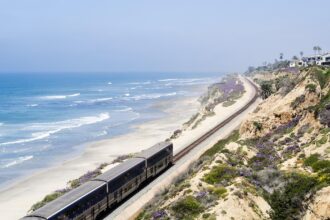
South of San Luis Obispo, the railway does something almost no other Amtrak long-distance route can offer: it runs directly alongside the Pacific Ocean for dozens of miles, with waves breaking just yards from the tracks in places and dolphins occasionally visible offshore on clear days.
This coastal stretch passes near Vandenberg Space Force Base and the small Surf station before continuing towards Santa Barbara, one of the most scenic stations on the entire route, with palm trees, red-tiled Spanish Colonial architecture and mountains framing the Pacific on either side of the platform.
From Santa Barbara, the train continues through Ventura and Oxnard, keeping close to the coastline for much of the way and passing several popular surfing beaches, before turning inland through the San Fernando Valley towards Van Nuys and Burbank.
The journey concludes at the historic Los Angeles Union Station, an Art Deco and Mission Revival landmark completed in 1939 that also serves as the departure point for the Southwest Chief and Sunset Limited, making it a genuine hub for onward rail travel across the western United States.
Because this coastal section usually falls on the second day of the journey in reasonable daylight, it’s often cited as the single best reason to choose the Coast Starlight over flying between the Pacific Northwest and Southern California, and it’s the stretch most passengers remember long after the trip is over.
Best for finding routes the airlines do not sell as a single ticket. Combines carriers to bring the fare down.
Search flightsBest for short trips. Install the eSIM at home and arrive with working data, no shop queue.
Browse eSIMsBest when public transport has stopped, or when you are travelling with children and bags.
Book a transferThe Coast Starlight’s Most Scenic Stretch: San Luis Obispo to Santa Barbara
If you only remember one section of the Coast Starlight, there’s a good chance it will be the journey between San Luis Obispo and Santa Barbara. This is where the railway reaches the Pacific and begins one of the most spectacular coastal train journeys in the United States, with long stretches where the ocean fills the view from the windows.
Shortly after leaving San Luis Obispo, the train climbs through the hills before reaching the coast and turning south. From here, the railway follows a remarkably undeveloped stretch of California shoreline, passing beaches, cliffs, open countryside and sections of coastline where there is no equivalent major coastal highway running alongside the tracks.
One of the most distinctive parts of the journey runs beside Vandenberg Space Force Base. The railway passes through territory that is otherwise relatively difficult for the general public to access, helping create the feeling that you’re seeing a side of the Californian coast most visitors miss when travelling between Los Angeles and San Francisco by road.
The train also passes Surf, an isolated railway location close to the Pacific, before continuing south towards Santa Barbara. Depending on conditions, passengers may spot seabirds, surfers and occasionally marine wildlife from the train, although naturally none of these sightings can be guaranteed.
This is the section where the Sightseer Lounge really earns its place. Seats beside the large windows become particularly popular as the train approaches the coast, so don’t wait until you can already see the Pacific before heading to the lounge. If the train crew announces that the coastal section is approaching, that’s usually your cue to find a good viewing position.
Even travellers who don’t have time for the complete Seattle–Los Angeles journey can experience this part of the route. A shorter Coast Starlight trip incorporating San Luis Obispo and Santa Barbara captures the defining scenery of the train without requiring you to spend around 35 hours onboard.
Sleeper Cabins Explained
One of the first decisions when booking the Coast Starlight is whether to travel in Coach or upgrade to one of Amtrak’s Sleeper options. Since the full journey lasts around 34 to 35 hours and includes one overnight stretch, a private cabin can make a genuine difference to comfort, particularly for longer segments of the route.
The most popular option is the Roomette, suited to one or two passengers. By day it offers two comfortable seats facing each other; at night these convert into a bed, with a second bunk folding down above. Roomettes include meals in the dining car, fresh bedding, and access to shared shower facilities at no extra charge.
Passengers wanting more space can book a Bedroom, which offers a noticeably larger cabin with its own private toilet and shower. Family Bedrooms, located on the lower level of the Superliner sleeper cars, suit parents travelling with children, while Accessible Bedrooms are designed for passengers with reduced mobility and offer additional turning space.
All sleeper fares include full dining car meals for the duration of the journey, which is one of the best value elements of upgrading, since food and drink can otherwise add up quickly over a trip of this length if bought individually from the cafe car.
For a single overnight trip, many travellers find Coach seating perfectly comfortable, especially for shorter segments such as Seattle to Portland or San Luis Obispo to Los Angeles. For the complete route, however, a Roomette is generally considered the best balance of comfort, privacy and value for most passengers.
Dining on the Coast Starlight
Dining is a genuine highlight of the Coast Starlight experience. Passengers travelling in Sleeper accommodation have all meals included and are seated in the traditional Dining Car, often at shared tables with fellow passengers, creating a sociable atmosphere throughout the journey that many riders say is one of their favourite parts of the trip.
The dining car menu typically features American classics such as steak, roast chicken, pasta and burgers, alongside salads, vegetarian dishes and desserts, with the menu changing periodically. Breakfast, lunch and dinner service times are usually announced over the train’s public address system, and reservations are taken at the door.
Coach passengers can use the Cafe Car, which offers sandwiches, snacks, pizza, beer, wine and coffee throughout the day. It’s a more casual option and doesn’t require a reservation, making it convenient for anyone who prefers to eat on a flexible schedule.
The Coast Starlight once featured a distinctive Pacific Parlour Car, a lounge exclusively for sleeper passengers with a small theatre, wine tastings and its own bar, dating back to the train’s original 1949 Southern Pacific heritage. Amtrak retired these historic cars in 2018 as part of a wider cost-cutting measure, so today’s dining and lounge facilities are shared between all passengers.
If you have dietary requirements, Amtrak can usually cater for vegetarian, vegan and gluten-free diets, though it’s worth notifying staff when booking wherever possible so the kitchen can plan ahead for your meals.
Mealtimes also double as a natural way to meet other passengers, since dining car seating is shared rather than private. Many travellers say the conversations struck up over breakfast or dinner end up being one of the more memorable parts of the whole journey.
The Sightseer Lounge Experience
The Sightseer Lounge is where most passengers spend their daylight hours on the Coast Starlight. Floor-to-ceiling windows curve into the roof of the carriage, giving uninterrupted views in almost every direction, particularly valuable along the Pacific coastline and during the Cascade crossing further north.
Comfortable lounge seating replaces the usual rows found in Coach, encouraging passengers to relax, chat with fellow travellers or simply watch the scenery pass by for hours at a time. It’s especially popular during the crossing of the Cascade Range and the coastal run between San Luis Obispo and Santa Barbara, where seats can fill up quickly.
The lower level of the carriage houses the Cafe Car, so passengers can easily grab a drink or snack without leaving the lounge area for long, then return to their seat to keep watching the view unfold.
Because the lounge is open to every passenger regardless of ticket type, it can get busy during the most scenic stretches. Arriving a little early before the coastal section south of San Luis Obispo is a sensible strategy if you want one of the best window seats for the run down to Santa Barbara.
For photographers, the Sightseer Lounge remains the best vantage point onboard, particularly for capturing the ocean views that make the Coast Starlight so distinctive among Amtrak’s long-distance trains, thanks to its elevated seating and wraparound glass.
Even passengers who booked a private sleeper cabin usually find themselves gravitating back to the lounge repeatedly throughout the trip. There’s simply more room to stretch out, and the social atmosphere of shared lounge seating suits a journey where meeting fellow travellers is part of the appeal.
Which Direction Is Better: Northbound or Southbound?
Unlike some Amtrak routes where direction makes little practical difference, the Coast Starlight has a genuine debate around whether northbound from Los Angeles or southbound from Seattle offers the better experience, largely because of how daylight lines up with the most scenic sections of the route.
Travelling northbound, passengers typically see the dramatic Central Coast south of San Luis Obispo on the first afternoon, then reach the Mount Shasta and Cascade crossing the following morning, often in good light. Many rail enthusiasts consider northbound the stronger direction for scenery precisely because of this sequence.
Travelling southbound from Seattle, the Pacific Northwest and Willamette Valley sections unfold on the first day, with the Bay Area often passed in the evening and the Central Coast reached the following day. Some passengers prefer this build-up towards the coastal finale into Los Angeles, saving the best scenery for last.
Exact daylight timing depends on the season, the specific departure and any delays along the route, so neither direction can guarantee perfect light for every highlight. Longer summer days generally improve the odds of catching both Shasta and the coastline in daylight regardless of which way you’re travelling.
Our advice is straightforward: book whichever direction suits your wider itinerary, and treat any extra daylight scenery as a welcome bonus rather than a guarantee. Both directions cover the same spectacular route from end to end.
If scenery genuinely is your top priority and your schedule is flexible, choosing the direction that puts the coastal stretch earlier in the trip means you’ll see it while you’re still fresh, rather than towards the end of a long overnight journey.
Which Side of the Coast Starlight Should You Sit On?
Choosing the right side of the train can make a noticeable difference on the Coast Starlight, particularly once you reach California. However, there isn’t one universally best side for the entire Seattle–Los Angeles journey because the railway twists, changes direction and presents different scenery throughout its route.
For the famous Pacific Coast section between San Luis Obispo and Santa Barbara, the ocean lies on the west side of the railway. That generally means the right-hand side when travelling southbound towards Los Angeles and the left-hand side when travelling northbound towards Seattle. If the Pacific views are your main reason for taking the train, this is the stretch where your position matters most.
Further north, things become less straightforward. Mountain views around Mount Shasta and the Cascades can appear from different sides as the railway curves through the landscape, so trying to choose one seat that guarantees every major view isn’t particularly useful.
Fortunately, you don’t have to spend the entire journey watching from your assigned Coach seat or sleeper cabin. The Sightseer Lounge provides large windows on both sides of the train, allowing you to move according to the scenery. For major landmarks such as Mount Shasta, this is often a better strategy than worrying about which side your accommodation happens to be on.
For the coastal stretch, however, we’d make a deliberate effort to secure a west-facing view. Head to the Sightseer Lounge before the train reaches the Pacific rather than afterwards, as the best seats can quickly fill once passengers realise the ocean is coming into view.
Best for solo travellers and anyone watching the budget. Dorm beds and private rooms in the same search.
Browse hostelsBest for anyone flying more than once or twice a year. Handles the compensation claim so you are not chasing the airline.
See AirHelp+Best for the gap between checking out and your train. Drop bags at a shop or hotel nearby and carry on.
Store your bagsBest Time of Year to Ride the Coast Starlight
The Coast Starlight runs every day of the year, and each season brings a genuinely different character to the journey, from wildflowers along the coast in spring to snow-dusted volcanoes in winter, so there’s no single wrong time to travel.
Spring brings green hillsides throughout the Willamette Valley and Central Coast, along with wildflowers in bloom along parts of the Pacific shoreline. Temperatures are mild for most of the route, and crowds are generally lighter than summer, making fares a little easier to find.
Summer is the busiest season and offers the longest daylight hours, increasing the chances of seeing both the Cascade crossing and the coastal stretch in good light. Sleeper cabins can sell out well in advance during peak summer weeks, so early booking really pays off.
Autumn brings golden colours to the Willamette Valley vineyards and generally settled, dry weather, making it a favourite among experienced rail travellers who prefer to avoid summer crowds while still enjoying comfortable temperatures along most of the route.
Winter can bring snow to the Cascade Range and occasional weather-related delays, but it also produces some of the most dramatic mountain scenery of the year, particularly around Mount Shasta, and fares are often at their lowest during this period.
The table below summarises what to expect each season, though the Pacific coastline itself remains impressive whenever you choose to travel, regardless of the time of year.
| Season | What to Expect | Best For |
|---|---|---|
| Spring | Green valleys, wildflowers, mild weather | Fewer crowds and fresh scenery |
| Summer | Long daylight hours, warm weather | First-time visitors and coastal photography |
| Autumn | Golden vineyards, settled weather | Quieter trains and scenic colour |
| Winter | Snow on the Cascades, dramatic light | Mountain scenery and off-peak fares |
Best Coast Starlight Trips If You Don’t Want to Ride the Whole Route
You don’t have to spend 34 to 35 hours travelling between Seattle and Los Angeles to enjoy the Coast Starlight. Because the train connects several major destinations along the West Coast, there are some excellent shorter journeys that let you experience a particular part of the route without committing to the complete overnight trip.
Seattle to Portland is the easiest introduction. It links two of the Pacific Northwest’s biggest cities while giving you several hours aboard the Coast Starlight, with views around Puget Sound, Washington’s forests and the Columbia River along the way. It works particularly well for travellers who like the idea of Amtrak but aren’t sure they want to spend a night onboard.
Portland to Northern California is considerably more adventurous. This takes you through the Willamette Valley and across the Cascades towards California, making it a good choice if mountain scenery interests you more than the Pacific coastline. Continuing towards Sacramento or the Bay Area also gives you the option of incorporating San Francisco into the trip.
For pure scenery, however, San Luis Obispo to Santa Barbara is difficult to beat. This relatively short section includes the Coast Starlight’s celebrated run beside the Pacific and allows you to experience one of the defining parts of the route as a manageable daytime rail journey.
Another attractive option is the Bay Area to Los Angeles, which combines a useful intercity journey with some of the best scenery in California. Rather than flying between Northern and Southern California, you can spend the day watching the landscape change before following the Pacific towards Santa Barbara and eventually arriving at Los Angeles Union Station.
The full Seattle to Los Angeles journey remains the definitive Coast Starlight experience, but it isn’t automatically the best choice for everybody. If you’re building a wider West Coast itinerary, using the train for one strategically chosen section can give you the scenery you want while leaving considerably more time to explore the destinations themselves.
Is the Coast Starlight Worth It?
For travellers moving between the Pacific Northwest and Southern California, the Coast Starlight offers something a flight simply cannot: an unbroken view of the coastline, mountains and farmland that make up the West Coast, seen at a pace where nothing rushes past too quickly to appreciate.
The biggest draw is undoubtedly the Central Coast section between San Luis Obispo and Santa Barbara, where the train runs directly beside the Pacific Ocean. Combined with the Mount Shasta crossing further north, it’s a journey packed with genuine highlights rather than long, empty stretches between them.
It’s also a relaxed way to connect several major West Coast cities in one trip, from Seattle and Portland to Sacramento, the Bay Area, Santa Barbara and Los Angeles, without the hassle of multiple flights, car rentals or repeated airport security checks along the way.
That said, it isn’t the fastest option available. Flying between Seattle and Los Angeles takes a few hours rather than a day and a half, so travellers on a tight schedule may prefer to fly and save the Coast Starlight for a leg where they genuinely have time to enjoy it properly.
Families travelling with young children should also weigh up whether a full overnight trip suits their itinerary, since a shorter daytime segment such as Santa Barbara to Los Angeles can capture much of the coastal scenery without committing to the entire 34-hour journey.
For anyone with the time to spare, though, the Coast Starlight is one of the best ways to see the West Coast, and its scenic reputation among rail travellers and travel writers alike is well and truly deserved.
It’s also worth considering as a one-way leg within a wider trip rather than a round trip. Many visitors fly into Seattle, ride the Coast Starlight south, then fly home from Los Angeles, turning what could be a simple point-to-point transfer into a genuine highlight of their holiday.
This one-way approach also avoids the need to retrace the same scenery twice, freeing up time in your itinerary to explore Seattle, Portland, San Francisco or Los Angeles properly at either end of the trip instead.

Booking Coast Starlight Tickets with Omio
If you’re ready to book the Coast Starlight, you can search for Amtrak journeys through Omio, which is particularly useful if you’re planning a wider US trip and want to compare rail journeys alongside other transport options in one place.
Search for your actual departure and arrival cities rather than simply searching for “Coast Starlight”. For example, you could search Seattle to Los Angeles, Portland to Sacramento, Oakland to Santa Barbara or San Luis Obispo to Los Angeles. Omio will then show the available Amtrak journey for your chosen date, including the departure and arrival times and the ticket options available through the platform.
For international travellers, one advantage of using Omio is having your bookings together in a familiar app rather than using a different website for every transport operator during a US trip. This can be particularly convenient if your itinerary combines Amtrak trains with buses, flights or European rail journeys booked elsewhere in the same account.
Before paying, check exactly which fare and accommodation type you’re purchasing. The Coast Starlight has a significant difference between travelling in a standard Coach seat and booking sleeper accommodation, and you shouldn’t assume that every accommodation option available directly from Amtrak will necessarily appear in exactly the same way through a third-party booking platform.

Book Amtrak Tickets and Sleeper Trains
Travelling by train in the United States can be a memorable way to cover long distances, especially on scenic routes and overnight journeys. Amtrak lets you book rail tickets, long-distance services, and sleeper train journeys across the country.
It is ideal for city-to-city travel, cross-country rail trips, and travellers who want a slower, more comfortable alternative to flying. Sleeper trains can also make long journeys easier by combining transport and overnight accommodation.
Could the Amtrak USA Rail Pass Save You Money?
If the Coast Starlight is just one part of a bigger American rail trip, it’s well worth considering the Amtrak USA Rail Pass before booking individual tickets, particularly if you’re planning to see more than one region of the country by train.
Rather than paying for each journey separately, the Rail Pass allows travel on multiple Amtrak routes within a set period. Many visitors combine the Coast Starlight with the California Zephyr, Empire Builder or Southwest Chief to build a longer coast-to-coast itinerary spanning several weeks.
Los Angeles Union Station, the Coast Starlight’s southern terminus, is also the starting point for the Southwest Chief and Sunset Limited, making it a natural hub for travellers piecing together several western routes into one larger trip.
It’s worth remembering that the Rail Pass covers eligible Coach travel, but private sleeper accommodation isn’t included and is booked as an additional charge on top of the pass itself.
Our full Amtrak USA Rail Pass Guide explains how the pass works, what’s included and who is most likely to benefit from buying one before starting to plan your trip in detail.
Before committing to a pass, add up the cost of your planned individual tickets first. For travellers only riding one or two long routes, buying tickets separately sometimes works out cheaper than the pass, so it’s worth doing the sums both ways before booking.
Practical Tips for Your Journey
A little preparation goes a long way on a journey of over 34 hours. Small choices before boarding can make a noticeable difference to your comfort throughout the trip, especially if you’re travelling the entire route from end to end.
Book sleeper cabins early, especially for summer departures. Roomettes and Bedrooms are limited in number and regularly sell out on the most popular dates, sometimes months in advance during peak season.
Choose your seat with the coastline in mind. If a window seat on the ocean side matters to you for the Central Coast section, ask staff or check seating diagrams in advance, particularly if you’re travelling in Coach.
Pack layers. Temperatures range from cool coastal mornings to warm Southern California afternoons, and the Cascade crossing can be noticeably colder than the rest of the trip, especially outside the summer months.
Allow flexibility for delays. Long-distance Amtrak trains share tracks with freight traffic and can occasionally run late, so avoid booking especially tight onward connections, whether by train, bus or flight.
Finally, keep a charged camera or phone handy for the coastal stretch south of San Luis Obispo. It arrives quickly and remains one of the most memorable moments of the entire journey, so it’s worth being ready rather than scrambling for your phone at the last minute.
Bring a portable charger. Power outlets are available at most seats, but they can be in high demand during busy departures, so a spare battery pack is a sensible backup for phones and cameras.

Rupert’s Handy Travel Tips
If you’re planning to ride the Coast Starlight, here are a few tips to help you get the most from the journey:
- Sit on the ocean side south of San Luis Obispo: The Pacific Ocean stretch is the signature moment of the whole trip, so try to secure a window seat on that side if you can.
- Watch for Mount Shasta: This volcanic peak is visible for over an hour near the Oregon-California border, weather permitting.
- Book sleepers early for summer: Roomettes and Bedrooms sell out quickly during the busiest travel months.
- Use Emeryville as your San Francisco gateway: Connecting buses run into downtown San Francisco, just as they do for California Zephyr passengers.
Want to meet the reindeer behind our travel tips? Find out more in our page Who is Rupert?.



Frequently Asked Questions
How long does the Coast Starlight take?
The full journey between Seattle and Los Angeles takes approximately 34 to 35 hours, covering around 1,377 miles (2,216 km) through Washington, Oregon and California.
What is the most scenic part of the Coast Starlight?
Most passengers point to the Central Coast section between San Luis Obispo and Santa Barbara, where the train runs directly alongside the Pacific Ocean, along with the Mount Shasta crossing further north.
Does the Coast Starlight stop in San Francisco?
Not directly. The train calls at Emeryville, across the bay, where connecting Amtrak buses run into downtown San Francisco, including the Salesforce Transit Center.
Are meals included on the Coast Starlight?
Meals are included for passengers travelling in Sleeper accommodation. Coach passengers can buy food and drink from the Cafe Car throughout the journey.
Is there still a Pacific Parlour Car on the Coast Starlight?
No. Amtrak retired the Pacific Parlour Cars in 2018. Today, all passengers share the Sightseer Lounge and dining facilities instead, regardless of ticket type.
Can you break your journey and continue later?
Yes, many passengers stop in cities such as Portland, Sacramento, Santa Barbara or the San Francisco Bay Area before continuing on a later train, though this typically needs to be booked as separate segments.
Is Wi-Fi available on the Coast Starlight?
Wi-Fi is offered onboard but can be unreliable, particularly through the Cascade Range and other remote stretches, so it’s sensible to download entertainment before boarding.
Can you use the Amtrak USA Rail Pass on the Coast Starlight?
Yes, the Coast Starlight can be included in a Rail Pass itinerary in Coach, subject to availability. Sleeper cabins are not covered by the standard pass and are booked separately.
What equipment does the Coast Starlight use?
The train runs with Superliner bilevel cars, the same equipment family used on the California Zephyr, Empire Builder and Southwest Chief, giving all four western long-distance trains a broadly similar onboard layout and cabin types.
Can you bring luggage onboard the Coast Starlight?
Yes, passengers can check larger bags at stations with checked baggage service and bring smaller carry-on items into the cabin. Sleeper passengers also have extra space in their cabin for bags that would otherwise need to be checked.
Can you smoke on the Coast Starlight?
No, this Superliner train is non-smoking throughout, in line with every other Amtrak long-distance service. The only allowance comes at some of the longer stops on the schedule, where crews may open the doors for a platform break if timekeeping allows, though passengers must stay right by the train and reboard as soon as the horn sounds. Because delays can cut this short with little warning, it’s worth treating any platform stop as a possible bonus rather than a guaranteed chance to step off.
Further Reading
If you’re planning a rail trip along the West Coast or beyond, these guides can help you plan the rest of your journey and decide which routes fit best into your itinerary.
Our Amtrak Routes Guide compares every major long-distance route across the country, while our Amtrak Sleeper Train Guide explains the different cabin types and whether upgrading from Coach is worth it. If you’re combining several journeys, our Amtrak USA Rail Pass Guide shows how the pass works and who benefits most from buying one.
The Coast Starlight is one of four great western long-distance trains bookable together on a Rail Pass itinerary. Read our guides to the California Zephyr, Empire Builder and Southwest Chief to see how they could combine into a longer American rail adventure.
Each of our Amtrak guides covers the scenery, onboard facilities and practical tips you need to plan your own journey, whether you’re travelling for a single overnight trip or crossing the entire country by train over several weeks. Together, they should give you everything you need to plan a full West Coast or cross-country rail itinerary with confidence.