Reviewed by our editorial team Updated
Why Use Plovdiv Airport?
Plovdiv Airport (PDV) is the gateway to one of the oldest continuously inhabited cities in Europe and provides direct access to the cultural, historical, and wine-producing heart of southern Bulgaria. While significantly smaller than Sofia Airport, Varna Airport, or Burgas Airport, it offers a convenient arrival point for travellers who want to avoid a longer transfer from the capital.
Located close to Plovdiv, Bulgaria’s second-largest city, the airport is particularly useful for visitors interested in exploring the city’s remarkable Roman heritage, the colourful streets of Kapana, the cobbled lanes of Plovdiv Old Town, and the vineyards of the famous Thracian Valley.
Unlike Bulgaria’s coastal airports, Plovdiv Airport is not dominated by beach tourism. Instead, it attracts city-break visitors, cultural tourists, wine enthusiasts, business travellers, and winter sports visitors heading towards Bulgaria’s ski resorts during the colder months.
One of the airport’s biggest advantages is simplicity. The compact terminal means shorter walking distances, quicker arrivals, and less stress than many larger airports. Visitors can often be on their way into the city within minutes of collecting their luggage.
For travellers seeking history, culture, gastronomy, and easy access to southern Bulgaria, Plovdiv Airport provides an efficient and increasingly attractive alternative to arriving through Sofia Airport.
Plovdiv Airport at a Glance
| Fact | Information |
|---|---|
| Airport Name | Plovdiv Airport |
| IATA Code | PDV |
| Location | Krumovo, Bulgaria |
| Distance to Plovdiv Centre | Approximately 12 km |
| Main Terminal | Passenger Terminal |
| Main Role | Gateway to Southern Bulgaria |
| Nearest Major City | Plovdiv |
| Known For | City Breaks, Roman History, Wine Tourism |
| Winter Role | Ski Charter Flights |
| Main Tourism Region | Thracian Valley |
Plovdiv Airport is considerably smaller than Bulgaria’s major international airports, but this often works to the visitor’s advantage. Arrivals are generally straightforward, queues are shorter, and onward transport is relatively easy to arrange.
Its location also places visitors within easy reach of both Plovdiv and the wider Rhodope Mountains region, making it an excellent base for exploring southern Bulgaria.
Compare hotels and other places to stay in Plovdiv.
Check availabilityBrowse apartments, homes and self-catering accommodation in Plovdiv.
Browse rentalsSee hotel prices from multiple booking sites in one search.
Compare ratesAirlines & Destinations from Plovdiv Airport
Unlike Varna Airport and Burgas Airport, which handle huge volumes of seasonal leisure traffic, Plovdiv Airport operates a more focused route network. The airport’s services tend to fluctuate throughout the year, with a mixture of scheduled flights, charter operations, and winter ski traffic.
Many visitors arriving through Plovdiv Airport are heading directly into the city itself. Others use the airport as a gateway to the Rhodope Mountains, nearby ski resorts, or the vineyards of the Thracian Valley.
The airport has traditionally maintained links with destinations in the United Kingdom, along with selected European cities. Route availability can change considerably from year to year, making it important to verify schedules directly with airlines before booking. Current arrivals and departures are published on the official Plovdiv Airport website.
During the winter season, charter flights become particularly important. Visitors travelling to Bulgaria’s mountain regions frequently use Plovdiv as an arrival point before continuing onwards to ski resorts and winter sports destinations.
Although the route network is smaller than that of Sofia Airport, the airport’s compact size and convenient location often make it an attractive alternative for travellers whose final destination lies in southern Bulgaria.
For visitors planning a cultural city break or wine-focused itinerary, arriving directly into Plovdiv Airport can significantly reduce overall travel times.
Arriving at Plovdiv Airport
Arriving at Plovdiv Airport is generally a relaxed and straightforward experience. The airport’s modest size means that passengers can move through immigration, baggage reclaim, and arrivals much more quickly than at many larger European airports.
After landing, passengers proceed through passport control before collecting their luggage. Because flight volumes are relatively low compared with Bulgaria’s larger airports, waiting times are often short and processing is usually efficient.
Inside the terminal, visitors will find basic passenger facilities including ATMs, currency exchange services, car hire providers, and passenger information points. While the terminal does not offer the extensive range of shops and restaurants found at larger airports, it provides everything most travellers require upon arrival.
Outside the terminal building, passengers will find areas for taxis, private transfers, and car hire collections. The compact layout means onward transport options are easy to locate and generally involve minimal walking. Three taxi companies serve the rank: Green (032 9999), One (032 2222), and Eco Taxi (032 6155); a typical fare to central Plovdiv runs around €9-10 (£8-9 / $10-12), though it is worth confirming the price before setting off.
Travellers planning to continue by rail should note that Plovdiv Airport does not have a railway station. Anyone wishing to use Bulgaria’s rail network must first travel into Plovdiv city centre and connect via Plovdiv Railway Station.
For most visitors, the airport’s biggest advantage is efficiency. Rather than spending time navigating a large international hub, passengers can begin exploring Plovdiv, Kapana, and the surrounding region almost immediately after arrival.
Reaching Plovdiv City Centre by Train
Travellers planning to continue their journey by rail should be aware that Plovdiv Airport does not have its own railway station. Unlike some larger European airports, there are no direct train services from the terminal, meaning passengers must first travel into the city before connecting with Bulgaria’s rail network.
Fortunately, Plovdiv Railway Station is one of the country’s most important transport hubs and is relatively easy to reach from the airport. Located south of the city centre, the station provides regular services to Sofia, Burgas, Varna, Stara Zagora, Dimitrovgrad, and numerous other destinations throughout Bulgaria.
The quickest way to reach the station is usually by taxi or private transfer, with journey times typically ranging between 20 and 30 minutes depending on traffic conditions. This makes onward rail travel straightforward for visitors continuing deeper into the country.
For Interrail travellers, the station is particularly valuable. Many visitors use Plovdiv as a stop between Sofia and the Black Sea Coast, while others continue towards international connections in neighbouring Balkan countries. The station is also within easy reach of the city’s main attractions, allowing travellers to combine sightseeing with onward rail travel.
Visitors staying in Kapana or Plovdiv Old Town often find it easiest to travel directly to their accommodation first before using the railway station later during their stay.
If rail travel forms part of your Bulgarian itinerary, Plovdiv Railway Station is the gateway to the country’s wider transport network rather than the airport itself.
Airport Shuttle to Central Plovdiv
For budget-conscious travellers, the airport shuttle provides the cheapest direct way to travel between Plovdiv Airport and the city centre. Unlike taxis or private transfers, it runs to a fixed price rather than a metered or negotiated fare, making it a popular option for visitors travelling light.
The airport is located approximately 12 kilometres south-east of central Plovdiv, near the town of Krumovo. There is no regular numbered city bus route serving the airport. Instead, a dedicated shuttle bus connects the terminal with Bus Station South (Yug) in central Plovdiv, close to Plovdiv Central Railway Station. The fare is 10 BGN (about €5 / £4 / $5.50), paid in cash directly on board. Journey time is normally around 20 to 30 minutes.
Unlike a normal city bus, the shuttle is timed to match the flight schedule rather than running to a fixed timetable: it departs the bus station roughly 2 hours 30 minutes before each scheduled flight departure, and leaves the airport around 30 minutes after each flight lands. Because timings are tied to specific flights, it is worth checking the current schedule with the airport before relying on it, particularly late at night.
One advantage of the shuttle is that it drops passengers directly at Bus Station South, within walking distance of Plovdiv Central Railway Station and close to the modern city centre. For backpackers, rail travellers, and visitors staying near the centre, it can represent excellent value compared with a taxi.
The service does have limitations. Because it is not a continuous, turn-up-and-go bus route, missing the scheduled departure can mean a long wait for the next one. Travellers carrying large suitcases may also find luggage space limited. Visitors staying within the steep cobbled streets of Plovdiv Old Town should be aware that they will almost certainly need to complete part of the journey on foot or use a short taxi ride from Bus Station South.
For most visitors arriving late at night, travelling with family, or carrying significant luggage, a taxi or private transfer remains the easier option. However, for those prioritising affordability and travelling to match the shuttle’s schedule, it provides a genuinely cheap route into one of Bulgaria’s most fascinating cities.
Private Transfers into Plovdiv
For many visitors, private transfers provide the easiest and most comfortable way to travel from Plovdiv Airport into the city. Rather than navigating public transport or searching for taxis after landing, passengers can simply meet their driver and travel directly to their accommodation.
Private transfer services are particularly popular among visitors staying within Plovdiv Old Town, where the historic street layout can sometimes make navigation more challenging for first-time visitors. Being delivered directly to your hotel, guesthouse, or apartment removes much of the uncertainty associated with arriving in a new destination.
Journey times between Plovdiv Airport and the city centre generally range from 20 to 30 minutes, depending on traffic conditions and the exact location of the accommodation. Transfers to districts such as Kapana, Old Town, and the modern city centre are all straightforward.
Families, business travellers, older visitors, and those arriving on evening flights often find private transfers particularly appealing. Fixed pricing provides certainty, while meet-and-greet services remove the need to negotiate fares or locate transport after arrival.
Many visitors also choose private transfers because they intend to begin sightseeing immediately. Being dropped directly into the heart of Plovdiv allows travellers to maximise their time in one of Bulgaria’s most fascinating cities.
For convenience and simplicity, private transfers remain one of the most popular arrival options.

Book Ahead for Your Arrival in Plovdiv
Instead of looking for transport after your flight, Welcome Pickups lets you reserve your Plovdiv airport transfer before departure.
With your onward journey already arranged, you can head from arrivals towards your accommodation without having to make transport decisions at the airport.
Compare alternatives for your Plovdiv transfer. You can also check another transfer provider before booking.
Exploring Southern Bulgaria by Hire Car
For travellers planning to explore beyond Plovdiv, hiring a car at the airport can significantly enhance the experience. Southern Bulgaria contains some of the country’s most impressive scenery, historic sites, wine regions, and mountain landscapes, many of which are easier to access by road than by public transport.
Four companies have desks at Plovdiv Airport: Top Rent A Car, VIVORENT.bg, DLRENT, and SIXT, allowing visitors to collect vehicles shortly after arrival. Because passenger numbers are relatively modest compared with Bulgaria’s larger airports, the collection process is often quick and straightforward.
One of the biggest advantages of car hire is access to the renowned Thracian Valley, one of Bulgaria’s premier wine-producing regions. Numerous vineyards, wineries, and tasting experiences are located within easy driving distance of the city and can be difficult to reach using public transport alone.
The nearby Rhodope Mountains provide another compelling reason to hire a car. Visitors can easily reach destinations such as Bachkovo Monastery, Asen’s Fortress, Chepelare, Pamporovo, and numerous traditional villages scattered throughout the mountains.
Driving in the region is generally uncomplicated. Major roads are well maintained, navigation apps work reliably, and distances between attractions are relatively manageable. Visitors planning multiple day trips often discover that car hire offers the greatest flexibility and value.
For travellers interested in history, wine tourism, mountain scenery, and independent exploration, Plovdiv Airport serves as an excellent starting point for a southern Bulgarian road trip.
Choose Car Hire for Plovdiv
A rental car may be the most practical option if you want to explore areas beyond central Plovdiv without being tied to bus or train schedules.
Comparing both Discover Cars and EconomyBookings can help you see a broader range of prices and vehicle options before booking.
Search flights and useful route combinations for your trip.
View flightsChoose an Airalo eSIM and arrange mobile data before you arrive.
Browse eSIMsCheck private pickup options and plan your onward journey before arrival.
View transfersReaching Plovdiv Old Town
For many visitors, the real destination is not simply Plovdiv city centre but the remarkable Plovdiv Old Town, one of the best-preserved historic districts in the Balkans. Famous for its Roman ruins, National Revival houses, cobbled streets, and hilltop viewpoints, the Old Town is where many first-time visitors choose to stay.
The journey from Plovdiv Airport to Plovdiv Old Town generally takes between 20 and 30 minutes by road. Because the district sits on a hill and contains numerous pedestrianised streets, visitors should be aware that direct vehicle access is not always possible to every accommodation property.
For this reason, private transfers and taxis are often the most convenient option. Drivers familiar with the area can usually drop passengers at the nearest accessible point, allowing only a short walk to their accommodation.
Visitors arriving with heavy luggage should pay particular attention to hotel locations. While the historic atmosphere of the Old Town is one of its greatest strengths, the steep streets and uneven cobblestones can make moving large suitcases more challenging than in modern city districts.
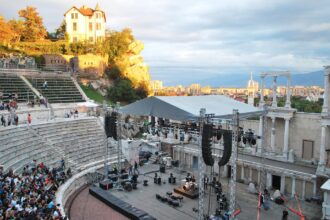
Many of the city’s most famous attractions are located here, including the Ancient Theatre of Philippopolis, Nebet Tepe, the Ethnographic Museum, and numerous beautifully restored historic mansions. Staying in the Old Town places visitors within walking distance of much of what makes Plovdiv special.
For travellers seeking atmosphere, history, and character, the Old Town remains one of the most rewarding places to base yourself anywhere in Bulgaria.
Visiting Kapana Creative District
The vibrant Kapana Creative District has become one of the most popular areas to stay in Plovdiv. Once a neglected quarter of narrow streets and workshops, Kapana has transformed into a lively neighbourhood filled with independent cafés, restaurants, galleries, bars, boutique shops, and cultural venues.
Located close to both the city centre and Plovdiv Old Town, Kapana offers visitors an excellent balance between historic sightseeing and modern urban culture. Many travellers now choose accommodation here specifically because of its atmosphere and central location.
The journey from Plovdiv Airport to Kapana typically takes around 20 to 30 minutes depending on traffic. Taxis and private transfers provide direct access to the district, while bus passengers can usually reach the area via the city centre.
One of Kapana’s biggest attractions is walkability. Visitors staying here can easily reach the Roman Stadium, Old Town, shopping districts, railway station, and many of the city’s best restaurants without requiring additional transport.
The area is particularly popular with younger travellers, couples, digital nomads, and visitors interested in Plovdiv’s creative and cultural scene. Throughout the year, Kapana hosts festivals, exhibitions, markets, and cultural events that add to its distinctive character.
For travellers looking for a lively urban atmosphere, Kapana has become one of the most desirable districts in Plovdiv.
Travelling Between Sofia Airport and Plovdiv
Although Plovdiv Airport serves the city directly, a significant number of international visitors still arrive via Sofia Airport (SOF) before continuing to Plovdiv. In fact, this route is often more important than some of the airport-specific transfer searches because Sofia offers a far wider range of international flights.
The journey between Sofia Airport and Plovdiv covers approximately 145 kilometres and can be completed using several transport options.
For rail travellers, one of the most popular methods is travelling from Sofia Airport into the city before connecting to a train from Sofia Central Station. Regular services operate throughout the day, with journey times generally ranging from 2 hours 15 minutes to 3 hours depending on the service selected. This is often the preferred choice for Interrail travellers and visitors looking for an affordable option.
Long-distance coaches provide another excellent alternative. Direct bus services operate between Sofia and Plovdiv, offering competitive prices and frequent departures. Journey times are usually comparable to rail services.
Private transfers are considerably faster and more convenient. Direct road transfers generally take around 1 hour 45 minutes to 2 hours, depending on traffic conditions. This option is particularly popular among families, business travellers, and visitors arriving on long-haul flights.
Travellers hiring a car will find the journey straightforward thanks to Bulgaria’s modern A1 Trakia Motorway, which links Sofia and Plovdiv. The route is well maintained and provides one of the easiest long-distance drives in the country.
For many international visitors, Sofia Airport to Plovdiv remains one of the most important transport connections in Bulgaria.
Exploring the Thracian Valley
One of the biggest reasons to arrive via Plovdiv Airport is access to the famous Thracian Valley, one of the most important wine-producing regions in southeastern Europe. Stretching across southern Bulgaria, the valley combines vineyards, historic sites, traditional villages, and beautiful landscapes that are often overlooked by international visitors.
The region is particularly famous for its production of Mavrud, one of Bulgaria’s most celebrated native grape varieties. Numerous wineries welcome visitors for tastings, vineyard tours, and food experiences, making the area increasingly popular with wine enthusiasts.
Many of the valley’s best wineries are located within easy driving distance of Plovdiv. This makes car hire particularly attractive for visitors wishing to explore independently. While organised tours are available, having your own vehicle provides far greater flexibility when building a personalised itinerary.
Beyond wine tourism, the region also contains important archaeological sites linked to the ancient Thracians, whose civilisation dominated much of the Balkans thousands of years ago. Historic tombs, fortresses, and cultural landmarks can be found throughout the surrounding countryside.
Combined with nearby attractions such as Bachkovo Monastery, Asen’s Fortress, and the Rhodope Mountains, the Thracian Valley offers visitors a completely different side of Bulgaria from the country’s beaches and resort destinations.
For travellers interested in wine, history, food, and culture, few regions in Bulgaria are as rewarding as the countryside surrounding Plovdiv.
Airport Hotels & Overnight Stays
While most passengers arriving at Plovdiv Airport head directly into the city, there are situations where staying near the airport can be a sensible option. Late-night arrivals, early-morning departures, business trips, and winter charter flights can all make an overnight stay particularly convenient.
Unlike Varna Airport and Burgas Airport, there is not a large concentration of airport hotels immediately surrounding the terminal. Instead, many visitors choose accommodation either in nearby Krumovo or within Plovdiv city centre, which is only a relatively short drive away.
For most travellers, staying in central Plovdiv makes more sense than booking an airport-area hotel. The city offers a far wider choice of accommodation, ranging from boutique properties in Plovdiv Old Town to stylish hotels in Kapana and modern business hotels near the commercial districts. Because transfer times to the airport are usually only around 20 to 30 minutes, visitors can enjoy the city while still remaining close to their departure point.
Luxury travellers frequently choose properties such as the DoubleTree by Hilton Plovdiv Center, while visitors seeking character often prefer boutique options in the historic centre. The compact nature of the city means that even accommodation away from the airport remains relatively convenient.
Business travellers may prefer hotels close to major roads connecting the airport and city centre, particularly when working around tight schedules. Many hotels can also arrange airport transfers directly, simplifying arrival and departure logistics.
For the vast majority of visitors, spending a night in Plovdiv rather than near the airport provides a much more rewarding experience while remaining practical from a transport perspective.
Facilities at Plovdiv Airport
Compared with Bulgaria’s larger airports, Plovdiv Airport offers a more modest range of facilities. However, its compact size often results in a faster and more relaxed passenger experience, which many travellers find preferable to navigating a major international hub.
The terminal provides the essential services required by both leisure and business travellers. Visitors will find check-in facilities, passport control, baggage handling services, waiting areas, and passenger assistance services. Walking distances are short, meaning passengers can move through the airport quickly and efficiently.
Food and drink options are available within the terminal, although visitors should not expect the extensive dining choices found at larger airports. Most passengers find the facilities more than adequate for the relatively short waiting times typically associated with flights operating from Plovdiv.
Basic shopping opportunities are also available, including travel essentials, refreshments, and selected duty-free products. While retail options are limited compared with airports such as Sofia Airport, the airport’s scale means that most passengers spend very little time navigating the terminal anyway.
Free Wi-Fi is available throughout much of the airport, allowing travellers to access travel documents, check accommodation bookings, arrange onward transport, and stay connected before departure. Seating areas are generally comfortable and easy to access.
The airport also provides facilities for passengers with reduced mobility. Travellers requiring assistance should notify their airline before departure to ensure appropriate arrangements can be made.
Overall, Plovdiv Airport prioritises simplicity and efficiency rather than scale, which suits the needs of most visitors extremely well.
Compare hostels and lower-cost places to stay in Plovdiv.
Search hostelsGet help with compensation, eligible lounge access and disruption support.
Explore AirHelp+Use convenient luggage storage around Plovdiv between arrival, check-in and departure.
Check storageStaying Connected at Plovdiv Airport
Having reliable internet access immediately after landing can make a significant difference when arriving in a new destination. Whether you need to contact accommodation providers, arrange transport, access booking confirmations, or navigate around the city, connectivity is now an essential part of modern travel.
Plovdiv Airport offers free Wi-Fi, allowing visitors to connect shortly after arrival. This is usually sufficient for checking messages, arranging transfers, and downloading tickets before leaving the terminal.
However, many travellers prefer to organise mobile data before travelling. Installing an eSIM prior to departure allows visitors to connect almost immediately upon landing, eliminating the need to search for local mobile providers or physical SIM cards.
This can be particularly useful for travellers planning to explore Plovdiv Old Town, Kapana, the Thracian Valley, or the wider region. Having access to navigation apps, restaurant recommendations, accommodation details, and transport information from the moment you arrive can greatly simplify the start of a trip.
Visitors staying for longer periods may choose to purchase a local Bulgarian SIM card in Plovdiv city centre, where there is generally a wider choice of providers and pricing options than at the airport.
For most short-term visitors, however, arriving with data already activated remains the simplest and most convenient approach. Being connected from the moment you land allows you to focus on enjoying Plovdiv rather than worrying about finding mobile services.
Common Mistakes First-Time Visitors Make
Although Plovdiv Airport is relatively easy to use, first-time visitors still make several common mistakes that can affect their journey.
One of the biggest errors is assuming that Plovdiv Airport is located within the city itself. While it is reasonably close, travellers still need onward transport to reach Plovdiv Old Town, Kapana, or the city centre. Some visitors underestimate transfer times and fail to plan accordingly.
Another common mistake is assuming there is a railway station at the airport. Bulgaria’s rail network is excellent for travelling between cities such as Sofia, Plovdiv, and Burgas, but passengers must first travel to Plovdiv Railway Station before boarding a train.
Many visitors also overlook the attractions beyond the city. The nearby Thracian Valley, Bachkovo Monastery, Asen’s Fortress, and Rhodope Mountains are among southern Bulgaria’s highlights, yet some travellers spend their entire trip within the city limits without realising what is nearby.
A further mistake is automatically flying into Sofia Airport without checking whether Plovdiv Airport offers a suitable route. Direct flights into Plovdiv can sometimes save several hours of onward travel.
Finally, many visitors fail to arrange mobile connectivity before arrival. Having access to maps, hotel reservations, and transport information immediately after landing can significantly improve the overall travel experience.
Avoiding these common mistakes helps ensure a smoother and more enjoyable visit to one of Bulgaria’s most fascinating cities.
Which Transfer Option Is Right for You?
Choosing the best transfer from Plovdiv Airport depends largely on the type of trip you are taking. Unlike Varna Airport and Burgas Airport, where many visitors are heading directly to beach resorts, travellers arriving in Plovdiv often have very different priorities. Some are visiting the city’s famous Roman monuments, others are exploring the Thracian Valley, while many are beginning wider journeys across Bulgaria.
For city-break visitors, a taxi or private transfer is usually the most practical choice. The journey into Plovdiv Old Town or Kapana is relatively short, and direct transport removes the hassle of navigating buses with luggage through historic streets and pedestrian areas.
For wine tourists, car hire often provides the greatest value. Many of the best wineries in the Thracian Valley are scattered across the countryside and are difficult to visit efficiently using public transport. Having your own vehicle allows complete flexibility when exploring vineyards, villages, and cultural attractions.
For Interrail travellers, the priority is normally reaching Plovdiv Railway Station quickly and efficiently. The airport shuttle can be the cheapest option if its timing matches your flight, while taxis provide the fastest route for those carrying luggage or working to a timetable.
For road-trip travellers, hiring a car at Plovdiv Airport unlocks some of the most rewarding destinations in southern Bulgaria. The Rhodope Mountains, Bachkovo Monastery, Asen’s Fortress, and numerous wineries become significantly easier to access independently.
For business travellers, private transfers often provide the best balance between efficiency and convenience. Fixed pricing, direct transport, and reliable collection services make planning easier when working to a schedule.
The good news is that Plovdiv Airport is compact and easy to use, meaning every transfer option is relatively straightforward compared with many larger international airports.

Rupert’s Handy Travel Tips
Flying into Plovdiv? Rupert has a few practical suggestions to help you make the most of your arrival in southern Bulgaria.
- Don’t assume Plovdiv Airport is within walking distance of the city. You’ll still need onward transport to reach Old Town, Kapana, or your hotel.
- If you’re staying in Plovdiv Old Town, check how close vehicles can get to your accommodation. The historic streets can make luggage transfers more challenging than expected.
- Consider hiring a car if you want to explore the Thracian Valley, Rhodope Mountains, or Bulgaria’s wine regions.
- If flights into Plovdiv are unavailable, don’t worry. The connection between Sofia Airport and Plovdiv is one of the easiest long-distance journeys in Bulgaria.
- Activate an eSIM before travelling so you can access maps, bookings, and transport information immediately after landing.
Rupert’s verdict: Plovdiv Airport is small, efficient, and easy to navigate. Spend less time worrying about transfers and more time exploring one of Europe’s oldest cities.
Want to learn more about Rupert? Visit our Who is Rupert? page.




Frequently Asked Questions
How far is Plovdiv Airport from Plovdiv city centre?
Plovdiv Airport is located approximately 12 kilometres south-east of the city centre. Most journeys take between 20 and 30 minutes depending on traffic conditions.
Is there a bus from Plovdiv Airport to the city centre?
Not a regular numbered city bus. A dedicated shuttle bus, timed to match the flight schedule, connects the airport with Bus Station South (Yug) in central Plovdiv for 10 BGN (about €5), paid in cash on board.
Does Plovdiv Airport have a railway station?
No. There is no railway station at Plovdiv Airport. Travellers wishing to continue by train must first travel to Plovdiv Railway Station in the city.
How do I get from Sofia Airport to Plovdiv?
Visitors can travel by train, coach, private transfer, taxi, or hire car. The journey typically takes between 1 hour 45 minutes and 3 hours depending on the transport option selected.
Is Plovdiv Airport open all year?
Yes. Plovdiv Airport operates year-round, although flight schedules vary considerably between summer and winter seasons.
Should I hire a car at Plovdiv Airport?
If you plan to explore the Thracian Valley, Rhodope Mountains, wineries, monasteries, or historic sites outside the city, car hire can be an excellent option.
How far is Plovdiv Old Town from the airport?
The journey from Plovdiv Airport to Plovdiv Old Town is usually around 20 to 30 minutes by road.
Is Plovdiv Airport or Sofia Airport better for visiting Plovdiv?
If direct flights are available, Plovdiv Airport is usually the most convenient option. However, Sofia Airport offers a much wider choice of international routes and excellent onward transport links.
Can I visit the Thracian Valley without a car?
Yes, but having a car provides significantly more flexibility when exploring wineries and attractions spread across the region.
What is Plovdiv Airport mainly used for?
The airport serves city-break visitors, business travellers, wine tourists, and winter ski traffic, as well as providing access to southern Bulgaria.

Further Reading & Related Guides
If you’re planning to explore the city after arriving, our Things to Do in Plovdiv Guide covers the Ancient Theatre of Philippopolis, Roman Stadium, Kapana Creative District, Nebet Tepe, and many of the city’s other highlights. Visitors continuing to Bulgaria’s capital should also read our Best Things To Do In Sofia Guide and Sofia Airport Transfers Guide.
Travellers interested in exploring the wider country can use our Bulgaria Travel Guide for itinerary inspiration and practical advice. Rail enthusiasts should also consult our Bulgaria Interrail Pass Guide, particularly if travelling onwards from Plovdiv Railway Station.
Before you travel, don’t forget to compare connectivity options in our eSIM Guide, helping you stay connected from the moment you land in Bulgaria.