Reviewed by our editorial team Updated
Why Visit Jerash from Amman
A day trip from Amman to Jerash is one of the easiest and most rewarding journeys you can make in Jordan. Located north of the capital, Jerash contains some of the best preserved Roman ruins anywhere in the world and offers a completely different atmosphere from the busy streets and hills of Amman.
What surprises many visitors is the sheer scale of the site. Jerash is not simply a collection of ruins or a small archaeological zone. It is an enormous ancient city filled with colonnaded streets, temples, theatres, plazas, churches, gates, and stone-paved roads that still survive in remarkable condition nearly two thousand years later.
For travellers visiting Jordan, Jerash provides one of the clearest opportunities to experience the scale and sophistication of the ancient Roman Empire outside Europe itself. Walking through the city feels far more immersive than many archaeological sites because so much of the urban layout remains visible and easy to understand.
Another major advantage is how accessible the site is from Amman. The journey normally takes under an hour by road, making Jerash one of the simplest day trips in the country. Travellers can visit independently by taxi, rental car, organised tour, or local transport, while still returning to Amman comfortably in the evening.
Jerash also contrasts strongly with Jordan’s desert landscapes. Instead of sandstone canyons and arid scenery, the area around Jerash contains rolling hills, olive groves, greener countryside, and cooler temperatures during much of the year.
For many visitors, Jerash becomes one of the biggest surprises of their entire Jordan trip. Petra may be more globally famous, but Jerash often feels easier to explore, less exhausting physically, and far more extensive than travellers initially expect.
Quick Overview of a Jerash Day Trip
A typical Jerash day trip from Amman is straightforward to organise and normally fits comfortably into a single day without feeling rushed. Most travellers leave Amman during the morning, spend several hours exploring the archaeological site, then return to the capital during the afternoon or early evening.
Because the ruins cover a very large area, most visitors spend at least three to five hours walking around the site itself. Travellers interested in photography, Roman history, archaeology, or slower paced exploration often stay even longer.
The route between Amman and Jerash is relatively simple by Jordanian standards, with good road access for most of the journey. Organised tours are extremely popular because they remove the stress of arranging transport and often combine Jerash with other northern Jordan destinations such as Ajloun Castle or Umm Qais.
One of the reasons Jerash works so well as a day trip is that the site is easy to understand visually. Even visitors with little historical knowledge can quickly recognise the Roman streets, theatres, arches, temples, and marketplaces spread throughout the city.
| Jerash Day Trip Overview | Details |
|---|---|
| Distance from Amman | Around 50 km north of the capital |
| Typical Journey Time | 45 minutes to 1 hour |
| Recommended Visit Length | 3 to 5 hours |
| Best Travel Style | Independent trip or guided tour |
| Main Attraction Type | Roman archaeological site |
| Best Known Feature | Colonnaded Roman streets and plazas |
Many travellers choose to combine Jerash with nearby cultural or historical sites because northern Jordan contains several major attractions within relatively short driving distances.
Best if you want daily housekeeping and a front desk. Filter by area first, then by price.
Check availabilityBest for longer stays. Whole apartments and houses, so you are not eating out three times a day.
View rentalsBest for double-checking. Runs the same Amman search across several booking sites so you are not leaving money behind.
Compare pricesWhere Is Jerash and Why Is It Famous?
Jerash is located in northern Jordan, approximately 50 kilometres north of Amman, in a fertile hilly region that historically formed part of important trade and military routes linking the Middle East with the Mediterranean world.
The city is famous because it contains one of the best preserved and most complete Roman provincial cities anywhere outside Italy. While many Roman sites across the world survive only as fragmented ruins, Jerash still contains remarkably intact streets, columns, arches, theatres, temples, and urban infrastructure that allow visitors to understand how the city once functioned.
Ancient Jerash was originally known as Gerasa and became one of the major cities of the Decapolis, a group of important Roman-influenced cities spread across the eastern Mediterranean region.
The city flourished particularly during the first and second centuries AD, when Roman influence across the region reached its height. Wealth generated through trade, agriculture, and regional connections allowed Gerasa to develop into a prosperous urban centre filled with monumental architecture and public buildings.
One of the most striking things about Jerash today is how walkable and visually understandable the site remains. Visitors can still follow the original stone-paved streets, stand inside large theatres, walk beneath towering columns, and trace the layout of the ancient city almost exactly as Roman inhabitants once experienced it.
Jerash is also unusual because the ruins sit directly beside the modern city of Jerash. Ancient Roman structures and modern Jordanian life exist almost side by side, creating a fascinating contrast between the ancient and contemporary worlds.
For many travellers, the site becomes especially memorable because of its atmosphere. Unlike some archaeological sites where visitors view ruins from a distance, Jerash allows people to physically move through the ancient city itself, creating a much more immersive historical experience.
How to Get from Amman to Jerash
Travelling from Amman to Jerash is relatively easy compared with many journeys elsewhere in Jordan, which is one of the reasons the site works so well as a day trip from the capital.
The most convenient option for many travellers is taking a taxi or booking a private driver. This allows maximum flexibility, direct transport between your hotel and the archaeological site, and the ability to return whenever you choose. Taxi journeys are usually straightforward because Jerash is a very well known destination for local drivers.
Rental cars are also popular because the roads between Amman and Jerash are generally manageable for confident drivers. Travellers planning to continue towards Ajloun or other northern Jordan destinations often prefer having their own vehicle for the day.
Organised tours remain one of the most common ways to visit Jerash, especially for travellers with limited time in Jordan. Many tours include hotel pickup in Amman, transport, guides, and combinations with nearby attractions such as Ajloun Castle.
Public transport is possible but less straightforward for tourists unfamiliar with Jordanian bus systems. Minibuses and shared transport services operate between Amman and Jerash, although schedules can feel less predictable than visitors from Europe or North America may expect.
One important thing travellers should understand is that Jordanian traffic conditions can vary significantly depending on the time of day. Leaving Amman early in the morning usually creates a smoother and faster journey than departing during busy traffic periods later in the day.
| Transport Option | Typical Experience | Best For |
|---|---|---|
| Taxi or Private Driver | Simple and flexible | Most tourists |
| Rental Car | Maximum independence | Multi-stop northern Jordan trips |
| Organised Tour | Easiest overall experience | Short visits and first-time travellers |
| Public Minibus | Cheaper but less predictable | Budget travellers |
Most travellers arrive at Jerash through the main visitor entrance near Hadrian’s Arch, where ticket offices, parking areas, and visitor facilities are located.
Driving from Amman to Jerash
Driving from Amman to Jerash is one of the easiest self-drive journeys in Jordan, which is one reason many travellers choose to visit independently rather than joining an organised tour. The roads are generally straightforward, the route is well known, and the overall driving distance is relatively short compared with many other major attractions in the country.
Most journeys from central Amman take between 45 minutes and 1 hour, although traffic conditions inside the capital can sometimes increase travel times significantly during busy periods. Leaving early in the morning usually creates a smoother journey and allows travellers to explore Jerash before the hottest part of the day.
The route north from Amman gradually leaves the dense urban environment behind and passes into greener hill country, olive groves, and smaller towns. For many visitors, this change in scenery becomes one of the first surprises of northern Jordan, especially after spending time in the drier desert regions further south.
Road conditions are generally good for most of the route, particularly on the larger roads leading north out of the capital. However, drivers should still remain alert because Jordanian driving standards can feel aggressive compared with parts of Europe, especially inside Amman itself.
Parking near the archaeological site is usually relatively straightforward. Most visitors park near the main entrance area close to Hadrian’s Arch, where ticket offices, cafés, and visitor facilities are located.
One major advantage of driving independently is flexibility. Travellers can spend as long as they want exploring Jerash itself without needing to follow tour group schedules. Having a rental car also makes it much easier to combine Jerash with nearby destinations such as Ajloun Castle, Umm Qais, or other parts of northern Jordan during the same day.
Travellers should also remember that temperatures around Jerash can become extremely hot during summer afternoons. Carrying water inside the vehicle is strongly recommended because exploring the archaeological site itself involves long periods of walking in direct sunlight.
For travellers planning a wider northern Jordan itinerary, renting a car can often become one of the most efficient ways to explore multiple historic and cultural sites beyond Amman itself.
Guided Tours to Jerash
Guided tours remain one of the most popular ways to visit Jerash, particularly for travellers with limited time in Jordan or those wanting a deeper understanding of the site’s Roman history.
One of the biggest advantages of joining a tour is convenience. Most organised excursions include hotel pickup from Amman, transport to the archaeological site, and return travel later in the day. This removes the need to arrange taxis, public transport, or navigation independently.
For many visitors, guides also make a huge difference to the overall experience inside Jerash itself. While the ruins are visually impressive even without historical knowledge, understanding the role of the temples, theatres, streets, arches, and marketplaces helps bring the ancient city to life far more effectively.
Many tours explain how ancient Gerasa functioned during the Roman period, why it became one of the major cities of the Decapolis, and how trade, religion, entertainment, and politics shaped daily life inside the city nearly two thousand years ago.
Another advantage of organised tours is that they often combine Jerash with additional attractions in northern Jordan. Popular combinations include Ajloun Castle, Umm Qais, the Dead Sea, or religious sites around the Jordan Valley. This can make guided tours particularly useful for travellers trying to experience multiple regions of Jordan within a short itinerary.
Private tours are also widely available and are especially popular with couples, families, or small groups wanting greater flexibility. These tours often allow travellers to control how long they spend at Jerash and whether additional stops are included during the day.
Some visitors still prefer exploring independently because Jerash is relatively easy to navigate visually, and many of the major structures are clearly signposted. However, for travellers interested in Roman history or archaeology, a knowledgeable guide often adds substantial value to the experience.
For many first-time visitors to Jordan, Jerash becomes significantly more memorable when explored with historical context rather than simply walking through the ruins alone.
Jerash Entrance Fees, Tickets & Opening Hours
Visitors entering Jerash must purchase an entry ticket before accessing the archaeological site, although travellers using the Jordan Pass usually receive entry included within the pass itself.
For many tourists, the Jordan Pass represents excellent value because it combines visa-related benefits with entry to multiple major attractions across the country, including Petra, Wadi Rum, and Jerash itself. Travellers planning to visit several major Jordanian sites often save substantial money by purchasing the pass before arriving in the country.
For travellers without the Jordan Pass, the standalone entrance ticket to Jerash currently costs around 12 JOD (≈£14 / $17 / €16) for foreign visitors, with a discounted rate for children. This figure is set by Jordan’s Ministry of Tourism and can change, so it is worth checking the current rate before your visit.
The main ticket office is located near the visitor entrance close to Hadrian’s Arch, where parking areas, cafés, souvenir shops, and visitor facilities are also located.
Opening hours vary slightly depending on the season, with longer opening times during the summer months when daylight hours are extended. Most travellers prefer visiting during the morning because temperatures become significantly hotter during the middle of the day, particularly in summer.
One of the advantages of Jerash is that the archaeological site is large enough that it rarely feels overwhelmingly crowded once visitors spread throughout the ruins. Even during busy tourism periods, quieter areas can usually still be found away from the main entrance zone.
Travellers should also remember that exploring Jerash involves extensive walking on stone surfaces and open ground with relatively limited shade in certain areas. Carrying water, sun protection, and comfortable footwear is strongly recommended throughout much of the year.
| Jerash Visitor Information | Details |
|---|---|
| Jordan Pass Accepted | Yes |
| Main Entrance Location | Near Hadrian’s Arch |
| Typical Visit Length | 3 to 5 hours |
| Best Time to Visit | Morning or late afternoon |
| Terrain | Stone paths and archaeological surfaces |
Visitors planning to explore the site thoroughly should allow enough time not only for the major landmarks but also for the quieter streets, churches, theatres, and viewpoints spread throughout the ancient city.
History of Jerash
The history of Jerash stretches back thousands of years, although the city became most famous during the period of Roman rule, when it was known as Gerasa and developed into one of the most important urban centres in the eastern Roman Empire.
The area around Jerash was inhabited long before the Romans arrived, with evidence of settlement dating back to prehistoric and Hellenistic periods. However, the city’s greatest expansion began after Roman influence spread across the region during the first century BC.
Jerash eventually became part of the Decapolis, a network of important Greco-Roman cities spread across the eastern Mediterranean and Near East. These cities acted as centres of trade, administration, culture, and Roman influence throughout the region.
Because of its strategic location along regional trade routes, Gerasa became wealthy and highly developed. Merchants, soldiers, travellers, and pilgrims passed through the city, helping finance the construction of monumental public buildings, paved roads, temples, theatres, baths, fountains, and defensive walls.
Much of what visitors see today dates from the first and second centuries AD, particularly during the height of Roman imperial power. Huge colonnaded streets were constructed across the city, while monumental gateways, religious buildings, and entertainment venues demonstrated the city’s prosperity and importance.
One reason Jerash feels so visually impressive today is because the Roman city was built with durable stone architecture that survived centuries of decline, earthquakes, and abandonment. Many structures still stand to remarkable heights, allowing visitors to understand the scale of the ancient city far more clearly than at many archaeological sites elsewhere in the world.
After the Roman period, Jerash continued to exist under Byzantine and later Islamic rule. Churches were constructed across the city during the Byzantine era, many decorated with mosaics that still survive today.
Over time, however, changing trade routes, political shifts, and a series of earthquakes gradually reduced the city’s importance. Major earthquakes during the medieval period caused extensive destruction, and large parts of the city were eventually abandoned.
For centuries, much of ancient Jerash remained buried beneath soil and vegetation until archaeological excavation work began uncovering the ruins during the nineteenth and twentieth centuries. These excavations revealed one of the best preserved Roman provincial cities ever discovered.
Today, Jerash stands as one of the greatest archaeological treasures in the Middle East and remains one of the most visited historic sites in Jordan. Walking through the city now allows visitors to follow the same streets once used by Roman citizens nearly two thousand years ago.
Best for finding routes the airlines do not sell as a single ticket. Combines carriers to bring the fare down.
Search flightsBest for short trips. Install the eSIM at home and arrive in Amman with working data, no shop queue.
Browse eSIMsBest after a long flight or a late landing. Price agreed before you travel, and no taxi queue.
Check transfersUNESCO Status & World Heritage Importance
Although Jerash is not currently an official UNESCO World Heritage Site, it has been on Jordan’s UNESCO Tentative List since 2004 and is widely regarded as one of the strongest future UNESCO candidates in Jordan because of its extraordinary historical importance and state of preservation.
Many travellers are actually surprised to learn that Jerash does not already hold UNESCO status because the archaeological site feels comparable in scale and quality to some of the most famous Roman heritage sites in Europe and the Mediterranean region.
The city is internationally recognised for containing one of the best preserved examples of a Roman provincial city anywhere outside Italy itself. Unlike many ancient sites where only isolated ruins survive, Jerash still preserves large sections of its original urban layout, including colonnaded streets, theatres, temples, plazas, gates, churches, and public spaces.
One of the reasons Jerash is considered so important archaeologically is because visitors can clearly understand how the city once functioned. The surviving roads, drainage systems, marketplaces, religious buildings, and entertainment venues still form an identifiable urban landscape rather than scattered fragments of ruins.
Jerash also reflects multiple historical periods layered across the same site. Roman structures stand beside Byzantine churches, later Islamic remains, and traces of medieval occupation, showing how the city evolved over centuries of political and cultural change.
Jordan already contains several globally recognised UNESCO locations, including Petra, Wadi Rum, and the Baptism Site of Jesus. Jerash is often discussed alongside these sites because of its immense cultural and historical value.
For many visitors, one of the most remarkable aspects of Jerash is how immersive the experience feels. Instead of viewing ruins from a distance, travellers can walk directly along ancient Roman roads, stand inside theatres, pass beneath monumental arches, and move through spaces that still resemble a functioning ancient city.
The archaeological importance of Jerash continues to attract historians, researchers, archaeologists, and conservation specialists from around the world. Ongoing preservation and excavation work still reveals new discoveries within the ancient city today.
Even without formal UNESCO designation, Jerash is widely considered one of the most significant historical attractions anywhere in the Middle East and remains one of the highlights of travelling in Jordan.
Learn More from UNESCO
This destination is connected to a UNESCO World Heritage Site, recognised for its outstanding cultural, historical, or natural importance. You can explore official listings, background information, and protected heritage sites through UNESCO’s global database.
What to See in Jerash
One of the reasons Jerash impresses so many visitors is the sheer variety of ancient structures spread across the site. Rather than consisting of one single monument, the city contains an enormous collection of Roman streets, temples, theatres, arches, plazas, churches, staircases, fountains, and defensive structures that together create the feeling of a complete ancient city.
Most visitors begin near Hadrian’s Arch, the monumental gateway built to honour the visit of the Roman Emperor Hadrian during the second century AD. The scale of the arch immediately gives an indication of how wealthy and important Jerash once became during the Roman era.
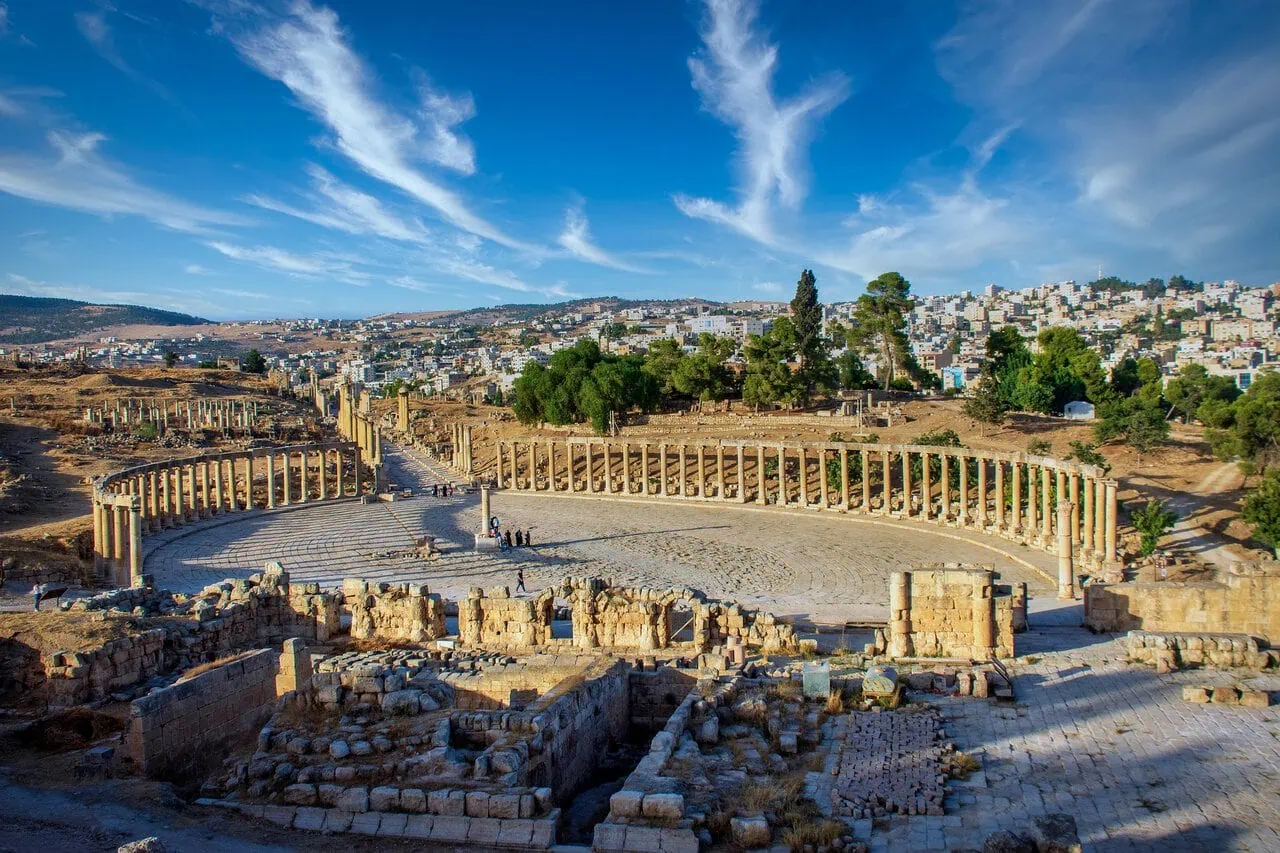
Beyond the arch lies the vast archaeological complex itself, where one of the main highlights is the famous Oval Plaza. Surrounded by columns and opening into the city’s main streets, the plaza remains one of the most visually distinctive spaces anywhere in Jordan.
The long colonnaded avenue known as the Cardo Maximus forms the backbone of the ancient city. Visitors can still walk directly along the original stone-paved Roman road while surrounded by towering columns stretching into the distance.
Jerash also contains several remarkably preserved theatres, including the impressive South Theatre, where visitors can still climb the seating areas and look down across the ancient performance space below. The acoustics inside some parts of the theatre remain surprisingly strong even today.
Religious buildings form another major part of the site. The Temple of Artemis, dedicated to the city’s patron goddess, sits on elevated ground overlooking much of Jerash and remains one of the most striking structures in the archaeological complex.
Byzantine churches scattered throughout the site contain important mosaic remains, while smaller side streets and quieter corners reveal fountains, baths, staircases, markets, and residential areas that help visitors imagine daily life inside the city centuries ago.
One of the most enjoyable things about Jerash is that many visitors discover their favourite areas accidentally while wandering through the ruins. Some of the most atmospheric parts of the site are not necessarily the largest monuments but the quieter pathways, side streets, and partially restored structures hidden deeper within the ancient city.
Walking Route Through Jerash
The best way to experience Jerash is to walk slowly through the ancient city following the original Roman streets, pathways, and colonnaded avenues that still survive remarkably well today. Unlike some archaeological sites where visitors mainly observe ruins from a distance, Jerash allows travellers to move directly through the heart of the old city itself, creating a far more immersive and atmospheric experience.
Most visitors begin near Hadrian’s Arch, the enormous ceremonial gateway that once welcomed travellers into ancient Gerasa. The scale of the structure immediately demonstrates how wealthy and important the city became during the height of the Roman Empire.
From there, the route usually continues towards the vast Hippodrome, where ancient chariot races, athletic events, and public spectacles once entertained thousands of spectators. Even today, the size of the arena helps visitors visualise the scale and energy of Roman civic life.
After passing the Hippodrome, most travellers enter the famous Oval Plaza, one of the most iconic locations anywhere in Jordan. Surrounded by elegant stone columns and opening directly onto the city’s main streets, the plaza remains one of the most visually striking parts of Jerash and often becomes a favourite photography location.
From the plaza, the route naturally follows the spectacular Cardo Maximus, the city’s main Roman avenue. Walking along this ancient street is one of the defining experiences of visiting Jerash because much of the original stone paving still survives beneath your feet. Towering columns line both sides of the road, creating one of the most impressive Roman streetscapes anywhere in the Middle East.
As you continue through the city, smaller pathways branch towards temples, theatres, churches, fountains, staircases, marketplaces, and elevated viewpoints. Many visitors gradually work uphill towards the magnificent Temple of Artemis, which overlooks large parts of the archaeological site and provides some of the best panoramic views across the ruins and surrounding countryside.
The impressive South Theatre is another major highlight. Visitors can still climb through the ancient seating areas while overlooking the stage and surrounding city ruins below. The acoustics remain surprisingly effective even today.
One of the most enjoyable things about Jerash is that the city still feels highly walkable despite its enormous size. The surviving Roman street system naturally guides visitors between the major landmarks, while quieter side streets and partially restored buildings create a sense of exploration throughout the site.
| Suggested Walking Route | Main Highlights |
|---|---|
| Hadrian’s Arch | Monumental Roman entrance gateway |
| Hippodrome | Ancient arena and entertainment complex |
| Oval Plaza | Iconic colonnaded public square |
| Cardo Maximus | Main Roman avenue and paved street |
| South Theatre | Roman performance venue and viewpoints |
| Temple of Artemis | Major religious site with elevated views |
| Byzantine Churches | Historic mosaics and religious buildings |
Most visitors spend between three and five hours exploring Jerash properly, although travellers interested in Roman history, photography, or archaeology can easily spend much longer wandering through the remarkably preserved streets and ruins.
Hadrian’s Arch
One of the first major landmarks visitors encounter at Jerash is the enormous Hadrian’s Arch, a monumental Roman gateway constructed to commemorate the visit of the Roman Emperor Hadrian during the second century AD.
The arch was built in 129 AD when Hadrian travelled through the eastern provinces of the Roman Empire. At the time, ancient Gerasa was developing into one of the region’s wealthiest and most influential cities, and the impressive gateway reflected both civic pride and loyalty to Rome itself.
Even today, Hadrian’s Arch creates a dramatic introduction to the archaeological site. Rising high above the surrounding landscape, the structure immediately gives visitors a sense of the scale, ambition, and prosperity of the Roman city beyond.
The architecture follows the classic style of monumental Roman triumphal arches, featuring huge central passageways, carved stone decoration, symmetrical design, and massive proportions intended to impress anyone entering the city. Although earthquakes and centuries of decline damaged parts of the structure, extensive restoration work has helped preserve much of its original appearance.
One reason the monument feels especially impressive is because it stands slightly apart from the denser urban ruins deeper inside Jerash. This separation allows visitors to approach the arch gradually while seeing the hills and countryside surrounding the ancient city.
For many travellers, passing beneath Hadrian’s Arch feels like crossing directly from the modern world into the Roman past. It creates one of the strongest first impressions anywhere in Jordan and immediately establishes the historical importance of the site.
The area around the arch is also one of the best locations for photography, particularly during the morning when the light illuminates the stonework and visitor numbers are generally lower.
Today, the structure remains one of the finest surviving Roman arches anywhere in the Middle East and continues to symbolise the power and prestige ancient Jerash once held within the empire.
The Hippodrome
Near the entrance to the archaeological site sits the vast Hippodrome, one of the most important entertainment spaces in ancient Jerash. During the Roman period, this huge arena hosted chariot races, horse events, athletic competitions, military displays, and large public spectacles attended by crowds from across the city.
Although parts of the structure are now ruined, the overall scale of the Hippodrome remains remarkably easy to understand. Visitors can still clearly see the long oval shape of the arena and imagine the noise, excitement, and energy that would once have filled the stadium during major Roman events.
The Hippodrome demonstrates how Roman cities functioned not only as centres of trade and administration but also as places of mass entertainment and civic gathering. Public spectacles formed a major part of urban life throughout the Roman Empire, and arenas such as this played a central role in social and political culture.
One particularly interesting aspect of Jerash is how closely the entertainment spaces sit alongside religious buildings, markets, temples, and political areas. Walking through the city reveals how interconnected daily Roman life once was, with commerce, religion, entertainment, and public life all existing side by side within the same urban landscape.
Today, the Hippodrome often feels quieter than famous sections of Jerash such as the Oval Plaza or the Cardo Maximus, but spending time here helps visitors appreciate the enormous scale and sophistication of the ancient city far more fully.
The arena also acts as an important transition point between the monumental entrance structures near Hadrian’s Arch and the denser archaeological core deeper inside Jerash itself.
For many travellers, the Hippodrome becomes one of the first places where the sheer size and ambition of ancient Gerasa truly becomes clear.
Oval Plaza
The spectacular Oval Plaza is one of the most famous and visually distinctive locations in Jerash and is often considered the symbolic centre of the ancient city. Surrounded by elegant stone columns and framed by major Roman streets, temples, and public buildings, the plaza creates one of the most memorable views anywhere in Jordan.
What makes the plaza especially unusual is its shape. Unlike the rectangular forums found in many Roman cities, Jerash’s main public square was built in a huge oval formation, creating a dramatic open space that still feels impressive nearly two thousand years later.
The plaza originally functioned as a major civic, commercial, and social gathering space linking different sections of the city together. Merchants, travellers, officials, soldiers, and local residents would once have crossed this area constantly as part of everyday life in ancient Gerasa.
Today, visitors entering the plaza from the direction of the Hippodrome are immediately confronted by rows of towering columns curving around the enormous open square. The view becomes even more dramatic when combined with the surrounding hills, theatres, temples, and the wider archaeological site stretching beyond the plaza itself.
The vast open space also helps visitors understand the scale and ambition of Roman urban planning. Jerash was not a small frontier outpost but a wealthy and highly organised city connected to major regional trade routes throughout the eastern Roman Empire.
Many travellers spend considerable time in the Oval Plaza simply taking photographs, sitting among the ruins, or watching visitors move through the ancient city. The atmosphere changes significantly throughout the day depending on the lighting and visitor numbers, with early morning and late afternoon often creating the most atmospheric conditions.
The plaza also acts as a natural crossroads within Jerash because many of the site’s major walking routes branch outward from this central point towards the Cardo Maximus, the theatres, the temples, and the religious buildings spread across the city.
Even for visitors with little interest in archaeology, the Oval Plaza remains one of those places where the scale and grandeur of the ancient Roman world suddenly becomes very easy to imagine.
Best for a short stop where being central matters more than the room. Dorms and private rooms both listed.
See hostelsBest if you have ever given up on a claim. AirHelp checks whether the flight qualifies and pursues it for you.
See the benefitsBest for the gap between checking out and your train. Drop bags at a shop or hotel nearby and carry on.
Store your bagsCardo Maximus
The magnificent Cardo Maximus forms the main artery of ancient Jerash and remains one of the best preserved Roman streets anywhere in the world. Stretching through the centre of the city and lined with towering stone columns, the avenue still gives visitors a remarkably clear impression of what a major Roman urban centre once looked like.
Walking along the Cardo Maximus is one of the defining experiences of visiting Jerash. Large sections of the original stone paving still survive beneath your feet, while rows of columns continue into the distance on both sides of the avenue.
During the Roman period, this street functioned as the commercial and social heart of the city. Shops, markets, public buildings, fountains, and gathering spaces once lined the route, while merchants, officials, travellers, and local residents moved constantly through the busy urban centre.
One of the most fascinating details visitors notice today is the visible cart wheel grooves carved into the paving stones. These marks provide a direct physical connection to the everyday life of the city nearly two thousand years ago and remain one of the most striking small details in the entire archaeological site.
The Cardo Maximus also demonstrates the sophistication of Roman engineering and city planning. Drainage systems, underground infrastructure, and carefully organised street layouts formed part of a highly advanced urban design intended to support large populations and constant daily activity.
As visitors continue along the avenue, smaller side streets branch towards temples, churches, plazas, baths, fountains, staircases, and residential areas. This creates a strong feeling of moving through a genuine ancient city rather than simply observing isolated ruins.
The avenue becomes especially atmospheric during quieter moments when visitor numbers thin out and the surrounding columns cast long shadows across the ancient paving stones. Many travellers say this is the point where Jerash feels most immersive and historically alive.
For photographers, the Cardo Maximus also provides some of the best visual perspectives in the archaeological site, with the endless lines of columns creating dramatic symmetry stretching deep into the ruins.
Today, the avenue remains one of the clearest surviving examples of Roman urban architecture anywhere in the Middle East and stands as one of the major highlights of travelling in Jordan.
The Temple of Artemis
Standing on elevated ground above much of the ancient city, the impressive Temple of Artemis remains one of the most important and visually striking structures in Jerash.
The temple was dedicated to Artemis, the patron goddess of ancient Gerasa, and originally formed one of the city’s most important religious centres during the height of the Roman period. Construction began during the second century AD, when Jerash was experiencing its greatest prosperity and expansion.
Although much of the original structure has been damaged over the centuries, several enormous Corinthian columns still remain standing today, creating one of the most recognisable and dramatic silhouettes anywhere in the archaeological site.
The elevated position of the temple also provides some of the best panoramic views across Jerash. From the surrounding terraces and pathways, visitors can look down across the Oval Plaza, the Cardo Maximus, the theatres, churches, and the wider ruins spread across the ancient city below.
Reaching the temple involves climbing uphill through sections of the archaeological complex, but the views and atmosphere make the effort worthwhile. Along the route, travellers pass staircases, ruined walls, smaller shrines, and partially restored structures that help demonstrate the enormous scale of the ancient city.
The surviving columns reveal the ambition and sophistication of Roman religious architecture. Even in their incomplete state, the structures still communicate the wealth and political importance Jerash once possessed during its peak centuries under Roman rule.
One of the most fascinating aspects of the Temple of Artemis is how it combines monumental architecture with dramatic landscape positioning. The temple dominates the surrounding city visually, reinforcing the religious and symbolic importance it once held within ancient Gerasa.
The site becomes especially beautiful during the late afternoon, when warm sunlight illuminates the pale stone columns and the hills surrounding northern Jordan.
For many travellers, the Temple of Artemis represents the moment where Jerash feels most monumental, most atmospheric, and most unmistakably Roman.
The South Theatre
The large South Theatre is one of the most impressive surviving structures in Jerash and remains one of the clearest examples of Roman entertainment architecture anywhere in the region.
Built during the first century AD, the theatre once hosted performances, ceremonies, speeches, music, and major public gatherings attended by thousands of spectators. Even today, much of the seating area survives remarkably well, allowing visitors to climb through the structure and experience the scale of the venue directly.
One of the most remarkable features of the South Theatre is its acoustics. Sounds projected from the stage area can still travel surprisingly clearly through parts of the seating sections, demonstrating the sophisticated engineering skills of Roman architects and builders.
The elevated seating rows also provide excellent views across parts of the archaeological site and the surrounding hills beyond Jerash itself. Many visitors climb to the upper levels specifically for photography and panoramic views across the ruins.
Unlike modern theatres designed mainly for comfort and entertainment, Roman theatres functioned as major civic gathering spaces connected closely with political, religious, and social life. Public ceremonies, performances, speeches, and celebrations all played important roles within Roman urban culture.
The stone staircases, seating rows, arches, and stage areas remain highly atmospheric today, particularly during quieter periods when the theatre becomes less crowded and visitors can fully appreciate the scale of the structure.
At certain times, cultural performances and demonstrations have occasionally taken place inside the theatre, helping travellers visualise how the venue originally functioned during the height of ancient Gerasa.
For many visitors, the South Theatre becomes one of the easiest places in Jerash to imagine daily life in the ancient city because the structure still feels so architecturally complete compared with many archaeological ruins elsewhere in the world.

Byzantine Churches & Mosaics
Although Jerash is best known for its spectacular Roman ruins, the city also contains an important collection of Byzantine churches and surviving mosaic floors that reveal how the city continued to evolve long after the Roman period declined.
During the Byzantine era, Christianity spread across the region and many older Roman buildings were adapted or replaced with churches and religious structures. At its height, Jerash contained numerous churches spread throughout the city, many decorated with detailed mosaics, carved stonework, and religious symbolism.
Today, visitors walking through the archaeological site can still see the remains of several important churches, particularly in the areas surrounding the Temple of Artemis and the higher sections of the ancient city. Although many structures survive only partially, the remaining stonework and mosaic fragments still provide a fascinating glimpse into this later phase of Jerash’s history.
Some of the surviving mosaics are particularly impressive because of their detail and preservation. Decorative geometric patterns, inscriptions, and symbolic Christian imagery remain visible in parts of the church floors despite centuries of earthquakes, weather damage, and abandonment.
One of the most interesting aspects of Jerash is how the city reflects multiple civilisations layered on top of one another. Roman streets and pagan temples stand alongside Byzantine churches and later Islamic remains, allowing visitors to see how the city changed over hundreds of years rather than existing as a single frozen moment in history.
The church areas also tend to feel quieter than major landmarks such as the Oval Plaza or Cardo Maximus, making them particularly atmospheric for slower exploration and photography.
For travellers interested in religious history, archaeology, or the transition between the Roman and Byzantine worlds, these churches add an important extra dimension to the Jerash experience beyond the city’s famous Roman monuments.
The surviving mosaics also demonstrate the artistic sophistication and wealth that continued to exist in Jerash even after the peak of Roman imperial power had passed.
Jerash Festival & Events
Every year, the ancient ruins of Jerash become the setting for one of the most famous cultural events in Jordan, the Jerash Festival of Culture and Arts.
Held during the summer months, the festival transforms parts of the archaeological site into a major performance venue featuring concerts, theatre productions, dance performances, poetry, exhibitions, and cultural events from across the Middle East and beyond.
One of the reasons the festival feels so unique is the setting itself. Watching performances inside ancient Roman theatres surrounded by two thousand years of history creates an atmosphere very different from a modern concert venue.
The festival has become one of Jordan’s best known cultural celebrations and attracts both local visitors and international tourists. During the event, Jerash becomes far busier than usual, with performers, artists, musicians, and visitors filling the ancient streets and theatres.
For many travellers, visiting Jerash during the festival provides a completely different experience compared with visiting during quieter periods. The ruins feel more alive, with music, performances, lights, and crowds bringing energy back into spaces originally designed for public gatherings and entertainment during the Roman era.
At the same time, travellers who prefer calmer archaeological exploration may prefer visiting outside the festival season because the site can become significantly more crowded during major performances and events.
The South Theatre and other large performance spaces inside Jerash are often used during the festival because of their remarkable acoustics and dramatic historical setting.
Even outside official festival dates, Jerash occasionally hosts smaller performances, demonstrations, or cultural activities that help visitors imagine how the city once functioned as a centre of entertainment and public life.
For travellers interested in combining archaeology with contemporary Jordanian culture, the Jerash Festival offers one of the most unusual and memorable experiences anywhere in the country.
How Long to Spend in Jerash
One of the biggest mistakes travellers make when visiting Jerash is underestimating the size of the archaeological site. Many visitors initially assume they will spend one or two hours exploring the ruins before quickly moving on, but in reality Jerash is far larger and more immersive than most people expect.
For most travellers, a comfortable visit normally requires at least three to five hours, especially if you want enough time to explore the main streets, theatres, temples, churches, viewpoints, and quieter sections of the city without rushing constantly.
Visitors interested mainly in the major highlights such as Hadrian’s Arch, the Oval Plaza, the Cardo Maximus, the Temple of Artemis, and the South Theatre can usually complete a shorter visit in around three hours. However, travellers interested in photography, Roman history, archaeology, or slower paced exploration often spend considerably longer wandering through the ruins.
One reason Jerash takes longer to explore than expected is because the city feels highly walkable and encourages exploration. Smaller side streets, elevated pathways, churches, staircases, and quieter ruins constantly tempt visitors away from the main tourist routes.
The weather also affects how long people stay. During the cooler months, travellers often spend much longer inside the archaeological site because walking conditions are far more comfortable. In the height of summer, the intense heat and limited shade can make exploration more physically tiring, especially during midday.
Many visitors combine Jerash with nearby attractions such as Ajloun Castle or Umm Qais, particularly when travelling by rental car or organised tour. In these cases, travellers usually spend slightly less time at Jerash itself to allow enough time for the wider itinerary.
Travellers arriving early in the morning often enjoy the best overall experience because temperatures are cooler, lighting conditions are excellent for photography, and visitor numbers are generally lower.
For many people, Jerash ultimately becomes one of those places where the experience improves the slower you move through it. Rushing through the city quickly often means missing many of the details, quieter corners, and atmospheric viewpoints that make the site feel so memorable.

Best Time to Visit Jerash
The best time to visit Jerash depends heavily on the type of experience you want, but for most travellers the most comfortable seasons are spring and autumn, when temperatures are milder and walking conditions are far more pleasant.
During spring, the hills surrounding Jerash often become greener and more colourful, creating a surprisingly scenic contrast to the pale stone ruins of the ancient city. Temperatures are usually warm without becoming overwhelmingly hot, making this one of the best periods for long days exploring the archaeological site.
Autumn also provides excellent conditions, particularly during September, October, and early November, when temperatures begin to cool after the intense Jordanian summer. The softer sunlight during this period also creates excellent photography conditions across the ruins.
Summer remains one of the busiest tourist periods, but temperatures inside Jerash can become extremely hot during the middle of the day. Much of the archaeological site offers limited shade, meaning visitors exploring during midday heat can quickly become exhausted. Travellers visiting during summer should ideally arrive early in the morning or later during the afternoon.
Winter is generally quieter and cooler, although weather conditions can occasionally become wet or cold compared with other parts of Jordan. Even so, winter visits can still be very enjoyable because the lower visitor numbers often create a calmer and more atmospheric experience inside the ruins.
Lighting conditions also make a major difference to the experience. Early morning and late afternoon usually provide the most dramatic views, with lower sunlight creating stronger shadows across the columns, plazas, temples, and stone streets.
Travellers interested in cultural events may also want to visit during the period of the Jerash Festival, when performances and activities bring extra energy to the ancient city. However, this is also when the site becomes busiest and most crowded.
For most visitors, the ideal approach is to combine cooler seasons with an early morning arrival, allowing enough time to explore Jerash slowly before temperatures and crowds increase later in the day.
Food, Cafés & Facilities Near Jerash
After spending several hours walking through the enormous ruins of Jerash, most visitors are ready for food, shade, and a break from the heat. Fortunately, the area around the archaeological site is well set up for tourism, with a range of cafés, restaurants, souvenir shops, and visitor facilities located close to the main entrance.
Near the entrance beside Hadrian’s Arch, travellers will find several small cafés and tourist restaurants serving traditional Jordanian food, grilled meats, flatbreads, salads, tea, coffee, and cold drinks. These places are especially busy during the middle of the day when organised tour groups arrive from Amman and other parts of Jordan.
One of the most common surprises for visitors is how physically tiring Jerash can become. The archaeological site is much larger than most people expect, and walking across ancient stone streets, staircases, and open ground in the Jordanian heat can quickly become exhausting. Stopping for food and water after exploring the ruins is therefore highly recommended rather than trying to rush straight back to Amman.
Travellers looking for a more traditional local experience can also find restaurants and bakeries in the modern city of Jerash itself, located directly beside the archaeological zone. These local restaurants are often cheaper than the tourist cafés near the entrance and can provide a more authentic atmosphere away from the organised tour groups.
Facilities at the site itself are generally decent by regional archaeological standards. Visitors will find ticket offices, toilets, shaded rest areas, small souvenir stalls, and parking facilities near the entrance area. However, once deeper inside the archaeological complex, facilities become much more limited, so carrying water while exploring is essential.
During the hotter months, cold drinks and shaded seating become particularly important because temperatures in northern Jordan can rise very quickly during the middle of the day. Many travellers choose to explore Jerash during the morning before stopping for lunch afterwards once the heat becomes stronger.
The combination of ancient ruins, surrounding hills, cafés, and slower paced atmosphere also makes Jerash feel noticeably calmer than parts of central Amman. Many visitors find the area surprisingly relaxing despite its importance as one of Jordan’s biggest tourist attractions.
Combining Jerash with Ajloun or Umm Qais
One of the biggest advantages of visiting Jerash is that it combines very easily with several other important attractions in northern Jordan, particularly Ajloun Castle and Umm Qais.
Many organised tours from Amman already combine these locations into a single itinerary because the distances between them are relatively manageable by Jordanian standards. Travellers renting a car also frequently combine all three destinations within the same day, although it can become a fairly long and busy itinerary.
The most popular combination is usually Jerash and Ajloun Castle. Located in the hills northwest of Jerash, Ajloun offers a completely different atmosphere from the Roman ruins. Instead of colonnaded Roman streets and theatres, visitors find a large Islamic hilltop fortress overlooking forests, valleys, and countryside across northern Jordan.
The contrast between the two sites works especially well because travellers experience two completely different historical periods during the same day. Jerash reflects the height of the Roman Empire, while Ajloun is associated with the medieval Islamic world and the era of Saladin and the Crusades.
Travellers with more time sometimes continue further north towards Umm Qais, another important archaeological site famous for its dramatic views across the Sea of Galilee, the Golan Heights, and northern Jordan. Umm Qais combines Roman ruins with spectacular scenery and is often considered one of the most underrated destinations in the country.
However, adding Umm Qais to the itinerary creates a significantly longer day because of the extra driving distance from Amman. Travellers attempting all three locations in one day should expect a packed schedule with limited downtime.
For many visitors, combining Jerash with Ajloun provides the best overall balance between archaeology, scenery, and travel time without making the day feel rushed or exhausting.
The landscapes around northern Jordan also surprise many travellers. Compared with the desert scenery associated with places like Petra and Wadi Rum, this region contains greener hills, olive groves, forests, farmland, and cooler temperatures during much of the year.

Safety, Clothing & Practical Tips
Visiting Jerash is generally very straightforward and safe for tourists, but there are several practical things travellers should know before arriving at the archaeological site.
The biggest challenge for most visitors is not security but the combination of heat, walking distances, and uneven surfaces. Jerash is far larger than many people expect, and exploring the ruins properly involves several hours of walking across ancient stone paving, staircases, gravel paths, and open ground.
Comfortable footwear is therefore extremely important. Trainers or walking shoes are far better than sandals or unsuitable fashion footwear, especially because some areas of the site contain uneven stones polished smooth by centuries of use and weathering.
The weather also catches many travellers off guard, particularly during summer. Large sections of Jerash offer very limited shade, and temperatures can become extremely hot during the middle of the day. Carrying water, sunscreen, hats, and light clothing is highly recommended throughout much of the year.
Early morning visits are often the most comfortable because temperatures remain cooler and the archaeological site is generally quieter. This also provides much better lighting conditions for photography compared with the harsher midday sun.
Travellers should also be prepared for a substantial amount of walking uphill in certain areas, particularly around the Temple of Artemis and the elevated sections of the ruins. Although the site is manageable for most visitors, it can become tiring in hot conditions.
As with most major tourist attractions in Jordan, visitors may encounter souvenir sellers near the entrance areas. However, Jerash is generally calmer and less intense than some heavily visited sites elsewhere in the region.
One of the most useful practical tips is simply allowing enough time. Jerash becomes far more enjoyable when explored slowly rather than rushed between landmarks. Many travellers who initially planned a quick stop end up staying much longer once they realise how extensive and atmospheric the ancient city actually is.
For most visitors, Jerash ultimately feels far safer, calmer, and easier to explore than they initially expected before arriving in Jordan.

Rupert’s Handy Travel Tips
Visiting Jerash is much more physically demanding than many travellers expect because the archaeological site is enormous and involves long periods of walking across stone streets and open ground. Rupert strongly recommends treating the visit like a proper outdoor activity rather than a quick sightseeing stop.
- Arrive early: temperatures become extremely hot during summer afternoons, and the lighting is much better for photography in the morning.
- Wear comfortable shoes: the ancient paving stones can become slippery and uneven in places throughout the ruins.
- Carry more water than you think you need: shade becomes limited once you are deeper inside the archaeological site.
- Slow down and explore the side streets: some of the most atmospheric areas of Jerash are away from the main tourist routes.
Want to meet the reindeer behind our travel tips? Find out more in our page Who is Rupert?.




Frequently Asked Questions About Visiting Jerash
Is Jerash worth visiting from Amman?
Yes, Jerash is widely considered one of the best day trips from Amman and one of the most impressive archaeological sites in the entire Middle East. The city contains some of the best preserved Roman ruins anywhere outside Italy and offers a very different experience from places such as Petra or Wadi Rum.
How long does it take to get from Amman to Jerash?
The journey from Amman to Jerash usually takes between 45 minutes and 1 hour depending on traffic conditions, your starting point inside Amman, and the time of day you travel.
Can you visit Jerash independently?
Yes, many travellers visit Jerash independently by taxi, rental car, or local transport. The archaeological site is relatively easy to navigate, although guided tours can provide much deeper historical context.
Is Jerash included in the Jordan Pass?
Yes, entry to Jerash is normally included with the Jordan Pass, which also covers many other major attractions across Jordan including Petra and Wadi Rum.
How much time do you need in Jerash?
Most visitors spend between three and five hours exploring Jerash properly. Travellers interested in archaeology, Roman history, or photography often stay longer because the site is much larger than expected.
What should you wear when visiting Jerash?
Comfortable walking shoes are strongly recommended because the site contains uneven stone surfaces, staircases, and long walking distances. During warmer months, lightweight clothing, sunscreen, hats, and water are also essential because shade is limited in many areas.
Can Jerash be combined with other destinations?
Yes, many travellers combine Jerash with Ajloun Castle or Umm Qais during the same day, particularly when travelling by rental car or organised tour.
What is the best time to visit Jerash?
For most travellers, spring and autumn provide the best weather conditions. Early mornings are usually the most comfortable time to explore because temperatures are cooler and the archaeological site is generally quieter.
Further Reading & Related Guides
If you are planning a wider trip across Jordan, several other guides across AppySavvyTraveller can help you explore the country more effectively. Travellers beginning their journey in the capital should start with our detailed Amman Travel Guide, which covers transport, local apps, attractions, neighbourhoods, and practical travel advice for navigating Jordan’s largest city.
Visitors continuing south after Jerash should also read our comprehensive Petra Travel Guide, which explains how to explore Jordan’s most famous archaeological site, including practical advice on tickets, walking routes, and what to expect inside the ancient city.
Travellers planning a broader itinerary through Jordan may also find our Ultimate Jordan Road Trip guide useful, especially if combining Jerash, Ajloun, Petra, Wadi Rum, and Aqaba within one trip.
For travellers interested in Jordan’s religious and cultural heritage, our guide to the Baptism Site of Jesus and Mount Nebo explains two of the country’s most important pilgrimage destinations and how they fit into wider Jordan itineraries.
Visitors heading towards the coast after exploring northern Jordan should also read our Aqaba Travel Guide, particularly if planning to relax on the Red Sea or continue onwards towards the Jordan–Israel border crossing near Eilat.
Travellers using the Jordan Pass should also explore our detailed Jordan Pass Spotlight Guide, which explains how the pass works and how it can save significant money across multiple attractions throughout the country.