Reviewed by our editorial team Published
When the clocks change and the canal water turns black by late afternoon, Ghent does not simply switch on a few strings of lights and call it Christmas. The city runs a genuine, sprawling winter festival called the Gentse Winterfeesten, and from 3 December 2026 to 3 January 2027 it takes over the historic core between Sint-Baafsplein and Korenmarkt with more than 150 wooden chalets, an ice rink, a big wheel, and a separate artisan market tucked beneath the towers of Gravensteen castle.
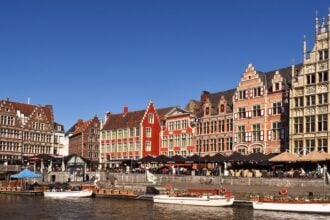
What makes Ghent’s version distinctive is not scale alone. This is a student city with a young, slightly scruffy energy that Bruges, its more polished neighbour thirty minutes down the line, does not really have, and the market threads through medieval squares where the reflections of fairy lights genuinely ripple across the Leie and Lys canals after dark. Gravensteen, the moated stone castle that has loomed over the Graslei waterfront since the twelfth century, gets its own seasonal transformation and forms a backdrop that no other Belgian Christmas market can borrow.
This guide covers where the stalls actually are, what you can eat and buy, how the ice rink and Ferris wheel work, what things cost, and how Belgian shop-closure rules differ from what visitors from the UK or Ireland might expect around 26 December. If you want the wider picture of the city beyond the festive stalls, our guide to things to do in Ghent covers Gravensteen, the cathedral and the canal boat trips in more depth.
Dates below are the 2026 to 2027 season as confirmed by the city’s own tourism office. Daily opening hours had not yet been finalised for 2026 at the time of writing, so we have used the previous season’s pattern as a reliable guide and flagged it as such.
| Market/Location | Approx. Dates (2026) | Hours | Nearest Transport |
|---|---|---|---|
| Main market, Sint-Baafsplein to Korenmarkt | 3 Dec 2026 to 3 Jan 2027 | Around midday to late evening daily, shorter on 24 & 31 Dec (previous-season pattern) | Ghent-Sint-Pieters station, then tram or bus into the centre |
| Ice rink, near St Bavo’s Cathedral | 3 Dec 2026 to 3 Jan 2027 | Similar daily hours to the market | Short walk from Korenmarkt or Sint-Baafsplein |
| Sint-Veerleplein artisan market, by Gravensteen | Early Dec 2026 to 3 Jan 2027 | Daily, similar hours to the main market | 10-minute walk from Korenmarkt |
| Winter Wonderland at Gravensteen castle | 4 Dec 2026 to 3 Jan 2027 | Daytime; check castle opening hours separately | Walkable from the main market |
The Squares and Stalls of the Gentse Winterfeesten
The Gentse Winterfeesten is not one market square but a chain of squares that visitors walk between, which is part of what makes it feel bigger and more varied than a single-site market. The city’s own tourism office describes the layout as running from Sint-Baafsplein, past the cathedral, through Botermarkt and the narrow lane of Klein Turkije, and on to Korenmarkt, with more than 150 wooden huts distributed along the route.
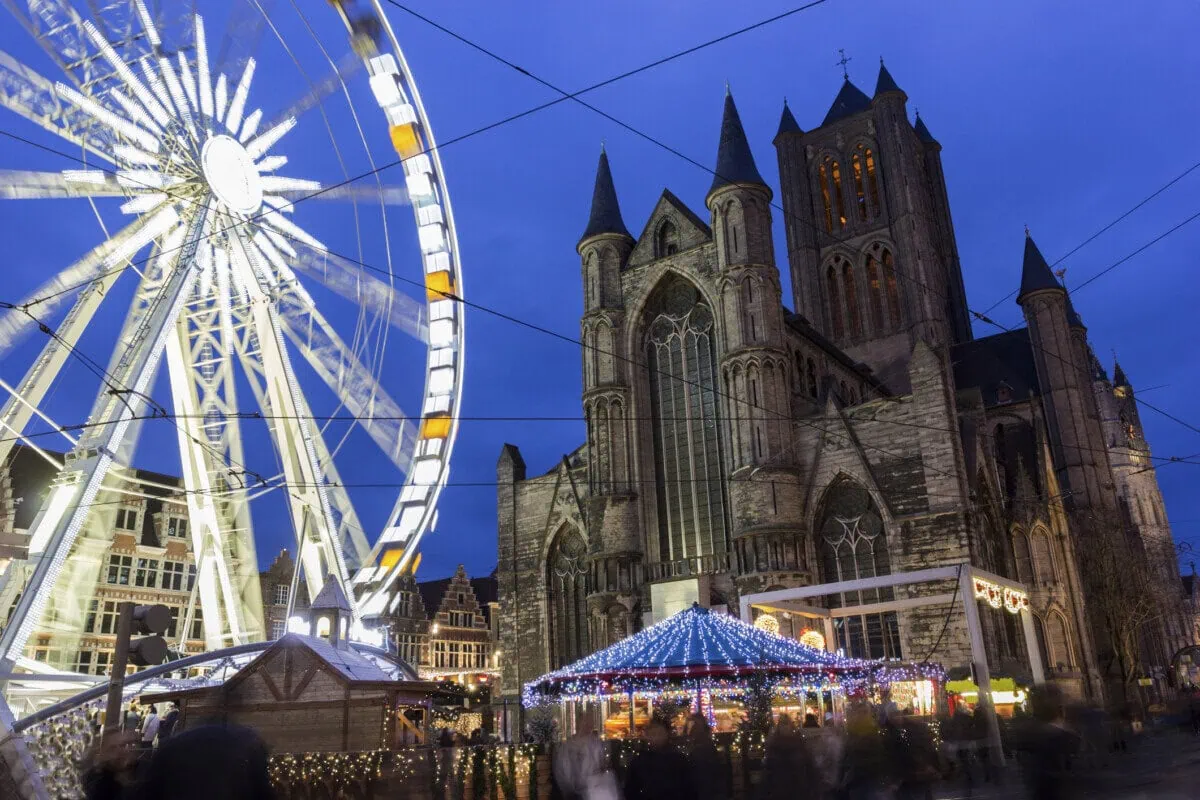
Sint-Baafsplein sits in the shadow of St Bavo’s Cathedral and is where the ice rink is normally sited, alongside a cluster of food chalets. Botermarkt and Klein Turkije, the narrowest stretch of the route, are dominated by food and drink stalls, which is where the smell of waffles and mulled wine tends to be strongest. Korenmarkt, the widest and most open square, is where the Ferris wheel stands and where the market feels most like a fairground.
A short walk away, Sint-Veerleplein, the cobbled square directly in front of Gravensteen castle, hosts a smaller, separate cluster of chalets that leans more towards artisan goods and local specialities than fairground food, and it is noticeably quieter than Korenmarkt on a Saturday evening. Layouts shift slightly from year to year, so treat the exact chalet count and precise square-by-square mix as indicative rather than fixed, and expect official maps to appear on the Winterfeesten organisers’ own site closer to December.
Ice Skating, the Big Wheel and Other Rides
Ghent’s ice rink has an unusually candid recent history worth knowing before you lace up. During the 2022 to 2024 energy crisis, the city swapped the traditional ice rink for a roller-skating track to cut energy use, a decision organisers later admitted was unpopular: visitor numbers to the rink reportedly fell from around 31,000 in 2019 to roughly 11,000 by 2024. For the 2025 season the city brought real ice back, citing more energy-efficient modern rink technology, and the ice rink was expected to continue for 2026.
The rink sits near St Bavo’s Cathedral on Sint-Baafsplein, close to the old Stadshal city pavilion, and typically runs for the full length of the festival. Skate hire is available on site for anyone without their own boots, and sessions are usually sold in timed slots on busy evenings and weekends, so arriving earlier in the day tends to mean less queuing.
Korenmarkt is home to the market’s other headline attraction, a Ferris wheel that has run under the name Grand Soleil in recent seasons, standing around 44 metres tall and giving genuinely good views over the cathedral, the Belfry and the rooftops of the old town after dark. Smaller rides round out the fairground feel, including a carousel decorated with giant illuminated baubles known as the Sapin Magique, a reindeer-themed carousel aimed at younger children, and a further carousel near Gravensteen castle itself.
Best if you want daily housekeeping and a front desk. Filter by area first, then by price.
Check availabilityBest for families, or any stay past about four nights. A kitchen and a washing machine start paying for themselves.
Browse rentalsBest if you have already picked a hotel. Checks the big booking sites for the same room and shows who is cheapest.
Check dealsThe Winter Wonderland Castle and Family Activities
Gravensteen, Ghent’s genuinely medieval moated castle, gets its own seasonal programme separate from the main market chalets, running as a Winter Wonderland from roughly 4 December 2026 to 3 January 2027. The castle’s stone halls and battlements are dressed for the season, and the visit is aimed squarely at families rather than being a straight repeat of the castle’s usual daytime tour.
One recurring feature is a children’s trail sometimes billed as the “Little Guide”, in which kids search the castle for a hidden jester character as they move through the rooms, turning what could be a dry historical visit into something closer to a treasure hunt. Regular Gravensteen admission and any winter-specific supplement apply separately from the free Christmas market itself, so check current castle ticket prices before you go rather than assuming winter dressing means free entry.
Elsewhere, St Bavo’s Cathedral has previously hosted a Christmas diorama display during the festival period, and market-adjacent activities such as reindeer or Santa meet-and-greets have featured in past seasons as part of the city’s broader “Family Fun” winter programming. None of this needs pre-booking in the way a ticketed attraction would; it is built into wandering the market itself, which suits families who do not want a rigid schedule over the school holidays.
What to Buy at the Christmas Market
Stalls at the Gentse Winterfeesten lean towards genuine craft rather than mass-produced tat, which is one reason locals still bother going back most weekends of December. Expect chalets selling handmade ceramics and pottery, wooden jewellery and accessories, hand-illustrated artwork and Christmas cards, and Belgian chocolate truffles sold by weight rather than in pre-packed boxes, alongside the more predictable tree decorations, candles and festive homeware.
Winter clothing stalls are a genuine feature too, with alpaca wool socks, scarves and other knitwear regularly turning up among the gift stalls, useful given how the wind off the canals can cut through a normal coat. Leather goods, from small wallets to belts, are another recurring category, made by independent sellers rather than chain brands.
The Sint-Veerleplein cluster by Gravensteen tends to be the better bet for slower browsing and genuinely local sellers, since it draws a fraction of the footfall that Korenmarkt does on a Friday or Saturday night. If gift shopping is the main goal, an early weekday afternoon visit before the crowds and the fairground music arrive gives stallholders more time to talk you through what they make and where it comes from.
Packing purchases home is worth a moment’s thought too, since Ghent’s cobbled squares and crowded evenings are not the easiest place to carry anything fragile for hours. Stallholders selling ceramics and glassware generally wrap purchases well, but it is still worth doing breakable buys earlier in your visit rather than last, so they are not getting jostled through Korenmarkt at its busiest. Cash machines are scattered around the surrounding streets if a stallholder is one of the rarer card-free sellers, though this is increasingly uncommon at Belgian markets.
Food and Drink at the Winterfeesten
This is where the market genuinely earns its reputation. Classic Flemish and Belgian staples dominate, starting with waffles and frites sold from stalls throughout the route, Dutch-style oliebollen doughnuts, and the inevitable cones of speculoos-flavoured treats that show up at every Belgian winter market worth visiting.
On the drinks side, glühwein and other mulled wine variations are everywhere, alongside hot Aperol drinks that have become a newer market staple in recent seasons. Belgian jenever, the juniper-based spirit that predates gin, turns up warmed and spiced at several chalets, and dedicated bars such as the Moose Bar and Chalet Chouffe serve Christmas-strength Belgian beers alongside the more familiar mulled options. Chez Babette, based at the City Pavilion, is another recurring drinks spot worth knowing by name if you are trying to find friends in a crowd.
Food goes well beyond the standard Christmas market formula too, with stalls selling oysters and shrimp croquettes reflecting Belgium’s genuine seafood tradition, churros, and hot Cécémel chocolate milk for anyone skipping alcohol. International food stalls, including Peruvian and various Asian options, have featured in recent seasons alongside the Flemish classics, so the food offering is broader than a purely traditional market if you want a change from waffles by your third visit of the season.
How Much Everything Costs
Walking around the Gentse Winterfeesten itself is free. There is no gate, ticket or entry fee for the market squares, the chalets or simply browsing the stalls, which is standard for Belgian Christmas markets and consistent across every season the festival has run.
Individual attractions are where the spending happens. Based on recent seasons, the Ferris wheel has typically cost in the region of €10 (£9/$11) for adults and around €6 (£5/$7) for children, and the reindeer carousel has run at roughly €5 (£4/$5) a ride.
Exact prices are set by the ride operators each year rather than the city, so treat these as a guide rather than a guarantee. Ice rink admission including skate hire has generally sat in a broadly similar bracket to other European city rinks, and current pricing is best confirmed on the day at the rink itself since operators do not always publish it far in advance.
Food and drink prices are typical for a Belgian city Christmas market: a cup of mulled wine or glühwein generally runs around €4 to €5 (£3 to £4/$4 to $5), a waffle from €3 to €5 (£3 to £4/$3 to $5) depending on toppings, and a beer at one of the themed bars such as Chalet Chouffe around €4 to €6 (£3 to £5/$4 to $7). None of this needs cash specifically; contactless card payment is near-universal at Belgian market stalls now.
Christmas Opening Times and Belgian Shop Closures
Belgium’s shop-closure pattern around Christmas catches out a fair number of British and Irish visitors, mostly because it does not match what they are used to at home. On 25 December, Christmas Day itself, most shops, supermarkets and everyday services close, public transport typically runs on a reduced Sunday-style schedule, and banks and postal services shut entirely, much as you would expect anywhere in Europe.
The genuinely useful thing to know is what happens on 26 December. Unlike the UK, Boxing Day is not a public holiday in Belgium, so most shops, supermarkets and services reopen and trade completely normally, with no special Boxing Day sales tradition either. If your trip is timed around picking up bargains the day after Christmas, Ghent will disappoint on that specific front, but it also means the city and its shops are genuinely open for business rather than shuttered for an extra day.
1 January, New Year’s Day, is a full public holiday and follows the same closure pattern as Christmas Day, with most shops shut and transport reduced. Christmas Eve, 24 December, is not an official holiday either, but many shops close early in the afternoon rather than trading a full day, and the Winterfeesten market itself typically runs shorter hours on both 24 and 31 December than its usual midday-to-late-evening pattern.
Sunday trading in Ghent’s centre is broadly normal for a Belgian city, with many shops, particularly around the market streets, open on Sundays through the festive season even though Sunday trading is more restricted in quieter neighbourhoods outside the centre.
Seeing in the New Year in Ghent
Ghent’s New Year’s Eve is centred on the water rather than the market squares. The city’s official fireworks display takes place at Portus Ganda marina, around the Voorhoutkaai, on the night of 31 December, with the site opening to visitors from around 11pm for atmospheric visuals and mood music before the fireworks themselves go off at midnight.
A genuinely distinctive detail is that Ghent has deliberately moved towards quieter, more animal-friendly fireworks in recent years, using smaller rockets, less gunpowder and lower launch heights specifically to reduce noise pollution for pets and wildlife rather than putting on the loudest possible show. It is a small thing, but it is a fair reflection of the city’s slightly understated approach to big public events compared with some of its neighbours.
The Winterfeesten market itself keeps running right through to 3 January 2027, so New Year’s Eve in Ghent effectively combines the last big night of Christmas market atmosphere with the fireworks down at the marina, rather than the market closing before the year turns over. Portus Ganda sits within Ghent’s low emission zone, so anyone driving in for the fireworks should check their vehicle qualifies before setting off, and public transport or a taxi is the simpler option on the night itself given the crowds.
Best for long or awkward journeys. Builds one itinerary out of separate flights.
View flightsBest for short trips. Install the eSIM at home and arrive with working data, no shop queue.
Browse eSIMsBest after a long flight or a late landing. Price agreed before you travel, and no taxi queue.
Check transfersGetting Around Ghent’s Compact Centre
Ghent’s historic core is genuinely walkable, which matters when the Winterfeesten spreads across four or five separate squares. From Korenmarkt to Sint-Veerleplein by Gravensteen is around a 10-minute walk at a normal pace, and every other market location sits somewhere on that same short stretch, so there is rarely a need for a tram or taxi once you are in the centre.
Arriving into the city is a different matter, since Ghent-Sint-Pieters, the main railway station, sits around 2.5 kilometres from Korenmarkt and the market itself. Trams and buses run frequently from the station into the centre, and the journey takes roughly 15 to 20 minutes depending on connections, which is straightforward but worth building into your timings if you are arriving by train from Brussels or elsewhere in Belgium. Our guide to Belgium train tickets explains how the country’s current fare system works if you are planning the journey in.
December in Ghent is genuinely cold and damp rather than dramatically freezing, with daytime temperatures typically hovering a few degrees either side of freezing and a real chance of rain rather than snow on any given visit. Layering matters more than a single heavy coat, and decent waterproof footwear is worth prioritising over style, since the market’s cobbled squares get slick when wet and the queues for the ice rink and Ferris wheel are entirely outdoors.
Ghent or Bruges for a Christmas Market Day Trip
Ghent and Bruges get compared constantly, and for good reason: both are compact medieval cities with canals, chocolate shops, and their own Christmas markets within roughly 30 minutes of each other by train. The honest difference is that Bruges is more consistently picture-postcard pretty and considerably busier with tourists, while Ghent has a scruffier, more lived-in feel driven partly by its large student population, and its market draws noticeably smaller crowds on an average weeknight.
For families specifically, Ghent has the edge on sheer variety of things to actually do beyond looking at buildings, given the Ferris wheel, ice rink, multiple carousels and the Gravensteen Winter Wonderland all sit within the same short walk. Bruges leans harder into atmosphere and photogenic canals than fairground-style activity, so the right choice depends on whether your group wants to do things or mostly wants to look at things.
Plenty of visitors simply do both from a Brussels base, since Ghent, Bruges and Brussels form a genuinely easy triangle by rail. If you are basing yourself in the capital, our guide to day trips from Brussels covers exactly this kind of two-city itinerary, and if you are travelling from further afield in the region, the Interrail Benelux Pass guide is worth checking before you buy individual train tickets for a longer trip.
One-Day Ghent Christmas Market Itinerary
Morning is the best time to start at Sint-Baafsplein, in front of St Bavo’s Cathedral, before the midday crowds fill the chalets around the ice rink. From there the walk through Botermarkt and Klein Turkije towards Korenmarkt is easy going, and a short detour to Graslei and Korenlei, the historic quays just off Korenmarkt, is worth the ten minutes for calm water and good daylight photographs. The Belfry, visible from several points along this stretch, is worth a glance now if you plan to climb it later, since queues build through the afternoon.
Afternoon suits the family side of the market best, starting with Gravensteen Winter Wonderland, the castle’s seasonal programme a short walk from Korenmarkt, where the children’s jester trail keeps younger visitors occupied for half an hour or so. From the castle, the Sint-Veerleplein artisan cluster is a natural next stop, quieter than Korenmarkt and better suited to unhurried gift browsing than the main run of stalls. Grab a waffle or a shrimp croquette from one of the food stands along the way rather than saving lunch for a sit-down restaurant.
Evening is when the market genuinely comes alive, so head back to Korenmarkt as the light fades to catch the Grand Soleil Ferris wheel lit up against the old town rooftops. The ice rink on Sint-Baafsplein is at its best after dark too, with the cathedral floodlit behind the skaters, and a cup of gluhwein from one of the Botermarkt stalls makes a good reason to linger rather than rush between attractions. Two to three hours after dark is enough to cover the whole route without feeling rushed.

Best Time of Day to Visit
Ghent rewards visitors who split the day rather than arriving only after dark. Daylight hours, roughly late morning through mid-afternoon, are the better window for the canals, the Graslei and Korenlei waterfront, and climbing the Belfry, since the stone facades and reflections photograph far better in natural light than under strings of market bulbs. The historic centre is also calmer before the Winterfeesten crowds build, making it easier to see Gravensteen and the guild houses rather than the queue in front of them.
Once the light drops in the late afternoon, the balance shifts firmly towards the Winterfeesten itself. The chalets, the Grand Soleil wheel and the ice rink are all designed to be seen lit up, and the canals take on a second life after dark as the market’s lights ripple across the water. Food and drink stalls are also busiest and most atmospheric in the evening, when mulled wine and waffles feel like the natural thing to be doing.
The practical recommendation is straightforward: treat daylight as sightseeing time and dusk onward as market time. Arrive by late morning, cover the Belfry and the canals before mid-afternoon, then let the market take over once the chalets are properly lit and busy. A tight one-day visit gets the best of both halves of Ghent by planning around that single hinge point.
More Than the Market: Ghent’s Historic Centre
The Winterfeesten is only one layer of a city that has plenty to offer once the chalets close for the night. Ghent’s historic centre is built around the Leie and Lys canals, and the guild houses along Graslei and Korenlei give the city a waterside character that survives whether or not the Christmas lights are on. Much of the old town, including the streets around Korenmarkt and Sint-Veerleplein, is pedestrianised, so walking between the market squares and the wider centre involves no traffic to dodge.
Outside the festival dates, Gravensteen castle, St Bavo’s Cathedral and the Belfry form the backbone of a year-round visit, and the Ghent Altarpiece inside the cathedral remains one of Belgium’s most significant artworks regardless of the season. For a fuller look at these sights, along with Patershol’s restaurant streets and the city’s museums, our guide to things to do in Ghent covers the rest of the historic centre in more depth than a market guide has room for.
That wider identity is worth keeping in mind even on a market-focused trip, since Ghent’s student population and canal-side setting give it a different character from more purely commercial Christmas destinations. A visitor with a spare hour or two beyond the stalls gets a genuinely different city, one built on medieval trade and university life rather than festive shopping alone, and the two sides of Ghent sit only a short walk apart.

Rupert’s Handy Travel Tips
A few reindeer-tested tips for making the most of the Gentse Winterfeesten without freezing or queuing your evening away.
- Go on a weekday afternoon: Korenmarkt and the Ferris wheel queue get genuinely busy on Friday and Saturday evenings; a weekday before dark is far calmer.
- Skip the ice rink queue where you can: book or arrive early on weekends, since timed sessions fill up fast once the evening crowds show up.
- Don’t skip Sint-Veerleplein: the smaller artisan market by Gravensteen gets a fraction of the footfall of Korenmarkt and is a much better spot for actual gift shopping.
- Bring a card, not just cash: almost every stall now takes contactless payment, so you don’t need to hunt for an ATM mid-market.
- Check 26 December before you plan around it: shops trade normally in Belgium that day, so don’t expect a quiet city or Boxing Day sales.
- Wear proper waterproof shoes: the cobbles around Korenmarkt and Sint-Baafsplein get slick when wet, and December in Ghent is more damp than snowy.
- Pair it with Bruges by train: the journey is short enough to see both cities’ markets from a single Belgian base if you plan your day around the train timetable.
Want to meet the reindeer behind our travel tips? Find out more in our page Who is Rupert?.




Frequently Asked Questions
When does the Gentse Winterfeesten run in 2026?
The 2026 to 2027 season runs from 3 December 2026 to 3 January 2027, spanning Sint-Baafsplein, Botermarkt, Klein Turkije and Korenmarkt, with the separate Gravensteen Winter Wonderland starting a day later on 4 December.
Is it free to visit the Ghent Christmas market?
Yes, walking around the market squares and browsing the chalets is free. You only pay for individual extras like the Ferris wheel, the ice rink, carousels, and any food or drink you buy.
Where is the ice rink in Ghent?
The ice rink is normally set up on Sint-Baafsplein near St Bavo’s Cathedral, close to the old Stadshal city pavilion, and runs for the full length of the festival with skate hire available on site.
Are shops open in Belgium on 26 December?
Yes. Unlike the UK, Boxing Day is not a public holiday in Belgium, so shops and supermarkets in Ghent trade as normal on 26 December, with no dedicated Boxing Day sales tradition.
Can I combine Ghent with a trip to Bruges?
Easily. The two cities are around 30 minutes apart by direct train, and many visitors see both Christmas markets in a single day if they start early and prioritise the highlights in each.
What is there to do in Ghent at Christmas besides the market?
The Gravensteen Winter Wonderland, the illuminated canals along the Graslei and Korenlei, and the city’s usual attractions like the Belfry and St Bavo’s Cathedral all run alongside the market itself through the festive period.
Further Reading
For more on the city beyond the Christmas stalls, our full guide to things to do in Ghent covers Gravensteen castle, the Ghent Altarpiece and the canal boat trips year-round. If you are basing a trip in the capital, things to do in Brussels and day trips from Brussels both cover how Ghent fits into a wider Belgian itinerary.
For the practical side of getting around by rail, see our guides to Belgium train tickets explained and the Interrail Benelux Pass guide, both useful if you are combining Ghent with Bruges, Brussels or destinations further afield in the Benelux region.
For official, up-to-date market information, including any last-minute changes to hours, chalet numbers or attractions, the official Gentse Winterfeesten page on visit.gent.be is the most reliable source, and it is the page the city’s own tourism office keeps updated closest to December each year.
Prices for the Ferris wheel, carousels and ice rink in this guide are drawn from recent seasons rather than an official rate card, since individual ride operators set and adjust those prices themselves rather than the city publishing them centrally, so treat them as a sensible planning guide and confirm on the day if budget is tight. Between the market squares, Gravensteen and the canal walks either side of them, two or three hours after dark is normally enough to see the Winterfeesten properly without rushing.