Reviewed by our editorial team Updated
Why Use Trains in Cornwall?
Cornwall rail travel offers one of the easiest and most enjoyable ways to explore the far south west of England. While many visitors arrive expecting to hire a car, the county’s railway network reaches some of its most popular destinations and avoids many of the traffic problems that affect Cornwall during the busy summer months. Roads into places such as St Ives, Newquay, Falmouth, and Looe can become heavily congested, while railway stations are often located within walking distance of beaches, harbours, attractions, and town centres.
The network is centred around the Cornish Main Line, which runs between Penzance and Plymouth, with several branch lines connecting some of Cornwall’s most famous destinations. Travellers can step off a train and walk directly to the beaches of St Ives, the harbour at Falmouth, the surfing capital of Newquay, or the fishing port of Looe without worrying about parking charges or narrow country roads.
For visitors travelling from elsewhere in Britain, Cornwall is also connected by the famous Night Riviera Sleeper Train, allowing passengers to leave London Paddington in the evening and wake up in Cornwall the following morning. This creates the unusual opportunity to reach the county without losing a day of sightseeing to travel.
Perhaps most importantly, Cornwall’s railway network is surprisingly easy to understand once you see how the branch lines connect. The entire system revolves around a handful of interchange stations, making it possible to travel almost anywhere in the county using a combination of main line and branch line services.
Understanding the Cornwall Rail Network
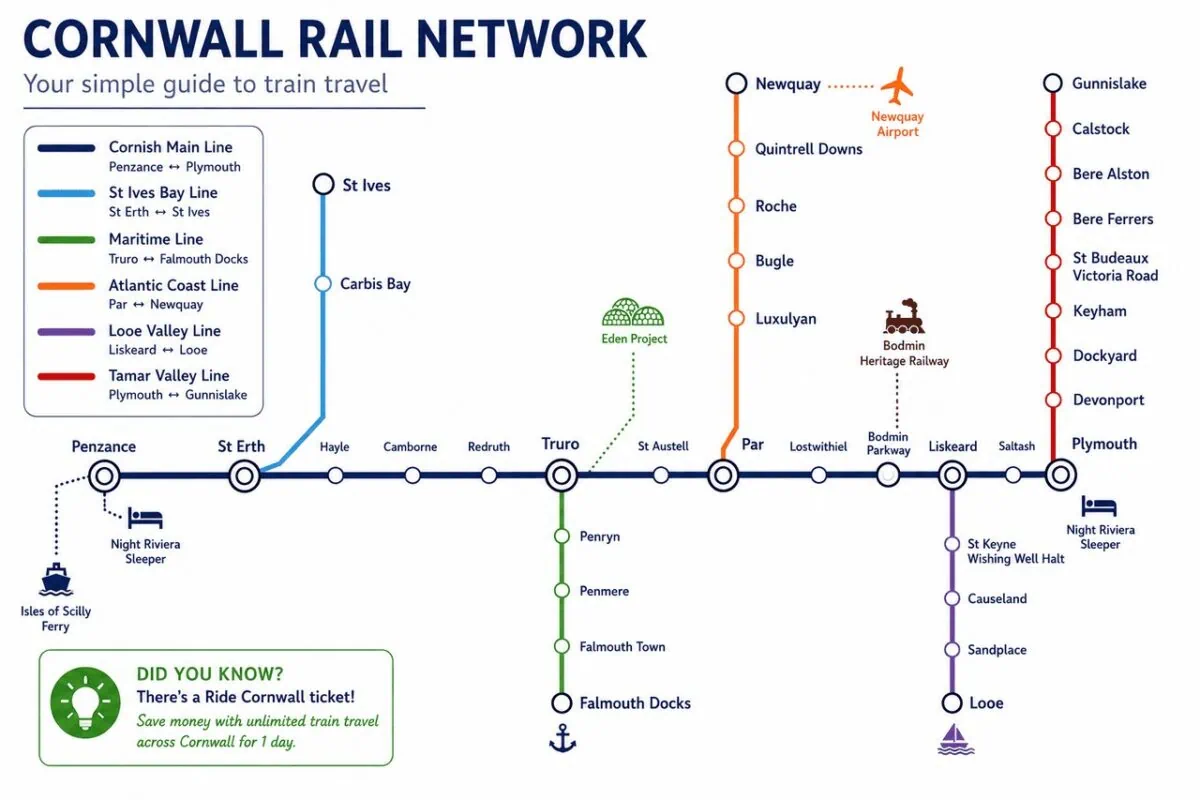
The Cornwall railway system is much smaller than many visitors expect, which actually works in its favour. Unlike larger regional networks that can appear intimidating to first-time users, Cornwall’s trains operate around a straightforward structure built upon one main route and five branch lines.
The backbone of the network is the Cornish Main Line, which links Penzance, St Erth, Hayle, Camborne, Redruth, Truro, St Austell, Par, Lostwithiel, Bodmin Parkway, Liskeard, and Plymouth. Most journeys around Cornwall begin somewhere along this route.
Several branch lines connect to the main line at key interchange stations. At St Erth, passengers can change for the famous St Ives Bay Line. At Truro, trains branch off towards Falmouth via the Maritime Line. At Par, the Atlantic Coast Line provides access to Newquay, while Liskeard acts as the gateway to the Looe Valley Line. Finally, at Plymouth, the Tamar Valley Line heads north through some of the most scenic countryside in Devon and Cornwall.
These interchange stations effectively act as Cornwall’s transport hubs. Once visitors understand where these connections are located, the entire network becomes remarkably easy to navigate. This is one reason rail travel works so well in Cornwall. Even visitors unfamiliar with the county can quickly learn how the system fits together.
Best for a short trip. Compare rooms by neighbourhood, price and guest rating before you book.
Compare hotelsBest for longer stays. Whole apartments and houses, so you are not eating out three times a day.
View rentalsBest as a last check before booking. Compares hotel rates across several sites in one search.
Compare ratesCornish Main Line: Penzance to Plymouth
The Cornish Main Line is the principal railway route through Cornwall and serves as the foundation for all rail travel within the county. Running from Penzance in the far west to Plymouth in Devon, the line links many of Cornwall’s largest towns and provides connections to every branch line in the network.
A typical stopping service takes approximately 2 hours 3 minutes to travel between Penzance and Plymouth. Along the way, trains call at St Erth, Hayle, Camborne, Redruth, Truro, St Austell, Par, Lostwithiel, Bodmin Parkway, Liskeard, Menheniot, St Germans, Saltash, and several stations around Plymouth. Faster services may omit some of the smaller intermediate stops.
For many travellers, the most useful stations are not necessarily the largest. St Erth provides access to St Ives, Truro connects with Falmouth, Par links to Newquay, and Liskeard serves the route to Looe. These stations act as gateways to some of Cornwall’s most visited destinations and are therefore particularly important for tourists.
The route itself is highly scenic. West of Truro, trains pass former mining districts that helped shape Cornwall’s industrial history. Around St Austell and Par, the landscape changes to rolling countryside and china clay country. Further west, the line passes close to the coast near Hayle and approaches the dramatic landscapes surrounding Mount’s Bay and Penzance.
Passengers arriving at Penzance can continue directly to the Isles of Scilly Ferry Terminal, while those heading east reach Plymouth, where onward connections are available to destinations across England, Wales, and Scotland. This combination of practical transport links and attractive scenery makes the Cornish Main Line far more than simply a route between stations. For many visitors, it becomes part of the holiday experience itself.
St Ives Bay Line
Among all Cornwall’s railway routes, the St Ives Bay Line is often regarded as the most beautiful. Although the journey lasts only around 12 minutes, the route has become famous for offering some of the finest coastal railway scenery in Britain.
The line begins at St Erth, where passengers leave the Cornish Main Line and board a branch service towards Carbis Bay and St Ives. Almost immediately after departure, the railway climbs above the coastline and opens up spectacular views across St Ives Bay, with golden beaches, turquoise water, and the Atlantic Ocean stretching into the distance.
The first stop is Carbis Bay, a popular destination known for its sandy beach and luxury hotels. The railway station sits within walking distance of the shoreline, making it one of the easiest beach destinations in Cornwall to reach by train.
Continuing beyond Carbis Bay, the line curves around the coastline before arriving at St Ives, one of Cornwall’s most famous seaside towns. The station sits just moments from the harbour, beaches, art galleries, and narrow historic streets that attract visitors throughout the year. Unlike many coastal destinations where railway stations are located on the outskirts of town, St Ives station places passengers directly in the heart of the action.
The branch line is particularly valuable during summer when traffic into St Ives can become extremely heavy and parking spaces scarce. Many visitors choose to leave their cars elsewhere and use the railway instead, avoiding congestion while enjoying one of Britain’s most memorable train journeys.
Maritime Line: Truro to Falmouth
The Maritime Line connects the county capital of Truro with the important port town of Falmouth and is one of the most useful branch lines for visitors exploring southern Cornwall. The complete journey takes approximately 25 minutes, making it one of the quickest ways to reach the coast from Cornwall’s main railway network.
Departing from Truro, trains travel south through the countryside before calling at Penryn, home to part of the University of Exeter Cornwall Campus and a historic town in its own right. The line then continues through Penmere before reaching Falmouth Town and finally Falmouth Docks.
One of the greatest strengths of the Maritime Line is its convenience. Both Falmouth Town and Falmouth Docks stations are located within easy walking distance of the waterfront, meaning passengers can step off the train and quickly reach the harbour, beaches, restaurants, and visitor attractions. This makes rail travel particularly attractive during summer when roads into Falmouth can become busy.
Falmouth is one of Cornwall’s most important maritime centres and offers a very different atmosphere to destinations such as St Ives or Newquay. The town combines a working harbour with historic naval connections, waterfront pubs, independent shops, and attractions including Pendennis Castle. Cruise ships also regularly visit Falmouth, further emphasising its role as one of Cornwall’s key ports.
Because the line is short and services operate throughout the day, many visitors use Truro as a base and make an easy day trip to Falmouth. Others combine the Maritime Line with the Cornish Main Line to create wider rail itineraries across the county.

Atlantic Coast Line: Par to Newquay
The Atlantic Coast Line provides Cornwall’s rail connection to Newquay, Britain’s most famous surfing destination. Although relatively short, this route plays a major role in Cornwall tourism by linking the county’s busiest beach resort with the wider national railway network.
The journey begins at Par, one of Cornwall’s most important interchange stations. From here, trains head north through Luxulyan, Bugle, Roche, and Quintrell Downs before arriving at Newquay. The full journey takes around 45 minutes, making it an easy and comfortable alternative to driving.
Unlike the dramatic coastal scenery of the St Ives branch, the Atlantic Coast Line travels through the heart of Cornwall’s interior. Passengers pass former industrial landscapes, countryside villages, and areas associated with Cornwall’s china clay industry before reaching the Atlantic coast.
The route is particularly valuable because it provides direct access to Newquay without the need to navigate summer traffic. During peak holiday periods, roads around Newquay can become extremely congested, while rail passengers arrive within walking distance of many of the town’s attractions.
Although Newquay Airport does not have its own railway station, the line remains useful for travellers arriving in the area. The airport lies a short distance from the town, allowing onward connections by bus or taxi.
For beach lovers, surfers, and families, the Atlantic Coast Line offers one of the simplest ways to reach Cornwall’s north coast. Combined with the Cornish Main Line, it allows visitors to travel from destinations such as Penzance, Truro, or Plymouth directly to Newquay without needing a car.

Organise Your your destination Train Trip with Omio
You can use Omio to research train travel for your destination, check schedules and compare ticket options before making your booking.
For journeys involving connections or multiple operators, having the available services together can make it much easier to work out your itinerary.
Scan to open
on your phone

Looe Valley Line
The Looe Valley Line is one of Cornwall’s most charming branch railways and provides access to a destination that many visitors might otherwise overlook. Running between Liskeard and Looe, the route takes approximately 28 minutes and passes through peaceful countryside before reaching the south coast.
The line leaves the Cornish Main Line at Liskeard and travels through St Keyne Wishing Well Halt, Causeland, and Sandplace before terminating at Looe. These small stations serve rural communities and help give the line a distinctly local character that contrasts with some of Cornwall’s busier tourist routes.
Part of the appeal of the Looe Valley Line is the scenery. The railway follows the East Looe River for sections of the journey, passing woodland, farmland, and attractive river views before reaching the coast. The pace feels slower and more relaxed than many modern railways, making the journey itself part of the experience.
At the end of the line sits Looe, a traditional Cornish fishing port that remains one of the county’s most attractive seaside towns. Visitors will find a bustling harbour, seafood restaurants, sandy beaches, boat trips, and narrow streets filled with independent businesses. The station is conveniently located close to the town centre, making rail travel particularly straightforward.
Many visitors are surprised by how easy it is to reach Looe by train. The branch line removes the need to navigate narrow roads and limited parking while providing a scenic introduction to one of Cornwall’s most authentic coastal destinations.
Tamar Valley Line
The Tamar Valley Line stretches north from Plymouth into the beautiful countryside surrounding the River Tamar, offering one of the most scenic railway journeys in south west England. While part of the route technically lies in Devon, it remains closely connected to Cornwall’s rail network and is often explored by visitors staying in the county.
Starting at Plymouth, trains call at Devonport, Dockyard, Keyham, St Budeaux Victoria Road, Bere Ferrers, Bere Alston, Calstock, and finally Gunnislake. The complete journey takes approximately 45 minutes.
The highlight for many passengers is the approach to Calstock, where trains cross the spectacular Calstock Viaduct high above the River Tamar. The structure is one of the most recognisable railway landmarks in the region and provides outstanding views across the valley.
Beyond Calstock, the railway continues through increasingly rural landscapes before reaching Gunnislake, close to the border between Cornwall and Devon. The area is popular with walkers, cyclists, and visitors interested in the region’s industrial heritage.
Unlike the branch lines serving Cornwall’s major beach resorts, the Tamar Valley Line appeals to travellers looking for scenery, history, and countryside rather than traditional seaside attractions. It therefore provides an excellent contrast to routes such as the St Ives Bay Line or Atlantic Coast Line.
For railway enthusiasts, the Tamar Valley Line is often considered one of the most rewarding branch lines in the south west. For general visitors, it offers a peaceful and highly scenic day trip that showcases a different side of Cornwall and its neighbouring landscapes.
Best for long or awkward journeys. Builds one itinerary out of separate flights.
View flightsBest for anyone whose home plan charges by the megabyte abroad. Pay a fixed price up front.
Check eSIMsBest after a long flight or a late landing. Price agreed before you travel, and no taxi queue.
Check transfersCornwall Attractions You Can Reach by Train
One of the biggest advantages of Cornwall rail travel is that many of the county’s most famous attractions can be reached without a car. While some rural destinations still require a short bus ride or taxi journey, the railway network provides access to many of Cornwall’s most popular visitor destinations.
Passengers arriving at Penzance are within easy reach of St Michael’s Mount, one of Cornwall’s most iconic landmarks. The tidal island sits across Mount’s Bay and can be reached by a short bus ride, taxi journey, or even a coastal walk for those looking to explore the area.
The same station also acts as the gateway to the Isles of Scilly Ferry Terminal. Travellers can arrive by train and continue directly to the Scillonian III service for onward travel to St Mary’s. This seamless rail and ferry connection makes it possible to travel from cities across Britain to the Isles of Scilly using public transport alone. Visitors planning an island trip should also see our Penzance to Isles of Scilly Ferry Guide and Isles of Scilly Travel Guide for further planning advice.
At Par, visitors can access the world-famous Eden Project, one of Cornwall’s most visited attractions. Shuttle buses frequently connect the station with the attraction, making rail travel one of the simplest ways to visit the enormous biomes and gardens without worrying about parking.
Rail enthusiasts and families may also wish to visit the Bodmin Railway, Cornwall’s principal heritage railway. Although the preserved railway operates separately from the National Rail network, Bodmin Parkway serves as the nearest connection point and acts as the gateway to one of the county’s most popular railway attractions.
The branch lines themselves also deliver passengers directly to major destinations. St Ives station sits beside some of Cornwall’s finest beaches, Falmouth Docks station provides access to the harbour and maritime attractions, Newquay station serves Cornwall’s surfing capital, and Looe station places visitors within walking distance of a traditional fishing harbour and sandy beach.
Because so many of Cornwall’s leading attractions sit close to railway stations, travelling by train is often far easier than many first-time visitors expect.
Ride Cornwall Ticket: The Best Value Rail Pass in Cornwall
For visitors planning to explore multiple destinations, the Ride Cornwall Ticket is often the best value ticket available anywhere in the county.
Many first-time visitors purchase separate tickets for journeys to places such as St Ives, Falmouth, Newquay, or Looe, unaware that a dedicated Cornwall-wide ticket exists. The Ride Cornwall Ticket allows unlimited travel across Cornwall’s railway network and participating bus services for a single day, making it particularly attractive for visitors hoping to explore several destinations during one trip.
The ticket works especially well because Cornwall’s rail network is built around short branch lines. A visitor might spend the morning in St Ives, travel to Truro for lunch, continue to Falmouth during the afternoon, and return to their accommodation in the evening, all using the same ticket.
Families often find the greatest savings because the cost of multiple individual train tickets can quickly add up during a busy sightseeing day. Travellers staying in locations such as Penzance, Truro, or St Austell can also use the ticket to make spontaneous day trips without worrying about purchasing separate fares each time they travel.
The ticket is particularly valuable during summer when roads become busy and parking charges increase across many of Cornwall’s most popular destinations. Rather than driving between attractions, visitors can simply move between branch lines and main line services throughout the day.
Anyone planning to use Cornwall’s trains extensively should strongly consider purchasing a Ride Cornwall Ticket before travelling. For a full breakdown of pricing, validity, and how to use the ticket, see our dedicated Ride Cornwall Ticket Guide.
For visitors making just one or two shorter hops rather than a full day of branch-line hopping, GWR’s contactless Pay As You Go system now covers every station in Cornwall, plus Plymouth and the Tamar Valley Line. Simply tap a contactless card or phone at the yellow readers when boarding and alighting, and the system automatically charges the cheapest available fare for that day, including weekly price capping for anyone making the same journey repeatedly. It removes the need to plan a ticket in advance and works alongside, rather than instead of, the Ride Cornwall Ticket.
Night Riviera Sleeper Train
The Night Riviera Sleeper Train provides one of Britain’s most unusual rail journeys and remains one of the most comfortable ways to reach Cornwall from London.
Operated by Great Western Railway, the sleeper departs London Paddington in the evening and travels overnight through southern England before arriving in Cornwall the following morning. Rather than spending hours travelling during the day, passengers can enjoy a night’s sleep and wake up close to some of Cornwall’s most popular destinations.
The service continues all the way to Penzance, allowing passengers to arrive within easy reach of destinations including St Ives, Falmouth, Newquay, St Michael’s Mount, and even the Isles of Scilly Ferry. This makes the sleeper particularly attractive for visitors travelling from London and the South East.
Accommodation is available in private cabins, offering considerably more comfort than attempting the journey on a late evening service. Many travellers treat the Night Riviera as part of the holiday itself, enjoying the novelty of sleeping on a train before waking up beside the Cornish coast.
The sleeper also works exceptionally well with Cornwall’s branch line network. Arriving passengers can simply transfer to local services at stations such as St Erth, Truro, Par, or Liskeard and continue deeper into the county.
For travellers hoping to maximise their time in Cornwall while avoiding a full day’s travel, the Night Riviera remains one of the most practical and memorable transport options available.
Suggested Cornwall Rail Itineraries
One of the strengths of Cornwall’s railway network is how easily different branch lines can be combined into enjoyable day trips. Visitors do not need extensive planning or complicated ticketing arrangements to see several parts of the county in a single day.
A popular itinerary begins in Penzance, continues to St Ives via the scenic branch line from St Erth, before returning to Truro and continuing onwards to Falmouth. This route combines some of Cornwall’s best coastal scenery with two of its most popular destinations and can comfortably be completed in a day.
Visitors based in eastern Cornwall might choose a route linking Looe, Par, and Newquay. This combines the relaxed atmosphere of a traditional fishing port with the beaches and surfing culture of Cornwall’s north coast, while showcasing two very different branch lines.
Rail enthusiasts often prefer a more comprehensive circuit involving the Tamar Valley Line, Looe Valley Line, Atlantic Coast Line, and St Ives Bay Line. Such a journey showcases almost every part of Cornwall’s railway network and highlights how varied the county’s branch lines really are.
For visitors arriving on the Night Riviera, a particularly efficient itinerary involves arriving at Penzance, exploring the far west of Cornwall, travelling to St Ives, and then using the main line to continue towards Truro, Falmouth, or Newquay. This approach maximises sightseeing opportunities while minimising road travel.
Cornwall Rail Travel Tips
Cornwall rail travel is generally straightforward, but a few simple tips can make journeys smoother, particularly during the busy holiday season when trains and destinations become significantly more crowded.
Summer is by far the busiest period for Cornwall’s railways. Routes serving St Ives, Newquay, and Falmouth can become extremely popular during school holidays, especially when good weather is forecast. Travellers hoping to secure seats should avoid leaving journeys until the last minute and should be prepared for busier trains during the middle of the day. Live departures, disruption alerts, and Railcard details for the whole network are available from National Rail.
Visitors should also pay close attention to interchange stations. While Cornwall’s network is easy to understand, many destinations require a change of train. Travellers heading to St Ives must change at St Erth, passengers travelling to Falmouth change at Truro, those bound for Newquay change at Par, and journeys to Looe require a connection at Liskeard. Knowing these interchange points in advance makes navigation considerably easier.
The Ride Cornwall Ticket is worth investigating before travelling. Many visitors unknowingly purchase multiple separate tickets throughout the day when a single day ticket would have provided better value. This is particularly true for travellers planning to visit more than one destination during the same day.
Those arriving from elsewhere in Britain should consider whether the Night Riviera Sleeper Train offers a more convenient option than daytime travel. Arriving in Cornwall early in the morning allows visitors to maximise their holiday time while avoiding several hours of daytime travel.
Finally, remember that Cornwall’s railway stations are often much closer to attractions than many people expect. St Ives, Falmouth Town, Falmouth Docks, Newquay, Looe, and Penzance all offer easy access to major attractions on foot. In many cases, travelling by train can actually be more convenient than driving.

Rupert’s Handy Travel Tips
Exploring Cornwall by train? Here are a few tips to help you get the most from Cornwall’s unique railway network:
- Learn the interchange stations: The most important stations on the network are St Erth, Truro, Par, and Liskeard. These are the gateways to Cornwall’s famous branch lines.
- Take the train to St Ives: During summer, parking and traffic can be challenging. Using the St Ives Bay Line from St Erth is usually faster, easier, and far more scenic.
- Consider a Ride Cornwall Ticket: If you’re planning multiple journeys in one day, this ticket can provide excellent value and covers both rail and bus travel across much of Cornwall.
- Sit on the coastal side: The journey between St Erth and St Ives offers some of the finest railway views in Britain. Choose a window seat and keep your camera ready.
- Don’t overlook the branch lines: Many visitors focus on the main line, but routes to Falmouth, Newquay, and Looe are attractions in their own right.
- Arriving from London: The Night Riviera Sleeper Train allows you to wake up in Cornwall and maximise your sightseeing time.
Want to meet the reindeer behind our travel tips? Find out more in our page Who is Rupert?.



Frequently Asked Questions About Cornwall Rail Travel
Can you explore Cornwall without a car?
Yes. Cornwall’s railway network connects many of the county’s most popular destinations, including St Ives, Falmouth, Newquay, Looe, Penzance, and Truro. Combined with local buses and occasional taxis, it is entirely possible to enjoy a Cornwall holiday without hiring a car.
What is the most scenic train line in Cornwall?
Most visitors consider the St Ives Bay Line between St Erth and St Ives to be Cornwall’s most scenic railway. The route offers spectacular views across St Ives Bay and is regularly listed among Britain’s finest railway journeys.
Can I use the Ride Cornwall Ticket on trains?
Yes. The Ride Cornwall Ticket provides unlimited travel on Cornwall’s railway network and participating bus services for one day, making it one of the best-value tickets available to visitors exploring multiple destinations.
Which station should I use for St Ives?
Passengers should travel to St Erth on the Cornish Main Line and change onto the branch service for St Ives. The branch journey takes approximately 12 minutes and includes a stop at Carbis Bay.
Can I reach the Isles of Scilly by train?
Yes. Travellers can take a train to Penzance and then continue to the Isles of Scilly Ferry Terminal for sailings to St Mary’s. This is one of the easiest ways to reach the islands without a car.
Does the Night Riviera Sleeper Train go to Cornwall?
Yes. The Night Riviera Sleeper Train operates between London Paddington and Penzance, providing overnight accommodation and direct access to Cornwall’s rail network the following morning.
Can I reach Newquay Airport by train?
Not directly. The nearest railway station is Newquay, which is connected to Par via the Atlantic Coast Line. The airport can then be reached using local transport from the town.
What is the most important interchange station in Cornwall?
Several stations play key roles, but St Erth, Truro, Par, and Liskeard are particularly important because they provide connections to Cornwall’s major branch lines.
Best for short city stops where being central matters more than the room. Dorms and private rooms both listed.
See hostelsBest for anyone flying more than once or twice a year. Handles the compensation claim so you are not chasing the airline.
See AirHelp+Best if your room is not ready yet. Left luggage booked in advance, so you are not hunting for a locker.
Check storageFurther Reading & Related Guides
Many visitors first discover Cornwall rail travel while planning a holiday to destinations such as St Ives, Penzance, Falmouth, or the Isles of Scilly. If you are travelling from London, our Night Riviera Sleeper Train Guide explains how to arrive in Cornwall overnight and connect directly onto branch line services the following morning.
Travellers heading to Cornwall’s far west should also explore our Best Things to Do in Penzance guide, which covers one of the county’s most important railway hubs and provides ideas for extending your stay beyond a simple day trip. From Penzance, many visitors continue onwards using the Penzance to Isles of Scilly Ferry, making our dedicated ferry guide and comprehensive Isles of Scilly Travel Guide useful next reads when planning an island adventure.
If your goal is to explore multiple destinations in a single day, our detailed Ride Cornwall Ticket Guide explains how Cornwall’s best-value day ticket can reduce transport costs while giving you the freedom to travel between St Ives, Falmouth, Newquay, Looe, and other destinations across the county. Finally, travellers building a wider south west itinerary should continue with our Devon & Cornwall Travel Guide, which combines Cornwall’s rail network with nearby destinations and attractions across the wider region.