Reviewed by our editorial team Updated
Why Visit Bodmin Railway?
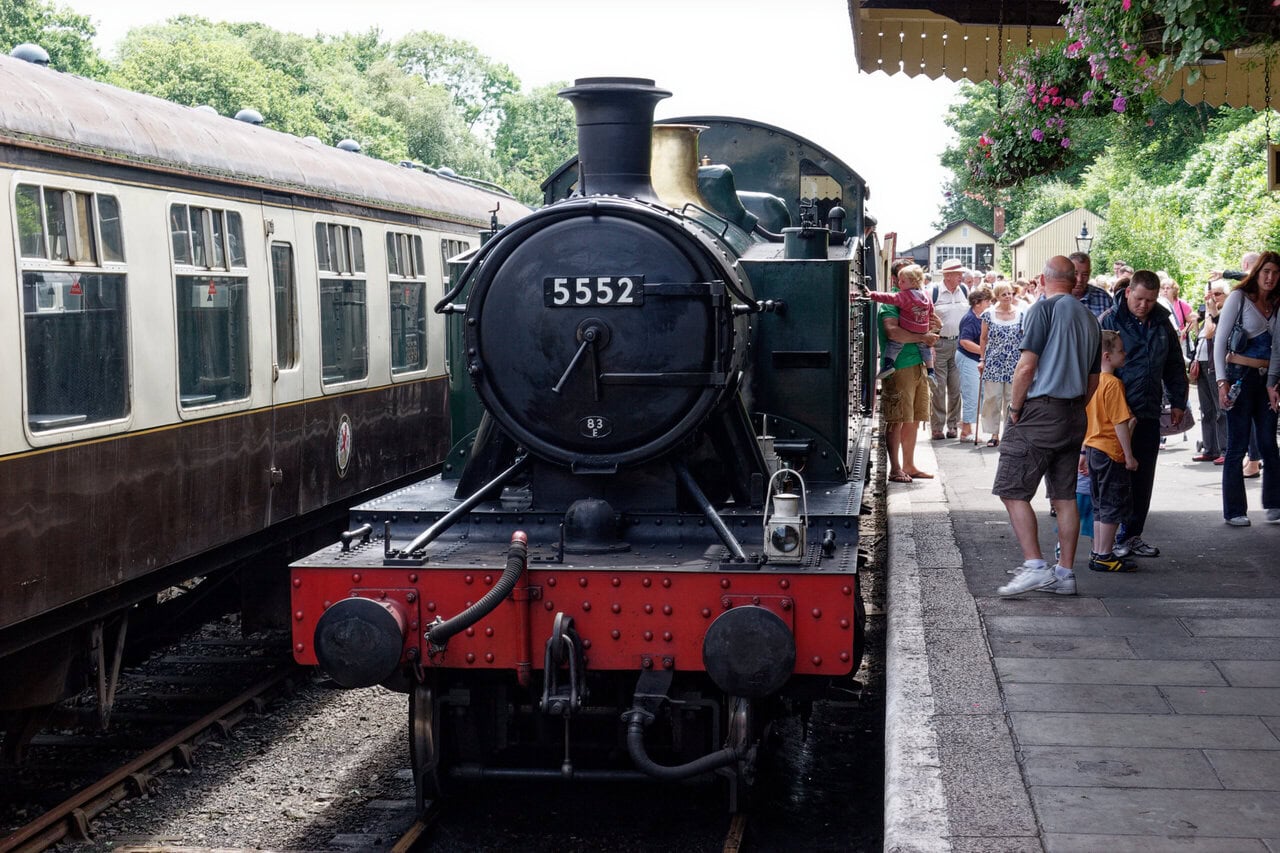
Bodmin Railway is Cornwall’s principal heritage railway and offers one of the most authentic steam railway experiences in the South West. Unlike some preserved railways that operate short demonstration rides, Bodmin Railway runs over a substantial section of former Great Western Railway track, allowing visitors to experience genuine railway heritage while travelling through attractive Cornish countryside.
What makes the railway particularly appealing is the variety it offers. Railway enthusiasts come for the restored locomotives, semaphore signalling, historic stations and traditional operating practices. Families enjoy the opportunity to ride behind a steam locomotive, explore the stations and attend seasonal events. Meanwhile, visitors already exploring Cornwall often discover that the railway provides an enjoyable half-day attraction that combines history, scenery and a relaxing train journey.
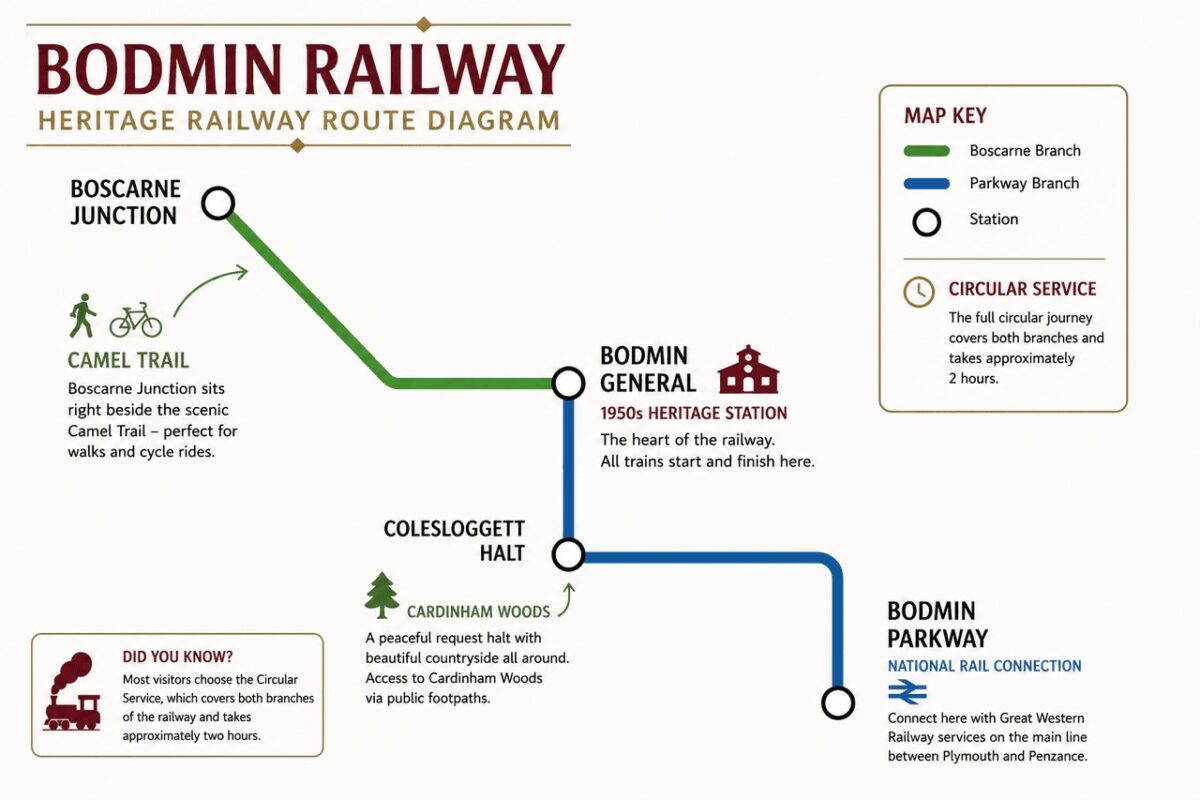
The railway is centred on beautifully restored Bodmin General Station, which recreates the atmosphere of a 1950s British Railways Western Region station. From here, trains travel towards both Bodmin Parkway and Boscarne Junction, covering a total route length of approximately 6½ miles. For many visitors, the journey itself is only part of the attraction. Watching locomotives run around their trains, observing traditional signalling, and exploring the station facilities are all part of the experience.
The location also makes the railway particularly easy to include within a wider Cornwall itinerary. Sitting close to the A30, A38, Bodmin Parkway mainline station, the Camel Trail, and attractions such as Bodmin Beacon, it can easily be combined with other Cornwall sightseeing opportunities.
Bodmin Railway at a Glance
Before planning a visit, it helps to understand how the railway operates and what to expect from the experience.
| Feature | Details |
|---|---|
| Railway Length | 6½ miles |
| Main Station | Bodmin General |
| Other Stations | Bodmin Parkway, Colesloggett Halt, Boscarne Junction |
| Typical Full Journey | Approximately 2 hours |
| Heritage Period | Primarily 1950s British Railways |
| Track Layout | Two branch lines meeting at Bodmin General |
| Main Traction | Steam and heritage diesel trains |
| Parking | Available at Bodmin General |
| Accessibility | Best access via Bodmin General |
| Nearest National Rail Station | Bodmin Parkway |
The most popular ticket is the Circular Service, formerly known as the All-Line service. This covers both branches of the railway and allows visitors to experience the entire route. The complete round trip covers approximately 13 miles of travel and typically lasts around two hours, including operational stops while locomotives run around their trains and take on water.
Unlike a simple out-and-back journey, the Circular Service allows passengers to experience both sides of the railway. This is generally the option most visitors choose because it provides the fullest experience and best value.
Best for a short trip. Compare rooms by neighbourhood, price and guest rating before you book.
Compare hotelsBest for families, or any stay past about four nights. A kitchen and a washing machine start paying for themselves.
Browse rentalsBest for double-checking. Runs the same search across several booking sites so you are not leaving money behind.
Compare pricesThe History of Bodmin Railway
The origins of today’s railway stretch back to the great age of railway expansion in Victorian Britain. Bodmin Parkway Station, originally known as Bodmin Road, was opened by the Cornwall Railway in 1859 as part of the main line linking Plymouth with Penzance. While this gave Bodmin a nearby railway connection, the station itself was located several miles outside the town.
To solve this problem, the Great Western Railway opened a branch line into Bodmin in 1887, creating what is now known as Bodmin General Station. A year later, an additional connection was built to Boscarne Junction, linking the branch with the historic Bodmin & Wadebridge Railway, one of the earliest railways in the world.
For many decades the network around Bodmin was considerably busier than it appears today. Trains once operated towards Padstow, Wadebridge, Wenfordbridge, Bodmin Road, and Bodmin North, making the area an important railway centre within Cornwall. However, changing transport patterns and the growth of road travel eventually led to closures across much of the network.
The preservation movement ensured that a significant part of this railway heritage survived. Through the efforts of volunteers and supporters, the line was gradually restored and reopened, creating the modern Bodmin Railway. Today, visitors can experience a working heritage railway while also learning about Cornwall’s wider railway history through preserved infrastructure, historic buildings, and restored rolling stock.
Understanding the Different Journeys
One aspect that can initially confuse first-time visitors is the range of ticket options available. Fortunately, the choices are straightforward once you understand how the railway is laid out.
The most comprehensive option is the Circular Service, which covers both branch lines. Trains travel from Bodmin General towards Bodmin Parkway, return through Bodmin General, and continue onwards to Boscarne Junction before returning again. This complete experience takes around two hours and is the option chosen by most visitors.
| Ticket Type | Duration | Adult Fare |
|---|---|---|
| Circular Service | Approx. 2 hours | £24 |
| Return Journey | Approx. 1 hour | £16.50 |
| Single Journey | One-way trip | £9 |
The Return Journey covers one branch line before returning to Bodmin General. This option takes approximately one hour and suits visitors who may be short on time but still want to experience a steam train ride.
The Single Journey allows passengers to travel one-way between Bodmin General and either Boscarne Junction or Bodmin Parkway. While less popular than the other options, it can be useful for visitors planning walks, connecting with the Camel Trail, or integrating the railway into a wider day out.
Children under three travel free, dogs are welcome for a small additional charge, and discounted fares are available for carers and concessionary travellers. Tickets can be booked online in advance through the Bodmin Railway official website or purchased on the day, subject to availability.
Stations on the Railway
Although the railway is only 6½ miles long, each station has its own character and tells a different part of the story of Cornwall’s railway heritage. Together they create a journey that feels much longer than the mileage might suggest.
Bodmin Parkway
Bodmin Parkway is the railway’s connection to the national rail network and remains one of Cornwall’s most important mainline stations. Located on the busy route between Plymouth and Penzance, it provides the gateway through which many visitors first arrive at Bodmin Railway.
Originally opened as Bodmin Road in 1859 by the Cornwall Railway, the station predates Bodmin General by almost thirty years. It became a junction station in 1887 when the branch line into Bodmin opened, allowing passengers to transfer between the Cornish main line and the town itself. Today, that connection survives through the heritage railway, making Bodmin Parkway one of the few places in Cornwall where visitors can step directly from a modern intercity train onto a heritage steam railway.
Heritage services operate from Platform 3, adjacent to the platforms used by modern Great Western Railway trains. This creates the unusual sight of preserved steam locomotives sharing a station with contemporary services heading towards London Paddington, Plymouth, and Penzance. For many visitors, the contrast between the two eras of railway travel is one of the highlights of the experience.
The station also contains an important physical link to the national railway network through the railway’s exchange siding. Controlled from Lostwithiel Signal Box, this connection occasionally allows visiting locomotives and rolling stock to arrive directly from elsewhere in Britain. Although it is not used by passenger trains, it remains an important operational asset and a fascinating reminder that Bodmin Railway is still physically connected to the wider railway system.
Railway enthusiasts often enjoy watching the locomotive uncouple from its train and run around to the opposite end before the return journey begins. The steep climb away from Bodmin Parkway also provides some of the most dramatic steam locomotive action anywhere on the railway, with engines working hard as they leave the picturesque Glynn Valley behind and begin the ascent towards Bodmin.
The former signal box on the platform has been converted into a café operated by the Cornish Rail Coffee Co., providing refreshments for heritage railway passengers, mainline travellers and walkers exploring the surrounding countryside. Combined with attractive valley views and excellent rail connections, Bodmin Parkway offers one of the most distinctive starting points on the railway.
Colesloggett Halt
Nestled amongst quiet Cornish countryside between Bodmin Parkway and Bodmin General, Colesloggett Halt is perhaps the railway’s most peaceful and least-known station.
Opened by Bodmin Railway in 1993, the halt was originally created to serve a nearby farm attraction which has since closed. Although the attraction itself has disappeared, the station remains and continues to provide a glimpse into a quieter side of Cornwall that many visitors never see.
Unlike the other stations on the railway, Colesloggett feels distinctly rural. There is no car park, no ticket office, and no traditional station building. Instead, passengers are surrounded by open countryside, fields, woodland and rolling landscapes that feel largely unchanged from previous generations. For many visitors, the halt captures the atmosphere of a forgotten country railway station far better than any carefully restored heritage site.
The station is also unusual operationally. Trains travelling towards Bodmin Parkway will stop here if requested, but steam trains returning towards Bodmin General do not normally call. The reason lies in the steep gradients that characterise much of the railway. Locomotives need to maintain momentum on the climb away from Bodmin Parkway, making regular stops impractical when travelling uphill.
For walkers, Colesloggett provides access to some attractive countryside routes. The most notable destination is Cardinham Woods, one of Cornwall’s most popular woodland recreation areas. However, visitors should be aware that the route involves a walk of approximately 1½ miles across fields and footpaths. Conditions can be muddy, stiles are present in places, and the route is not suitable for wheelchairs, pushchairs, or visitors with limited mobility.
For railway enthusiasts, Colesloggett offers another point of interest. The station sits on one of the most demanding sections of the line, allowing visitors to appreciate the effort required from steam locomotives as they tackle the railway’s famously steep gradients. Watching a train work its way through the surrounding countryside often feels more like a scene from a rural branch line in the 1950s than a modern tourist attraction.
Bodmin General
At the heart of the railway sits Bodmin General, the headquarters, principal station, and operational centre of the entire railway.
Opened in 1887 by the Great Western Railway, the station was built to finally provide the town of Bodmin with a direct railway connection from what is now Bodmin Parkway. More than a century later, it remains the focal point of the railway and one of the finest preserved heritage stations in Cornwall.
The station has been carefully restored to reflect the appearance of a typical 1950s British Railways Western Region station. Traditional signage, period architecture, semaphore signalling, and historic railway furniture help create an atmosphere that transports visitors back to the final years of Britain’s steam era. Unlike some heritage railways where only small sections have been restored, Bodmin General feels like a complete working railway environment.
Most visitors begin their journey here. The station houses the booking office, gift shop, café, exhibition areas, workshops, locomotive facilities and visitor amenities. The free car park makes it the most convenient starting point for many travellers, while the station’s position close to Bodmin town centre allows it to be combined easily with other local attractions.
Operationally, Bodmin General is also the most interesting location on the railway. It sits at the junction between the line to Bodmin Parkway and the line to Boscarne Junction, meaning all trains must pass through the station. Visitors can therefore watch locomotives uncouple from their trains, run around the carriages, take on water, and prepare for the next stage of the journey. These traditional railway operations are becoming increasingly rare elsewhere and are often just as fascinating as the train ride itself.
The station is also home to the railway’s workshops and locomotive facilities. While access to engineering areas is limited, visitors can often see locomotives, coaches and wagons receiving maintenance or awaiting their next turn of duty. Combined with the historic setting and active railway operations, Bodmin General offers one of the most immersive heritage railway experiences in Cornwall.
Boscarne Junction
Boscarne Junction provides a very different atmosphere from Bodmin General. Situated beside the popular Camel Trail and surrounded by peaceful countryside, it serves as both a heritage railway station and a gateway to one of Cornwall’s most popular outdoor recreation areas.
Although the site has functioned as a railway junction since the nineteenth century, there was surprisingly never a passenger station here during the heyday of the railways. The current station was constructed by Bodmin Railway and opened in 1996, designed in the style of a traditional Southern Railway halt complete with a simple platform and waiting room. Many visitors are surprised to learn that while trains have passed through Boscarne for well over a century, passengers could not actually board a train here until the preservation era.
Historically, Boscarne was one of the most important railway locations in North Cornwall. The original Bodmin & Wadebridge Railway, opened in 1834, passed through here, making it one of the earliest railway routes anywhere in the world.
Later, the Great Western Railway’s branch from Bodmin General arrived, turning Boscarne into a busy junction where trains could head towards Wadebridge, Padstow, Wenfordbridge, Bodmin Road, and Bodmin General. During the first half of the twentieth century, the area would have seen trains operated by both the Great Western Railway and the Southern Railway, creating an unusual mix of railway companies in one location.
Today, the atmosphere is considerably quieter, but traces of that fascinating history remain. Standing on the platform, it is easy to imagine the days when goods trains, passenger services, and branch line workings all converged here before the widespread closures of the 1960s transformed Cornwall’s railway network.
The station’s location beside the Camel Trail is one of its biggest attractions. Many visitors use Boscarne as the starting point for walks and cycle rides along the former railway trackbed towards Wadebridge and Padstow. The route follows the beautiful River Camel, passing through some of Cornwall’s most attractive inland scenery. Because of this, Boscarne often appeals not only to railway enthusiasts but also to walkers, cyclists, photographers, and wildlife watchers.
The surrounding area offers plenty to explore. Within walking distance are riverside paths, open countryside, local vineyards, tea rooms, and traditional Cornish pubs. The station’s waiting room, opened in 2010, provides welcome shelter for passengers waiting for the next train, while the peaceful setting encourages many visitors to linger longer than originally planned.
For railway enthusiasts, Boscarne is particularly significant because it represents the surviving fragment of a much larger network. Looking beyond the modern station, it is possible to appreciate how important this location once was to Cornwall’s railway history and why preservationists worked so hard to bring trains back here. Today, it serves as both a pleasant destination and a tangible link to one of the earliest chapters in British railway development.

What You’ll See Along the Route
The railway journey itself is one of the highlights of a visit, with the route offering a surprising variety of scenery, engineering features, and historical points of interest.
Leaving Bodmin Parkway, trains immediately begin climbing one of the steepest preserved railway routes in Britain. The gradient reaches an impressive 1 in 37, demanding considerable effort from steam locomotives and providing excellent sound effects for passengers riding behind them.
Shortly after departure, the train crosses a viaduct above the River Fowey, offering attractive views into the valley below. The route then passes the location known as Charlie’s Gate, a seemingly ordinary section of railway with a rather extraordinary history.
This stretch of line became famous because it was regularly used to stable the Royal Train overnight. Members of the Royal Family, including King Charles III, have spent nights aboard trains positioned here before continuing their journeys the following day.
The railway then passes beneath both the A38 and A30, two of Cornwall’s most important roads, before reaching Quarry Curve, the highest point on the entire railway. From here, passengers gain views towards Bodmin Beacon, whose distinctive monument can often be seen rising above the surrounding landscape.
Beyond Bodmin General, the route descends towards Boscarne through open countryside. Excellent views can be enjoyed across fields and farmland, while railway enthusiasts often appreciate the sharply curved sections of track that demonstrate the engineering challenges involved in constructing railways through Cornwall’s hilly terrain.
Approaching Boscarne, the line crosses the River Camel, one of Cornwall’s most important rivers, before arriving beside the famous Camel Trail.
Steam Trains, Diesel Trains & Special Events
While steam locomotives remain the main attraction for many visitors, Bodmin Railway offers far more than ordinary train rides.
Throughout the operating season, a mixture of steam and heritage diesel services operate according to a series of colour-coded timetables. The railway’s calendar runs from spring through autumn, with additional winter events and special services taking place throughout the year.
Steam trains dominate much of the summer timetable and provide the classic heritage railway experience. Watching a locomotive work hard on the steep gradients between Bodmin Parkway and Bodmin General is one of the highlights of any visit. The sound, smell, and atmosphere are all part of the appeal.
The railway also hosts a wide variety of special events. These include Spring Diesel Weekends, Autumn Diesel Galas, Steam Shanty Evenings, Afternoon Tea Trains, and the ever-popular Santa by Steam services that operate during the festive season.
One particularly unusual feature is the programme of themed dining and entertainment trains. Visitors can book experiences including Murder Mystery Trains, Evening Dining Trains, and even Evening Disco Trains, providing a very different way to experience the railway.
The annual operating calendar means that no two visits are necessarily the same. A summer visit behind a steam locomotive offers a very different experience from an autumn diesel gala or a festive Santa service, encouraging many enthusiasts to return multiple times throughout the year.
Accessibility & Visitor Facilities
One area where Bodmin Railway deserves considerable credit is its commitment to accessibility and visitor comfort. While heritage railways inevitably face challenges because of historic infrastructure and rolling stock, significant effort has been made to ensure as many visitors as possible can enjoy the experience.
Bodmin General provides the best accessibility across the railway. Level access is available from the car park through the booking hall and onto the platform, while accessible toilets and baby-changing facilities are available on site. Dedicated Blue Badge parking spaces are located directly outside the station entrance.
Wheelchair users can be accommodated on most daytime services, although advance booking is strongly recommended as space is currently limited to two wheelchair positions per train. Boarding ramps are available, and staff are happy to assist passengers when required.
The railway is also actively involved in supporting Cornwall’s ambition to become more autism-friendly. Visitors who may benefit from additional information about noise levels, steam locomotive operation, or station environments are encouraged to contact the railway before travelling.
Facilities for visitors are excellent by heritage railway standards. The Cornish Rail Coffee Co. café at Bodmin General serves drinks, snacks, sandwiches, cakes, and traditional Cornish favourites, while the station gift shop offers souvenirs and railway-themed merchandise. Picnic areas are available at both Bodmin General and Boscarne Junction, making it easy for visitors to spend several hours on site.
Best for long or awkward journeys. Builds one itinerary out of separate flights.
View flightsBest if you want maps and messaging working the moment you switch your phone on.
See eSIM plansBest when public transport has stopped, or when you are travelling with children and bags.
Book a transferHow to Get to Bodmin Railway
One of the biggest advantages of Bodmin Railway is how easy it is to reach. Whether you are arriving by train, car, or public transport, the railway is well positioned for visitors exploring Cornwall.
Travellers arriving by rail should head for Bodmin Parkway, one of Cornwall’s principal mainline stations. Great Western Railway services operate throughout the day between Plymouth, Exeter, Bristol, London Paddington, and Penzance, making Bodmin Railway one of the easiest heritage railways in Britain to reach without a car.
Passengers arriving from London Paddington can travel directly to Bodmin Parkway in approximately four and a half hours, while travellers from Plymouth typically reach the station in around 30 minutes. Visitors travelling from western Cornwall can expect journey times of approximately 35 minutes from Truro, 50 minutes from Redruth, and around one hour from Penzance.
Upon arrival at Bodmin Parkway, Bodmin Railway services depart from Platform 3, adjacent to the mainline platforms. The sight of a heritage steam train waiting alongside modern intercity services creates a memorable start to the experience.
Visitors travelling by car will generally find Bodmin General the most convenient starting point. The station postcode is PL31 1AG, and approximately 50–70 parking spaces are available on site. During busy operating days and special events, the car park can fill quickly, so early arrival is advisable. If parking is unavailable, the nearest alternative is the Victoria Square Pay and Display Car Park, located approximately 4–5 minutes’ walk from the station.
Those already exploring Bodmin can simply walk to the station. Bodmin General sits approximately 10–15 minutes from the town centre, making it easy to combine a railway visit with local attractions, shops, cafés, and museums.
Is Bodmin Railway Worth Visiting?
For most visitors, the answer is an easy yes.
What separates Bodmin Railway from many heritage railways is the combination of an attractive route, authentic operating practices, excellent facilities, and strong connections to Cornwall’s wider railway history. Visitors are not simply boarding a short demonstration train ride. Instead, they are experiencing a working heritage railway that recreates many aspects of Britain’s railway past.
Families tend to enjoy the steam locomotives, station facilities, and relaxed atmosphere. Railway enthusiasts appreciate the steep gradients, traditional signalling, locomotive operations, and historical significance of the route. Meanwhile, general visitors often find that the railway provides an enjoyable way to experience a different side of Cornwall away from the county’s beaches and coastal resorts.
The location also helps. A visit can easily be combined with the Camel Trail, Bodmin Beacon, Cardinham Woods, or a wider exploration of Cornwall. Because the railway connects directly with the national rail network at Bodmin Parkway, it is also accessible to visitors who prefer not to drive.
Perhaps the strongest endorsement comes from the fact that many visitors stay far longer than expected. What begins as a simple train ride often turns into several hours exploring stations, watching locomotive movements, visiting the café, browsing the gift shop, and learning about Cornwall’s railway heritage.
For anyone with even a passing interest in railways, local history, engineering, or heritage attractions, Bodmin Railway represents one of the most rewarding transport attractions in Cornwall.

Rupert’s Handy Travel Tips
Planning a trip on Bodmin Railway? Here are a few useful tips to help you get the most from your visit:
- Choose the Circular Service: Most visitors find the full two-hour Circular Service offers the best value, allowing you to experience both branches of the railway.
- Arrive early at Bodmin General: The station itself is part of the attraction. Leave time to explore the restored 1950s station, signal box, gift shop and locomotive facilities.
- Bring a camera: Some of the best photo opportunities are found around Charlie’s Gate, Quarry Curve, the River Fowey crossing and the approach to Boscarne Junction.
- Combine your visit with the Camel Trail: Boscarne Junction sits directly beside one of Cornwall’s most popular walking and cycling routes.
- Book special events early: Santa by Steam, dining trains, murder mystery events and diesel galas are among the railway’s most popular experiences and often sell out in advance.
- Arriving by train: Heritage services connect directly with Great Western Railway services at Bodmin Parkway, making Bodmin Railway one of the easiest heritage railways in Britain to reach without a car.
Want to meet the reindeer behind our travel tips? Find out more in our page Who is Rupert?.



Frequently Asked Questions About Bodmin Railway
How long is the full Bodmin Railway journey?
The full Circular Service covers both branches of the railway and takes approximately two hours, including operational stops at Bodmin General and Bodmin Parkway.
Which station should I start from?
Most visitors start at Bodmin General, which has parking, the café, gift shop, toilets, and the railway’s main facilities.
Can I join the train at Bodmin Parkway?
Yes. Bodmin Railway trains operate from Platform 3 at Bodmin Parkway and connect directly with Great Western Railway services.
Are steam trains available every day?
Not always. Bodmin Railway operates a mixture of steam and diesel services depending on the timetable and time of year.
Can I bring my dog?
Yes. Dogs are welcome on trains for a small additional charge, provided they remain under control and on a lead.
Is Bodmin Railway suitable for children?
Absolutely. The combination of steam locomotives, historic stations, countryside scenery, and family-friendly facilities makes it popular with children of all ages.
Is there wheelchair access?
Yes, although advance booking is strongly recommended. Wheelchair users will generally find Bodmin General the easiest station from which to begin their journey.
Can I use a Ride Cornwall Ticket on Bodmin Railway?
No. Bodmin Railway is a heritage railway and operates separately from the National Rail network and the Ride Cornwall ticket scheme.

Further Reading & Related Guides
A visit to Bodmin Railway often forms part of a wider Cornwall adventure. If you’re planning to explore the county by rail, our Cornwall Rail Travel Guide explains how the mainline and branch line network connects destinations such as St Ives, Falmouth, Newquay, and Looe. Visitors arriving by train should also see our Ride Cornwall Ticket Guide, which can significantly reduce travel costs when exploring multiple destinations in a single day.
Travellers arriving from London may wish to read our Night Riviera Sleeper Train Guide, which explains how to travel overnight to Cornwall and connect onwards to destinations including Bodmin. If you’re planning a broader itinerary across the region, our Devon & Cornwall Travel Guide provides inspiration for attractions, scenic routes, historic sites, and coastal destinations throughout the South West.