Reviewed by our editorial team Updated
Few international borders in Europe are crossed as casually as the one between Copenhagen and Malmö. Step onto a train at Copenhagen Central and, less than 40 minutes later, you can be standing in Sweden’s third-largest city, having barely noticed you left Denmark at all. The link that makes this possible is the Öresund Bridge (Øresundsbron in Danish, Öresundsbron in Swedish), a combined bridge-tunnel crossing that opened in 2000 and instantly became one of Scandinavia’s defining pieces of infrastructure, carrying road traffic, rail passengers, and a fair share of pop-culture fame all on the same 16-kilometre stretch of water.
This page is a dedicated deep dive into the crossing itself, not a general Copenhagen sightseeing guide with Malmö tacked on as a footnote. Thousands of people make this journey every single day as a genuine international commute, which is part of what makes it such an unusual trip: you are not so much “visiting another country” as riding a well-drilled regional train service that happens to cross a maritime border partway through. That everyday normality sits alongside a structure genuinely worth stopping to admire, and a slice of television history, since the bridge lent its name and its opening act to the Scandi-noir series The Bridge (Bron/Broen).
Below, we cover every genuine way to make the crossing: the frequent Öresundståg train service, which operator actually runs it in 2026, driving and the toll costs involved, and whether a ferry option exists at all. We then look at the bridge and tunnel structure itself, including the artificial island of Peberholm built specifically to carry the road and rail line between the two, before a short section on why Malmö is worth the trip and the practical details (passports, currency, and roaming) you need to know before you go.
Copenhagen to Malmö at a Glance
| Method | Journey Time | Approx. Price (one-way) | Change Needed? |
|---|---|---|---|
| Öresundståg train | 35-40 minutes | ~90-165 DKK (125-220 SEK / €12-19 / £10-17 / $13-21) | No, genuine through-train |
| Driving (Öresund Bridge) | ~45-55 minutes centre-to-centre | Toll ~440-520 DKK (610-720 SEK / €59-70 / £51-60 / $64-75) | N/A |
| Ferry | Not a direct option | N/A | N/A – nearest crossing is ~40km north |
Taking the Train: Öresundståg Across the Bridge
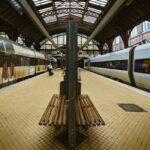
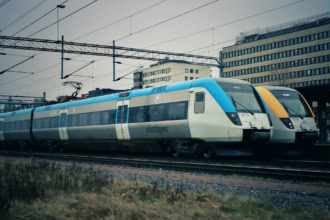
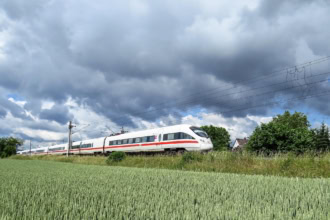
For almost everyone making this trip, the train is the obvious choice, and it genuinely is a single through-service rather than a journey with a change partway. The Öresundståg network runs directly from Copenhagen (calling at Nørreport, Copenhagen Central, Copenhagen Airport at Kastrup, and Ørestad) straight through the tunnel, across Peberholm, and over the bridge to Hyllie, Triangeln, and Malmö Central, without requiring passengers to disembark or switch trains at any point. The whole journey between the two central stations takes around 35-40 minutes, of which roughly 10 minutes is spent actually crossing the fixed link.
As of 2026, the trains are operated by VR Sverige, which took over the Öresundståg contract from Transdev in December 2025 under a five-year deal with Öresundståg AB, the company jointly owned by the six southern Swedish regions the network serves (Skåne, Blekinge, Halland, Kronoberg, Kalmar, and Västra Götaland). It is worth flagging because the operator has changed hands more than once this decade, from SJ and Transdev in earlier years, to SJ’s own Öresund subsidiary from 2020, then to Transdev again from late 2022 after Denmark’s rail authority withdrew from the joint arrangement, and now to VR Sverige. Whichever brand appears on the timetable board, the service, stations, and through-running pattern stay the same.
Frequency is genuinely excellent for an international route: trains cross the bridge roughly every 15-20 minutes through the day, tightening to around every 10 minutes at peak commuting times, and continuing at a reduced but still regular pattern into the evening. On board, expect straightforward regional-train comfort rather than a premium experience: 1st and 2nd class seating, free WiFi, power sockets at most seat bays, plenty of luggage space, and step-free access at the main stations, but no catering trolley or café carriage, so bring your own food and drink if you want something on the way. Seat reservations are not used on these services, so you simply board and sit down.
Because Sweden carries out identity checks on arriving passengers, you will need valid photo ID or a passport for the crossing; these checks typically happen on the platform or on board around Hyllie, the first Swedish stop, and are designed not to affect the train’s schedule, so they add a few minutes of queueing rather than a change of train. A single one-way ticket costs from around 90 DKK (125 SEK, roughly €12/£10/$13) if bought through the Rejsekort app or Öresundståg’s own ticketing, rising to about 165 DKK (220 SEK, roughly €19/£17/$21) for a standard walk-up fare bought at a station machine; there is no option to buy on board, so sort your ticket before boarding. Tickets can be bought via the Öresundståg website, station machines, or comparison platforms such as Omio.

Organise Your Copenhagen Train Trip with Omio
You can use Omio to research train travel for Copenhagen, check schedules and compare ticket options before making your booking.
For journeys involving connections or multiple operators, having the available services together can make it much easier to work out your itinerary.
Scan to open
on your phone

Best for a short trip. Compare rooms by neighbourhood, price and guest rating before you book.
Compare hotelsBest for families, or any stay past about four nights. A kitchen and a washing machine start paying for themselves.
Browse rentalsBest for double-checking. Runs the same search across several booking sites so you are not leaving money behind.
Compare pricesDriving Across the Öresund Bridge
Driving is the practical option if you have a car, want to carry more luggage than the train comfortably allows, or are continuing further into Sweden afterwards. From central Copenhagen, the whole trip to central Malmö takes around 45-55 minutes depending on traffic and time of day, of which the fixed link itself (tunnel, Peberholm, and bridge combined) accounts for roughly 15-20 minutes at normal driving speed, plus time at the toll plaza on the Swedish side.
The toll is charged only when driving from Denmark into Sweden (the return direction into Denmark is free of charge on the bridge itself, though Denmark’s own bridges elsewhere have separate tolls). Booking a standard car’s crossing online in advance costs around 440-465 DKK (610-645 SEK, roughly €59-62/£51-54/$64-67), while paying at the toll booth without pre-booking pushes the price up to about 520 DKK (720 SEK, roughly €70/£60/$75). Anyone crossing regularly can join the operator’s own ØresundGO discount scheme, which charges a modest annual fee (currently around 350-370 DKK, roughly €47-50/£41-43/$50-54) in exchange for cutting each crossing to about 180 DKK (250 SEK, roughly €24/£21/$26).
Practically speaking, the drive itself is easy: the E20 motorway runs straight across the link with no sharp curves or unusual traffic patterns, and the toll plaza is fully automated with card and app payment, so there is no need to carry cash. The one thing worth planning around is rush hour on both approaches, since the bridge is a genuine daily commuter route for tens of thousands of people and queues build at the toll plaza and on the E20 into central Copenhagen and Malmö at peak times.
Is There a Ferry Between Copenhagen and Malmö?
Honestly, no, not directly. There is no passenger or vehicle ferry running the Copenhagen-Malmö route itself. A vehicle ferry did once connect Dragør (just south of Copenhagen) with Limhamn (on Malmö’s southern edge), but that service closed decades before the bridge was ever built and has not operated since, so it is not a live option today whatever an older guidebook might suggest.
The nearest genuine ferry crossing of the Öresund strait today runs roughly 40 kilometres further north, between Helsingør in Denmark and Helsingborg in Sweden, the narrowest point of the strait. Vehicle ferries (currently operated by Öresundslinjen) and a foot-passenger service (Sundbusserne) shuttle across in around 20 minutes, and it is a genuinely pleasant crossing in its own right, passing close to Kronborg Castle, the setting for Shakespeare’s Hamlet. It is not, however, a practical substitute for a Copenhagen-Malmö trip: getting there involves an additional train from Copenhagen to Helsingør (around 45 minutes), the ferry crossing itself, and then a further train from Helsingborg down to Malmö, adding well over an hour compared with the direct Öresundståg service. It is worth doing as its own day out, but not as a way to reach Malmö specifically.
The Öresund Bridge and Drogden Tunnel: A Feat of Engineering
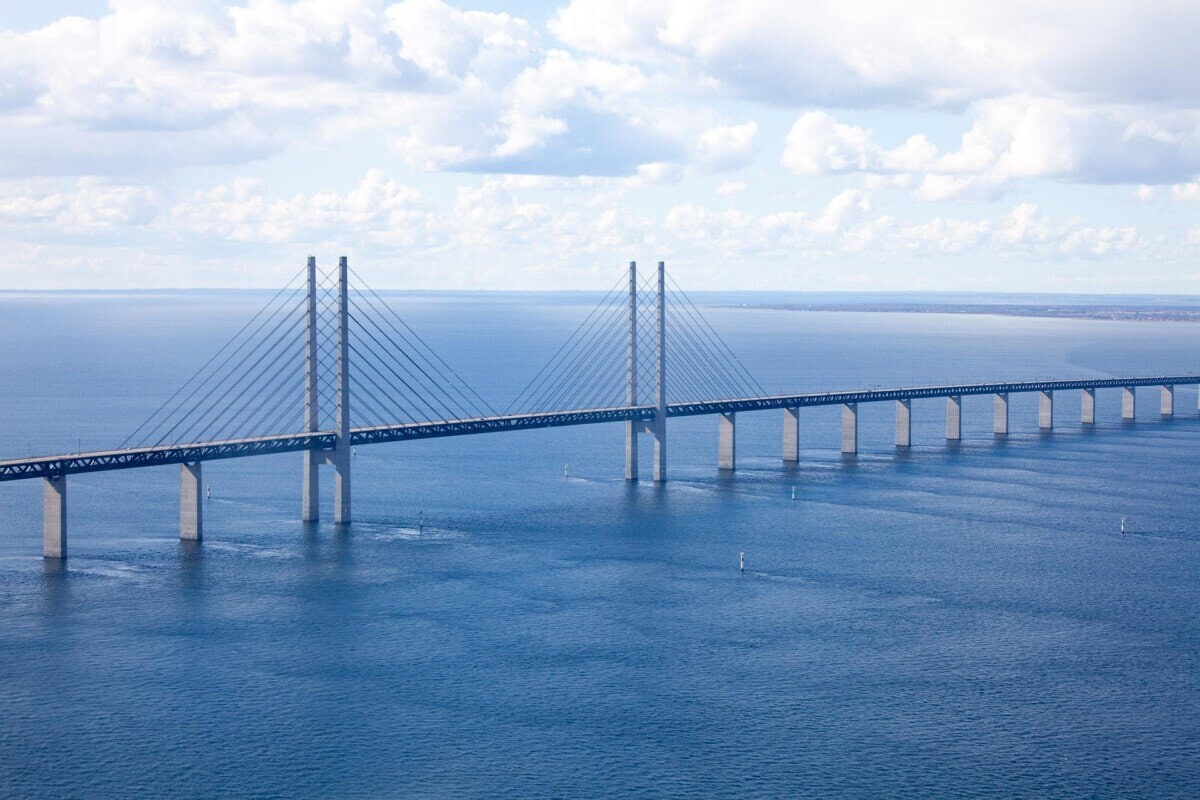
What makes the Öresund crossing genuinely remarkable is that it is not simply a bridge, but a combined bridge-island-tunnel system built to solve a problem a single structure couldn’t: ships need a clear, unobstructed channel to reach Copenhagen Airport and the busy port approaches nearby, while aircraft using the airport need the crossing to stay low enough not to interfere with flight paths. The solution was to sink the northern section underwater entirely.
Starting from the Danish side, trains and cars first pass through the Drogden Tunnel, a 4-kilometre immersed-tube tunnel built by casting concrete sections in a dry dock, floating them into position, and sinking them into a trench dredged across the seabed. The tunnel surfaces on Peberholm, a 4-kilometre artificial island created entirely from material excavated during construction, that was never intended for public access and has since become an unplanned nature reserve, colonised naturally by plants, birds, and other wildlife with almost no human interference in the quarter-century since it was built. From Peberholm, the crossing continues as a proper cable-stayed bridge for the final 7.8 kilometres to the Swedish coast at Lernacken near Malmö, its main pylons reaching 204 metres and giving ships 57 metres of clearance beneath the deck at the highest navigable point.
The whole fixed link runs to roughly 16 kilometres door to door and opened to traffic in July 2000, immediately becoming one of the longest combined road-and-rail crossings in Europe and a genuine symbol of Nordic cooperation between two countries that had relied on ferries for centuries beforehand.
Fame on Screen: The Bridge (Bron/Broen)
Beyond the engineering, the crossing has a genuine claim to pop-culture fame. The Danish-Swedish television series The Bridge (Bron in Swedish, Broen in Danish) opens with its now-iconic premise: a body found lying exactly on the border line partway across the bridge, forcing a Danish and a Swedish detective to work the case together across two jurisdictions. The show used the real bridge for its exterior and drone shots, alongside genuine locations around both Copenhagen and Malmö, and its success (three original seasons, plus a US remake called The Bridge and a UK/French version called The Tunnel) turned the Öresund crossing into something recognisable to audiences who had never set foot in Scandinavia.
It is worth knowing this before you cross, if only because the moment the bridge itself comes into view from the train window, plenty of visitors find themselves thinking of that opening scene rather than anything in a guidebook. If you are a fan of the show, there is no dedicated viewing platform or memorial at the crossing point itself, but the view from the train as it emerges from the Drogden Tunnel onto Peberholm and then up onto the bridge deck is exactly the vantage point the series made famous, so a window seat on the Malmö side of the carriage is worth angling for.
Why Visit Malmö While You’re There?
Given how easy the crossing is, it would be a shame to treat Malmö as nothing more than a photo stop from the train window. Sweden’s third-largest city is compact enough to explore properly in an afternoon, yet has enough genuine variety to reward a longer stay, and it sits close enough to Copenhagen that many visitors combine the two without ever booking a hotel on the Swedish side.
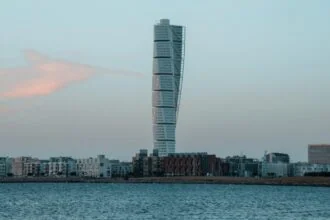
Malmöhus Castle, a squat 15th-century fortress just west of the centre, is one of Scandinavia’s oldest surviving castles and now houses the city’s history, art, and natural history museums inside its thick walls and surrounding moat. For a complete contrast, the Turning Torso, a 190-metre twisting residential tower designed by Santiago Calatrava, dominates the Malmö skyline from the Western Harbour and has become the city’s defining modern landmark since it was completed in 2005. In between the two eras sits Lilla Torg, a cobbled 16th-century square lined with half-timbered buildings, now packed with cafés, bars, and restaurants that make it the natural place to end a day of sightseeing with a meal or a drink.
This page is deliberately focused on the crossing rather than repeating a full Malmö itinerary, so treat these three as a taster of what is on the other side of the bridge rather than the complete picture: all three are within easy walking distance of Malmö Central station, which means the practical case for making the trip is as straightforward as the journey itself.
Practical Tips for Crossing Between Denmark and Sweden
Both Denmark and Sweden are full Schengen Area members, so there is no passport control in the formal EU sense, but that does not mean the border is invisible. Sweden reintroduced identity checks on arrivals from Denmark back in 2015, and these remain in place in 2026, so bring a passport or a valid national ID card for the crossing regardless of your nationality; UK and other non-EU travellers should carry a passport rather than relying on a driving licence.
Currency is the detail most first-time visitors get wrong: Denmark uses the Danish krone (DKK), while Sweden uses its own, separate Swedish krona (SEK), and the two are not interchangeable despite the similar name and symbol. Card payments are near-universal on both sides of the border, including on the trains and at the bridge toll, so carrying cash in either currency is rarely necessary, but check your bank’s foreign transaction fees before relying on a card for every purchase.
Mobile roaming works seamlessly for anyone on an EU/EEA plan, since both countries fall under the same “roam like at home” rules, but non-EU visitors should check their carrier’s rates before crossing, since a UK, US, or other international plan that covers Denmark will not automatically extend to Sweden without its own agreement. A travel eSIM is a straightforward way to sidestep the question entirely and stay connected on both sides of the bridge without swapping SIM cards partway through the trip.

Rupert’s Handy Travel Tips
The Copenhagen-Malmö crossing is about as easy as international travel gets, but a few small habits make it smoother still.
- Buy your train ticket before boarding: there’s no option to pay on board an Öresundståg service, and inspectors do issue fines.
- Sit on the Malmö-facing side heading east: it gives you the best view as the train climbs out of the tunnel onto the bridge deck.
- Carry a passport, not just a driving licence: Sweden’s identity checks at Hyllie apply to everyone, including EU nationals.
- Don’t assume Danish kroner spend in Sweden: the two krona currencies look similar but aren’t interchangeable, so switch your card’s default currency mentally, not physically.
- If driving, book your toll online first: it’s noticeably cheaper than paying at the booth and avoids any queuing.
Want to meet the reindeer behind our travel tips? Find out more in our page Who is Rupert?.



Best for long or awkward journeys. Builds one itinerary out of separate flights.
View flightsBest for short trips. Install the eSIM at home and arrive with working data, no shop queue.
Browse eSIMsBest if you would rather not work out the transport on arrival. Book it now and forget it.
View transfersFrequently Asked Questions About Copenhagen to Malmö
How long does it take to get from Copenhagen to Malmö?
By train it takes around 35-40 minutes centre to centre, of which about 10 minutes is spent crossing the Öresund Bridge and Drogden Tunnel itself. Driving takes roughly 45-55 minutes depending on traffic and toll-plaza queues.
Who operates the trains between Copenhagen and Malmö?
The Öresundståg service is operated by VR Sverige, which took over the contract from Transdev in December 2025. It remains a genuine, direct through-train with no change required between the two cities.
Do I need my passport to cross from Denmark to Sweden?
Yes. Both countries are in the Schengen Area, so there’s no formal passport control, but Sweden carries out identity checks on arrivals, so bring a passport or valid national ID card whichever way you’re travelling.
Is there a ferry between Copenhagen and Malmö?
No, not directly. The old Dragør-Limhamn ferry closed long before the bridge opened in 2000 and hasn’t operated since. The nearest ferry crossing today is around 40km further north, between Helsingør and Helsingborg, and it isn’t a practical substitute for a direct Copenhagen-Malmö trip.
How much does it cost to cross the Öresund Bridge by car?
Booking online in advance, a standard car costs around 440-465 DKK (roughly €59-62/£51-54/$64-67) one-way, rising to about 520 DKK at the toll booth. Frequent crossers can cut this to around 180 DKK with the ØresundGO discount scheme.
Can I use euros in Denmark or Sweden?
Not as the primary currency; Denmark uses the Danish krone (DKK) and Sweden uses the separate Swedish krona (SEK). Card payments are accepted almost everywhere on both sides of the border, so carrying cash in either currency is rarely necessary.
Further Reading
If this crossing is one leg of a wider Scandinavian trip, our Interrail Denmark Pass Guide explains how a Danish One Country Pass covers the trains you’ll use to reach Copenhagen in the first place, while the Interrail Sweden Pass Guide is the natural next step once you’ve crossed the bridge and want to keep exploring Malmö, Gothenburg, or further into Sweden by rail. For a full rundown of what to see once you arrive, our Things to Do in Malmö guide covers Turning Torso, the old town and the city’s beaches in detail. And if the trip stretches further into Sweden, our Things to Do in Gothenburg guide covers Liseberg, the canals and the archipelago.
For anyone building a longer multi-country itinerary around this crossing rather than a single hop, our Interrail Pass Guide breaks down how the full Europe-wide pass compares with buying individual One Country passes, and whether it’s worth the extra cost for a Scandinavia-focused trip. Before you set off, it’s also worth sorting out how you’ll stay connected on both sides of the border: our eSIM Apps Guide covers the simplest way to keep data working seamlessly as you move between Danish and Swedish networks, without needing to swap SIM cards partway through your trip.
Once you’re across the bridge, or before you’ve even set off, our Things to Do in Copenhagen guide covers the city’s own sights in full, and our Copenhagen Airport Transfers guide is worth a look if you’re flying into Kastrup rather than arriving overland. If you’re arriving by sea instead, our Ferries from Copenhagen guide covers the overnight route to Oslo and the ferry crossing to Bornholm, and explains why no ferry runs to Malmö itself.